Scaling Revenue Intelligence: Growth-Ready Implementation
September 09, 2025

Is scaling revenue intelligence keeping you up at night? You're not alone. A staggering 78% of sales organizations struggle to effectively implement revenue intelligence systems that grow with their business. While most companies recognize its value, the execution often falls short.
Revenue intelligence scalability isn't just a trendy concept—it's becoming essential for competitive advantage. I've seen firsthand how scalable sales intelligence transforms forecasting accuracy and sales productivity when implemented correctly. Throughout this article, I'll share practical revenue intelligence strategies that work for teams of all sizes, whether you're just starting out or looking to expand your existing capabilities.
By the end of this guide, you'll have a clear, actionable plan to implement revenue intelligence that grows with your organization. First, we'll explore what revenue intelligence looks like in 2025, then break down the essential data sources, and finally walk through a phased implementation approach that ensures adoption and measurable results.
Revenue intelligence has evolved from an optional tool to a fundamental cornerstone of modern sales success in 2025. This rapid transformation has reshaped how forward-thinking businesses approach revenue generation and customer relationships.
STOP GUESSING YOUR PIPELINE
START GROWING IT WITH AI SALES!!
Revenue intelligence refers to the comprehensive analysis of sales pipeline and customer data using AI and machine learning to generate real-time, actionable insights. Unlike traditional CRM systems that primarily store data, revenue intelligence platforms actively analyze patterns, predict outcomes, and recommend strategic actions.
The strategic importance of revenue intelligence within Revenue Operations (RevOps) cannot be overstated. It serves as the essential piece that brings together siloed data across multiple departments, creating a unified source of truth. As Forrester notes, these solutions capture human engagement activity between buyers and sellers, automatically update CRM platforms, and provide AI-powered analysis for critical decision-making.
Revenue intelligence platforms offer several key capabilities that strengthen RevOps frameworks:
Deal risk detection - AI identifies potential issues before they materialize
Real-time coaching - Conversational intelligence suggests coaching moments during customer interactions
Automated data capture - Systems log emails, calls, and meetings without manual entry
Cross-functional alignment - Marketing, sales, and customer success teams operate from shared data
The integration of revenue intelligence within RevOps creates significant competitive advantages. Organizations implementing advanced revenue intelligence strategies are experiencing 32% higher win rates and 28% faster sales cycles compared to traditional approaches. Additionally, these platforms help scale sales operations by providing visibility into every deal's status throughout the pipeline.
Effective revenue intelligence systems rely on four essential data streams that feed their analytical engines. These data sources work together to create a complete picture of customer interactions, sales processes, and financial outcomes. Let me walk through each one and explain how they contribute to scaling revenue intelligence effectively.
Customer Relationship Management (CRM) systems serve as the foundational layer for revenue intelligence. They store critical information about every customer interaction, including contact details, communication history, and deal progression through various stages. This data helps teams understand customer behavior, track sales progress, and manage relationships effectively.
Modern revenue intelligence platforms automatically update your CRM, eliminating the tedious manual data entry that traditionally consumes sales reps' time. This automation saves teams countless hours and reduces human error, allowing reps to focus on closing deals rather than documentation.
The true power emerges when AI analyzes CRM data to identify patterns that human analysts might miss. For instance, analyzing historical deal progression can reveal which opportunities have the highest likelihood of closing based on hundreds of variables simultaneously. These insights enable sales teams to prioritize their efforts on deals with the greatest potential return.
Ready to turn your Rep
INTO BEST PERFORMER ?
A CRM AI agent is an advanced digital assistant powered by artificial intelligence that enhances traditional customer relationship management (CRM) systems. Unlike conventional CRMs that primarily serve as data storage and tracking tools, AI-driven agents actively analyze customer interactions, automate routine tasks, and provide intelligent recommendations.
These agents leverage technologies such as natural language processing (NLP), machine learning, and predictive analytics to understand customer needs, personalize interactions, and streamline workflows. For example, they can automatically log customer conversations, suggest the next best action for sales representatives, prioritize leads based on conversion potential, or even resolve customer queries in real time without human intervention.
For sales and support teams, CRM AI agents act as productivity multipliers. They minimize time spent on manual data entry, reduce errors, and ensure that customer engagements are timely and relevant. Beyond efficiency, they also empower teams with deeper insights into customer behavior, enabling proactive decision-making and more personalized customer experiences.
In essence, CRM AI agents are transforming CRMs from passive databases into dynamic, intelligent platforms that drive growth, efficiency, and stronger customer relationships.
Sales engagement data encompasses all touchpoints between sales teams and prospects or customers. This includes emails, phone calls, meetings, and other communication channels. Revenue intelligence platforms capture these interactions automatically, creating a detailed record of prospect engagement.
Specifically, this data reveals how prospects respond to your sales efforts - which messages resonate, where engagement drops off, and what follow-up strategies yield the best results. The analysis helps optimize outreach, improve follow-up processes, and ultimately increase conversion rates.
Moreover, platforms like SalesPlay can enhance this data through automatic lead enrichment - adding relevant business intelligence such as company financials, technology usage, recent news developments, and buying behavior patterns. This enriched data provides sales teams with crucial context for personalized outreach.
Financial data forms the monetary backbone of revenue intelligence, covering revenue figures, cost structures, and profitability metrics. This information helps teams understand the financial impact of sales activities, measure return on investment, and align sales strategies with financial goals.
Notably, revenue intelligence platforms optimize pricing strategies, discount management, and revenue recognition processes. By aligning these financial elements with business objectives, organizations can maximize their revenue potential and profitability.
Additionally, financial data enables more accurate revenue forecasting, better resource allocation decisions, and proactive risk management. Teams can identify potential revenue leaks, such as missed upsell opportunities or customer churn risks, and address these issues proactively before revenue slips away.
Conversation data represents one of the most valuable yet often underutilized data sources. It comes from recorded sales calls, meetings, and other verbal interactions, capturing nuances that might otherwise be lost - including tone, sentiment, and specific pain points discussed.
AI-powered conversation intelligence tools analyze these interactions using natural language processing. They extract valuable insights about customer needs, preferences, objections, and decision-making styles. As a result, sales teams can refine their pitches, improve training programs, and enhance overall communication strategies.
Essentially, conversation intelligence enables revenue teams to harness AI to convert unstructured data from spoken, written, and video conversations into actionable insights that improve seller performance. For instance, the technology can identify common objections and questions, allowing teams to sharpen their playbooks and address concerns proactively.
What makes this data particularly valuable is that only 35% of sales teams currently track the effectiveness of their content. Organizations that leverage conversation data gain a significant competitive advantage through deeper customer understanding and more effective sales approaches.

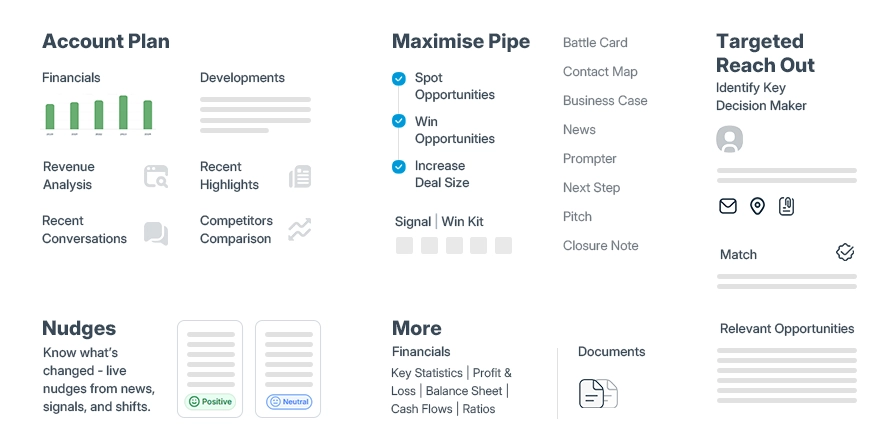
As organizations scale, the limitations of traditional sales analytics become increasingly apparent. The contrast between conventional approaches and revenue intelligence systems represents a fundamental shift in how businesses track, analyze, and act on sales data.
Traditional sales analytics primarily focuses on historical data, usually sourced from CRM systems. These conventional methods deliver periodic reports—typically weekly, monthly, or quarterly—providing only a retrospective view of what has already occurred.
Revenue intelligence, however, operates in real-time, constantly monitoring sales metrics and KPIs. This eagle-eyed, immediate view allows teams to quickly spot red flags and opportunities in their pipeline. Instead of discovering issues after the quarter ends, revenue intelligence alerts teams to potential problems as they develop, enabling timely intervention.
Consider this practical difference: A traditional analytics system might show that three major deals fell through last quarter. In contrast, a revenue intelligence platform would flag these at-risk deals while they're still active, allowing sales leaders to step in and potentially save them. This proactive capability becomes increasingly valuable as organizations scale and deal volumes grow.
The analytical capabilities between these approaches differ dramatically. Traditional forecasting involves what can be described as static modeling—taking historical data and making projections based solely on past performance. This approach produces limited insights and struggles to account for unforeseen events.
Conversely, revenue intelligence leverages advanced algorithms, artificial intelligence, and machine learning to deliver robust predictive analytics. These systems continuously update as new data arrives, analyzing vast amounts of information including historical performance, current pipeline dynamics, external market factors, and buyer-side engagement.
The accuracy gap between these approaches continues to widen. Recent Gartner research reveals only 7% of sales organizations achieve forecast accuracy of 90% or higher with traditional methods. Revenue intelligence tools address this limitation through:
AI-powered predictions for deal likelihood to close or stall
Explanations for why deals face challenges
Commit calculators that help sales leaders set and adjust revenue goals
Identification of patterns and themes that define best practices
Traditional analytics often operates in isolation, with departments maintaining separate projections that rarely align with broader company objectives. Marketing teams develop their forecasts, sales teams create theirs, and customer success works from entirely different data sets.
Revenue intelligence fundamentally transforms this dynamic by creating a unified view that breaks down departmental walls. These platforms integrate data from sales, marketing, customer success, and other teams into a single source of truth. This integration enables:
Enhanced collaboration through shared dashboards and automated insights
Marketers analyzing leads to understand campaign performance while sales teams leverage these marketing insights
Consistent messaging across all customer touchpoints
Identification of revenue growth opportunities not apparent when teams operate in isolation
The impact of this unified approach becomes increasingly significant as organizations scale. Without it, teams develop inconsistent messaging, marketing generates unqualified leads, sales misses opportunities, and customer success lacks understanding of customer expectations—all resulting in poor experiences and higher churn rates.
Revenue intelligence doesn't simply replace traditional analytics—it represents an entirely new approach to understanding and optimizing the revenue generation process. By providing real-time insights, predictive capabilities, and cross-functional alignment, it offers the scalability that growing organizations need to maintain their competitive edge.
STOP CHASING PROSPECTS
START CLOSING DEALS!!
Successfully implementing revenue intelligence requires a methodical approach—not a "flip the switch" event. Based on successful implementation patterns from leading organizations, I recommend dividing your rollout into three distinct phases. This structured methodology ensures proper adoption and maximizes the return on your investment.
The journey toward scaling revenue intelligence begins with choosing the right pilot team. Select a sales pod or region with strong leadership and a willingness to experiment. This group will become your internal champions and provide valuable feedback for wider deployment.
Executive buy-in proves essential during this initial phase. Leadership alignment ensures the rollout receives proper prioritization and doesn't get sidelined by competing initiatives. Initially, schedule executive briefings to secure their support and establish clear expectations for the pilot.
Prior to launching, I recommend defining 2-3 specific key performance indicators (KPIs) that align with your business objectives. These might include:
Forecast accuracy improvement
Meeting-to-close ratio
CRM hygiene score
Opportunity load per rep
Given these points, create a baseline measurement for each KPI beforehand. This allows you to demonstrate concrete improvements as your implementation progresses. Henceforth, your pilot team will operate with clear, measurable objectives rather than vague goals.
The second phase focuses on ensuring data quality and integration across all systems. Remember: your revenue intelligence platform will only be as effective as the data it analyzes.
Start by conducting a thorough data audit to identify potential roadblocks and develop a clear integration strategy. This includes evaluating your CRM, ERP, marketing automation platform, and other data sources that hold pieces of your revenue puzzle.
Undeniably, data cleansing represents a critical step. As the saying goes, "garbage in, garbage out." Straightaway, ensure your contact records, deal stages, and activity logs are accurate and up-to-date. This may involve:
Standardizing naming conventions for accounts
Fixing inconsistent field values
Removing duplicate records
Updating missing information
Throughout this phase, create data governance practices and standards to maintain data quality going forward. Correspondingly, your integration should establish a "single source of truth" that bridges previously siloed information from sales, marketing, and customer success.
The final phase involves incorporating revenue intelligence into daily workflows and training users to maximize its value. Albeit powerful, even the best software becomes useless if your team doesn't adopt it.
Show reps what's in it for them—how the platform makes their jobs easier and more effective. Training should be role-specific rather than generic, showing each person how the software addresses their particular needs. Furthermore, encourage peer learning and knowledge sharing to create a collaborative environment.
Positive reinforcement drives adoption. Recognize and reward early adopters to motivate the entire team. In due time, create a center of excellence with power users who can support others and share best practices.
Change management proves critical during this phase. Clearly communicate the reasons for implementing revenue intelligence and address concerns directly. Since resistance often stems from uncertainty, provide adequate resources to help everyone feel confident using the system.
Once your pilot demonstrates success, expand in waves across your organization—first to other sales teams, then to customer success, and finally to marketing. This phased expansion allows you to refine your approach based on feedback and results from each group.
By following this structured approach to scaling revenue intelligence, you'll build momentum from day one and establish a solid foundation for long-term growth and adoption across your organization.
STOP GUESSING YOUR PIPELINE
START GROWING IT WITH AI SALES!!
Revenue intelligence delivers substantial returns when applied strategically. The ROI of these platforms comes from four primary use cases that transform sales effectiveness across growing organizations.
First and foremost, organizations adopting AI-powered revenue intelligence experience significant forecast precision gains. Traditional methods often struggle with accuracy, whereas modern platforms can push forecast accuracy above 90% across sales segments and teams. This improvement stems from AI analyzing patterns across all customer interactions rather than relying solely on lagging indicators.
The impact is measurable—companies using AI-driven forecasting models have seen a reduction in forecast errors by an average of 15-20% compared to conventional approaches. In practical terms, this means finance teams can make more confident resource allocation decisions while sales leaders set realistic targets backed by data rather than intuition.
The best revenue intelligence platforms include commit calculators that help sales leaders set revenue goals, then measure the impacts of adding or removing deals from the pipeline. In turn, teams can adapt to last-minute changes while still reaching targets. For example, when a large deal falls through, the system immediately identifies new opportunities to close the revenue gap.
Among the most valuable features of revenue intelligence is its ability to surface deals at risk before they become unwinnable. These platforms continuously monitor for stalled opportunities, sending automated alerts to help managers intervene in critical situations.
Furthermore, revenue intelligence platforms track deal changes and progressions to assess risks over time across the entire sales pipeline. The technology flags when champions become inactive, proposals remain unviewed, or meeting frequency decreases—all indicators of deal trouble.
Through this proactive approach, B2B firms have achieved 21.6% faster sales cycles and 18.4% higher pipeline conversion rates. For instance, Adobe adopted Clari across sales operations and achieved 24% more accurate sales forecasts, while reducing time spent on pipeline reviews by 35%.
Indeed, sales coaching remains one of the most cost-effective ways to ensure teams don't miss out on deals. Organizations that provide effective sales coaching improve quota attainment by up to 7%.
Revenue intelligence transforms coaching from anecdotal feedback into data-driven guidance. The platforms identify successful talk tracks, objection handling techniques, and key behaviors—scoring and pre-coaching each rep after every call. This happens without requiring managers to review every conversation manually.
On top of that, AI-powered platforms create asynchronous learning environments where reps can study successful calls from experienced team members. This approach makes training more scalable as teams grow. The technology also enables contextual feedback directly within the platform, eliminating the need for additional coaching meetings.
Make Every Rep Speak
Like Your Top 1%
Poor CRM data directly impacts the bottom line—bad data costs the US economy USD 3.00 trillion annually. As such, maintaining clean, accurate sales data becomes vital for revenue operations.
Revenue intelligence platforms automatically capture and log key information from calls, emails, and meetings directly into CRM systems. This automation eliminates the tedious manual data entry that historically consumes sales time, with inaccurate contact data wasting 27.3% of sales reps' time—equivalent to 546 hours annually per rep.
The value extends beyond time savings. Given that 20-25% of the average contact database decays yearly as prospects change addresses, email contacts, and jobs, automated data hygiene ensures teams work with current information. This prevents reps from chasing dead ends and makes both metrics and forecasts more reliable.
The automation impact adds up quickly—AI-powered workflow automation reclaims approximately 18-22 hours weekly for sales professionals by handling repetitive tasks. This allows representatives to spend more time on high-value activities like building relationships and closing deals.
While revenue intelligence platforms offer powerful capabilities, implementing them successfully requires overcoming several critical hurdles. My experience shows that addressing these challenges proactively significantly increases your chances of successful deployment and scalability.
Poor data quality stands as the most significant obstacle to revenue intelligence success. When organizations implement these systems, they often discover that existing data is inconsistent, incomplete, or inaccurate. This undermines analytical accuracy and erodes user confidence. In fact, Gartner estimates that poor data quality costs the average enterprise between USD 12.90–USD 15.00 million annually.
To tackle this challenge, consider these proven approaches:
Regular data cleaning: Systematically remove duplicates, correct errors, and fill missing information to maintain data integrity
Validation processes: Implement checks that ensure accuracy and consistency across all data sources before feeding information into your revenue intelligence platform
Integration tools: Deploy robust solutions that connect different systems while preserving data quality throughout the process
SalesPlay's implementation experience shows organizations can achieve 97% data accuracy rates within 60 days through automated cleansing algorithms, validation rules, and monitoring processes—compared to just 73% accuracy with manually maintained systems.
Nevertheless, even the best revenue intelligence platform becomes useless without proper adoption. According to CSO Insights, only 36% of sales representatives consistently use their company's CRM system. This trend appears in alarming statistics showing up to 63% of CRM projects fail, with nearly half failing specifically due to slow user adoption.
As such, consider these adoption-focused strategies:
Clear communication: Explicitly explain the benefits of revenue intelligence to your team, focusing on how it improves decision-making, enhances collaboration, and increases revenue potential.
Team involvement: Include team members in the selection and implementation process to build ownership and reduce resistance. Organizations following SalesPlay's structured change management approach achieve 89% user adoption within 90 days—significantly higher than the industry average of 52%.
Comprehensive training: Provide ongoing support through multiple learning formats to help team members gain confidence with new tools. This approach results in 94% user proficiency within 30 days.
In addition to adoption challenges, scaling revenue intelligence requires addressing legitimate security and compliance concerns. Integrating data from various sources increases the risk of breaches and regulatory non-compliance.
The costs of security lapses extend beyond direct financial penalties. Non-compliance can lead to business disruption, including suspension from government contracts, potential lawsuits, manufacturing stoppages, and even complete shutdown in extreme cases.
To protect your revenue intelligence implementation:
Data encryption: Use strong encryption for both data in transit and at rest to prevent unauthorized access.
Access controls: Implement strict permissions ensuring only authorized personnel can view sensitive information. This becomes particularly important as your revenue intelligence program scales across departments.
Regular compliance checks: Conduct ongoing audits to verify that your data practices meet all relevant regulations. This is especially crucial as data privacy laws continue to evolve globally.
Besides these technical protections, create clear governance frameworks that balance security requirements with accessibility. This approach enables confident scaling while maintaining regulatory compliance across all operations.
Tracking the right KPIs forms the backbone of successful revenue intelligence implementation. To determine whether your investment delivers real value, you need metrics that clearly demonstrate impact on revenue operations.
Pipeline velocity measures how quickly potential revenue moves through your sales process. This essential metric combines several key performance factors into one powerful indicator using the formula: (Number of Opportunities × Win Rate × Average Deal Size) ÷ Sales Cycle Length.
First, pipeline velocity helps revenue teams understand how effectively they're converting leads into customers. Organizations tracking this metric experience improved forecasting accuracy and can identify bottlenecks in their sales process that might be hindering growth.
Second, win rates (calculated as Deals Won ÷ Total Closed Deals × 100%) serve as the ultimate measure of sales effectiveness and product-market fit. The benchmark for most B2B sales teams hovers between 20-30%. By monitoring win rates alongside pipeline velocity, sales leaders can pinpoint which opportunities merit prioritized outreach, maximizing revenue per rep.
Sales cycle length—the average time from first contact to closed sale—directly impacts revenue predictability. To calculate this metric, simply divide the total number of days it takes to close every sale by the total number of deals.
Ideally, B2B sales cycles should range from 3-6 months, although this varies by industry and deal complexity. Shorter sales cycles improve cash flow and enable more accurate revenue forecasting. When implementing revenue intelligence, many organizations see significant improvements, with some B2B firms achieving 21.6% faster sales cycles.
Average deal size complements this metric by tracking revenue generated per sale. As you scale revenue intelligence, watch for increases in both metrics—larger deals closing faster indicate your system is working effectively.
Forecast accuracy emerges as a critical KPI for scaling revenue intelligence, with the best performers achieving over 90% accuracy. The formula—1 - |Forecasted Sales - Actual Sales| ÷ Actual Sales × 100%—provides a clear view of prediction reliability.
Notably, companies using AI-powered forecasting have seen a reduction in forecast errors by 15-20% compared to traditional approaches. This improvement directly impacts business planning and resource allocation decisions.
Rep productivity metrics complete the picture by showing how efficiently your team converts opportunities into revenue. These include:
Number of outbound calls made
Average lead response time
Deals closed per month
Together, these metrics form a holistic view of revenue intelligence performance. As your implementation scales, these KPIs should show consistent improvement—providing concrete proof that your revenue intelligence strategy delivers measurable business impact.
STOP GUESSING YOUR PIPELINE
START GROWING IT WITH AI SALES!!
The true power of revenue intelligence emerges when it expands beyond isolated teams to connect your entire organization. After successful implementation, your next challenge involves spreading these capabilities throughout the company for maximum impact.
Breaking down departmental silos stands as a crucial advantage of scaled revenue intelligence. Without proper alignment, organizations lose approximately USD 62.40 million annually in productivity due to poor communication between departments. When revenue intelligence connects teams, it creates a shared foundation for decision-making.
Almost unanimously (97%), sales leaders agree that different teams must work together to achieve accurate forecasts and predictions. This coordination happens because revenue intelligence provides:
Marketing teams with campaign performance insights tied directly to revenue outcomes
Sales representatives with visibility into marketing-sourced leads and content effectiveness
Customer success with early warning signs about at-risk accounts
One SaaS company that implemented this cross-functional approach saw customer satisfaction increase by 15%. Similarly, organizations with strong GTM alignment grow 19% faster and are 15% more profitable than their peers.
Modern revenue intelligence platforms leverage sophisticated machine learning algorithms that assign probability scores to deals based on hundreds of variables simultaneously. These systems analyze patterns across interactions, deal characteristics, and market conditions to predict outcomes with remarkable accuracy.
Throughout your scaling process, these AI capabilities become increasingly valuable by automating routine tasks. Revenue intelligence tools save 18-22 hours weekly for sales professionals through workflow automation. The technology also identifies subtle patterns in buyer behavior that human analysts might miss entirely.
Your revenue intelligence platform should grow with your business, accommodating increasing data volumes and complexity without performance degradation. The right solution offers several key integration capabilities:
First, it must provide compliance features adhering to data protection laws and industry standards. This becomes increasingly important as your implementation spreads across departments and regions.
Second, examine platforms that offer foundational integrations with CRMs, dialers, and communication tools, plus advanced API capabilities for your unique enterprise data architecture.
Lastly, choose a platform that automates data capturing from emails, calls, and meetings to eliminate manual data entry. This automation becomes exponentially more valuable as your team grows.
Revenue intelligence has transformed from a nice-to-have tool into an essential component of modern sales organizations. Throughout this article, we've examined how scalable revenue intelligence systems provide real-time insights, predictive modeling, and cross-functional alignment that traditional analytics simply cannot match.
The four core data sources—CRM, sales engagement, financial, and conversation data—work together to create a complete picture of your revenue operations. When properly integrated, these sources fuel AI-powered analysis that identifies patterns human analysts might miss entirely.
Successful implementation requires a thoughtful, phased approach. Start with a well-selected pilot team and clear goals, then move through data integration before finally embedding the platform into daily workflows. This methodical strategy ensures proper adoption across your organization.
The ROI from revenue intelligence comes through specific, measurable improvements. Companies using these platforms experience dramatic gains in forecast accuracy, faster identification of at-risk deals, and more effective sales coaching. Additionally, automated data capture eliminates hours of manual work while maintaining CRM hygiene.
Challenges will certainly arise during implementation. Data quality issues, resistance to change, and security concerns can derail your efforts if not addressed proactively. However, the organizations that overcome these hurdles position themselves for significant competitive advantage.
As your revenue intelligence capabilities scale across teams, the true power emerges. Marketing, sales, and customer success teams operate from shared data, creating alignment that accelerates growth and improves profitability. Thus, companies that deploy these systems effectively grow 19% faster than their peers.
Revenue intelligence represents more than just another sales tool—it fundamentally changes how organizations understand and optimize their revenue generation process. The companies that embrace this technology now will undoubtedly outpace competitors who rely on outdated approaches. Your journey toward scalable revenue intelligence starts with the first step outlined in this guide. The time to act is now.
Your SDRs work 9–5
AI Sales works 24/7!!
Revenue intelligence is a comprehensive analysis of sales pipeline and customer data using AI and machine learning to generate real-time, actionable insights. Unlike traditional sales analytics that focus on historical data and periodic reporting, revenue intelligence provides real-time monitoring, predictive modeling, and cross-functional collaboration capabilities.
The core data sources for revenue intelligence include CRM data (contact history and deal stages), sales engagement data (emails, calls, meetings), financial data (revenue, cost, and margin metrics), and conversation data (sentiment and objection tracking). These sources work together to create a complete picture of customer interactions, sales processes, and financial outcomes.
Successful implementation of revenue intelligence involves a phased approach: 1) Selecting a pilot team and setting clear goals, 2) Integrating and cleansing data across systems, and 3) Embedding the platform into daily workflows and providing comprehensive team training. This methodical strategy ensures proper adoption and maximizes return on investment.
Key use cases that drive ROI for revenue intelligence include forecast accuracy improvement, deal risk detection and inspection, sales coaching and onboarding at scale, and CRM hygiene and automation. These applications help organizations improve decision-making, enhance collaboration, and increase revenue potential.
Companies can measure the success of revenue intelligence implementation by tracking key performance indicators (KPIs) such as pipeline velocity, win rates, sales cycle length, average deal size, forecast accuracy, and rep productivity metrics. These KPIs provide a holistic view of revenue intelligence performance and should show consistent improvement as the implementation scales.


Category: Uncategorized Tags: ai, AIOps, Artificial Intelligence, cloud, cloud platform, Cybersecurity, Information and Communications Technology , VR