The study involved four major activities to estimate the current size of the soft tissue repair market. Exhaustive secondary research was done to collect information on the market and its different subsegments. The next step was to validate these findings, assumptions, and sizing with industry experts across the value chain through primary research. Both top-down and bottom-up approaches were employed to estimate the complete market size. Thereafter, market breakdown and data triangulation procedures were used to estimate the market size of the segments and subsegments.
Secondary Research
In the secondary research process, various sources were utilized to identify and gather information for the study of the soft tissue repair market. These sources included company annual reports, press releases, and investor presentations, as well as white papers, certified publications, and articles by recognized authors. Reputable websites, regulatory bodies, and databases such as D&B Hoovers, Bloomberg Business, and Factiva were also consulted for this report. This research aimed to gather crucial information about the leading companies in the industry, market classification, and segmentation based on industry trends down to the most detailed levels, including geographic markets. Additionally, key developments related to the market were also focused on. Through this secondary research, a database of key industry leaders was created.
Primary Research
Extensive primary research was conducted after gathering information about the soft tissue repair market through secondary research. Several primary interviews were held with market experts from both the demand and supply sides across major regions, including North America, Europe, the Asia Pacific, Latin America, and the Middle East & Africa. Data was collected through questionnaires, emails, and telephone interviews. The primary sources from the supply side included various industry experts, such as CEOs, VPs, Directors of business development, marketing, product development/innovation teams, and other key executives from manufacturers and distributors operating in the soft tissue repair market, as well as key opinion leaders.
Primary interviews were conducted to gather valuable insights, including market statistics, revenue data from products and services, market breakdowns, market size estimations, market forecasting, and data triangulation. This primary research also provided an understanding of various trends related to technologies, applications, industry verticals, and regions. Stakeholders, including customers and end users, were interviewed to gain the buyers' perspective on suppliers, the products themselves, their current usage, and the future outlook of their businesses. This information is crucial as it impacts the overall market dynamics.
The following is a breakdown of the primary respondents:
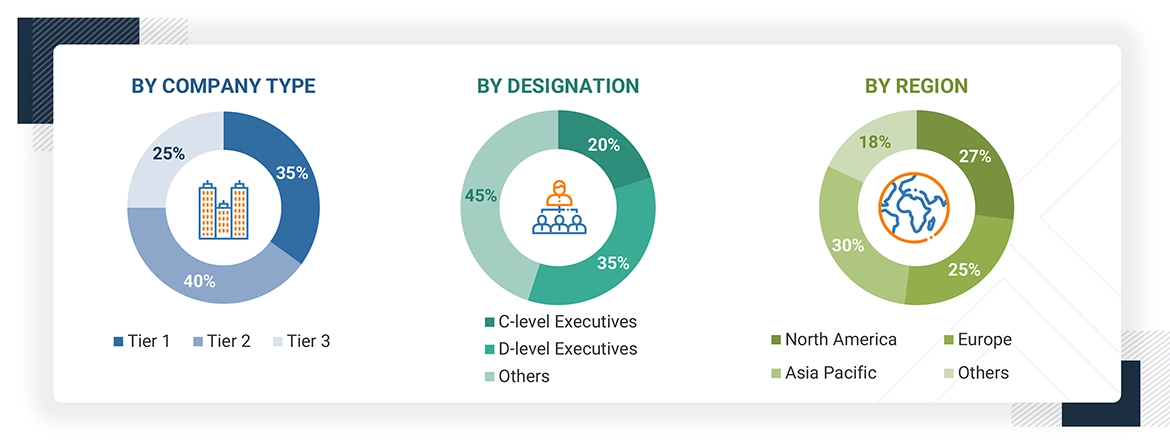
Note 1: C-level executives include CEOs, COOs, CTOs, and VPs.
Note 2: Others include sales, marketing, and product managers.
Note 3: Companies are classified into tiers based on their total revenue. As of 2024: Tier 1 = >USD 1 billion, Tier 2 = USD 500 million to USD 1 billion, Tier 3 = < USD 500 million.
To know about the assumptions considered for the study, download the pdf brochure
Market Size Estimation
The research methodology used to estimate the size of the soft tissue repair market includes the following details.
The market sizing was undertaken from the global side.
Country-level Analysis: The size of the soft tissue repair market was obtained from the annual presentations of leading players and secondary data available in the public domain. Shares of products in the overall soft tissue repair market were obtained from secondary data and validated by primary participants to arrive at the total soft tissue repair market. Primary participants further validated the numbers.
Geographic Market Assessment (By Region & Country): The geographic assessment was done using the following approaches:
Approach 1: Geographic revenue contributions/splits of leading players in the market (wherever available) and respective growth trends
Approach 2: Geographic adoption trends for individual product segments by end users and growth prospects for each of the segments (assumptions and indicative estimates validated from primary interviews)
At each point, the assumptions and approaches were validated by industry experts who were contacted during primary research. Considering the limitations of data available from secondary research, revenue estimates for individual companies (for the overall soft tissue repair market and geographic market assessment) were ascertained based on a detailed analysis of their respective product offerings, geographic reach/strength (direct or through distributors or suppliers), and the shares of the leading players in a particular region or country.
Global Soft Tissue Repair Market Size: Bottom-up & Top-down Approach
Data Triangulation
The market was split into several segments and subsegments after arriving at the overall market size—using the market size estimation processes. Data triangulation and market breakdown procedures were employed to complete the overall market engineering process and arrive at the exact statistics of each market segment and subsegment. The data was triangulated by studying various factors and trends from both the demand and supply sides in the soft tissue repair market.
Market Definition
Soft tissues within the human body include a diverse array of structures, such as muscles, tendons, ligaments, fascia, nerves, fibrous tissues, blood vessels, and synovial membranes. These tissues serve critical functions by connecting, supporting, and enveloping various organs and systems throughout the body. Soft tissue injuries arise from factors such as repetitive overuse, sprains, and strains, resulting in damage that can manifest as pain, swelling, bruising, and a decrease in functionality. Such injuries may significantly impair mobility and overall quality of life, thus requiring comprehensive management approaches. The surgical procedure known as soft tissue repair is designed to restore and reinforce damaged, weakened, or ruptured soft tissues. This intervention employs various techniques aimed at re-establishing the structural and functional integrity of the affected tissues, thereby promoting the healing process and facilitating a return to normal activities.
Some of the key secondary sources referred to:
-
US Food & Drug Administration (US FDA)
-
Centers for Disease Control and Prevention (CDC)
-
American Academy of Orthopedic Surgeons (AAOS)
-
Association of Surgeons of Great Britain (ASGB)
-
German Society of Surgery (DGCH)
-
European Surgical Association (ESA)
-
The Association of Surgeons of India (ASI)
-
Chinese Society of Laparo-endoscopic Surgery (CSLES)
-
Japan Surgical Society (JSS)
-
Adhesive and Sealants Industry (ASI)
-
General Surgeons Australia (GSA)
-
Brazilian Society of Surgical Oncology (BSSO)
-
American Urological Association (AUA)
-
American Association of Oral and Maxillofacial Surgeons (AAOMS)
-
World Health Organization (WHO)
-
Organization for Economic Co-operation and Development (OECD)
-
Annual Reports, SEC Filings, Investor Presentations, and Press Releases of Key Players
-
White Papers, Journals/Magazines, and News Articles
-
Paid Databases: Factiva, D&B, and Bloomberg Business
Report Objectives
-
To define, describe, and forecast the soft tissue repair market by product, application, end user, and region
-
To provide detailed information regarding the major factors influencing market growth (such as drivers, restraints, opportunities, and challenges)
-
To strategically analyze micromarkets with respect to individual growth trends, prospects, and contributions to the overall soft tissue repair market
-
To analyze market opportunities for stakeholders and provide details of the competitive landscape for market leaders
-
To forecast the revenue of the market segments concerning six main regions: North America (the US and Canada), Europe (Germany, France, the UK, Italy, Spain, and the Rest of Europe), the Asia Pacific (China, Japan, India, South Korea, Australia, and the Rest of Asia Pacific), Latin America (Mexico, Brazil, and the Rest of Latin America), the Middle East & Africa, and GCC Countries
-
To profile the key players in the soft tissue repair market and comprehensively analyze their global revenue shares and core competencies
-
To benchmark players within the market using a proprietary Company Evaluation Matrix framework, which analyzes market players on various parameters within the broad categories of business strategy excellence and strength of product portfolio
-
To track and analyze competitive developments, such as product launches & approvals, partnerships, agreements, collaborations, and acquisitions, in the soft tissue repair market



 US TO GROW AT HIGHEST CAGR DURING STUDY PERIOD
 NORTH AMERICA FASTEST-GROWING MARKET IN THE REGION










John
May, 2022
Which are the key factors driving the growth of the Global Soft Tissue Repair market?.
Jackson
May, 2022
Which segment, based on product type, accounted for the highest demand in Soft Tissue Repair Market?.
Kahlill
May, 2022
What are the key factors hampering the growth of the Soft Tissue Repair Market?.