Best AI Sales Platform: Top Tools & Software for B2B Sales Teams
November 21, 2025
The sales landscape has undergone a seismic shift. While your competitors are still manually researching prospects and crafting generic outreach emails, forward-thinking sales teams are leveraging AI sales platforms to identify opportunities before they even hit the market, personalize engagement at scale, and close deals faster than ever before.


The statistics staggering sales teams using AI-powered platforms report up to 50% more qualified leads, 30% faster deal cycles, and significantly improved conversion rates. But here's the challenging sales tool now claims to be "AI-powered," making it nearly impossible to separate genuine innovation from clever marketing.
This comprehensive guide cuts through the noise. We'll explore what truly defines an AI sales platform, examine the best solutions transforming B2B sales in 2025, and provide you with a framework to select the right platform for your team's unique needs.
An AI sales platform is a sophisticated software solution that leverages artificial intelligence technologies—including machine learning, predictive analytics, natural language processing, and generative AI—to enhance and automate core sales processes. Unlike traditional sales automation tools that simply execute predefined workflows, true AI sales platforms make intelligent decisions, learn from patterns, and continuously improve performance without constant human intervention.
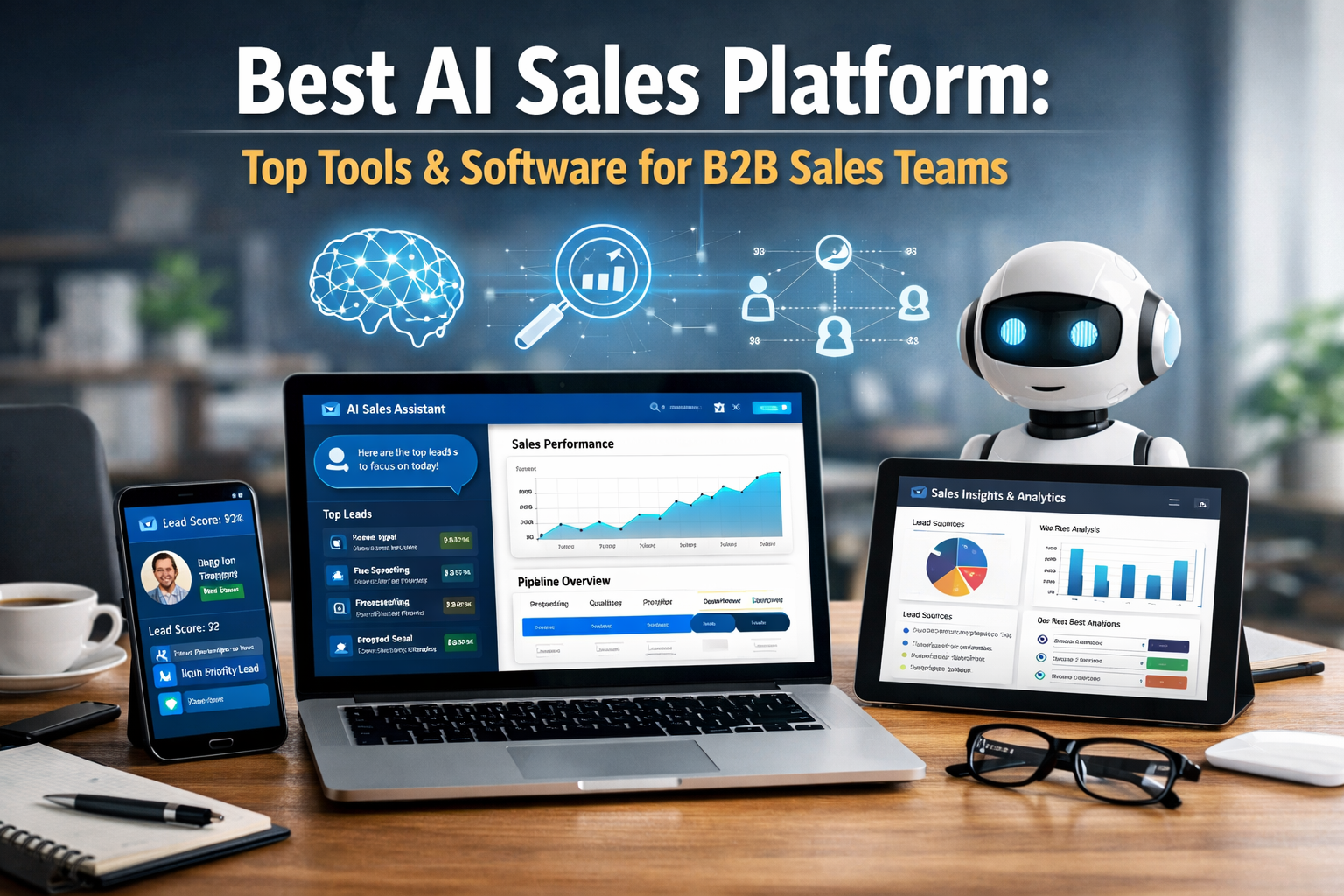
The distinction is critical. Basic automation follows rigid if-then rules: "If a lead downloads a whitepaper, then send email sequence A." AI-powered platforms, however, analyze hundreds of variables simultaneously—engagement patterns, behavioral signals, market trends, and historical data—to determine the optimal next action for each unique prospect.
These platforms have evolved dramatically from their early iterations. First-generation sales tools focused on data management and basic automation. Second-generation solutions added predictive scoring and basic analytics. Today's third-generation AI sales platforms incorporate advanced capabilities like real-time opportunity detection, autonomous research agents, dynamic personalization, and conversational intelligence that rivals human insight.
The traditional sales playbook is broken. Sales representatives spend only 28% of their time actually selling, with the remaining hours consumed by administrative tasks, research, data entry, and manual follow-ups. Meanwhile, buyer expectations have skyrocketed—they demand personalized experiences, instant responses, and interactions that demonstrate deep understanding of their specific challenges.
Eliminate Time-Wasting Manual Tasks: AI handles prospect research, data enrichment, meeting scheduling, CRM updates, and follow-up sequences automatically. Your reps reclaim dozens of hours weekly to focus on high-value activities like relationship building and strategic conversations.
Uncover Hidden Revenue Opportunities: Advanced AI algorithms analyze market signals, organizational changes, technology adoption patterns, and budget cycles to identify accounts entering buying windows before intent data providers even detect the signal. You engage prospects when they're forming requirements, not after they've already shortlisted competitors.
Perfect Lead Prioritization: Predictive AI scores every lead based on hundreds of factors—not just demographic fit, but behavioral engagement, timing signals, organizational changes, and similarity to your best customers. Your team focuses energy on the opportunities most likely to convert.
Achieve True Personalization at Scale: Generative AI creates customized messaging, presentations, and value propositions for each prospect based on their industry, role, company challenges, and individual preferences. Every touchpoint feels thoughtfully crafted, even when reaching thousands of accounts.
Accelerate Deal Velocity: AI-powered insights identify exactly what actions move specific deals forward. It surfaces the right content, suggests optimal next steps, flags risks before they derail opportunities, and coaches’ reps through complex negotiations in real-time.
Improve Forecast Accuracy: Machine learning models analyze your pipeline with precision that humans simply cannot match accounting for deal characteristics, engagement patterns, competitive dynamics, and historical win rates to predict revenue with remarkable accuracy.
The result? Sales organizations implementing AI platforms report dramatic improvements: 40-50% increases in productivity, 25-35% higher win rates, and 20-30% shorter sales cycles. More importantly, they're building sustainable competitive advantages that compound over time as their AI systems learn and improve.
STOP GUESSING YOUR PIPELINE
START GROWING IT WITH AI SALES!!
Side-by-side feature and capability comparison of leading platforms
| Platform | Primary Strength | Best For | Pricing Range | Key Integrations | Setup Time | Company Size |
|---|---|---|---|---|---|---|
| SalesPlay | All-in-One Revenue | B2B teams wanting unified AI across entire sales cycle | Custom | Salesforce, HubSpot, Pipedrive | 3-4 weeks | Mid-Market / Enterprise |
| Outreach | Sales Engagement | Workflow automation and multi-touch campaigns | $2K-$10K/mo | Salesforce, HubSpot, LinkedIn | 2-3 weeks | Enterprise |
| Cognism | Prospecting & Intent | Teams needing verified contact data and buying signals | $1K-$5K/mo | Salesforce, HubSpot, Pipedrive | 1-2 weeks | Mid-Market / Enterprise |
| Clay | Data Enrichment | SMBs and startups building custom lead lists | $99-$500/mo | Google Sheets, Zapier, API | 1 week | SMB / Mid-Market |
| ZoomInfo | B2B Intelligence | Enterprise teams needing comprehensive company intel | $3K-$15K/mo | Salesforce, HubSpot, LinkedIn | 2-3 weeks | Enterprise |
| Gong.io | Conversation Intelligence | Sales teams wanting call analysis and rep coaching | $500-$5K/mo | Salesforce, Zoom, Teams, Google Meet | 1-2 weeks | Mid-Market / Enterprise |
| Lavender | Email Optimization | Sales reps needing real-time email writing assistance | $29-$99/user/mo | Gmail, Outlook, Salesforce | 1 day | All Sizes |
| Regie.ai | Generative AI Content | Sales teams automating email and copy at scale | $299-$999/mo | Gmail, LinkedIn, Salesforce | 1-2 weeks | SMB / Mid-Market / Enterprise |
| Salesloft | Sales Engagement | Teams needing cadence automation and rhythm AI | $2K-$8K/mo | Salesforce, HubSpot, LinkedIn | 2-4 weeks | Mid-Market / Enterprise |
| Salesforce Einstein | CRM-Native AI | Salesforce shops wanting built-in AI capabilities | $165-$330/user/mo | Native Salesforce, 1000+ apps | 2-4 weeks | Enterprise |
| HubSpot Sales Hub | SMB-Friendly CRM | Growing companies needing accessible CRM + basic AI | $50-$3.2K/mo | Native integrations, Zapier, 1000+ apps | 1-2 weeks | SMB / Mid-Market |
Not all AI sales platforms are created equally. The best solutions distinguish themselves between several critical dimensions:
Genuine AI Capabilities, Not Just Automation: The platform should leverage machine learning models that improve over time, not just execute static workflows. Look for capabilities like predictive scoring that adapts to your data, natural language generation that creates original content, and recommendation engines that suggest contextual actions.
Comprehensive Sales Process Coverage: While specialized tools excel at specific functions, leading platforms address multiple stages of the sales journey—from initial prospecting through post-sale expansion. The question isn't whether a single tool does everything, but whether your chosen platform integrates seamlessly into a cohesive ecosystem.
Data Quality and Intelligence: AI is only as good as the data it processes. Premier platforms combine proprietary data collection with rigorous verification processes, ensuring the contact information, company intelligence, and market signals they provide are accurate, compliant, and actionable.
Seamless Integration Architecture: Your AI sales platform must connect with your existing tech stack—CRM, email, calendar, video conferencing, marketing automation—without creating data silos or requiring constant manual synchronization. API quality and native integrations determine whether AI insights actually reach your team at the moment of need.
Transparent and Governed AI: Black box AI creates compliance risks and trust issues. The best platforms explain their recommendations, allow human oversight, maintain data governance, and ensure outputs are curated and brand-appropriate rather than producing unfiltered AI-generated content.
Measurable Business Impact: Superior platforms provide clear ROI through metrics like time saved, conversion rate improvements, pipeline velocity increases, and forecast accuracy. They offer robust analytics that connect platform usage to revenue outcomes.
The AI sales platform landscape has matured into distinct categories, each addressing specific aspects of the sales workflow. Understanding these categories helps you build an optimal technology stack.
Modern revenue operations demand platforms that orchestrate the entire sales process through intelligent automation and AI-powered insights. These comprehensive solutions eliminate the complexity of managing multiple point solutions while providing unified data and coordinated workflows.
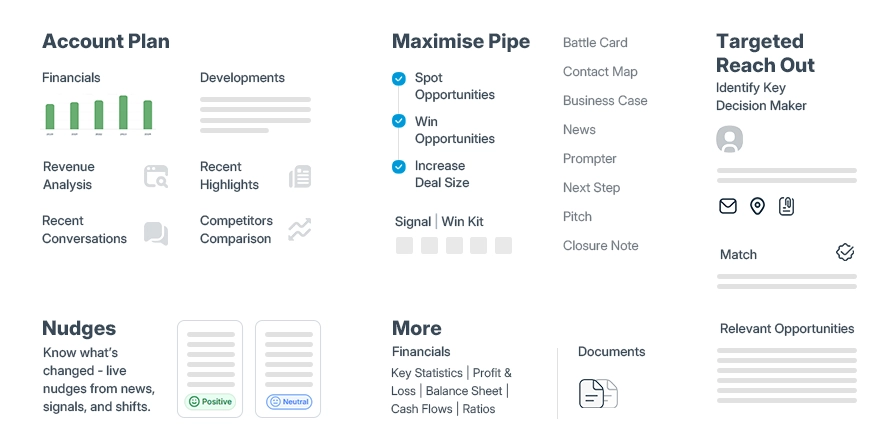
SalesPlay by MarketsandMarkets exemplifies this approach with its integrated system built around three core pillars: spotting opportunities before competitors, enabling every rep to perform like top performers, and delivering hyper-personalized experiences through unified tools. The platform deploys six specialized AI agents that work together across the sales cycle—from initial opportunity detection through post-sale expansion. What sets SalesPlay apart is its ability to act on revenue shifts in real-time rather than simply providing research data. The system automatically surfaces hot opportunities based on live market signals, builds customized sales kits with presentations and messaging tailored to each opportunity's decision-makers, and provides guided actions that keep deals moving forward.
Outreach stands as another leading AI revenue workflow platform, offering workflow-first functionality that orchestrates every stage of the sales process. Their AI agents surface best-fit prospects, automate research, and recommend next best actions to increase productivity. The platform excels at identifying and engaging all stakeholders with AI-powered account insights that align teams around buyer priorities and reduce friction.
Regie.ai provides a comprehensive suite of generative and analytical AI tools specifically geared toward sales teams. From email verification and call script generation to automatic social media posts and icebreaker suggestions, Regie.ai handles campaigns from top to bottom with autopilot AI agents managing prospecting, copywriting, sequencing, and even inbound email responses.
Identifying and understanding ideal prospects consumes enormous time in B2B sales. AI-powered prospecting platforms use machine learning to discover high-fit accounts, enrich contact data, and surface buying signals that indicate readiness to purchase.
Cognism leads this category with Cortex AI, their governed AI engine that sources, matches, and validates millions of company and contact records. The platform offers Diamond Data phone-verified mobile numbers, intent data powered by Bombora, and AI-powered company research that provides contextual information on target accounts' business direction, strategy, and competitors. Their AI Search feature allows sales teams to find prospects using ChatGPT-style text or voice prompts, making prospecting intuitive and fast.
Clay excels at data enrichment and lead profile building. The platform quickly crawls LinkedIn for custom lead reporting and offers numerous AI tools for enriching lead profiles. Clay's built-in OpenAI bot, Claygent, can interact with spreadsheet data to generate insights, identify company types, or create outreach email copy based on personas. The waterfall approach cycles through multiple data enrichment services to maximize contact information accuracy.
ZoomInfo provides comprehensive B2B intelligence with AI-powered intent data, technographics, and organizational charts. Their platform combines a massive contact database with predictive analytics to identify accounts in-market for your solutions.
Advanced platforms in this category layer intent data on top of contact intelligence, monitoring which companies are actively researching relevant topics, experiencing growth signals like funding rounds or leadership changes, or exhibiting technology adoption patterns that indicate need.
Ready to turn your Rep
INTO BEST PERFORMER ?
Once you've identified prospects, the challenge becomes engaging them effectively across multiple channels while maintaining personalization at scale. AI sales engagement platforms orchestrate complex, multi-touch campaigns that adapt based on recipient behavior and engagement patterns.
Overloop AI specializes in ultra-personalized email generation at scale and automated multi-channel outreach campaigns. Users can upload prospect lists or filter through the platform's internal database to target ideal prospects. The platform generates campaigns that speak to each prospect's unique pain points, ensuring quantity without compromising quality.
Postaga excels at outreach sequencing by analyzing your existing domain to suggest and deploy outreach campaigns. The platform walks you through campaign types based on goals—cold sales outreach, link building, content promotion—and generates email sequences with timelines. Postaga's AI creates email copy with custom fields based on profiles and enriched data, automating entire campaigns from concept to execution.
Salesloft provides a comprehensive sales engagement platform with AI-powered cadence recommendations, email templates, and analytics. Their Rhythm AI feature determines the best times to engage prospects and recommends optimal actions.
These platforms use natural language generation to create email copy, LinkedIn messages, and call scripts customized to each prospect's industry, role, and specific challenges. Machine learning algorithms determine optimal send times, channel selection, and message cadence based on historical engagement data.
Your CRM contains a goldmine of sales intelligence that most teams barely tap. AI-enhanced CRM platforms apply machine learning to your historical data, uncovering patterns that drive accurate forecasting, intelligent lead scoring, and actionable deal insights.
Salesforce Sales Cloud with Einstein AI leads this category, offering Einstein Copilot that leverages customer and CRM data to guide sellers at every stage. Einstein auto-generates personalized sales emails, provides feedback on customer interactions, forecasts conversion rates, and suggests actions most likely to move deals forward. The platform includes predictive lead scoring, conversation intelligence, and AI-powered insights for closing deals.
HubSpot Sales Hub features powerful predictive lead scoring tools that analyze behavioral and demographic data to predict close likelihood. The system automatically scores and ranks leads, alerting appropriate reps when potential customers reach predetermined qualification thresholds. HubSpot's AI also generates email sequences and provides predictive sales forecasts.
Pipedrive offers AI-powered sales assistant features including deal probability prediction, activity recommendations, and email insights that help prioritize work and identify opportunities.
Predictive lead scoring in these platforms analyzes hundreds of variables—engagement behavior, fit characteristics, timing signals, and similarity to won deals—to accurately predict conversion probability. The models continuously learn from outcomes, automatically adjusting scoring criteria as your business evolves.
Sales conversations contain invaluable insights that disappear the moment calls end unless you have technology to capture and analyze them. Conversation intelligence platforms record, transcribe, and extract actionable intelligence from sales calls, demos, and meetings.
Gong.io dominates this category with AI-driven feedback on sales conversations. The platform analyzes interactions to provide reps with actionable insights from prospect interactions including cold calls, discovery calls, and presentations. Using data from top performers, Gong's AI algorithm provides suggestions like "Discovery calls where the rep asks 8-10 questions have the highest success rate." The platform automatically tracks key concepts, objections, competitor mentions, and custom pricing discussions.
Fireflies.ai specializes in AI meeting note-taking, integrating with video conferencing platforms like Zoom and Google Meet. It automatically records, transcribes, summarizes, and takes notes on customer interactions, then integrates with CRMs to log transcripts and notes. This frees reps to focus entirely on prospects rather than scrambling to take notes.
Avoma offers AI-powered meeting performance scoring specifically designed for sales use cases. The platform provides intelligent topic detection, live bookmarking, keyword tracking, and AI scorecards that show how agents perform during meetings based on custom success criteria.
Dialpad provides real-time AI coaching during sales calls through Real-Time Assist (RTA) cards that give reps live guidance when the AI recognizes trigger words. The platform includes AI Playbooks that identify top-performing scripts, Ai Recaps for automatic call summaries, and QA scorecards for performance evaluation.
Advanced AI in these platforms analyzes conversation content to identify successful patterns, common objections, competitor mentions, and coaching opportunities. Sentiment analysis uses voice tone and language patterns to gauge prospect engagement and buying signals.
Email remains the primary communication channel in B2B sales, yet most sales emails fail to generate responses. AI email optimization platforms act as writing coaches, analyzing draft emails in real-time and providing specific suggestions to improve effectiveness.
Lavender leads this category by integrating directly into your inbox through a browser extension. The platform is trained on over one billion emails, providing AI-driven suggestions about improving email quality and scoring emails to identify issues that might hurt reply rates. Lavender's Personalization Assistant sends lead data into your inbox and advises how to use that information effectively. The platform's Email Coach feature shows detailed scoring metrics including writing clarity, readability, personalization quality, mobile rendering, and call-to-action effectiveness. It even includes a mobile preview window and integrated ChatGPT for on-the-fly composition.
Crystal takes a unique approach by assessing prospect personalities using the DISC methodology. The platform uses AI to predict personality traits from available data, then provides tips for human interaction customized to each prospect's communication style. Crystal includes an AI writing assistant that crafts email sequences matching the prospect's personality—whether they respond best to data-driven insights or emotionally charged language.
Copy.ai serves as a GTM AI platform that empowers sales teams to produce better content faster. The tool offers social media content creation workflows, AI LinkedIn post writers, blog post generators, and content repurposing capabilities that turn long transcripts into short, impactful posts.
These platforms evaluate multiple dimensions—subject line effectiveness, email length, reading complexity, personalization quality, mobile rendering, and call-to-action clarity—providing specific feedback on each element. They track performance across teams, identifying which reps excel at email engagement and what techniques drive results.
STOP CHASING PROSPECTS
START CLOSING DEALS!!
Several other specialized platforms deserve mention for specific use cases:
My AI Front Desk provides a true AI virtual receptionist that handles phone conversations, schedules appointments, and routes calls intelligently. Unlike simple call transcribers, this platform deploys a pleasantly voiced bot that has real-time conversations and makes decisions like a human receptionist would.
Zapier Agents enables AI orchestration across 7,000+ apps, allowing sales teams to create agents that perform actions based on data triggers. This connects AI capabilities across your entire tech stack, automating workflows like lead enrichment, notification sending, and data synchronization without manual intervention.
InsightSquared specializes in no-code, AI-powered sales forecasting and analytics with 350 out-of-the-box reports. The platform's Forecast Summary feature identifies data gaps affecting accuracy and provides pipeline management insights that help sales managers run more effective pipeline reviews.
Cirrus Insight's Meeting AI automates prospect and customer research ahead of scheduled meetings, leveraging AI to supply comprehensive insights on companies and contacts. This eliminates hours of research and helps reps have high-value interactions that drive closed deals.
Empower by Ringover focuses on conversational AI with sentiment analysis that identifies emotions and topics discussed during interactions. The platform generates call summaries, transcriptions, and personalized analytics including call scores that help reps self-identify improvement opportunities.# Best AI Sales Platform: Top Tools & Software for B2B Sales Teams in 2025
When evaluating AI sales platforms, assess capabilities across these critical dimensions:
Intelligent Prospecting and Account Selection: The platform should identify high-potential accounts using AI analysis of firmographic data, technographic signals, buying intent, and organizational changes. Look for natural language search capabilities that let you describe ideal customers conversationally rather than building complex Boolean queries.
Predictive Analytics and Scoring: Machine learning models should provide accurate predictions for lead conversion probability, deal close likelihood, optimal engagement timing, and revenue forecasting. The AI should explain its predictions and allow you to adjust weighting based on your business specifics.
Automated Research and Enrichment: AI agents should automatically gather comprehensive information about accounts and contacts—company background, strategic priorities, technology stack, organizational structure, recent developments—saving hours of manual research per deal.
Dynamic Personalization at Scale: Generative AI should create customized content for each prospect—emails, presentations, value propositions—based on their specific context. This goes far beyond mail merge fields to produce genuinely tailored messaging that demonstrates understanding.
Multichannel Orchestration: The platform should coordinate outreach across email, phone, social media, and direct mail, using AI to determine optimal channel mix and timing for each prospect based on their engagement preferences.
Conversational Intelligence: AI should analyze sales conversations to surface key topics, track competitor mentions, identify objections, measure sentiment, and provide coaching insights. Real-time assistance during calls adds even more value.
Deal Intelligence and Guidance: For opportunities in your pipeline, AI should analyze deal characteristics to predict outcomes, identify risks, recommend next actions, and suggest relevant content based on what worked in similar situations.
Seamless CRM Integration: Bidirectional sync with your CRM should happen automatically, with AI enriching CRM data, updating records based on activities, and surfacing insights within the CRM interface.
Compliance and Data Governance: The platform must maintain rigorous data privacy standards, respect consent preferences, comply with regulations like GDPR and CCPA, and provide transparency into how AI makes decisions.
Actionable Analytics and ROI Measurement: Robust reporting should connect platform usage to business outcomes—time saved, conversion improvements, pipeline velocity, forecast accuracy—demonstrating clear return on investment.

Understanding how AI sales platforms operate in practice helps you envision their impact on your workflow. Here's how leading platforms orchestrate the sales process from initial opportunity identification through closed deals:
The process begins with AI analyzing vast amounts of market data to identify accounts matching your ideal customer profile and exhibiting buying signals. Advanced platforms monitor organizational changes, technology adoption, budget cycles, regulatory developments, industry trends, and competitor movements to spot opportunities before traditional intent data surfaces.
You either upload your target account list or allow the AI to suggest high-potential accounts based on similarity to your best customers. The platform enriches each account with comprehensive intelligence—company overview, strategic priorities, organizational structure, technology stack, recent developments, and key stakeholders.
For each priority account, AI agents conduct extensive research automatically. They analyze earnings calls, press releases, job postings, technology deployments, and social media activity to understand business priorities and potential needs. The platform identifies specific triggers that indicate purchase readiness—leadership changes, expansion plans, system implementations, or strategic initiatives that align with your solution.
This research isn't generic—it's focused on uncovering insights relevant to your value proposition. The AI identifies which of your offerings align best with each account's current priorities and which decision-makers to approach.
Rather than making reps build presentations and talking points from scratch, AI generates complete engagement kits for each opportunity. This includes customized slide decks highlighting relevant case studies and ROI calculations, email sequences adapted to the prospect's industry and role, call scripts with suggested discovery questions, value propositions emphasizing benefits that matter to this specific account, and battlecards for handling likely objections.
Every piece of content is contextually relevant—not just mail-merged with the company name but genuinely tailored to their business situation.
The platform orchestrates initial outreach across appropriate channels, using AI to determine optimal timing, messaging, and sequence. Email campaigns adapt based on engagement—if a prospect opens but doesn't respond, the AI might trigger a LinkedIn connection request or a phone call from a rep.
Generative AI continuously creates fresh variations of messages to avoid repetition and test different approaches. Machine learning analyzes which variations drive engagement and adjusts accordingly.
During sales calls and meetings, conversation intelligence platforms provide live assistance. They transcribe conversations in real-time, identify key moments worth noting, suggest questions when conversation stalls, surface relevant competitive intelligence when needed, and flag important commitments or next steps.
Post-call, the AI automatically generates meeting summaries, updates CRM records, and recommends follow-up actions based on conversation content.
As opportunities advance, AI continuously analyzes deal health by comparing engagement patterns, stakeholder involvement, deal velocity, and competitive positioning against similar won and lost deals. It identifies red flags early—multi-threading gaps, missing stakeholders, engagement drops, extended decision timelines—and alerts reps to address issues before they derail deals.
The platform recommends specific actions to move deals forward: which stakeholders to engage, what content to share, when to discuss pricing, how to handle specific objections.
Sales leaders gain AI-powered visibility into pipeline reality. Machine learning models predict which deals will close this quarter with impressive accuracy, identifying both at-risk opportunities and unexpected upside. This allows proactive pipeline management rather than reactive scrambling at quarter-end.
After deals close, the AI continues working—monitoring customer health signals, identifying expansion opportunities, flagging renewal risks, and orchestrating customer success activities. The platform alerts teams when customers exhibit behaviors associated with upsell readiness or churn risk.
This end-to-end orchestration means AI isn't just a tool reps use occasionally—it's an intelligent system that augments every stage of the sales process, continuously learning and improving based on outcomes.
STOP GUESSING YOUR PIPELINE
START GROWING IT WITH AI SALES!!
Technology alone doesn't transform sales performance—successful implementation requires thoughtful change in management and strategic execution. Follow these proven practices to maximize your AI platform investment:
Define Clear Success Metrics: Before implementation, establish specific, measurable goals, increased qualified leads per rep, shortened sales cycles, improved conversion rates, higher forecast accuracy, time saved on administrative tasks. These metrics guide platform configuration and prove ROI.
Start with High-Impact Use Cases: Rather than trying to revolutionize everything simultaneously, identify 2-3 processes where AI can deliver immediate value with minimal disruption. Common starting points include lead scoring, email personalization, or conversation intelligence.
Ensure Data Foundation Quality: AI performance depends entirely on data quality. Before launch, audit your CRM data completeness and accuracy, establish data hygiene processes, define clear data governance policies, and integrate all relevant data sources. Garbage truly means garbage out with AI.
Invest in Comprehensive Training: Sales teams won't adopt tools they don't understand or trust. Provide hands-on training that goes beyond features to demonstrate how AI improves their daily work. Show real examples of how the platform helps close deals faster or find better prospects.
Balance AI Automation with Human Judgment: AI should augment human decision-making, not replace it. Establish clear guidelines about when reps should follow AI recommendations versus applying their own judgment. The best results come from human-AI collaboration.
Monitor, Measure, and Iterate: Track adoption rates, usage patterns, and outcome improvements weekly. Gather feedback from reps about what's working and what's not. Use these insights to refine configurations, adjust scoring models, and optimize workflows.
Celebrate Early Wins: Publicly recognize reps who successfully leverage AI to close deals or accelerate pipelines. These success stories build momentum and encourage broader adoption.
The AI sales platform category continues evolving rapidly. Several emerging trends will reshape sales technology in the coming years:
Autonomous AI Agents: Future platforms will deploy AI agents that work independently on behalf of sales reps—conducting research, qualifying leads, scheduling meetings, even handling initial outreach conversations. Human salespeople will focus exclusively on high-value strategic activities while AI handles repetitive execution.
Hyper-Personalization at Every Touchpoint: As AI becomes more sophisticated, every interaction—emails, presentation, pricing proposals, contract terms—will be dynamically customized not just to the company or role, but to the individual's specific priorities, communication preferences, and decision-making style.
Predictive Revenue Intelligence: AI will move beyond analyzing current pipeline to predict future opportunity generation. Platforms will forecast which accounts will enter buying cycles months in advance, allowing proactive engagement before needs crystalize.
Integrated GTM AI Platforms: The lines between sales, marketing, and customer success AI will blur as platforms orchestrate entire go-to-market motions. These systems will coordinate activities across teams, ensuring consistent messaging and seamless customer experiences.
Ethical AI and Regulation: As AI becomes more prevalent, regulations governing its use in sales will emerge. Platforms that prioritize transparency, explainability, and ethical AI practices will gain competitive advantage.
The AI sales platform market offers unprecedented opportunity to transform sales performance, but choosing the right solution requires careful evaluation. Start by deeply understanding your specific challenges and goals. What's broken in your current sales process? Where do reps waste the most time? Which metrics need improvement?
Evaluate platforms based on genuine AI capabilities rather than marketing claims. Request detailed demonstrations using your actual data and use cases. Talk to current customers about real-world results and implementation challenges. Assess integration quality with your existing tech stack.
Most importantly, remember that AI platforms are tools that amplify your strategy—they don't substitute for having a clear go-to-market approach, understanding your ideal customers, and building genuine relationships. The most successful sales organizations use AI to eliminate friction and scale what already works, not to paper over fundamental strategic weaknesses.
The winners in the AI-powered sales era won't be those with the most technology—they'll be organizations that thoughtfully integrate AI into human-centered sales processes, continuously optimize based on data, and maintain the judgment to know when human insight matters most.
Ready to transform your sales process with intelligent AI? The platforms exist today to help you spot opportunities before competitors, engage prospects with genuine personalization, and close deals faster than ever before. The only question is whether you'll lead this transformation or watch competitors gain the advantage.

An AI sales platform is a software solution that uses artificial intelligence to automate, optimize, and guide sales activities such as lead prioritization, outreach, forecasting, and pipeline management. It helps sales teams close deals faster using data-driven insights.
AI is used in B2B sales for lead scoring, predictive forecasting, personalized outreach, conversation intelligence, deal risk analysis, and revenue optimization. It enables sales teams to focus on high-value opportunities and improve win rates.
Key features include AI-driven lead scoring, account intelligence, predictive analytics, CRM integration, automated outreach, conversation insights, and revenue forecasting dashboards.
AI sales platform pricing typically ranges from a few hundred to several thousand dollars per user per year, depending on features, data depth, integrations, and team size. Enterprise platforms often offer custom pricing.
Most AI sales platforms can be implemented within 2–6 weeks, depending on data readiness, CRM integrations, and customization requirements. Cloud-based platforms usually offer faster deployment.
Your SDRs work 9–5
AI Sales works 24/7!!
Yes, most AI sales platforms integrate seamlessly with popular CRMs such as Salesforce, HubSpot, and Microsoft Dynamics to enhance existing workflows without replacing core systems.
AI sales platforms improve performance by identifying high-intent buyers, recommending next best actions, reducing manual tasks, improving forecast accuracy, and increasing pipeline conversion rates.
ROI can be measured through improvements in pipeline velocity, win rates, forecast accuracy, average deal size, and reduced sales cycle time after implementing an AI sales platform.
No, AI will not replace B2B sales representatives. Instead, it augments sales teams by automating repetitive tasks and providing insights, allowing reps to focus on relationship-building and strategic selling.
Most enterprise-grade AI sales platforms comply with data privacy regulations such as GDPR and SOC 2, using secure data handling, encryption, and compliance-ready architectures.
Yes, many AI sales platforms are designed for small and mid-sized teams, offering scalable features, flexible pricing, and fast onboarding without requiring technical expertise.
No, modern AI sales platforms are designed with intuitive dashboards and no-code workflows, allowing sales teams to use AI insights without technical or data science expertise.
STOP GUESSING YOUR PIPELINE
START GROWING IT WITH AI SALES!!

Category: Uncategorized Tags: ai, AIOps, Artificial Intelligence, cloud, cloud platform, Cybersecurity, Information and Communications Technology , VR