Innovative Sales Intelligence Applications: Emerging Use Cases
September 08, 2025

Advanced sales intelligence applications are transforming how we close deals in 2024. Did you know that sales teams using AI-powered intelligence tools are seeing conversion rates increase by up to 30%? I've watched this technology evolve from basic contact databases to sophisticated systems that can predict buyer behavior with remarkable accuracy.
Today's sales intelligence platform landscape offers unprecedented capabilities for revenue teams. However, many organizations are still scratching the surface of what's possible. Next-gen sales intelligence combines predictive analytics, conversation intelligence, and automated insights to create a competitive edge. In fact, forward-thinking companies are implementing these tools to reduce sales cycles and improve win rates across industries.
Sales intelligence emerging trends point to even more exciting developments on the horizon. Throughout this article, I'll explore how these innovations are reshaping sales processes, examine market growth projections, and highlight specific use cases that demonstrate the real-world impact of these technologies. Whether you're looking to upgrade your current tech stack or exploring sales intelligence for the first time, you'll discover practical applications that can drive meaningful results for your organization.
The sales intelligence market is experiencing significant growth as organizations increasingly recognize its value in driving revenue. Looking at current figures, the global sales intelligence market is valued at USD 3.65 billion in 2025 and is projected to reach approximately USD 9.02 billion by 2034, expanding at a CAGR of 10.54% during this period. Alternative market analyzes suggest even more ambitious growth trajectories, with some forecasts indicating the market could reach USD 11.7 billion by 2035.
STOP GUESSING YOUR PIPELINE
START GROWING IT WITH AI SALES!!
Revenue projections for sales intelligence vary somewhat between research sources, indicating the dynamic nature of this market. According to one analysis, the market is expected to grow from USD 8.51 billion in 2025 to USD 25.76 billion by 2034, representing a robust CAGR of 13.82%. This substantial growth is fueled by increasing adoption of AI technologies across sales operations. For instance, enterprises using AI are closing new logo deals 20% faster than they were two years ago.
Additionally, businesses invested approximately USD 13.80 billion in AI technologies last year alone, underscoring the growing commitment to intelligence-driven sales approaches. The software segment maintains dominance in the market, accounting for about 70-80% of revenue share, with cloud deployment representing over 80% of installations as of 2024.
North America continues to lead the global sales intelligence landscape, accounting for 46% of the market share in 2024. This dominance stems primarily from the concentration of sales intelligence vendors and early technology adoption. The U.S. specifically holds a significant position, with its market valued at USD 1.07 billion in 2024 and projected to reach approximately USD 2.93 billion by 2034.
In comparison, Europe represented 24.4% of the global sales intelligence market in 2020. The European market is expected to grow at a CAGR of 11.2% through the forecast period, slightly outpacing global averages. Within Europe, France is anticipated to register the highest growth rate from 2021 to 2027.
The contrast between regions extends to growth potential as well:
|
Region |
Market Share (2024) |
Growth Rate |
|
North America |
46% |
10.60% CAGR |
|
Europe |
~24% |
11.2% CAGR |
|
Asia Pacific |
Smaller share |
15.2% CAGR |
While North America maintains leadership, Asia Pacific is emerging as the fastest-growing region with an impressive 15.2% CAGR forecast through 2034, presenting substantial opportunities for sales intelligence platform providers looking to expand their global footprint.
Across industries, the adoption of next-gen sales intelligence shows varied patterns. The IT & telecom sector currently leads adoption, accounting for 27% of the market in 2024. This sector's dominance reflects the natural alignment between technology companies and advanced sales tools. Previously, this segment accounted for 23.7% of revenue share in 2022.
Nevertheless, other sectors are rapidly embracing sales intelligence solutions:
The BFSI (Banking, Financial Services, and Insurance) sector is projected to capture 24.90% of market revenue by 2025, making it a close second to IT & telecom.
Retail & e-commerce is the fastest-growing vertical, expected to expand at a CAGR of 14.7%, surpassing the previous growth projection of 12.9%.
Healthcare is also showing significant adoption, holding a substantial market share as of 2023.
In terms of enterprise size, large enterprises accounted for 75.0% of the market in 2022. However, the SME segment is witnessing faster growth, with a projected CAGR of 12.3%. This trend highlights how sales intelligence emerging trends are becoming more accessible and valuable to businesses of all sizes, not just large corporations.
Three core technologies form the backbone of modern sales intelligence applications. I've observed how these technologies create unprecedented capabilities for revenue teams who need deeper insights into customer behavior and preferences.
Artificial Intelligence (AI) and Machine Learning (ML) have fundamentally changed how sales teams qualify leads. Predictive lead scoring leverages sophisticated algorithms to analyze historical data and calculate a score for each lead based on their likelihood to convert. This approach outperforms traditional manual scoring methods by processing vast datasets to identify patterns that would overwhelm human analysts.
For example, Microsoft's predictive lead scoring system examines past lead behaviors to generate a score between 1-100. A lead scoring 80 has a significantly higher conversion probability than one scoring 50. Furthermore, the model identifies key factors influencing each score, allowing sales representatives to understand why certain leads rank higher than others.
The effectiveness of AI-powered lead scoring is striking—98% of sales teams using this technology report improved lead prioritization. Unlike rule-based systems, these ML models continuously learn from new data, automatically adjusting predictions as market conditions and buyer behaviors evolve. Consequently, the scoring accuracy increases over time, creating a progressively more refined system.
AI lead scoring solves a common business challenge: misalignment between marketing and sales teams. By establishing a shared, data-driven scoring system, both departments can agree on which leads deserve priority attention. Notably, organizations need at least 40 qualified and 40 disqualified leads to train an effective model.
Ready to turn your Rep
INTO BEST PERFORMER ?
Natural Language Processing (NLP) transforms how Customer Relationship Management (CRM) systems handle unstructured data. As a subfield of AI, NLP enables computers to understand, interpret, and generate language in ways that mirror human capabilities. This technology proves especially valuable given that most customer data exists in unstructured formats like emails, social media posts, and customer reviews.
In CRM applications, NLP processes this unstructured text to extract valuable insights in seconds—tasks that would require hours of human analysis. The technology identifies trends, patterns, and customer preferences from textual data to personalize offerings and optimize marketing strategies. Beyond basic text analysis, NLP delivers:
Sentiment analysis to gage customer emotions and opinions
Text summarization to condense large volumes into actionable insights
Multilingual support for global customer engagement
Context recognition for accurate interpretation of customer requests
Major corporations including Johnson & Johnson already utilize NLP to annotate and categorize customer calls, gaining insights into real-world product usage. Salesforce has integrated NLP into its platform through "Einstein Voice," allowing sales teams to use natural language commands for updating records and scheduling meetings.
The integration of voice and conversation analytics represents the next frontier in sales intelligence. This technology works like a sophisticated notetaker and analyst during sales calls, measuring critical elements such as talk-listen ratios, conversational sentiment, and mention of specific keywords.
Modern conversation intelligence software employs AI, ML, and NLP to transcribe and assess conversations in real-time. Beyond simple transcription, these systems analyze tone, inflection, pauses, and facial cues to determine likely attitudes and buying intent—even when prospects try to mask their true feelings.
The practical applications are substantial. Conversation intelligence tools like Gong analyze every interaction to identify larger patterns about deals and leads, combining this with market trends for comprehensive insights. Similarly, Microsoft's Copilot enables sales managers to search for important call details using natural language queries.
Such systems have evolved from simple recording tools to sophisticated analytics platforms that flag coaching opportunities, identify successful tactics, and help sales teams understand precisely where deals are won or lost. With security features meeting regulations like GDPR or HIPAA, these platforms safely handle sensitive client data while providing invaluable insights.
Sales teams increasingly rely on data-driven approaches to identify promising prospects. Advanced sales intelligence applications now offer sophisticated lead prioritization and scoring capabilities that dramatically improve conversion rates and sales efficiency.
Behavioral data transforms how sales teams evaluate and rank leads. Rather than depending solely on static information like job titles or company size, modern sales intelligence platforms track how prospects interact with content across multiple touchpoints. This approach enables sales representatives to understand engagement patterns and communication preferences at a deeper level.
AI-powered lead scoring solutions utilize behavioral analytics to distinguish between high-value and low-value prospects. By examining historical trends and current engagement patterns, these systems assess each lead's potential value. Indeed, organizations implementing behavioral data-based strategies report up to 79% higher conversion rates. This improvement occurs primarily because teams focus their efforts on leads genuinely likely to convert rather than pursuing every possible opportunity.
Key behavioral metrics tracked by next-gen sales intelligence include:
Website activity (time spent on site, feature comparisons)
Content engagement (views of case studies, technical documentation access)
Email interaction (response rates, click-through patterns)
Event participation (demo attendance, webinar engagement)
Subsequently, leads can be segmented into priority tiers based on their behavioral signals. Hot leads showing immediate interest require prompt response, warm leads benefit from 48-hour follow-up, and nurture-tier leads enter automated flows.

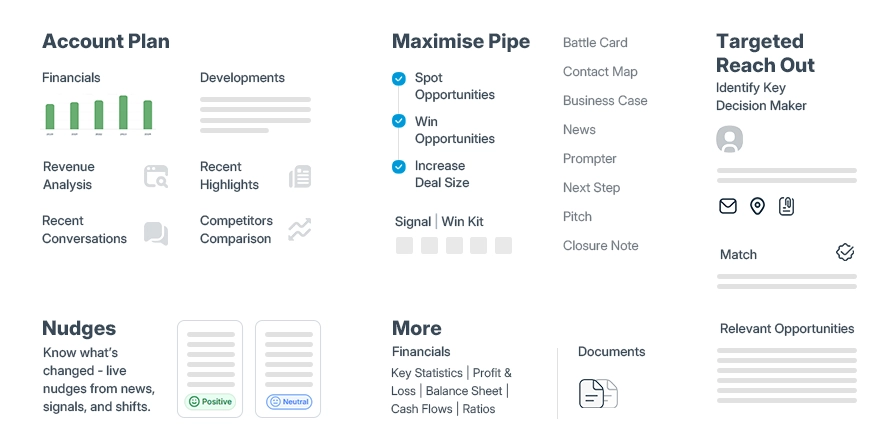
Trigger-based sales alerts function as automated notifications that inform sales representatives when prospects demonstrate behaviors indicating purchase intent. Unlike traditional lead scoring that provides static values based on demographic data, trigger alerts capture real-time actions signaling readiness to buy.
These alerts monitor what sales experts call "digital body language"—the online equivalent of nonverbal cues observed in face-to-face meetings. Common trackable buyer behaviors include multiple visits to pricing pages, downloading technical specifications, extended time reviewing product features, sharing content with colleagues, and comparing product tiers.
The implementation of trigger-based alerts delivers remarkable strategic advantages. Companies using these systems report 35-40% higher conversion rates with perfectly timed outreach, 28% reduction in sales cycle length, and 42% improvement in prospect engagement metrics. Moreover, organizations consistently experience higher close rates (22-35% improvement), larger deal sizes (15% average increase), and faster revenue recognition.
Website behavior provides some of the clearest indicators of purchase intent, particularly when analyzing patterns rather than isolated actions. Pricing page interactions and product comparison activities especially indicate active evaluation.
Salesforce Einstein Lead Scoring leverages AI to transform data into actionable insights, helping sales teams navigate the lead avalanche and identify hidden gems. The system evaluates both explicit data (information leads directly provide) and implicit data (behavioral signals like website activity and content engagement).
Einstein's multi-dimensional approach allows for precise, individualized assessment of each lead's conversion potential. It considers website behavior, email engagement, social media activity, and marketing campaign engagement to generate scores. These scores act as a prioritization tool, allowing sales representatives to focus their efforts on leads with the highest conversion probability.
Besides basic scoring, Einstein provides additional valuable insights through features like predictive analytics. The system can analyze historical data to predict conversion likelihood within specific timeframes. Furthermore, Einstein Lead Insights highlights specific lead behaviors contributing to high scores, empowering sales teams to tailor outreach strategies accordingly.
This intelligent prioritization resolves common alignment issues between marketing and sales departments. By establishing a shared, data-driven scoring system, both teams agree on which leads deserve priority attention, fostering improved collaboration and efficiency throughout the sales process.
Forecasting sales performance has evolved substantially with advanced sales intelligence applications. Traditional spreadsheet-based projections often fail due to outdated inputs, reliance on gut feelings, and lack of visibility into real buyer behavior. Instead, today's AI-powered forecasting systems provide data-driven predictability that transforms how companies manage their sales pipeline.
Time series forecasting represents a fundamental approach to sales prediction, analyzing chronologically ordered historical data to identify patterns that inform future expectations. Unlike other methods relying on external factors, time series models focus exclusively on past data points for prediction, resulting in more reliable sales projections.
These models consist of four essential components that work together:
Trend component (long-term directional movement)
Seasonal component (predictable patterns at fixed intervals)
Cyclical component (non-seasonal fluctuations from business conditions)
Irregular component (random variations)
Forecastio leverages these principles to offer specialized modeling approaches based on business patterns. For sales with consistent patterns, traditional statistical methods like ARIMA and SARIMA excel at identifying trends, seasonality, and cyclic patterns. These approaches work exceptionally well for businesses with steady sales patterns and minimal market disruptions.
To implement effective time series forecasting, companies need at least 2-3 years of consistent historical data (24-36 data points minimum). Though implementation complexity remains low to moderate, the results can be substantial, as these models identify subtle patterns that would otherwise remain invisible to sales teams.
STOP CHASING PROSPECTS
START CLOSING DEALS!!
The integration between CRM platforms and forecasting tools creates a powerful foundation for accuracy improvement. Rather than relying on static inputs like pipeline stages or manually entered notes, modern CRM-integrated forecasting pulls insights from conversations, sentiment analysis, activity patterns, and engagement gaps.
Key metrics for assessing forecast accuracy include forecast variance (difference between predicted and actual sales), forecast bias (consistent overestimation or underestimation), and win/loss ratios. These measurements allow organizations to identify improvement areas, refine forecasting models, and adjust sales strategies accordingly.
Salesforce's Einstein AI capability exemplifies this integration, measuring opportunity conversion probability and identifying at-risk pipelines. When combined with Sales Cloud and Forecasting features, this approach has improved win rates by 14%. The system evaluates leads based on potential value, opportunity health, and relevant sales activities rather than gut feeling or manual updates.
Revenue Grid offers another example with its Salesforce-native forecast evolution reports that track pipeline changes. These tools allow teams to:
Analyze pipeline value at the beginning and end of selected periods
Review opportunities across different forecast categories
Perform retrospective analysis by specific sales teams or representatives
One of the most valuable applications of AI in forecasting is estimating which deals are most likely to close. AI models analyze multiple deal-related parameters to assign probability scores, enabling sales managers to focus efforts where success is most likely.
To accurately calculate deal probabilities, AI systems analyze various data points including:
Deal value (higher-value deals are prioritized differently)
Sales cycle length compared to historical performance
Time spent in the current pipeline stage
Number of engaged decision-makers
Recency of interaction activity
Email response rates and engagement metrics
The effectiveness of AI-based probability calculation is remarkable—companies using AI for sales predictions report a 79% accuracy rate versus just 51% achieved through conventional methods. Furthermore, businesses implementing AI-powered forecasting tools can improve their sales forecast accuracy by up to 25% in just 90 days.
This shift toward data-driven forecasting allows teams to move beyond static reporting into forward-looking decision enablement. The technology essentially automates what skilled sales managers have always done intuitively—assess deal health, identify risks, and focus resources where they'll have the greatest impact.
Personalization has become the cornerstone of effective sales strategies, with modern tools now enabling tailored content at scale. A recent Gong survey revealed that sales representatives spend 5.9 hours weekly drafting personalized content and 6.2 hours creating content from scratch. This time investment highlights why 78% of sales reps want to use generative AI to personalize their sales engagement and shorten writing time.
Copy.ai's Cold Email Generator transforms how sales teams approach outreach by automating personalized email creation. This tool takes minimal text input along with prospect information to craft tailored messages that resonate with recipients. The technology leverages artificial intelligence to analyze LinkedIn profiles of potential leads and incorporate specific product details, ensuring each email feels individually crafted.
The results speak for themselves—companies using AI-powered cold email tools report substantial benefits:
Time efficiency by automating personalized email creation
Enhanced engagement through customization that increases open rates
Scalability to expand outreach from hundreds to thousands of prospects with minimal resource increase
Furthermore, Copy.ai integrates seamlessly with major CRM platforms including Salesforce, HubSpot, and Slack. This connectivity allows for real-time synchronization of lead data and interactions, keeping the entire sales team aligned.
STOP GUESSING YOUR PIPELINE
START GROWING IT WITH AI SALES!!
Dynamic content refers to material that varies based on individual user signals, creating unique experiences tailored to behaviors and interests. Unlike static content that remains identical for all users, dynamic content adapts to each prospect's specific profile and history.
When implemented with CRM data, dynamic content becomes particularly powerful. Sales teams can establish variable sections containing different copy, images, and calls-to-action that display specifically to targeted segments. This capability allows for precise customization without requiring extensive manual work.
For instance, if a customer previously purchased shoes from a particular brand in size 7.5, an email can be automatically generated highlighting a sale on similar styles from the same brand—complete with links to add those exact shoes in their size to their shopping cart. This level of personalization creates a sense that the company truly understands each customer's preferences.
AI sales tools thoroughly analyze customer interactions to uncover hidden patterns and correlations, then use this data to predict behaviors, recommend next steps, and highlight potential risks. These insights remove guesswork from the sales process, enabling data-driven decisions about individual deals.
Sales call analysis represents one of the most valuable applications of this technology. Advanced sales intelligence applications can identify strengths and areas for improvement by analyzing recordings, email interactions, and win/loss data. This analysis offers benchmarking against other team members, which representatives can use for self-coaching.
After evaluating conversations, next-generation sales intelligence platforms provide specific recommendations about when and how to follow up with prospects. These suggestions might include the optimal time for contact, most effective content to share, or potential objections to address proactively.
Equally important, managers can leverage these insights to focus coaching efforts more effectively. The technology identifies which team members need assistance with specific sales skills, allowing for personalized feedback and tailored training programs.
The rise of Artifical Intelligence powered sales development representatives (AI SDR) marks a fundamental shift in sales intelligence. These virtual agents handle routine sales tasks with efficiency that human teams struggle to match.
Artisan's AI BDR Ava represents next-generation intelligence in sales outreach automation. As an all-in-one AI-first sales automation platform, Ava executes the entire B2B outbound process up to the handoff point to account executives. This virtual assistant:
Builds lead lists using a B2B database of 300+ million contacts
Researches leads through advanced web scraping
Identifies optimal outreach playbooks
Composes personalized outreach emails
Tracks high-intent website visitors for targeted outreach
By outsourcing 80% of SDR-related tasks to platforms like Artisan, companies can dramatically scale outbound sales efforts without expanding their teams. Initially designed to streamline processes, these tools now fully automate them, contributing to revenue growth. In fact, a Salesforce survey found that 83% of sales teams using AI experienced revenue growth versus 66% for those without.
Conversational AI has transformed lead qualification by engaging prospects through natural dialog. Unlike traditional qualification methods, AI sales assistants can interact with leads 24/7, ask pre-programmed questions to gage interest, and route qualified prospects to human representatives.
These systems leverage natural language processing to understand customer language naturally and engagingly. They analyze responses and behavior in real-time, creating personalized experiences based on each prospect's specific profile. After gathering essential information, AI qualification tools use machine learning algorithms to score leads instantly, identifying the most promising prospects.
The value proposition is clear: leads go cold fast, but conversational AI ensures immediate engagement. This approach yields measurable results, as businesses with AI-enabled sales teams generate 50% more leads and appointments than those using traditional methods.
Among the most practical applications of sales intelligence technology is automated meeting scheduling. Virtual sales assistants integrate with calendar systems like Google Calendar or Outlook to coordinate appointments without human intervention.
For instance, Biky, an AI salesperson, fully automates scheduling by syncing calendars and assigning salespeople automatically. This system initiates conversations with empathy, automatically segments and qualifies leads, then proposes appointments based on advisor availability. As soon as appointments are scheduled, the system sends confirmations, notifies the relevant advisor, and synchronizes with their calendar.
Companies implementing such automation report dramatic improvements: +90% effectiveness in automatic scheduling, 3× more conversions, and reductions exceeding 30% in Customer Acquisition Cost.
Make Every Rep Speak
Like Your Top 1%
Sales teams achieve better results when armed with AI-generated insights directly applicable to their selling scenarios. Modern sales enablement solutions leverage artificial intelligence to create battle cards, generate playbooks, and integrate with established platforms to boost sales effectiveness.
Battle cards serve as one-page references that equip sales representatives with essential information for strategic sales conversations. These concise documents provide a consolidated view of everything needed to sell effectively, including product overviews, customer profiles, value propositions, competitive differentiators, objection handling, and pricing strategies. Primarily designed to keep representatives focused during calls, battle cards prevent conversational derailment and ensure consistency across teams.
Copy.ai's workflow builder has streamlined battle card creation with a simple prompt-based approach: "Given [your data source], create a sales battle card so I can come to the call prepared. Include [specific information] in your battle card". The AI-generated output can be refined based on professional insights to align with brand voice and customer preferences.
Common battle card formats include:
Product templates highlighting features, pricing, and value propositions
Competitive templates focusing on positioning against market rivals
Objection handling templates with pre-scripted rebuttals
AI transforms sales playbook development by analyzing vast amounts of historical data. Trust Insights' Casino framework offers a template approach to sales playbook creation, focusing on specific components that must be included for effectiveness. This framework combines three major data sources: AI-transcribed sales calls, CRM data converted to machine-readable format, and Slack conversation exports.
The traditional challenge with playbooks—their excessive length—is now manageable through AI. A typical AI-generated playbook might span 50,000 words across 153 pages, yet tools like Google's NotebookLM can create digestible summaries, mind maps, and study guides from these comprehensive resources.
Clari seamlessly integrates with leading sales and customer engagement tools, thereby ensuring smooth workflows across CRM, sales enablement, and engagement platforms. This integration helps boost productivity while streamlining processes throughout the sales technology stack.
The platform's AI capabilities analyze call data and deal activity to recommend specific next steps, such as sharing pricing calculators, booking demonstrations, or escalating issues. Furthermore, Clari's AI-powered innovations like Smart Deal Summaries and Advanced Opportunity Predictions have seen rapid adoption, with AI Deal Summaries usage increasing by 572% in just six months.
AI tools embedded in platforms like Salesforce help sales managers identify when representatives struggle, thus allowing them to assign role-specific enablement resources. Unlike one-size-fits-all approaches, these systems create personalized enablement journeys based on representatives' roles, product focus, and performance metrics.
Physical retail spaces are now becoming laboratories for advanced sales intelligence applications. The integration of AI into brick-and-mortar locations creates new opportunities for enhancing customer experience and operational efficiency.
LoweBot, introduced by Lowe's Innovation Labs in 2017, represents an early practical implementation of autonomous retail service robots. This AI-powered assistant helps customers locate products and provides information about current promotions. When a customer asks for a specific item like a hammer, LoweBot displays available options and guides them to the exact location in the store using integrated mapping technology. Beyond customer service, LoweBot tracks inventory in real time and detects sales patterns to inform business decisions.
Retail robots fundamentally transform shopping experiences while collecting valuable data. Remarkably, 96% of shoppers report neutral or favorable attitudes toward store robots. These machines monitor shelf inventory through sensors, automatically notifying staff when restocking is needed. Moreover, electronic price tags can update automatically based on demand fluctuations or promotions. This technology particularly resonates with frequent shoppers, who embrace robots 29% more than infrequent visitors.
AI-driven layout optimization analyzes customer behavior patterns, purchase history, and market trends to design more effective store environments. Through heat-mapping technology, retailers visualize high-traffic areas and identify products attracting shopper attention. This analysis helps create intuitive pathways with clear signage to guide customers toward specific product categories. Implementing AI-optimized layouts can increase sales by up to 15%, primarily by placing high-demand products in high-traffic areas and reducing bottlenecks.
Sales intelligence applications have undoubtedly transformed how businesses approach their revenue generation strategies. Throughout this article, I've shown how AI and ML technologies now power everything from lead scoring to forecasting, creating unprecedented opportunities for sales teams. The market growth figures speak volumes – expanding from USD 3.65 billion in 2025 to potentially USD 9.02 billion by 2034, with some regions like Asia Pacific growing at an impressive 15.2% CAGR.
What stands out most clearly is how these technologies solve real business problems. Predictive lead scoring eliminates guesswork, helping teams focus on prospects most likely to convert. Similarly, conversation analytics uncovers hidden patterns in customer interactions that would otherwise remain invisible. These capabilities don't merely enhance efficiency; they fundamentally change how sales professionals understand their customers and markets.
The personalization possibilities particularly demonstrate the practical value of next-gen sales intelligence. Rather than generic outreach, AI systems now craft tailored messages based on prospect behavior and CRM data. This approach aligns perfectly with modern buyer expectations while saving hours of manual work. Additionally, automated meeting scheduling and 24/7 AI assistants ensure businesses never miss engagement opportunities, regardless of time zone differences or staffing limitations.
Perhaps most fascinating are the physical retail applications emerging alongside digital tools. LoweBot and similar AI-powered assistants bridge the gap between online and in-store experiences, offering personalized guidance while simultaneously collecting valuable data on customer preferences and inventory needs. These innovations suggest we've barely scratched the surface of what's possible.
Sales intelligence technologies will certainly continue evolving at a rapid pace. Organizations that adopt these tools thoughtfully stand to gain significant advantages in their markets. Though implementation requires careful planning and integration with existing systems, the potential benefits – faster sales cycles, higher conversion rates, and improved customer satisfaction – make the investment worthwhile. After examining these emerging use cases, one thing becomes clear: data-driven sales intelligence has moved beyond novelty status to become an essential component of successful sales strategies.
AI is revolutionizing sales intelligence by enabling predictive lead scoring, automated forecasting, and personalized content creation. It analyzes vast amounts of data to identify patterns and insights that help sales teams prioritize leads, optimize their strategies, and close deals more effectively.
The main benefits include improved lead prioritization, increased conversion rates, more accurate sales forecasting, and personalized customer interactions. These applications also save time by automating routine tasks and provide data-driven insights for better decision-making.
AI-powered lead scoring uses machine learning algorithms to analyze historical data and calculate a score for each lead based on their likelihood to convert. It considers factors like website behavior, email engagement, and demographic information to provide a more accurate assessment of lead quality.
Virtual sales assistants, powered by AI, handle routine tasks like email outreach, lead qualification, and meeting scheduling. They can engage with prospects 24/7, freeing up human sales representatives to focus on high-value activities and strategic conversations.
In physical retail, sales intelligence applications are being used through AI-powered robots for customer assistance and inventory management. These technologies also help optimize store layouts based on customer behavior data, leading to improved shopping experiences and increased sales.
STOP GUESSING YOUR PIPELINE
START GROWING IT WITH AI SALES!!

Category: Uncategorized Tags: ai, AIOps, Artificial Intelligence, cloud, cloud platform, Cybersecurity, Information and Communications Technology , VR