Week 3 Synthesis: Specialized Sales Intelligence Applications
September 04, 2025

Specialized sales intelligence is transforming how top-performing teams win deals in today's competitive markets. Have you ever wondered why some sales teams consistently outperform others? The answer often lies in how they collect, analyze, and act on customer data.
Sales intelligence applications have evolved from simple contact databases to sophisticated platforms that predict buyer behavior and guide strategic decisions. Custom sales intelligence solutions now offer tailored capabilities for specific industries and selling motions, creating unique advantages for teams that implement them correctly. Additionally, these tools help sales professionals prioritize their time on the most promising opportunities while reducing research time by up to 30%.
In this article, I'll walk you through seven specialized use cases that are reshaping sales organizations in 2025 - from account-based selling optimization to vertical-specific intelligence applications. We'll explore how each application addresses specific sales challenges and delivers measurable results. By the end, you'll understand which specialized intelligence capabilities might best support your team's sales strategy.
Modern sales intelligence platforms have evolved dramatically, now functioning as the central nervous system for high-performing sales organizations. In 2025, these systems go far beyond basic contact information, offering sophisticated capabilities that fundamentally change how sales teams operate.
STOP GUESSING YOUR PIPELINE
START GROWING IT WITH AI SALES!!
The foundation of effective sales intelligence begins with comprehensive data collection across multiple channels. Today's platforms automatically integrate information from internal CRM systems, social media profiles, and specialized third-party databases to create a unified view of prospects and customers.
According to recent research, sales teams struggle when systems aren't connected—43% of companies face challenges measuring sales strategy effectiveness due to siloed data. This disconnection directly impacts decision-making quality and overall sales performance.
Modern intelligence platforms solve this problem by:
Automatically capturing and syncing relevant data from email, calendar, and calls
Standardizing specific fields like company names and addresses to prevent duplicates
Incorporating news APIs to collect media mentions and company updates in real-time
Enriching lead profiles with social media engagement and content consumption patterns
Companies that establish proper data governance protocols experience 40% higher data quality and 35% higher productivity. Furthermore, organizations that implement unified platforms can boost team efficiency by up to 40% while increasing pipeline conversions by 56%.
AI has fundamentally transformed lead prioritization, with 4 in 5 sales teams now experimenting with or implementing AI solutions. Modern sales intelligence applications use machine learning algorithms to analyze vast datasets and determine which prospects deserve immediate attention.
Unlike traditional manual scoring methods, AI lead scoring uses predictive analytics to identify patterns in historical data, creating models that continuously improve over time. The system examines variables including firmographics, digital engagement metrics, behavioral patterns, and demographic information to calculate accurate scores.
This approach delivers remarkable results—98% of sales teams using AI report improved lead prioritization. Organizations implementing AI-based scoring experience 10% higher lead conversion rates and significantly shorter sales cycles by focusing resources on high-potential opportunities.
Most platforms now update scores automatically every 7-10 days, ensuring sales teams always work with current information. This continuous learning process allows the system to adapt to changing market conditions and buyer behaviors without manual reconfiguration.
Perhaps the most valuable function of modern sales intelligence is the ability to detect and respond to buying signals as they happen. These platforms monitor digital activities that indicate purchase intent, such as:
Website visits to pricing or product pages
Content engagement with case studies or technical documentation
Social media interactions and intent signals
Form completions and trial sign-ups
The timing of response to these signals is critical—sales representatives are seven times more likely to have meaningful conversations with decision-makers when they reach out within an hour of detecting a buying signal.
In practice, modern intelligence platforms use triggers (specific events in a system) and actions (automated responses) to create event-based workflows. For instance, when a prospect visits a pricing page or shares content about your industry, the system can immediately alert the appropriate salesperson with contextual information about the prospect's journey.
This capability is especially valuable given that buyers complete up to 68% of their research journey before engaging with salespeople. Consequently, each interaction must deliver significant value that buyers couldn't find independently.
As sales intelligence continues to evolve, these core functions provide the essential foundation for the specialized applications that give forward-thinking sales teams their competitive edge.
Account-based selling strategies have become essential for B2B organizations seeking higher conversion rates. With the right sales intelligence tools, companies can now precisely target and engage high-value accounts through personalized approaches that yield measurable results.
Ready to turn your Rep
INTO BEST PERFORMER ?
Creating a solid Ideal Customer Profile (ICP) forms the foundation of effective account-based selling. Modern sales intelligence applications now offer sophisticated firmographic filters that analyze company characteristics such as size, industry, revenue, location, and growth trends to identify accounts matching your ICP.
Firmographic data enables sales teams to:
Prioritize accounts that closely match historical closed-won deals
Create customized messaging based on specific company characteristics
Allocate marketing budgets more efficiently by aligning with specific segments
In 2025, technographic filters have become equally important for account targeting. These filters examine a company's technology stack, providing insights into software and hardware that prospects currently use. This data is particularly valuable when your solution integrates with or replaces existing technologies.
For instance, if your product integrates with Salesforce or HubSpot, you're more likely to close deals with companies already using these CRMs. To gather technographic data, sales teams now use a combination of purchased datasets, review sites, job postings analysis, and customer surveys.
B2B companies increasingly recognize the importance of technographic data, with many incorporating it into their account targeting strategies. This approach is particularly effective when you offer solutions that complement a prospect's existing technology infrastructure or when you aim to replace a competitor's product.
Timing remains crucial in sales. Trigger events—specific occurrences that signal buying opportunities—often determine whether a prospect engages with your outreach or ignores it.
Common trigger events that specialized sales intelligence applications now track include:
New executive appointments (particularly valuable as leadership changes often trigger vendor evaluations)
Funding rounds or financial events
Geographic expansions or new office openings
Product launches or strategic initiatives
Regulatory changes affecting the prospect's industry
When companies experience these events, they become significantly more receptive to new solutions. Researchers have found that contacting a prospect following a trigger event can substantially increase your chances of connecting with decision-makers.
Modern sales intelligence platforms monitor these triggers through earnings calls, SEC filings, LinkedIn activity, company announcements, and industry newsletters. The most advanced systems now use AI to detect subtle signals that indicate buying readiness, automatically re-segmenting accounts based on these triggers.
Perhaps the most significant advancement in account-based selling is the focus on multi-threading—building relationships with multiple stakeholders within target accounts. This approach addresses a critical challenge: the average B2B buying decision now involves between 11-20 stakeholders.
Multi-threading proves remarkably effective for closing complex deals. A LinkedIn study revealed that 78% of sales professionals take a single-threaded approach when engaging with accounts. However, among top-performing sellers, 46% maintain relationships with seven or more decision-makers in their highest-value accounts.
Effective multi-threading requires understanding various stakeholder archetypes involved in purchase decisions:
Initiators who identify problems requiring solutions
Gatekeepers who control vendor access
Influencers who shape decision criteria
Deciders who make final purchasing choices
Purchasers who handle procurement
End users who work directly with solutions
Modern stakeholder mapping tools now visualize relationships between these individuals, showing their influence patterns and communication channels. This capability allows sales teams to identify key influencers, potential advocates, and even relationship conflicts within the buying committee.
By combining these three specialized applications—firmographic/technographic filtering, trigger event tracking, and multi-threading insights—sales teams can optimize their account-based selling strategies. The result is more precise targeting, better-timed outreach, and deeper account penetration that leads to larger deals and higher conversion rates.

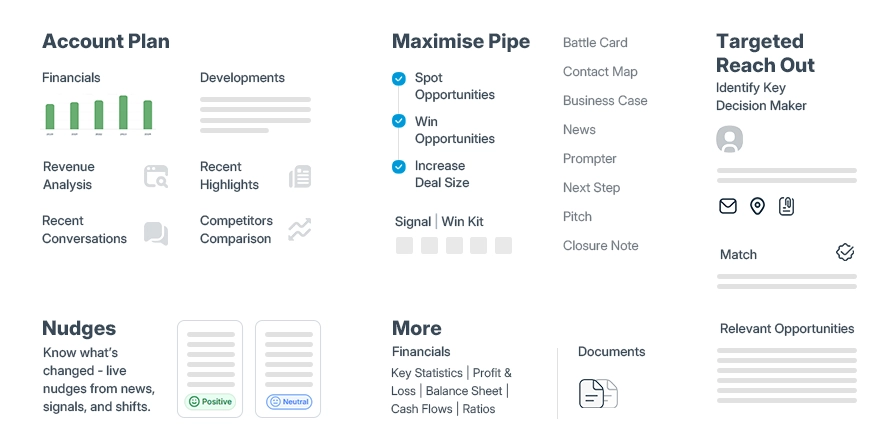
Precise pipeline forecasting has emerged as a critical capability for sales organizations seeking predictable revenue growth. Specialized sales intelligence now offers advanced tools that dramatically improve how teams predict future performance, allocate resources, and close deals with greater certainty.
Modern sales intelligence applications now employ sophisticated predictive analytics to transform historical data into accurate forecasts. Unlike traditional forecasting methods that rely heavily on manual input and basic trends, AI-powered systems analyze hundreds of variables simultaneously to detect subtle patterns that human analysts might miss.
The foundation of effective predictive modeling involves a structured analytics pipeline with several interconnected components:
Data ingestion from diverse sources (CRM systems, surveys, work logs)
Preprocessing to clean missing values and standardize inputs
Feature engineering to select relevant predictors
Model training using algorithms like XGBoost
Continuous evaluation through cross-validation
Cross-validation represents a critical element in the evaluation process. Rather than relying on training error (which can be misleadingly optimistic), effective models use k-fold or randomized cross-validation to test predictions against unseen data. This approach ensures the model generalizes well to future scenarios instead of simply memorizing past patterns.
Organizations implementing AI-powered forecasting report remarkable results—83% of sales teams using AI witnessed revenue growth compared to only 66% without AI. Additionally, these systems provide insights not just about what might happen but also why certain outcomes are likely, helping teams understand which factors most strongly influence success.
Another critical component of modern forecast accuracy is real-time deal health monitoring. Rather than waiting for end-of-period reports, specialized intelligence applications now continuously analyze deal momentum and buyer engagement.
These systems assign each opportunity a live, AI-driven health score by analyzing multiple dimensions:
Engagement patterns across stakeholders
Buyer intent signals from content interaction
Historical trends compared to similar deals
Internal momentum metrics like task completion
The most effective platforms flag early warning signs like sudden stakeholder silence or stalled email replies before they impact forecasts. Moreover, these tools provide visibility into whether deals are trending positively or require intervention—enabling managers to coach their teams on getting at-risk opportunities back on track.
For instance, Agilepitch's system continuously syncs with CRM, email, calendar, and sales tools to pull live engagement data, offering clear breakdowns of what's driving scores up or down. Ultimately, this approach shifts forecasting from optimistic guesses to predictions based on actual buyer behavior.
The final piece of the forecasting puzzle involves connecting sales predictions with quote generation. Configure, Price, Quote (CPQ) tools now integrate directly with sales intelligence platforms to ensure consistency between what's quoted and what's forecasted.
Oracle CPQ, for example, ensures that sales forecasts remain reliable by basing them on real-world quotes rather than hypothetical opportunities. This integration creates a feedback loop where quote data flows back into sales intelligence, allowing teams to analyze closing patterns and improve future predictions.
Furthermore, advanced systems now enable revenue outcome configuration based on custom quotes. For instance, revVana enhances CPQ capabilities by offering dynamic, customizable schedules that prorate revenue to the day and update frequently as deal terms change. This level of precision enables more accurate and granular forecasting.
The CPQ-intelligence integration delivers several key benefits:
Automated forecasting for every deal in the pipeline
Reduction in manual forecasting processes
More precise and detailed topline revenue projections
Better financial planning and resource allocation
When properly implemented, this specialized intelligence application ensures that quotes contain correct pricing, configurations, and discount approvals—eliminating costly change orders while improving forecast reliability.
STOP CHASING PROSPECTS
START CLOSING DEALS!!
In today's hyper-competitive market, tracking competitors' moves has become a cornerstone of effective sales strategies. Specialized sales intelligence applications now offer robust competitive monitoring capabilities that provide organizations with actionable insights to outmaneuver rivals and capture market share.
Competitor price monitoring transforms pricing from guesswork into strategic advantage through systematic tracking and analysis of competitive pricing data. In fact, this process goes beyond manually checking websites—it's now a technology-driven discipline providing real-time intelligence across your entire competitive landscape.
Modern competitive intelligence platforms use automated data collection systems that continuously:
Scan competitor websites, marketplaces, and retail channels to capture current pricing information
Monitor promotional activities, stock availability, and bundling strategies
Organize data into actionable insights enabling teams to understand pricing trends
This systematic approach yields measurable results across key business areas. Organizations implementing effective competitor monitoring report improved margin protection, better customer alignment, and faster response to market shifts. Indeed, sales teams can justify maintaining higher prices when competitive advantages support them, while avoiding destructive price wars that erode brand value.
First and foremost, quality competitive pricing data enables teams to identify pricing gaps, optimize promotions, monitor market trends, and enhance decision-making. Nevertheless, this requires reliable data collection methods and accurate product matching to compare exact, equivalent, and similar products across the competitive landscape.
Leadership transitions at competitor companies signal far more than personnel changes—they often indicate pending strategic shifts, potential acquisitions, or major restructuring efforts. By monitoring executive movements, sales teams can anticipate competitive moves and adapt their strategies accordingly.
When competitors experience leadership changes, they typically enter a period of strategic uncertainty. During this window, forward-thinking sales teams can capture clients and gain market share before competitors recalibrate their approach. For instance, new CEOs frequently reevaluate vendor relationships, creating perfect opportunities to introduce alternative solutions.
Besides executive changes, funding rounds provide critical competitive intelligence. New investments typically precede periods of expansion, product development, or market repositioning. Sales intelligence platforms now automatically track these financial events through SEC filings, press releases, and industry newsletters to provide early warning of potential competitive threats.
Deep analysis of competitor product adoption offers invaluable insights for sales teams seeking differentiation. Through competitive product intelligence, businesses can evaluate competitors' features, pricing strategies, user experiences, and technological implementations.
Success comes from differentiation rather than imitation. Simply replicating competitor features proves ineffective; true competitive advantage emerges from understanding user needs and delivering unique value. In this context, sales intelligence applications help identify where competitors excel and where they fall short.
Through continuous monitoring of social media, online reviews, and customer forums, sales intelligence platforms can track sentiment around competitor offerings and identify emerging trends. This insight allows sales teams to highlight competitive weaknesses during sales conversations while positioning their solutions as superior alternatives addressing specific pain points.
Above all, effective competitive product intelligence requires structured, ongoing analysis rather than sporadic monitoring. The competitive landscape constantly shifts, and maintaining a strong market position demands continuous evaluation and adaptation to changing customer expectations.
STOP GUESSING YOUR PIPELINE
START GROWING IT WITH AI SALES!!
Industry-specific sales intelligence has become essential as markets require increasingly tailored approaches. Unlike general-purpose solutions, vertical-specific intelligence applications address the unique challenges and requirements of particular sectors, enabling sales teams to navigate specialized landscapes with precision.
The healthcare industry faces strict regulatory oversight, making compliance a top priority for sales teams. Regulatory compliance in healthcare directly impacts patient safety, quality standards, and fraud prevention. Sales intelligence applications in this sector now incorporate specialized tracking capabilities for critical regulations including:
HIPAA for patient privacy protection
EHR requirements and the HITECH Act
CMS rules for billing and coding practices
FDA guidelines for clinical research
Healthcare compliance tracking software has emerged as a critical tool, automating monitoring processes that were previously manual and error-prone. First and foremost, these specialized applications provide real-time alerts about regulatory changes, allowing sales teams to position their solutions as compliance enablers.
Modern healthcare compliance platforms include built-in security features to protect sensitive information while facilitating appropriate data access and sharing. Essentially, sales intelligence in healthcare must demonstrate how proposed solutions align with compliance requirements—a crucial selling point when targeting this strictly regulated market.
Financial services sales intelligence focuses heavily on risk assessment and relationship management. An investment risk profile (IRP) represents a cornerstone element of financial advisory services, evaluating three key dimensions: risk need, risk-taking ability, and behavioral loss tolerance.
A well-constructed risk profile enables financial advisors to tailor investment strategies to client goals and risk appetites. Subsequently, sales intelligence applications designed for financial services must accommodate these specialized needs by providing accurate risk profiling tools and relationship insights.
At this point, modern financial sales intelligence goes beyond basic contact information. Current platforms analyze an individual's debt-to-income ratio, credit score, and payment history to assess their capacity to take on new debt. For corporate clients, systems evaluate internal and external threats that might affect stability or profitability.
Relationship mapping has become particularly valuable in financial services. These specialized tools visualize connections between stakeholders, showing influence patterns and communication channels—critical for complex financial sales processes involving multiple decision-makers.
Technographic data—information about a company's technology ecosystem—forms the foundation of tech-focused sales intelligence. This includes details about hardware, operating systems, software applications, and even technology adoption timelines.
Tech sector intelligence goes deeper than merely identifying which software a prospect uses. It uncovers hardware preferences, industry-specific tools, social media presence, and adoption of emerging technologies like AI and blockchain.
Sales teams leverage technographic data for targeted prospecting by identifying companies using similar or competing tools, creating precise outreach strategies. Understanding a prospect's technology stack also reveals potential integration opportunities and competitive displacement strategies.
Effective technographic analysis helps technology sales teams:
Segment prospects with similar needs for personalized messaging
Understand specific problems prospects face based on their current tools
Prioritize leads more likely to need particular solutions
Shorten sales cycles by engaging prospects at optimal times
These vertical-specific applications demonstrate how specialized sales intelligence has evolved to address the unique requirements of different industries, moving beyond general-purpose solutions to deliver highly tailored capabilities for specific market segments.
Make Every Rep Speak
Like Your Top 1%
Timing outreach perfectly can make or break sales opportunities. Intent data—intelligence that reveals potential buyers' online research activities—enables sales teams to identify precisely when prospects are most receptive to engagement. Understanding and applying intent intelligence has become a cornerstone of specialized sales intelligence applications in 2025.
Intent data provides critical insights into prospect interests through digital breadcrumbs left during their research journey. First of all, it's essential to understand the two primary types of intent data available to sales teams.
First-party intent data comes directly from your owned digital properties. This includes website visits, content downloads, form submissions, and product usage patterns. First-party data offers superior accuracy and reliability since it comes directly from interactions with your brand. Although this data is highly valuable, it's limited to prospects who have already discovered your company—missing early-stage researchers who haven't yet engaged with your content.
Third-party intent data, conversely, comes from external sources like publisher networks, review sites, and online forums. This intelligence reveals research activities across the broader internet, identifying accounts showing interest in relevant topics before they visit your website. Third-party intent data creates a baseline of normal content consumption for companies, allowing the system to detect when interest in a specific topic spikes above normal levels.
| Intent Type | Strengths | Limitations | Best For |
| First-party | High accuracy, directly actionable | Limited to known contacts | Lead scoring, personalized follow-up |
| Third-party | Wide coverage, early-stage detection | Lower precision, account-level only | Discovering in-market accounts, competitive plays |
Combining both types delivers the most comprehensive view of buyer intent. As a result, 90% of organizations now use intent data to prioritize accounts, provide clear direction to sales teams, and identify new leads.
Modern sales intelligence platforms now automatically score different engagement signals based on their correlation with purchase readiness. Not only does this help prioritize leads, but it also provides context for personalization.
The most effective scoring models assign point values to different behaviors based on their importance and relevance to your business. Higher values go to actions strongly indicating purchase intent (pricing page visits, demo requests), while lower values are assigned to general educational content consumption.
Clearly, different behaviors carry different weights:
Pricing page views: 25 points
Requested demo: 30 points
Third-party surge on relevant topics: 20 points
Downloaded implementation guide: 10 points
Notably, negative scoring has become equally important—identifying actions that suggest disinterest or disqualification. This prevents unqualified leads from receiving artificially high scores.
Despite its effectiveness, intent scoring data has a limited shelf-life. Information from six months ago typically lacks relevance as prospects may have already solved their problems or decision-makers might have changed roles.
Sales intelligence applications now use AI to map intent signals to specific buying stages, enabling precisely timed outreach aligned with prospect readiness.
Different signals correlate strongly with particular buying stages:
Awareness stage: Topic surges on general educational content (e.g., "what is PLG?")
Consideration stage: Product page visits, comparison guides, review site activities
Decision stage: Pricing page visits, competitor research, demo requests
Hence, sales teams can determine not just who to contact but when and how to approach them. Research shows sales representatives are seven times more likely to have meaningful conversations with decision-makers when they reach out within an hour of detecting relevant buying signals.
AI sales assistants now synthesize thousands of data points in seconds to prioritize accounts and deliver tailored recommendations based on intent signals. Although this technology continues evolving, companies implementing intent-driven prioritization report 2.5x increases in conversion rates and 20%+ reductions in time-to-close.
Intent data transforms outreach from cold calling into strategic engagement with prospects actively researching solutions like yours—at precisely the moment they're most receptive to hearing from you.
Effective sales enablement tools integrated with intelligence platforms dramatically boost sales performance by delivering the right resources at the right moment. Sales teams with AI-powered enablement tools experience 179% quota attainment from new representatives, transforming how sellers engage prospects throughout the buying journey.
AI now curates content based on specific buyer personas, replacing generic approaches with tailored recommendations. Modern platforms analyze buyer behavior, engagement patterns, and historical interactions to suggest the most relevant materials for each prospect type. This persona-specific approach results in higher engagement and conversions by addressing unique needs and interests of different buyer types.
Current systems go beyond basic segmentation. They examine:
Digital engagement metrics across channels
Content consumption patterns
Industry-specific challenges and objectives
Role-based priorities and concerns
Therefore, instead of requiring sellers to search through content libraries, AI presents precisely what's needed based on the buyer's profile and position in the sales funnel. This capability proves particularly valuable during critical moments, as 83% of sales teams using AI report increased revenue growth.
Account activity now automatically activates appropriate sales playbooks, guiding representatives through optimal next steps. When prospects visit pricing pages or engage with specific content, intelligence platforms can trigger personalized outreach sequences or alert sellers to reach out with helpful resources.
Specifically, these triggers include high-value moments such as:
Website visits to pricing or product pages
Content engagement with case studies
Executive changes or funding rounds
Trial user activation reaching key milestones
In fact, mapping plays to specific buyer journey moments has become essential for effective selling. Sales playbooks now incorporate real customer data, creating repeatable success patterns rather than relying on theoretical approaches.
Conversation intelligence tools transform call data into actionable coaching insights. These platforms analyze calls to identify missed opportunities, track talk-to-listen ratios, and evaluate objection handling effectiveness. Thereafter, the system converts these observations into structured coaching workflows, allowing managers to scale feedback across entire teams.
Ultimately, this technology identifies what top performers do differently, enabling organizations to replicate successful approaches. By capturing winning talk tracks and objection handling techniques, sales leaders turn instinct into repeatable strategy. The impact? Organizations report a 62% increase in win rates through applying these conversation intelligence insights.
STOP GUESSING YOUR PIPELINE
START GROWING IT WITH AI SALES!!
Data-driven territory planning transforms how sales teams allocate resources and set targets in 2025. Specialized sales intelligence applications now provide the analytical foundation for fair territory design and realistic quota setting, replacing traditional spreadsheet-based planning with precision mapping.
Advanced territory mapping tools visualize sales data across geographic regions, clearly showing where opportunities cluster and how accounts distribute across territories. Initially, businesses managed territories using simple geographic boundaries like zip codes or drive time.
In contrast, today's intelligent mapping software links critical account data to the mapping process, allowing sales teams to:
Design territories based on multiple factors beyond geography, including account size and market potential
Balance workloads across territories for equitable opportunity distribution
Identify untapped markets through demographic and firmographic overlays
Organizations implementing optimized territory design report sales increases of 2-7% without any change in total resources or sales strategy. To clarify, this improvement comes solely through better territory alignment, as optimal designs can improve seller productivity by 10-20%.
Effective quota planning relies on analyzing historical performance patterns within territories. In essence, sales intelligence platforms examine past conversion rates to create realistic targets that stretch teams without discouraging them.
Certainly, territory imbalances can sabotage quota attainment before the sales year begins. For instance, an enterprise rep with 50 target accounts shouldn't carry identical quotas as colleagues managing 200 mid-market opportunities.
AI-powered planning tools analyze variables like:
Pipeline metrics revealing sales velocity and conversion patterns
Seasonal trends showing quarterly performance variations
Territory-specific factors affecting sales potential
As an illustration, if historical data shows Q1 typically generates 15% of annual revenue while Q4 generates 35%, quotas should reflect this reality rather than being divided equally.
Throughout this article, we've examined how specialized sales intelligence applications are transforming sales operations across multiple dimensions. These powerful tools now serve as the central nervous system for high-performing sales teams, enabling them to work smarter rather than harder.
Sales intelligence has certainly evolved beyond basic contact databases. Modern platforms combine AI-driven analytics, real-time alerts, and custom insights that address specific sales challenges across industries. The data speaks for itself—teams using these specialized applications consistently achieve higher conversion rates, shorter sales cycles, and increased revenue.
Account-based selling now benefits from precise targeting through firmographic and technographic filters, while trigger event tracking ensures perfectly timed outreach. Additionally, multi-threading insights help sales professionals navigate complex buying committees with strategic precision.
Sales forecasting has likewise transformed through predictive modeling, real-time deal health scoring, and CPQ integration. These capabilities eliminate guesswork, replacing optimistic projections with data-backed predictions that help organizations plan resources effectively.
Competitive intelligence applications have become equally essential, offering detailed insights into competitor pricing, executive changes, and product trends. This intelligence allows teams to position their solutions strategically against alternatives.
Vertical-specific applications address unique industry needs—from healthcare compliance tracking to financial risk profiling and technology stack analysis. Therefore, sales teams can speak the language of their prospects and address industry-specific pain points.
Intent data has fundamentally changed how teams time their outreach, identifying exactly when prospects are actively researching solutions. First-party and third-party signals combine with behavioral scoring to pinpoint perfect engagement moments.
Sales enablement integration now delivers contextual resources precisely when needed. AI-powered content recommendations, triggered playbooks, and conversation intelligence transform how representatives prepare for and conduct sales conversations.
Finally, territory and resource planning applications ensure fair workload distribution and realistic quota setting through geo-based opportunity mapping and historical performance analysis.
The future belongs to sales teams that embrace these specialized intelligence applications. Organizations that implement them thoughtfully will undoubtedly outperform competitors still relying on outdated approaches. Your next step? Evaluate which specialized applications align with your specific sales challenges and integrate them into your workflow. The results will speak for themselves.
Your SDRs work 9–5
AI Sales works 24/7!!
Modern sales intelligence platforms integrate data from multiple sources, use AI for lead scoring and prioritization, and provide real-time alerts for buying signals. These functions help sales teams work more efficiently and effectively by focusing on high-potential opportunities.
Account-based selling is enhanced through firmographic and technographic filters for precise targeting, trigger event tracking for timely outreach, and multi-threading insights for effective stakeholder mapping. These capabilities enable sales teams to engage high-value accounts more strategically.
AI significantly improves sales forecasting by using predictive modeling on historical pipeline data, providing real-time deal health scoring, and integrating with CPQ tools for quote accuracy. This results in more precise predictions and better resource allocation.
Sales intelligence platforms assist in competitive intelligence by monitoring competitor pricing and positioning, tracking executive changes and funding rounds, and analyzing product adoption trends. This information helps sales teams differentiate their offerings and respond to market shifts.
Intent data helps sales teams identify when prospects are most receptive to engagement by analyzing first-party and third-party intent signals, scoring behavioral content engagement, and using AI to predict buying stages. This enables more targeted and timely outreach, increasing the likelihood of meaningful conversations with decision-makers.


Category: Uncategorized Tags: ai, AIOps, Artificial Intelligence, cloud, cloud platform, Cybersecurity, Information and Communications Technology , VR