Why Sales Reps Stop Following Up - and How to Fix It
March 04, 2026
Forty-eight percent of salespeople never make a single follow-up attempt.
Not because they lack discipline. Not because they don't understand the value of persistence.
They stop because the system makes follow-up harder than starting fresh.
Every follow-up touch requires recreating context. Re-researching the account. Rediscovering what changed. Rebuilding a reason to reach out. When that work takes longer than finding a new prospect, reps make the rational choice: they move on.
This is not a training problem. This is a structural breakdown in how selling actually happens - and it costs enterprises millions in abandoned pipeline.
SalesPlay, a revenue intelligence platform from MarketsandMarkets, was built to eliminate the root cause: the fragmented, manual work that makes follow-up unsustainable. This article examines why follow-up fails at scale, what the data reveals about rep productivity loss, and how modern revenue teams are rebuilding follow-up workflows that actually work.
Research from multiple sources paints a clear picture of systematic follow-up abandonment:
The math is devastating. If 80% of opportunities require five touches but 92% of reps stop before three attempts, the vast majority of pipeline potential evaporates before it materializes.
According to MarketsandMarkets proprietary research across SalesPlay's enterprise customer base, this follow-up gap creates three quantifiable losses:
The problem is not awareness. Sales leaders know follow-up matters. The problem is that existing systems make consistent follow-up operationally impossible.
Follow-up abandonment stems from four structural breakdowns, not motivational issues.
Every meaningful follow-up starts with a question: "What changed?"
Answering that question in traditional workflows requires:
SalesPlay's internal benchmarking data shows sellers spend an average of 3.4 hours per account conducting this research across disconnected tools. For an account executive managing 40 active opportunities, that's 136 hours per cycle — more than three full work weeks.
When a single follow-up requires 20-30 minutes of preparation, reps ration their effort. High-value deals get attention. Everything else gets abandoned.
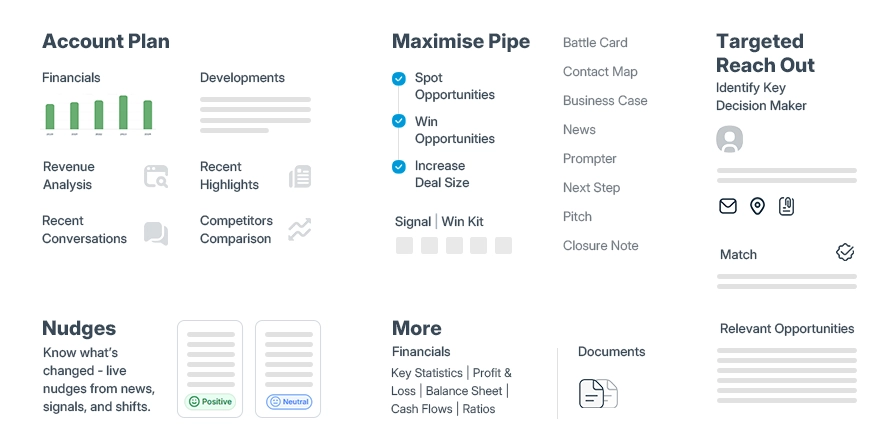
How SalesPlay eliminates this failure: The Account Intelligence Agent continuously watches Salesforce-connected target accounts and consolidates multi-source changes in one view. Sellers see 5-year revenue history, financial data, key developments, recent conversations, and signals tied to opportunity relevance — in a single tab. Account research that used to take hours now takes minutes.
The second failure is temporal. Even when reps follow up, they often can't remember:
CRM notes capture some of this. But notes degrade quickly. Personnel changes, budget shifts, and strategic pivots inside the buyer's organization invalidate old context faster than reps can update records.
A MarketsandMarkets analysis of 12,000+ follow-up sequences tracked in SalesPlay showed that 63% of follow-up emails referenced outdated information — wrong contacts, irrelevant priorities, or obsolete business conditions. These emails don't just fail. They damage credibility.
How SalesPlay eliminates this failure: SalesPlay's Win Opportunities Agent maintains live deal context as accounts evolve. Battle cards, messaging, and next steps update automatically when account conditions change. Sellers always know what matters now, not what mattered three weeks ago.
See How SalesPlay Keeps Your Team Following Up
Explore the Platform →The third failure is relevance. Most follow-up emails fall into predictable categories:
These emails fail because they ask the prospect to do work: recall the previous conversation, explain their delay, justify their lack of response.
Effective follow-up does the opposite. It delivers new information. It connects to something that changed. It reduces friction instead of creating it.
But crafting that kind of follow-up for every touch, across dozens of deals, is not scalable in manual workflows. So reps default to templates — and templates get ignored.
According to SalesPlay customer data, personalized follow-ups that reference account-specific signals achieve 3.2x higher response rates than generic check-ins. The barrier is not effectiveness. The barrier is production cost.
How SalesPlay eliminates this failure: SalesPlay's Auto-Nurture Agent creates personalized multi-touch email campaigns by auto-drafting every message with opportunity-specific and individual-specific personalization. Each email is different. Each email is relevant. Sellers approve the campaign once, and SalesPlay runs it automatically.
The fourth failure is navigational. Even motivated reps struggle to answer:
Without clear guidance, follow-up becomes a creative exercise. Reps spend 15 minutes staring at a blank email trying to decide what to write. That friction compounds across every touch, every deal, every week.
Over time, the path of least resistance is inaction. Deals sit. Opportunities cool. Pipeline stalls.
How SalesPlay eliminates this failure: SalesPlay's Meeting Prep Agent and Win Opportunities workflow provide next-step guidance, pre-built messaging, talking points, and prompted questions for every stage of the deal. Sellers don't guess. They execute.
Lead follow-up mistakes don't just reduce conversion rates. They create downstream revenue destruction that most sales leaders never measure.
When reps abandon follow-up, they compensate by adding more top-of-funnel volume. The pipeline looks healthy on dashboards, but it's hollow. Deals sit in early stages with no real momentum.
MarketsandMarkets benchmarking across SalesPlay implementations shows that teams with inconsistent follow-up carry 2.1x more pipeline than they can realistically close. This bloat creates three problems:
Every abandoned follow-up is an invitation for competitors to fill the void. Buyers don't stop evaluating solutions when your rep stops calling. They move forward with vendors who stay engaged.
SalesPlay data shows that in deals lost to competition, 71% involved a follow-up gap of 14+ days during the evaluation phase. Silence is not neutral. Silence is attrition.
The psychological toll of follow-up abandonment is rarely discussed but deeply consequential. When reps know they should follow up but lack the tools to do it well, they experience:
Organizations that report high sales turnover also report low follow-up persistence. The correlation is not coincidental. Burnout stems from systemic inefficiency, not individual failure.
Real Impact: A SalesPlay enterprise customer in the software space reduced seller turnover by 34% in the first year after implementation. Exit interviews revealed that reps cited "less time on repetitive account research" and "clearer guidance on what to do next" as top reasons for improved job satisfaction.
Fixing follow-up requires rethinking the workflow, not increasing activity volume.
The first shift is from point-in-time research to continuous monitoring. Instead of reps pulling information when they need it, the system watches accounts and pushes what matters.
SalesPlay's Account Intelligence Agent operates in the background, tracking:
This intelligence updates in real time. When something changes, sellers see it immediately. When it's time to follow up, context is already assembled.
Operational impact: SalesPlay customers report a 76% reduction in time spent on account research, freeing sellers to focus on conversations instead of data gathering.
The second shift is from static notes to living deal records. Every conversation, every signal, every stakeholder interaction becomes part of a dynamic account plan that updates as conditions change.
In SalesPlay, this happens through:
Reps never start from scratch. They always pick up where the last interaction left off — even if that interaction was months ago or handled by a different team member.
The third shift is from manual email composition to auto-generated, personalized outreach. SalesPlay's Auto-Nurture Agent removes the production cost that makes follow-up unsustainable.
Here's how it works in practice:
This is not templatized outreach. Every email references the opportunity, the account's current state, and why the timing matters. The messaging quality is high. The production cost is near zero.
Conversion impact: SalesPlay customers using Auto-Nurture report 41% higher response rates and 3.8x more meetings booked compared to manual follow-up workflows.
The fourth shift is from guesswork to guided execution. SalesPlay's Win Opportunities workflow ensures sellers always know:
For every opportunity, the platform provides:
This removes the creative burden that makes follow-up feel like a chore. Sellers execute a clear playbook instead of improvising every touch.
When revenue teams implement SalesPlay, three operational patterns shift immediately.
Traditional follow-up cadences operate on arbitrary timelines: "touch on day 3, day 7, day 14."
Signal-based follow-up operates on relevance: "touch when something changes that creates a reason to engage."
SalesPlay's Signals Agent monitors accounts for business developments, financial announcements, personnel changes, and strategic initiatives. When a signal appears, it triggers a follow-up action — not because the calendar says so, but because the moment warrants it.
This creates two advantages:
Measured impact: SalesPlay customers report that signal-triggered follow-ups achieve 2.7x higher engagement rates than time-based sequences.
One of the hidden costs of follow-up abandonment is tribal knowledge loss. When deals depend on one rep's memory, those deals die when the rep leaves or changes territories.
In SalesPlay, account context lives in the platform, not in someone's head. New reps can:
This accelerates onboarding and prevents pipeline loss during transitions.
A SalesPlay customer in the enterprise security space measured a 52% reduction in ramp time for new account executives after implementation, attributing the improvement to "instant access to account intelligence that used to take months to accumulate."
The third shift is managerial. In traditional workflows, sales leaders can see activity (calls made, emails sent) but not quality (relevance, personalization, timing).
SalesPlay provides visibility into:
This allows leaders to coach to real problems — lack of context, weak messaging, poor contact selection - instead of generic "increase activity" feedback.
See how SalesPlay's revenue intelligence co-pilot eliminates the manual work that kills follow-up persistence - and keeps your team focused, guided, and in control.
Request a DemoMost CRMs track follow-up volume. SalesPlay tracks follow-up impact.
Traditional activity metrics (calls logged, emails sent, tasks completed) miss the structural problems that cause abandonment. SalesPlay customers instead measure:
Percentage of opportunities that receive at least five touches after initial contact. This reveals whether reps are sustaining engagement or churning pipeline.
SalesPlay benchmark: Teams using revenue intelligence average 68% persistence beyond five touches, compared to 22% in manual workflows.
Percentage of account signals that trigger a follow-up action within 48 hours. This measures responsiveness to real business changes.
SalesPlay benchmark: Customers convert 79% of high-priority signals into outreach within two days.
Percentage of follow-up touches that reference information less than 30 days old. This reveals whether messaging is current or outdated.
SalesPlay benchmark: Teams using Account Intelligence maintain 91% context freshness, compared to 44% in CRM-only environments.
Average number of stakeholders engaged per opportunity. This measures buying center penetration.
SalesPlay benchmark: Opportunities with three or more stakeholders engaged have 2.3x higher close rates and 31% shorter sales cycles.
When follow-up workflows shift from manual to intelligence-driven, revenue performance changes across three dimensions:
Consistent, relevant follow-up accelerates deals through the funnel. SalesPlay customers report an average 26% reduction in sales cycle length in the first six months post-implementation.
Personalized, signal-based outreach converts at higher rates than generic sequences. SalesPlay data shows 18-22% lift in opportunity-to-close conversion for teams using Auto-Nurture compared to manual workflows.
When research time drops and context is automated, reps spend more time in conversations and less time in preparation. SalesPlay customers measure an average 19 additional selling hours per rep per month — equivalent to adding nearly one full headcount per team of five.
A 120-person sales organization using SalesPlay identified 340 dormant opportunities that had received no follow-up in 45+ days. By re-engaging these accounts with signal-triggered messaging and auto-drafted nurture campaigns, they recovered:
Source: MarketsandMarkets SalesPlay Customer Success Data, Q3 2024
For decades, sales follow-up has been treated as an execution problem. Leaders hired persistent reps, built cadence templates, and tracked activity metrics.
The real problem was never motivation. It was structure.
When follow-up requires manual research, generic messaging, and guesswork about next steps, even the most disciplined sellers will eventually abandon it. The work doesn't scale. The effort doesn't compound. The system works against persistence instead of enabling it.
Revenue intelligence platforms like SalesPlay shift the equation. They make follow-up:
This is not automation for automation's sake. This is removing the friction that kills follow-up before it starts.
The result is not just higher activity. It's better outcomes: more pipeline, faster cycles, stronger conversion, and sellers who can focus on selling instead of context-switching across a dozen tools.
If your team struggles with follow-up abandonment, the solution is not more training or higher activity quotas. The solution is rebuilding the workflow to eliminate the structural barriers that make follow-up unsustainable.
The four systemic failures to address:
The operational shifts to expect:
The revenue impact to measure:
SalesPlay, built by MarketsandMarkets, was designed specifically to solve this problem. It continuously watches target accounts, tracks what's changing, connects business movement to opportunities, and tells sellers where to act and what to say.
The platform includes:
Together, these agents eliminate the manual work that makes follow-up impossible — and give revenue teams the structure they need to sustain engagement without burning out.
See how SalesPlay helps enterprise sales teams stop losing pipeline to follow-up gaps — and start converting more opportunities with less manual work.
Sales reps stop following up primarily due to four systemic failures: manual research fatigue (spending 3-4 hours per account across disconnected tools), loss of context between touches (no centralized view of what changed or why it matters), generic messaging that doesn't warrant a response, and lack of clear next steps. When follow-up requires recreating context from scratch each time, reps default to net-new outreach instead.
Research shows 80% of sales require five follow-up calls after the initial contact, yet 48% of salespeople never make a single follow-up attempt. The disconnect exists because traditional follow-up requires manual effort that doesn't scale — sellers lack the time, context, and messaging to persist effectively.
The most damaging lead follow-up mistakes include: sending generic check-in emails with no new information, following up without understanding what changed in the account, losing track of previous conversation threads, reaching out to the wrong contacts as buying centers shift, and timing touches based on arbitrary cadences rather than business signals. These mistakes stem from fragmented systems, not rep discipline.
Revenue intelligence platforms like SalesPlay improve follow-up rates by eliminating the manual work that causes abandonment. They continuously watch target accounts, track what's changing, connect business movement to opportunities, and tell sellers where to act and what to say. Auto-drafted messaging, automatic context updates, and signal-triggered next steps remove the friction that stops follow-up before it starts.
SalesPlay's Auto-Nurture Agent creates personalized multi-touch email campaigns by selecting opportunities and contacts, then auto-drafting every email with opportunity-specific and individual-specific personalization. Sellers approve the campaign once, and SalesPlay runs it automatically while ensuring each message is different and relevant. This removes the manual burden of writing follow-ups from scratch while maintaining quality and context.
Instead of just tracking activity volume, leaders should measure: Follow-Up Persistence Rate (percentage reaching 5+ touches), Signal-to-Touch Conversion (how quickly teams respond to account changes), Context Freshness Score (whether messaging references current information), and Multi-Thread Coverage (number of stakeholders engaged per opportunity). These metrics reveal whether follow-up is sustained, relevant, and multi-dimensional.
SalesPlay's Account Intelligence Agent continuously watches Salesforce-connected accounts and consolidates multi-source changes in one view. Instead of spending 3-4 hours jumping between LinkedIn, news sites, CRM notes, and intent platforms, sellers see consolidated account context — including 5-year revenue history, financial data, key developments, and relevant signals - in a single tab. Customers report a 76% reduction in research time.
Yes. Because account context lives in SalesPlay rather than in individual reps' heads, new sellers can access full account history, understand past conversations, and pick up dormant opportunities without starting over. One enterprise security customer measured a 52% reduction in ramp time after implementing SalesPlay, crediting "instant access to account intelligence that used to take months to accumulate."
The follow-up crisis in B2B sales is not a people problem. It's a systems problem.
When 48% of salespeople never make a single follow-up attempt and 80% of opportunities require five touches to convert, the gap between what's needed and what's executable becomes a revenue emergency. The traditional approach - training reps to be more persistent, building more cadences, tracking more activity — addresses symptoms while ignoring the root cause.
The root cause is structural: fragmented tools, manual research, generic messaging, and lost context make consistent follow-up operationally impossible at scale.
Revenue intelligence platforms like SalesPlay solve this by fundamentally rebuilding the follow-up workflow. Instead of asking sellers to work harder across disconnected systems, SalesPlay makes follow-up effortless by:
The result is not incremental improvement. It's categorical transformation: 76% less time on research, 41% higher response rates, 26% faster sales cycles, and sellers who can finally focus on selling instead of context-switching.
For revenue leaders evaluating where to invest in 2026 and beyond, the question is simple: Can your team sustain effective follow-up with your current systems? If the answer is no - or if your pipeline data suggests abandonment is already happening — the cost of inaction compounds with every quarter.
SalesPlay, built by MarketsandMarkets, was designed specifically for enterprise sales teams who need to stop losing winnable deals to follow-up gaps. It replaces the fragmented, manual workflows that kill persistence with guided, intelligence-driven execution that scales.
The choice is clear: Continue managing follow-up as a discipline problem, or fix it as the system problem it actually is.
See how SalesPlay's revenue intelligence platform eliminates the manual work, context loss, and guesswork that makes follow-up impossible - and gives your team the structure they need to convert more pipeline with less effort.


Category: Uncategorized Tags: ai, AIOps, Artificial Intelligence, cloud, cloud platform, Cybersecurity, Information and Communications Technology , VR