Building Scalable Revenue Intelligence Solutions
September 04, 2025

Revenue intelligence solutions are transforming how companies track and optimize their sales performance. I've seen businesses struggle with fragmented data, inaccurate forecasts, and missed opportunities for far too long. When your sales team is juggling dozens of deals across different stages, it's nearly impossible to get accurate visibility without the right tools.
Actually, implementing a revenue intelligence platform can increase win rates by 15-20% and improve forecast accuracy by up to 30% . However, the challenge isn't just adopting these tools—it's building solutions that can scale as your organization grows. Throughout this article, I'll walk you through the essential components of scalable revenue intelligence, from real-time data integration to AI-driven insights that adapt to your unique sales motion.
Whether you're just starting your revenue intelligence journey or looking to upgrade your current setup, you'll discover practical approaches to architecture, implementation strategies, and how to evaluate the right tools for your specific needs. Let's explore how to build revenue intelligence solutions that don't just work today but scale effectively for tomorrow's challenges!
STOP GUESSING YOUR PIPELINE
START GROWING IT WITH AI SALES!!
The core strength of a successful revenue intelligence solution lies in its ability to expand alongside your business needs while maintaining performance. Scalability isn't just about handling larger data volumes—it's about providing deeper insights as your organization grows. First and foremost, a truly scalable revenue intelligence platform must possess three critical capabilities that work in harmony to elevate your sales operations.
The foundation of any scalable revenue intelligence solution is its ability to collect and process data as it happens. This real-time capability begins with aggregating data from various sources across your revenue tech stack—including CRM systems, marketing automation platforms, and communication tools. This integration forms a robust revenue orchestration platform that consolidates information into a centralized repository.
Advanced revenue intelligence platforms automatically capture sales interactions such as:
Call notes and recordings
Meeting details and attendee information
Email communications and engagement metrics
Calendar activities and scheduling patterns
This automated data capture creates a single, unified, and perpetually up-to-date record of all customer interactions. Additionally, it eliminates the primary inefficiency of traditional CRM systems: manual data entry. By automating this process, revenue intelligence solutions free up valuable selling time while providing more accurate, unbiased data.
Furthermore, real-time dashboards enable continuous performance monitoring, allowing teams to make immediate adjustments as market conditions change. This instant access to performance data facilitates agile responses that would be impossible with periodic reporting cycles.
Beyond data collection, scalable revenue intelligence solutions leverage artificial intelligence to transform raw information into actionable guidance. AI analyzes vast amounts of information to identify patterns, trends, and anomalies that would otherwise remain hidden.
The most sophisticated platforms employ predictive analytics to forecast outcomes based on historical performance and current activities. These AI models provide milestone-based projections for each pipeline stage, giving precise insights into what's likely to happen at every step. Consequently, sales leaders can anticipate outcomes with greater accuracy, set realistic targets, and adjust approaches in real-time.
Notably, AI-powered platforms can process natural language conversations, identify emotional cues, and predict deal outcomes with 89% accuracy—a 34% improvement over previous generation systems. This technology goes beyond simple keyword recognition to understand context, sentiment, and buying signals, enabling sales teams to focus efforts where they matter most.
As pipeline conditions evolve, these AI models continuously learn and improve over time. This perpetual cycle of data ingestion, cleansing, analysis, and enablement ensures that insights remain relevant regardless of how your business grows or changes.
The third pillar of scalability is breaking down organizational silos. Revenue intelligence empowers sales, marketing, and service teams with holistic access to critical data throughout the selling pipeline. This cross-functional visibility creates alignment around consistent, data-driven processes instead of team-level, subjective assumptions.
Shared dashboards and regular communication mechanisms help teams operate from the same source of truth. This transparency helps identify bottlenecks and improvement areas, enabling data-driven decisions aimed toward common goals. In fact, revenue intelligence promotes alignment by providing unified views of data and performance metrics.
Revenue enablement acts as the connective tissue between these teams, ensuring everyone is equipped with the knowledge and tools needed to work together effectively. This collaborative approach allows organizations to create more synergy among customer-facing units by leveraging cross-functional data.
For sales leaders, one of revenue intelligence's greatest values is gaining comprehensive, real-time visibility into pipeline dynamics that traditional CRM systems cannot provide. This "X-ray vision" into which opportunities truly have traction versus those at risk allows for informed decisions about resource allocation and strategic focus.
By combining these three elements—real-time data ingestion, adaptive AI insights, and cross-functional visibility—revenue intelligence solutions can scale alongside your business, providing increasingly valuable intelligence as your organization grows.
Ready to turn your Rep
INTO BEST PERFORMER ?
Behind every effective revenue intelligence solution stands a robust technical architecture. At its core, this architecture consists of three critical components that work together to deliver the scalability and performance modern sales organizations require.
The technical foundation of revenue intelligence platforms revolves around an API-first architecture that exposes every revenue process as a native business API. Unlike traditional app-first designs that confine functionality to user interfaces, API-first approaches enable true headless operations. This architecture is essential since it allows AI agents to take direct action within the platform, going beyond basic analysis to automate workflows and make real-time decisions.
Modern revenue intelligence solutions connect with over 200 different systems, including CRM platforms, marketing automation tools, customer success systems, and external data sources. This integration capacity creates a centralized repository that enhances visibility across every customer interaction.
Throughout this process, the data undergoes cleansing to:
Remove duplicates
Normalize formats
Enrich records with third-party intelligence
Once compiled, the unified dataset becomes the foundation for all subsequent analysis. Essentially, this integration architecture serves as the data backbone, with the revenue intelligence platform acting as a context engine that feeds structured, AI-enriched insights into your CRM and other systems.
Advanced AI and machine learning form the analytical engine of scalable revenue intelligence platforms. These models process this unified data lake, identifying patterns and signals virtually impossible for humans to detect manually.
The sophistication of predictive models continues to advance rapidly. While early systems might consider a dozen variables in their calculations, today's platforms analyze hundreds or even thousands of data points to generate increasingly accurate predictions. This enables machine learning algorithms to evaluate numerous variables simultaneously to generate sophisticated deal scores and risk assessments.
Throughout the evolution of these systems, the predictive capabilities have made significant progress. Current AI engines process natural language conversations, identify emotional cues, and predict deal outcomes with 89% accuracy—a 34% improvement over previous generation systems. These models consider factors ranging from stakeholder engagement patterns to competitive landscape analysis, providing sales teams with actionable intelligence at every stage.
For risk detection specifically, AI/ML solutions offer improved forecasting accuracy by capturing nonlinear effects between scenario variables and risk factors. Financial institutions have particularly benefited from these capabilities in credit scoring, anomaly detection, internal controls, and regulatory compliance.
The third architectural pillar supporting scalable revenue intelligence platforms is cloud-native infrastructure. This approach enables unlimited scalability while maintaining performance and security standards. Cloud-native deployments demonstrate 67% lower total cost of ownership and 45% faster deployment times compared to on-premises implementations.
Elastic scaling in these environments is achieved through automated resource management based on real-time demand. The platform automatically scales resources based on usage patterns, ensuring consistent performance during peak demand periods. This dynamic scaling occurs through several key mechanisms:
First, Horizontal Pod Autoscaler adjusts the number of pod replicas based on metrics like CPU utilization or custom metrics. Second, Cluster Autoscaler dynamically adjusts the size of the underlying node pool to ensure sufficient resources. Finally, serverless functions scale automatically per invocation without manual intervention.
The benefits extend beyond mere scalability. Cloud-native infrastructure offers high availability with built-in redundancy and distributed systems. Services are deployed across multiple availability zones, ensuring automatic and seamless failover. Additionally, containerized frameworks help mitigate outages because services can restart quickly on alternative hosts.
Overall, this architecture represents a fundamental shift in how revenue intelligence platforms operate—moving from monolithic systems to modular, composable, and elastic solutions that can adapt to changing business needs.
Implementing revenue intelligence solutions early offers tangible business benefits that extend far beyond basic sales tracking. Early adopters gain significant advantages through three primary use cases that deliver immediate value while establishing the foundation for future growth.

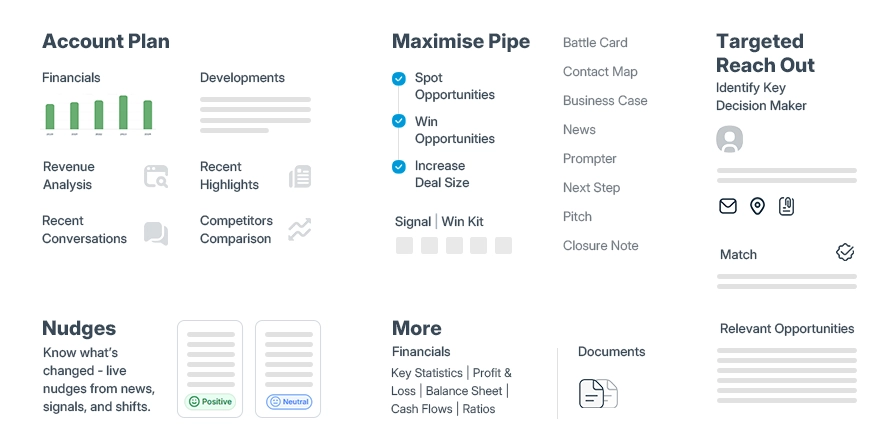
Traditional sales forecasting relies heavily on rep optimism and manually updated CRM stages—often leading to missed predictions. In fact, according to research, 68% of companies miss their forecasts by 11% or more. This persistent inaccuracy undermines organizational planning and resource allocation.
Revenue intelligence platforms transform this process by capturing actual buyer engagement signals rather than relying on subjective assessments. These systems track concrete indicators including:
Website interactions and content downloads
Email engagement metrics (opens, clicks, responses)
Stakeholder additions or changes
Product usage behavior
This shift from subjective to objective assessment creates measurable improvements. AI-powered forecasting connects historical trends with live deal signals to deliver predictions with up to 89% accuracy—a 34% improvement over previous generation systems.
First and foremost, pipeline forecasting becomes more reliable as AI algorithms analyze thousands of data points, calculating the statistical likelihood of each opportunity closing. Sales leaders can therefore triangulate hard numbers, deal context, and AI-backed signals to deliver boardroom-ready forecasts. Moreover, this approach eliminates the approximately 2.5 hours per week that average sales reps waste on forecasting activities.
The second compelling use case involves transforming how organizations coach sales representatives. Traditional coaching faces a fundamental problem—it typically relies on anecdotal feedback or random call sampling. Managers rarely have sufficient time to review enough calls to identify meaningful patterns.
Revenue intelligence addresses this limitation through conversation intelligence that records, transcribes, and analyzes every customer interaction. These platforms identify successful talk tracks, objection handling techniques, and critical behaviors that drive results. Based on this analysis, the systems automatically score conversations against defined criteria like talk ratios, discovery questions, and objection handling.
The impact on performance is substantial. Organizations that provide effective sales coaching see improved quota attainment by up to 7%. Additionally, new reps can learn asynchronously rather than shadowing colleagues on live calls, potentially cutting ramp-up time by 50%.
Through AI-powered coaching, revenue intelligence platforms enable managers to:
Surface coaching moments without reviewing every conversation
Build libraries of best sales practices for team-wide learning
Measure performance improvements against real benchmarks
The third key application centers on deal inspection that transcends traditional pipeline reviews. Rather than simply asking "What stage is the deal in?", revenue intelligence platforms show whether buyers are genuinely engaged.
These systems create visual representations—often called heatmaps—that aggregate activity, content engagement, and buyer intent signals across opportunities. Sales leaders can instantly visualize which deals show momentum and which are stalling based on actual prospect behavior rather than rep updates.
According to studies, one of the most valuable features of revenue intelligence is its ability to detect deals at risk before they become unwinnable. The platforms continuously monitor for warning signs such as stalled opportunities, sending automated notifications that help managers intervene at precisely the right moment.
This approach proves especially valuable given that only 5% of your target audience is typically in-market at any given time. By focusing efforts on prospects showing genuine buying signals, sales teams optimize their resources while maximizing conversion opportunities.
Through these three primary use cases, revenue intelligence justifies early investment by delivering immediate improvements to forecast accuracy, sales effectiveness, and deal visibility—all essential capabilities for organizations pursuing sustainable growth.
STOP CHASING PROSPECTS
START CLOSING DEALS!!
Effective alignment between revenue intelligence and revenue operations drives sustainable business growth. As the foundation for sales, marketing, and customer success collaboration, RevOps transforms isolated efforts into coordinated action that improves efficiency across the entire revenue lifecycle. A properly integrated revenue intelligence solution becomes the engine that powers this alignment, creating visibility that traditional systems cannot provide.
Establishing common metrics forms the critical first step in aligning revenue intelligence with RevOps strategy. When revenue teams operate from different success measures, they naturally compete rather than collaborate. Alternatively, shared KPIs establish a unified language that keeps everyone moving toward the same objectives.
For meaningful alignment, focus on these cross-functional metrics:
Lead Conversion Rate: Measures how effectively marketing-generated leads progress into actual opportunities or customers
Sales Qualification Rate: Evaluates whether marketing is filling the pipeline with qualified prospects
Customer Lifetime Value: Ensures both teams prioritize long-term value over short-term wins
This approach transforms how teams operate. Indeed, rather than playing the blame game when targets are missed, teams with shared KPIs take collective ownership of the entire revenue cycle. Furthermore, these unified metrics foster natural collaboration through joint strategy meetings where data is reviewed together.
Centralized visualization tools eliminate data silos by consolidating financial metrics like sales revenue, profitability margins, and cost analysis into a single interface. This creates a consolidated view that transforms scattered information into a unified reference point accessible to everyone on your team.
For maximum effectiveness, customize dashboards based on role requirements:
For CROs and Sales Leaders: Create "State of the Union" dashboards showing top-level, year-to-date performance against target KPIs, including notable deals and top-performing reps.
For Sales Managers: Implement pipeline dashboards displaying each rep's conversion rates and deal progression alongside team activity metrics.
For RevOps Teams: Develop performance dashboards that drill into closed deals by region, account, or product to identify factors contributing to win rates or slowing conversions.
These unified views streamline reporting processes and eliminate tool bloat. Consequently, teams become more efficient with a unified platform that fully serves their needs. Equally important, this visibility enables better, faster decision-making when issues arise, such as a sudden spike in customer churn.
The third pillar of alignment comes through automation that eliminates repetitive tasks, saving time and reducing human error across sales cycles. Advanced revenue intelligence platforms can detect patterns in customer interactions and automatically trigger appropriate next steps.
Effective workflow automation includes:
Automatic CRM updates: Capture sales activities like emails, meetings, and tasks without manual data entry
Risk detection alerts: Identify stalled opportunities and send notifications for timely intervention
Task assignments: Route high-priority follow-ups to appropriate team members
These capabilities streamline operations and enhance coordination between teams. By connecting sales conversations, pipeline data, and deal stages across tools like Slack, Salesforce, and calendars, these systems transform fragmented activities into repeatable, intelligent processes.
Through these three alignment strategies, revenue intelligence becomes fully integrated with your RevOps framework, creating a cohesive system that drives consistent results and sustainable growth throughout the revenue lifecycle.
Modern revenue intelligence platforms offer key features that extend beyond initial implementation, enabling continuous growth as organizations expand. These capabilities form the backbone of systems designed to evolve with changing business demands.
The daily burden of manual data entry remains one of the greatest productivity killers for sales teams. Revenue intelligence platforms eliminate this obstacle through automated activity capture that records every customer interaction directly in your CRM system. This technology automatically logs:
Emails, meetings, and tasks without rep intervention
Call notes, meeting details, and calendar activities
Contact information from communication threads
Correspondingly, this automation creates significant productivity benefits. First, representatives gain back approximately 2.5 hours weekly previously spent on administrative tasks. Second, the elimination of manual entry ensures consistent and accurate customer records, maintaining data quality regardless of team size. Third, real-time syncing keeps information perpetually current as organizations scale.
Markedly, this functionality serves as the foundation for comprehensive deal tracking. For example, SalesPlay processes over 50 billion data points monthly without performance degradation, supporting everything from startups to Fortune 500 enterprises.
STOP GUESSING YOUR PIPELINE
START GROWING IT WITH AI SALES!!
Albeit powerful, data collection alone isn't enough for long-term scalability. AI capabilities transform raw information into actionable guidance that improves as your dataset grows.
Advanced revenue intelligence systems analyze conversation transcripts to generate concise summaries highlighting key discussion points. These summaries extract critical elements like objections raised, next steps discussed, and required follow-ups—all without requiring representatives to take manual notes.
Henceforth, these insights sync directly to your CRM, ensuring everyone stays aligned without needing to review complete call recordings. For managers, this functionality proves particularly valuable, allowing them to assess deal progress and coaching opportunities efficiently.
AI suggestions extend beyond summarization. The technology identifies buying signals and readiness indicators that might otherwise be missed. Subsequently, the system recommends optimal follow-up strategies based on comprehensive analysis of prospect behavior and communication history. Likewise, it flags risks in the sales pipeline and suggests remedial actions for stalled opportunities.
Organizations implementing these capabilities report 78% improvement in sales team adoption rates compared to traditional reporting interfaces. This direct correlation with improved performance outcomes illustrates the long-term value of AI-powered guidance.
The third pillar supporting scalable revenue intelligence involves customized information delivery based on organizational roles. This approach ensures each team member receives precisely the insights needed for their function—nothing more, nothing less.
Role-specific dashboards eliminate information overload by providing focused views of relevant metrics. For instance, executives might see high-level performance trends, whereas frontline managers access detailed activity metrics for their teams. Forth with, this customization drives faster performance since team members can quickly locate the information they need without wading through irrelevant data.
Team-level insights enable managers to identify patterns across representatives, establishing benchmarks and best practices. Through visualization tools, leaders can easily spot communication patterns, stakeholder engagement levels, and executive alignment within accounts.
Concurrently, proper security protocols protect sensitive information. Best practices include AES-256 encryption for stored data, HTTPS for data in transit, and strict permission controls. These measures ensure that as your organization grows, data remains protected while still accessible to those who need it.
Together, these three feature categories form the foundation of revenue intelligence platforms built for long-term scalability—enabling organizations to grow without sacrificing insight quality or performance.
Selecting the right revenue intelligence platform requires careful evaluation of capabilities, integration potential, and implementation requirements. After reviewing dozens of tools, I've identified key differentiators that determine scalability and organizational fit.
Each platform offers distinct advantages for specific team structures and sales motions:
Gong excels at conversation intelligence and coaching with top-tier call analysis and rep performance tracking. Priced at approximately $1,000+ per user annually, it's geared toward sales-led organizations focusing on coaching and pipeline insights. Nonetheless, some teams report spending $100K+ in their first year without clear ROI.
Clari stands out for enterprise revenue operations with advanced forecast accuracy through machine learning. Its strength lies in predictive pipeline visibility and deal risk scoring. Although powerful, Clari requires substantial RevOps maturity to deploy effectively and isn't tailored for smaller organizations.
Claap positions itself as the modern conversation intelligence platform built for representatives and RevOps teams. With transparent pricing and no platform fees, it offers AI-powered call summaries and superior HubSpot integration. Additionally, it provides an open data ecosystem working with Notion, Slack, and other tools via API.
Avoma targets meeting productivity with AI meeting assistance and conversation intelligence. While less robust in forecasting capabilities, it delivers excellent automation and ease-of-use, making it suitable for lean teams.
Make Every Rep Speak
Like Your Top 1%
The ongoing debate between HubSpot and Salesforce has evolved beyond simply choosing one platform—many companies now leverage both simultaneously. Initially, integration capabilities with your existing tech stack should be a primary selection criterion.
For Salesforce-centric organizations:
Gong offers native Salesforce integration with deal boards
Clari provides tight CRM alignment with robust sales data enrichment
For HubSpot-first teams:
Claap delivers the strongest HubSpot integration with field mapping and automation
Gong's HubSpot integration remains a known weak spot, often requiring manual workarounds
Beyond basic integration, consider how these tools enhance CRM functionality through bi-directional synchronization. The most effective integrations enable customization of record synchronization and seamless communication of key lead information.
Time-to-value (TTV) measures how quickly users realize meaningful benefits from a product after implementation. The average TTV for SaaS companies is 1 day, 12 hours, and 23 minutes, though revenue intelligence platforms often require longer setup periods.
Implementation complexity varies significantly:
Gong's implementation is consultant-heavy and potentially lengthy
Claap offers fast, frictionless setup where most customers onboard themselves without requiring calls
Clari and Avoma fall between these extremes with moderate implementation requirements
Prior to selection, take advantage of free trials or demos to test platform fit. Equally important, read reviews on sites like G2 or Capterra to understand how similar businesses use the tools.
The onboarding experience directly impacts adoption rates and long-term success. Look for platforms that offer interactive walkthroughs to reduce friction and guide users through initial setup. Furthermore, the availability of in-app resource centers for immediate support can prevent users from abandoning the platform during implementation.
Successful deployment of revenue intelligence solutions follows a structured approach centered around proving value before full-scale adoption. Drawing from hundreds of successful implementations, I've found a proven methodology that maximizes ROI while minimizing disruption.
First, establish an AI Council with representatives from sales, marketing, and customer success to govern your implementation. Choose 2-3 pilot teams carefully—look for departments facing specific pain points that revenue intelligence can address. Ideal candidates include high-performing sales teams open to new technologies or struggling teams needing data-driven guidance.
Beyond team selection, define clear, measurable KPIs before implementation begins. For SaaS companies, these might include customer acquisition cost, lifetime value, and recurring revenue metrics. Document baseline performance to establish a clear before-and-after comparison. Set SMART goals (Specific, Measurable, Achievable, Relevant, Time-bound) for your pilot project to provide a clear roadmap.
Training extends past basic tool functionality to practical application of insights during actual buyer interactions. Create comprehensive programs covering both technical operations and strategic usage of the platform. Organizations following structured training achieve 94% completion rates with 87% of participants demonstrating proficiency within 30 days.
Establish transparent feedback mechanisms where field reps and call agents can share updates in real-time. Simple tools like chat apps or shared online files enable continuous learning. This ongoing exchange creates actionable intelligence that empowers teams to make smarter decisions quickly.
Following successful pilot validation, implement a phased approach spanning 9-12 months:
Phase 1 (Weeks 1-4): Audit data quality, fix gaps, prepare experiment pipeline
Phase 2 (Weeks 5-8): Train baseline models, connect systems, implement initial dashboards
Phase 3 (Weeks 9-12): Release 2-3 weekly updates, start team enablement, prepare 12-month scale plan
Organizations completing stakeholder alignment during implementation demonstrate 78% faster time-to-value and 45% higher long-term platform satisfaction compared to implementations without formal alignment activities.
The evolution of revenue intelligence is advancing rapidly as new technologies reshape how sales organizations operate. Looking toward 2025 and beyond, three major innovations will fundamentally change how teams leverage these platforms.
AI-powered sales agents are moving beyond analytics to take independent action across the sales cycle. These autonomous systems can qualify leads, handle objections, and even book meetings for sales representatives. In practice, these agents work around the clock, providing continuous support by responding to inquiries in multiple languages and through preferred channels like SMS or WhatsApp. Salesforce's Agentforce has already processed over 1 million support requests autonomously. Eventually, these agents will function best as part of a hybrid approach—handling repetitive tasks while humans focus on strategic activities that drive revenue.
Future revenue intelligence platforms will deliver insights directly where work happens—not in separate dashboards. Via native integrations, these tools will surface key information within communication platforms like:
Slack threads with deal risk alerts and next steps
Notion pages containing AI-generated call summaries
Email systems providing contextual conversation intelligence
This seamless approach enables teams to receive insights without switching applications. For example, Momentum's platform delivers Slack-native alerts about deal risks, allowing representatives to act immediately on critical information. As a result, this embedded intelligence creates a real-time revenue engine that updates your CRM and drives behavior change automatically across teams.
Personalized coaching will expand from occasional manager reviews to continuous AI-powered feedback. These systems generate detailed coaching recommendations after every customer interaction. Furthermore, role-specific guidance tailored to each representative's position, experience level, and historical performance ensures relevant development. This approach reduces new hire ramp time by up to 40% through immediate, call-specific feedback. Forthcoming innovations will include AI avatars that roleplay as specific buyer personas, complete with industry knowledge and personality characteristics.
Revenue intelligence solutions have transformed from simple reporting tools to sophisticated AI-powered platforms that drive strategic decisions across entire organizations. Throughout this article, we've explored how these systems combine real-time data, predictive analytics, and cross-functional visibility to create a single source of truth for revenue teams.
The scalability factors we've examined—from cloud-native architecture to automated data capture—allow these platforms to grow alongside your business without performance degradation. Therefore, organizations can start with focused use cases like pipeline forecasting or sales coaching before expanding to enterprise-wide implementation.
Notably, the integration between revenue intelligence and RevOps creates alignment that traditional siloed approaches cannot achieve. Shared KPIs, unified dashboards, and automated workflows break down barriers between teams, creating cohesive revenue operations that respond quickly to market changes.
The right platform selection ultimately depends on your specific needs, existing tech stack, and organizational maturity. Each option—whether Gong, Clari, Claap, or Avoma—offers distinct advantages for particular sales motions and team structures. Your selection process should focus on integration capabilities, implementation timelines, and clear ROI metrics.
Looking ahead, autonomous AI agents, embedded insights, and hyper-personalized coaching will soon elevate revenue intelligence from analytical tools to proactive business partners. These innovations will fundamentally change how sales teams operate, shifting focus from manual processes to strategic activities that directly impact revenue growth.
The path to scalable revenue intelligence starts with understanding your current limitations, selecting appropriate tools, and implementing them with clear objectives. Success comes through proving value with pilot teams before rolling out across your organization. This methodical approach ensures adoption, engagement, and measurable business impact.
Revenue intelligence represents more than just another sales tool—it establishes the foundation for data-driven growth that adapts to changing markets and evolving buyer behaviors. Regardless of your organization's size, the principles of scalable revenue intelligence apply universally: gather accurate data, transform it into actionable insights, and deliver those insights exactly when and where they're needed.
STOP GUESSING YOUR PIPELINE
START GROWING IT WITH AI SALES!!
A scalable revenue intelligence solution typically includes real-time data ingestion from various sources, AI-driven insights that adapt to pipeline changes, and cross-functional visibility across sales, marketing, and customer success teams.
Revenue intelligence platforms use AI and machine learning to analyze vast amounts of data, including buyer engagement signals and historical trends, to predict outcomes with up to 89% accuracy. This is a significant improvement over traditional forecasting methods.
Early implementation of revenue intelligence can lead to more accurate pipeline forecasting, improved sales coaching through call pattern analysis, and better deal inspection using engagement heatmaps. These benefits can justify the investment by delivering immediate improvements in forecast accuracy and sales effectiveness.
Revenue intelligence aligns with RevOps by establishing shared KPIs across sales, marketing, and customer success teams, providing unified dashboards for pipeline and forecast health, and implementing automated workflows for deal progression and alerts. This alignment creates a cohesive system that drives consistent results.
Future trends in revenue intelligence include autonomous AI agents for deal follow-ups, embedded insights in communication platforms like Slack and email, and hyper-personalized coaching at scale. These innovations are expected to further enhance the efficiency and effectiveness of sales teams.

Category: Uncategorized Tags: ai, AIOps, Artificial Intelligence, cloud, cloud platform, Cybersecurity, Information and Communications Technology , VR