Choosing the Right Sales Intelligence Platform: Buyer's Guide 2025
September 03, 2025

Did you know that 67% of sales professionals waste over 4 hours weekly on manual research that a sales intelligence platform could automate?
This statistic shocked me too. However, with hundreds of options flooding the market, choosing the right sales intelligence tool feels like finding a needle in a digital haystack. The wrong sales intelligence software can drain your budget while delivering minimal ROI, but the right one transforms prospecting efficiency by 35% or more.
AI in Sales has completely changed the game. Today's top-performing teams leverage intelligence platforms that deliver instant insights about prospects, predict buying signals, and automate tedious research tasks.
Fortunately, I've created this buyer's guide to help you navigate the complex landscape of sales intelligence solutions for 2025. After reviewing dozens of platforms and speaking with sales leaders across industries, I've gathered everything you need to make a confident, informed decision.
Let's explore what features matter most, which platforms deserve your attention, and how to ensure your investment pays off handsomely!
STOP GUESSING YOUR PIPELINE
START GROWING IT WITH AI SALES!!
A sales intelligence platform serves as the digital backbone of modern sales teams, collecting and analyzing data from multiple sources to provide actionable insights throughout the sales process. Unlike traditional research methods, these specialized software solutions automate the gathering of valuable information about prospects, markets, and competitors.
Sales intelligence platforms are software solutions designed to collect, process, and analyze data from numerous external sources to equip sales teams with critical insights. These systems transform raw data into applicable information that optimizes every stage of the sales cycle. The global sales intelligence market reflects its growing importance, with projections showing it will reach USD 3.80 billion by 2025, growing at a Compound Annual Growth Rate (CAGR) of 12.3%.
I've found that effective sales intelligence systems provide value across multiple dimensions:
Data collection and enrichment: Automatically gathering and updating contact and company information
Prospecting assistance: Discovering new, high-intent leads based on specific criteria
Real-time insights: Identifying buying signals and technology usage patterns
Integration capabilities: Syncing directly with existing CRM systems
Automation features: Streamlining outreach and follow-up sequences
Fundamentally, these platforms prepare sales professionals with crucial information before they engage with prospects. Instead of relying solely on internal records, sales intelligence tools gather data from company websites, social media platforms, third-party databases, technographic providers, and intent signal tracking services.
The adoption of AI has dramatically enhanced sales intelligence capabilities. According to the State of Sales Report, 4 in 5 sales teams are either experimenting with or have already implemented AI. This technology efficiently sifts through vast amounts of available data, pulls relevant insights, and creates actionable summaries for sales teams.
Many professionals initially confuse sales intelligence platforms with CRM systems or data enrichment tools. Although related, they serve distinctly different purposes in the sales ecosystem.
A Customer Relationship Management (CRM) system focuses primarily on managing existing customer relationships and tracking deal progress. In contrast, sales intelligence centers on discovering new opportunities and gathering market insights for competitive advantage. CRMs typically rely on manual data entry from your sales team, whereas sales intelligence platforms automatically collect information from multiple external sources.
The key differences extend beyond data collection methods:
Focus and perspective: CRMs look backward at past interactions, while sales intelligence looks forward to identify new opportunities.
Data sources: CRMs manage internal data about known contacts, whereas sales intelligence platforms incorporate external data about potential prospects.
Primary function: CRMs track relationship history, whereas sales intelligence provides dynamic, forward-looking insights.
Additionally, data enrichment represents another related yet distinct concept. Data enrichment is the process of gathering and refining first-party customer data using third-party data providers to increase your database's range and accuracy. Many tools with data enrichment functionality may call themselves sales intelligence platforms or prospecting tools, offering data enrichment as one feature among several.
Rather than competing, these systems work complementarily. The power of sales intelligence lies in its ability to enhance and enrich existing CRM data—acting much like a good editor by filling gaps and correcting inaccurate information. This integration creates a unified workflow where external intelligence continually refreshes your internal customer database.
For sales teams seeking efficiency gains, this distinction matters. Sales intelligence platforms save countless hours of manual research, allowing representatives to focus on building relationships and closing deals rather than hunting for contact information or company details.
Ready to turn your Rep
INTO BEST PERFORMER ?
Organizations implementing advanced revenue intelligence strategies are seeing 32% higher win rates and 28% faster sales cycles compared to traditional approaches. These impressive figures illustrate why selecting the right sales intelligence platform isn't just a technology decision—it's a strategic imperative that directly affects your bottom line.
The data speaks volumes: companies using sales intelligence tools experience an average 23% increase in annual revenue within 12 months of implementation. This substantial growth stems from several measurable improvements:
31% increase in high-value selling activities
34% improvement in reps achieving quota targets
27% reduction in average sales cycle duration
18% increase in average deal size
Furthermore, sales reps typically spend less than a third of their time actually selling, with the remainder consumed by administrative tasks and manual research. Effective sales intelligence platforms address this productivity gap head-on. By automating data collection and analysis, these tools enable representatives to focus on relationship-building and closing deals.
The financial impact extends beyond just closing more deals. Organizations using predictive revenue intelligence see a 41% improvement in forecast accuracy, which translates to better financial planning, resource allocation, and risk mitigation. Consequently, this enhanced forecasting capability supports sustainable growth by uncovering opportunities for expansion and scalability.
Modern sales intelligence platforms also significantly improve lead quality. According to Forrester analysts, companies using B2B sales and marketing intelligence saw 35% more leads in their pipeline—notably, these leads were higher quality, ensuring sales reps could close deals and drive higher revenue.
As we move toward 2025, several key trends are transforming how sales intelligence platforms operate and deliver value:
AI-powered intelligence evolution: The era of gut-driven decisions in sales is over. By 2025, 35% of chief revenue officers will create centralized AI teams to make artificial intelligence a bigger part of sales strategies. Sales intelligence platforms now process natural language conversations, identify emotional cues, and predict deal outcomes with 89% accuracy—a 34% improvement over previous generation systems.
Data-driven decision making: Sales teams are increasingly abandoning intuition in favor of concrete data. McKinsey reports that AI could boost annual sales productivity by up to USD 1.20 trillion, helping teams move faster and work more efficiently. This shift toward analytics-driven sales is reshaping how organizations identify opportunities and allocate resources.
Real-time revenue optimization: One of the most significant trends for 2025 is the move toward dynamic, real-time intelligence. Modern platforms analyze over 400 market variables to recommend optimal pricing strategies for individual deals. This capability has enabled clients to achieve 15% higher average deal values while maintaining healthy win rates.
Hyper-targeting and personalization: According to McKinsey, 71% of customers expect personalization. Sales intelligence tools in 2025 will excel at gathering and analyzing vast amounts of data to identify prospects that precisely fit the ideal customer profile, enabling truly personalized outreach at scale.
Integration and automation: The sales intelligence market is experiencing unprecedented growth, with research indicating a 47% year-over-year increase in platform adoption. This surge isn't merely about technology adoption—it represents a fundamental shift in how organizations approach revenue generation, customer relationship management, and sales forecasting.
Given these trends, the choice of sales intelligence platform in 2025 will directly determine whether your organization merely keeps pace or gains significant competitive advantage through superior insights, productivity, and revenue growth.
When evaluating sales intelligence platforms, certain features separate standard solutions from exceptional ones. Five critical capabilities determine whether your investment will deliver meaningful ROI or become another underutilized tool.

Data quality forms the foundation of any effective sales intelligence platform. Leading platforms verify information across hundreds of sources to ensure accuracy. Specifically, top providers like ZoomInfo boast databases with over 100 million company profiles and more than 220 million professional contacts worldwide. The best platforms achieve data accuracy rates of 95% or higher through triple-verification processes and AI-powered validation.
Phone-verified mobile numbers have become particularly valuable, as they help sales teams connect with up to 87% of their prospect list. Equally important is comprehensive geographic coverage—especially for teams targeting international markets. Cognism, for instance, has earned a reputation for exceptional European data coverage while maintaining strict compliance standards.
Artificial intelligence has fundamentally transformed sales intelligence tools in recent years. Modern platforms leverage AI to extract atomic insights—synthesized, easy-to-consume perspectives from analyzing various information sources and data points.
Effective AI features include:
Predictive lead scoring that analyzes historical data to forecast conversion probability
Opportunity insights that identify expected growth based on emerging signals
Automated research capabilities that eliminate manual data entry
Conversation intelligence that parses entire call transcripts to provide key takeaways and next steps
By 2027, approximately 95% of seller research workflows will begin with AI, compared to less than 20% in 2024. This shift creates substantial productivity gains, as AI can sift through data and assign scores to each prospect, freeing representatives to focus on high-profile customers.
Timely intelligence drastically improves sales effectiveness. Modern platforms track buyer intent signals, technographic changes, funding events, and other trigger events that indicate sales readiness. Indeed, 45% of open opportunities in CRM systems have AI signals telling representatives when to engage.
The most effective systems surface actionable insights as events happen—not after weekly review meetings. Real-time alerts for competitor insights, market trends, and prospect activities help teams respond promptly to opportunities. Essentially, this capability prevents risks from snowballing and creates alignment across sales engagement, RevOps, and customer success teams.
Seamless integration with existing technology stacks is non-negotiable. Top sales intelligence platforms offer bidirectional CRM syncing that instantly pushes updates like opportunity stage changes and call notes into your CRM while pulling data to fuel alerts and analytics.
Native integrations with popular tools like Salesforce, HubSpot, Slack, Zoom, and marketing automation platforms reduce switching costs and ensure adoption. Organizations using these integrated solutions report up to a 30% reduction in sales cycles and a 25% increase in conversion rates.
Specifically, revenue intelligence tools that activate your CRM (rather than just integrating with it) deliver the most value, eliminating repetitive tasks and improving execution across the sales process.
As regulations around data usage intensify, compliance capabilities have become crucial selection criteria. According to a PwC survey, 87% of consumers believe data privacy is a natural human right and expect companies to handle their personal data responsibly.
Effective platforms implement privacy-by-design principles to operate within strict frameworks while maintaining effectiveness. This includes robust consent management, data minimization practices, and transparent data usage policies.
Most importantly, organizations must assess whether platforms achieve compliance with global regulations including GDPR, CCPA, and emerging frameworks in Asia and Latin America. The average cost of a data breach is $4.45 million, making security and compliance investments not just ethical but financially prudent.
STOP CHASING PROSPECTS
START CLOSING DEALS!!
Selecting a sales intelligence platform involves more than comparing feature lists. Smart buyers prioritize criteria that ensure long-term success across their unique sales environment. After testing dozens of platforms, I've identified four critical evaluation factors that determine whether your investment will deliver meaningful results.
Your chosen platform must grow alongside your business without compromising performance or functionality. As your company expands, so will your need for data-driven insights. The best sales intelligence solutions offer flexible infrastructure that handles increasing data volumes while supporting additional users and features.
Consider how the platform accommodates various team structures. ZoomInfo and other enterprise-grade solutions excel with large sales organizations, whereas Apollo.io may better serve SMB teams needing high-volume outbound capabilities. Moreover, evaluate whether the platform can adapt as your sales motion evolves—from outbound to inbound focus or from SMB to enterprise targeting.
Prior to committing, many vendors offer trial periods where you can test the platform's agility in your specific environment. During this assessment, pay special attention to performance under increased user loads and how the system handles your projected data growth.
Even the most powerful software fails if your team abandons it due to complexity. Ensuring quick adoption remains essential for maintaining productivity throughout implementation. The interface should feature intuitive navigation and streamlined workflows that minimize training requirements while maximizing user engagement.
Consider these adoption statistics from G2 user reports:
Apollo.io ranks in the top 10% for ease of use and setup
ZoomInfo ranks in the top 20% for ease of use and setup
HubSpot Sales Hub ranks in the top 20% for ease of use and setup
Most importantly, a sales intelligence tool should work harmoniously with systems you already use. Integrations with your CRM, email platform, and marketing tools prevent duplicate data entry and ensure everyone works with current information.
Implementing new technology inevitably brings challenges. Therefore, proactive customer support should rank high on your priority list when evaluating sales intelligence tools. Understand each vendor's support framework—ideally seeking providers offering 24/7 customer assistance through multiple channels including phone, email, and live chat.
Quality support makes a substantial difference in:
Streamlining the onboarding process
Helping users quickly grasp platform functionalities
Providing personalized guidance for new users
Offering training sessions and detailed guides
Effective training resources are equally crucial. According to the State of Sales Report, 3 in 4 sales reps say their company's enablement programs prepare them to meet their quotas. Look for platforms that offer comprehensive libraries of training materials, including videos, slide decks, and data sheets.
Some vendors like SalesIntel offer in-depth onboarding sessions followed by webinars, live demos, and step-by-step guides covering everything from basic navigation to advanced features. This structured approach ensures your team can quickly leverage the platform's full capabilities.
Budget considerations naturally influence platform selection. Beyond the headline price, understand the complete cost structure to avoid unexpected expenses. Some tools appear affordable initially but quickly become costly due to hidden charges and add-ons.
Transparent pricing models typically indicate vendor integrity. When examining options, note that:
Entry-level platforms start around $588/rep/year
Mid-tier solutions cost approximately $1,188/rep/year
Enterprise platforms like ZoomInfo may run $3,000-5,000/rep/year
Sales intelligence software presents substantial ROI potential through automation of tedious manual research tasks. Look for platforms that help track key performance indicators like connect rates, win rates, and deal cycle length to measure success. Ultimately, the right platform should demonstrate clear value through improved sales productivity, higher quality leads, and shortened sales cycles.
Finally, choose vendors offering flexible pricing plans that allow scaling your subscription as needs evolve. This approach protects your investment while providing the agility to adapt as your organization grows.
STOP GUESSING YOUR PIPELINE
START GROWING IT WITH AI SALES!!
The sales intelligence landscape has evolved dramatically, with certain platforms pulling ahead through innovation and exceptional capabilities. Based on extensive testing and market research, here's my analysis of the most impactful tools for 2025.
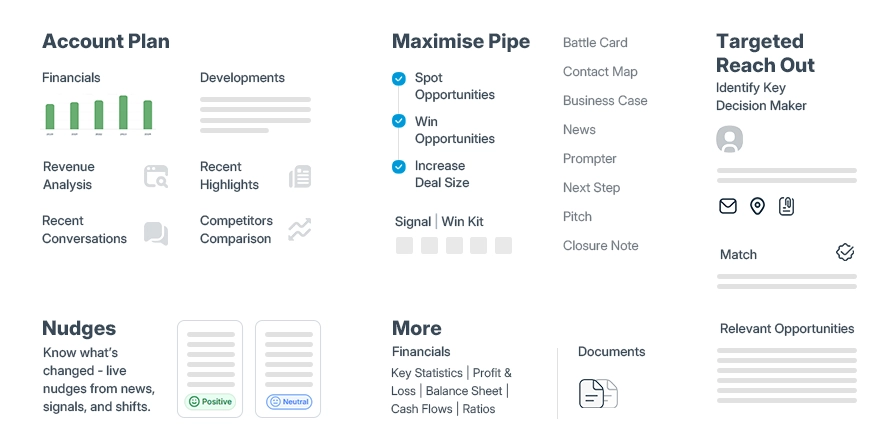
SalesPlay is the world's first AI Sales intelligence platform that transforms sales execution speed and precision through its revolutionary suite of 7 AI Agents. Unlike competitors offering fragmented data, SalesPlay delivers pitch-ready opportunity ecosystems—hyper-personalized sales kits, mapped buying centers, and conversion-ready outreach sequences that eliminate 80% of manual work while consistently closing deals others can't identify.
Built on exclusive MarketsandMarkets intelligence and thousands of premium data sources, and exclusive vendor partnerships, the platform creates a competitive moat that drives 3x productivity gains by enabling every rep to execute with the precision of your organization's elite performers.
ZoomInfo stands as the market leader with the most comprehensive B2B database available. Its platform contains over 300 million verified contacts and 100 million company profiles. What makes ZoomInfo exceptional is its proprietary data collection methodology that combines human verification and AI-powered analysis to deliver industry-leading contact accuracy rates.
The platform excels through its WebSights functionality, which displays all companies visiting your website in real-time along with their corresponding data, including engagement level. This feature, coupled with its intent data capability, enables sales teams to identify companies actively searching for solutions like yours. ZoomInfo's recently introduced Copilot AI assistant further enhances the platform by providing AI-guided sales recommendations about who to contact and when.
Cognism distinguishes itself through its exceptional European market coverage and GDPR compliance. The platform's Diamond Data® feature delivers phone-verified mobile numbers with remarkable accuracy, resulting in connection rates that significantly outperform machine-generated direct dials.
Beyond data, Cognism excels with its advanced Salesforce integration, allowing users to import Salesforce data to Cognism and access search filters specific to their CRM. For teams focused on international markets, particularly in Europe, Cognism provides unmatched accuracy with data that's continuously refreshed to prevent decay.
Apollo.io provides an end-to-end AI sales platform with over 275 million contacts and 73 million companies. What sets Apollo apart is its unified approach - combining prospecting, engagement, and deal management in a single interface.
The platform features 65+ advanced search filters for precise targeting by industry, company size, job title, and more. Additionally, Apollo.io enables customizable sequences for nurturing prospects across multiple channels including emails, calls, and LinkedIn. Its affordability makes it particularly attractive for SMBs and startups looking for a comprehensive solution without enterprise-level pricing.
LinkedIn Sales Navigator leverages the world's largest professional network to help sales teams identify and connect with decision-makers. The platform excels in relationship building by providing detailed insights into shared experiences, leads, and companies.
Navigator's advanced search capabilities include over 40 filters that go beyond free or Premium LinkedIn accounts. Its newest addition, Relationship Explorer, suggests the best path based on target buyer personas - showing up to eight relevant individuals to focus on instead of targeting everyone at an account.
HubSpot Sales Hub combines AI-powered tools with the context needed to build meaningful customer relationships. The platform's greatest strength is its AI agents that work autonomously to accelerate deals.
These agents include a Prospecting Agent that researches leads and crafts personalized outreach, and an AI Meeting Assistant that handles pre- and post-meeting tasks. Furthermore, HubSpot's Breeze Copilot streamlines everything from marketing to sales with prompt-based automation that handles tasks efficiently. These features collectively help sales teams focus on quality over quantity.
Seamless.AI functions as a real-time search engine rather than a static database. The platform crawls through the web in real-time to find, verify, and validate contact information, ensuring data freshness.
Its Chrome extension allows users to gather leads anywhere on the web, most notably LinkedIn. Seamless.AI also features an Autopilot function that automatically generates extensive contact lists based on your criteria, handling large volumes of data instantaneously. The platform integrates with popular CRMs including Salesforce, HubSpot, and Microsoft Dynamics.
Make Every Rep Speak
Like Your Top 1%
Gong.io stands out as a revenue intelligence platform focused on conversation analysis. The system automatically records and transcribes sales conversations across calls, emails, and meetings, then uses AI to extract actionable insights.
Key features include AI-labeled highlights that flag pricing discussions, objections raised, next steps committed, and competitor mentions. Gong also provides deal health scoring based on rep activity and buyer engagement. For sales leaders, the platform offers data-driven coaching by revealing what top performers do differently.
Jeeva AI represents the cutting edge of agentic AI that automates the entire top-of-funnel process. Unlike tools that merely suggest actions, Jeeva actually performs the work, allowing reps to focus exclusively on closing deals.
The platform works nonstop to find decision-makers showing buying intent by scanning the open web and pulling from 100+ real-time sources. Jeeva then automatically verifies contacts and syncs them directly to your CRM. Perhaps most impressively, its agentic AI handles personalized outreach through emails, DMs, calls, and chats - following up until meetings are booked.
Selecting the perfect sales intelligence platform requires matching the tool's capabilities to your specific sales model. Different team structures demand different intelligence solutions to maximize effectiveness.
Outbound sales teams actively seek prospects through cold calling, email outreach, and direct messages. These teams benefit from sales intelligence tools that emphasize prospecting capabilities. Outbound teams require platforms with extensive contact databases, automated outreach sequencing, and precise targeting filters.
Conversely, inbound sales teams respond to prospects who initiate contact through your website, content marketing, or referrals. For these teams, intelligence platforms that excel at lead scoring, intent data, and buyer engagement tracking deliver greater value. Inbound-focused tools should integrate with content marketing efforts and provide real-time alerts when qualified leads engage with your materials.
A key question to consider: How complex are your products or services? Straightforward offerings often succeed with inbound approaches, subsequently requiring tools that nurture existing interest. Complex solutions typically demand outbound strategies with intelligence platforms that support detailed prospect research and personalization.
Field sales representatives meet prospects face-to-face, necessitating mobile-friendly intelligence tools. These outside sales reps manage fewer accounts but pursue larger deals, accordingly benefiting from platforms that deliver in-depth company research and competitive intelligence accessible on mobile devices.
Inside sales teams work remotely via phone and digital channels, handling higher volumes of smaller transactions. Their effectiveness depends on sales intelligence software offering automated dialing, email tracking, and conversation intelligence. Since inside reps can make 4x more contacts at half the cost of field reps, their tools must support rapid qualification and prioritization.
Small and mid-sized businesses need cost-effective platforms that deliver immediate value without complex implementations. SMBs benefit from sales intelligence tools providing fewer, clearer signals tied to genuine buyer behavior rather than overwhelming data volumes.
Enterprise organizations primarily need scalable platforms with advanced compliance features, deep integration capabilities, and sophisticated team management. These larger companies can leverage comprehensive platforms that connect marketing, sales, and customer success data for unified intelligence.
For companies with limited resources, beware of enterprise-grade platforms that promise automation but create operational burdens. The ideal SMB tool surfaces actionable insights without requiring technical expertise or continuous adjustments.
Proper implementation determines whether your sales intelligence platform delivers exceptional ROI or becomes an expensive, underutilized tool. I've discovered that following a structured approach significantly increases adoption rates and accelerates time-to-value.
Starting with a controlled pilot program helps mitigate risks while ensuring a smooth transition. Before full-scale deployment, test your chosen platform with a small team and gather continuous feedback. This 30-day testing period typically follows this timeline:
Week 1: Define clear success metrics and configure targeting parameters
Week 2: Enable the platform during all live meetings and interactions
Week 3: Analyze patterns that correlate with progress
Week 4: Codify effective approaches as team defaults
Organizations running structured pilots report adoption rates exceeding 85% within the first 90 days, versus industry averages of 60-65%.
Base your ideal customer profile on existing CRM data including customer behavior, sales processes, and market research. A data-driven approach helps identify your most successful customers by examining revenue, customer lifetime value, and retention rates.
After establishing your ICP, build scoring logic that weights intent signals and firmographic fit to automatically route high-quality leads. This approach focuses your sales efforts on prospects most likely to convert.
Creating cheat sheets for interpreting intent data and reviewing them during weekly stand-ups builds confidence in the new system. Sales leaders should become familiar with the tool first, subsequently running comprehensive training programs for managers and representatives.
A feedback loop helps identify areas for improvement within the AI model, allowing teams to fine-tune it for better integration.
Map A/B/C lead buckets to multichannel playbooks that streamline outreach. Effective AI in Sales implementation automates repetitive tasks like data collection and prospect research, letting representatives focus on relationship-building.
Naturally, measuring improvement through metrics like connect rates, time-to-qualified, and forecast accuracy helps validate your investment.
Successful implementation of a sales intelligence platform requires careful measurement of specific performance indicators. After investing in such technology, tracking the right metrics ensures you're getting maximum value.
The most powerful evidence of sales intelligence success comes from improved win rates. Teams using AI features in their sales processes report win rates increasing by 50%. Meanwhile, organizations using sales enablement technologies experience a 49% win rate on forecasted deals compared to 42.5% for companies without such tools.
Connect rates offer another vital metric—with proper implementation, sales development representatives can increase meetings booked from 12 to 18 per month. Companies using AI weekly report 80% higher win rates overall.
The average B2B sales cycle stretches to 83 days, yet sales intelligence helps compress this timeline dramatically. After implementation, organizations typically reduce deal cycles from 48 to 34 days. Of teams leveraging AI weekly, 81% report shorter deal cycles.
Sales representatives spend merely 25% of their time actually selling. A well-implemented sales intelligence tool cuts research time from 4 hours to just 1 hour weekly. Beyond time savings, 73% of teams using AI regularly see increases in average deal size-proving that quality, not just efficiency, improves with proper sales intelligence.
STOP GUESSING YOUR PIPELINE
START GROWING IT WITH AI SALES!!
Sales intelligence platforms have become essential tools for modern sales teams seeking to maximize efficiency and results. Throughout this guide, I've shown how these systems go beyond traditional CRM capabilities by automating research, identifying high-value prospects, and delivering actionable insights in real-time.
Choosing the right platform certainly makes a significant difference to your bottom line. Teams using advanced intelligence tools experience 32% higher win rates and 28% faster sales cycles compared to those relying on conventional methods. Additionally, the right platform can transform your sales operations through AI-powered predictions, data-driven decision making, and hyper-targeted prospecting.
When selecting a platform, focus primarily on data accuracy, AI capabilities, real-time insights, seamless integrations, and compliance features. These elements will determine whether your investment delivers meaningful ROI or becomes another underutilized tool. Therefore, evaluate each platform based on scalability, ease of use, support resources, and pricing transparency.
The market offers excellent options for various needs - ZoomInfo for enterprise-grade data coverage, Cognism for European markets, Apollo.io for end-to-end capabilities, LinkedIn Sales Navigator for relationship building, HubSpot for integrated marketing and sales, Seamless.AI for real-time data, Gong.io for conversation intelligence, and Jeeva AI for autonomous prospecting.
After choosing your platform, success depends on thoughtful implementation. A structured 30-day pilot, clear ICP definition, thorough team training, and workflow automation will significantly increase adoption rates and accelerate time-to-value. Ultimately, measure your success through improved connect rates, shortened sales cycles, and enhanced rep productivity.
As we progress through 2025 and beyond, sales intelligence will continue evolving with even more sophisticated AI capabilities. Teams that adopt these platforms now will undoubtedly gain competitive advantages through better data, sharper insights, and more efficient processes. The question isn't whether you need sales intelligence—it's which platform will best power your specific sales strategy toward unprecedented growth.
A sales intelligence platform is a software solution that collects and analyzes data from multiple sources to provide actionable insights for sales teams. Unlike CRMs which focus on managing existing customer relationships, sales intelligence platforms help discover new opportunities and gather market insights for competitive advantage.
AI enhances sales intelligence by efficiently analyzing vast amounts of data, providing predictive lead scoring, identifying buying signals, and automating research tasks. This allows sales teams to focus on high-value activities and make data-driven decisions, potentially increasing win rates by up to 50%.
When evaluating sales intelligence platforms, focus on data accuracy and coverage, AI and predictive capabilities, real-time insights and alerts, seamless CRM integrations, and robust compliance and data privacy features. These elements are crucial for maximizing the platform's effectiveness and ROI.
Consider your sales strategy (outbound vs. inbound, field vs. inside sales) and company size (SMB vs. enterprise). Evaluate platforms based on scalability, ease of use, support resources, and pricing transparency. Run a 30-day pilot to test the platform's fit with your specific needs before full implementation.
Track key performance indicators such as connect rates, win rates, deal cycle length, and rep productivity improvements. Successful implementations typically result in higher win rates, shorter sales cycles, and increased average deal sizes. Monitor these metrics to ensure you're getting maximum value from your investment.
Your SDRs work 9–5
AI Sales works 24/7!!

Category: Uncategorized Tags: ai, AIOps, Artificial Intelligence, cloud, cloud platform, Cybersecurity, Information and Communications Technology , VR