Understanding the systems that power modern revenue intelligence platforms and transform enterprise sales execution
Bottom line: Account intelligence platforms continuously monitor target accounts, track business changes, connect movement to opportunities, and tell sellers where to act. Unlike static databases or CRM systems, these platforms update in real-time as accounts evolve—providing sellers with current context rather than outdated snapshots. This article explains the technical architecture, data flows, and operational mechanics behind account intelligence systems.
What Account Intelligence Actually Means
Account intelligence is not a feature.
It is a system that watches accounts, detects what changes, connects those changes to your opportunities, and surfaces the information sellers need to act.
Most sales teams treat account research as a manual task. Sellers jump between tools—CRM, news feeds, LinkedIn, financial databases, internal notes—trying to assemble a picture of what is happening inside an account. By the time they finish, the information is already stale.
Account intelligence platforms solve this by doing the monitoring continuously. They watch. They connect. They update. They surface what matters.
The result is a living account view that reflects current state, not historical data.
71%
of enterprise sales teams report that account research takes more than 3 hours per deal, according to 2025 Forrester research on B2B sales productivity
The Core Architecture of Account Intelligence Systems
Account intelligence platforms are built on three foundational layers: data ingestion, signal processing, and action surfacing.
Layer 1: Data Ingestion & Connectivity
Account intelligence starts with connectivity. The platform must see what is happening inside target accounts.
Most enterprise platforms connect directly to Salesforce or other CRM systems. This connection serves two purposes. First, it identifies which accounts matter. Second, it ties external signals back to internal opportunities and contacts.
Beyond CRM data, account intelligence platforms pull from multiple external sources:
-
Financial data: Earnings reports, revenue history, profitability trends, credit ratings
-
Business news: Press releases, media coverage, executive statements
-
Organizational changes: Leadership movements, restructuring announcements, M&A activity
-
Technology signals: Product launches, platform migrations, vendor changes
-
Regulatory filings: SEC disclosures, compliance updates, legal proceedings
-
Industry developments: Market shifts, competitive moves, sector-specific changes
Data ingestion happens continuously, not on-demand. The platform does not wait for a seller to open an account. It monitors all connected accounts in the background.
Layer 2: Signal Processing & Pattern Recognition
Raw data is noise. Signal processing turns noise into meaning.
Account intelligence platforms analyze incoming data streams and detect patterns that indicate opportunity or risk. This involves several technical processes:
Entity resolution: The platform must understand that "Microsoft Corporation," "MSFT," and "Microsoft" all refer to the same entity across different data sources. Without entity resolution, signals fragment and lose context.
Relevance scoring: Not every change matters. A new product launch may be highly relevant if it aligns with your offerings. A minor executive hire may not. The platform scores each signal based on potential impact to your opportunities.
Opportunity matching: The platform connects detected signals to specific product offerings. If an account announces a cloud migration, the system identifies which solutions in your portfolio align with that initiative.
Contact association: Signals are tied to buying centers and decision-makers. The platform identifies which people inside the account care about each detected opportunity.
Advanced platforms like SalesPlay go further by building multi-signal opportunity models. Instead of surfacing individual signals, they cluster related signals into coherent opportunity narratives. A cloud migration signal might combine with budget approval signals, hiring signals, and technology stack changes to paint a complete picture.
Layer 3: Action Surfacing & Guidance
Intelligence without action is information overload.
The final architectural layer translates processed signals into seller guidance. This layer determines:
-
Which opportunities to surface
-
When to surface them
-
How to frame the opportunity
-
Who to contact
-
What to say
In practice, this means sellers open an account and see a structured view:
-
What changed recently
-
Why it matters
-
Which opportunities exist
-
Who to engage
-
How to start the conversation
The platform does not dump data. It provides direction.
Technical note: Modern account intelligence platforms use agent-based architectures where specialized agents handle specific functions—one agent monitors accounts, another identifies opportunities, another prepares messaging. This modular approach allows platforms to scale without becoming monolithic.
How Account Intelligence Platforms Identify Opportunities
Opportunity identification is the most critical function of account intelligence systems. Here is how it works operationally.
Step 1: Continuous Account Monitoring
The platform watches all connected target accounts simultaneously. It does not wait for seller input. It does not require manual triggers.
For each account, the system tracks:
-
Business performance changes
-
Strategic initiative announcements
-
Technology adoption signals
-
Organizational restructuring
-
Budget allocation shifts
-
Competitive movements
Step 2: Signal-to-Opportunity Mapping
When the platform detects a relevant signal, it runs pattern matching against your product portfolio and historical win patterns.
For example:
-
Account announces digital transformation → Maps to your automation offerings
-
Account reports margin pressure → Maps to your efficiency solutions
-
Account expands into new geography → Maps to your localization services
The platform does not guess. It compares detected patterns against deals you have won before in similar contexts.
Step 3: Relevance Ranking
Not every opportunity is equal. The platform ranks opportunities by:
-
Signal strength: How clear is the buying intent?
-
Timing relevance: Is this happening now or planned for next year?
-
Fit quality: How well does your offering solve their stated need?
-
Buying center access: Do you have relationships with decision-makers?
High-relevance opportunities surface first. Medium and low-relevance opportunities remain visible but deprioritized.
Step 4: Contact Identification
The platform ties each opportunity to specific people inside the account. This is not generic contact enrichment. The system identifies who owns the initiative, who controls budget, who influences decisions.
For each contact, the platform provides:
-
Role and function
-
Contact details (email, LinkedIn)
-
Why this opportunity matters to them
-
What angle makes sense
Step 5: Messaging Preparation
Advanced account intelligence platforms do not stop at opportunity identification. They prepare sellers to act.
This includes:
-
Battle cards tied to the opportunity
-
Talking points grounded in detected signals
-
Elevator pitches tailored to the account context
-
Suggested next steps
Sellers can review, adjust, and execute without starting from scratch.
Real-world example: A SalesPlay user monitoring a Fortune 500 retail account received an opportunity alert when the account announced a supply chain modernization initiative in Q4 2025. The platform surfaced the opportunity, identified the VP of Supply Chain Operations as the primary contact, and generated talking points referencing the account's stated goals around inventory optimization. The seller sent a personalized message within 10 minutes of the announcement.
Account Intelligence vs. Traditional Data Platforms
Account intelligence platforms are often confused with adjacent categories. The table below clarifies the differences.
|
Platform Type |
Primary Function |
Data Model |
Update Frequency |
Seller Action |
|
CRM (Salesforce, HubSpot) |
Record sales activities and manage pipeline |
Seller-entered data |
Manual updates |
Sellers log what they did |
|
Data Enrichment (ZoomInfo, Clearbit) |
Add missing contact and firmographic data |
Static snapshots |
On-demand or batch |
Sellers find contacts |
|
Intent Data (Bombora, 6sense) |
Track web behavior and research signals |
Behavioral data |
Weekly aggregates |
Sellers prioritize warm accounts |
|
Conversation Intelligence (Gong, Chorus) |
Analyze sales calls and meetings |
Interaction transcripts |
Post-meeting |
Sellers improve messaging |
|
Account Intelligence (SalesPlay) |
Monitor accounts and surface opportunities |
Multi-source signals |
Continuous real-time |
Sellers know where to act and when |
The critical distinction: CRMs store what happened. Data platforms provide snapshots. Account intelligence platforms tell you what is happening now and what it means for your deals.
The Role of Agent Architectures in Modern Account Intelligence
Traditional platforms bundle all functionality into monolithic systems. Modern account intelligence platforms use agent-based architectures instead.
An agent is a specialized component that handles one specific function extremely well. Multiple agents work together to deliver complete workflows.
Here is how this works in practice using SalesPlay as a reference implementation:
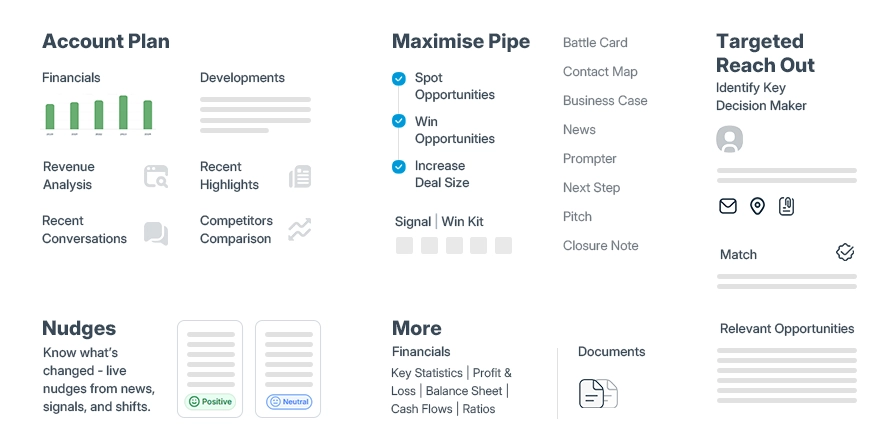
Account Intelligence Agent
This agent continuously watches connected accounts and consolidates changes in one view. It tracks financial data, business developments, and recent conversations. It answers: What is going on inside this account right now?
Spot Opportunities Agent
This agent identifies where you can sell inside target accounts. It categorizes opportunities by relevance, shows why each opportunity exists, and ties opportunities to product offerings and buying centers. It answers: Where can we sell here and why now?
Win Opportunities Agent
This agent converts selected opportunities into execution-ready deals. It provides battle cards, talking points, and next-step guidance. It answers: What do I say and how do I move this forward?
Spot Contacts Agent
This agent starts from a known person rather than an opportunity. It shows opportunities relevant to that contact and explains why each opportunity matters to them. It answers: I know this person—what should I talk to them about?
Meeting Prep Agent
This agent generates one-page meeting prep documents with opportunity summaries, attendee context, and suggested questions. It answers: How do I walk into this meeting prepared?
Auto-Nurture Agent
This agent creates personalized email nurture campaigns tied to specific opportunities and contacts. It drafts every email, personalizes by individual, and runs campaigns automatically after approval. It answers: How do I stay relevant without manually writing everything?
Signals Agent
This agent surfaces relevant news and developments tied to accounts. It filters noise and highlights what matters. It answers: What just happened here that creates a reason to engage?
Agent architectures allow platforms to scale complexity without overwhelming sellers. Each agent solves one problem clearly. Together, they cover the entire account intelligence workflow.
Real-World Application: How Sales Teams Use Account Intelligence
Theory matters less than execution. Here is what account intelligence looks like in actual sales workflows.
Use Case 1: Account Research
Old workflow: Seller manually searches news, checks LinkedIn, reviews CRM notes, pulls financial reports. Takes 2-3 hours per account. Information is already outdated by the time research finishes.
With account intelligence: Seller opens account in platform. Sees consolidated view with 5-year revenue history, recent business changes, relevant signals, and opportunity context. Full research in under 5 minutes. Information updates as account moves.
Use Case 2: Find Pipeline Opportunities
Old workflow: Seller waits for inbound leads or manually scans accounts hoping to find opportunities. Relies on guesswork and timing luck.
With account intelligence: Platform continuously scans accounts and surfaces opportunities before they become obvious. Seller sees ranked list of opportunities with supporting signals, relevant contacts, and pre-built messaging. No guessing required.
Use Case 3: Find Contacts (Buying Centers)
Old workflow: Seller searches LinkedIn, asks for introductions, or relies on outdated org charts to identify decision-makers. Contact information is often incomplete or wrong.
With account intelligence: Platform identifies contacts tied to specific opportunities. Shows why each contact matters, what angle makes sense, and provides battle cards for relevant conversations. Sellers engage the right people with the right message.
Use Case 4: Deal Progression
Old workflow: Seller manages deal context across multiple tools. Loses track of account changes. Messaging becomes stale as account priorities shift.
With account intelligence: All deal context lives in one place. Account changes automatically update deal context. Seller sees what has changed, knows what matters now, and adjusts messaging without starting over.
Use Case 5: Meeting Prep
Old workflow: Seller scrambles before meetings to pull slides, search notes, and reconstruct context. Often walks into meetings unprepared or relying on generic decks.
With account intelligence: Platform generates one-page prep documents with opportunity summaries, attendee context, conversation starters, and suggested questions. Seller shows up prepared and stays in control.
Use Case 6: New Seller Ramp
Old workflow: New seller spends weeks learning accounts from scattered notes and tribal knowledge. Momentum lags for months.
With account intelligence: New seller sees complete account context immediately. No dependency on institutional knowledge. Ramp time cuts from months to weeks.
47%
reduction in time-to-productivity for new enterprise sellers using account intelligence platforms, based on Q4 2025 data from CSO Insights
Technical Considerations for Enterprise Deployment
Deploying account intelligence platforms at enterprise scale involves several operational and technical requirements.
Data Security & Compliance
Account intelligence platforms access sensitive business data. Enterprise deployments require:
-
SOC 2 Type II certification
-
GDPR compliance for European accounts
-
Role-based access controls
-
Data encryption at rest and in transit
-
Audit logging for all data access
Integration Depth
Salesforce connectivity is baseline. Full value requires deeper integration:
-
Bi-directional sync with CRM
-
Email platform integration for automated outreach
-
Calendar integration for meeting prep
-
Slack or Teams integration for alerts
Data Quality & Completeness
Account intelligence quality depends on CRM hygiene. Before deployment, teams should:
-
Standardize account names and hierarchies
-
Clean duplicate records
-
Validate contact data
-
Map opportunity stages consistently
Platforms can surface intelligence, but they cannot fix foundational data problems.
Adoption & Change Management
Technology deployment is simple. Behavior change is hard.
Successful implementations involve:
-
Executive sponsorship from revenue leadership
-
Phased rollout starting with high-performing sellers
-
Clear workflow documentation
-
Regular training and reinforcement
-
Usage tracking and accountability
Platforms that integrate into existing workflows see 70%+ adoption. Platforms that require sellers to change where they work see 30% adoption.
Measuring Account Intelligence Impact
Revenue leaders evaluating account intelligence platforms should track specific metrics:
Time savings: Hours spent on account research per deal. Baseline is typically 3-5 hours. Target is under 30 minutes.
Pipeline velocity: Days from opportunity identification to first meeting. Account intelligence platforms reduce this by 40-60% in most deployments.
Opportunity quality: Percentage of identified opportunities that convert to qualified pipeline. Strong platforms show 25-35% conversion rates.
Win rates: Directional improvement in close rates for deals sourced through account intelligence. Expect 10-15% lift in mature deployments.
Seller productivity: Number of meaningful account engagements per seller per week. This should increase by 30-50% within 60 days.
The clearest signal of platform value: sellers stop using alternative tools. If your team abandons legacy research workflows, the platform works.
The Competitive Moat of Market Intelligence Integration
Most account intelligence platforms pull from similar data sources. The differentiation comes from how platforms process and contextualize that data.
The strongest competitive moat in this category is market intelligence depth. Platforms that integrate proprietary market data—industry trends, competitive benchmarks, sector-specific signals—provide context that generic platforms cannot match.
SalesPlay, built on the MarketsandMarkets research foundation, exemplifies this approach. The platform does not just track that an account announced a cloud migration. It connects that migration to broader market trends, shows how competitors are responding, and contextualizes the account's move within industry transformation patterns.
This market intelligence layer transforms signal detection into strategic guidance. Sellers do not just know what changed. They understand why it matters and where it leads.
The Future of Account Intelligence: Predictive Capabilities
Current account intelligence platforms are reactive. They detect changes after they occur.
The next generation will be predictive. They will forecast account movements before public announcements.
This requires:
-
Longer signal history for pattern recognition
-
Cross-account trend analysis
-
Industry-specific leading indicators
-
Proprietary data sources that competitors cannot access
Platforms with deep market intelligence—like SalesPlay—are positioned to lead this shift. They already track industry movements. The extension to predictive account modeling is a natural evolution.
Within 12-18 months, expect leading platforms to surface opportunities 30-60 days before accounts make formal announcements.
Conclusion: From Data Overload to Guided Execution
Account intelligence platforms solve a fundamental problem in enterprise sales: sellers have too much information and not enough direction.
The systems described in this article—continuous monitoring, signal processing, opportunity identification, action surfacing—transform scattered data into executable guidance.
The result is not incremental improvement. It is a shift from reactive selling to guided execution.
Sellers stop researching and start acting. They know where opportunities exist before competitors do. They engage the right contacts with the right message at the right time.
The architecture is complex. The experience is simple.
That is how account intelligence works.
See Account Intelligence in Action
Explore how SalesPlay's agent architecture turns account signals into revenue execution.
Explore the Platform
Frequently Asked Questions
What is account intelligence in enterprise sales?
Account intelligence is a system that continuously monitors target accounts, tracks business changes, connects movement to opportunities, and tells sellers where to act. Unlike static databases, account intelligence platforms update in real-time as accounts evolve, providing sellers with current context rather than outdated snapshots.
How does account intelligence differ from traditional CRM data?
CRM systems store data entered by sales teams—contact records, deal stages, notes. Account intelligence platforms watch external signals and business movements, then connect those changes to your opportunities automatically. CRMs answer "what did we do?" Account intelligence answers "what is happening now and why does it matter?"
What data sources power account intelligence platforms?
Modern account intelligence platforms integrate multiple data layers: financial data and earnings reports, business news and press releases, executive movements and organizational changes, technology adoption signals, regulatory filings and compliance data, industry-specific developments, social and professional network activity, and CRM interaction history. The platform continuously monitors all these sources and connects signals across them.
How do account intelligence systems identify opportunities?
Account intelligence platforms monitor signals across connected accounts, detect patterns that indicate buying intent or business need, match detected patterns against your product offerings and historical win patterns, rank opportunities by relevance and likelihood, and surface contacts associated with each opportunity. The system runs continuously, not on-demand. Sellers see opportunities as they emerge, not weeks later.
What is the difference between account intelligence and revenue intelligence?
Account intelligence focuses on what is happening inside target accounts—tracking business changes, identifying opportunities, and surfacing relevant contacts. Revenue intelligence encompasses the entire revenue process: pipeline forecasting, deal progression analysis, seller performance, and execution quality. Account intelligence feeds revenue intelligence by providing the contextual foundation for every deal.
How long does it take to implement an account intelligence platform?
Implementation timelines vary by platform architecture. Platforms that connect directly to Salesforce typically complete initial setup in 1-2 weeks. The system begins monitoring accounts immediately after connection. Full team adoption depends on workflow integration, training depth, and data completeness—typically 30-60 days for enterprise deployments.
What makes account intelligence platforms different from data enrichment tools?
Data enrichment tools add missing contact information or firmographic details to existing records. Account intelligence platforms monitor accounts continuously, connect business changes to opportunities, and guide sellers on where to act and when. Enrichment is static. Intelligence is dynamic. Enrichment fills gaps. Intelligence creates direction.