How Sales Teams Personalize Nurture Without Manual Effort
February 03, 2026
Every sales team talks about personalization.
Very few can do it consistently.
It's not because reps don't care. Most do. They understand that buyers expect relevance, context, and timing. They know generic follow-ups don't work anymore. The issue is that manual personalization collapses the moment scale enters the picture.
Once reps manage dozens of accounts, personalization becomes fragile. Signals get buried. Follow-ups are delayed. Context lives in too many places. By the time a rep figures out what's happening, the buyer has already moved on. Learn more about detecting buyer intent signals in real-time ?
That's why modern revenue teams are changing how nurture works. Instead of asking reps to manually track behavior, interpret intent, and decide next steps, they're building systems where personalization happens automatically — quietly, consistently, and at the right moment.
At SalesPlay, this is a pattern we see across high-performing teams. The best ones don't send more messages. They send fewer, better-timed, more relevant ones — without asking reps to do more work.
Manual nurture doesn't fail dramatically. It fails gradually.
A follow-up goes out a day late.
A meaningful signal goes unnoticed.
A message sounds right — but arrives too early or too late.
None of this feels catastrophic in isolation. But over time, it compounds.
Traditional nurture relies heavily on human memory and discipline. Reps are expected to remember where every account stands, notice subtle changes, and respond appropriately. That expectation might work with five accounts. It doesn't work with fifty.
The cost of this gradual failure is measurable. According to recent sales effectiveness studies, sales reps spend an average of 21% of their day writing emails, yet only 8.8% of those emails receive responses. The problem isn't volume—it's context. When reps lack real-time signal awareness, they're essentially guessing at relevance.
Buyers, meanwhile, are moving faster than ever. They research independently. They engage anonymously. They shift priorities mid-quarter. They don't announce when they're ready — they signal it.
Sales teams that personalize nurture without manual effort aren't cutting corners. They're acknowledging a simple truth: speed and relevance beat effort every time.
Personalization today isn't about clever subject lines or inserting a company name into an email.
It's about context.
Why is this account active right now?
What changed since the last meaningful interaction?
Which signal matters more than the rest?
Good personalization answers those questions automatically. Great personalization makes them obvious before a rep even asks.
Consider two approaches:
Generic approach: "Hi [Name], wanted to follow up on our last conversation about [Product]. Do you have time for a quick call?"
Signal-driven approach: "Hi Sarah, noticed your team recently expanded your engineering department by 40% and you've been reviewing our API documentation. This often indicates teams preparing for integration—happy to walk through what that typically looks like for companies at your stage."
The difference isn't effort. It's awareness.
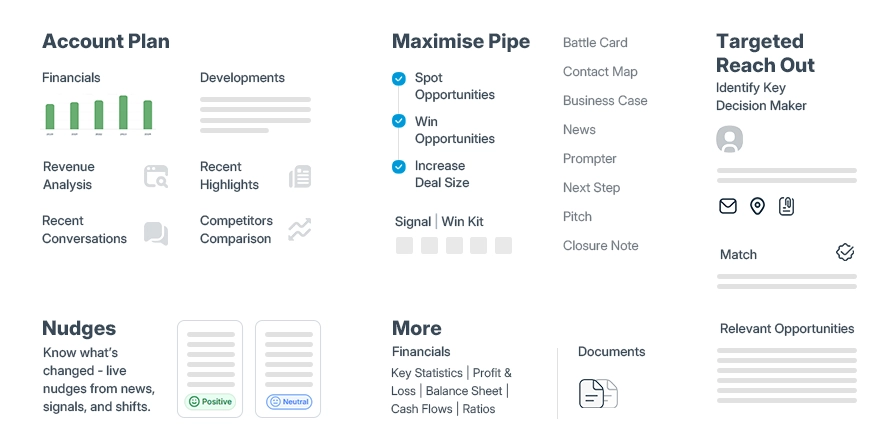
This is where SalesPlay changes the equation. Instead of forcing reps to piece together context from CRM notes, dashboards, and alerts, SalesPlay connects the dots across engagement, account movement, and buying signals.
Reps don't have to "hunt" for insight. They start every interaction already informed.
Some of the strongest buying signals don't come from conversations.
They come from behavior.
Repeated visits to specific solution pages
Increased engagement after long periods of silence
Content consumption that suddenly becomes more focused
These patterns are easy to miss when tracked manually. They're also easy to misinterpret without context. See how revenue intelligence platforms decode buyer behavior ?
SalesPlay continuously monitors these behaviors and highlights when something meaningful changes. Nurture adapts automatically, without waiting for a rep to notice a spike in activity days later.
Behavior alone tells you that something is happening. Context tells you why.
A funding announcement.
A new leadership hire.
A shift in market focus.
These moments often explain sudden engagement. Discover how to leverage firmographic signals for better targeting? When systems connect behavioral and business signals, personalization becomes more accurate and less speculative.
This is how SalesPlay helps teams avoid guesswork. Reps don't just see activity — they see the story behind it.
Not all signals carry equal weight. High-performing teams focus on what drives real action.
Tier 1 Signals (Immediate Action Required):
Tier 2 Signals (Monitor Closely):
Tier 3 Signals (Track but Don't Chase):
SalesPlay automatically categorizes these signals, so reps focus energy where it matters most. Instead of treating all activity equally, the system highlights what deserves immediate attention versus what should simply be tracked.
High-performing reps often struggle the most with scale.
They care deeply about quality. They want to do the right thing. But as volume increases, the mental load becomes unsustainable. Important details slip through the cracks, not because reps aren't capable, but because humans aren't designed to track hundreds of micro-signals at once.
When sales teams personalize nurture without manual effort, they aren't replacing skill. They're protecting it.
Automation handles monitoring and prioritization. Humans handle judgment, nuance, and conversation.
That division of labor is what makes personalization sustainable.
Sales automation often gets a bad reputation — and honestly, it's earned. Many tools automate activity without understanding context, resulting in spammy outreach and disconnected messaging.
SalesPlay works differently.
Instead of automating messages, it automates awareness.
It detects meaningful changes in account behavior
It prioritizes accounts based on real signals, not static scores
It surfaces context directly inside existing workflows
Reps remain in control of the conversation. They simply start from a stronger position.
This is how sales teams personalize nurture without manual effort while keeping interactions human.
The most successful SalesPlay implementations follow a clear timeline that minimizes disruption while maximizing adoption:
Week 1-2: Foundation
Connect data sources and establish baseline signal tracking. Teams typically integrate their CRM, marketing automation platform, and website analytics during this phase. No changes to daily workflows yet.
Week 3-4: Configuration
Configure nurture triggers based on your buyer journey stages. This is where sales and marketing leadership define which signals matter most for your specific sales motion.
Week 5+: Refinement
Refine based on what reps report as most valuable. The system learns which signals lead to real conversations, and prioritization improves over time.
Teams don't need to overhaul existing processes. SalesPlay layers intelligence onto workflows already in place, which is why adoption rates remain high even months after implementation. See how SalesPlay integrates with Salesforce, HubSpot, and other platforms ?
A well-written message sent too late is still irrelevant.
SalesPlay-driven nurture reacts to buyer timing, not internal schedules. When interest increases, the system highlights the moment immediately. Reps don't wait for weekly reviews or CRM reminders. Read our guide to mastering sales cadence and timing ?
This shift alone dramatically improves response quality. Messages land when buyers are actively thinking about the problem you solve, not when your cadence says it's "day 7."
Not all engagement means the same thing.
Early-stage buyers want clarity and education. Late-stage buyers want reassurance and specificity. Treating them the same is one of the fastest ways to lose trust.
SalesPlay helps teams align nurture with where the buyer actually is — not where the sales process says they should be. Explore content mapping strategies for each buying stage ? Content, messaging, and follow-ups adjust automatically as signals evolve.
When a buyer moves from educational content to pricing research, the system recognizes the shift and adjusts recommendations accordingly. Reps don't need to guess whether someone is ready for a demo or still gathering information.
SalesPlay doesn't replace your CRM. It makes it usable.
CRMs are excellent at storing data. They're less effective at explaining what matters right now. SalesPlay sits above that data, interpreting change and surfacing priority.
Instead of forcing reps to live inside dashboards, SalesPlay delivers insight where decisions are made. That's the difference between having information and having direction.
Modern revenue teams build their stack in layers: CRM for record-keeping, marketing automation for campaign management, conversation intelligence for call analysis, and revenue intelligence platforms like SalesPlay for signal detection and prioritization. Each tool serves a distinct purpose, and integration between them creates clarity rather than complexity.
The most important outcomes aren't always the loudest ones.
Yes, engagement rates matter. So do conversions and pipeline velocity. But teams using SalesPlay often notice something else first: less friction.
Reps spend less time figuring out who to contact
Follow-up conversations feel more natural and timely
Deals stall less often for "unknown reasons"
When sales teams personalize nurture without manual effort, success shows up as clarity before it shows up as revenue. Learn how to build a revenue operations dashboard that tracks what matters ?
When sales teams personalize nurture without manual effort, the returns appear across multiple dimensions:
Time Savings:
Revenue Impact:
Opportunity Cost Recovery:
These metrics compound over quarters, making the difference between hitting and missing targets. For a typical sales team of 20 reps, time savings alone translate to 120-160 hours weekly — the equivalent of 3-4 full-time employees dedicated solely to research and account monitoring.
Sending more messages doesn't create personalization. Understanding when to act does.
Too many teams confuse automation with productivity. They set up sequences that touch accounts every 3-5 days regardless of buyer behavior. Volume goes up. Quality goes down. Buyers disengage.
The better approach: automate the monitoring and prioritization, then let reps decide when and how to engage based on actual signals.
Automation magnifies whatever data you feed it. Poor inputs lead to poor outcomes.
If your CRM contains outdated contacts, incomplete company information, or stale engagement data, automated nurture will surface the wrong accounts at the wrong time. Clean data isn't optional — it's foundational.
Systems still need oversight. Feedback loops matter.
Even the best signal detection needs human calibration. What looks like buying intent in one industry might be noise in another. Regular reviews ensure the system continues improving rather than reinforcing bad assumptions.
SalesPlay customers avoid these traps by using automation as support, not substitution. The platform surfaces what matters, but humans make the final call on engagement strategy.
SalesPlay continuously monitors account engagement, behavioral signals, and business context to highlight meaningful moments automatically. Instead of asking reps to search for insight, it brings the most relevant information directly into their workflow, enabling timely and informed outreach.
The platform connects data across your CRM, marketing automation, website analytics, and other systems to create a complete picture of each account's journey. When something changes — engagement increases, new stakeholders appear, or buying behavior shifts — reps see it immediately without checking multiple dashboards.
Not when it's done correctly. Buyers don't experience automation — they experience relevance.
When outreach reflects their current needs and timing, it feels thoughtful rather than scripted. The goal isn't to send automated messages; it's to ensure reps have the context needed to personalize every interaction.
Buyers actually prefer this approach because they receive fewer, more relevant messages instead of generic follow-ups that ignore their actual behavior and interests.
No. Smaller teams often benefit the most because they can't afford to miss signals.
SalesPlay helps lean teams act with the awareness and responsiveness of much larger organizations. When you only have 3-5 reps covering hundreds of accounts, automated signal detection becomes essential rather than optional.
The platform scales with your team, starting with core signal detection and expanding as your sales motion becomes more sophisticated.
Most teams notice improvements in engagement and response quality within a few weeks. Pipeline impact typically follows as nurture workflows stabilize and reps begin trusting the signals they see.
The timeline generally looks like this:
No. SalesPlay supports decision-making rather than replacing it.
Reps still choose how to engage; they simply start each interaction with better context and clearer priorities. The system highlights which accounts deserve attention and why, but humans decide what to say and when to say it.
Think of it as having a research assistant who monitors all your accounts 24/7 and taps you on the shoulder when something important happens. You're still driving the conversation.
Yes. SalesPlay is designed to complement existing systems, not disrupt them.
It connects signals across tools so reps don't have to jump between platforms to understand what's happening. Native integrations with Salesforce, HubSpot, Outreach, Salesloft, and other common sales tools ensure data flows seamlessly.
The platform doesn't require you to change CRMs or abandon tools you've already invested in. It makes those tools more valuable by adding a layer of intelligence on top.
SalesPlay is built with enterprise-grade security and compliance standards, including SOC 2 Type II certification and GDPR compliance.
All buyer signal data is encrypted both in transit and at rest. The platform never shares proprietary engagement insights outside your organization. Access controls ensure only authorized users can view sensitive account information.
For organizations with strict data residency requirements, SalesPlay offers deployment options that keep data within specific geographic regions.
Marketing automation nurtures broad audiences through predefined campaigns. SalesPlay enables 1:1 sales nurture by detecting individual account signals and prompting timely, contextual outreach from reps.
They complement each other: marketing generates interest and educates prospects at scale, while SalesPlay helps sales capitalize on that interest by highlighting which specific accounts are showing buying intent right now.
Marketing automation says "this campaign got 1,000 opens." SalesPlay says "these 12 accounts from that campaign are now pricing research and should be contacted today."
Absolutely. Every organization's buying journey is different.
SalesPlay allows full customization of signal weighting, trigger thresholds, and nurture sequences to match your specific sales motion and ideal customer profile. What constitutes a "hot" signal for a PLG SaaS company looks very different from an enterprise hardware sale.
During onboarding, teams work with SalesPlay to define which behaviors matter most, how to prioritize conflicting signals, and what actions should trigger for each account type. These configurations can be adjusted anytime as your sales strategy evolves.
Sales teams personalize nurture without manual effort not because they want shortcuts, but because buyers demand relevance at speed.
SalesPlay exists to make that possible.
It watches what changes.
It connects the context.
And it gives reps back what they've always needed most: timing and clarity.
That's not automation replacing sales.
That's automation finally working for sales.
Ready to see how your team could personalize nurture at scale?


Category: Uncategorized Tags: ai, AIOps, Artificial Intelligence, cloud, cloud platform, Cybersecurity, Information and Communications Technology , VR