Pipeline Generation for Enterprise Sales Teams Using Account Signals
February 02, 2026
Attention: Enterprise sales teams waste 72% of outreach efforts targeting accounts at the wrong time. While competitors chase manufactured demand through generic content syndication, elite revenue organizations build pipeline before buying committees formally convene. The differentiator? Signal-based intelligence. Account signals—observable business events that indicate shifting priorities, budget reallocation, or organizational flux—create natural buying windows that traditional lead generation completely misses. A VP Engineering leaving a current customer to join a target account isn't just interesting trivia. It's a revenue catalyst with quantifiable conversion superiority. Research analyzing 4.2 million target accounts reveals champion contacts moving to new organizations generate opportunities at 58% higher rates than cold outreach. Yet most sales organizations remain tethered to legacy demand generation frameworks optimized for volume, not timing. This comprehensive field guide examines how leading enterprise teams architect signal-based pipeline generation systems—from foundational signal taxonomy through predictive modeling and execution orchestration. We'll dissect frameworks that separate reactive sellers from proactive revenue architects, exploring market intelligence integration, buying center identification methodologies, and the orchestration systems that convert signals into closed revenue.
Enterprise pipeline generation operates under a fundamental constraint that renders conventional lead generation methodologies obsolete. The buying journey isn't linear. It's fractal.
Traditional demand generation assumes a predictable funnel where marketing generates leads, SDRs qualify prospects, and AEs close deals. This assembly-line model collapses under enterprise complexity. Forrester's 2024 State of Business Buying Report documents buying committees now average 13 stakeholders across disparate functional areas. Each stakeholder operates on independent evaluation timelines, responds to different value propositions, and maintains distinct approval thresholds.
The result? Sales cycles extending beyond 12 months where momentum evaporates between stakeholder touchpoints. According to revenue intelligence research, only 23% of initial champion contacts remain in role by the time enterprise deals reach procurement review. The traditional "find a champion, build consensus" playbook fails when organizational dynamics shift faster than deal velocity.
Gartner's Sales Development Research reveals 58% of SDRs identify competition as their primary pipeline generation obstacle—not budget constraints or solution fit. Translation: by the time conventional demand generation surfaces intent, competitors have already established position. The deal isn't lost during evaluation. It's lost before the RFP.
Source: Gartner Sales Development Representatives and Pipeline Generation Study
Volume-based approaches compound the problem. Organizations desperate for pipeline coverage deploy "spray and pray" campaigns that generate activity metrics without revenue outcomes. The average enterprise SDR now requires 4x more outreach activities in 2026 to book meetings compared to 2022, according to UserGems' pipeline benchmark analysis. Increased effort produces diminishing returns because generic outreach lacks the contextual relevance that drives executive engagement.
Signal-based pipeline generation replaces manufactured demand with natural buying windows. Rather than interrupting prospects with generic value propositions, sellers engage when business conditions create genuine evaluation impetus.
This isn't intent data rebranded. Intent monitoring tracks content consumption—whitepapers downloaded, website visits, search behavior. Signals monitor business change—funding events, leadership transitions, technology investments, regulatory compliance deadlines, revenue trajectory shifts. Where intent suggests someone might be researching solutions, signals indicate the organization is experiencing conditions that necessitate action.
Definitional Clarity: Account signals are observable business events, movements, or conditions within target organizations that indicate changing priorities, budget availability, or buying urgency. They transform selling from persuasion exercises into value alignment at optimal timing.
The performance differential is dramatic. Organizations implementing comprehensive signal-based approaches achieve 91% forecast accuracy compared to 67% with traditional methods, according to MarketsandMarkets SalesPlay research. More critically, they generate pipeline competitors cannot see because they're engaging accounts before formal evaluation begins.
Not all signals carry equivalent predictive value. Effective signal-based systems require hierarchical frameworks that prioritize based on conversion probability, timing relevance, and actionability.
People signals track individual career transitions that create account access opportunities or indicate internal priority shifts.
Previous power users, executive sponsors, or economic buyers moving to target accounts. UserGems data shows these contacts generate opportunities with 114% higher win rates, 12% shorter cycles, and 54% larger deal sizes.
Former stakeholders from successful implementations joining new organizations. These carry pre-established trust and solution familiarity, converting 50% faster than cold contacts.
New C-suite or VP-level appointments, particularly in functions aligned with your solution category. New executives deploy 75% of budgets within first two quarters, creating compressed evaluation windows.
Hiring velocity within specific departments indicates investment priorities. A company adding 15 data engineers signals infrastructure modernization initiatives.
Company signals monitor business events that alter buying capacity, strategic direction, or operational priorities.
Signal Stacking Principle: Individual signals provide engagement triggers. Multiple concurrent signals indicate genuine buying windows. An account that just raised $50M, hired a new CRO, and posted 15 sales roles isn't casually exploring—they're building go-to-market infrastructure. This is when elite sellers engage.
Raw signals create noise without prioritization frameworks. The challenge isn't signal scarcity—it's signal overload. Modern monitoring systems track 30+ signal categories across thousands of target accounts, generating daily alert volumes that exceed human processing capacity.
This is where AI-powered revenue intelligence platforms like SalesPlay by MarketsandMarkets become essential infrastructure. Rather than bombarding sellers with undifferentiated alerts, advanced systems apply predictive modeling to identify which signal combinations indicate genuine buying intent.
Leading implementations evaluate signals across four critical dimensions:
How recent is the signal? Leadership changes matter most in the first 90 days when new executives establish priorities and allocate budgets. Funding announcements create 120-day windows before capital deployment strategies crystallize. Temporal scoring weights signals based on optimal engagement timing relative to the business event.
Does the signal map to known buying centers? A CFO hiring signal matters immensely for financial software vendors, minimally for HR tech providers. Advanced systems maintain solution-specific stakeholder matrices that score signals based on functional relevance to buying committee composition.
Does this organization match Ideal Customer Profile parameters? Signals from accounts with strong ICP alignment (industry, company size, technology stack, growth trajectory) warrant immediate action. Signals from edge-case prospects enter lower-priority nurture streams. SalesPlay's Account Intelligence Agent continuously evaluates fit across multiple dimensions, ensuring sellers focus on opportunities with genuine close potential.
What signal combinations preceded previous wins? Machine learning models analyze closed-won deal histories to identify which signal patterns correlate with successful outcomes. If 73% of enterprise wins involved accounts that experienced both executive hiring and technology adoption signals within 60 days, the system prioritizes accounts exhibiting similar patterns.
Organizations leveraging these multi-dimensional frameworks achieve 34% better forecast accuracy and 28% improvement in deal closure rates compared to teams using single-variable scoring, according to MarketsandMarkets revenue intelligence analysis.
Signal relevance decays rapidly. A funding announcement loses competitive advantage within 48 hours as every vendor in the category triggers outreach. Executive appointments become public knowledge across LinkedIn and industry publications within days.
Batch-processing systems that aggregate signals weekly or monthly miss the engagement window. By the time sellers receive alerts, competitors have already established position. This demands continuous monitoring architectures with real-time routing to appropriate sellers.
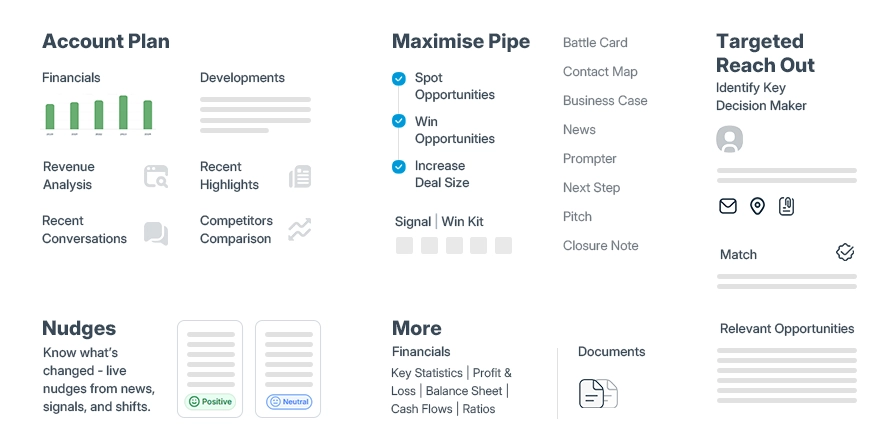
Modern platforms like SalesPlay deploy specialized AI agents that work as autonomous intelligence operatives, each focused on specific aspects of the pipeline generation workflow:
This agent-based architecture enables what traditional sales intelligence platforms cannot: predictive opportunity identification before formal evaluation begins. While competitors react to published RFPs, signal-optimized teams engage during the internal problem definition phase when solution parameters are still flexible.
Signal detection without systematic execution generates insights that die in Slack channels. The gap between "this account is interesting" and "this account is in pipeline" determines whether signal-based approaches deliver revenue or remain analytical curiosities.
Not every signal warrants immediate sales engagement. Establish clear qualification thresholds:
Advanced teams implement signal scoring algorithms that automatically triage into appropriate workflows, eliminating manual review overhead.
Enterprise deals require multi-stakeholder engagement. Signals often reveal individual contacts but rarely surface complete buying committees.
Systematic buying center mapping combines:
SalesPlay's Spot Contacts Agent automates this research, starting from known contacts and surfacing relevant opportunities tied to their function, including battle cards and messaging aligned to each stakeholder's priorities. This converts the "I know this person" advantage into "I know exactly what to discuss with this person."
Generic outreach destroys signal advantage. If your messaging could apply to any account in your category, you've squandered the intelligence.
Signal-based messaging follows a three-element structure:
This isn't template customization—it's research-based relevance. Each message requires understanding why the signal matters to this specific account's context.
SalesPlay's Win Opportunities Agent generates execution-ready materials for each opportunity, including battle cards, elevator pitches, talking points, and auto-drafted emails. Rather than starting from blank documents, sellers review and refine AI-generated content that already incorporates signal context and stakeholder research.
Single touchpoint conversions are enterprise mythology. Complex deals require coordinated campaigns across multiple channels and timeframes.
Effective orchestration sequences include:
Automation enables consistency without sacrificing personalization. SalesPlay's Auto-Nurture Agent creates personalized email campaigns that maintain engagement without manual effort, drafting unique messages for each touch while ensuring every interaction reflects current account context.
See how SalesPlay transforms account signals into qualified pipeline faster than traditional demand generation methods.
Schedule a demoSignal-based pipeline generation requires integrated technology infrastructure that most organizations lack. The typical sales tech stack consists of disconnected point solutions—CRM for data management, intent platforms for signal monitoring, engagement tools for outreach, analytics for reporting.
This fragmentation creates three critical failures:
Each additional tool requires custom integration with existing systems. Organizations spend 40% of implementation budgets on integration engineering rather than value delivery. Worse, integrations break as platforms update APIs, creating ongoing maintenance overhead.
Sellers toggle between 6-8 applications daily, manually reconstructing account context across systems. This friction reduces productive selling time and introduces information gaps where critical details fall through cracks.
Signal intelligence lives in monitoring platforms. Account data resides in CRM. Engagement history sits in email systems. Deal context exists in documents and presentation files. No single source of truth means sellers operate with partial information, making decisions without complete context.
Modern revenue intelligence platforms address these failures through unified architectures that consolidate signal monitoring, opportunity identification, buying center mapping, and execution workflows into single environments.
SalesPlay: AI Sales and Revenue Intelligence Co-pilot exemplifies this consolidated approach. Rather than requiring sellers to navigate multiple tools, the platform provides a single interface where:
This integration delivers what individual tools cannot: complete visibility into where opportunities exist, why they exist now, and exactly how to pursue them.
Organizations implementing unified platforms achieve 43% higher user adoption and 31% better ROI compared to fragmented tool stacks, according to MarketsandMarkets integration research. The performance advantage stems from eliminating friction between intelligence and execution.
Traditional pipeline metrics optimize for the wrong outcomes. Volume-based KPIs (leads generated, emails sent, calls completed) measure activity without measuring effectiveness. Revenue leaders need visibility into whether signal-based approaches actually convert to closed deals at superior rates.
What percentage of high-priority signals convert to qualified pipeline within 30/60/90 days? Elite teams achieve >25% conversion on champion migration signals versus <5% on cold outreach.
Time from signal detection to first meaningful conversation. Best-in-class teams engage within 48 hours of high-value signals, establishing position before competitors mobilize.
Signal-sourced opportunities should close faster than traditional pipeline due to engagement during natural buying windows. Track cycle time differential between signal-based and demand-gen sourced deals.
Not all signals convert equally. Track which signal categories correlate with closed-won outcomes to refine prioritization frameworks.
Most organizations lack visibility into which signals actually influenced pipeline creation versus which merely correlated with deals that would have occurred anyway.
Sophisticated attribution requires control group analysis: comparing signal-engaged accounts against similar accounts approached through traditional methods. Organizations implementing rigorous attribution discover that certain signal categories (executive hiring, funding events) demonstrate clear causation while others (general news mentions) show correlation without conversion impact.
SalesPlay provides this attribution intelligence automatically, tracking which opportunities originated from signal identification versus other sources and measuring performance differentials across signal categories. This data enables continuous optimization—doubling down on high-converting signal types while deprioritizing or eliminating low-value alerts.
Signal-based approaches often begin as individual seller experiments or small team pilots. Scaling requires systematic change management that addresses process, technology, and cultural dimensions.
Implementation Reality: Organizations implementing comprehensive signal-based approaches report full revenue impact within 60-90 days, with leading indicators (engagement rates, meeting bookings) showing improvement within 2-3 weeks. The acceleration comes from engaging accounts during active buying windows rather than manufactured demand cycles.
Problem: Teams enable 30+ signal categories without prioritization, overwhelming sellers with daily alerts they cannot effectively action.
Mitigation: Start with 3-5 highest-converting signal types. Add additional categories only after establishing baseline performance. Implement AI-powered filtering that routes only high-priority signals to frontline sellers while automated nurture handles lower-priority opportunities.
Problem: Sellers acknowledge signals but fail to articulate why they matter, reducing messages to "I saw your announcement" without demonstrating relevant expertise.
Mitigation: Develop signal-specific messaging frameworks that guide sellers through acknowledgment + implication + proof structure. Use AI-generated draft messages that incorporate signal context, allowing sellers to review and refine rather than starting from scratch.
Problem: Individual sellers embrace signal-based approaches while broader team remains focused on traditional activity metrics, creating cultural tension and inconsistent methodology.
Mitigation: Leadership must champion signal-based selling through comp plan alignment, dashboard redesign, and public recognition of signal-sourced wins. Make signal engagement a formal component of sales methodology rather than optional experimentation.
Problem: Organizations lack visibility into which signals actually drive pipeline versus which generate activity without outcomes, preventing optimization.
Mitigation: Implement source attribution tracking from initial signal through closed deal. Review signal-to-conversion data monthly, adjusting priorities based on actual performance rather than intuition. Platforms like SalesPlay provide this attribution automatically.
Most sales methodologies eventually commoditize. Competitors adopt similar tools, replicate successful messaging, and neutralize tactical advantages. Signal-based selling creates more durable differentiation because it's rooted in timing rather than just technique.
Consider two vendors approaching the same account:
Vendor A uses traditional demand generation. They run broad campaigns, generate some intent data showing the account downloaded whitepapers, and launch generic outreach. They eventually get meetings but enter evaluation processes already in progress, competing against entrenched incumbents or shortlisted alternatives.
Vendor B uses signal-based intelligence. They identify the account hired a new CRO who previously championed their solution at another company. They engage within her first 30 days with messaging tied to challenges she's likely prioritizing based on the role transition. They help shape evaluation criteria before formal processes begin.
Vendor B doesn't just have better information—they have temporal advantage. They're participating in problem definition rather than solution selection. This positioning is nearly impossible for competitors to overcome regardless of feature parity or pricing aggression.
Organizations building signal-based capabilities create competitive moats that compound over time through:
Enterprise pipeline generation stands at an inflection point. Organizations clinging to volume-based demand generation watch win rates decline while sales cycles extend. Those embracing signal-based intelligence build pipeline competitors cannot see, engage accounts before RFPs formalize, and close deals while rivals are still crafting generic pitch decks.
The transformation requires more than tool adoption. It demands operational reimagination—from how accounts get prioritized to how sellers spend their time. It requires leadership commitment to metrics that measure effectiveness rather than activity. And it necessitates technology infrastructure that converts fragmented intelligence into unified execution workflows.
Platforms like SalesPlay by MarketsandMarkets provide the foundational architecture that makes signal-based selling operationally viable at enterprise scale. By consolidating account intelligence, signal monitoring, opportunity identification, buying center mapping, and execution orchestration into unified environments, they eliminate the integration debt and context-switching overhead that prevents most organizations from sustaining signal-based approaches.
The competitive landscape will continue fragmenting between organizations that react to visible demand and those that create pipeline from market intelligence. Between teams that compete on published RFPs and those that shape buying criteria before evaluation formalizes. Between sellers who prospect through volume and those who engage through timing.
Signal-based pipeline generation isn't the future of enterprise sales. It's the present operational reality for revenue leaders who've moved beyond legacy demand generation frameworks. The question facing every enterprise sales organization: will you lead this transformation or explain to boards why competitors are consistently outperforming with apparently similar offerings?
The signals are already there. The only question is whether you're reading them.
See how SalesPlay's AI agents identify opportunities, prioritize accounts, and generate execution-ready materials that convert signals into closed revenue.
Explore SalesPlay Platform

Category: Uncategorized Tags: ai, AIOps, Artificial Intelligence, cloud, cloud platform, Cybersecurity, Information and Communications Technology , VR