Revenue Intelligence Tools: Complete 2026 Buyer's Guide
August 22, 2025
Not all revenue intelligence tools are created equal. This guide breaks down the 7 distinct types of revenue intelligence tools reshaping enterprise sales in 2026—from unified AI co-pilots to specialized point solutions—so you can identify which revenue intelligence tool solves your actual problems.
Most revenue intelligence tool evaluations start with feature checklists. Sales leaders compare dashboards, analytics capabilities, and integration lists across vendors, hoping to identify the “best” tool. This approach misses what actually determines implementation success: tool architecture.
A forecasting tool and a conversation intelligence tool can both claim “AI-powered deal insights.” But one watches your CRM to predict which deals will close based on historical patterns and pipeline velocity. The other records calls to understand why deals stall based on conversation dynamics and stakeholder sentiment. Same feature claim. Completely different systems solving completely different problems.
The revenue intelligence tools market has matured past generic “AI sales tools” into distinct categories. Each type solves specific problems through different data inputs, analytical approaches, and user workflows. Understanding these architectural differences is the first step toward selecting the revenue intelligence tool that actually addresses your team's constraints.
According to Gartner's December 2025 Magic Quadrant for Revenue Action Orchestration, the revenue intelligence tools category is consolidating rapidly. Organizations are moving from 5-8 disconnected point solutions to 1-2 deeper revenue intelligence tools that handle multiple functions in integrated ways.
The median revenue technology stack decreased from 8.4 tools in 2024 to 5.2 tools in early 2026. This consolidation is driven by integration fatigue, data fragmentation costs, and the cognitive overhead of context-switching across multiple systems.
The question is no longer “which vendors have the most features?” but “which revenue intelligence tool architecture matches how we actually sell—and can it replace 3-4 of our existing tools?”
When revenue intelligence tool architecture doesn't match your sales motion, the failure doesn't show up in vendor demos. It appears 90 days post-implementation when adoption stalls at 35% because sellers find the workflows confusing, the insights disconnected from their daily reality, or the value proposition unclear.
Consider a common mismatch: deploying a conversation intelligence tool when your primary constraint is identifying where opportunities exist inside existing accounts. The tool will dutifully record calls and surface talk-time ratios, but if sellers don't know which accounts to prioritize or which contacts to engage in the first place, conversation analytics solve the wrong problem. This is where understanding revenue intelligence tool types becomes critical for successful revenue intelligence implementation.
Below, we classify the 7 distinct revenue intelligence tool types operating in 2026, explain what each actually does, map them to the buyer problems they solve best, and show you how to evaluate which tool architecture fits your team's actual selling motion.
Unified revenue co-pilot platforms consolidate multiple revenue intelligence functions into a single, integrated system. Rather than stitching together separate tools for account intelligence, opportunity identification, contact discovery, and deal progression, these platforms provide end-to-end guidance through connected capabilities working from a shared data foundation.
The defining characteristic of unified platforms is continuous context. When a seller moves from researching an account to identifying opportunities to preparing for a meeting, the context travels with them. No export/import. No copy/paste between tools. No manual reconciliation of disconnected data sources.
This architectural approach emerged from a fundamental insight: enterprise selling breaks when context fragments. When sellers jump between tools—CRM for pipeline, LinkedIn for contacts, news sites for account research, separate platforms for conversation intelligence—they lose the connective tissue that makes information actionable.
These platforms eliminate the fragmentation that breaks enterprise selling. When you sell into existing account bases—especially with complex products requiring 6-12 month sales cycles—the constraint isn't usually execution mechanics. It's knowing where to focus.
Your team has 500 accounts. Which 50 are most likely to buy in the next quarter? Within those 50, which specific opportunities exist right now? For each opportunity, who are the 3-5 people who actually influence the decision? What should you say to each person that connects to their priorities?
Traditional tools force sellers to manually research each question across different systems. Unified platforms answer all these questions from a single interface, with each answer informing the next. This is particularly valuable for teams implementing comprehensive account research workflows that need to scale across hundreds of target accounts.
Consider a typical Monday morning for an enterprise seller using a unified platform:
8:30 AM: Seller opens the platform. Instead of a static dashboard, they see accounts ranked by recent activity and opportunity relevance. One account shows a “high priority” flag because the CFO just announced a digital transformation initiative that aligns with the seller's automation product.
8:35 AM: Seller clicks into the account. Without navigating away, they see 5-year revenue history, recent financial filings, key business developments, and three specific opportunities tied to the transformation announcement. Each opportunity shows why it exists, which product fits, and who should be involved.
8:42 AM: Seller selects one opportunity and pushes it to “active pursuit.” The platform immediately generates a battle card with positioning guidance, elevator pitch, talking points, and three contacts already mapped to this opportunity with their roles and relevance explained.
8:50 AM: Seller reviews an auto-drafted email to the primary contact, adjusts two sentences, and sends. A three-touch nurture campaign is queued for the other two contacts. A meeting prep document is already available for when the first contact responds.
Total time from “which account?” to “outreach sent”: 20 minutes. No tool switching. No manual research. No starting from scratch on messaging. This workflow demonstrates why unified platforms excel at pipeline creation from existing accounts—the constraint shifts from research time to decision quality.
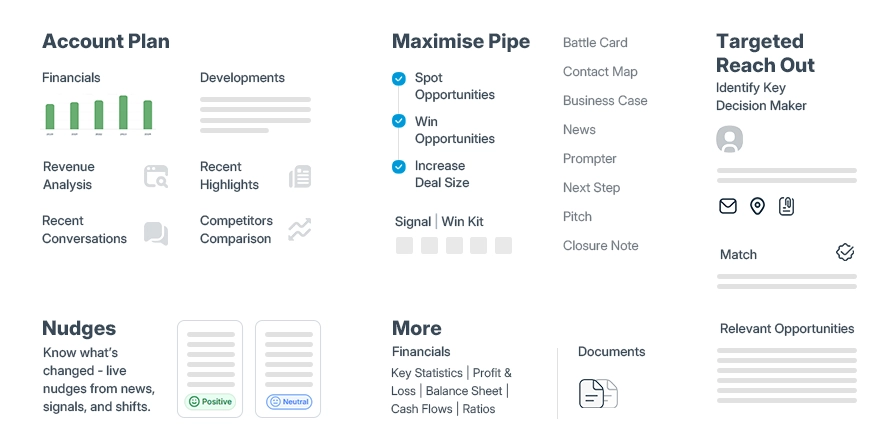
SalesPlay operates as a revenue intelligence co-pilot that consolidates multiple functions into integrated workflows:
Account Intelligence: Continuously tracks what's changing inside target accounts with 5-year revenue history, financial data, and business developments. Learn more about account intelligence capabilities that answer “What's happening inside this account right now—and why does it matter?”
Opportunity Identification: Uses pipeline generation to identify where to sell based on signal relevance and product fit. Categorizes opportunities by high/medium/low relevance and shows which signal triggered each opportunity, enabling proactive pipeline creation from accounts.
Deal Progression: Converts selected opportunities into execution-ready deals with battle cards, elevator pitches, talking points, and auto-drafted messaging. This handles deal progression by providing next-step guidance at every stage using revenue intelligence insights.
Contact Discovery: Leverages contact enrichment to identify who matters for each opportunity. Shows which opportunities are relevant to each person and provides messaging tied to their specific priorities for account-based selling.
Nurture Automation: Creates personalized email nurture campaigns tied to specific opportunities, drafting every message to ensure relevance without manual writing overhead.
Meeting Preparation: Generates one-page prep documents with attendee context, conversation starters, and smart questions to ensure sellers walk in prepared.
Signal Monitoring: Surfaces relevant news and developments filtered for engagement timing, cutting through noise to highlight what actually creates a reason to act based on account intelligence.
These capabilities share a common data foundation, so context flows automatically across all functions—no export/import between disconnected tools.
Unified platforms often complement rather than replace certain specialized tools. Common integration patterns include:
Unified Platform + Conversation Intelligence: Use the unified platform for pre-call research and opportunity identification, then layer conversation intelligence for post-call coaching and methodology adherence. For example, SalesPlay ensures sellers enter recorded calls with full account intelligence context, while conversation platforms capture what actually happens for coaching purposes.
Unified Platform + Forecasting: The unified platform creates and qualifies pipeline using pipeline generation; the forecasting platform predicts outcomes for revenue leadership using predictive forecasting. This combination addresses both “where do we create opportunities?” (unified) and “will we hit our number?” (forecasting).
Unified Platform + Engagement Automation: The unified platform determines who to engage and why using contact intelligence; the engagement platform handles high-volume sequence execution. This works well for teams running both account-based and outbound motions simultaneously.
Watch how SalesPlay's integrated capabilities eliminate tool fragmentation and guide sellers from account selection through deal closure—all from a single interface that maintains context across every step.
Conversation intelligence platforms record, transcribe, and analyze sales calls and meetings to surface patterns, coaching opportunities, competitive mentions, and deal risks. These platforms use natural language processing to understand what happens during customer interactions—not just what sellers reported happened.
The breakthrough innovation of conversation intelligence was making the previously invisible visible. Before these platforms, sales managers had to trust rep summaries of customer calls or occasionally shadow calls for quality assurance. Conversation platforms capture every word, identify patterns across hundreds of calls, and quantify what separates winning conversations from losing ones.
Conversation platforms answer the question: “What's actually being said in sales conversations—and what patterns separate wins from losses?” They make the previously invisible visible by capturing exact customer language, objections, and buying signals that get lost in CRM notes summarized as “good call, will follow up.”
Beyond recording, these platforms create accountability and coaching frameworks that scale beyond direct observation. A sales manager can't sit on 200 calls per month. But conversation intelligence can analyze all 200, surface the 15 that need immediate attention, and identify the 3 reps who need coaching on a specific skill.
Consider a typical use case: A sales manager notices that one rep has a 45% win rate while the team average is 28%. Using conversation intelligence, the manager compares winning vs. losing calls for this top performer:
Discovery Pattern Found: The top performer asks an average of 11 questions in discovery calls. The team average is 6. More specifically, the top performer asks 3-4 questions about implementation timeline, while most reps ask once or not at all.
Competitive Positioning Pattern: When competitors are mentioned, the top performer asks clarifying questions about what the prospect liked or didn't like about that vendor 78% of the time. Other reps immediately start positioning against the competitor without understanding the prospect's specific concerns.
Objection Handling Pattern: The top performer uses “help me understand” language before responding to objections. Other reps immediately counter-argue or minimize concerns.
These insights don't come from gut feeling. They come from quantified analysis using AI sales analytics across actual conversations. The manager can now share specific clips showing the behavior, explain why it works, and track whether other reps adopt it. This is fundamentally different from generic “ask better questions” coaching because it's grounded in your actual customer conversations.
Conversation intelligence excels at analyzing what happens during sales calls. It struggles with the question that precedes the call: “Who should we be talking to about what, and when?”
This is where conversation platforms integrate naturally with unified co-pilot platforms. Teams use account intelligence and contact enrichment to determine who to call, then ensure sellers enter those conversations prepared, while conversation intelligence captures what actually happens for coaching purposes.
The combination creates a complete loop: intelligence platforms identify the right conversations to have using pipeline generation, meeting prep ensures they start well, conversation platforms analyze what happens, and coaching improves future performance. Neither platform alone delivers this complete workflow.
Conversation intelligence raises legitimate privacy concerns that vary significantly by jurisdiction and industry. All major platforms include:
Organizations implementing conversation intelligence should establish clear policies about recording scope, retention periods, and access permissions before deployment. Retroactive policy creation after sellers have recorded 500+ calls creates legal and operational complexity. For guidance on establishing compliant governance, focus on consent management in your revenue intelligence implementation planning.
Forecasting platforms aggregate CRM data, sales activity patterns, and historical outcomes to predict which deals will close and whether teams will hit revenue targets. These systems focus on pipeline visibility and forecast accuracy for revenue leadership, transforming the traditional spreadsheet-based forecasting process into AI-powered predictive models using predictive sales intelligence.
The category emerged from a fundamental frustration: CRM-based forecasting was consistently 30-40% inaccurate because it relied on rep judgment (“this deal feels like 70% likely to close”) rather than behavioral data. Forecasting platforms analyze what actually predicts closure—activity patterns, stakeholder engagement, stage velocity, historical conversion rates—and build probabilistic models that outperform human intuition.
These platforms answer: “Will we hit our number—and if not, where exactly is the gap?” They give revenue leaders confidence in forecasts and visibility into pipeline health across the organization, enabling proactive decisions about resource allocation, hiring, and quota adjustments using predictive intelligence.
The deeper value comes from shifting forecasting from subjective judgment to data-driven prediction. When a rep says “this $200K deal is definitely closing this quarter,” the platform might show that similar deals with this activity pattern and stakeholder engagement close only 40% of the time. That gap between perception and probability drives better pipeline management and more realistic revenue planning.
Consider a typical quarterly forecast review using a forecasting platform:
Traditional Approach (Without Platform): VP Sales asks each manager for their forecast. Managers report numbers based on rep input. VP asks about specific deals. Managers explain their confidence. VP makes judgment calls about which forecasts to trust. Total time: 3 hours. Forecast accuracy: 68%.
Platform-Enabled Approach: VP opens dashboard showing each territory's forecast with confidence intervals. Platform has already flagged 8 deals as “high risk based on activity patterns.” VP drills into those 8 deals, sees which have stakeholder engagement issues vs. pricing concerns vs. timing questions. Managers come prepared with mitigation plans for flagged deals. Total time: 90 minutes. Forecast accuracy: 89%.
The time savings are notable, but the accuracy improvement is what matters. A 21-point accuracy improvement means better resource planning, more confident board commitments, and fewer end-of-quarter scrambles enabled by AI-powered forecasting strategies.
Forecasting platforms excel at predicting outcomes from existing pipeline. They struggle with the question that precedes forecasting: “Where do we create new pipeline to fill the gaps?”
When a forecasting platform shows you're $2M short of quota for Q3, it highlights the problem but doesn't solve it. This is where forecasting platforms integrate with unified co-pilot platforms. The forecasting platform quantifies the gap using predictive intelligence. The unified platform identifies where to create new opportunities inside existing accounts using pipeline generation from accounts to close it.
Consider this workflow: Clari shows a territory is $400K short for the quarter. The manager opens SalesPlay, filters by that territory's accounts, and sees 12 high-priority opportunities identified through pipeline generation that aren't yet in Salesforce. Three of those opportunities are sized at $150K-200K each. The manager assigns those opportunities to the rep with guidance, and the forecast gap shrinks from $400K to $150K within two weeks.
Neither platform alone enables this workflow. Forecasting without opportunity creation is reactive problem identification. Opportunity creation without forecast visibility is undirected activity. Together, they create a closed loop using revenue intelligence.
Forecasting platforms require specific foundations to deliver accurate predictions:
Organizations implementing forecasting platforms should audit these foundations before deployment. For detailed guidance, see revenue intelligence vs. traditional sales forecasting for implementation planning.
Sales engagement platforms orchestrate multi-touch outreach sequences across email, phone, LinkedIn, and other channels. They automate prospecting workflows and track activity effectiveness, enabling consistent high-volume outreach without manual effort for each touchpoint through sales automation.
These platforms emerged from the recognition that manual prospecting doesn't scale. When a seller needs to touch 50 prospects with 6 touchpoints each over 14 days, managing that manually through calendar reminders and email folders is inefficient and inconsistent. Engagement platforms turn this into automated sequences that execute predictably.
Engagement platforms answer: “How do we execute consistent, high-volume outreach without manual effort for each prospect?” They automate the mechanics of prospecting through sales automation so sellers spend more time in conversations and less time managing spreadsheets.
The category particularly addresses the inconsistency problem. Without engagement platforms, prospecting quality varies wildly by rep motivation, CRM discipline, and workload. One seller might execute 8-touch sequences religiously. Another might send one email and move on. Engagement platforms create process consistency that management can measure and optimize.
Engagement platforms excel at execution mechanics. Intelligence platforms determine who to engage and why. Smart teams combine both:
Intelligence-Driven Engagement: Use contact enrichment to identify which contacts matter for specific opportunities. Use lead nurture automation to draft personalized messaging tied to those opportunities. Then use an engagement platform to execute the multi-touch sequence with automated timing and activity logging.
This combination prevents the spray-and-pray problem where engagement platforms blast generic messages to loosely qualified lists. Intelligence platforms like SalesPlay ensure each sequence is targeted to relevant contacts with messaging tied to their actual priorities using account intelligence. The result: higher response rates, better-qualified meetings, and less wasted seller time.
Signal-to-action platforms capture real-time buyer intent signals—website visits, email engagement, content downloads, job changes, technographic shifts—and convert them into specific seller actions. These platforms bridge the gap between “something happened” and “here's exactly what to do about it.”
The category emerged from the frustration of having signals without context. Marketing automation platforms would alert you that someone from Acme Corp visited your pricing page. But which seller owns that account? Is Acme an active opportunity or cold prospect? What should the seller actually do with this information?
These platforms answer: “What should each seller do right now based on what buyers are doing?” They translate passive monitoring into active tasks, ensuring sellers act on buying signals before they cool using B2B intent data.
Signal platforms capture micro-moments of potential interest. The challenge is separating genuine buying signals from noise. Just because someone from Acme visited your pricing page doesn't mean Acme is ready to buy—it might be a student researching competitive analysis or an employee satisfying curiosity.
This is where signal platforms integrate with unified intelligence platforms. SalesPlay doesn't just capture what happened; it filters for relevance based on account intelligence, existing opportunities identified through pipeline generation, and historical engagement patterns. The result: fewer false positives, more confident action.
Specialized solutions solve narrow, specific problems within the revenue workflow. Rather than attempting end-to-end coverage, these platforms focus on being best-in-class at one particular function. Examples include contact data enrichment, email verification, competitive intelligence tracking, or proposal automation.
Point solutions excel when you have a specific, well-defined problem and existing platforms don't address it adequately. For example, if your team needs international contact data with mobile phone numbers for European prospects, Cognism's specialized focus delivers better coverage than general-purpose alternatives.
The challenge is integration overhead and context fragmentation as tool count increases. Each additional point solution represents another login, another data source to reconcile, and another integration to maintain.
According to RevOps.tools research, the median revenue technology stack shrank from 8.4 tools in 2024 to 5.2 tools in early 2026 as organizations prioritize integrated platforms over point solution collections through platform convergence.
This doesn't mean point solutions are disappearing. It means teams are asking: “Can our core platform absorb this function?” before adding new tools. If the answer is yes—even at 80% of the point solution's capability—many teams choose integration simplicity over marginal feature gains as discussed in best practices for integrating AI tools.
The point solutions surviving this consolidation are those solving problems that platforms can't reasonably absorb (like competitive intelligence tracking or contract management) or those offering dramatically superior capabilities in critical functions (like international contact enrichment or email deliverability).
Agentic AI platforms represent the newest category: autonomous systems that complete multi-step revenue workflows with minimal human intervention. Unlike traditional sales automation that follows rigid if/then rules, agentic platforms make contextual decisions, adapt execution based on outcomes, and learn from results using agentic AI workflows.
The term “agentic” refers to the platform's ability to act independently toward defined goals rather than waiting for human instruction at each step. An agentic CRM hygiene system doesn't just flag duplicate records—it merges them according to defined rules, learns which fields to prioritize, and improves its accuracy over time.
Agentic AI is transitioning from proof-of-concept to production deployment using autonomous SDR workflows. According to Gartner, 40% of enterprise applications will include task-specific AI agents by end of 2026, with revenue workflows among the highest-priority use cases.
Platforms like Gong are positioning as “Revenue AI OS” to accommodate agentic capabilities. SalesPlay embeds autonomous behavior within specialized functions—continuous account monitoring, automatic opportunity relevance analysis, and campaign execution after approval through agentic AI architecture.
Most “AI agents” announced in 2025 were rebranded automation scripts. True agentic systems demonstrate four characteristics as outlined in what is an agentic SDR:
When evaluating agentic claims, ask: “Can this system complete the entire workflow without human intervention, and does its performance improve based on outcomes?” If the answer is no, it's automation, not agentic AI. See AI SDRs vs traditional SDRs for capability comparisons.
Agentic AI only works with clean data and clear success metrics. Teams deploying agents without solid CRM hygiene, defined processes, and measurable outcomes typically see noisy recommendations and low trust adoption.
Before implementing agentic capabilities, audit:
For detailed guidance on preparing for agentic implementations, see revenue intelligence implementation best practices.
Within 18 months, the distinction between “agentic platforms” and traditional revenue intelligence will blur. Every major platform will embed autonomous capabilities through agentic AI stacks. The question will shift from “does it have agents?” to “what can those agents actually accomplish without human intervention—and how reliably?”
| If Your Primary Problem Is… | Revenue Intelligence Tool Type to Evaluate | Why This Type Fits |
|---|---|---|
| Sellers don't know where to sell in existing accounts | Unified Co-Pilot | Continuous account monitoring + opportunity detection |
| We can't see what's happening in sales conversations | Conversation Intelligence | Call recording + pattern analysis + AI coaching |
| Forecast accuracy is below 70% | Forecasting Platform | Predictive modeling + pipeline visibility for leadership |
| Outbound prospecting volume is inconsistent | Sales Engagement | Multi-channel sequence automation + activity tracking |
| Buyers show intent but reps don't know when to act | Signal-to-Action | Real-time intent monitoring + action routing |
| Reps spend 60%+ time on non-selling activities | Agentic AI | Autonomous workflow completion + administrative elimination |
| We manage 6+ disconnected revenue tools | Unified Co-Pilot | Integrated capabilities eliminate context switching through platform convergence |
| Revenue Intelligence Tool Type | Primary Data Sources | Analysis Focus |
|---|---|---|
| Unified Co-Pilot | CRM, external signals, financial data, news, org charts | Account context + opportunity relevance + contact mapping |
| Conversation Intelligence | Call recordings, meeting transcripts, conferencing tools | Conversation patterns + methodology adherence + objections using AI analytics |
| Forecasting | CRM pipeline, activity logs, historical close data | Close probability + pipeline health + quota attainment via predictive intelligence |
| Engagement | Email sends/opens, call attempts, LinkedIn touches | Sequence performance + response rates + activity volume through automation |
| Signal-to-Action | Website visits, email clicks, intent data, job changes | Buying behavior + engagement timing + stakeholder movement via intent signals |
| Agentic AI | Cross-platform: CRM + communication + web + documents | Workflow completion + autonomous decision execution using agentic stack |
| Revenue Intelligence Tool Type | Setup Time | Data Requirements | Ongoing Maintenance |
|---|---|---|---|
| Conversation Intelligence | 2-4 weeks | Conferencing integration only | Low (automatic capture) |
| Signal-to-Action | 2-6 weeks | Website tracking + CRM sync | Medium (intent source management) |
| Engagement Platforms | 4-8 weeks | CRM + email + contact database | Medium (template maintenance) |
| Forecasting Platforms | 6-12 weeks | Clean CRM with 6+ months history | High (pipeline governance) |
| Unified Co-Pilot | 4-8 weeks | Salesforce + account list definition | Low (autonomous monitoring) |
| Agentic AI | 8-16 weeks | Clean multi-source data + defined workflows | Medium (agent performance monitoring) |
Revenue performance breaks in predictable ways. Identify which constraint limits your team:
Account-Based Sales (Existing Customer Focus)
High-Volume Outbound (New Logo Acquisition)
Complex Enterprise Sales (Long Cycles, Multiple Stakeholders)
Inbound-Heavy (Marketing-Qualified Leads)
Platform types vary dramatically in integration requirements:
If your CRM data quality is poor, fix that before implementing forecasting or agentic platforms. If you lack historical pipeline data, conversation intelligence offers faster time-to-value than predictive forecasting. For integration planning, see best practices for integrating AI tools.
The 2026 architectural decision is not “best-of-breed vs. suite” but “how many platforms should we operate?”
When It Works:
Example Architecture:
When It Works:
Example Architecture:
Every platform type claims to solve multiple problems. Test against your actual constraint:
For implementation planning, see revenue intelligence implementation guide.
See how SalesPlay's unified co-pilot approach eliminates the need for 4-5 specialized tools while maintaining execution depth across account intelligence, opportunity detection, and deal progression workflows.
Successful revenue intelligence implementations require comprehensive planning that addresses technical, organizational, and cultural factors. According to industry research, organizations following structured implementation methodologies achieve 67% faster time-to-value and 41% higher user adoption rates.
For detailed planning guidance, see how to implement revenue intelligence.
Change management represents one of the most critical success factors for revenue intelligence implementations. These initiatives require sales teams to modify established workflows and embrace new analytical approaches through structured change management.
Budget 40% of implementation effort for training, adoption tracking, and behavioral reinforcement. Great technology with 30% adoption delivers zero value. Learn more about technology adoption best practices.
The success of revenue intelligence implementations depends heavily on seamless integration with existing sales technology stacks. Organizations with well-integrated platforms achieve 43% higher user adoption rates and 31% better return on investment.
Critical integration requirements include:
For integration planning, see maximizing platform value through integrations and best practices for integrating AI tools.
The median revenue tech stack decreased from 8.4 tools in 2024 to 5.2 tools in 2026 through platform convergence. Organizations are rationalizing around fewer, deeper platforms that handle multiple functions rather than stitching together specialized tools that fragment data and workflows.
Why This Matters: Integration overhead is not just technical—it's cognitive. Every additional tool represents context switching, data reconciliation, and user adoption friction. Unified platforms that maintain context across workflows create measurable productivity gains.
According to Gartner, 96% of revenue leaders expect their teams to use AI tools by end of 2026, with 40% of applications including task-specific agents through agentic AI workflows. The shift is from “AI-assisted” to “AI-executed” workflows.
Watch For: Most 2025 “agent” announcements were rebranded automation. True agentic behavior requires contextual decision-making, multi-step reasoning, and self-correction as described in what is an agentic SDR. Evaluate agent claims by asking: “Can it complete this workflow without human intervention, and does performance improve over time?”
The category is evolving from “telling you what happened” to “doing what needs to happen.” Platforms that only provide insights without execution paths are losing ground to systems that connect intelligence directly to action through revenue intelligence.
Example: Traditional conversation intelligence records calls and flags risks. Next-generation platforms generate battle cards, talking points, and email drafts based on those insights—turning analysis into executable next steps using automation.
Organizations with dirty CRM data, incomplete activity capture, or fragmented customer records see 40% lower AI accuracy than teams with clean foundational data. The “garbage in, garbage out” problem becomes more severe as AI sophistication increases.
Action: Before adding any intelligence platform, audit CRM hygiene, activity logging consistency, and data completeness. AI accelerates what you already do—if your processes are broken, AI makes broken processes faster. See AI sales ultimate guide for data preparation.
Generic revenue intelligence gives way to industry-specific platforms trained on vertical data patterns. Healthcare sales operates differently than manufacturing. Financial services compliance requirements differ from SaaS selling.
Early Signals: Platforms are launching industry-specific AI models. Expect this specialization to accelerate through 2027 with solutions like AI sales for technology companies.
For more on emerging trends, see what's changing in AI sales tools and the future of revenue intelligence.
Every revenue intelligence tool has impressive feature lists. What matters is how those features connect to how your team actually sells. A forecasting tool with 50 analytics widgets is useless if your sellers need help identifying where to sell next.
Instead: Map your actual selling workflow. Identify where it breaks. Choose the revenue intelligence tool type that fixes that break using appropriate revenue intelligence capabilities.
Revenue intelligence tool failure rarely comes from technology. It comes from sellers who don't adopt it because the workflow doesn't match how they work, the UI is confusing, or leadership doesn't reinforce usage.
Instead: Budget 40% of implementation effort for training, adoption tracking, and behavioral reinforcement following change management best practices. Great revenue intelligence tools with 30% adoption deliver zero value.
AI accelerates existing processes through automation. If your sales methodology is unclear, your qualification criteria are inconsistent, or your account segmentation is arbitrary, AI will automate that chaos faster.
Instead: Define clear processes before implementing intelligence. AI optimizes what already works; it doesn't create methodology from nothing. See AI sales implementation guide.
Many platforms optimize for impressive executive dashboards while creating friction for frontline reps. If sellers don't find value in daily workflows, adoption fails regardless of leadership enthusiasm.
Instead: Pilot with actual sellers. Measure whether their jobs become easier, clearer, or more productive. Executive visibility should follow rep value, not lead it.
Platform licensing is only 40-60% of total cost. Integration work, ongoing maintenance, user training, and admin overhead often exceed initial licensing fees over 3-year periods.
Instead:Calculate total cost including implementation services, integration development, annual admin time, and training programs following platform selection criteria. A $100K platform that requires $50K/year in maintenance costs $250K over three years.
Sales intelligence tools typically refer to contact and company data (who to call, their role, company size). Revenue intelligence tools encompass the entire revenue cycle—combining data intelligence with conversation analysis, pipeline prediction, deal guidance, and execution automation. Revenue intelligence tools tell you not just who to engage, but when, why, and how. See sales intelligence vs CRM vs revenue intelligence for detailed comparison.
Yes, and most mature sales organizations do. Common combinations include conversation intelligence tools (for coaching) + unified co-pilot tools (for account intelligence and opportunities) + forecasting tools (for leadership visibility). The key is ensuring data flows between tools to maintain context through proper integration.
Choose unified platforms when: (1) you're managing 5+ disconnected tools, (2) sellers complain about context switching, (3) data reconciliation consumes RevOps time, or (4) your primary constraint is knowing where to sell in existing accounts. Choose specialized tools when you have mature RevOps capable of managing complex integrations and highly specific workflow requirements. See platform convergence benefits.
Minimum requirements: Clean CRM with accurate account ownership, consistent opportunity stage definitions, regular activity logging, and at least 6 months of historical data. Platforms like conversation intelligence require less foundational data (just conferencing integration), while forecasting platforms and agentic AI require mature data governance. See implementation guide.
Typical timelines by revenue intelligence tool type:
Major platforms (Gong, Chorus, Jiminny) include built-in compliance features for GDPR, CCPA, and regional consent laws. However, legal requirements vary by jurisdiction and industry. Organizations must configure consent management, data retention policies, and access controls appropriately. Always consult legal counsel for your specific regulatory environment.
Expecting the revenue intelligence tool to tell you what to do before you've defined your sales methodology. Revenue intelligence tools accelerate clear processes through automation; they don't create methodology from chaos. Teams that succeed define qualification criteria, account selection logic, and opportunity prioritization frameworks before implementing AI—then use revenue intelligence tools to execute those frameworks at scale.

Category: Uncategorized Tags: ai, AIOps, Artificial Intelligence, cloud, cloud platform, Cybersecurity, Information and Communications Technology , VR