
Smart Home Market Size, Share and Trends

Smart Home Market Size, Share & Trends by Lighting Solutions, Security and Access Control, HVAC, Home Entertainment & Comfort, Home Healthcare, Smart Kitchen, Home Appliances, Smart Furniture, Smart Speaker, Control Interface - Global Forecast to 2032




SMART HOME MARKET SIZE, SHARE & TRENDS
According to Marketsandmarkets, The global smart home market size was valued at USD 213.73 billion in 2025 and is projected to reach USD 450.20 billion by 2032, growing at a CAGR of 11.8%. from 2025 to 2032. Growth is driven by rising internet penetration and proliferation of connected smart devices, increasing disposable income and expanding middle-class population in emerging economies, and growing demand for remote home monitoring and control. Additionally, increasing demand for energy-efficient and low-carbon smart home solutions, along with rising consumer focus on safety, security, and convenience, is accelerating market adoption.
MARKET SNAPSHOT TABLE
| REPORT METRIC | DETAILS |
|---|---|
| Market Size in 2025 (Value) | USD 213.73 BN |
| Market Forecast in 2030 (Value) | USD 450.20 BN |
| Growth Rate | 11.8% |
| Years Considered | 2021–2032 |
| Base Year | 2025 |
| Forecast Period | 2026–2032 |
| Units Considered | Value (USD BN), Volume (Million Units) |
| Report Coverage | Revenue forecast, company ranking, competitive landscape, growth factors, and trends |
| Top Companies |
|
| Growth Drivers |
|
| Segments Covered |
|
| Regional Scope | North America, Europe, Asia Pacific, South America, and Middle East & Africa |
KEY TAKEAWAYS
-
BY REGIONThe Asia Pacific is projected to register the highest CAGR of ~17.0%.
-
BY PROTOCOL & COMMUNICATION TECHNOLOGYThe wireless segment held the largest market share of ~64.0% in 2025.
-
BY PRODUCT TYPESmart Home HVAC is expected to grow at the highest CAGR of ~20.0%.
-
BY INSTALLATION TYPERetrofit installations are expected to register fast growth.
-
COMPETITIVE LANDSCAPE: KEY PLAYERSSchneider Electric, Siemens, Amazon.com, Inc., and Honeywell International Inc. were identified as some of the star players in the smart home market, given their strong market share and product footprint.
-
COMPETITIVE LANDSCAPE: STARTUPS/SMESGovee and Caavo have distinguished themselves among startups and SMEs due to their strong product portfolio and business strategies.
The smart home market size is projected to grow significantly over the next decade, supported by the rapid expansion of connected device ecosystems and improving digital infrastructure worldwide. Rising consumer spending power in emerging economies and increasing preference for convenient, remotely managed home environments are accelerating adoption. In addition, growing awareness around energy conservation and the need for safer, more efficient living spaces are contributing to sustained market growth.
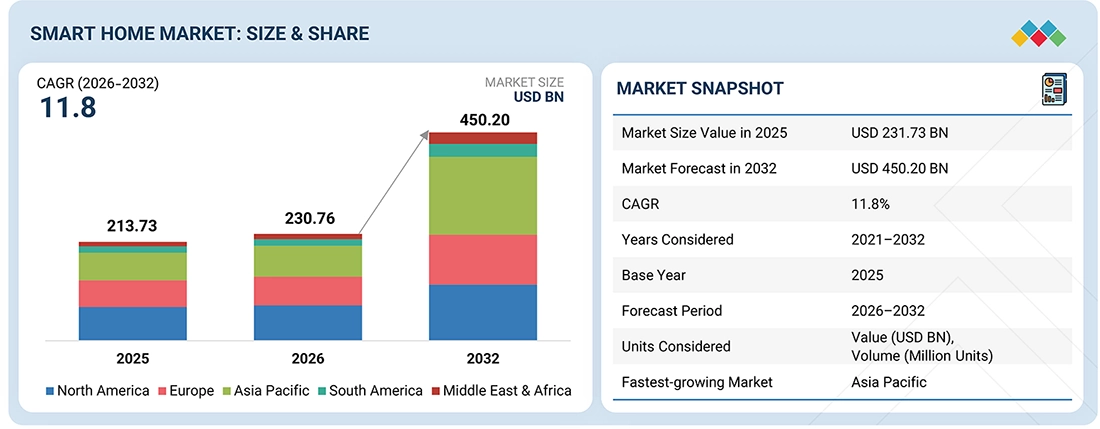
Source: Secondary Research, Interviews with Experts, MarketsandMarkets Analysis
TRENDS & DISRUPTIONS IMPACTING CUSTOMERS' CUSTOMERS
The smart home industry is undergoing a significant transformation in revenue streams, driven by the emergence of new use cases, connected technologies, evolving ecosystems, and strategic partnerships. While earlier adoption was centered around standalone devices, the demand is increasingly shifting toward integrated smart home platforms that enable seamless control, monitoring, and automation. Smart home solutions are also expanding their influence into adjacent domains such as building automation systems and across residential and healthcare applications. At the same time, evolving customer expectations around enhanced security, real-time monitoring, energy efficiency, personalized comfort, and convenience are accelerating innovation and driving higher-value opportunities across the market.
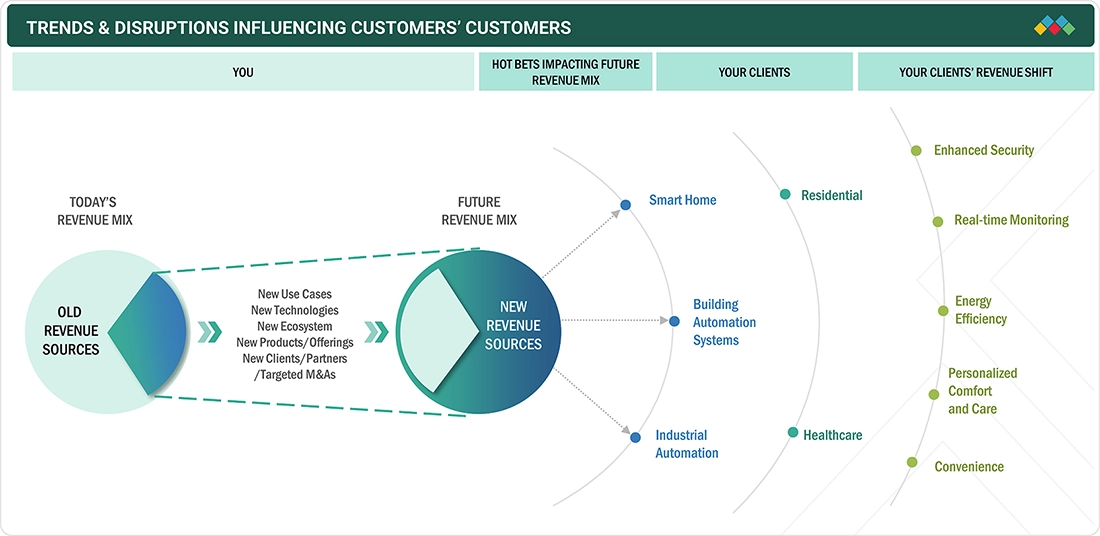
Source: Secondary Research, Interviews with Experts, MarketsandMarkets Analysis
SMART HOME MARKET DYNAMICS

Level
-
Rising Internet Penetration and Proliferation of Connected Smart Devices

-
Rising Consumer Focus on Safety, Security, and Convenience


Level
-
High Costs, Data Security Risks, and Connectivity Dependence Limiting Smart Home Adoption

-
Dependence on Stable Internet Connectivity and Network Infrastructure


Level
-
Favorable Government Regulations to Promote Green Buildings

-
Integration of IoT-enabled Lighting Controllers with Built-in Connectivity


Level
-
Interoperability Gaps and Lack of Unified Standards in Smart Home Ecosystems

-
Risk of Device Malfunction

Source: Secondary Research, Interviews with Experts, MarketsandMarkets Analysis
Driver: Rising Internet Penetration and Proliferation of Connected Smart Devices
The rapid expansion of internet connectivity, coupled with the growing adoption of smartphones and IoT-enabled devices, is significantly driving the smart home market. As more households gain access to high-speed internet, consumers are increasingly adopting connected devices such as smart speakers, lighting systems, and security solutions. This widespread connectivity enables seamless communication between devices, enhances automation capabilities, and supports real-time monitoring and control, thereby improving user convenience and accelerating the adoption of integrated smart home ecosystems globally.
Restraint: High Costs, Data Security Risks, and Connectivity Dependence Limiting Smart Home Adoption
The adoption of smart home solutions is constrained by high upfront costs associated with device procurement, installation, and system integration. Additionally, concerns related to data security and potential cyber threats discourage consumers from fully embracing connected home technologies. The reliance on stable internet connectivity further limits adoption, particularly in regions with underdeveloped network infrastructure. These factors collectively create barriers for mass-market penetration, especially in price-sensitive regions, slowing down the overall growth of the smart home market.
Opportunity: Favorable Government Regulations to Promote Green Buildings
Supportive government policies promoting energy efficiency and sustainable construction practices are creating strong growth opportunities for the smart home market. Initiatives focused on green buildings and smart city development are encouraging the adoption of energy-efficient solutions such as smart lighting, thermostats, and energy management systems. Regulatory frameworks and incentives, including subsidies and tax benefits, are further accelerating deployment. These measures not only support environmental goals but also drive consumer awareness and adoption of smart home technologies aligned with sustainability objectives.
Challenge: Interoperability Gaps and Lack of Unified Standards in Smart Home Ecosystems
The absence of standardized protocols across different smart home devices and platforms presents a major challenge for market growth. Devices from different manufacturers often lack compatibility, resulting in fragmented ecosystems and limited seamless integration. This creates complexity for users in managing multiple systems and reduces the overall user experience. Additionally, the lack of universal standards hinders scalability and slows innovation, as companies must develop proprietary solutions instead of interoperable systems, ultimately impacting the widespread adoption of smart home technologies.
SMART HOME MARKET SIZE, SHARE & GROWTH, 2032: COMMERCIAL USE CASES ACROSS INDUSTRIES
| COMPANY | USE CASE DESCRIPTION | BENEFITS |
|---|---|---|
 |
Deployment of AI-enabled smart home automation systems across single-family homes and multi-residential apartments, integrating lighting, climate control, and security systems through centralized control platforms and mobile interfaces | Up to 18% improvement in household energy efficiency, enhanced occupant comfort, and seamless control through customizable automation features |
 |
Implementation of integrated smart home systems in multi-family residential complexes, connecting lighting, HVAC, shading, and energy monitoring devices via IoT-based control architecture | Approximately 20–25% reduction in residential energy consumption, optimized living conditions, and reduced energy waste through predictive automation |
 |
Deployment of smart lock and digital access solutions in residential apartments and individual homes, enabling remote access control and digital key management | Improved home security, enhanced convenience, and reduced physical key management challenges for homeowners |
 |
Integration of residential energy management systems connecting smart meters, rooftop solar, and connected home devices for real-time energy monitoring and optimization | 15–20% reduction in household electricity usage, improved energy visibility, and support for residential sustainability goals |
 |
Deployment of connected thermostats and residential HVAC automation solutions enabling remote monitoring and automated temperature control within homes | Enhanced indoor comfort, optimized heating and cooling efficiency, and reduced household energy expenses |
Logos and trademarks shown above are the property of their respective owners. Their use here is for informational and illustrative purposes only.
SMART HOME MARKET ECOSYSTEM
The global smart home companies is rapidly evolving into a highly interconnected ecosystem, where lighting, security, HVAC, entertainment, and access control systems seamlessly integrate to deliver convenience, energy efficiency, and enhanced security. Dominated by established industrial giants and technology leaders, the ecosystem features specialized players like Signify, Acuity Brands, Legrand, and Schneider Electric in smart lighting; Honeywell, ABB, Bosch, and Daikin in HVAC; alongside major tech brands such as Apple and Amazon driving entertainment and platform integration. With strong participation from security and automation leaders like Siemens, Johnson Controls, and ASSA ABLOY, the market is characterized by both intense competition and increasing collaboration, as companies vie to become the central hub of the modern connected home.
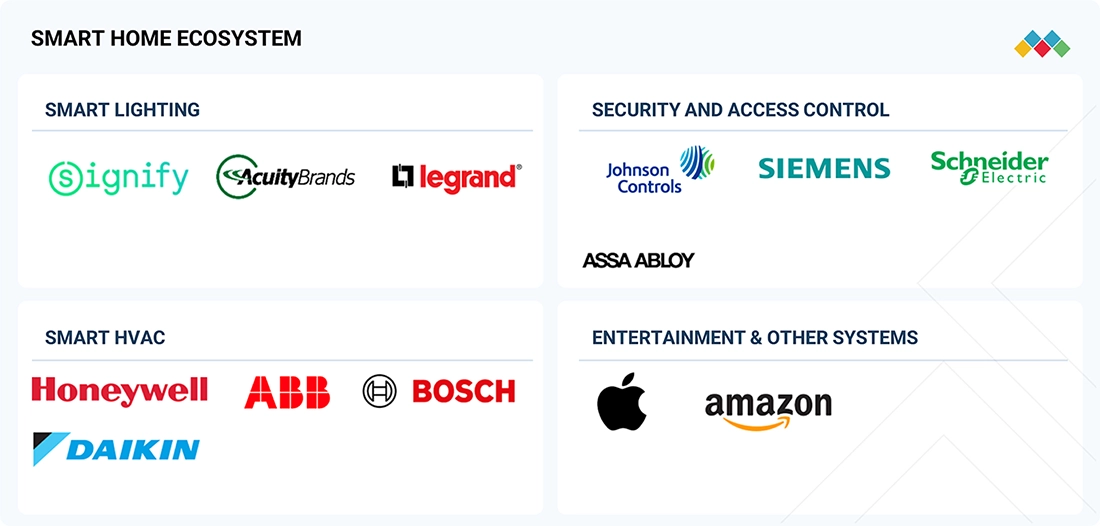
Logos and trademarks shown above are the property of their respective owners. Their use here is for informational and illustrative purposes only.
SMART HOME MARKET SEGMENTS
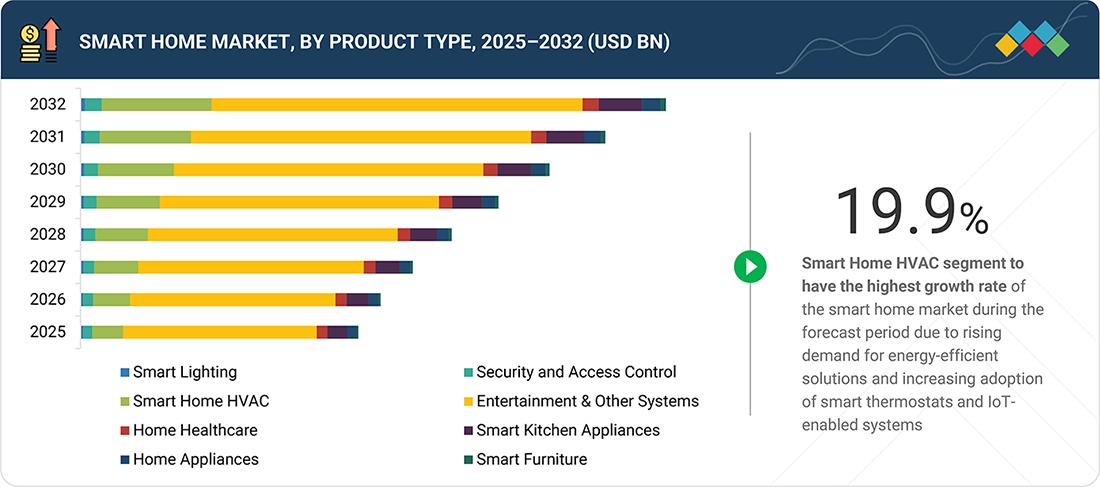
Source: Secondary Research, Interviews with Experts, MarketsandMarkets Analysis
Smart Home Market, By Product Type
The entertainment & other controls segment accounted for a significant market share in 2025, driven by the growing demand for real-time energy monitoring, HVAC optimization, and intelligent lighting control. The shift toward AI- and IoT-enabled analytics is enhancing interoperability and enabling predictive maintenance and sustainability-focused energy management across residential spaces.
Smart Home Market, By Installation Type
The retrofit segment accounted for a notable share in 2025, driven by the rising demand for upgrading existing residential infrastructure with smart technologies. Homeowners are increasingly adopting retrofit solutions to integrate smart devices without extensive structural modifications. The availability of wireless technologies and plug-and-play systems is simplifying installation processes. Additionally, growing awareness of energy efficiency and home automation benefits is encouraging consumers to modernize existing homes, thereby supporting the growth of the retrofit installation segment.
Smart Home Market, By End User
The individual homeowners segment held a significant market share in 2025, driven by the increasing preference for personalized and convenient living environments. Rising consumer awareness of smart home benefits, including enhanced security, energy efficiency, and remote accessibility, is fueling adoption. The availability of affordable smart devices and user-friendly platforms is further encouraging individual homeowners to invest in connected solutions. Additionally, growing demand for comfort, automation, and real-time control is strengthening this segment’s position in the market.
Smart Home Market, By Application
The safety and security segment accounted for a substantial market share in 2025, driven by increasing concerns regarding home safety and asset protection. The rising adoption of smart surveillance systems, video doorbells, and connected alarm solutions is supporting segmental growth. Advancements in AI-based monitoring, real-time alerts, and remote access capabilities are enhancing system effectiveness. Additionally, growing consumer focus on safety, combined with the need for continuous monitoring and control, is reinforcing the importance of this segment in smart home adoption.
SMART HOME MARKET REGION
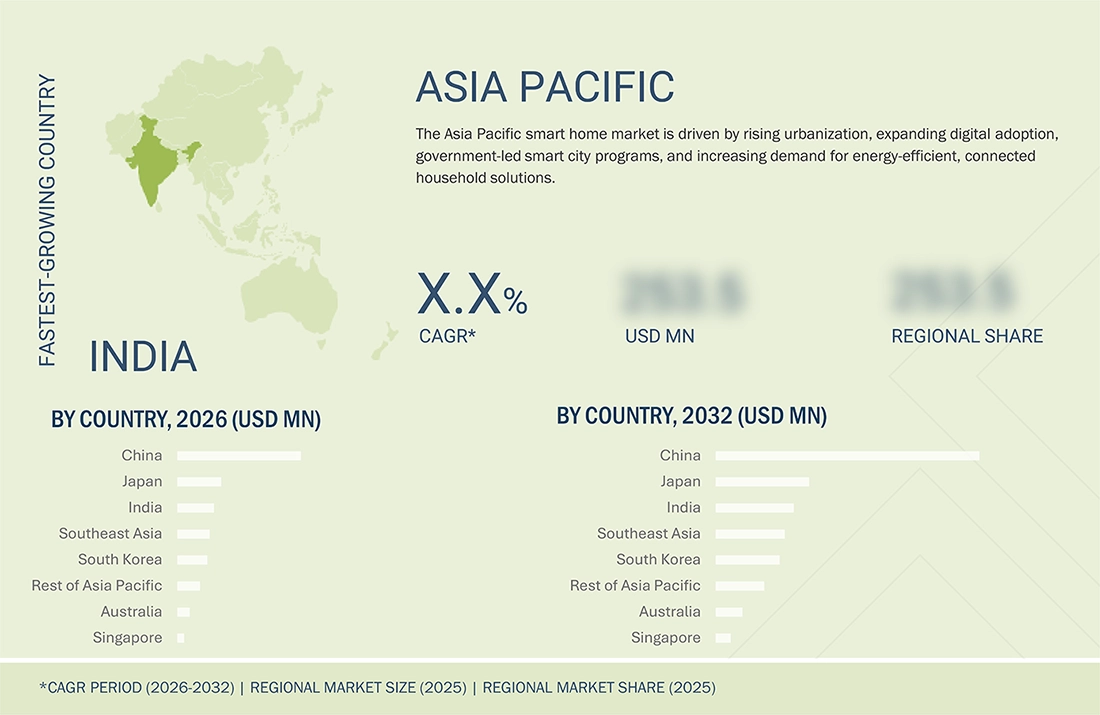
Asia Pacific is expected to be the fastest-growing region in the global smart home market during the forecast period.
The Asia Pacific region is the fastest-growing market, driven by strong government support for smart city development, rising digital adoption, and expanding urban infrastructure. China, in particular, is leading large-scale IoT deployment, high-speed connectivity upgrades, and nationwide smart home integration initiatives, accelerating adoption across residential and mixed-use environments. Government incentives promoting energy-efficient housing, combined with advancements in AI-powered home automation, smart security systems, and intelligent climate control technologies, are strengthening adoption in both single-family and multi-family homes. Additionally, the increasing integration of renewable energy solutions, smart metering, and cloud-connected home management platforms is enhancing household efficiency and user comfort, positioning the Asia Pacific as a leading hub for connected living innovation
North America smart home market is projected to reach USD 45.68 billion by 2030 from USD 32.58 billion in 2025, at a CAGR of 7.0% from 2025 to 2030. Growth is due to the high disposable income and strong consumer spending support early adoption of smart home technologies.
The Asia Pacific smart home market is expected to grow to USD 41.05 billion by 2030 from USD 27.77 billion in 2025, at a CAGR of 8.1 % from 2025 to 2030. The Asia Pacific smart home market is primarily driven by rapid urbanization, growing middle-class income levels, and rising consumer awareness of connected living and convenience-driven lifestyles.
The European smart home market was valued at USD 24.74 billion in 2025 and is projected to reach USD 36.12 billion by 2030; it is expected to register a CAGR of 7.9% during the forecast period..
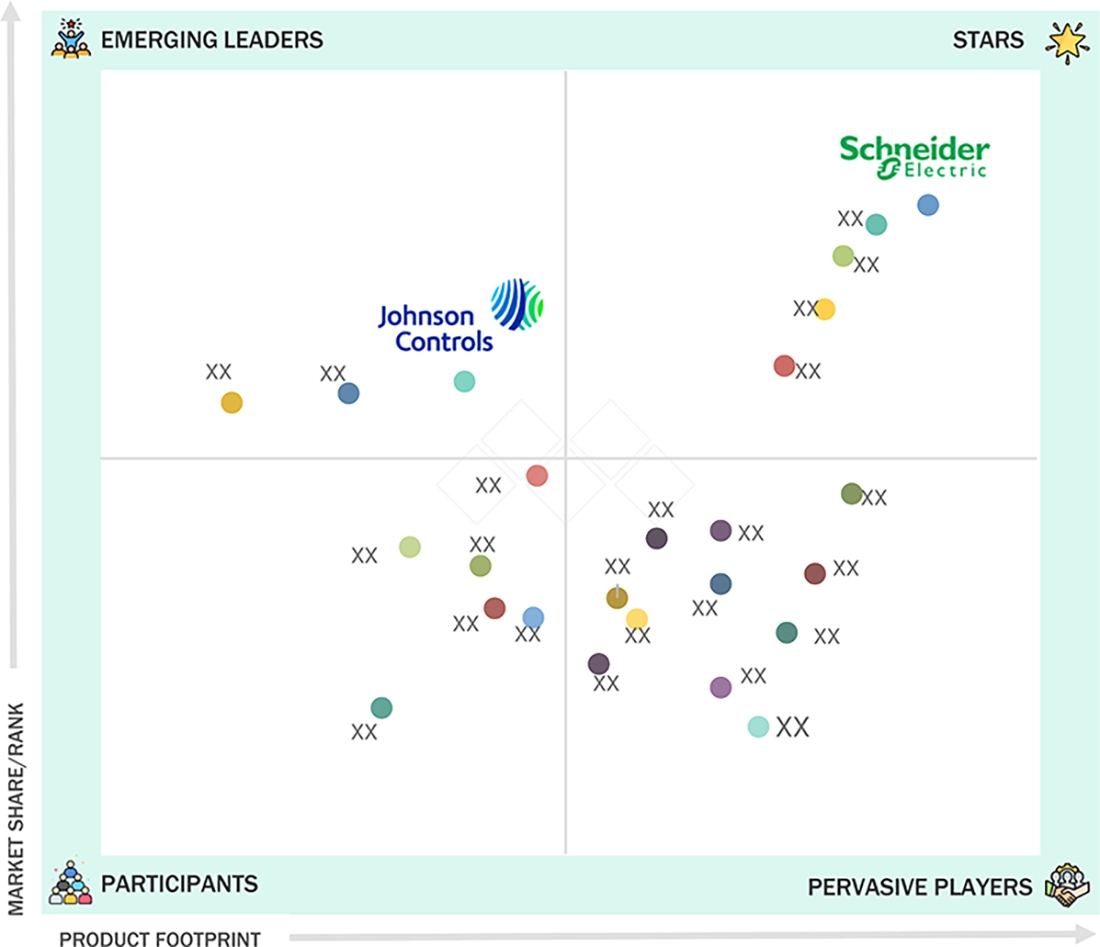
SMART HOME MARKET SIZE, SHARE & GROWTH, 2032: COMPANY EVALUATION MATRIX
In the smart home market, Schneider Electric (Star) holds a leading position with a strong global presence, comprehensive product portfolio, and proven expertise in integrated home automation systems, HVAC optimization, and smart energy management solutions. The company’s continued focus on system interoperability, digital twin integration, and AI-enabled analytics has reinforced its position as a top-tier provider across residential and mixed-use buildings. Johnson Controls (Emerging Leader) is demonstrating notable momentum through innovations in connected home solutions, IoT-enabled systems, and scalable cloud-based monitoring platforms, gaining significant traction among energy-efficient and smart living projects.
Source: Secondary Research, Interviews with Experts, MarketsandMarkets Analysis
SMART HOME MARKET KEY PLAYERS
- Schneider Electric (France)
- Siemens (Germany)
- Amazon.com, Inc. (US)
- Honeywell International Inc. (US)
- ASSA ABLOY (Sweden)
- Johnson Controls (Ireland)
- Robert Bosch (Germany)
- ADT (US)
- DAIKIN INDUSTRIES, Ltd. (Japan)
- ABB (Switzerland)
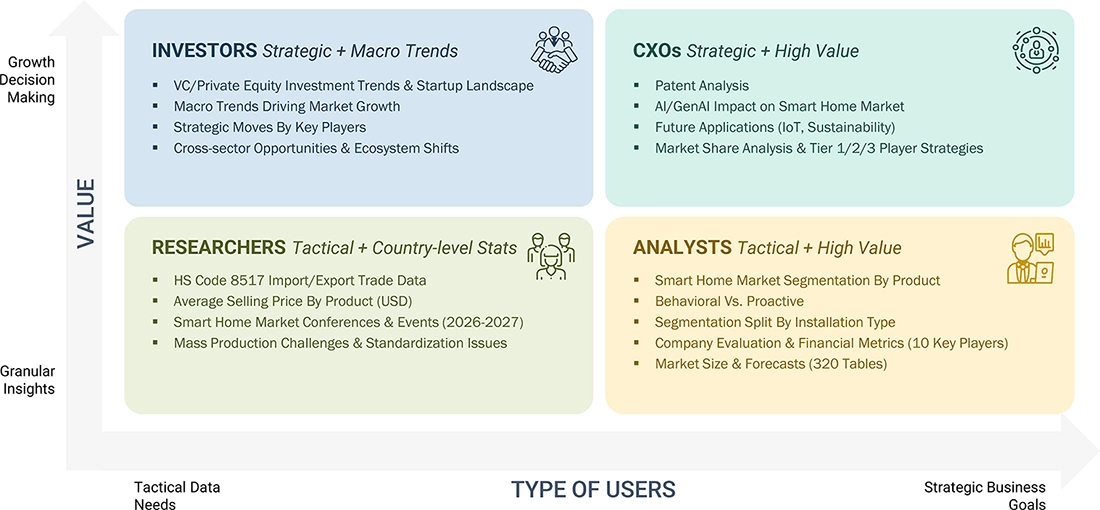
WHAT IS IN IT FOR YOU: SMART HOME MARKET SIZE, SHARE & GROWTH, 2032 REPORT CONTENT GUIDE
DELIVERED CUSTOMIZATIONS
We have successfully delivered the following deep-dive customizations:
| CLIENT REQUEST | CUSTOMIZATION DELIVERED | VALUE ADDS |
|---|---|---|
| Smart home device manufacturer | In-depth competitive profiling of leading smart home vendors across lighting, HVAC, and energy management systems; conducted strategic roadmap assessment for next-generation connected devices integrating AI, IoT, and cloud-based analytics; included M&A and partnership landscape analysis for regional expansion and technology collaboration. | Identified emerging product innovation clusters in Western Europe |
| Property developer / facility operator | Detailed benchmarking of smart home and automation deployments across multi-residential and commercial complexes | Conducted cost–benefit evaluation of IoT-enabled HVAC, lighting, and security integration |
| Energy and housing ministry / smart city authority | Conducted policy and infrastructure readiness mapping for nationwide smart home deployments | Evaluated interoperability and data protection frameworks aligned with GDPR |
| Technology provider / IoT platform integrator | Performed market mapping of connected home platforms covering AI-based automation software, cloud-enabled data analytics, and mobile app interoperability | Conducted evaluation of cybersecurity frameworks and IoT data compliance mechanisms for European markets. |
RECENT DEVELOPMENTS
- November 2025 : Siemens launched the Inhab Power Source Manager for residential energy ecosystems. This hardware solution integrates solar panels, batteries, and EV chargers dynamically. It provides cloud-based monitoring and optimization to maximize renewable self-consumption efficiency.
- June 2025 : Schneider Electric launched integrated home automation offering GPS-enabled appliance control, energy monitoring, and app-based control for smart living environments.
- June 2025 : Honeywell launched the Honeywell Home X2S smart thermostat during CES 2025. The thermostat is designed for easy installation and features a simple display with buttons, differentiating it from more high-tech models like the Google Nest Learning Thermostat, which typically utilize touchscreens.
Table of Contents
 Exclusive indicates content/data unique to MarketsandMarkets and not available with any competitors.
Methodology
The study involved four major activities in estimating the current size of the smart home market. Exhaustive secondary research was conducted to gather information on the market, adjacent markets, and the overall high-end refractometer landscape. These findings, along with assumptions and projections, were validated through primary research involving interviews with industry experts and key stakeholders across the value chain. Both top-down and bottom-up approaches were utilized to estimate the overall market size. Subsequently, market breakdown and data triangulation techniques were applied to determine the sizes of various segments and subsegments. Two key sources, secondary and primary, were leveraged to conduct a comprehensive technical and commercial assessment of the smart home market.
Secondary Research
The secondary research process referred to various secondary sources to identify and collect necessary information for this study. The secondary sources included annual reports, press releases, and investor presentations of companies; white papers; journals and certified publications; and articles from recognized authors, websites, directories, and databases. Secondary research was conducted to obtain key information about the industry’s supply chain, the market’s value chain, the total pool of key players, market segmentation according to the industry trends (to the bottom-most level), regional markets, and key developments from market- and technology-oriented perspectives. The secondary data was collected and analyzed to determine the overall market size, which is further validated through primary research.
Primary Research
Extensive primary research was conducted after gaining knowledge about the current scenario of the smart home market through secondary research. Several primary interviews were conducted with experts from the demand and supply sides across five major regions—North America, Europe, the Asia Pacific, South America, and the Middle East & Africa. This primary data was collected through questionnaires, emails, and telephonic interviews.
Breakdown of Primary Interviews

Notes: The three tiers of companies have been defined based on their total revenue as of 2025. The categorization given below has been applied:
Tier 1: >USD 1 billion, Tier 2: USD 250 million–USD 1 billion, and Tier 3: <USD 250 million.
Other designations include sales managers, marketing managers, and product managers
To know about the assumptions considered for the study, download the pdf brochure
Market Size Estimation
The bottom-up approach has been employed to arrive at the overall size of the smart home market from the revenues of key players and their share. Calculations based on revenues of the key players identified in the market led to the estimation of the market’s overall size.
- Initially, over 40 companies offering smart home solutions were identified. Their offerings were mapped based on product type.
- After understanding the different types of smart homes offered by various manufacturers, the market was categorized into different segments based on the data gathered through primary and secondary sources.
- To derive the global smart home market, global shipments of top players for each smart home device that were considered in the scope of the report were tracked.
- A suitable penetration rate was assigned for each product type to derive shipments of smart homes.
- The smart home market, based on different product types, was derived using the average selling price (ASP) at which a particular company offers its devices. The ASP of each device was identified based on secondary sources and validated from primary sources.
- For the projected market values of each device type, the Y-o-Y projections showed steep growth initially until 2025. The market is expected to witness a sharp ascent after that, considering the demand for smart homes for different applications.
- For the CAGR, the market trend analysis was carried out by understanding the industry penetration rate and the demand and supply of smart homes in different applications.
- The smart home market was also tracked through the data sanity method. The revenues of over 40 key providers were analyzed through annual reports and press releases and summed to derive the overall market.
- For each company, a percentage was assigned to its overall revenue or, in a few cases, segmental revenue to derive its revenue for the smart home. This percentage for each company was assigned based on its product portfolio and range of smart home offerings.
- The estimates at every level were verified and cross-checked by discussing them with key opinion leaders, including CXOs, directors, and operations managers, and finally, with the domain experts at MarketsandMarkets.
- Various paid and unpaid sources of information, such as annual reports, press releases, white papers, and databases, were studied.
- The global market size of smart homes was estimated through the data of 40 major companies.
- The growth of the smart home market witnessed an upward trend during the studied period, as it is currently in the initial stage of the product cycle, with major players beginning to expand their business into various application areas of the market.
- Types of smart homes, their features and properties, geographical presence, and key applications served by all players in the smart home market were studied to estimate and arrive at the percentage split of the segments.
- Different types of smart homes and their penetration for products were also studied.

Data Triangulation
After arriving at the overall market size—using the market size estimation processes as explained above, the market was split into several segments and subsegments. To complete the entire market engineering process and arrive at the exact statistics of each market segment and subsegment, data triangulation and market breakdown procedures were employed, wherever applicable. The data was triangulated by studying various factors and trends from the demand and supply sides in the smart home market.
Market Definition
A smart home is incorporated with advanced automation systems that enable inhabitants to monitor and control the functions of the house. Smart home systems enable owners to control lights, heating, ventilation, and air conditioning (HVAC), security alarms, and other household devices remotely through their smartphones, tablets, or computers. Smart homes are equipped with wired and wireless communication technologies such as Wi-Fi, Bluetooth, universal powerline bus (UPB), Insteon, Z-Wave, and Zigbee to offer intelligent insights and details to homeowners by continuously monitoring various aspects of the homes. As part of the Internet of Things (IoT), smart home systems and devices often operate together, sharing consumer usage data and automating actions based on homeowners’ preferences.
According to Smart Home Energy, an association in the UK, smart homes use home automation technologies to provide homeowners with intelligent feedback and information by monitoring many aspects of a home. For example, a smart home’s refrigerator may be able to catalog its contents, suggest menus, recommend healthy alternatives, and order replacements as food is used up.
Key Stakeholders
- Device & Hardware Manufacturers
- Platform & Ecosystem Providers
- Software & IoT Solution Providers
- Semiconductor & Component Suppliers
- Telecom & Connectivity Providers
- System Integrators & Installers
- Real Estate Developers & Construction Companies
- Energy & Utility Providers
- Security & Monitoring Service Providers
- E-commerce & Retail Channels
- Regulatory Bodies & Government Organizations
- End Users (Residential Consumers)
Report Objectives
- To define, describe, and forecast the smart home market by residence type, protocol & communication technology, product type, installation type, control interface, end user type, application, and region, in terms of value
-
To forecast the market size, in terms of value, for various segments with regard to
main regions— North America, Europe, the Asia Pacific, South America, and the Middle East & Africa - To provide detailed information regarding major factors such as drivers, restraints, opportunities, and challenges influencing the growth of the market
- To analyze the supply chain, market ecosystem, trends/disruptions impacting customer business, technology analysis, pricing analysis, Porter’s five forces model, key stakeholders and their buying criteria, case study analysis, trade analysis, patent analysis, key conferences and events for the upcoming quarters, regulations related to the market, and investment and funding scenario
- To analyze the micromarkets with respect to industry trends, prospects, and contribution to the total market
- To analyze the AI/Generative AI impact and the US tariff impact on the market
- To analyze opportunities in the market for stakeholders by identifying high-growth segments of the market and providing a detailed competitive landscape for market leaders
- To profile key players and comprehensively analyze their market position in terms of ranking and core competencies
- To analyze strategic developments such as product launches, collaborations, contracts, expansions, and partnerships undertaken by the leading players in the market
Available customizations:
With the market data given, MarketsandMarkets offers customizations according to the company’s specific needs. The following customization options are available for the report:
Company Information:
- Detailed analysis and profiling of additional market players (up to five)
Key Questions Addressed by the Report
What is the current size of the Smart Home Market?
The global Smart Home Market was valued at approximately 213.73 billion in 2025.
What is the projected market size of the Smart Home Market by 2029?
The market is projected to reach around USD 450.20 billion by 2032, driven by rising adoption of connected devices and home automation technologies.
What CAGR is expected for the Smart Home Market during the forecast period?
The Smart Home Market is expected to grow at a CAGR of around 11.8% from 2025 to 2032.
What are the major trends shaping the Smart Home Market?
Key trends include AI-powered home automation, IoT-enabled devices, voice-controlled assistants, smart security systems, energy management solutions, and connected home ecosystems.
What is a major growth driver for the Smart Home Market?
A major growth driver is the rising internet penetration and proliferation of connected smart devices, enabling seamless connectivity, automation, remote monitoring, and real-time control.
Which companies are leading the Smart Home Market?
Major companies include Amazon, Google, Apple, Samsung Electronics, Honeywell, Schneider Electric, Johnson Controls, ABB, Siemens, and Robert Bosch.
Which industry segment is driving Smart Home Market growth?
The residential segment dominates the market due to increasing adoption of smart speakers, lighting systems, security devices, smart appliances, and energy management solutions.
What are the key applications of smart home technologies?
Major applications include smart security, lighting control, entertainment systems, HVAC management, smart appliances, energy monitoring, and home automation platforms.
Which region holds a significant share of the Smart Home Market?
North America holds a major market share due to high technology adoption, strong IoT infrastructure, and demand for connected home solutions. Asia Pacific is expected to witness strong growth due to increasing urbanization and digital connectivity.
What does the report analysis indicate about the future of the Smart Home Market?
The report indicates strong future growth driven by IoT expansion, AI integration, smart device adoption, increasing internet connectivity, energy efficiency needs, and growing demand for automated living solutions.
Need a Tailored Report?
Customize this report to your needs
Get 10% FREE Customization
Customize This ReportPersonalize This Research
- Triangulate with your Own Data
- Get Data as per your Format and Definition
- Gain a Deeper Dive on a Specific Application, Geography, Customer or Competitor
- Any level of Personalization
Let Us Help You
- What are the Known and Unknown Adjacencies Impacting the Smart Home Market
- What will your New Revenue Sources be?
- Who will be your Top Customer; what will make them switch?
- Defend your Market Share or Win Competitors
- Get a Scorecard for Target Partners

Custom Market Research Services
We Will Customise The Research For You, In Case The Report Listed Above Does Not Meet With Your Requirements
Get 10% Free CustomisationTESTIMONIALS

Tetsuya Ohhira
Business Development Manager-Technology Business
Nikon Corporation,
Leading Japanese MNC specializing in optics and imaging productswww.nikon.com
MarketsandMarkets™ response
is quick. Their attitude is flexible and positive. Analyst Insights are globally considered and
significant. Client Services quickly respond to our inquiry and demand. Their wide range of global
surveys help us make our strategic plan.
We hope Knowledge Store will be easier to search
for a report.
VP - Marketing & Business Development
Leading Provider of Process Control Solutions
We engaged with MarketsandMarkets on a study to perform an analysis and recommend a Go-To-Market strategy for metrology and process control in the semiconductor market. The study was tailored to our targets and needs with well-defined milestones. Our overall experience with the MarketsandMarkets team was very good throughout the project in all aspects including the analysis methodologies used, the quality and depth of primary and secondary data sets, the professionalism and flexibility of the team and the ability to meet the target schedule and milestones. We want to thank MarketsandMarkets team for a job well done.
Growth opportunities and latent adjacency in Smart Home Market







piter
Mar, 2019
Need to understand about market share analysis..
matt
Sep, 2015
On this report - is it possible to get a market forecast and other commentary on the Middle East region? .
User
Jan, 2020
What is the market size of the Middle-East smart home market?.
Kevin
Jan, 2017
Will Google and Amazon or any other big player enter the market for central controlling device of the smart home, are players like alarm.com on their way out?.
Johanna
Mar, 2019
I would like to get an overview of the heating/cooling, security, connected care and remote diagnostics of the smart home market..
Maegan
Nov, 2017
Looking specifically at Security & Access Control, HVAC, Entertainment in US markets and growth trends technology diffusion, learning curves and competition, and IP analysis..
Jiangyu
Jun, 2019
Hi, I'd like to learn more about the smart home market, including its market size and growth trend, details of different product categories and strong players in this domain. I would appreciate a lot if you can provide me a sample of this report..
David
Apr, 2026
What are the main risks for investors in the smart home IoT market (fragmentation, standard wars, slow adoption, supply chain constraints)?.
Bertie
Apr, 2026
Which region offers the highest ROI for smart home IoT expansion (US vs EU vs APAC)?.
Christy
Oct, 2014
Does this report provide data on any new industries that consumers have indicated an interest in for smart home technologies, such as lawn and garden or outdoor living/spaces?.
William
Jun, 2015
I am looking at a few different markets and I am hoping for at least the following questions: I am looking for the following items in order from most important to least important. 1: Forecast 3-5 years through 2025 (Units and Revenue) broken down by country: US, Canada, France, Belgium, UK, Netherlands (all of Europe) 2: 2019 actuals by competitor share 3: Historical (2017, 2018)..
Rebecca
Mar, 2019
Dear Sir, we're on the process of working on smart home market now. Can we get market research report example from your side. .
Joana
Feb, 2015
I would like to obtain projections for the investments in the smart homes market in Europe and possible projections of human resources involved in the smart homes field (graphics with these information's if possible)..
James
Oct, 2018
Hi, we are particularly interested in smart lock market size and penetration rate of different countries, do you got any report suitable for this? .
Sachin
Sep, 2019
I am extremely fascinated by the idea of smart homes as it is a way forward for the construction & designing industry. I am planning to setup a venture in this space, and for that I wish to do a thorough and detailed research about its market share, customer requirements and future prospects..
Ian
Nov, 2014
Hi, I am interested to know about the reform in our industry. Especially the development of new innovations that can help provide additional value to customers..
VALERY
Mar, 2019
In case of market analysis, we would like to understand this market before launching our SaaS solution. .
Hoa
Mar, 2015
I'd like to know the market segmentation and in particular anything about the smart homes in the bathroom..
Chuck
Feb, 2019
I am an MBA student and as part of my final project I am researching the smart home and smart home security industry. I came across this report in my search and think it would be beneficial to my research. I cannot afford to pay for this report, but would appreciate a sample PDF or a full copy. .
Paul
Feb, 2015
I am interested to know about this market. This is purely for individual curiosity, not a business interest at this time..
Marcel
Mar, 2016
Looking to understand viability of installation and customization services company for the smart home market in greater LA. Is there demand for these services today?.
Marcel
Mar, 2016
Looking to understand viability of installation and customization services for smart home market in North America. What is the current demand for these services?.
Rahul
Jun, 2019
I'm thinking of setting up a smart home products company and I needed some data to understand consumers. Would be great if you could share a sample that's more geared towards consumer personals / profiles. .
Jaroslaw
Nov, 2018
Dear Team Members, I would like to find out, if you could sell us the report for the UK market only. If so, what would be the price? .
Philipp
Mar, 2016
Need information on Smart Home Market by Product especially for Air Quality surveillance including Temperature, Humidity and air pollutants like PM2.5, VOCs, Ozone etc..
Madeleine
Feb, 2019
Writing my thesis on voice interaction in the smart home and would like to get a free sample of the report if possible..
Andrew
Jul, 2022
I will be looking at:* UK Specific Smart home market data only* The ability to look at lock penetration by market segment* The ability to understand lock type sold in volumes* To understand ideally, who is selling these locks* To understand/confirm the route to market for these.This will allow me to propose market opportunities for our existing solutions and proposals for those we need to develop further..
Rom
Mar, 2019
Our team is evaluating investment opportunities in the space and is analyzing whether this is a market thematic to pay attention to. Kindly clarify about your report scope..
Sam
Mar, 2017
Interest in smart thermostat and home surveillance markets. Particularly NEST products and competitor products.
Aug, 2019
Looking for quality market data on smart home space, as well as additional specifics around the smart lighting sub-category..
Jae
Feb, 2019
I want to write a paper on which company is the most important firm in Home IoT, with its key local suppliers or intermediaries information. I also require a brief initial description of the kind of governance structure that characterizes home IoT industry. .
Benas
Apr, 2019
I wish to use the information presented in the article for research on the smart home market as part of a bachelor's project..
Fangzhou
Apr, 2019
Our company is building an IoT platform, and smart home is the most important part of IoT project. So we want to download this article and learn more about marketing information..
davidhuang
Mar, 2019
Hello, could you pls send me the pdf brochure of Global forecast of Smart home market in the next 3-5years? .
Darshan
Dec, 2015
Specifically interested in a deep dive of the home appliance segment, with a further deep dive of the smart components used within each category. Services are also an area of interest, as there is potential for revenue models based on this..
Franz
Sep, 2019
Need to identify addressable market, related to numbers of connected appliances and know about estimates for software market size..
Abdullah
Apr, 2019
I'm starting a smart home construction business and looking for information on the smart homes market segmentation in South Africa..
Ted
Feb, 2015
I am a tech industry journalist. I would like the whole report if possible to extract a few items from..
ram
Oct, 2016
Interested in smart home market for internet service providers in 2016-2022. Need to know market trends for applications for safety &security and entertainment..
Francis
Apr, 2019
I am currently reviewing an investment opportunity for major corporations in this sector. Need general market trends. .
Joongho
Sep, 2019
I'm conducting consult study for a government agency and writing report for construction road map. So I need global market forecast about Smart Home..
Ankit
Aug, 2019
I am a student studying MBA and I am interested in this report which can help me in my project assignment. It would be grateful if you could provide the report free of cost for my project..
sissiyam
May, 2019
My company will launch the new product line, smart home products and we want to extend oversea market and need to understand about the market..
Bernardino
Jul, 2016
I am interested to get samples of: Smart Home Market by Lighting Control (Timer, Daylight Sensor, Occupancy Sensor) - Security & Access Control - HVAC - Entertainment - Home Healthcare - Smart Kitchen. .
Philippa
Aug, 2018
Just looking for projected market size to calculate building industry growth for a school assignment..
Nabil
Mar, 2019
We are a startup in Smart Homes and would love to understand the market a little better - we don't have the scale to afford the full report but start with the sample and then hopefully as we scale and can afford the full report in some time..
Francisco
Feb, 2019
We need to understand about the research methodology used by MarketsandMarkets for market size calculation?.
jinlong
Jan, 2014
I am interest in product analysis and global forecast, especially for the market in America and Canada. .
Sibay
Nov, 2017
Market penetration of smart homes potential for Turkey region. .
Izabela
Oct, 2019
I'm looking for data about smart refrigerators (or household products) and how many people use them now and plan to use in the future. I'm preparing press release about Korean company which cooperates with my Client and this data will be helpful to make my article more interesting..
Sayantani
May, 2019
To The Team of Markets and Markets. What we are looking for the facts & figures that will tell us how many smart homes are built in India and what is the percentage of that compared to the total number of homes built in the country (a region-specific report would be very useful). The report should also include general trends and other related statistics, the key market players, and also the possible impact of the home automation phenomenon on builders, system integrators and other middle players/ channel partners. Please let us know if such report is available and what is the price of the same. .
kristine
Dec, 2016
Our product line engage with smart home automation devices, all parts and functionality therein; and we are interested in the following sections: 1. Who are the prime distributor of smart home systems in Dubai, Europe, and emerging cities in Russia 2. Who are the major integrators, building supplier/contractors for residential buildings, hotels, and or business centers in Dubai, Europe..
Patrick
Dec, 2016
Dear MarketsandMarkets Team, I am a student and in one subject we have to generate business model for a start-up idea for active assisted living. Thus, we also have to come up with a market analysis and I think that the reports could be used as a reliable source because of your expertise. Since I am a student, I cannot buy all the reports I would like to have, therefore I only can ask you if you would be so kind to offer me this report. .
Damola
Nov, 2016
Hi, I am very interested in learning more about Smart Home report or anything that you may have that's specific to the North America market. We are looking to learn more about the industry and would like to discuss what your report entails. .
Valentin
Oct, 2019
Dear Markets and Markets Team, for my dissertation in Marketing Management in Turin (Italy), I need some information and statistic data about trend of Smart Home Market. .
Laura
Sep, 2015
Need to know about market scenario for commercial/residential security systems CCTV (commercial/residential) systems, access control (commercial/residential systems), and fire (commercial) systems..
Jann
Sep, 2015
We would like to know which are smart gateway major players and overall units shipped. .
Cade
Sep, 2019
I'm looking to get a better understanding of the your smart home market definition, as well as an understanding of for which segment the key growth is expected over the next few years. We're trying to ascertain the relevance of standalone product sales vs. bundled subscriptions, and which will more greatly influence projected growth. .
Anton
Sep, 2019
We are interested in smart home control and engineering automation systems..
Anton
Sep, 2019
We are interested in intelligent buildings management system..
chris
Aug, 2011
Client is looking for some clarification on market numbers and trends..
Helen
Aug, 2016
I am interested in how the Smart Home Market and market scenario of Europe region. .
Gary
Aug, 2019
Need market analysis of smart home products in China. Who are the main players, what is the size of the market..
혜영
Jul, 2015
Need to understand about the market scope and coverage..
Veijo
Jul, 2016
I belong to the group that makes an international study on request of government agencies. The aim of the study is to investigate how new smart technology solutions and innovations as well as the ongoing process of digitalization of services could support and facilitate independent and safe living at home for older people. It is also essential to consider the international context and cooperation. The research consortium will interview expert in companies and research institutions/universities and make e-mail surveys in order to collect the necessary date for study. This involves several countries (Denmark, the Netherlands, USA and Japan) and will be carried out between June 2020 and December 2020..
carl
Jul, 2010
Need to know about market growth rate, key global service providers for the smart home market, and key smart home device manufacturers..
Sohail
Jul, 2021
Hi greetings! I have seen that you have analyzed Schneider Electric. Is there a possibility to just get total information about them, instead of this report ?. Waiting for your response. .
Joshua
Jul, 2019
Hi, I am looking at a subset of this report. My only interest and focus is on Smart Thermostats and nothing else. What would be the cost for sub section of this report that only includes information on smart thermostats?.
Jordan
Jul, 2019
For personal knowledge I would like to understand the current size of the smart home market and its predicted future growth..
Justin
Jul, 2013
I would like to buy smart home market sample report. Can u send me via e-mail? This is for study of market insight in general. .
Artyom
Jun, 2014
Dear Team Members, we are group of three students of eMBA program and we are making a master project on Smart Home Renovation Solutions. Your market report may be useful in our work. Would it be possible to buy it with any discount?.
Renee
Jun, 2019
I'm writing a story about practical home gadgets, like fitness gadget MIRROR, smart fridges, robotic lawnmowers, etc. I'd love to chat with an expert about industry trends..
Weibost
Jun, 2019
We need to know more about the Smart Home. We need to get information on market for smart kitchen and home appliances. .
Julien
Jun, 2011
I want some parts of this report for a school study. In fact, I study in an engineering school and I have to do a project of enterprise creation in home automation. .
Hamza
May, 2016
Need details on Smart Home Market by Product (Lighting Control (Timer, Daylight Sensor, Occupancy Sensor), Security & Access Control, HVAC, Entertainment, Home Healthcare and Smart Kitchen), Software & Service (Behavioral, Proactive), and Geography - Global Forecast to 2022 .
Eric
May, 2019
Focusing on investment and M&A opportunities in the Smart Home, Connected Home, Home Automation and IoT (residential/home) space. Looking at research sources to support investment strategies..
Elvis
May, 2019
I am interested in understanding the overall market my company is in and make recommendations if needed..
Manon
Apr, 2018
Hello, I am a first year master's degree student. Please could you send me the sample of the marketing study case by email (I'm very interested in the "Smart Kitchen"). .
Andrea
Apr, 2017
Good Evening, I am a Master's student, writing my dissertation about an evaluation of the smart home market. I was wondering if I could get free access to this report to include it in my academic research. .
J
Apr, 2019
This is a new industry for me, so I wonder if I can obtain more information about it. I appreciate it if you could send me a copy. .
Natasha
Mar, 2018
The robot that we offer is also incorporated with Alexa speaking interaction. Need to know how smart home devices will help us to understand our go to market strategies..
Franca
Mar, 2019
I am currently writing a thesis about Smart Homes and it would be very valuable to get the insights from this study. .
Richard
Mar, 2015
I'm interested in topline numbers for the development of the smart home market across Europe for an article I'm writing. What is the current European position in terms of smart homes devices shipped in 2018 and where those to numbers will go by 2025. .
Bryan
Feb, 2019
We are analyzing an opportunity in the smart home space and would like to better understand the breakdown of the smart home marketing by category..
Anne
Feb, 2010
Interested to know about market size for energy management devices for consumer consumption?.
Tim
Feb, 2017
We are hoping to understand who are the major companies in each of the product categories, preferably with sales figures. .
Mahmoud
Feb, 2017
Need information on Smart home Lighting control Smart Kitchen, Security, Access Control Software & Service ..
George
Jan, 2019
Need information on smart home IoT barriers. Education and benefit value proposition are real barriers to market penetration. .
Ofer
Jan, 2015
Need to know about upcoming market trends and their effects..
Monika
Jan, 2015
Need to know about market scenario for connected lighting - lighting's role and place in a smart home, consumer insights, expectations, and demand..