The study involved four major activities in estimating the size of the Asia Pacific smart home market . Exhaustive secondary research has been carried out to collect information on the market, the peer markets, and the parent market. Both top-down and bottom-up approaches have been employed to estimate the total market size. Market breakdown and data triangulation methods have also been used to estimate the market for segments and subsegments.
Secondary Research
Revenues of companies offering data center accelerator systems have been obtained from the secondary data available through paid and unpaid sources. The revenues have also been derived by analyzing the product portfolio of key companies, and these companies have been rated according to the performance and quality of their products.
In the secondary research process, various sources have been referred to for identifying and collecting information for this study on the Asia Pacific smart home market share . Secondary sources considered for this research study include government sources, corporate filings, and trade, business, and professional associations. Secondary data has been collected and analyzed to arrive at the overall market size, which has been further validated through primary research.
Secondary research has been mainly used to obtain key information about the supply chain of data center accelerator systems to identify key players based on their products and prevailing industry trends in the Asia Pacific smart home market share by product, offering, sales channel, and installation type, and region. Secondary research also helped obtain market information- and technology-oriented key developments undertaken by market players to expand their presence and increase their market share.
Primary Research
Extensive primary research has been conducted after understanding and analyzing the current scenario of the Asia Pacific smart home market share through secondary research. Several primary interviews have been conducted with the key opinion leaders from the demand and supply sides across Asia Pacific. Approximately 25% of the primary interviews were conducted with the demand-side respondents, while approximately 75% were conducted with the supply-side respondents. The primary data has been collected through questionnaires, emails, and telephone interviews.
After interacting with industry experts, brief sessions were conducted with highly experienced independent consultants to reinforce the findings from our primary. This, along with the in-house subject matter experts’ opinions, has led us to the findings as described in the remainder of this report. The breakdown of primary respondents is as follows:
To know about the assumptions considered for the study, download the pdf brochure
Market Size Estimation
The bottom-up approach has been employed to arrive at the overall size of the Asia Pacific smart home market share from the revenues of key players and their share. Calculations based on revenues of the key players identified in the market led to the estimation of the market’s overall size.
-
Approach to arrive at market size using bottom-up analysis (demand side)
-
Initially, over 25 companies offering Asia Pacific smart home solutions were identified. Their offerings were mapped based on products, software, and services.
-
After understanding the different types of Asia Pacific smart homes offered by various manufacturers, the market was categorized into different segments based on the data gathered through primary and secondary sources.
-
To derive the Asia Pacific smart home market share , global shipments of top players for each smart home device in Asia Pacific considered in the scope of the report were tracked.
-
A suitable penetration rate was assigned for each product type to derive the shipments of Asia Pacific smart home market.
-
Market share was derived the Asia Pacific smart home market based on different product types using the average selling price (ASP) at which a particular company offers its devices. The ASP of each device was identified based on secondary sources and validated from primaries.
-
For the projected market values of each device type, the Y-o-Y projections showed a steep growth initially until 2023. The market is expected to witness a sharp ascent after that, considering the demand for Asia Pacific smart homes for different applications.
-
For the CAGR, the market trend analysis was carried out by understanding the industry penetration rate and the demand and supply of Asia Pacific smart homes in different applications.
-
The Asia Pacific smart home market share is also tracked through the data sanity method. The revenues of over 25 key providers were analyzed through annual reports and press releases and summed to derive the overall market.
-
For each company, a percentage is assigned to its overall revenue or, in a few cases, segmental revenue to derive its revenue for the Asia Pacific smart homes market. This percentage for each company is assigned based on its product portfolio and range of Asia Pacific smart homes offerings.
-
The estimates at every level have been verified and cross-checked by discussing them with key opinion leaders, including CXOs, directors, and operation managers, and finally, with the domain experts at MarketsandMarkets.
Various paid and unpaid sources of information, such as annual reports, press releases, white papers, and databases, have been studied’
The top-down approach has been used to estimate and validate the total size of the Asia Pacific Smart Home Industry .
-
The market size of Asia Pacific Smart Homes market was estimated through the data sanity of 25 major companies.
-
The growth of the Asia Pacific smart homes industry witnessed an upward trend during the studied period, as it is currently in the initial stage of the product cycle, with major players beginning to expand their business into various application areas of the market.
-
Types of smart homes, their features and properties, geographical presence, and key applications served by all players in the Asia Paciific smart home Industry were studied to estimate and arrive at the percentage split of the segments.
-
Different types of smart homes and their penetration for products in Asia Pacific were also studied.
-
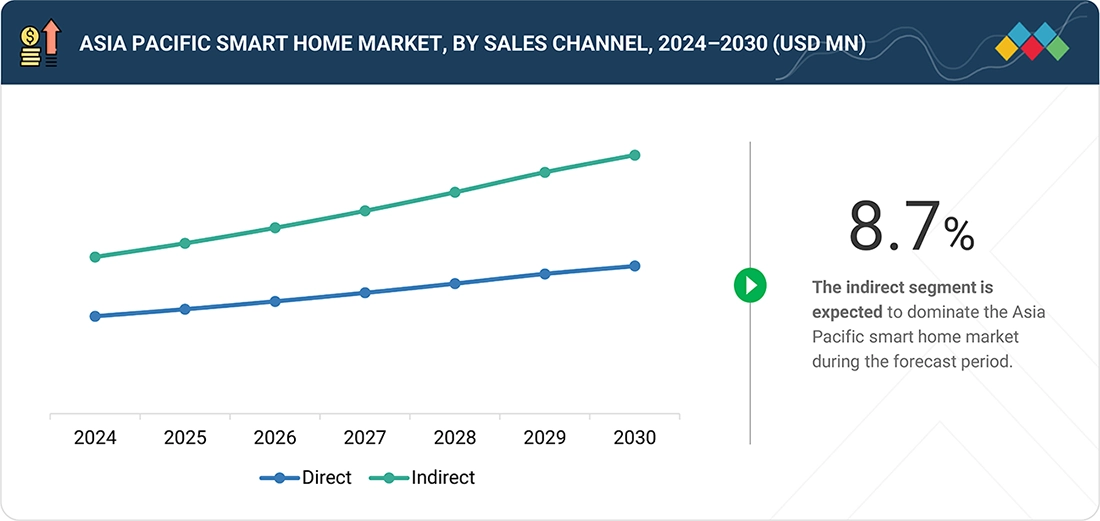
Based on secondary research, the market split for Asia Pacific smart homes market by sales channel, offering, and installation type was estimated.
-
Multiple discussions with key opinion leaders across major companies involved in developing the Asia Pacific smart home market and related components were conducted to validate the market split of sales channel, offering, and installation type.
-
The regional splits were estimated using secondary sources based on factors such as the number of players in a specific country and region and the adoption and use cases of each implementation type with respect to products in the region.
Data Triangulation
After arriving at the overall market size-using the market size estimation processes as explained above-the market has been split into several segments and subsegments. To complete the entire market engineering process and arrive at the exact statistics of each market segment and subsegment, data triangulation and market breakdown procedures have been employed, wherever applicable. The data has been triangulated by studying various factors and trends from the demand and supply sides in the Asia Pacific smart home Industry growth.
Market Definition
A smart home is incorporated with advanced automation systems that enable inhabitants to monitor and control the functions of the house. Smart home systems enable owners to control lights, heating, ventilation, and air conditioning (HVAC), security alarms, and other household devices remotely through their smartphones, tablets, or computers. Smart homes are equipped with wired and wireless communication technologies such as Wi-Fi, Bluetooth, universal powerline bus (UPB), Insteon, Z-Wave, and Zigbee to offer intelligent insights and details to homeowners by continuously monitoring various aspects of the homes. As part of the Internet of Things (IoT), smart home systems and devices often operate together, sharing consumer usage data and automating actions based on homeowners’ preferences.
According to Smart Home Energy, an association in the UK, smart homes use home automation technologies to provide homeowners with intelligent feedback and information by monitoring many aspects of a home. For example, smart home refrigerators may be able to catalog its contents, suggest menus, recommend healthy alternatives, and order replacements as food is used up.
Key Stakeholders
-
Raw Material and Manufacturing Equipment Suppliers
-
Automation and Control Vendors
-
Automation and Control Networking Technology Vendors
-
Real Estate Builders
-
System Integrators
-
Homeowners
-
Project Consultants
-
Designers/Consultants (HVAC, Security, and Fire and Safety)
-
Component Manufacturers (Sensors and Controls)
-
Home Management System (Products and Servers) Providers
-
Asia Pacific Smart Home-related Associations, Organizations, Forums, and Alliances
-
Government Bodies Associated with Green Buildings
Report Objectives
-
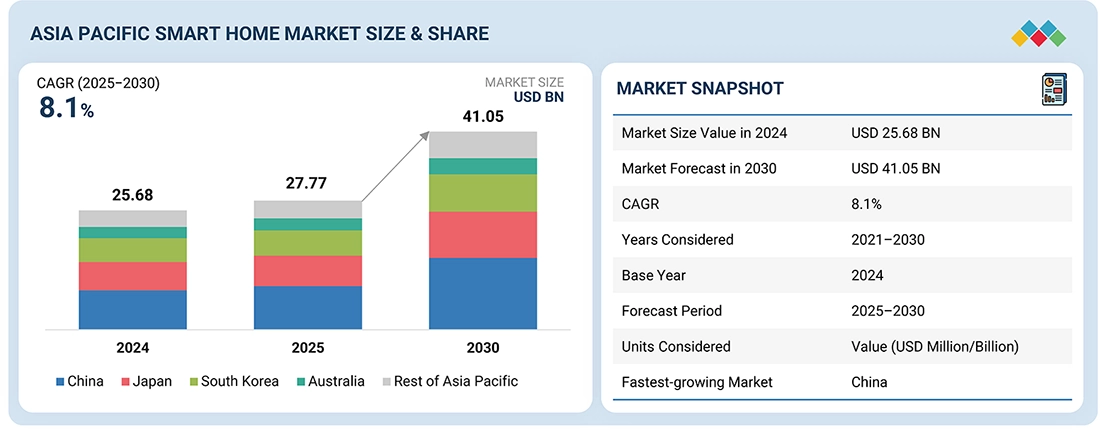
To define, describe, segment, and forecast the Asia Pacific smart home market, by product, offering, sales channel, and installation type, in terms of value
-
To forecast the market for products, in terms of volume
-
To describe the protocols and technologies used for Asia Pacific smart home market
-
To provide detailed information regarding the drivers, restraints, opportunities, and challenges influencing the growth of the Asia Pacific smart home industry
-
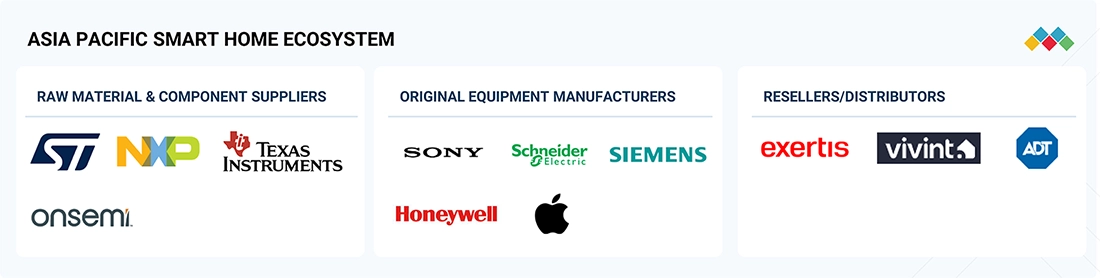
To provide a detailed overview of the Asia Pacific smart home market supply chain, along with the ecosystem, technology trends, use cases, regulatory environment, and Porter’s five forces analysis
-
To analyze industry trends, pricing data, patents and innovations, and trade data (export and import data) related to the Asia Pacific smart home market
-
To strategically analyze the micromarkets1 with respect to individual growth trends, prospects, and contributions to the total market
-
To strategically profile the key players and comprehensively analyze their market shares and core competencies2
-
To analyze opportunities for stakeholders and provide a detailed competitive landscape of the market
-
To analyze competitive developments, such as product launches/developments, collaborations, partnerships, acquisitions, and research & development (R&D) activities carried out by players in the Asia Pacific smart home Industry
Available customizations:
With the given market data, MarketsandMarkets offers customizations according to the specific requirements of companies. The following customization options are available for the report:
-
Detailed analysis and profiling of additional market players based on various blocks of the supply chain











Shuyi
May, 2019
I am currently collecting customer data to enter Indonesian smart home market. The report could really help..