Competitive Intelligence: Staying Ahead in Sales Technology
September 16, 2025

Ever wondered why some companies always seem to have the best sales automation software before everyone else? Competitive intelligence is that secret weapon separating market leaders from the pack.
I've seen firsthand how staying informed about competitor moves can transform sales outcomes. Sales automation tools aren't just about efficiency—they're about gaining that crucial edge. Additionally, understanding what sales automation platforms your competitors use allows you to anticipate their strategies and counter them effectively.
In this exciting world of sales technology, knowledge truly equals power. Throughout this article, I'll show you exactly how to gather, analyze, and act on competitive intelligence that will keep you ahead of the curve. From tracking competitor announcements to creating battle cards that win deals, we'll cover the practical steps that turn information into results.
STOP GUESSING YOUR PIPELINE
START GROWING IT WITH AI SALES!!
In today's fast-paced sales technology landscape, competitive intelligence has transformed from a nice-to-have into a business necessity. The companies at the forefront of sales automation aren't just lucky—they're strategically informed about market movements and competitor activities.
Competitive intelligence (CI) in 2025 is far more dynamic, data-driven, and business-critical than ever before. At its core, CI is the systematic process of gathering, analyzing, and disseminating information about competitors with the goal of providing actionable insights for informed decision-making. This intelligence helps identify opportunities and threats while developing effective sales and marketing strategies.
In recent years, the importance of competitive intelligence has grown substantially, with team sizes increasing by 24% from previous years. This growth reflects not just increased investment but a fundamental shift in how businesses view competitive information.
Modern CI has evolved beyond simple competitor tracking. It now encompasses:
Analysis of adjacent industries and broader market forces
Regulatory shifts and their potential impact
Partner and supply-chain dynamics
Customer intelligence and preference patterns
Furthermore, AI has become a game-changer in the competitive intelligence space. There's been a remarkable 76% year-over-year increase in AI adoption within CI teams, with 60% of teams now using AI daily. This technological integration allows for analyzing massive volumes of unstructured data in seconds, automating routine tasks, and surfacing insights faster than humanly possible.
Today's competitive intelligence falls into two main categories: tactical and strategic. Tactical CI focuses on short-term needs and immediate actions—like pricing strategies or marketing campaigns. Meanwhile, strategic CI looks at long-term planning through comprehensive analysis of industry trends, technology shifts, and macroeconomics.
For sales teams using automation platforms, competitive intelligence has become indispensable. Indeed, sales teams are getting hungrier for competitor intel as more deals face competitive challenges. In fact, 60% of buyers only connect with sales representatives after they've researched options and created their shortlist. Consequently, sales professionals need comprehensive competitor intelligence to effectively educate these well-informed buyers.
A well-designed competitive intelligence program significantly impacts sales performance. Companies maintaining battlecards report that these assets have helped improve their win rates in 71% of cases. These battlecards equip sales teams with valuable knowledge about key competitors and keep them updated on the ever-changing competitive landscape.
In sales technology environments specifically, competitive intelligence serves multiple critical functions. First, it identifies gaps in the market that competitors have overlooked, allowing sales teams to position their products or services to meet unmet needs. Second, it provides insights into pricing strategies, helping teams establish and refine their own approaches based on market values.
The financial impact of competitive intelligence in sales cannot be overstated. The CI software market for small and medium businesses alone is projected to climb from USD 2.56 billion in 2023 to USD 6.02 billion by 2030. Similarly, SMB competitive intelligence spending will jump from USD 26.60 million in 2025 to USD 51.50 million by 2032.
For companies utilizing sales automation tools, competitive intelligence removes guesswork from the strategy development process. It powers decision-making with accurate insights rather than gut feelings or anecdotal evidence. As a result, sales teams can anticipate market shifts, understand competitor strategies, and make informed decisions that directly impact revenue.
In essence, competitive intelligence in today's sales technology environment is about transforming data into actionable insights that drive strategic decisions, optimize resource allocation, and ultimately improve win rates against key competitors.
Ready to turn your Rep
INTO BEST PERFORMER ?
Successful sales teams don't just collect random information—they focus on specific types of competitive intelligence that directly impact their bottom line. Throughout my years in sales, I've found that four distinct categories of CI provide the most value when selecting and using the best sales automation software.
Competitor intelligence examines the overall strategies and operations of your rivals in the sales technology space. This type of CI helps sales teams understand competitors' strengths, weaknesses, and positioning. It involves analyzing financial statements, profit margins, revenue growth, and cost structures to gain insights into how competitors operate.
For sales teams, competitor intelligence is particularly valuable because it equips them with up-to-date information about key competitors and the ever-changing competitive landscape. This knowledge allows sales professionals to emphasize areas where their sales automation tools have competitive advantages and address objections related to gaps.
Moreover, monitoring press releases, website updates, and social media can reveal changes in competitors' marketing messaging and overall market outlook. When integrated into CRM systems, this intelligence helps sales teams tailor their competitive positioning to win more business.
Customer intelligence (CI) illuminates customer needs, identities, behaviors, and preferences. This valuable data helps sales teams refine their strategies by understanding what motivates buying decisions.
The five primary types of customer intelligence that benefit sales teams include:
Transactional data: Purchase history, time of transaction, payment methods, and promotional offers used
Behavioral data: Website visits, content downloads, and purchasing behaviors
Psychographic data: Information about attitudes, interests, personality traits, and values
Demographic data: Age, gender, income, location, and other characteristics
Attitudinal data: Customer satisfaction, pain points, and sentiment
Organizations that put effort into understanding customers typically see better conversion rates and higher ROI on their sales technology investments. Perhaps most importantly, sales teams can use customer intelligence to proactively anticipate needs and capitalize on conversion opportunities early, increasing customer lifetime value.
Product intelligence focuses on gathering, analyzing, and acting on data related to how customers use products. For sales teams, this intelligence is crucial when comparing your sales automation platforms against competitors.
Although product intelligence primarily benefits product managers and designers, sales teams gain significant advantages from this data. With access to product intelligence, sales can have more effective upsell conversations with power users and identify potential at-risk customers when product usage trails off.
By monitoring competitor product launches, feature updates, and pricing changes, sales teams can identify gaps in competitor offerings and highlight their own product's strengths. This approach enables sales professionals to benchmark features against competitors and position their sales automation tools more effectively.
Market intelligence provides a broader view of the industry landscape, including trends, customer demographics, and overall market conditions. This intelligence helps sales teams identify new opportunities and navigate potential challenges.
For sales teams, market intelligence offers visibility into the near future—typically three to six months out—allowing them to align their efforts with market strength. Key metrics that form the foundation of market intelligence include:
GDP growth by industry and state
Unemployment rates
Home price indices
Consumer and business sentiment
When sales teams understand market intelligence, they can ramp up efforts when end markets show strength and realign to other opportunities when markets weaken. This strategic approach allows sales professionals to make better decisions about which sales automation software features to highlight when targeting specific industries or regions.

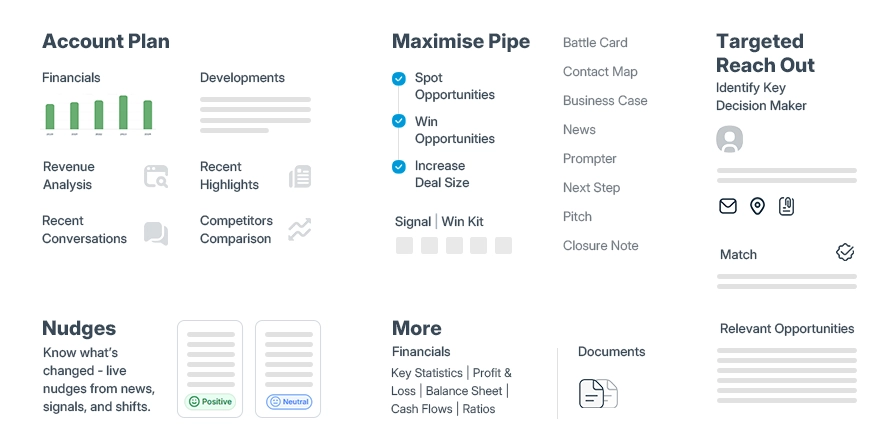
Through strategic market intelligence, sales teams can boost their pipeline by identifying cross-selling and upselling opportunities. When combined with the right sales automation tools, this intelligence helps create more targeted campaigns and identify potential at-risk customers before they churn.
Staying one step ahead of your rivals requires strategic monitoring of their every move. The best sales teams recognize that tracking competitor activities isn't just about collecting data—it's about extracting actionable insights that directly influence your sales approach.
Press releases serve as official windows into your competitors' strategic moves. These announcements reveal product launches, executive appointments, funding rounds, and market expansions that provide critical business intelligence.
Setting up a systematic approach to tracking press releases offers several advantages:
First, you'll gain strategic positioning insights as press releases expose how competitors position themselves against market trends and customer pain points. Second, they function as an early warning system—new product announcements or market entries signal potential threats to your market share.
To implement an effective monitoring framework:
Set up real-time alerts using tools like Google Alerts or specialized platforms to track competitor names and industry keywords
Analyze messaging patterns to document how competitors frame their announcements, what benefits they emphasize, and what markets they target
Connect these insights to your strategy development by refining your positioning, accelerating product roadmaps, or adjusting pricing for your sales automation platforms
For more advanced monitoring, consider platforms like AlphaSense, Meltwater, or specialized tools like Brand24 that cover news sites, PR wires, and social media simultaneously.
Social media provides unfiltered insights into your competitors' strategies and audience engagement. A proper social media competitive analysis helps you understand where your brand stands compared to competitors and identify differentiating factors that can give your sales automation tools an edge.
When analyzing competitors' social presence, examine:
Activity patterns—how often they post and how quickly they respond to comments
Engagement metrics—track followership, visual quality, and audience engagement
Content distribution—which platforms they prioritize and what content formats perform best
Job postings reveal more about your competitors' strategy than you might think. Every new role signals where they're investing and what they're building next. Pay close attention to:
Engineering roles that hint at new features, sales roles signaling territory expansion, leadership hires suggesting new initiatives, and customer success roles indicating growth. Beyond just open positions, look for patterns in job locations (geographic expansion), required skills (tech stack changes), and department growth (strategic priorities).
Additionally, unfiltered feedback about competitors often appears on Reddit, Discord servers, and industry forums where users share real experiences. These community discussions reveal actual user pain points, feature requests, complaints, and hidden product strengths that can inform your sales automation software positioning.
Your competitors' websites often reveal their strategic direction before it's publicly announced. Tools like Visualping allow you to track specific pages for the exact insights you need.
When analyzing competitor websites, focus on:
Corporate development signals—look for new executive hires, acquisitions, or funding rounds. Additionally, monitor their news updates section, as businesses typically use websites to announce important changes first.
Content marketing and PR sections often showcase new initiatives that can be turned into opportunities for your sales automation tools. Review competitors' social media integration as well—even if their social media exists separately from their website, investigating their profiles and activity provides valuable intelligence.
Email monitoring remains a powerful technique in 2025. Sign up for everything competitors offer (preferably with a non-work email): lead magnets, newsletters, blog digests, and trial signup flows. Then track patterns in email frequency, subject line strategies, promotional campaigns, and product announcements to spot shifts in sales messaging.
Lastly, backlinks analysis reveals digital endorsements. Using SEO tools like Ahrefs or SEMrush, track who's linking to competitors—and why. This unveils their PR, content, and partnership strategies that directly affect their sales technology positioning.
STOP CHASING PROSPECTS
START CLOSING DEALS!!
Customer intelligence gives sales teams a powerful advantage in crowded marketplaces. Unlike competitor analysis that focuses outward, customer intelligence turns the spotlight on what buyers actually think about your sales automation software. Let's examine three proven methods for gathering this intelligence that can directly boost your win rates.
Win/loss interviews provide crucial insights into why prospects choose—or reject—your sales automation tools. Surprisingly, less than 20% of companies invest in post-decision research, yet teams conducting these interviews consistently enjoy a 14.2% increase in win rates.
The timing of these conversations matters tremendously. Aim to conduct interviews within four weeks of the deal outcome, before the customer's experience with your product (or a competitor's) influences their recollection. Phone calls or in-person meetings yield far better results than surveys since they allow for natural follow-up questions when interesting responses emerge.
For actionable results, consider asking:
"What were the main criteria you based your decision on?"
"How did our sales automation platform compare to alternatives?"
"Was there anything missing from our offering that influenced your decision?"
To ensure objectivity, have someone outside the sales team conduct these interviews. Product marketing, customer success, or even third-party researchers can often extract more honest feedback than the sales representative who worked the deal.
An astonishing 91% of shoppers read customer reviews before making purchasing decisions, and these reviews significantly impact brand trust and purchasing behavior. For sales teams promoting automation platforms, this feedback represents a goldmine of intelligence.
First, look beyond surface-level ratings to understand the sentiment behind comments. AI-powered tools can now recognize patterns and trends in customer feedback that might be invisible to human reviewers. Second, identify common themes across multiple reviews—those repeated mentions of a specific feature or issue can reveal true product strengths or weaknesses.
Categorizing feedback adds essential context to each theme and helps prioritization discussions. Focus on high-level issues rather than specific features when organizing this intelligence. This approach ensures you have a comprehensive view of each problem area organized by themes over time.
Notably, businesses basing decisions on customer data are 19 times more likely to be profitable. This insight makes customer feedback analysis not just helpful but essential for sales teams seeking competitive advantage.
Internal sources often provide the most valuable competitive intelligence. Those off-hand remarks salespeople hear on calls or prospecting emails competitors send to your clients often reveal more than any external analysis.
However, ethical boundaries must be strictly observed when gathering intelligence from former employees. The passing of trade secrets in any context—whether from current or former employees—remains both unethical and illegal. Instead, focus conversations on general market knowledge, industry trends, or customer preferences rather than proprietary information.
When speaking with experts across your organization, ask about market trends or general competitor habits. These discussions can yield valuable insights without crossing ethical lines. Sales representatives often collect intelligence naturally during their interactions with prospects and customers—creating a systematic way to capture and share these insights can transform random comments into actionable intelligence.
By systematically implementing these three approaches to customer intelligence gathering, your sales team will gain the insights needed to position your sales automation software more effectively against competitors and address prospect concerns before they become objections.
STOP GUESSING YOUR PIPELINE
START GROWING IT WITH AI SALES!!
Product intelligence serves as the backbone of effective sales strategies. When properly utilized, it enables teams to anticipate market shifts and position their solutions advantageously against competitors.
Detecting competitor pricing changes before they become public gives sales teams a decisive edge. Forward-thinking companies can identify pricing tests or shadow rollouts weeks before official announcements. This early warning system allows for timely adjustments to your own sales automation tools' positioning.
Several effective methods for tracking price changes include:
Monitoring front-end pricing pages and metadata schema updates
Examining hidden coupon URLs that reveal discount strategies
Analyzing ad copy tests that signal new pricing approaches
Reviewing early customer feedback across review sites
SaaS companies frequently roll out pricing changes quietly first—testing new price points on select visitor cohorts or A/B testing different plan names before public announcements. For instance, one company's pricing schema in JSON-LD updated to include a new USD 19.00 starter plan (previously USD 9.00), yet it wasn't visible on their front-end page. This intelligence allowed competitors to prepare responsive strategies.
Product performance benchmarks serve as essential reference points for comparing your sales automation software against competitors. These benchmarks typically use percentiles to describe how well your product performs on particular KPIs relative to similar products.
Fundamentally, benchmarking exists so companies can identify ways to make their products better. It forms a key part of the continuous improvement cycle that includes measurement, comparison to competition, and identifying opportunities for enhancement.
Effective benchmarking typically covers several areas:
First, feature comparisons help pinpoint missing features and identify your high-value offerings. Second, pricing benchmarks help establish appropriate price points to avoid over or undercharging. Third, quality and customer satisfaction metrics gage your product's effectiveness compared to alternatives.
According to industry research, businesses that base decisions on customer data are 19 times more likely to be profitable than those that don't. This makes benchmarking not just helpful but essential for sales teams seeking competitive advantage.
In competitive markets, finding and filling gaps in competitors' offerings creates substantial opportunities for growth and differentiation. These gaps represent unmet customer needs or underserved market segments that your sales automation platforms can target.
To identify these gaps, evaluate competitors' products based on functionality, pricing, customer service, and user experience. Look for features they consistently neglect or customer complaints they fail to address. These weak points create opportunities to develop products that exceed customer expectations in areas competitors overlook.
Beyond simple feature comparison, effective gap analysis requires a multi-faceted approach:
SWOT analysis helps evaluate competitors by assessing strengths, weaknesses, opportunities, and threats. Similarly, social listening reveals real-time customer feedback, highlighting what users feel is lacking in competing sales automation software.
By comparing your product's strengths against competitors' weaknesses, you can determine which improvements will create the greatest competitive edge. This process challenges assumptions and ensures decisions are based on data rather than intuition.
Ultimately, product intelligence isn't a one-time effort—it's a continuous cycle of monitoring, adapting, and refining. Ongoing tracking of market trends, competitor activity, and customer expectations helps you spot emerging opportunities early and maintain your competitive advantage.
Make Every Rep Speak
Like Your Top 1%
The right toolset makes all the difference when hunting for competitive advantages in the sales technology space. As companies expand their CI efforts, selecting the appropriate platforms becomes increasingly crucial for sales success.
Competitive intelligence tools and social listening tools serve different yet complementary purposes in your sales strategy. CI tools function as comprehensive platforms that gather, filter, and distribute competitive data across your organization. These specialized solutions track competitor activity in real-time, including changes to marketing messaging, products, pricing, hiring plans, and go-to-market strategies.
Social listening tools, on the other hand, focus primarily on gathering information across social media channels. They monitor brand mentions and conversations about specific topics but typically lack the broader analysis capabilities of dedicated CI platforms. Of the organizations using competitive intelligence, 40% employ dedicated social listening tools as part of their CI tech stack, making this category less widely adopted than full-featured CI solutions.
For optimal results, many sales teams utilize both types of tools. Full-featured CI platforms provide deeper analytical capabilities, whereas social listening tools offer real-time insights into public sentiment and brand perception.
Several standout platforms have emerged as favorites among sales teams seeking competitive advantages:
Crayon excels at delivering real-time market alerts, helping teams stay informed on competitor activities. Its features include AI-driven news summarization and content creation tools like battle cards and newsletters. Crayon has invested heavily in integrating their product into popular sales tools such as Gong, Slack, and Salesforce, meaning sales teams don't need yet another platform to access insights.
Kompyte provides flexible playbooks or "Battlecards" that are accessible directly in HubSpot and Salesforce. Its automated insights come through in real-time via emails, reports, Slack, Teams, and other channels to keep teams updated on competitor developments. Kompyte also offers win/loss analysis showing trends in sales performance and identifying your toughest competitors.
Klue automates the collection of competitive and market intelligence while streamlining analysis and distribution of insights. Like other leading platforms, Klue integrates with popular sales tools to make competitive intelligence available where sales teams already work.
For teams prioritizing social listening, Brandwatch stands out as the clear winner, used by 40% of companies employing dedicated social listening tools. Users praise its "robust analytics and reporting, comprehensive features" and "expansive" capabilities.
The most effective competitive intelligence happens when CI tools connect directly to your CRM system. This integration ensures sales representatives have relevant competitor information precisely when they need it—during prospect interactions.
Importantly, 69% of CI practitioners use a dedicated sales enablement platform to deliver insights to sales teams, making this the second most-adopted category of tools amongst competitive intelligence professionals. These integrations allow teams to streamline workflows and improve productivity.
When properly integrated, CI tools can automatically enrich CRM data, offering sales teams a complete view of competitive landscapes without switching between multiple platforms. For example, Kompyte's two-way integration with Salesforce allows teams to effortlessly pull win/loss data directly from the CRM.
The best implementations integrate competitive intelligence directly into sales processes, enabling representatives to access battle cards, competitor updates, and market insights without disrupting their workflow. Therefore, when selecting CI tools, prioritize those offering seamless connections to your existing sales technology stack.
By carefully selecting and integrating the right competitive intelligence tools, your sales team gains the insights needed to position your sales automation software effectively against competitors.
In the pursuit of competitive advantage, ethical boundaries define the difference between legitimate research and potential legal trouble. Drawing this line correctly ensures your CI efforts remain both effective and principled.
Ethical competitive intelligence involves gathering information through legally accessible sources, primarily public domain content. Despite this, navigating the "gray zone" requires careful judgment about what you can do legally versus what you should do ethically.
Acceptable practices include:
Analyzing publicly available information (websites, press releases)
Conducting honest interviews with proper identification
Reviewing publicly shared financial information
Attending industry events openly as yourself
Unethical actions often cross into potential illegality through misrepresentation, confidentiality breaches, or outright espionage. Essentially, pretending to be someone else (like a customer or student) to extract information violates core CI ethics and damages company credibility.
Corporate espionage refers to the illegal theft of proprietary information, intellectual property, or trade secrets without consent for commercial gain. This crime costs the US economy up to 3% of annual GDP and over USD 500 billion, plus millions of jobs.
Unlike ethical competitive intelligence, espionage involves illegal activities like:
Hacking into competitor systems
Stealing trade secrets
Improperly accessing customer information
Bribing employees for confidential data
Under the Economic Espionage Act, penalties can include up to 15 years in prison and fines up to USD 500,000. Above all, remember this principle: "If it feels wrong, it probably is" and "If you don't want your mother to see it in the news, you probably shouldn't do it".
The Strategic and Competitive Intelligence Professionals (SCIP) provides the most widely embraced guidelines for ethical behavior in CI activities. This framework emphasizes transparency, honesty, and integrity throughout all intelligence gathering.
SCIP's code requires practitioners to be:
Transparent: Accurately disclose identity and organization prior to interviews
Conflict-Free: Avoid conflicts of interest in fulfilling duties
Honest: Provide realistic recommendations in all professional activities
With this purpose in mind, developing a clear internal ethics policy translates these values into specific behaviors. Your policy should outline permitted methods (monitoring public sites, surveys) and prohibited tactics (misrepresentation, accessing gated content without permission).
In this context, the best sales automation software providers maintain strict ethical standards in their competitive research, recognizing that ethical intelligence gathering builds long-term credibility for both their company and the CI profession as a whole.
STOP GUESSING YOUR PIPELINE
START GROWING IT WITH AI SALES!!
Collecting competitive intelligence is only half the battle—the real value emerges when you transform those insights into tangible sales results. For sales teams utilizing automation software, this translation process makes all the difference between merely having information and actually winning more deals.
Battle cards function as quick-reference guides that equip your sales representatives with competitive positioning they can actually use during calls. Certainly, these resources must be concise and scannable to be effective during high-pressure sales situations.
Effective battle cards typically include:
Why your sales automation tools win against specific competitors
Competitor strengths and how to counter them
Recent field intelligence about competitor changes
Quick dismissal points for handling objections
The best battle cards avoid overwhelming detail, placing essential information upfront in as few characters as possible. Afterward, ensure they're easily accessible in tools your team already uses, like Slack, Teams, or directly within your CRM.
Given that battle cards alone aren't enough, structured training exercises help sales teams internalize competitive information. Role-playing exercises create low-stakes environments where representatives can practice handling competitive objections before facing real USD 200,000 ARR accounts.
First, present realistic customer scenarios based on actual win/loss data. Next, allow team members time to review battle cards and prepare their responses. Subsequently, encourage participation through "popcorn-style" exercises where everyone contributes. Following each exercise, reflect on what worked and collect feedback on the battle cards themselves.
Organizations utilizing competitive intelligence effectively report remarkable results—companies maintaining battle cards have improved win rates in 71% of cases. Undoubtedly, this happens because CI enables sales teams to know exactly what customers need to hear when choosing between your sales automation platform and competitors.
CI-influenced wins come from arming sellers with up-to-date information about products, pricing, and positioning. Coupled with systematic win/loss analysis, these insights help identify strengths, weaknesses, and areas for differentiation that ultimately increase close rates.
Your SDRs work 9–5
AI Sales works 24/7!!
Competitive intelligence stands as a crucial differentiator for sales teams looking to excel in today's technology-driven marketplace. Throughout this article, we've seen how systematic intelligence gathering transforms from mere information into powerful sales advantages.
Sales teams equipped with thorough competitive insights make better decisions, position their products more effectively, and ultimately win more deals. Additionally, the right combination of competitor, customer, product, and market intelligence creates a complete picture that guides strategic planning and tactical execution.
Ethical boundaries certainly matter in this process. The line between legitimate research and questionable tactics remains clear – your reputation depends on staying firmly on the right side of that line. Consequently, following established guidelines ensures your competitive intelligence activities build rather than damage trust.
Battle cards and sales playbooks bring all this intelligence to life during actual customer conversations. Therefore, sales representatives armed with concise, accessible competitive information respond confidently to objections and highlight their solutions' strengths against alternatives.
Remember that competitive intelligence isn't a one-time project but an ongoing practice. Market conditions change rapidly, competitors evolve their strategies, and customer preferences shift. Your sales team must stay alert to these changes and adapt accordingly.
I've witnessed firsthand how sales organizations that prioritize competitive intelligence consistently outperform their peers. They anticipate market shifts rather than react to them. They understand their competitors' moves before customers mention them. Above all, they position their sales automation tools based on facts rather than assumptions.
The tools, platforms and approaches outlined here provide a starting point for building your own competitive intelligence capabilities. Start small if needed, but start now. Your competitors are already gathering intelligence about you – the question is whether you'll gain the same advantage.
Competitive intelligence in sales technology involves systematically gathering and analyzing information about competitors, customers, products, and market trends to gain actionable insights. It helps sales teams make informed decisions, develop effective strategies, and stay ahead in the rapidly evolving sales tech landscape.
Sales teams can track competitor moves by monitoring press releases and announcements, analyzing social media and job postings, and examining website changes and content. Using specialized tools and setting up alerts for competitor names and industry keywords can help automate this process and provide timely insights.
The most valuable types of competitive intelligence for sales teams include competitor intelligence, customer intelligence, product intelligence, and market intelligence. These categories provide comprehensive insights into rival strategies, customer needs, product comparisons, and broader market trends, enabling sales teams to refine their approach and positioning.
Competitive intelligence can be integrated into CRM systems through dedicated CI tools that connect directly to your CRM. This integration ensures sales representatives have relevant competitor information available during prospect interactions, enriching CRM data and offering a complete view of competitive landscapes without switching between multiple platforms.
Ethical competitive intelligence involves gathering information through legally accessible sources, primarily public domain content. It's important to avoid misrepresentation, confidentiality breaches, or corporate espionage. Following industry guidelines, such as those provided by the Strategic and Competitive Intelligence Professionals (SCIP), helps maintain ethical standards in CI activities.
STOP GUESSING YOUR PIPELINE
START GROWING IT WITH AI SALES!!


Category: Uncategorized Tags: ai, AIOps, Artificial Intelligence, cloud, cloud platform, Cybersecurity, Information and Communications Technology , VR