What Pipeline Generation Really Means in Enterprise Sales
February 12, 2026
It isn't.
Real pipeline generation in enterprise sales is the ability to identify and create qualified opportunities inside target accounts before those opportunities enter the market. Not after prospects raise their hand. Not when RFPs arrive. Before.
This distinction matters because by the time an enterprise buyer shows obvious intent, competitors have already shaped the requirements.
Search "pipeline generation meaning" and you'll find explanations that sound reasonable but miss what actually happens in enterprise sales:
"Pipeline generation is the process of creating and managing potential sales opportunities."
"It involves identifying prospects, nurturing them through the sales funnel, and converting them into customers."
These definitions describe a funnel. They assume prospects move linearly from awareness to consideration to decision. They work when you're selling into SMB or when you have strong inbound demand.
They fail in enterprise sales.
Enterprise buyers don't move through funnels. They don't wait for your nurture sequence. They don't respond to cold outreach that ignores their business context.
Enterprise pipeline generation requires a different model entirely.
Pipeline generation in enterprise sales is the process of detecting where business changes inside target accounts create opportunities for what you sell—then engaging before those opportunities become obvious.
This means:
You're continuously watching target accounts. Tracking what's changing. Connecting those changes to specific opportunities. Then creating pipeline from those signals.
The core principle: Pipeline doesn't come from volume. It comes from knowing where to look and when to engage.
The traditional approach to pipeline generation treats accounts as static targets. You build a list. You run a campaign. You measure response rates.
But accounts aren't static. They're dynamic systems with constantly shifting priorities, budgets, and pain points.
When you understand pipeline generation as signal-based opportunity identification, everything changes:
Enterprise sales teams face a specific pipeline problem that doesn't exist in SMB or mid-market:
You're working with a fixed number of target accounts.
You can't just "add more leads" when pipeline is low. Your total addressable market might be 500 companies. Or 200. Or 50.
Each account represents significant revenue potential—six figures minimum, often seven or eight. But each account also has:
Traditional lead generation tactics don't work here. You can't run a webinar and expect 50 enterprise accounts to register. You can't cold email your way into a Fortune 500 procurement process.
You need a different approach. One focused on depth, not breadth. On precision, not volume. On timing, not persistence.
When enterprise sales teams lack systematic pipeline generation, several patterns emerge:
Reactive selling. Your team waits for inbound interest or referrals. When pipeline dips, panic sets in. Everyone scrambles. Quota becomes a question mark.
Random outreach. Sellers pick accounts based on gut feeling or recent news. They send generic messages. Response rates stay low. Morale drops.
Stale pipeline. Opportunities sit in your CRM for months. No movement. No clarity on next steps. Forecast calls become guessing games.
Late engagement. By the time your team engages, requirements are set. Competitors have shaped the evaluation. You're responding to an RFP designed around someone else's solution.
These aren't execution problems. They're pipeline generation problems.
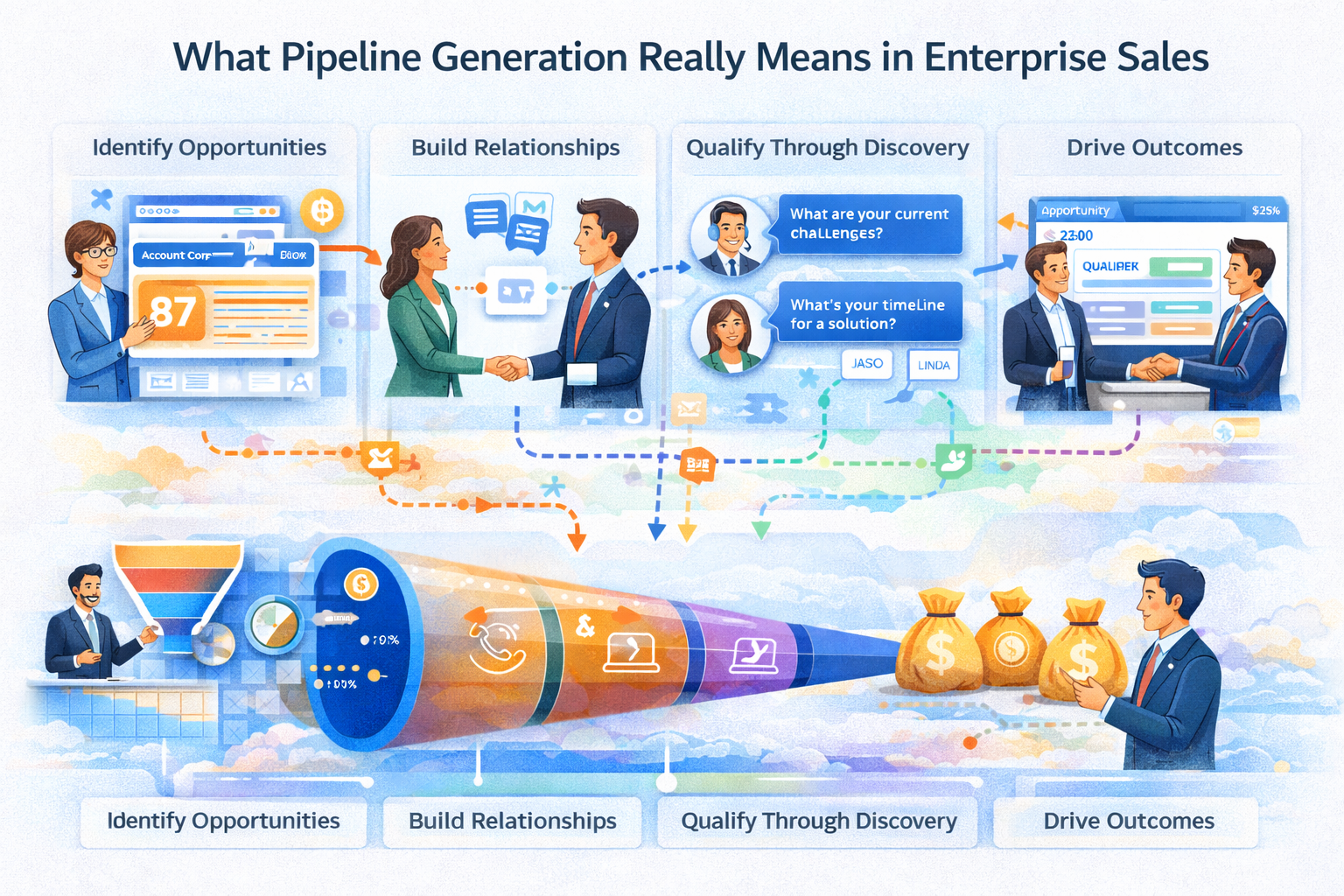
Effective pipeline generation in enterprise sales follows a specific sequence. Not a funnel. A sequence based on account intelligence and business timing.
You can't generate pipeline from accounts you don't understand.
Account intelligence is the foundation. You need to know what's happening inside each target account:
This isn't one-time research. It's continuous monitoring. Accounts change weekly. Sometimes daily.
The question isn't "what do we know about this account?" The question is "what changed this week?"
Not every change creates an opportunity. Most don't.
Pipeline generation requires connecting business changes to specific selling opportunities. You need to detect when:
This is where most teams fail. They see the signal—a new VP of Sales, a funding announcement, a technology partnership. But they don't connect it to a specific opportunity.
"They just raised $100M" isn't an opportunity. "They just raised $100M and announced expansion into three new markets, which will require the sales infrastructure we provide" is an opportunity.
Once you've identified an opportunity, you need to know who to engage.
Enterprise deals involve multiple stakeholders:
Effective pipeline generation from existing accounts starts with understanding who cares about each specific opportunity and why.
Generic titles don't help. "VP of Sales" tells you nothing about whether this person owns the problem you solve.
You need context:
Now you engage. Not with a cold pitch. With relevant context.
Your outreach should demonstrate you understand:
This isn't about perfect messaging. It's about relevance. Show that you've done the work to understand their situation. Connect the dots between their business reality and what you offer.
The first conversation isn't the deal. It's the start of opportunity development.
You're validating that the signal you detected represents real business need. You're confirming budget availability and timing. You're mapping the full buying committee. You're understanding evaluation criteria.
This is where pipeline generation transitions into deal execution. But it only works if the first four steps were done correctly.
The mechanics of pipeline generation differ completely between enterprise and SMB sales:
| Dimension | SMB Pipeline Generation | Enterprise Pipeline Generation |
|---|---|---|
| Focus | Volume and velocity | Depth and precision |
| Account approach | Many accounts, light research | Fewer accounts, deep intelligence |
| Opportunity source | Inbound leads, outbound campaigns | Signal-based identification |
| Engagement timing | Campaign-driven, periodic | Signal-driven, continuous |
| Messaging | Value proposition and features | Business context and relevance |
| Success metric | Response rate and meeting volume | Opportunity quality and conversion |
| Sales cycle | Weeks to months | Months to quarters |
| Primary challenge | Standing out in noise | Timing and relevance |
Understanding this difference prevents teams from applying SMB tactics to enterprise accounts. The principles don't transfer.
These terms are often used interchangeably. They shouldn't be.
Lead generation focuses on capturing interest. Someone downloads a whitepaper. Attends a webinar. Fills out a contact form. You've generated a lead.
The question is: "Who might be interested in what we sell?"
Pipeline generation focuses on identifying opportunities. You detect a business change inside a target account. You connect it to a specific need. You engage the right stakeholders. You've generated pipeline.
The question is: "Where can we sell, and why now?"
Lead generation is reactive. You're waiting for interest signals.
Pipeline generation is proactive. You're identifying opportunities before interest signals appear.
In enterprise sales, pipeline generation matters more. Most enterprise buyers don't fill out forms or download whitepapers. They don't attend vendor webinars. They don't raise their hand until they're ready to evaluate—at which point you're late.
Most enterprise sales teams struggle with pipeline generation for specific, fixable reasons:
Sellers manually check news sites, LinkedIn, and company websites. Maybe. When they remember. When they have time.
This doesn't scale. Sellers have territories with dozens of accounts. Each account has hundreds of signals. Manual monitoring catches maybe 5% of what matters.
Without systematic monitoring, you're guessing. You engage based on what you happen to notice, not what actually matters.
Teams see the signal but can't connect it to opportunity.
"They hired a new CRO" appears in your feed. Now what? Is this relevant? Should someone reach out? What should they say?
Most sellers default to generic congratulations messages. These get ignored. The signal was real. The execution was wrong.
You engage too early—before budgets are allocated, before pain is acute. The conversation goes nowhere.
You engage too late—after competitors have shaped requirements, after evaluation criteria are set. You're fighting uphill.
Enterprise pipeline generation requires precision timing. The window when a business change creates opportunity but buying processes haven't started is narrow.
Your team jumps between:
Each system holds part of the picture. None connect the dots. Sellers spend more time gathering information than acting on it.
Teams lack defined criteria for what constitutes a real opportunity versus interesting information.
Is a funding round an opportunity? Depends. Is a new executive an opportunity? Depends. Is a product launch an opportunity? Depends.
Without clear criteria tied to your specific offerings, sellers waste time chasing signals that don't convert to pipeline.
Revenue intelligence platforms automate what enterprise sales teams previously did manually—and poorly.
They continuously monitor target accounts across multiple data sources. They detect business changes and connect them to specific opportunities. They surface buying centers and provide engagement context.
This changes pipeline generation from periodic activity to continuous process.
Instead of quarterly campaigns, you have ongoing opportunity identification. Instead of generic outreach, you have signal-based engagement. Instead of guessing where to focus, you know.
The operational shift is significant:
This isn't theoretical. Sales leaders using revenue intelligence to create pipeline see measurable differences in conversion rates, sales cycle length, and deal quality.
Most teams measure pipeline generation incorrectly. They count volume:
These metrics reward activity, not outcomes.
Better metrics focus on quality and conversion:
What percentage of identified opportunities turn into real deals?
If you're creating 100 opportunities per quarter but only 5 convert to closed-won, your opportunity identification is broken. You're generating noise, not pipeline.
How long from opportunity identification to first substantive conversation?
In enterprise sales, speed matters. The opportunity you identify today might be filled by a competitor tomorrow. If it takes three weeks to schedule a meeting, you're too slow.
How long from opportunity creation to closed-won?
Signal-based pipeline should close faster than reactive pipeline because timing aligns with business need. If your generated opportunities have the same or longer sales cycles, something's wrong with your signal interpretation.
What's your close rate on opportunities you proactively identified versus opportunities that came inbound?
Effective pipeline generation produces higher win rates because you're engaging early with relevant context. If your generated pipeline wins less often than inbound, your engagement timing or messaging needs work.
Are you identifying opportunities in the right accounts with the right scope?
Deal size validates that your opportunity criteria align with business potential. Small deals from large accounts suggest you're finding tactical opportunities instead of strategic ones.
The real test: Can your sales leaders predict next quarter's pipeline based on this quarter's signals? If not, your pipeline generation isn't systematic enough.
Effective enterprise pipeline generation requires four components working together:
You can't monitor everything. Focus on accounts that match your ideal customer profile.
Criteria should include:
This list shouldn't be static. Review quarterly. Add accounts showing positive signals. Remove accounts where opportunities dried up.
This is where account signal monitoring happens.
You need systems that:
Manual research can't keep up. Sales intelligence platforms automate this monitoring and surface what matters.
Define what constitutes a real opportunity for your specific offerings.
Map common business changes to selling opportunities:
This framework should be documented, taught to sellers, and refined based on conversion data.
Once an opportunity is identified, what happens next?
Define the process:
Without structure, opportunities get ignored or mishandled. Your intelligence is only valuable if it leads to action.
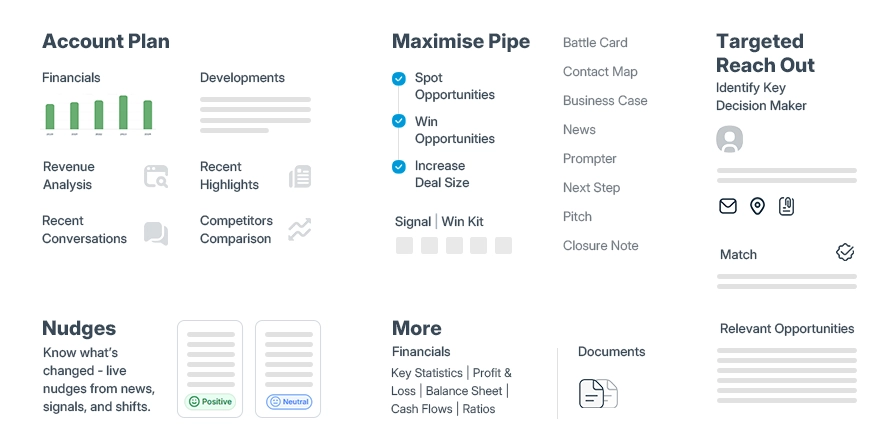
Watch how SalesPlay identifies opportunities inside your target accounts before they enter the market.
Start Free Trial Watch DemoNot every business change creates opportunity. A company hiring in accounting doesn't create sales technology opportunities. A funding round for a SaaS company might—or might not—depending on their growth plans.
Fix: Score signals based on relevance to your offerings. High-relevance signals get immediate attention. Low-relevance signals get monitored but don't trigger outreach.
You see a signal. You reach out immediately. But you don't understand the full business context or the stakeholder's specific challenges.
The conversation feels generic. The prospect disengages.
Fix: Establish minimum context requirements before engagement. Know the business situation, the stakeholder's role, and the specific problem this opportunity addresses.
You identify an opportunity and reach out to one person. That person seems interested. Then the deal stalls because you didn't map the full buying committee.
Enterprise deals require multiple stakeholders. Single-threaded relationships fail.
Fix: Map buying committees early. Identify economic buyers, technical evaluators, end users, and influencers. Develop relationships across the committee, not just with your initial contact.
Teams feel pressure to show pipeline growth. They lower opportunity criteria. They count questionable opportunities as pipeline.
Forecasts become unreliable. Win rates drop. Time gets wasted on deals that won't close.
Fix: Set quality thresholds for pipeline inclusion. Not every identified opportunity goes into the forecast. Require validation: budget confirmed, timeline established, buying committee mapped, technical fit verified.
Pipeline generation is shifting from periodic campaigns to continuous intelligence.
The teams winning in enterprise sales:
This requires different tools, different processes, and different metrics than traditional pipeline generation approaches.
But the core principle remains: know where business is moving inside your target accounts. Identify where that movement creates opportunities. Engage before those opportunities become obvious.
Pipeline generation in enterprise sales isn't about doing more. It's about knowing more, sooner, and acting with precision.
Pipeline generation in enterprise sales is the process of identifying and creating qualified opportunities within target accounts before they enter the market. It's not about volume or cold outreach—it's about detecting where budget, priorities, and business changes align with what you sell, then creating opportunities from those signals.
Enterprise pipeline generation focuses on depth over volume. You're working with fewer accounts but need to understand each one deeply—tracking business changes, budget cycles, organizational shifts, and strategic initiatives. SMB pipeline relies on velocity and volume. Enterprise pipeline requires precision, timing, and account intelligence.
Lead generation focuses on capturing inbound interest or creating outbound contact lists. Pipeline generation focuses on identifying real opportunities inside target accounts—whether or not they've raised their hand. Lead generation asks "who might be interested?" Pipeline generation asks "where can we sell, and why now?"
Measure pipeline quality, not just pipeline volume. Look at: opportunity conversion rate (how many identified opportunities turn into real deals), sales cycle length, average deal size, win rate on generated pipeline, and time from opportunity identification to closed-won. High-quality pipeline generation produces fewer but better opportunities.
Real signals include: organizational changes (new executives, department restructures, team expansions), budget movements (new funding rounds, increased departmental budgets, fiscal year planning), strategic shifts (new product launches, market expansion, technology modernization), performance gaps (declining metrics, missed targets, operational inefficiencies), and regulatory or compliance changes requiring new capabilities.
Traditional methods fail because they rely on either inbound interest (which comes too late) or spray-and-pray outbound (which ignores account context). Enterprise buyers don't respond to generic outreach. By the time they show obvious buying signals, competitors are already engaged. Effective pipeline generation requires continuous account monitoring and signal-based engagement before opportunities become obvious.
Account intelligence reveals what's changing inside target accounts—budget shifts, organizational changes, strategic priorities, and business challenges. This allows you to identify opportunities before they enter the market. Instead of waiting for buyers to signal interest, you detect where their business is moving and where your offerings align with those movements.
Timing determines whether pipeline converts. Engage too early and budgets aren't allocated. Engage too late and competitors have shaped the requirements. The right timing is when an internal change creates a need, budgets are being planned, but formal buying processes haven't started. This requires continuous account monitoring, not periodic outreach campaigns.
Existing accounts offer higher-quality pipeline opportunities because you already have relationships and context. Focus on: expansion opportunities (new departments, use cases, or product lines), organizational changes creating new needs, budget increases or reallocations, and strategic initiatives requiring additional capabilities. New accounts require more research but follow the same principle—identify business changes that create opportunities for what you sell.
Effective pipeline generation requires systems that continuously monitor target accounts, detect business changes and signals, connect those signals to specific opportunities, surface buying centers and contacts, and provide context for engagement. You need account intelligence platforms, not just CRM systems or static databases. The technology should tell you where to act and why, not just store information.
SalesPlay identifies opportunities inside your target accounts before they become obvious. See how signal-based pipeline generation works in practice.
Get Started Free Explore Platform

Category: Uncategorized Tags: ai, AIOps, Artificial Intelligence, cloud, cloud platform, Cybersecurity, Information and Communications Technology , VR