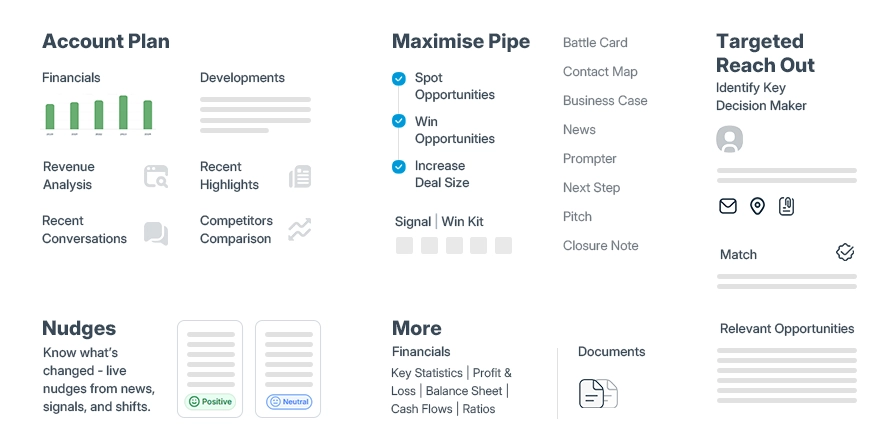
Your competitors are already talking to your best accounts.
Not because they have better products. Not because their sellers are sharper.
Because they saw the signals first.
While your team waits for inbound intent or quarterly account reviews, competitors are sitting in procurement conversations. By the time your sellers engage, buyers have already defined requirements. Your win rate drops from 35% to 15%. Deal cycles stretch by months. Contract values shrink by 30%.
This isn't a seller execution problem. It's a revenue intelligence problem.
What Are Early Buying Signals?
Early buying signals are behavioral and business indicators that show an account is entering a buying cycle before they reach out to vendors. Unlike late-stage intent signals (demo requests, pricing page visits), early signals happen 3-9 months before formal procurement begins.
Examples include: new executive hires in relevant departments, budget approvals in board minutes, technology stack changes, regulatory compliance deadlines, vendor contract renewals, organizational restructuring, and strategic initiative announcements.
Why Sales Teams Miss Early Buying Signals
Most enterprise sales teams rely on three signal sources:
-
CRM data – Updated sporadically, often weeks behind reality
-
News alerts – Overwhelm sellers with noise; 95% is irrelevant
-
Manual research – Works for 10-20 top accounts, not the full TAM
None of these systems connect signals to opportunities. None show why a signal matters. None operate in real time.
The Fragmentation Problem
Your sellers jump between LinkedIn, ZoomInfo, Google News, Salesforce, earnings transcripts, and 6sense. Each tool shows a piece of the story. None connect those pieces into action.
A CFO gets promoted to COO. Your product fits cost optimization. But that signal lives in LinkedIn. The opportunity context lives in Salesforce. The financial context lives in earnings reports.
By the time a seller manually connects these dots, two competitors have already scheduled discovery calls.
The Scale Problem
Manual account research works when you have 15 target accounts. It breaks when you have 150.
Your best sellers spend 2-3 hours per account doing research. That's 8-12 accounts per week, max. The other 138 accounts get ignored until they show inbound intent—which means they're already talking to competitors.
This is why pipeline generation stalls in the middle market. Not enough sellers to cover the TAM. Not enough time to research deeply.
The Noise Problem
Most signal platforms drown sellers in alerts.
Your target account announces a new VP of Engineering. Is that relevant? Depends on your product.
If you sell developer tools, extremely relevant. If you sell HRIS software, probably not.
Sellers receive 40-60 alerts per day. They learn to ignore them. Real signals get lost in the noise.
The Real Cost: When sellers engage after competitors have already influenced buyer requirements, win rates drop from 35-45% to 15-20%. Deal cycles extend by 30-40%. Average contract value decreases by 25-35%.
What Happens When You Miss Early Signals
Let's walk through a real scenario:
Month 1: Your target account's CTO leaves. The interim CTO starts evaluating the technology stack. Your competitor, using account intelligence, sees this signal immediately. They reach out within 72 hours.
Month 2: The interim CTO forms an evaluation committee. Your competitor is already presenting. They're shaping requirements. Your team has no idea this is happening.
Month 3: A job posting appears for a "Senior Manager, Cloud Infrastructure." Your sales team sees it in a weekly news digest. By now, your competitor has met with three stakeholders and submitted a proposal.
Month 4: Your BDR finally reaches the account. "We're in final vendor selection," the CTO says. "Happy to add you to the process, but our timeline is tight."
You're vendor option three. You'll spend the next 60 days fighting for a deal your competitor has already won.
The Pipeline Impact
Missing early signals doesn't just cost you individual deals. It compounds across your entire pipeline.
Assume you have 200 target accounts. Assume 30% enter a buying cycle each year (60 accounts). If you miss signals on 40% of those opportunities (24 accounts), and each represents $150K ACV, you've lost $3.6M in pipeline before your fiscal year starts.
That's not a rounding error. That's the difference between hitting quota and missing by 40%.
How Early Signal Detection Actually Works
Effective early signal detection requires three capabilities:
1. Continuous Account Monitoring
Not weekly. Not monthly. Continuous.
Revenue intelligence platforms watch target accounts in real time. When something changes—leadership, financials, technology, hiring—the system captures it immediately.
This isn't possible manually. It requires automation.
2. Signal-to-Opportunity Mapping
A signal alone is meaningless. "Company X raised $50M" tells you nothing about whether you can sell there.
The system must connect signals to your specific offerings:
-
Does this signal indicate budget availability?
-
Does it suggest a problem your product solves?
-
Does it reveal stakeholder changes that open new buying centers?
-
Does it indicate urgency (regulatory deadline, contract renewal)?
Platforms with buyer intent detection show not just what changed, but why it matters.
3. Relevance Filtering
Most accounts generate 10-15 signals per quarter. Only 1-2 matter.
Effective systems rank signals by relevance to your product. High-relevance signals get surfaced immediately. Medium-relevance signals get monitored. Low-relevance signals get ignored.
This filtering is what makes signal detection actionable. Without it, you're back to drowning in noise.
Key Insight: The goal isn't to collect more signals. The goal is to surface the 3-5 signals per month that represent real pipeline opportunities—and connect them directly to execution.
Revenue Intelligence vs. Traditional Intent Data
Many revenue leaders conflate signal detection with intent data. They're related but different.
Intent Data Limitations
Intent data tracks content consumption and web behavior. It shows what buyers are researching.
Problems:
-
Intent shows interest, not authority or budget
-
Intent data is often shared across many vendors (you're competing with 5-10 other sellers)
-
Intent spikes happen late in the buying cycle, often after requirements are set
-
Intent doesn't show why an account is researching your category
Business Signal Advantages
Business signals track what's actually changing inside target accounts:
-
Budget allocation (board approvals, funding rounds, cost reduction initiatives)
-
Organizational priorities (new executives, strategic initiatives, restructuring)
-
Technology changes (vendor selections, platform migrations, stack consolidations)
-
Compliance triggers (regulatory deadlines, audit findings, policy changes)
These signals reveal buying readiness before intent shows up. They indicate budget, urgency, and stakeholder involvement.
Most effective revenue teams combine both: signals identify accounts entering buying cycles, intent refines messaging and timing.
How Revenue Intelligence Platforms Detect Signals
Modern revenue intelligence platforms automate signal detection through account intelligence capabilities.
Here's how it works:
-
Account Connection – Platform connects to Salesforce and monitors your target accounts
-
Multi-Source Aggregation – Pulls signals from financial data, organizational changes, technology movements, hiring patterns, and market developments
-
Opportunity Detection – Maps signals to your product offerings and identifies where you can sell
-
Relevance Scoring – Ranks opportunities by likelihood and fit (high/medium/low relevance)
-
Context Provision – Shows why each signal matters, which product fits, and who to engage
The output isn't a list of signals. It's a prioritized pipeline of opportunities tied to specific accounts, stakeholders, and next actions.
What This Looks Like in Practice
A seller logs into the platform Monday morning. They see:
-
3 high-relevance opportunities across 2 accounts (with context on why they're relevant)
-
7 medium-relevance opportunities to monitor
-
Pre-built battle cards and messaging for each opportunity
-
Recommended contacts with role context and engagement history
No jumping between tools. No manual research. No guessing what matters.
The system has already connected signals to opportunities, mapped stakeholders, and prepared execution materials. The seller focuses on engagement, not research.
Comparing Revenue Intelligence Approaches
Not all revenue intelligence platforms detect signals the same way.
Conversation Intelligence Platforms
Tools like Gong focus on analyzing sales calls and meetings. They detect signals from conversations you're already having.
Strength: Deep insight into active deals and buyer sentiment.
Limitation: Only works for accounts already engaged. Doesn't identify new opportunities before contact.
Engagement Platforms
Tools like Outreach and SalesLoft automate cadences and track engagement. They show who responded and when.
Strength: Efficient multi-touch campaigns and response tracking.
Limitation: No insight into which accounts to target or why they're in-market.
Intent Data Aggregators
Tools like 6sense collect third-party intent signals from content consumption.
Strength: Shows which accounts are researching your category.
Limitation: Late-stage signals (buyers already talking to competitors), shared across many vendors, no account-specific context.
Account Intelligence Platforms
Platforms focused on account intelligence continuously monitor business changes inside target accounts and connect those changes to specific opportunities.
Strength: Early signal detection, opportunity mapping, account-specific context, actionable prioritization.
Limitation: Requires Salesforce integration and defined target account list.
Buying Guidance: If you're evaluating platforms, ask: "Does this system detect opportunities before buyers show intent? Can it tell me why a signal matters for my product? Does it connect signals directly to execution?"
What Revenue Leaders Do Differently
Teams that consistently capture early signals operate differently.
They Instrument Signal Detection
They don't rely on manual research. They implement revenue intelligence systems that monitor accounts continuously.
This isn't a "nice to have." It's infrastructure. Like CRM. Like email.
They Connect Signals to Workflow
Seeing a signal isn't enough. The system must show:
-
Why this signal matters
-
Which product offering fits
-
Who to contact
-
What to say
Platforms that surface signals without context create more work, not less.
They Measure Signal-to-Opportunity Conversion
Revenue leaders track:
-
What percentage of signals convert to qualified opportunities?
-
How quickly do sellers act on high-relevance signals?
-
What's the win rate on signal-sourced deals vs. inbound deals?
-
How much pipeline comes from early signal detection vs. late-stage intent?
This data shows whether signal detection is creating pipeline or just creating noise.
They Focus on Account Coverage, Not Just Top Accounts
Most teams research their top 20 accounts thoroughly and ignore the rest.
Revenue leaders ensure every target account gets monitored. Because you can't predict which accounts will enter buying cycles next quarter.
The VP who seemed uninterested six months ago just got promoted to CTO. The company that missed quota last year just raised $100M. The "not ready" account just announced a compliance deadline.
Coverage matters more than depth.
What Changes When You Detect Signals Early
Teams that implement effective signal detection see three operational shifts:
1. Sellers Stop Waiting for Inbound
When you see signals before buyers reach out, you control timing. You shape requirements. You influence buying committees before they form.
Your pipeline becomes proactive, not reactive.
2. Research Becomes Execution
Sellers spend less time researching (the system does that) and more time engaging. Instead of "let me look into that account," it's "here are three opportunities I can act on today."
Time to first contact drops from weeks to hours.
3. Pipeline Quality Improves
Early engagement means higher win rates (35-45% vs. 15-20%), shorter deal cycles (4-6 months vs. 8-12 months), and larger contracts (buyers haven't been price-anchored by competitors).
You're not just generating more pipeline. You're generating better pipeline.
See How SalesPlay Detects Early Buying Signals
SalesPlay continuously monitors your target accounts, surfaces relevant opportunities, and tells you exactly where to act—before competitors engage.
Watch Demo
Implementation: Where to Start
If your team is missing early signals, here's where to start:
Step 1: Define Your Signal Taxonomy
What changes inside an account indicate buying readiness for your product?
Examples:
-
If you sell cloud infrastructure: CTO changes, technology migrations, cost reduction initiatives
-
If you sell HR software: new CHRO hires, compliance deadlines, workforce expansions
-
If you sell security: breach announcements, regulatory changes, insurance requirements
Don't try to track everything. Focus on the 5-7 signal types that consistently predict buying cycles.
Step 2: Instrument Continuous Monitoring
Manual research doesn't scale. You need a system that:
-
Connects to Salesforce and monitors your target accounts
-
Aggregates signals from multiple sources automatically
-
Runs continuously (daily at minimum, real-time ideally)
Evaluate revenue intelligence platforms based on signal coverage, relevance filtering, and integration depth.
Step 3: Connect Signals to Execution
The system must do more than alert you. It must show:
-
Why this signal matters (opportunity context)
-
Which product offering fits (solution mapping)
-
Who to engage (stakeholder identification)
-
How to engage (messaging and battle cards)
Platforms that surface signals without context create alert fatigue. You want signal-to-action, not signal-to-research.
Step 4: Measure and Refine
Track signal-to-opportunity conversion. If 80% of signals generate no action, your filtering isn't working. If sellers ignore signals, your relevance scoring needs tuning.
Revenue intelligence is not set-and-forget. It requires ongoing calibration.
The Strategic Advantage of Early Signal Detection
Here's what most revenue leaders miss:
Early signal detection isn't just about speed. It's about control.
When you engage early, you influence how buyers think about the problem. You shape their requirements. You introduce evaluation criteria your product excels at.
When you engage late, you respond to requirements competitors defined. You compete on price because differentiation is already established. You fight for vendor option two or three.
The difference between 40% win rates and 20% win rates often comes down to who engaged first.
That's not luck. That's revenue intelligence.
Frequently Asked Questions
What are early buying signals in B2B sales?
Early buying signals are behavioral and business indicators that show an account is entering a buying cycle before they reach out to vendors. These include organizational changes (new leadership, budget approvals, strategic initiatives), technology stack changes, hiring patterns in relevant departments, financial events (funding rounds, earnings changes), regulatory compliance deadlines, and vendor contract renewals. Unlike late-stage intent signals (like demo requests), early signals happen 3-9 months before formal procurement begins.
Why do sales teams miss early buying signals?
Sales teams miss early buying signals because of fragmented data across multiple tools (CRM, news sources, LinkedIn, data providers), manual research that doesn't scale beyond top 20 accounts, signal overload where sellers can't distinguish relevant changes from noise, lack of real-time monitoring causing 2-4 week delays, and absence of systems connecting signals to actual opportunities. Most teams only see signals when buyers are already talking to competitors.
What is the cost of missing early buying signals?
Missing early buying signals costs companies 40-60% of qualified pipeline opportunities. When sellers engage after competitors have already influenced buyer requirements, win rates drop from 35-45% to 15-20%. Deal cycles extend by 30-40% because sellers enter as "vendor option three" rather than trusted advisors. Late engagement also reduces average contract value by 25-35% as buyers have already defined scope with other vendors.
How is signal-based selling different from intent data?
Intent data tracks content consumption and web behavior (what buyers are researching), while signal-based selling tracks actual business changes inside target accounts (what is happening in their business). Intent shows interest but not timing or authority. Signals reveal budget allocation, organizational priorities, and specific buying triggers. Intent data is often shared across many vendors. Business signals are harder to detect but indicate real buying readiness. Most effective approaches combine both, using signals to identify accounts and intent to refine messaging.
What tools detect early buying signals automatically?
Revenue intelligence platforms with account intelligence capabilities detect early buying signals by continuously monitoring Salesforce-connected accounts, tracking multi-source business changes, connecting movements to relevant opportunities, and surfacing signals tied to your specific offerings. Effective systems consolidate financial data, organizational changes, technology signals, hiring patterns, and market movements into a single view. The best platforms rank signals by relevance and show why each signal matters to your product fit.
How do you prioritize buying signals across hundreds of accounts?
Prioritize buying signals by relevance scoring (does this signal align with your solution category), timing analysis (is this actionable now or 6 months out), stakeholder mapping (are decision-makers involved), budget indicators (is funding approved or likely), and competitive positioning (are we early or late to this opportunity). Revenue intelligence systems automate this prioritization by categorizing opportunities as high/medium/low relevance based on your product offerings and historical win patterns.
Can AI detect buying signals better than manual research?
AI-powered signal detection outperforms manual research in coverage (monitoring hundreds of accounts continuously vs. 10-20 accounts manually), speed (real-time alerts vs. weekly research cycles), pattern recognition (identifying combinations of signals that predict buying readiness), and noise filtering (separating relevant changes from irrelevant updates). However, human judgment remains essential for understanding account context, relationship history, and strategic fit. The most effective approach combines AI detection with seller interpretation.
How do revenue intelligence platforms compare for signal detection?
Revenue intelligence platforms differ significantly in signal detection capabilities. Some focus on conversation intelligence from calls and meetings (like Gong), others on engagement tracking and cadence automation (Outreach, SalesLoft), and some on intent data aggregation (6sense). Platforms with account intelligence capabilities continuously monitor business changes inside target accounts, connect signals to specific opportunities, and provide context on why signals matter. The best systems integrate with Salesforce, require minimal setup, and surface signals sellers can act on immediately.
Stop Missing Pipeline Opportunities
See how SalesPlay surfaces early buying signals and converts them into qualified pipeline—before your competitors engage.
Get Started