How to Surface Buying Opportunities Across Target Accounts
February 11, 2026
The best sales organizations do not rely on luck or periodic research. They surface buying opportunities before competitors know they exist. They connect business movement to product fit. They know who cares, why it matters, and when to act.
This is not about better intent data or more touchpoints. It is about continuous revenue intelligence applied to the accounts that matter most.
📈 Enterprise Reality: 67% of buying opportunities inside target accounts go undetected because sales teams lack continuous account monitoring and signal-to-opportunity translation.
Enterprise accounts are not static. They change constantly. Budgets shift. Priorities evolve. Initiatives launch. Executives move. Technology stacks expand.
Traditional account planning cannot keep pace. By the time a quarterly business review happens, the account has already moved. Sellers operate with outdated assumptions. Opportunities slip past because no one was watching when the signal appeared.
Sales teams see accounts through fragmented tools. CRM shows deal history. LinkedIn shows job changes. News feeds show announcements. Intent platforms show topic interest. Nothing connects these signals into opportunity context.
When a CFO joins, a new compliance mandate drops, or a digital transformation program launches, sellers miss the connection to what they sell. The signal exists. The opportunity stays hidden.
Opportunities have windows. A reorganization creates a 90-day period when new leaders evaluate systems. An acquisition creates a 6-month window for consolidation. A regulatory change creates urgency before a deadline.
Sellers who spot these moments three months late find budgets allocated and decisions made. Timing determines whether an opportunity is winnable or already lost.
Not every signal matters. A leadership change in marketing does not create a cybersecurity opportunity. A new manufacturing facility does not trigger a need for HR software.
Sales teams drown in noise because they cannot filter signals by relevance. They chase everything or ignore everything. Neither works.
Even when sellers spot an opportunity, they struggle to act. They do not know who owns the initiative. They do not know what message resonates. They do not know which offering fits.
The opportunity sits in a spreadsheet while sellers research, draft messaging, and debate approach. Velocity dies in preparation.
Sales teams treat account intelligence as a research project, not a continuous system. They look for opportunities when they need pipeline, not when opportunities actually emerge.
A buying opportunity is not a contact. It is not an intent signal. It is not a budget rumor.
A buying opportunity is a specific, actionable moment when business movement inside an account aligns with your product capabilities.
Business Context: Something changed or is about to change. A new initiative launched. A system failed. A regulation took effect. A competitor was replaced. Growth accelerated. Costs spiked.
Product Fit: The change connects to what you solve. Not hypothetically. Specifically. The account needs what you offer because of what just happened.
Buyer Accessibility: You can identify who cares about this problem and reach them. The opportunity includes people, not just circumstances.
Without all three, you have a signal. Not an opportunity.
Intent data shows research behavior. Someone downloaded a whitepaper. Visited a competitor site. Attended a webinar. This indicates interest in a topic.
Opportunities show business need. The company hired a Chief Data Officer. They announced a cloud migration. They missed compliance deadlines. They acquired a company with legacy systems.
Intent tells you someone is looking. Opportunities tell you why they should buy from you, which product fits, and who decides.
📊 Research Finding: Sales teams using continuous account intelligence identify 3.4x more qualified opportunities per target account compared to teams relying on periodic research and intent signals alone.
Surfacing buying opportunities at scale requires a system, not heroic effort. The best sales organizations follow a consistent framework.
Stop researching accounts when you need something. Start watching accounts continuously.
What to monitor:
These signals create the conditions for buying. They change priorities, free budgets, and create urgency.
Raw signals mean nothing without context. The translation step connects what changed to what you sell.
When a healthcare company announces HIPAA audit failures, that signal translates differently for security software, compliance platforms, and training providers. Each sees a different opportunity in the same event.
Translation requires:
This is where most manual approaches break. A seller cannot hold 50+ signal-to-product mappings in their head across 20+ accounts.
Not all opportunities deserve equal attention. Categorize by strength and urgency.
High-priority opportunities: Multiple supporting signals, clear product fit, identified decision-makers, recent triggering events
Medium-priority opportunities: Single strong signal or multiple weak signals, probable fit, partial stakeholder visibility
Low-priority opportunities: Weak signals, indirect fit, unclear buying center, distant timing
High-priority opportunities get immediate action. Medium opportunities get monitoring. Low opportunities stay visible but do not consume selling time.
Every opportunity needs a person. Identify who owns the problem this opportunity solves.
A security breach creates opportunities across multiple functions. The CISO cares about prevention. The CIO cares about architecture. The CFO cares about insurance costs. The General Counsel cares about liability.
The same signal creates different conversations with different people. Map opportunities to specific roles, not just accounts. Learn more about contact enrichment strategies.
Sellers need more than "this account is hiring a CTO." They need why that matters, what it likely means, and what to say about it.
Context assembly packages the opportunity for action:
This transforms opportunities from ideas into executable pipeline.
Opportunity surfacing is not a one-time event. It is a continuous process where accounts move, signals accumulate, and relevance shifts. The system must update as the account updates.
Manual opportunity detection does not scale. A seller managing 15 enterprise accounts cannot watch every signal, translate every change, and maintain current context across hundreds of potential opportunities.
Agent-based revenue intelligence solves this through specialized, continuous workflows.
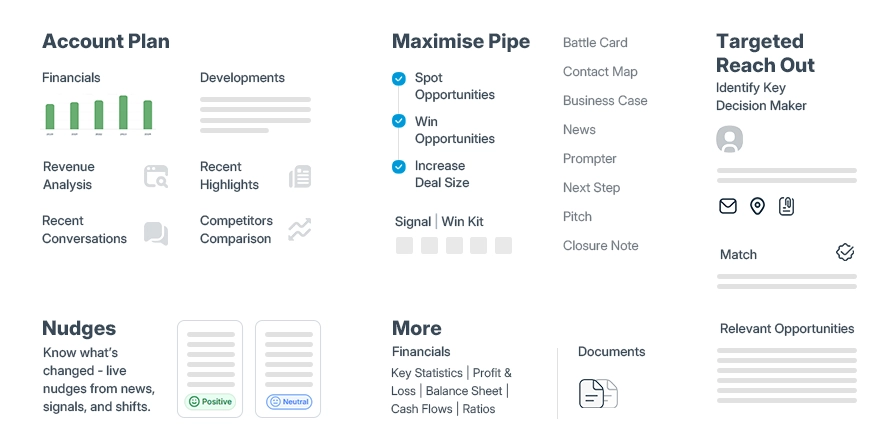
Account Intelligence Agents continuously watch target accounts connected through CRM. They track multi-source changes and consolidate them in one place. When an account moves, the intelligence updates.
This includes 5-year revenue history, financial data, key developments, business changes, recent conversations, and signals tied to opportunity relevance. The agent answers: "What is going on inside this account right now, and why does it matter?"
Spot Opportunities Agents identify opportunities inside target accounts tied to your offerings. They categorize by relevance—high, medium, low—and show why each opportunity exists, which signal triggered it, supporting sub-signals, which product offering fits, and associated buying centers.
Sellers review opportunity context, decide whether to pursue, and push selected opportunities into active deal workflows. The agent answers: "Where can we sell here, and why now?"
Signals Agents surface relevant news and developments tied to accounts. They filter noise and highlight what matters. This ensures sellers see triggering events as they happen, not weeks later.
Together, these agents create a system where opportunity detection runs continuously without manual effort. Explore how AI sales tools enable this approach.
Traditional sales tools show you data. Agent-based systems show you what the data means and what to do about it.
A job change notification in LinkedIn shows a new VP of Engineering joined. An agent-based system shows that this creates a technology stack review opportunity, identifies which of your products fit that review, surfaces who else is involved, and suggests what conversation makes sense.
The difference is not better data. It is better translation of data into action.
While competitors rely on periodic account reviews and generic intent signals, SalesPlay continuously monitors Salesforce-connected accounts, translates signals into product-specific opportunities, and presents them ranked by relevance with full buying center context.
Opportunity surfacing works differently depending on account maturity, relationship depth, and selling motion.
Challenge: Zero relationship, minimal account knowledge, unclear entry point
Workflow: Start with account intelligence to understand recent changes. Look for triggering events—new executives, announced initiatives, financial movements, competitive displacements.
Spot opportunities focused on these triggers. A new CRO typically reviews sales technology within 90 days. A failed audit creates compliance urgency. An acquisition creates consolidation pressure.
Identify the right contact based on the opportunity type. Map the conversation to what just happened. Enter with context, not cold outreach.
Challenge: Relationship exists in one business unit, opportunity exists in another, no warm introduction
Workflow: Monitor the full account, not just your contact's function. When signals appear in other divisions—reorganizations, new leaders, strategic shifts—surface opportunities tied to those movements.
Use existing relationships for context, not introduction. "We work with your sales team. I noticed your marketing organization just brought in a new CMO. Based on what we see with similar transitions, there is usually a 6-month window to evaluate marketing technology. Does that match what you are seeing?"
This positions you as an advisor who understands the business, not a vendor chasing another deal. Learn more about generating pipeline from existing accounts.
Challenge: Opportunity went cold, no clear reason, unclear path forward
Workflow: Check what changed since the deal stalled. Did the champion leave? Did budget shift? Did priorities change? Did a competitor win elsewhere?
Surface new signals that create fresh urgency. If the deal stalled because of budget, watch for new funding. If it stalled because the champion left, watch for the replacement to settle. If it stalled because priorities shifted, watch for those priorities to change again.
Re-engagement works when tied to new context, not when repeating old conversations.
Challenge: Large enterprise account, selling one product, potential for more, no visibility into other opportunities
Workflow: Continuously surface opportunities across all business units and functions. Even if you sell security software to IT, watch for opportunities in finance, operations, compliance, and HR.
When opportunities appear outside your current relationship, use account intelligence to understand context before reaching out. This prevents generic "I'd love to talk" outreach and enables relevant, informed conversations.
💡 Expansion Insight: Enterprise accounts with continuous opportunity monitoring generate 2.8x more expansion revenue than accounts managed through periodic check-ins and relationship-dependent discovery.
| Approach | Coverage | Timing | Relevance | Execution Readiness |
|---|---|---|---|---|
| Manual Account Research | Periodic snapshots, often outdated before use | Reactive, happens when pipeline is needed | Seller-dependent, inconsistent quality | Requires separate messaging and stakeholder work |
| Intent Data Platforms | Topic-level signals across many accounts | Shows interest, not business drivers | Broad, not product-specific | Requires interpretation and context building |
| Sales Intelligence Tools | Contact changes, company news, technographics | Real-time notifications, but no opportunity logic | Shows what happened, not why it matters | Data only, action steps not included |
| CRM Activity Tracking | Internal activity and deal history only | Backward-looking, not predictive | Limited to logged information | No external signal integration |
| Agent-Based Revenue Intelligence | Continuous monitoring of target accounts with multi-source consolidation | Surfaces opportunities as signals emerge | Filtered by product fit and categorized by strength | Includes stakeholders, messaging, and next steps |
A press release about a new office location is not equivalent to a missed earnings target. A VP hire in marketing is not equivalent to a security breach.
Sales teams that surface every signal as an opportunity lose seller trust. Within weeks, opportunities get ignored because the noise-to-signal ratio is too high.
Fix: Build relevance filters based on historical win patterns. Which signals actually preceded closed deals? Which led nowhere? Let data determine signal strength, not assumptions.
Opportunities decay. A new CIO creates a 90-day evaluation window. After that, they have chosen vendors and moved on. A compliance deadline creates urgency until it passes. After that, budgets reallocate.
Surfacing opportunities without time context leads to late outreach. By the time sellers act, the window closed.
Fix: Attach timing urgency to each opportunity. Flag when the window likely closes. Prioritize opportunities with near-term urgency over distant possibilities.
Opportunities do not respect org charts. A supply chain transformation creates opportunities in procurement, operations, IT, and finance. If you only talk to your existing IT contact, you miss three other buying centers.
Relationship-dependent opportunity detection leaves money on the table.
Fix: Surface opportunities account-wide, not contact-wide. When an opportunity appears in a different function, use account intelligence to understand context before outreach. Expand relationships based on where opportunities exist, not where comfort exists. Learn more about lead enrichment strategies.
Sending 100 emails does not create 100 opportunities. Having 50 "active" deals in your CRM does not mean 50 real buying opportunities exist.
Activity metrics drive behavior toward volume, not quality. Sellers chase anything that moves instead of focusing on opportunities that matter.
Fix: Define opportunity criteria clearly. Business context + product fit + buyer accessibility. If one component is missing, it is a lead or a signal, not an opportunity. Track opportunities separately from activity. Explore AI sales pipeline management best practices.
If your opportunity detection system produces more opportunities than your sellers can pursue, your filters are too loose. Quality beats quantity. High-confidence, well-timed opportunities with clear buyers win deals. Everything else creates busy work.
You cannot improve what you do not measure. Track these metrics to understand whether your opportunity surfacing actually works.
What percentage of surfaced opportunities become qualified pipeline? If this number is below 30%, your relevance filtering is broken. You are surfacing noise, not opportunities.
How long between when a signal appears and when a seller engages? Fast teams act within 48 hours. Slow teams act within 2 weeks. By then, the window often closed.
Compare win rates for opportunities surfaced through continuous intelligence versus those found through periodic research or inbound interest. If continuous intelligence produces better win rates, double down. If not, fix the translation logic.
How many active opportunities exist per target account on average? Enterprise accounts typically contain 3-7 viable opportunities at any time. If you only see 1-2, you are missing the rest.
Do sellers actually pursue surfaced opportunities, or do they ignore them? Low adoption means low trust. Fix the quality problem before adding more opportunities.
📊 Performance Benchmark: Top-performing sales teams using agent-based opportunity detection achieve 45-60% opportunity-to-pipeline conversion rates compared to 18-25% for teams using manual research and intent data.
Surfacing opportunities only creates value if sellers act on them consistently. This requires process, not heroic effort.
Dedicate 30 minutes per week per account executive to review new opportunities. Filter by high priority. Decide: pursue now, monitor, or ignore.
This prevents opportunity backlog and ensures timely action on the best chances.
Not every opportunity requires custom strategy. Build repeatable plays for common scenarios. New executive hire play. M&A integration play. Compliance deadline play. Failed audit play.
Playbooks speed execution and improve consistency. Explore sales enablement strategies for playbook development.
Require sellers to identify at least two relevant stakeholders before pursuing an opportunity. This prevents spray-and-pray outreach and forces account depth.
If an opportunity sits untouched for 14 days, close it. Either it was not actually important, or the seller does not have capacity. Do not let stale opportunities clutter the pipeline.
Opportunity detection is shifting from reactive research to predictive systems.
The next generation goes beyond "what changed" to "what will likely change." Predictive models identify accounts entering transformation windows before announcements happen. Pattern recognition spots early indicators that precede budget shifts, executive changes, and strategic pivots.
This does not replace human judgment. It makes judgment better informed and better timed.
Sales teams using predictive opportunity intelligence engage accounts 4-6 weeks earlier than competitors. That head start often determines who wins.
Market intelligence platforms like MarketsandMarkets provide the foundational data layer that powers predictive opportunity detection. Combined with continuous account monitoring and agent-based workflows, this creates intelligence depth competitors cannot match through generic intent data or manual research.
Implement opportunity surfacing in phases.
Phase 1: Define Your Target Account List
Start with 20-50 high-value accounts. These should be current customers with expansion potential or strategic prospects worth deep focus.
Phase 2: Establish Signal Relevance Mapping
Document which signals matter for each product offering. Which executive changes trigger evaluation windows? Which financial movements create budget availability? Which regulatory changes create urgency?
Phase 3: Implement Continuous Monitoring
Connect accounts to intelligence sources. Set up monitoring that updates as accounts move, not when you remember to check. Consider operationalizing account intelligence.
Phase 4: Build Opportunity Review Rhythm
Weekly cadence, consistent format, clear decision framework. Pursue, monitor, or close.
Phase 5: Measure and Refine
Track conversion rates, win rates, and seller adoption. Adjust relevance filters based on what actually produces pipeline.
Most teams see measurable pipeline improvement within 60 days. Full maturity takes 4-6 months. Learn more about how sales leaders use revenue intelligence to create pipeline.
Buying opportunities are specific, actionable moments when budget, priorities, or business initiatives inside a target account align with your offerings. Unlike general intent signals, buying opportunities connect business movement to your product capabilities and identify who cares, why it matters now, and which offering fits.
Surface buying opportunities early by continuously tracking account signals including financial movements, organizational changes, technology initiatives, regulatory pressures, and strategic announcements. Connect these signals to your product capabilities and buyer personas. The key is continuous monitoring, not periodic research.
Intent data shows research behavior and topic interest. Buying opportunities connect business context to specific product fit. Intent tells you someone is looking. Opportunities tell you why they should buy, which offering matches, and who decides. Intent is a signal. Opportunities are executable.
Enterprise accounts typically contain 3-7 active buying opportunities at any time across different business units, initiatives, and stakeholder groups. Most sales teams only see 1-2 because they lack continuous account intelligence and cross-functional visibility.
Agents continuously monitor account changes, connect signals to product offerings, identify relevant stakeholders, and present opportunities ranked by relevance. This replaces manual research and guesswork with systematic opportunity detection tied to real business movement. Learn more about AI sales tools.
Prioritize opportunities by signal strength, account fit, buying center accessibility, and timing urgency. High-priority opportunities combine multiple supporting signals, clear product fit, identified decision-makers, and recent triggering events that create windows for engagement.
Yes, when automation focuses on continuous monitoring and relevance filtering rather than generic outreach. The right approach automates signal detection, opportunity categorization, and context assembly while keeping human judgment in pursuit decisions and relationship strategy. Explore sales automation best practices.
Stop guessing where to sell. Start seeing opportunities as they emerge across your target accounts.
Surfacing buying opportunities across target accounts is not about more data. It is about better translation of business movement into executable pipeline.
The sales teams that win do not wait for inbound signals. They continuously monitor what changes inside their most important accounts. They connect those changes to product fit. They identify who cares and why it matters now.
This requires systems, not heroics. Manual research cannot keep pace with how fast enterprise accounts move. Agent-based revenue intelligence makes continuous opportunity detection possible at scale.
The difference shows in pipeline quality, deal velocity, and win rates. Teams using continuous opportunity surfacing see more opportunities, act faster, and close more deals in their target accounts.
Start with 20-50 accounts. Build signal-to-opportunity translation. Implement weekly review rhythm. Measure conversion and refine filters.
The opportunities are already there. You just need to see them before your competitors do.
Ready to transform how you find and win opportunities? Start your free trial or explore how SalesPlay helps you find real pipeline.


Category: Uncategorized Tags: ai, AIOps, Artificial Intelligence, cloud, cloud platform, Cybersecurity, Information and Communications Technology , VR