Agentic AI in Manufacturing Market by Component (Platforms, Services), Deployment Model (Cloud, On-Premises, Hybrid), End-use Industry (Discrete Manufacturing, Process Manufacturing, Heavy Equipment), and Region — Global Forecast to 2032


Agentic AI in Manufacturing Market 2032: Size, Share & Growth Report
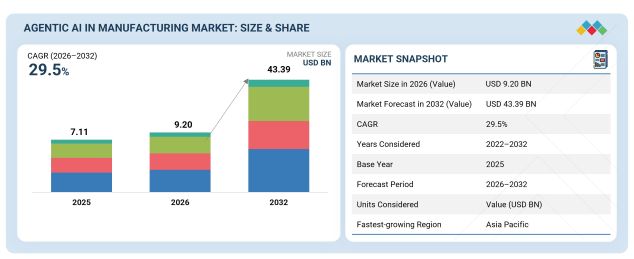
The agentic AI in manufacturing market is estimated to be USD 9.20 billion in 2026 and is projected to reach USD 43.39 billion by 2032, growing at a CAGR of 29.5% from 2026 to 2032, fueled by manufacturers' shift from AI as a reporting layer to AI as an execution layer embedded directly inside core ERP and line-of-business transactional workflows.
Market Overview
The agentic AI in manufacturing market marks a shift in which enterprise software moves beyond dashboards and visibility toward autonomous agents that validate constraints, recommend actions, and trigger workflow execution directly inside transactional systems such as order management, procurement, and supply chain orchestration.
For instance, SAP unveiled new agentic AI tools for manufacturing and supply chain operations at Hannover Messe 2026, centered on software embedded in business processes across production, logistics, and cloud-based enterprise systems. The launch included SAP Supply Chain Orchestration, which uses a real-time knowledge graph alongside Joule, SAP's AI assistant, to detect changes in supply and production conditions and trigger actions within core workflows.
SAP extended this same positioning dramatically at Sapphire 2026, unveiling what it calls the Autonomous Enterprise: a three-layer architecture comprising SAP Business AI Platform, SAP Autonomous Suite, and Joule Work, orchestrating more than 200 specialized agents across finance, supply chain, procurement, and human resources. The company announced a partnership with Anthropic to embed Claude as a primary reasoning engine across its AI-enabled portfolio, alongside a EUR 100 million partner fund to accelerate deployment.
Manufacturers are also under growing pressure from an entirely new source of demand: shop-floor execution platforms converging with ERP-level orchestration. QAD's Redzone platform, showcased at Hannover Messe 2026, is explicitly positioned around the idea that manufacturers do not have a data problem but an execution problem, extending agentic automation from passive systems of record into autonomous systems of action on the shop floor itself.
Top 10 Key Takeaways
- North America has the largest installed base, driven by concentrated ERP and hyperscale software investment and early enterprise adoption of autonomous agent platforms.
- Asia Pacific is the fastest-growing region, propelled by China, Japan, and South Korea's dense discrete manufacturing base scaling AI-embedded enterprise systems.
- Platforms lead by component share, reflecting manufacturers' preference for licensed agent orchestration software over managed implementation services.
- Discrete manufacturing is adopting most aggressively, reflecting the complex, multi-step assembly and supply coordination that autonomous agents are best suited to orchestrate.
- Cloud deployment is extending its lead as manufacturers favor vendor-managed agent runtimes over on-premises infrastructure for faster time-to-value.
- ERP vendors are racing to embed domain-specific agents directly into core business processes rather than offering agentic capability as a bolt-on module.
- Vendor consolidation is accelerating, with platform providers expanding from single-function agents into unified autonomous enterprise architectures.
- The largest near-term opportunity is agent-to-agent interoperability, which lets manufacturers orchestrate agents across ERP, MES, and supply chain systems from different vendors.
- Foundation-model partnerships are becoming standard practice, with ERP majors embedding third-party reasoning engines rather than building proprietary models from scratch.
- The primary near-term restraint is adoption friction from legacy ERP and line-of-business system complexity that predates agent-ready architecture.
Why the Agentic AI in Manufacturing Market Matters Now
Manufacturers have historically managed enterprise operations through a comparatively rigid mix of transactional ERP systems and periodic dashboard review, adequate when order volumes and supply conditions changed slowly enough for quarterly or monthly planning cycles. Agentic AI platforms exist because that model has broken down: rising costs, intensifying global competition, and persistent supply volatility now demand that enterprises sense market changes in real time and translate them into immediate execution, a pace no dashboard-and-report cycle can sustain.
The market covers the software platforms and implementation services used to deploy autonomous, goal-directed agents across manufacturing enterprise operations, spanning order management, procurement, supply chain orchestration, maintenance scheduling, and service processes. It includes established ERP and enterprise software majors that embed agentic capability into existing platforms, and specialized vendors building agent orchestration layers on top of legacy systems of record. The scope excludes shop-floor-only agent deployments not connected to enterprise transactional systems and generic horizontal agentic AI platforms not purpose-built for manufacturing workflows. The market connects to the broader enterprise resource planning market, the supply chain management software market, and the agentic AI in smart factories market.
The market's structure reflects a platform-versus-services divide. The largest manufacturers deploy full-stack autonomous suites from ERP majors such as SAP, trading platform lock-in for deep native integration and vendor-managed governance. Mid-market manufacturers increasingly adopt narrower, function-specific agent services layered onto existing ERP investments, trading full-suite breadth for faster, lower-risk deployment on a single high-value workflow such as supply chain orchestration. Discrete manufacturers sit alongside process manufacturing and heavy equipment operators as the largest and most aggressive adopter segment, reflecting the complexity of assembly operations that benefit most from autonomous coordination.
Report Scope
|
Report Metric |
Details |
|
Market Size in 2026 (Value) |
USD 9.20 Billion |
|
Market Forecast in 2032 (Value) |
USD 43.39 Billion |
|
Growth Rate |
CAGR of 29.5% from 2026-2032 |
|
Years Considered |
2022-2032 |
|
Base Year |
2026 |
|
Forecast Period |
2026-2032 |
|
Units Considered |
Value (USD Billion) |
|
Report Coverage |
Revenue forecast, company ranking, competitive landscape, growth factors, and trends |
|
Top Companies |
|
|
Growth Drivers |
|
|
Segments Covered |
|
|
Regional Scope |
North America, Europe, Asia Pacific, Rest of World |
Market Trends Shaping Agentic AI in Manufacturing
The key trend is enterprise software shifting from dashboards to autonomous execution layers. SAP's positioning of agentic AI at Hannover Messe 2026 makes this explicit: dashboards and visibility are no longer enough in a manufacturing environment shaped by cost pressure and persistent volatility, so AI must operate inside transactional workflows where it can validate constraints and trigger actions directly.
Another trend is ERP majors racing to embed domain-specific agents across core business processes rather than treating agentic AI as a separate add-on layer. SAP's Autonomous Enterprise architecture, unveiled at Sapphire 2026, orchestrates more than 200 specialized agents across finance, supply chain, procurement, and human resources through a unified Business AI Platform.
A third trend is shop-floor execution platforms converging with ERP-level agentic orchestration. QAD Redzone's positioning around systems of action rather than systems of record signals that the historical separation between shop-floor execution software and enterprise ERP is narrowing as both layers adopt agentic capability.
A fourth trend is foundation-model partnerships becoming standard practice for enterprise agent reasoning. SAP's partnership with Anthropic to embed Claude as a primary reasoning engine across its AI-enabled portfolio demonstrates that ERP vendors increasingly prefer partnering with foundation-model providers over building proprietary models from scratch.
The fifth trend sees free and low-cost agent runtimes lowering adoption friction for mid-market manufacturers. SAP's decision to make Joule Studio free, including its agent runtime, until the end of 2026, alongside no-cost agent-to-agent interoperability, reflects vendor recognition that removing upfront cost barriers accelerates platform-wide adoption.
Market Drivers Accelerating Growth
The first key factor is manufacturers shifting from AI as a reporting layer to AI as an execution layer. As rising costs and intensifying global competition compress decision windows, manufacturers need considerably more autonomous execution capability than dashboard-and-report cycles were ever designed to provide.
The second factor is ERP vendors embedding autonomous agents directly into transactional workflows, specifically because native integration eliminates the data-silo problem that standalone automation tools could never fully resolve. SAP's Supply Chain Orchestration, using a real-time knowledge graph alongside Joule, demonstrates that agents embedded inside core ERP systems can sense and respond to supply changes considerably faster than bolt-on automation layers.
The third factor is cost pressure and global competition accelerating end-to-end process orchestration across design, planning, procurement, manufacturing, logistics, and service. As manufacturers increasingly need to connect processes not only across internal teams but across company boundaries with suppliers and logistics partners, they require agentic orchestration considerably more integrated than point-solution automation tools can offer.
Market Challenges and Restraints
The key obstacle is adoption friction from legacy ERP and line-of-business system complexity that predates agent-ready architecture. Manufacturers running decades-old S/4HANA predecessors or comparable legacy platforms face genuine integration cost and timeline risk when connecting autonomous agents to transactional workflows never designed for agent input.
Another hurdle is workforce retraining requirements to supervise rather than execute transactions, which is slowing adoption specifically among mid-market manufacturers. As agentic AI automates routine supply chain coordination and maintenance scheduling, procurement managers and plant operators must be retrained to audit AI agent decisions rather than manually executing transactions, a change management challenge that pure technology deployment cannot solve alone.
The third challenge involves governance and guardrails for autonomous agents acting on transactional data. With agents increasingly authorized to trigger real business actions such as order releases and supplier rerouting, manufacturers require robust governance frameworks rather than unchecked automation, a challenge that vendors are only beginning to formalize through agent-to-agent interoperability standards and audit tooling.
Segment Insights
By Component
Platforms lead the market by component share, reflecting manufacturers' preference for licensed agent orchestration software that can be embedded directly into existing ERP and line-of-business systems.
Services are the fastest-growing component category, as manufacturers increasingly require implementation, integration, and change-management support to connect agentic platforms with legacy transactional systems.
By End-use Industry
Discrete manufacturing leads the market in adoption intensity, reflecting the complex, multi-step assembly and supply coordination that autonomous agents are best suited to orchestrate across interdependent production processes.
Process manufacturing is the fastest-growing end-use segment, as continuous-production operators increasingly deploy agentic orchestration to manage the tight process-control tolerances that batch and continuous manufacturing require.
Key segmentation highlights:
- Platforms remain the primary entry point for enterprise adoption, while services show the fastest growth as implementation complexity drives demand for specialized support.
- Cloud deployment is gaining share fastest, though on-premises remains significant among regulated manufacturers with strict data-residency requirements.
- Discrete manufacturing accounts for the largest share of spending, while process manufacturing represents the fastest-growing end-use segment.
- Heavy equipment manufacturers increasingly serve as an early-adopter segment for supply chain orchestration agents given their complex, global supplier networks.
- Vendor consolidation is compressing the number of distinct point solutions a typical manufacturer needs to integrate and maintain.
Agentic AI in Manufacturing Market by Region
North America
North America holds the largest base, valued at roughly USD 3.31 billion in 2026 and projected to reach about USD 15.26 billion by 2032, growing at a CAGR of 29.0%.
The US leads with key platform vendors including SAP's North American operations, Microsoft, Oracle, and QAD, alongside deep enterprise investment in autonomous ERP transformation. Canada also contributes through growing interest in supply chain orchestration modernization.
Europe
Europe is advancing in line with the global pace, valued at approximately USD 2.02 billion in 2026 and forecast to reach around USD 9.24 billion by 2032, at a CAGR of 28.8%.
Germany spearheads European adoption through SAP's home-market presence and Hannover Messe's role as the world's leading stage for industrial transformation announcements. The UK and France contribute through growing discrete manufacturing digitalization programs.
Asia Pacific
Asia Pacific is the fastest-growing region, valued at roughly USD 3.04 billion in 2026 and projected to reach about USD 15.20 billion by 2032, growing at a CAGR of 30.8%.
China, Japan, and South Korea spearhead regional growth through dense discrete manufacturing ecosystems increasingly connecting ERP systems with agentic orchestration layers. India advances through expanding enterprise software adoption and growing government AI infrastructure investment.
Rest of World
The Rest of World market reached an estimated USD 0.83 billion in 2026 and is projected to hit about USD 3.68 billion by 2032, growing at a CAGR of 28.2%.
The Middle East is investing in enterprise AI adoption as part of broader industrial diversification strategies. Latin America contributes through Brazil's growing manufacturing digitalization and enterprise software modernization programs.
Key Company Insights
The competitive landscape consists of four tiers: established ERP and enterprise software majors, specialized manufacturing execution system vendors, hyperscale cloud and foundation-model providers, and systems-integration consultancies. Major players include:
- SAP SE
- Microsoft Corporation
- Oracle Corporation
- Infor
- QAD Inc.
- Salesforce
- IBM Corporation
- Epicor Software
- IFS AB
- Rockwell Automation
- Siemens Aktiengesellschaft
- Amazon Web Services
- Anthropic
- Deloitte
- PTC Inc.
SAP SE leads through the scale and depth of its Autonomous Enterprise architecture, combining SAP Business AI Platform, SAP Autonomous Suite, and Joule Work into a unified system now orchestrating more than 200 specialized agents, and extended through a strategic partnership with Anthropic to embed Claude as a primary reasoning engine across its portfolio.
QAD Inc., through its Redzone platform, has become a leading shop-floor execution vendor following its positioning shift from passive systems of record toward autonomous systems of action, directly connecting workforce execution with agentic automation for supply chain coordination and maintenance scheduling.
Microsoft Corporation and Oracle Corporation each continue extending cloud and foundation-model infrastructure into specialized manufacturing agent deployment, competing directly with more ERP-native entrants for large enterprise transformation programs.
Recent Developments
- May 2026: SAP unveiled the Autonomous Enterprise at Sapphire 2026, a three-layer architecture comprising SAP Business AI Platform, SAP Autonomous Suite, and Joule Work, orchestrating more than 200 specialized agents across finance, supply chain, procurement, and human resources, alongside a strategic partnership with Anthropic to embed Claude as a primary reasoning engine and a EUR 100 million partner fund.
- April 2026: SAP unveiled new agentic AI tools for manufacturing and supply chain operations at Hannover Messe 2026, including SAP Supply Chain Orchestration, which uses a real-time knowledge graph alongside Joule to detect changes in supply and production conditions and trigger actions within core workflows.
- April 2026: QAD | Redzone showcased its agentic, AI-powered manufacturing platform at Hannover Messe 2026, positioning the offering around shifting manufacturers from passive systems of record to autonomous systems of action on the shop floor.
- May 2026: SAP made Joule Studio free, including its agent runtime, until December 31, 2026, and introduced no-cost, unlimited agent-to-agent interoperability, a move Forrester described as the most aggressive commercial step SAP had taken in a decade.
Real-World Use Cases
SAP's Autonomous Enterprise illustrates how a single, unified architecture can replace the fragmented reporting and automation tools many manufacturers have historically operated across finance, supply chain, and procurement separately. Built on SAP Business AI Platform as the control layer and SAP Autonomous Suite as the execution layer, the architecture lets Joule, SAP's AI assistant, initiate actions such as order releases while the system validates material availability, capacity, and scheduling constraints in real time. The company's claim that agent-led migration tooling can reduce ERP transformation efforts by more than 35% demonstrates how quickly agentic AI is moving from pilot programs to measurable enterprise impact.
QAD Redzone's shop-floor platform shows how agentic execution can scale from a workforce-connection tool into a genuine system of action addressing what the company frames as manufacturing's core execution problem rather than a data problem. By connecting frontline workers directly to autonomous supply chain coordination and maintenance scheduling, the platform gives ERP leaders a concrete path to redefine procurement manager and plant operator roles around supervising and auditing AI agents rather than manually executing transactions.
Opportunities and Future Outlook
Through 2032, agentic AI will continue to reshape how manufacturers plan, execute, and govern increasingly autonomous enterprise operations. The forces driving the market — the shift from AI as a reporting layer to AI as an execution layer, ERP vendors embedding autonomous agents into transactional workflows, and cost pressure accelerating end-to-end orchestration — are compounding simultaneously with a new source of demand: agent-to-agent interoperability standards maturing enough to unlock genuinely cross-vendor orchestration across ERP, MES, and supply chain systems. The next phase will be fully autonomous enterprise operation, with agentic platforms coordinating finance, supply chain, and shop-floor execution in real time while manufacturers focus on strategic governance rather than manual transaction review.
The competitive landscape will be defined by platform breadth and native-integration depth. Established ERP majors compete against specialized manufacturing execution vendors and hyperscale cloud providers for the same enterprise transformation budgets. For Chief Information Officers, VP Supply Chain leaders, and investors, organizations that deploy unified, governed agentic platforms will manage ERP transformation cost, reduce order-to-cash cycle time, and scale autonomous operations more effectively than those relying on fragmented, legacy transactional systems in an increasingly agentic operating environment.
Frequently Asked Questions (FAQ)
1. How big is the agentic AI in manufacturing market?
The agentic AI in manufacturing market was estimated at roughly USD 9.20 billion in 2026 and is projected to reach about USD 43.39 billion by 2032. North America accounts for the largest share, driven by concentrated ERP and hyperscale software investment.
2. What is the agentic AI in manufacturing market growth rate?
The market is forecast to grow at a CAGR of approximately 29.5% from 2026 to 2032. Asia Pacific is the fastest-growing region at around 30.8%, driven by China, Japan, and South Korea's dense discrete manufacturing base.
3. Which segment leads the agentic AI in manufacturing market?
By component, platforms lead the market, while services experience the fastest growth. By end-use industry, discrete manufacturing leads, though process manufacturing shows the fastest growth.
4. Who are the key players in the agentic AI in manufacturing market?
Leading players include SAP SE, Microsoft Corporation, Oracle Corporation, Infor, QAD Inc., Salesforce, IBM Corporation, Epicor Software, IFS AB, Rockwell Automation, Siemens Aktiengesellschaft, Amazon Web Services, Anthropic, Deloitte, and PTC Inc.
5. What are the factors driving the agentic AI in manufacturing market?
The primary drivers are manufacturers shifting from AI as a reporting layer to AI as an execution layer, ERP vendors embedding autonomous agents directly into transactional workflows, and cost pressure and global competition accelerating end-to-end process orchestration.
Speak With Our Analyst
The agentic AI in manufacturing market is where enterprise software and autonomous execution converge into a single transformation category, and the segment-level detail on component economics, deployment model, end-use industry dynamics, and competitive platform positioning is where strategic decisions are won or lost. MarketsandMarkets can help you go deeper: request a sample of the full study, speak with our analyst about your specific questions, or customize the scope to your target components, end-use industries, and geographies. Reach out to explore how this intelligence can inform your enterprise AI strategy, platform selection, or investment thesis.
 Exclusive indicates content/data unique to MarketsandMarkets and not available with any competitors.
TABLE OF CONTENTS
1 Introduction
1.1 Study Objectives
1.2 Market Definition and Scope
1.2.1 Inclusions and Exclusions
1.3 Study Scope
1.3.1 Markets Covered
1.3.2 Geographic Segmentation
1.3.3 Years Considered
1.4 Currency Considered
1.5 Stakeholders
2 Research Methodology
2.1 Research Approach
2.1.1 Secondary Research
2.1.2 Primary Research
2.1.2.1 Breakdown of Primaries
2.2 Market Size Estimation
2.2.1 Bottom-Up Approach
2.2.2 Top-Down Approach
2.3 Data Triangulation
2.4 Research Assumptions
2.5 Limitations and Risk Assessment
3 Executive Summary
4 Premium Insights
4.1 Attractive Opportunities in the Agentic AI in Manufacturing Market
4.2 Market, By Component
4.3 Market, By Region
4.4 Market, By End-use Industry
5 Market Overview
5.1 Introduction
5.2 Market Dynamics
5.2.1 Drivers
5.2.1.1 Manufacturers Shifting From AI as a Reporting Layer to AI as an Execution Layer
5.2.1.2 ERP Vendors Embedding Autonomous Agents Directly Into Transactional Workflows
5.2.1.3 Cost Pressure and Global Competition Accelerating End-to-End Process Orchestration
5.2.2 Restraints
5.2.2.1 Adoption Friction From Legacy ERP and Line-of-Business System Complexity
5.2.2.2 Workforce Retraining Requirements to Supervise Rather Than Execute Transactions
5.2.3 Opportunities
5.2.3.1 Agent-to-Agent Interoperability Standards Unlocking Cross-Vendor Orchestration
5.2.3.2 Vertical Industry AI Solutions Tailored to Discrete and Process Manufacturing
5.2.4 Challenges
5.2.4.1 Governance and Guardrails for Autonomous Agents Acting on Transactional Data
5.2.4.2 Regulatory Data Requirements Increasingly Tied to Operational Agent Decisions
5.3 Value Chain Analysis
5.4 Ecosystem Analysis
5.5 Investment and Funding Scenario
5.6 Pricing Analysis
5.7 Trends and Disruptions Impacting Customer Business
5.8 Technology Analysis
5.8.1 Key Technologies (Agent Orchestration Platforms, Knowledge Graphs, Natural Language Interfaces)
5.8.2 Complementary Technologies (ERP Integration Layers, MES Connectors)
5.8.3 Adjacent Technologies (Robotic Process Automation, Supply Chain Control Towers)
5.9 Porter's Five Forces Analysis
5.10 Key Stakeholders and Buying Criteria
5.11 Case Study Analysis
5.12 Key Conferences and Events
5.13 Regulatory Landscape
5.13.1 EU AI Act Provisions Affecting High-Risk Enterprise AI Agents
5.13.2 Data Residency and Sovereignty Requirements Across Global Manufacturing Operations
5.13.3 US Export Controls Affecting Enterprise AI Platform Deployment
5.14 Impact of AI and Generative AI on the Market
5.15 Impact of 2025 US Tariffs on Supply Chains
6 Industry Trends
6.1 Enterprise Software Shifting From Dashboards to Autonomous Execution Layers
6.2 ERP Majors Racing to Embed Domain-Specific Agents Across Core Business Processes
6.3 Shop-Floor Execution Platforms Converging With ERP-Level Agentic Orchestration
6.4 Foundation-Model Partnerships Becoming Standard for Enterprise Agent Reasoning
6.5 Free and Low-Cost Agent Runtimes Lowering Adoption Friction for Mid-Market Manufacturers
6.6 Vendor Consolidation Building Unified Autonomous Enterprise Platforms
7 Technology Adoption and Strategic Disruption Landscape
7.1 ERP-Native Agent Platforms vs. Independent Orchestration Layers
7.2 Cloud-Based Agent Runtimes vs. On-Premises Deployment for Regulated Manufacturers
7.3 Single-Vendor Autonomous Suites vs. Best-of-Breed Agent Frameworks
7.4 Build vs. Partner: Manufacturer Enterprise AI Sourcing Strategy
8 Customer Landscape and Buyer Behavior
8.1 Decision-Making Process — Chief Information Officer, VP Supply Chain, Chief Financial Officer
8.2 Build vs. Buy: Large Manufacturers Building Proprietary; Mid-Market Using Vendor Platforms
8.3 ROI Framework: ERP Transformation Cost Reduction, Order-to-Cash Cycle Time, Service Levels
8.4 Adoption Barriers: Legacy System Complexity, Governance Uncertainty, Workforce Readiness
9 Agentic AI in Manufacturing Market, By Component
9.1 Introduction
9.2 Platforms
9.3 Services
10 Agentic AI in Manufacturing Market, By Deployment Model
10.1 Introduction
10.2 Cloud
10.3 On-Premises
10.4 Hybrid
11 Agentic AI in Manufacturing Market, By End-use Industry
11.1 Introduction
11.2 Discrete Manufacturing
11.3 Process Manufacturing
11.4 Heavy Equipment
12 Agentic AI in Manufacturing Market, By Region
12.1 Introduction
12.2 North America
12.2.1 United States
12.2.2 Canada
12.3 Europe
12.3.1 Germany
12.3.2 United Kingdom
12.3.3 France
12.3.4 Rest of Europe
12.4 Asia Pacific
12.4.1 China
12.4.2 Japan
12.4.3 South Korea
12.4.4 India
12.4.5 Rest of Asia Pacific
12.5 Rest of World
12.5.1 Middle East
12.5.2 Latin America
13 Competitive Landscape
13.1 Overview
13.2 Key Player Strategies / Right to Win
13.3 Revenue Analysis
13.4 Market Share Analysis
13.5 Company Evaluation Matrix
13.6 Competitive Benchmarking
13.7 Competitive Scenario
14 Company Profiles
14.1 SAP SE
14.2 Microsoft Corporation
14.3 Oracle Corporation
14.4 Infor
14.5 QAD Inc.
14.6 Salesforce
14.7 IBM Corporation
14.8 Epicor Software
14.9 IFS AB
14.10 Rockwell Automation
14.11 Siemens Aktiengesellschaft
14.12 Amazon Web Services
14.13 Anthropic
14.14 Deloitte
14.15 PTC Inc.
15 Appendix
15.1 Discussion Guide
15.2 KnowledgeStore: MarketsandMarkets' Subscription Portal
15.3 Customization Options
15.4 Related Reports
15.5 Author Details













Growth opportunities and latent adjacency in Agentic AI in Manufacturing Market