Agentic AI in Smart Factories Market Size, Share & Report Growth by Agent Function (Quality and Defect-Detection, Supply Chain Orchestration, Adaptive Process Optimization), Deployment Mode (On-Premises/Edge, Cloud, Hybrid), End-User, and Region — Global Forecast to 2032


Agentic AI in Smart Factories Market 2032: Size, Share & Growth Report
The agentic AI in smart factories market is estimated to be USD 6.88 billion in 2026 and is projected to reach USD 26.12 billion by 2032, growing at a CAGR of 24.9% from 2026 to 2032, fueled by manufacturers' shift from passive monitoring dashboards toward autonomous control loops that learn from live production data instead of following rigid scripts.
Market Overview
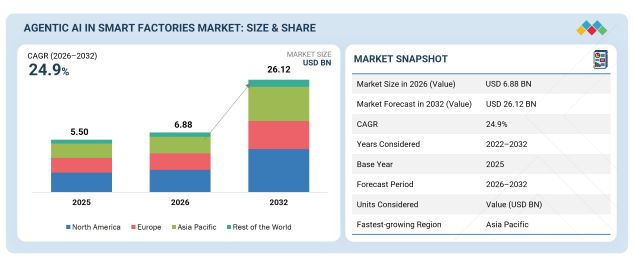
The agentic AI in smart factories market marks a shift in which factories move beyond rule-based automation scripts toward autonomous agents that perceive production conditions, reason across multiple steps, and take corrective action without waiting for human sign-off on every decision.
For instance, Siemens and NVIDIA expanded their strategic partnership at CES 2026 to build what the companies call the Industrial AI Operating System, aiming to build the world's first fully AI-driven, adaptive manufacturing sites, starting with the Siemens Electronics Factory in Erlangen, Germany, as the first blueprint. Using an AI Brain powered by software-defined automation combined with NVIDIA Omniverse libraries, factories can continuously analyze their digital twins, test improvements virtually, and turn validated insights into real-world changes.
Siemens extended this same collaboration further in July 2026, announcing self-verifying agentic AI workflows for semiconductor and PCB design that let engineering teams move from autonomous task orchestration toward continuously validated outcomes, integrated into Siemens's Intelligence Center X platform for agent creation and orchestration across design, manufacturing, and supply chain operations.
Top 10 Key Takeaways
- North America has the largest installed base, driven by concentrated hyperscaler investment and early enterprise adoption of agentic AI across manufacturing operations.
- Asia Pacific is the fastest-growing region, propelled by China, Japan, and South Korea's dense electronics and automotive manufacturing base scaling AI-driven production.
- Predictive maintenance agents lead by adoption share, offering rapid ROI through measurable downtime reduction across industrial equipment fleets.
- Automotive manufacturing is adopting most aggressively, reflecting the complexity of assembly operations that benefit most from autonomous optimization.
- Edge deployment is gaining share fastest, as millisecond-level latency and data-sovereignty requirements push inference away from centralized cloud architectures.
- Full-stack partnerships between software, silicon, and systems specialists are becoming the default go-to-market model rather than single-vendor point solutions.
- Vendor consolidation is accelerating, with platform providers expanding from single-function agents into broader industrial AI operating systems.
- The largest near-term opportunity is adaptive manufacturing site conversion, where entire facilities are redesigned around continuous digital-twin-validated optimization.
- Digital twins are evolving from passive simulation tools into active physical-world intelligence layers that agents query and act upon in real time.
- The primary near-term restraint is integration complexity with legacy manufacturing execution systems that were never designed for autonomous agent input.
Why the Agentic AI in Smart Factories Market Matters Now
Manufacturers have historically managed production through a comparatively rigid mix of scripted automation and passive monitoring dashboards, adequate when production variables were limited and exceptions were rare. Agentic AI platforms exist because that model has broken down: modern production lines generate live data volumes and exception-heavy workstreams that rule-based scripts cannot adapt to, while global competitive pressure demands optimization cycles measured in minutes rather than the weeks a manual engineering review would require.
The market covers the software and platform layers used to deploy autonomous, goal-directed agents on the factory floor, spanning predictive maintenance, quality and defect detection, supply chain orchestration, production planning and scheduling, and adaptive process optimization. It includes established industrial automation majors that extend existing platforms with agentic capability, and AI infrastructure providers that supply the underlying compute and model layer. The scope excludes generic horizontal agentic AI platforms not purpose-built for manufacturing environments and simple rule-based automation lacking autonomous decision-making capability. The market connects to the broader smart factory market, the industrial IoT market, and the digital twin market.
The market's structure reflects a partnership-driven divide. The largest manufacturers deploy full-stack solutions co-created by software, silicon, and systems specialists such as Siemens and NVIDIA, trading integration complexity for deeply validated, physics-grounded agentic workflows. Mid-market manufacturers increasingly adopt narrower, function-specific agents from specialized vendors, trading full-stack breadth for faster time-to-value on a single high-ROI use case such as predictive maintenance. Semiconductor and electronics manufacturers sit alongside traditional discrete manufacturers as a fast-growing, distinct segment specifically seeking agentic workflows for design verification and yield optimization.
Report Scope
|
Report Metric |
Details |
|
Market Size in 2026 (Value) |
USD 6.88 Billion |
|
Market Forecast in 2032 (Value) |
USD 26.12 Billion |
|
Growth Rate |
CAGR of 24.9% from 2026-2032 |
|
Years Considered |
2022-2032 |
|
Base Year |
2026 |
|
Forecast Period |
2026-2032 |
|
Units Considered |
Value (USD Billion) |
|
Report Coverage |
Revenue forecast, company ranking, competitive landscape, growth factors, and trends |
|
Top Companies |
|
|
Growth Drivers |
|
|
Segments Covered |
|
|
Regional Scope |
North America, Europe, Asia Pacific, Rest of World |
Market Trends Shaping Agentic AI in Smart Factories
The key trend is factories moving from passive monitoring dashboards to autonomous control loops. Plant managers are shifting away from systems that merely flag anomalies toward agents that act on production data directly, as process control architectures increasingly require instantaneous decision-making at the machine level where human-in-the-loop latency has become unacceptable for complex variable optimization.
Another trend is full-stack partnerships shortening engineering cycles across software, silicon, and systems specialists. Partnerships such as Siemens-NVIDIA, Samsung-ASML, and ABB-Microsoft highlight how vendors are co-creating full-stack solutions rather than expecting manufacturers to integrate point solutions themselves.
A third trend is self-verifying agentic workflows replacing simple task automation. Siemens's expanded Fuse EDA AI Agent, now integrated with NVIDIA technology, lets long-running domain-scoped agents reason, act, and continuously validate decisions against deterministic, physics-based engines rather than operating as unchecked automation.
A fourth trend is digital twins evolving from passive simulation into active physical-world intelligence. Siemens's Digital Twin Composer combined with NVIDIA Omniverse libraries lets manufacturers recreate every machine, conveyor, and operator path with physics-level accuracy, enabling agents to simulate and refine system changes before any physical modification occurs.
Market Drivers Accelerating Growth
The first key factor is rising demand for autonomous decision-making over static automation scripts. As production variables multiply and exception-heavy workstreams grow, manufacturers need considerably more adaptive systems than rule-based scripts were ever designed to provide.
The second factor is digital twin and simulation maturity enabling trusted agentic deployment, specifically because physics-grounded validation gives plant managers confidence to let agents act autonomously. Siemens's PepsiCo deployment demonstrates that this approach can identify up to 90% of potential issues before any physical modification, giving manufacturers considerably more confidence to expand agentic scope.
The third factor is CFO-level AI budget expansion following proven downtime and defect-reduction ROI. As predictive-maintenance and defect-detection agents demonstrate measurable savings, finance leaders are releasing considerably larger AI budgets than they would for unproven automation initiatives, extending this market's investment base well beyond pilot-stage spending.
Market Challenges and Restraints
The key obstacle is integration complexity with legacy manufacturing execution systems that were never designed for autonomous agent input. Modern agentic platforms have to interoperate with decades-old MES and SCADA infrastructure rather than replacing them outright, and that integration work remains a genuine, often underestimated cost and timeline risk.
Another hurdle is the shortage of skilled industrial AI and orchestration talent, which is slowing deployment specifically among mid-market manufacturers. Organizations without deep in-house AI expertise remain understandably cautious about deploying autonomous agents at scale, and that caution continues to shape adoption timelines even where the underlying technology is proven.
The third challenge involves trust and verifiability of autonomous agent decisions on the factory floor. With agents increasingly making real-time production decisions, manufacturers require continuously validated, physics-based verification rather than opaque model outputs, a challenge that self-verifying workflow approaches are only beginning to resolve.
Segment Insights
By Agent Function
Predictive maintenance agents lead the market by adoption share, reflecting their foundational role delivering rapid, measurable ROI through downtime reduction across industrial equipment fleets.
Adaptive process optimization agents are the fastest-growing function category, as manufacturers increasingly deploy edge-based agents that continuously analyze digital twins and turn validated insights into real-world production changes.
By End-User Industry
Automotive manufacturing leads the market in adoption intensity, reflecting the complexity of assembly operations that require autonomous optimization across thousands of interdependent process steps.
Key segmentation highlights:
- Predictive maintenance remains the primary entry point for agentic adoption, while adaptive process optimization shows the fastest growth in mature deployments.
- Edge deployment is gaining share fastest, though cloud deployment remains dominant among manufacturers still validating agentic use cases at smaller scale.
- Automotive manufacturing accounts for the largest share of spending, while semiconductor and electronics manufacturers represent the fastest growing customer segment.
- Supply chain orchestration agents increasingly serve as the coordination layer linking production-floor agents with broader enterprise planning systems.
- Vendor consolidation is compressing the number of distinct point solutions a typical manufacturer needs to integrate and maintain.
Agentic AI in Smart Factories Market by Region
North America
The US leads with key platform vendors including NVIDIA and Microsoft, alongside deep hyperscale investment from Amazon Web Services, whose IoT SiteWise Edge agents extend generative AI to factory-floor operations. Canada also contributes through growing interest in AI-driven manufacturing modernization.
Europe
Germany spearheads European agentic AI adoption through Siemens's Electronics Factory in Erlangen, the first blueprint site for the Siemens-NVIDIA Industrial AI Operating System. The UK and France contribute through growing automotive and aerospace manufacturing digitalization programs.
Asia Pacific
China, Japan, and South Korea spearhead regional growth through dense electronics and automotive manufacturing ecosystems, with Samsung's partnership with ASML illustrating how semiconductor manufacturers are co-creating agentic solutions for design and yield optimization. India advances through expanding industrial automation investment.
Rest of World
South America is projected to grow at a notably strong rate owing to Brazil's large-scale AI infrastructure investments. The Middle East is investing in smart-manufacturing programs as part of broader industrial diversification strategies.
Key Company Insights
The competitive landscape consists of four tiers: AI infrastructure and silicon providers, established industrial automation majors, hyperscale cloud providers, and specialized industrial software vendors. Major players include:
- NVIDIA Corporation
- Siemens Aktiengesellschaft
- Robert Bosch GmbH
- ABB
- Microsoft Corporation
- Amazon Web Services
- Rockwell Automation
- Schneider Electric
- Honeywell
- Samsung Electronics
- ASML
- IBM Corporation
- PTC Inc.
- Dassault Systèmes
NVIDIA Corporation leads through the scale and depth of its full-stack AI infrastructure, combining AI infrastructure, simulation libraries, models, frameworks, and blueprints into partnerships with industrial majors, most notably its expanded Siemens collaboration to build what the companies call the Industrial AI Operating System spanning design, engineering, and factory operations.
Siemens Aktiengesellschaft has become a leading industrial software platform provider following its Intelligence Center X launch and expanded Fuse EDA AI Agent system, now integrated with NVIDIA technology to deliver self-verifying agentic workflows across design, manufacturing, and supply chain operations.
Robert Bosch GmbH and ABB each continue extending focused industrial automation expertise into specialized agentic deployment, competing directly with more platform-integrated entrants for large manufacturing transformation programs.
Recent Developments
- July 2026: Siemens announced an expansion of its strategic partnership with NVIDIA to deliver self-verifying agentic AI workflows to electronic design automation, helping semiconductor and PCB engineering teams move from autonomous task orchestration toward continuously validated engineering outcomes, integrated into Siemens's Intelligence Center X platform.
- January 2026: Siemens and NVIDIA announced a significant expansion of their strategic partnership at CES 2026 to build the Industrial AI Operating System, aiming to develop the world's first fully AI-driven, adaptive manufacturing sites globally, starting with the Siemens Electronics Factory in Erlangen, Germany.
- January 2026: Siemens deployed its Digital Twin Composer combined with NVIDIA Omniverse libraries and computer vision at a PepsiCo facility, enabling AI agents to simulate, test, and refine system changes, identifying up to 90% of potential issues before physical modifications and delivering a 20% increase in throughput on initial deployment.
Real-World Use Cases
Siemens and NVIDIA's Industrial AI Operating System illustrates how a single, full-stack platform can replace the fragmented monitoring and automation tools many manufacturers have historically operated separately. Built on an AI Brain combining software-defined automation with NVIDIA Omniverse libraries, the platform lets factories continuously analyze their digital twins, test improvements virtually, and turn validated insights into real-world changes without waiting for a full engineering review cycle. The approach's deployment at a PepsiCo facility, delivering a 20% increase in throughput and identifying up to 90% of potential issues before physical modification, demonstrates how quickly agentic AI is moving from pilot to measurable production impact.
Opportunities and Future Outlook
Through 2032, agentic AI will continue to reshape how manufacturers plan, operate, and optimize increasingly autonomous production environments. The forces driving the market — rising demand for autonomous decision-making, digital twin and simulation maturity, and CFO-level AI budget expansion — are accelerating simultaneously with a new source of demand: full-stack partnerships between software, silicon, and systems specialists maturing enough to unlock genuinely adaptive manufacturing sites at scale. The next phase will be fully autonomous factory orchestration, with agentic platforms coordinating entire production ecosystems in real time while manufacturers focus on strategic capacity planning rather than manual process review.
The competitive landscape will be defined by platform breadth and physics-grounded verification depth. AI infrastructure providers compete alongside industrial automation majors for the same manufacturing transformation budgets. For Chief Technology Officers, VP Manufacturing leaders, and investors, organizations that deploy unified, self-verifying agentic platforms will manage production optimization, avoid costly integration missteps, and scale autonomous operations more effectively than those relying on fragmented, legacy automation scripts in an increasingly agentic operating environment.
Frequently Asked Questions (FAQ)
1. How big is the agentic AI in smart factories market?
The agentic AI in smart factories market was estimated at roughly USD 6.88 billion in 2026 and is projected to reach about USD 26.12 billion by 2032. North America accounts for the largest share, driven by concentrated hyperscaler investment and early enterprise adoption.
2. What is the agentic AI in smart factories market growth rate?
The market is forecast to grow at a CAGR of approximately 24.9% from 2026 to 2032. Asia Pacific is the fastest-growing region at around 26.2%, driven by China, Japan, and South Korea's dense electronics and automotive manufacturing base.
3. Which segment leads the agentic AI in smart factories market?
By agent function, predictive maintenance agents lead the market, while adaptive process optimization agents experience the fastest growth. By end-user, automotive manufacturing leads, though semiconductor and electronics manufacturers show the fastest growth.
4. Who are the key players in the agentic AI in smart factories market?
Leading players include NVIDIA Corporation, Siemens Aktiengesellschaft, Robert Bosch GmbH, ABB, Rockwell Automation, Schneider Electric, Honeywell, Samsung Electronics, ASML, IBM Corporation, PTC Inc., Dassault Systèmes, and Cognite.
5. What are the factors driving the agentic AI in smart factories market?
The primary drivers are rising demand for autonomous decision-making over static automation scripts, digital twin and simulation maturity enabling trusted agentic deployment, CFO-level AI budget expansion following proven ROI, and full-stack partnerships between software, silicon, and systems specialists.
Speak With Our Analyst
The agentic AI in smart factories market is where industrial automation and autonomous AI decision-making converge into a single production-optimization category, and the segment-level detail on agent function economics, deployment mode, end-user dynamics, and competitive platform positioning is where strategic decisions are won or lost. MarketsandMarkets can help you go deeper: request a sample of the full study, speak with our analyst about your specific questions, or customize the scope to your target functions, end-users, and geographies. Reach out to explore how this intelligence can inform your manufacturing AI strategy, platform selection, or investment thesis.
 Exclusive indicates content/data unique to MarketsandMarkets and not available with any competitors.
TABLE OF CONTENTS
1 Introduction
1.1 Study Objectives
1.2 Market Definition and Scope
1.2.1 Inclusions and Exclusions
1.3 Study Scope
1.3.1 Markets Covered
1.3.2 Geographic Segmentation
1.3.3 Years Considered
1.4 Currency Considered
1.5 Stakeholders
2 Research Methodology
2.1 Research Approach
2.1.1 Secondary Research
2.1.2 Primary Research
2.1.2.1 Breakdown of Primaries
2.2 Market Size Estimation
2.2.1 Bottom-Up Approach
2.2.2 Top-Down Approach
2.3 Data Triangulation
2.4 Research Assumptions
2.5 Limitations and Risk Assessment
3 Executive Summary
4 Premium Insights
4.1 Attractive Opportunities in the Agentic AI in Smart Factories Market
4.2 Market, By Agent Function
4.3 Market, By Region
4.4 Market, By End-User Industry
5 Market Overview
5.1 Introduction
5.2 Market Dynamics
5.2.1 Drivers
5.2.1.1 Rising Demand for Autonomous Decision-Making Over Static Automation Scripts
5.2.1.2 Digital Twin and Simulation Maturity Enabling Trusted Agentic Deployment
5.2.1.3 CFO-Level AI Budget Expansion Following Proven Downtime and Defect Reduction ROI
5.2.2 Restraints
5.2.2.1 Integration Complexity With Legacy Manufacturing Execution Systems
5.2.2.2 Shortage of Skilled Industrial AI and Orchestration Talent
5.2.3 Opportunities
5.2.3.1 Edge Deployment Enabling Millisecond-Level Latency and Data Sovereignty
5.2.3.2 Full-Stack Partnerships Between Software, Silicon, and Systems Specialists
5.2.4 Challenges
5.2.4.1 Trust and Verifiability of Autonomous Agent Decisions on the Factory Floor
5.2.4.2 Interoperability Across Mixed Vendor Automation and AI Stacks
5.3 Value Chain Analysis
5.4 Ecosystem Analysis
5.5 Investment and Funding Scenario
5.6 Pricing Analysis
5.7 Trends and Disruptions Impacting Customer Business
5.8 Technology Analysis
5.8.1 Key Technologies (Multi-Agent Orchestration, Digital Twins, Computer Vision)
5.8.2 Complementary Technologies (Edge AI Inference, Industrial IoT Sensors)
5.8.3 Adjacent Technologies (Predictive Maintenance Platforms, Robotic Process Automation)
5.9 Porter's Five Forces Analysis
5.10 Key Stakeholders and Buying Criteria
5.11 Case Study Analysis
5.12 Key Conferences and Events
5.13 Regulatory Landscape
5.13.1 EU AI Act Provisions Affecting High-Risk Industrial AI Systems
5.13.2 NIST AI Risk Management Framework for Manufacturing Applications
5.13.3 US Export Controls on Advanced AI Chips for Industrial Deployment
5.14 Impact of AI and Generative AI on the Market
5.15 Impact of 2025 US Tariffs on Supply Chains
6 Industry Trends
6.1 Factories Moving From Passive Monitoring Dashboards to Autonomous Control Loops
6.2 Full-Stack Partnerships Shortening Engineering Cycles Across Software, Silicon, and Systems
6.3 Self-Verifying Agentic Workflows Replacing Simple Task Automation
6.4 Digital Twins Evolving From Passive Simulation Into Active Physical-World Intelligence
6.5 Edge AI Agents Bringing Generative AI Directly to the Factory Floor
6.6 Vendor Consolidation Building End-to-End Industrial AI Operating Systems
7 Technology Adoption and Strategic Disruption Landscape
7.1 Cloud-Based Orchestration vs. Edge-Native Agent Deployment
7.2 Single-Vendor Full-Stack Platforms vs. Best-of-Breed Point Solutions
7.3 Ready-to-Deploy Agents vs. Custom-Built Domain-Specific Agents
7.4 Build vs. Partner: Manufacturer Industrial AI Sourcing Strategy
8 Customer Landscape and Buyer Behavior
8.1 Decision-Making Process — Chief Technology Officer, VP Manufacturing, Chief Financial Officer
8.2 Build vs. Buy: Large Manufacturers Building Proprietary; Mid-Market Using Vendor Platforms
8.3 ROI Framework: Downtime Reduction, Defect-Detection Accuracy, Throughput Gains
8.4 Adoption Barriers: Legacy System Integration, Talent Shortage, Trust in Autonomous Decisions
9 Agentic AI in Smart Factories Market, By Agent Function
9.1 Introduction
9.2 Predictive Maintenance Agents
9.3 Quality and Defect-Detection Agents
9.4 Supply Chain Orchestration Agents
9.5 Production Planning and Scheduling Agents
9.6 Adaptive Process Optimization Agents
10 Agentic AI in Smart Factories Market, By Deployment Mode
10.1 Introduction
10.2 On-Premises / Edge Deployment
10.3 Cloud Deployment
10.4 Hybrid Deployment
11 Agentic AI in Smart Factories Market, By End-User Industry
11.1 Introduction
11.2 Automotive Manufacturing
11.3 Semiconductor and Electronics
11.4 Food and Beverage
11.5 Industrial Machinery
12 Agentic AI in Smart Factories Market, By Region
12.1 Introduction
12.2 North America
12.2.1 United States
12.2.2 Canada
12.3 Europe
12.3.1 Germany
12.3.2 United Kingdom
12.3.3 France
12.3.4 Rest of Europe
12.4 Asia Pacific
12.4.1 China
12.4.2 Japan
12.4.3 South Korea
12.4.4 India
12.4.5 Rest of Asia Pacific
12.5 Rest of World
12.5.1 Middle East
12.5.2 Latin America
13 Competitive Landscape
13.1 Overview
13.2 Key Player Strategies / Right to Win
13.3 Revenue Analysis
13.4 Market Share Analysis
13.5 Company Evaluation Matrix
13.6 Competitive Benchmarking
13.7 Competitive Scenario
14 Company Profiles
14.1 NVIDIA Corporation
14.2 Siemens Aktiengesellschaft
14.3 Robert Bosch GmbH
14.4 ABB
14.5 Microsoft Corporation
14.6 Amazon Web Services
14.7 Rockwell Automation
14.8 Schneider Electric
14.9 Honeywell
14.10 Samsung Electronics
14.11 ASML
14.12 IBM Corporation
14.13 PTC Inc.
14.14 Dassault Systèmes
14.15 Cognite
15 Appendix
15.1 Discussion Guide
15.2 KnowledgeStore: MarketsandMarkets' Subscription Portal
15.3 Customization Options
15.4 Related Reports
15.5 Author Details













Growth opportunities and latent adjacency in Agentic AI in Smart Factories Market