AI Automation Market by Automation Type (Cognitive Automation, Agentic Automation), Functional Domain (Finance & Accounting, Operations & Supply Chain Management, Marketing), Integration Mode (Event-driven, API Architecture) - Global Forecast to 2035


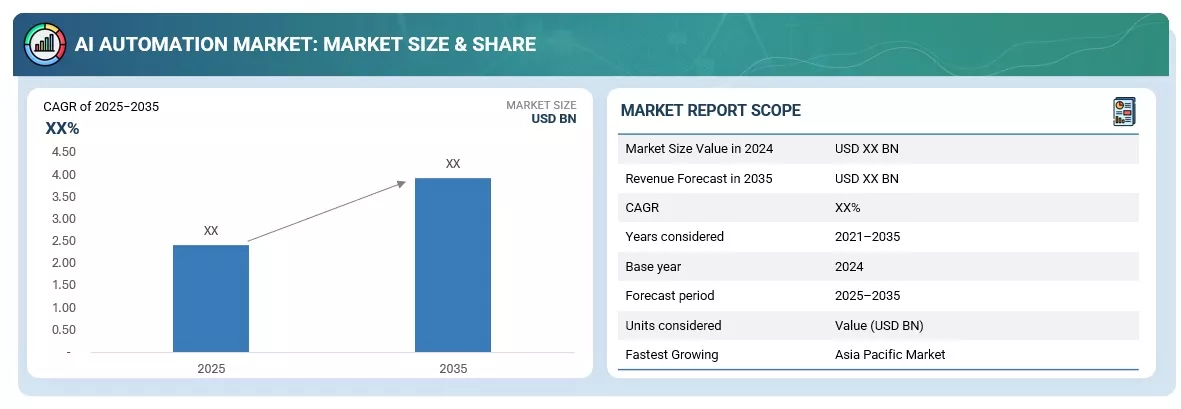
The global AI Automation market was valued at USD XX billion in 2024 and is projected to reach USD XX billion by 2035, growing at a CAGR of XX% between 2025 and 2035.
The growth of the AI Automation market is driven by increasing enterprise demand for intelligent process automation, operational efficiency, and scalable workflow management. Rising complexity in business operations, and the need for real-time, data-driven decision-making are fueling adoption across industries. AI Automation platforms, cognitive automation tools, autonomous agents, and cloud-based automation software enable organizations to streamline repetitive tasks, optimize back-office operations, and enhance customer engagement. By leveraging AI and process mining, these solutions support predictive task execution, intelligent workflow orchestration, and continuous process optimization, helping enterprises reduce costs, improve accuracy, and achieve measurable business outcomes.
AI Automation encompasses software, platforms, and intelligent tools designed to execute enterprise tasks with minimal human intervention. This includes cognitive automation platforms, autonomous agents, and cloud-based solutions that manage workflows, process structured and unstructured data, and facilitate automated decision-making. Key applications span finance operations, customer support, supply chain coordination, IT service management, and regulatory compliance. These solutions integrate with ERP, CRM, and other enterprise systems to centralize process management, enable continuous monitoring, and support adaptive task execution. By providing end-to-end automation capabilities, AI Automation tools allow organizations to scale operations efficiently, maintain consistent process quality, and enhance overall operational resilience.
Market by Industry
BFSI (Banking, Financial Services, and Insurance)
The BFSI sector represents a major segment in the AI Automation market due to its high-volume transactional operations, regulatory compliance requirements, and focus on operational efficiency. Financial institutions leverage intelligent automation and AI-driven agents to streamline loan approvals, fraud detection, claims processing, and compliance reporting. Automation reduces manual errors, accelerates decision-making, and ensures adherence to regulations such as FINRA and FCA standards. By integrating machine learning, natural language processing, and autonomous workflows, BFSI organizations can optimize risk management, improve customer experience, and deliver faster, more accurate services, driving significant adoption of AI Automation solutions.
Manufacturing
The manufacturing sector is a major driver of AI Automation adoption due to the need for efficiency, predictive maintenance, and supply chain optimization. Organizations implement AI-powered RPA, autonomous agents, and process discovery solutions to optimize production scheduling, quality control, inventory management, and procurement workflows. Intelligent automation enables real-time monitoring, error reduction, and adaptive decision-making in smart factories, aligning with Industry 4.0 objectives. Integration with enterprise resource planning (ERP) systems, industrial IoT devices, and predictive analytics platforms allows manufacturers to improve throughput, reduce downtime, and enhance operational agility. These factors position manufacturing as a top vertical for AI Automation deployment.
Healthcare & Life Sciences
Healthcare and life sciences represent a key vertical for AI Automation, driven by increasing digitalization of patient records, clinical workflows, and research operations. Hospitals, diagnostics laboratories, and pharmaceutical companies deploy AI Automation for patient scheduling, claims processing, laboratory test automation, and regulatory compliance. Intelligent automation platforms, combined with AI-driven process mining, enable predictive patient care management, reduce administrative workload, and streamline R&D and drug discovery workflows. Integration with electronic health records (EHRs), medical IoT devices, and cloud-based healthcare systems ensures real-time process execution, operational accuracy, and adherence to HIPAA and GDPR, making automation critical for efficiency and quality improvement.
Market by Integration Mode
API or Connector-Based Automation
API or connector-based automation is a core integration technology in the AI automation market, widely adopted for its ability to connect enterprise applications and automate cross-system workflows efficiently. These platforms enable organizations to orchestrate processes such as data synchronization, CRM updates, ERP transactions, and cloud service automation, reducing manual effort and operational delays. Supporting seamless integration with existing IT ecosystems, API-based automation enhances workflow efficiency, ensures data consistency, and drives scalable automation initiatives. Growing adoption across BFSI, healthcare, retail, and logistics sectors is fueling sustained demand for API-driven automation solutions.
Agentic or Event-Driven Architecture
Agentic or event-driven architecture is a key integration approach in the AI automation market, enabling systems to respond autonomously to real-time triggers, events, and contextual changes. These platforms support intelligent workflow orchestration, autonomous decision-making, and real-time process execution across IT operations, customer engagement, supply chain monitoring, and predictive maintenance. By integrating with enterprise IT environments and AI automation platforms, agentic or event-driven architectures improve operational agility, reduce human dependency, and optimize resource utilization. Increasing demand for adaptive, context-aware, and highly scalable automation solutions is driving rapid adoption across BFSI, manufacturing, and logistics sectors.
Market by Geography:
The AI Automation market is witnessing widespread adoption across North America, Europe, Asia Pacific, and the Rest of the World. North America leads the market due to advanced IT infrastructure, high cloud adoption, and early implementation of intelligent automation solutions. Organizations leverage AI Automation to optimize workflows, reduce manual effort, and improve operational efficiency. For example, in the United States, Blue Prism supports healthcare providers by automating patient records management, while WorkFusion helps financial institutions implement AI-driven invoice processing and compliance monitoring.
The Asia Pacific region is emerging as the fastest-growing market, driven by rapid industrial digitization, government-led AI initiatives, and the need for operational efficiency in large-scale enterprises. Manufacturing, logistics, and retail sectors are adopting AI-powered robotic process automation, autonomous agents, and process mining tools to streamline operations and enhance productivity. For instance, in India, EdgeVerve has implemented automated customer support and order fulfillment solutions for e-commerce companies, while in Japan, Hitachi’s AI-driven predictive maintenance solutions optimize manufacturing workflows.
Europe continues to advance steadily, supported by Industry 4.0 initiatives, structured regulatory frameworks for AI deployment, and investments in intelligent automation. Organizations in Germany, the UK, and France are adopting AI-driven process discovery, autonomous agents, and low-code/no-code automation platforms to enhance efficiency, accuracy, and compliance. In the Rest of the World, adoption is gradually increasing, with enterprises in Latin America and the Middle East leveraging cloud-based AI Automation for finance, supply chain, and customer service operations to improve scalability, responsiveness, and operational resilience.
Market Dynamics
Driver: Advancing Hyperautomation for Comprehensive Process Efficiency
Hyperautomation directly drives growth in the AI Automation market by integrating AI, robotic process automation, and machine learning to orchestrate end-to-end business processes. This approach goes beyond task-specific automation, improving efficiency in industries like manufacturing and finance through workflows such as production planning and financial reconciliation. Generative AI further optimizes processes in real time, reducing errors and manual intervention. In supply chains, hyperautomation enables dynamic inventory and logistics management. By enabling scalable, high-return automation solutions, hyperautomation positions enterprises to enhance operational agility and gain competitive advantage, making it a critical factor directly influencing the expansion of the AI Automation market.
Restraint: Navigating Regulatory and Compliance Complexities
Regulatory and compliance requirements directly affect the AI Automation market by limiting rapid adoption. Industries such as healthcare and banking face complex rules governing data privacy, AI ethics, and operational transparency. Automating sensitive processes like patient data handling or loan approvals requires rigorous auditing, documentation, and monitoring, increasing implementation costs and timelines. Multinational enterprises encounter additional hurdles due to differing regulations across regions, complicating global deployments. These compliance challenges slow market growth by extending project timelines and necessitating significant investments in governance and risk mitigation. Consequently, regulatory complexity is a direct restraint on the expansion of AI Automation adoption across industries.
Opportunity: Innovating with AI-Agentic Workflows and Autonomous Agents
AI-agentic workflows and autonomous agents directly influence AI Automation market growth by enabling systems to independently execute tasks and adapt to changing conditions. These agents enhance operational efficiency in IT operations, customer service, and logistics by proactively resolving issues, optimizing processes, and delivering personalized experiences. For example, autonomous agents can manage real-time inventory adjustments in supply chains. By reducing human intervention while improving responsiveness, these workflows create high-value automation applications. The development and adoption of agentic AI solutions directly expand the scope and impact of AI Automation, driving demand for intelligent, adaptive enterprise systems across industries.
Challenge: Addressing Cybersecurity Risks in AI Automation
Cybersecurity risks directly impact the AI Automation market by threatening the integrity and reliability of automated operations. AI systems integrated with cloud platforms or IoT devices are vulnerable to attacks, including data breaches and model manipulation. Sectors handling sensitive information, such as banking and healthcare, face heightened exposure. Ensuring robust security measures increases operational costs and can delay deployments. Organizations must prioritize secure architectures and continuous monitoring to protect data and maintain trust. These cybersecurity considerations directly slow market expansion, requiring enterprises to invest heavily in risk mitigation, which influences the pace and scale of AI Automation adoption.
Future Outlook
The AI Automation market is projected to grow steadily from 2025 to 2035, supported by the expanding use of artificial intelligence in enterprise operations and the shift toward intelligent process optimization. Increasing data volumes, the need for greater accuracy in routine workflows, and the adoption of context-aware automation solutions are transforming how organizations manage IT operations, finance, supply chain, and customer interactions. Enterprises are integrating AI with automation to achieve higher efficiency, consistency, and responsiveness across complex business environments.
North America is expected to remain the leading region due to mature cloud infrastructure, strong technology investment, and wide enterprise adoption across financial services, healthcare, and retail. Europe continues to advance under Industry 4.0 programs and policy support for responsible AI deployment, while the Asia-Pacific region, led by China, India, and Japan, is set to record the fastest growth, driven by large-scale automation initiatives, digital industrialization, and rapid enterprise modernization.
Market expansion is influenced by growing demand for unified automation platforms, development of intelligent agents for adaptive workflows, and the integration of AI with process orchestration tools. Persistent challenges include integration of legacy systems, compliance with evolving data protection regulations, and shortages of skilled professionals for AI model management. As automation systems become more autonomous and data-driven, enterprises will increasingly rely on AI Automation to enhance productivity, ensure operational continuity, and strengthen competitiveness through 2035.
Key Market Players
Key AI-automation companies include Microsoft (US), ServiceNow (US), IBM?(US), SAP (Germany), Accenture (Ireland), NVIDIA?(US), Bosch?Rexroth?AG (Germany), Schneider?Electric?SE (France), UiPath (US), Automation?Anywhere (US) among others.
These players focus on enhancing enterprise workflows through AI-powered automation, agentic process automation, robotic process automation (RPA), AI integration, cloud orchestration, and real-time decisioning. Strategic partnerships, embedded autonomous agents, and scalable enterprise platforms remain key approaches to expanding global presence and addressing evolving enterprise data, system-integration, compliance, and performance requirements.
Key Questions addressed in this report:
- What are the global trends influencing the growth of the AI Automation market?
- Which technologies and innovations will shape the market in the next decade?
- What are the industry-specific opportunities for AI Automation vendors?
- How are organizations using AI automation tools to drive strategic decision-making and operational efficiency?
 Exclusive indicates content/data unique to MarketsandMarkets and not available with any competitors.
- 1.1 OBJECTIVES OF THE STUDY
-
1.2 MARKET DEFINITIONINCLUSIONS AND EXCLUSIONS
-
1.3 MARKET SCOPEMARKET SEGMENTATIONREGIONS COVEREDYEARS CONSIDERED FOR THE STUDY
- 1.4 CURRENCY CONSIDERED
- 1.5 STAKEHOLDERS
- 2.1 KEY INSIGHTS AND MARKET HIGHLIGHTS
- 2.2 KEY MARKET PARTICIPANTS: INSIGHTS AND STRATEGIC DEVELOPMENTS
- 2.3 DISRUPTIVE TRENDS SHAPING THE MARKET
- 2.4 HIGH-GROWTH SEGMENTS & EMERGING FRONTIERS
- 2.5 SNAPSHOT: GLOBAL MARKET SIZE, GROWTH RATE, AND FORECAST
- 4.1 INTRODUCTION
-
4.2 MARKET DYNAMICSDRIVERSRESTRAINTSOPPORTUNITIESCHALLENGES
- 4.3 UNMET NEEDS AND WHITE SPACES
- 4.4 INTERCONNECTED MARKETS AND CROSS-SECTOR OPPORTUNTIES
- 4.5 STRATEGIC MOVES BY TIER-1/2/3 PLAYERS
- 5.1 EVOLUTION OF AI AUTOMATION
- 5.2 PORTER’S FIVE FORCES ANALYSIS
- 5.3 SUPPLY CHAIN ANALYSIS
- 5.4 ECOSYSTEM ANALYSIS
-
5.5 PRICING ANALYSISAVERAGE SELLING PRICE OF AUTOMATION TYPE, BY KEY PLAYERS, 2025AVERAGE SELLING PRICE, BY INTEGRATION MODE, 2025
- 5.6 KEY CONFERENCES AND EVENTS, 2025–2026
- 5.7 TRENDS/DISRUPTIONS IMPACTING CUSTOMER BUSINESS
- 5.8 INVESTMENT AND FUNDING SCENARIO
-
5.9 CASE STUDY ANALYSISIMPACT OF 2025 US TARIFF –AI AUTOMATION MARKET- INTRODUCTION- KEY TARIFF RATES- PRICE IMPACT ANALYSIS- IMPACT ON COUNTRY/REGION- IMPACT ON END-USE INDUSTRIES
- 6.1 KEY EMERGING TECHNOLOGIES
- 6.2 COMPLEMENTARY TECHNOLOGIES
- 6.3 ADJACENT TECHNOLOGIES
- 6.4 TECHNOLOGY/PRODUCT ROADMAP
-
6.5 PATENT ANALYSISMETHODOLOGYPATENTS FILED, BY DOCUMENT TYPE, 2015–2025INNOVATION AND PATENT APPLICATIONS
- 6.6 FUTURE APPLICATIONS
-
7.1 REGIONAL REGULATIONS AND COMPLIANCEREGULATORY BODIES, GOVERNMENT AGENCIES, AND OTHER ORGANIZATIONSKEY REGULATIONS- NORTH AMERICA- EUROPE- ASIA PACIFIC- MIDDLE EAST & AFRICA- LATIN AMERICA
- 8.1 DECISION-MAKING PROCESS
- 8.2 BUYER STAKEHOLDERS AND BUYING EVALUATION CRITERIA
- 8.3 ADOPTION BARRIERS & INTERNAL CHALLENGES
- 8.4 UNMET NEEDS FROM VARIOUS END-USE INDUSTRIES
-
9.1 INTRODUCTIONAUTOMATION TYPE: AI AUTOMATION MARKET DRIVERS
- 9.2 RULE-BASED AUTOMATION
- 9.3 AI-AUGMENTED AUTOMATION
- 9.4 GENERATIVE OR COGNITIVE AUTOMATION
- 9.5 AGENTIC OR AUTONOMOUS AI AGENTS
-
9.6 SELF-OPTIMIZING OR ORCHESTRATED AUTOMATIONAI AUTOMATION MARKET, BY FUNCTIONAL DOMAIN (MARKET SIZE & FORECAST TO 2035 – IN VALUE, USD MILLION)
-
10.1 INTRODUCTIONFUNCTIONAL DOMAIN: AI AUTOMATION MARKET DRIVERS
-
10.2 IT AND INFRASTRUCTURE MANAGEMENTTICKET TRIAGEINCIDENT PREDICTIONACCESS PROVISIONINGPATCH MANAGEMENTSYSTEM MONITORINGOTHERS (CONFIGURATION UPDATES, SELF-HEALING INFRASTRUCTURE)
-
10.3 CUSTOMER SUPPORT AND SERVICE DESKCHATBOTS AND VIRTUAL AGENTSTICKET CLASSIFICATIONQUERY ROUTINGSENTIMENT DETECTIONKNOWLEDGE RECOMMENDATIONOTHERS (SELF-SERVICE PORTALS, CASE SUMMARIZATION)
-
10.4 HUMAN RESOURCES AND EMPLOYEE SERVICESONBOARDING AUTOMATIONPAYROLL PROCESSINGRECRUITMENT SCREENINGEMPLOYEE QUERY BOTSLEAVE MANAGEMENTOTHERS (DOCUMENT VERIFICATION, ENGAGEMENT ANALYTICS)
-
10.5 FINANCE AND ACCOUNTINGINVOICE PROCESSINGEXPENSE AUTOMATIONRECONCILIATIONFRAUD DETECTIONFINANCIAL FORECASTINGOTHERS (AUDIT AUTOMATION, COMPLIANCE MONITORING)
-
10.6 MARKETING, SALES AND CONTENT OPERATIONSCONTENT GENERATIONCAMPAIGN AUTOMATIONLEAD SCORINGSALES FORECASTINGCUSTOMER SEGMENTATIONOTHERS (JOURNEY ORCHESTRATION, SENTIMENT ANALYTICS)
-
10.7 KNOWLEDGE MANAGEMENT AND ENTERPRISE SEARCHSEMANTIC SEARCHDOCUMENT SUMMARIZATIONMETADATA TAGGINGKNOWLEDGE GRAPH CREATIONCONTEXTUAL Q&AOTHERS (INFORMATION RETRIEVAL, TOPIC CLUSTERING)
-
10.8 OPERATIONS AND SUPPLY CHAIN MANAGEMENTSUPPLIER MANAGEMENTPURCHASE ORDER AUTOMATIONINVENTORY OPTIMIZATIONLOGISTICS AUTOMATIONPREDICTIVE MAINTENANCEOTHERS (DEMAND FORECASTING, PRODUCTION SCHEDULING)
-
10.9 ENTERPRISE PRODUCTIVITY AND COLLABORATIONMEETING SUMMARIZATIONEMAIL DRAFTINGWORKFLOW ORCHESTRATIONTASK AUTOMATIONREMINDER MANAGEMENTOTHERS (DOCUMENT CO-AUTHORING, COMMUNICATION ANALYTICS)
-
11.1 INTRODUCTIONINTEGRATION MODE: AI AUTOMATION MARKET DRIVERS
- 11.2 EMBEDDED AUTOMATION
- 11.3 PLATFORM-CENTRIC AUTOMATION
- 11.4 API OR CONNECTOR-BASED AUTOMATION
- 11.5 AGENTIC OR EVENT-DRIVEN ARCHITECTURE
- 11.6 CUSTOM-BUILT AND MANAGED AUTOMATION
-
12.1 INTRODUCTIONVERTICAL: MARKET DRIVERS
- 12.2 BFSI
- 12.3 HEALTHCARE & LIFE SCIENCES
- 12.4 MANUFACTURING
- 12.5 RETAIL & E-COMMERCE
- 12.6 TELECOMMUNICATIONS
- 12.7 GOVERNMENT & PUBLIC SECTOR
- 12.8 EDUCATION & RESEARCH
-
12.9 ENERGY & UTILITIES
-
12.10 TECHNOLOGY & IT SERVICES
-
12.11 MEDIA & ENTERTAINMENT
-
12.12 OTHERS (CONSTRUCTION & REAL ESTATE, TRAVEL & HOSPITALITY)
- 13.1 INTRODUCTION
-
13.2 NORTH AMERICANORTH AMERICA: AI AUTOMATION MARKET DRIVERSNORTH AMERICA: MACROECONOMIC OUTLOOKUNITED STATESCANADA
-
13.3 EUROPEEUROPE: AI AUTOMATION MARKET DRIVERSEUROPE: MACROECONOMIC OUTLOOKUKGERMANYFRANCEITALYSPAINREST OF EUROPE
-
13.4 ASIA PACIFICASIA PACIFIC: AI AUTOMATION MARKET DRIVERSASIA PACIFIC: MACROECONOMIC OUTLOOKCHINAINDIAJAPANSOUTH KOREAAUSTRALIA & NEW ZEALANDASEANREST OF ASIA PACIFIC
-
13.5 MDDLE EAST AND AFRICAMDDLE EAST AND AFRICA: AI AUTOMATION MARKET DRIVERSMIDDLE EAST & AFRICA: MACROECONOMIC OUTLOOKSAUDI ARABIAUAESOUTH AFRICATURKEYQATARREST OF MDDLE EAST AND AFRICA
-
13.6 LATIN AMERICALATIN AMERICA: AI AUTOMATION MARKET DRIVERSLATIN AMERICA: MACROECONOMIC OUTLOOKBRAZILMEXICOARGENTINAREST OF LATIN AMERICA
- 14.1 OVERVIEW
- 14.2 KEY PLAYER STRATEGIES/RIGHT TO WIN
-
14.3 REVENUE ANALYSIS FOR KEY PLAYERS, 2020 – 2024MARKET SPECIFIC REVENUE ANALYSIS
- 14.4 MARKET SHARE ANALYSIS, 2024
-
14.5 PRODUCT COMPARATIVE ANALYSISPRODUCT COMPARATIVE ANALYSIS, BY RULE-BASED AUTOMATIONPRODUCT COMPARATIVE ANALYSIS, BY AI-AUGMENTED AUTOMATION
-
14.6 COMPANY EVALUATION MATRIX: KEY PLAYERS, 2024STARSEMERGING LEADERSPERVASIVE PLAYERSPARTICIPANTSCOMPANY FOOTPRINT: KEY PLAYERS, 2024- COMPANY FOOTPRINT- REGION FOOTPRINT- AUTOMATION TYPE FOOTPRINT- INTEGRATION MODE FOOTPRINT- VERTICAL FOOTPRINT
-
14.7 COMPANY EVALUATION MATRIX: STARTUPS/SMES, 2024PROGRESSIVE COMPANIESRESPONSIVE COMPANIESDYNAMIC COMPANIESSTARTING BLOCKSCOMPETITIVE BENCHMARKING: STARTUPS/SMES, 2024- DETAILED LIST OF KEY STARTUPS/SMES- COMPETITIVE BENCHMARKING OF KEY STARTUPS/SMES
- 14.8 COMPANY VALUATION AND FINANCIAL METRICS OF KEY AI AUTOMATION VENDORS
-
14.9 COMPETITIVE SCENARIOPRODUCT LAUNCHES AND ENHANCEMENTSDEALSOTHERS
- 15.1 INTRODUCTION
-
15.2 KEY PLAYERSMICROSOFTUIPATHAUTOMATION ANYWHERESERVICENOWIBMSALESFORCEGOOGLEWORKDAYSAP- AISERA- MOVEWORKS- APPIAN- WORKFUSION- BLUE PRISM- COGNIZANT- ACCENTURE- DELOITTE- INFOSYS- WIPRO- CAPGEMINI- TRAY.IO- ZAPIER- MAKE (INTEGROMAT)- COGNITION LABS- HYPERSCIENCE- HUBSPOT
-
16.1 RESEARCH DATASECONDARY DATA- MAJOR SECONDARY SOURCES- KEY DATA FROM SECONDARY SOURCESPRIMARY DATA- KEY DATA FROM PRIMARY SOURCES- KEY PRIMARY PARTICIPANTS- BREAKUP OF PRIMARY INTERVIEWS- KEY INDUSTRY INSIGHTS
-
16.2 MARKET SIZE ESTIMATIONTOP-DOWN APPROACHBOTTOM-UP APPROACHBASE NUMBER CALCULATION
-
16.3 MARKET FORECAST APPROACHSUPPLY SIDEDEMAND SIDE
- 16.4 DATA TRIANGULATION
- 16.5 FACTOR ANALYSIS
- 16.6 RESEARCH ASSUMPTIONS
- 16.7 RESEARCH LIMITATIONS AND RISK ASSESSMENT












Growth opportunities and latent adjacency in AI Automation Market