Apiculture Market by Product type (Honey, Beeswax, Live-Bee, and Others), by Application (Medical, Food beverages, Cosmetics, and Others), by Method (Traditional Beekeeping, and Modern Beekeeping) and Region (North America, Europe, Asia-Pacific, South America, Rest of the world) -Global forecast to 2027


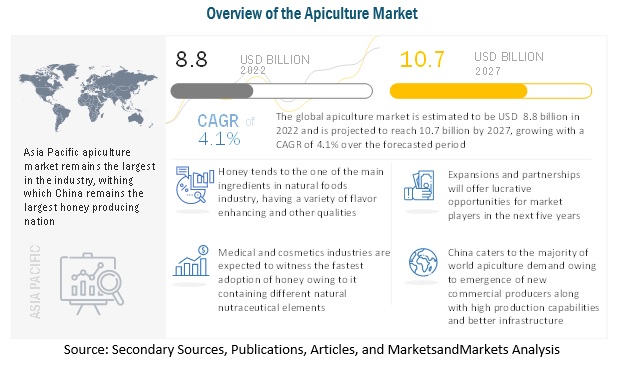
According to MarketsandMarkets, the global apiculture market is estimated to be valued at USD 8.8 billion in 2022. It is projected to reach USD 10.7 billion by 2027, with a CAGR of 4.1%, in terms of value between 2022 and 2027. Apiculture includes maintenance of bee colonies for the collection of different products, such as honey, beeswax, and other related products.
Apiculture Market Dynamics
Drivers: Increase in health consciousness drives a demand for natural sugar substitutes
There has been an increase in population demanding natural and healthy alternatives to processed sugar and artificial sugar substitutes. Since apiculture products, such as honey, are considered as highly nutritious and beneficial for health, there is a rising demand for the same to be used as a naturally occurring sugar substitute.
Restraints: Protection and nurturing the bees turns out to be the biggest constraint
The market is also being restrained due to increased honey adulteration and decrease in number of beehives and beekeepers along with scarcity of improved agricultural equipment. Honey adulterations especially prohibit the market from growing at its full potential.
Opportunities: Rising consumer interest towards apiculture products
Consumers are increasingly demanding immunity boosting products, especially since the COVID-19 pandemic. Honey being a natural ingredient for immunity boosting remedies, its market size is expected to witness a healthy growth over the forecasted period. Furthermore, use of honey is also growing in the pharmaceutical sector due to presence of various amino acids, enzymes, minerals and other natural substances.
Challenges: Managing live bees for apiculture tends to be cost intensive
Managing the live bees happens to be cost intensive, as maintenance and protection of the live bees is increasingly tending to be a high maintenance affair. This is owing to them being affected by rising local temperatures along with rising prevalence of pathogens in commercially managed bees.
By product, honey is projected to witness the fastest growth rate during the forecast period.
Honey is increasingly being accepted as a natural sugar substitute amongst health-conscious consumers. Presence of antibacterial and antioxidant properties has also made the product a good substitute for artificial sweeteners. Furthermore, it has a longer shelf life which further attracts consumers to purchase it.
By application, medical and cosmetics is expected to showcase the fastest growth
Owing to different natural nutraceutical elements found in honey, its usage in pharma industry is expected to witness a boost during the forecasted period. Honey’s anti-inflammatory and antioxidant properties make it a competitive proponent against other products in the market for health and anti-ageing benefits.
Asia Pacific has the largest market share in 2022 with China being the most dominant producer of honey and other apiculture products in the region. Higher yields of China are driven by emergence of new commercial producers along with high production capabilities and better infrastructure, when compared to other countries in the region.
Key Market Players:
Key players in this market include Betterbee (US), Dabur India Ltd. (India), Miler’s Honey Company (US), Thomas Apiculture (France), and Georgia Honey Farm (US), amongst others.
 Exclusive indicates content/data unique to MarketsandMarkets and not available with any competitors.
TABLE OF CONTENTS
1 INTRODUCTION
1.1 OBJECTIVES OF THE STUDY
1.2 MARKET DEFINITION
1.3 STUDY SCOPE
1.4 REGIONAL SEGMENTATION
1.5 PERIODIZATION CONSIDERED
1.6 CURRENCY CONSIDERED
1.7 VOLUME UNITS CONSIDERED
1.8 STAKEHOLDERS
2 RESEARCH METHODOLOGY
2.1 RESEARCH DATA
2.1.1 SECONDARY DATA
2.1.1.1 Key Data from Secondary Sources
2.1.2 PRIMARY DATA
2.1.2.1 Key Data from Primary Sources
2.1.2.2 Key Industry Insights
2.1.2.3 Breakdown of Primaries
2.2 MARKET SIZE ESTIMATION
2.2.1 MARKET SIZE ESTIMATION - METHOD 1
2.2.2 MARKET SIZE ESTIMATION - METHOD 2
2.3 DATA TRIANGULATION
2.4 ASSUMPTIONS FOR THE STUDY
2.5 LIMITATIONS OF THE STUDY
3 EXECUTIVE SUMMARY
4 PREMIUM INSIGHTS
5 MARKET OVERVIEW
5.1 INTRODUCTION
5.2 MARKET DYNAMICS
5.2.1 DRIVERS
5.2.2 RESTRAINTS
5.2.3 OPPORTUNITIES
5.2.4 CHALLENGES
6 INDUSTRY TRENDS
6.1 INTRODUCTION
6.2 VALUE CHAIN/SUPPLY CHAIN ANALYSIS
6.3 TECHNOLOGY ANALYSIS
6.4 PRICING ANALYSIS
6.5 ECOSYSTEM/ MARKET MAP
6.6 TRENDS/ DISRUPTION IMPACTING THE CUSTOMER’S BUSINESS
6.7 PATENT ANALYSIS
6.8 TRADE ANALYSIS
6.9 KEY CONFERENCES AND EVENTS IN 2022-2023
6.1 TARIFF AND REGULATORY LANDSCAPE
6.11 PORTER’S FIVE FORCES ANALYSIS
6.12 KEY STAKEHOLDERS & BUYING CRITERIA
6.13 CASE STUDY ANALYSIS
7 APICULTURE MARKET, BY PRODUCT TYPE
7.1 INTRODUCTION
7.2 HONEY
7.3 BEESWAX
7.4 LIVE-BEE
7.5 OTHER PRODUCT TYPE
8 APICULTURE MARKET, BY APPLICATION
8.1 INTRODUCTION
8.2 MEDICAL
8.3 FOOD BEVERAGES
8.4 COSMETICS
8.5 OTHER APPLICATIONS
9 APICULTURE MARKET, BY METHOD
9.1 INTRODUCTION
9.2 TRADITIONAL BEEKEEPING
9.3 MODERN BEEKEEPINGS
10 APICULTURE MARKET, BY REGION
10.1 INTRODUCTION
10.2 NORTH AMERICA
10.2.1 US
10.2.2 CANADA
10.2.3 MEXICO
10.3 EUROPE
10.3.1 GERMANY
10.3.2 FRANCE
10.3.3 UK
10.3.4 ITALY
10.3.5 SPAIN
10.3.6 REST OF EUROPE
10.4 ASIA PACIFIC
10.4.1 CHINA
10.4.2 INDIA
10.4.3 JAPAN
10.4.4 AUSTRALIA & NEW ZEALAND
10.4.5 REST OF ASIA PACIFIC
10.5 SOUTH AMERICA
10.5.1 BRAZIL
10.5.2 ARGENTINA
10.5.3 REST OF SOUTH AMERICA
10.6 REST OF THE WORLD
10.6.1 AFRICA
10.6.2 MIDDLE EAST
11 COMPETITIVE LANDSCAPE
11.1 OVERVIEW
11.2 MARKET SHARE ANALYSIS*
11.3 KEY PLAYERS STRATEGIES
11.4 COMPANY REVENUE ANALYSIS OF TOP 5 MARKET PLAYERS
11.5 COMPANY EVALUATION QUADRANT
11.5.1 STARS
11.5.2 EMERGING LEADERS
11.5.3 PERVASIVE PLAYERS
11.5.4 PARTICIPANTS
11.5.5 COMPETITIVE BENCHMARKING
11.6 PRODUCT FOOTPRINTS
11.7 STARTUP/SME EVALUATION QUADRANT
11.7.1 PROGRESSIVE COMPANIES
11.7.2 STARTING BLOCKS
11.7.3 RESPONSIVE COMPANIES
11.7.4 DYNAMIC COMPANIES
11.8 PRODUCT LAUNCHES, DEALS, AND OTHER DEVELOPMENTS
11.8.1 NEW PRODUCT LAUNCHES
11.8.2 DEALS
11.8.3 OTHER DEVELOPMENTS
11.8.4 PARTNERSHIPS, COLLABORATIONS, AND JOINT VENTURES
12 COMPANY PROFILES
12.1 BETTERBEE
12.2 DABUR INDIA LTD.
12.3 MILER’S HONEY COMPANY
12.4 THOMAS APICULTURE
12.5 GEORGIA HONEY FARM
12.6 CLEARSKYS
12.7 BEEHIVE BOTANICALS
12.8 BARTNIK
12.9 EURL ATLANTIC APICULTURE
Note: Currently, list of only 9 companies have been provided. However, this section covers 12-15 key company profiles which include business overview, recent financials, product offerings, key strategies, and swot analysis. recent financials can be provided based on data/information availability in public domain. The list of companies mentioned above can be altered depending upon client’s interest
13 APPENDIX
Note: The TOC prepared above is tentative and may subject to change, based on the research progress













Growth opportunities and latent adjacency in Apiculture Market