Battery Energy Storage System As A Service Market by Service Type (Subscription/Demand Charge Management, Energy Management/AI-Optimization, Tolling/Capacity Contracts, Financing/Leasing, Hybrid Solar-Plus-Storage), Application, End User - Global Forecast to 2032


Battery Energy Storage System As A Service Market to 2032: Size, Share & Growth Report
The global Battery Energy Storage System As A Service market is projected to grow from USD 2,450 million in 2026 to USD 9,800 million by 2032, at a CAGR of approximately 26% during 2026–2032. Growth is driven by high upfront battery storage capital costs making zero-CapEx service models the practical adoption unlock, surging data center power demand creating urgent behind-the-meter storage needs, and AI-driven energy optimization turning batteries from passive backup assets into active, revenue-generating subscription services.
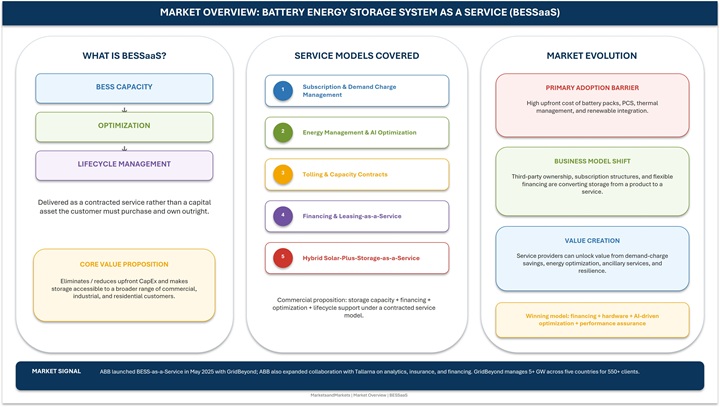
Battery Energy Storage System As A Service (BESSaaS) delivers battery storage capacity, optimization software, and lifecycle management as a contracted service rather than a capital asset the customer must purchase and own outright. The market spans subscription and demand charge management services, energy management and AI-optimization services, tolling and capacity contracts, financing and leasing-as-a-service, and hybrid solar-plus-storage-as-a-service, eliminating the upfront capital barrier that has historically kept battery storage out of reach for commercial, industrial, and residential customers.
The high initial cost of battery energy storage systems remains a significant barrier to broader adoption: procuring and installing battery packs, power conversion systems, thermal management, and renewable integration can be substantial, particularly for small businesses, residential users, and organizations with limited access to financing. New financing arrangements are transforming energy storage from a product to be purchased into a service to be consumed — by turning BESS into a subscription and eliminating upfront investment, storage becomes accessible to a much broader range of end users. Third-party-owned BESS models are expanding rapidly, driven by energy-as-a-service offerings and flexible financing structures that unlock revenue from ancillary services alongside simple backup power.
Major energy and technology players are moving decisively into the category. ABB launched its Battery Energy Storage Systems-as-a-Service offering in May 2025, describing it as “a flexible, zero-CapEx solution designed to accelerate the shift to clean, resilient and affordable energy.” The offering is delivered in partnership with GridBeyond, an AI-powered energy services company whose platform now manages more than 5 GW of assets across five countries for over 550 clients, providing real-time energy optimization and price forecasting for ABB's BESS-as-a-Service customers. ABB separately expanded its collaboration with climate-tech and finance platform Tallarna to bring data analytics, insurance solutions, and financing expertise that de-risk BESS projects. The Battery Energy Storage System As A Service market is where battery storage is being converted from a capital-intensive purchase into an accessible, revenue-generating subscription — and the providers that can combine financing, hardware, and AI-driven optimization into a single guaranteed-performance contract will capture the category's growth.
Top 10 Key Takeaways
- North America holds the largest market share, driven by the concentration of leading storage-as-a-service platforms and the fastest-growing behind-the-meter data center and commercial and industrial demand.
- Asia Pacific is the fastest-growing region, propelled by India's National Electricity Plan storage capacity targets and Australia's Capacity Investment Scheme and residential storage subsidy programs.
- Subscription and demand charge management services lead by service-type revenue; energy management and AI-optimization services are the fastest-growing service type as price forecasting and automated bidding mature.
- Commercial and industrial facilities dominate by application; data centers and mission-critical infrastructure are the fastest-growing application as hyperscale power demand accelerates behind-the-meter storage adoption.
- Commercial and industrial enterprises lead end users; data center and colocation operators are the fastest-growing end-user category as grid interconnection delays push operators toward on-site storage solutions.
- High upfront battery storage capital costs remain the single largest adoption barrier, making zero-CapEx, performance-guaranteed service models the practical unlock for commercial, industrial, and residential customers alike.
- ABB's May 2025 launch of its BESS-as-a-Service model, delivered through a partnership with GridBeyond for AI-driven optimization and price forecasting, illustrates how quickly established industrial vendors are converting storage into a subscription offering.
- ABB's expanded collaboration with climate-tech and finance platform Tallarna, announced alongside the BESS-as-a-Service launch, brings data analytics, insurance solutions, and financing expertise directly into the as-a-service model to help de-risk projects for commercial and industrial customers.
- The near-term opportunity lies in revenue stacking: capacity payments, ancillary services, and energy arbitrage form three distinct revenue streams that sophisticated service providers can combine to improve project economics beyond simple demand charge savings.
- The near-term risk is financing complexity: merchant battery storage without a long-term tolling or capacity agreement typically demands 300 to 500 basis points higher equity returns than fully contracted projects, raising the cost of capital for service providers without secured offtake.
Why the Battery Energy Storage System As A Service Market Matters Now
Battery storage has reached a genuine access inflection point. As ABB put it when launching its BESS-as-a-Service offering, new service models are designed to remove the barriers to clean technology adoption and accelerate industries' transition to net zero, supporting a shift from CapEx to OpEx that lets companies deploy battery storage without upfront investment. “Battery storage technologies are a key enabler of the energy transition, and by removing financial and technical barriers, our new ‘as-a-service’ model will empower businesses to take control of their energy needs, strengthen their resilience, and unlock new value from their assets,” said Stuart Thompson, President of ABB's Electrification Service business.
This matters commercially because storage-as-a-service converts a multi-year capital commitment into a predictable operating expense with a performance guarantee attached. A commercial customer no longer needs to underwrite battery degradation, revenue-market complexity, or interconnection risk directly — the service provider absorbs that risk in exchange for a share of the savings or a fixed subscription fee. Lee Todd, Head of Energy & Carbon Services for ABB's Electrification Service business, described the model's purpose directly: “Our partnership with GridBeyond reflects ABB's commitment to advancing technologies that support the seamless integration of renewables into the energy mix,” he said, describing how the partnership is “accelerating the transition to net zero by empowering industries” to adopt storage without capital risk.
The market covers subscription and demand charge management services, energy management and AI-optimization services, tolling and capacity contracts, financing and leasing-as-a-service, and hybrid solar-plus-storage-as-a-service. Out of scope are battery energy storage systems sold as capital equipment with no ongoing service component, general utility-scale grid infrastructure with no third-party service model, and renewable generation assets sold independently of a storage service contract.
The market connects to the
Generator Sales Market — https://www.marketsandmarkets.com/Market-Reports/generator-sales-market-47544335.html
Power Monitoring Market — https://www.marketsandmarkets.com/Market-Reports/power-monitoring-market-197503460.html
DERMS Architecture and Edge Control Market — https://www.marketsandmarkets.com/Market-Reports/derms-architecture-and-edge-control-market-206649623.html
Circuit Breaker Monitoring Systems Market — https://www.marketsandmarkets.com/Market-Reports/circuit-breaker-monitoring-systems-market-133358428.html
Power Device Analyzer Market — https://www.marketsandmarkets.com/Market-Reports/power-device-analyzer-market-259267665.html
Report Scope
|
Report Metric |
Details |
|
Market Size in 2026 (Value) |
USD 2,450 Million |
|
Market Forecast in 2032 (Value) |
USD 9,800 Million |
|
Growth Rate |
CAGR of 26% from 2026–2032 |
|
Years Considered |
2022–2032 |
|
Base Year |
2025 |
|
Forecast Period |
2026–2032 |
|
Units Considered |
Value (USD Million) |
|
Report Coverage |
Revenue forecast, company ranking, competitive landscape, growth factors, and trends |
|
Top Companies |
• Fluence Energy |
|
Growth Drivers |
• High upfront BESS capital costs making zero-CapEx service models the practical unlock |
|
Segments Covered |
• By Service Type: Subscription/Demand Charge Management, Energy Management/AI-Optimization, Tolling/Capacity Contracts, Financing/Leasing-as-a-Service, Hybrid Solar-Plus-Storage |
|
Regional Scope |
North America, Europe, Asia Pacific, Rest of World |
Market Trends Shaping Battery Energy Storage System As A Service
The defining trend is the shift from capital equipment purchase to subscription-based storage consumption. New financing arrangements are transforming energy storage from a product to be purchased into a service to be consumed, and by turning BESS into a subscription service and eliminating upfront investment, energy storage becomes accessible to a broader range of end users than the traditional ownership model ever reached.
A second trend is AI-driven optimization and price forecasting becoming the core service differentiator. ABB's partnership with GridBeyond integrates AI-driven energy optimization and price forecasting directly into its BESS-as-a-Service offering, while Stem's Athena and PowerTrack platforms use machine learning to forecast demand and automatically switch between battery power, on-site generation, and grid power to maximize financial returns for asset owners.
A third trend is energy majors and utilities acquiring storage-as-a-service platforms directly. ABB's own 2024 strategic investment in GridBeyond, which preceded their 2025 BESS-as-a-Service partnership, reflects a broader pattern of established energy and industrial companies choosing to invest in or partner with specialized storage-as-a-service software platforms rather than build AI-driven optimization capability internally.
A fourth trend is AI-driven optimization platforms scaling to gigawatt levels of managed assets. GridBeyond's platform now manages more than 5 GW of assets across five countries for over 550 clients across more than 1,400 sites, illustrating how quickly AI-driven demand response and storage optimization platforms have scaled to become foundational infrastructure for as-a-service storage models.
A fifth trend is revenue stacking across capacity, ancillary services, and arbitrage becoming standard practice. Capacity payments, ancillary services, and energy arbitrage form three distinct revenue streams that sophisticated lenders and service providers now model independently rather than as a single blended energy price, improving project economics for both the provider and the underlying financing structure.
Market Drivers Accelerating Growth
The first driver is high upfront battery storage capital costs, which remain a significant barrier to adoption for small businesses, residential users, and organizations in developing regions with limited access to financing — a barrier that zero-CapEx, service-based models remove directly by shifting capital investment onto the service provider.
The second driver is data center power demand growth: as hyperscale and colocation operators face lengthening grid interconnection queues, behind-the-meter storage-as-a-service offers a way to manage both electricity costs and the multi-year delays that increasingly constrain how quickly new compute capacity can be energized.
The third driver is AI-driven energy optimization converting storage from a passive backup asset into an active revenue-generating service: platforms from ABB/GridBeyond, Stem, and Fluence use machine learning-based price forecasting and automated bidding to capture value across multiple energy markets simultaneously, directly improving the economics service providers can offer customers.
Market Challenges and Restraints
The most significant restraint is merchant BESS without long-term contracts facing materially higher financing costs. Merchant battery storage without a tolling agreement typically demands 300 to 500 basis points higher equity returns than fully contracted projects, meaning storage-as-a-service providers without secured offtake agreements face a structurally higher cost of capital that must be passed through to customers or absorbed as lower margin.
A second restraint is battery degradation and long-duration performance risk shifting onto service providers. Most 2026 underwriting models assume 2–3% per-year energy throughput degradation for lithium iron phosphate chemistry under moderate cycling, falling to about 70% of nameplate capacity by year 10 and 60% by year 15 — performance risk that service providers, rather than customers, must now warranty and underwrite.
A third challenge is US tax credit and domestic content rule changes complicating financing structures, as recent legislative changes including stricter tax credit regulations and enhanced US material sourcing requirements may curb the pace of future development for providers that rely on tax-equity financing structures. A related challenge is revenue-stacking complexity: accurately valuing and contracting across capacity payments, ancillary services, and energy arbitrage as three independently priced revenue streams requires sophisticated software and market expertise that most commercial and industrial customers lack in-house, reinforcing demand for full-service providers.
Segment Insights
By Service Type
Subscription and demand charge management services lead by service-type revenue, reflecting their position as the most accessible entry point for commercial and industrial customers seeking predictable savings without underwriting battery performance or market-participation risk themselves.
Energy management and AI-optimization services are the fastest-growing service type, propelled directly by platforms such as ABB/GridBeyond's AI-driven price forecasting and Stem's Athena and PowerTrack systems, which convert storage-as-a-service from a simple backup arrangement into an actively managed, multi-market revenue-generating asset.
By Application
Commercial and industrial facilities dominate by application, anchored by behind-the-meter deployments that account for the substantial majority of commercial storage-as-a-service arrangements and that directly address demand charge management and resilience needs.
Data centers and mission-critical infrastructure are the fastest-growing application, driven directly by lengthening grid interconnection queues and operators' need to manage both electricity costs and energization delays through on-site, rapidly deployable storage capacity.
Key segmentation insights:
- Subscription/demand charge management leads service-type revenue; energy management/AI-optimization services grow fastest on price forecasting and automated bidding adoption.
- C&I facilities dominate by application; data centers/mission-critical infrastructure grow fastest on hyperscale power demand.
- C&I enterprises lead end users; data center/colocation operators grow fastest as grid interconnection delays push on-site storage adoption.
- The fully integrated hardware-software service model and the software-only AI optimization overlay model represent two competing routes to market.
- Zero-CapEx adoption barriers removal and data center demand growth are the structural drivers converting storage investment into recurring, production-scale service revenue.
Regional Analysis: Battery Energy Storage System As A Service Market by Region
North America
North America holds the largest share, valued at roughly USD 1,005 million in 2026 and projected to reach about USD 3,600 million by 2032, growing at a CAGR of approximately 23.7%. The United States dominates through the concentration of leading storage-as-a-service platforms — Fluence, Stem, Tesla Energy, and Sunrun — headquartered in the region, alongside the fastest-growing behind-the-meter data center and commercial and industrial demand. Canada contributes through growing utility and commercial storage-as-a-service investment.
Europe
Europe is valued at approximately USD 588 million in 2026 and forecast to reach around USD 2,400 million by 2032, expanding at a CAGR of approximately 26.4%. The United Kingdom anchors the region as home to GridBeyond, the AI-driven energy optimization platform underpinning ABB's BESS-as-a-Service offering, which now manages more than 5 GW of assets across five countries; Germany and France contribute through growing commercial and industrial storage-as-a-service adoption aligned with the region's grid flexibility priorities.
Asia Pacific
Asia Pacific is the fastest-growing region, valued at roughly USD 711 million in 2026 and projected to reach about USD 3,350 million by 2032, growing at a CAGR of approximately 29.5%. India's National Electricity Plan targets storage capacity scaling from 82 GWh in 2026–27 to 411 GWh by 2031–32, creating a structurally large addressable market for service-based deployment; Australia's Capacity Investment Scheme and AUD 7.2 billion residential storage subsidy program are accelerating both utility-scale and residential storage-as-a-service adoption; Japan contributes through growing commercial and industrial storage-as-a-service investment.
Rest of World
The Rest of World market is valued at USD 147 million in 2026 and is projected to reach about USD 450 million by 2032, growing at a CAGR of approximately 20.5%. The Middle East contributes through growing sovereign investment in grid-scale storage infrastructure, while Latin America adds expanding renewable energy integration and storage-as-a-service adoption.
Key Company Insights
The competitive landscape spans three tiers: AI-driven energy optimization and software platform providers, established industrial and energy conglomerates extending into storage-as-a-service, and specialized residential and community storage subscription providers. Leading players include Fluence Energy, ABB, GridBeyond, Stem, Inc., Tesla Energy, Wartsila, Honeywell International, Enel X, Bernhard Energy Solutions, Sunrun, Sonnen, Engie Storage, Swell Energy, NRStor Inc., and Powin Energy.
- Fluence Energy (AI-powered storage-as-a-service platform)
- ABB (BESS-as-a-Service model)
- GridBeyond (AI-driven energy optimization)
- Stem, Inc. (Athena/PowerTrack AI storage optimization platform)
- Tesla Energy (Megapack and energy services)
- Wartsila (GEMS Pulse battery analytics and BMS)
- Honeywell International (energy storage services)
- Enel X (energy storage and demand response services)
- Bernhard Energy Solutions (energy-as-a-service performance contracts)
- Sunrun (residential solar-plus-storage-as-a-service)
- Sonnen (residential battery storage subscription)
- Engie Storage (storage-as-a-service)
- Swell Energy (virtual power plant and storage-as-a-service)
- NRStor Inc. (energy storage project development and ownership)
- Powin Energy (battery storage systems and services)
ABB and GridBeyond anchor the market's most closely watched partnership, combining ABB's industrial-scale BESS hardware with GridBeyond's AI-driven energy optimization and price forecasting software to deliver zero-upfront-CapEx deployments. “Our partnership with GridBeyond reflects ABB's commitment to advancing technologies that support the seamless integration of renewables into the energy mix,” said Lee Todd, Head of Energy & Carbon Services for ABB's Electrification Service business, when the companies announced the offering. GridBeyond's platform, which now manages more than 5 GW of assets for over 550 clients across five countries, brings real-time energy optimization and demand-side response participation to the partnership. Fluence Energy competes closely with its own AI-powered storage-as-a-service platform, targeting real-time optimization of battery assets for commercial and utility customers.
Stem, Inc. anchors the software-centric optimization tier through its Athena and PowerTrack platforms, which use machine learning to forecast demand and automatically switch between battery power, on-site generation, and grid power. Tesla Energy, Wartsila, Honeywell, and Enel X extend established industrial and utility relationships into storage-as-a-service offerings, while Bernhard Energy Solutions specializes in long-term, performance-guaranteed energy-as-a-service contracts for institutional customers. Sunrun, Sonnen, Engie Storage, Swell Energy, NRStor, and Powin Energy round out a competitive field spanning residential subscription models, virtual power plant aggregation, and project development and ownership.
Key company strategy insights:
- ABB and GridBeyond's combined hardware-plus-AI-optimization partnership, backed by GridBeyond's 5 GW-plus managed asset base, gives them a structural advantage in delivering zero-CapEx contracts at scale.
- Fluence Energy's AI-powered platform launch positions it as a direct competitor to the ABB/GridBeyond combination in real-time battery asset optimization.
- Stem, Inc.'s Athena/PowerTrack software leadership gives it a structural advantage in the software-centric optimization tier.
- Tesla Energy, Wartsila, Honeywell, and Enel X compete by extending established industrial and utility relationships into new storage-as-a-service revenue lines.
- Sunrun, Sonnen, Engie Storage, and Swell Energy compete on residential and community-scale subscription and virtual power plant aggregation models distinct from the C&I-focused platforms.
Recent Developments
- October 2025: ABB and GridBeyond jointly released a white paper, “Batteries without Barriers,” describing how new as-a-service models let commercial and industrial businesses deploy battery storage profitably from day one without the associated capital investment, complexity, and risk.
- May 2025: ABB announced the launch of its Battery Energy Storage Systems-as-a-Service offering, a zero-CapEx solution the company said was designed to help businesses lower energy costs, reduce carbon emissions, and improve resilience without upfront capital investment.
- May 2025: GridBeyond and ABB announced a strategic partnership to deliver ABB's BESS-as-a-Service offering, with GridBeyond's AI-driven platform providing real-time energy optimization, demand-side response participation, and energy price forecasting.
- May 2025: ABB expanded its partnership with climate-tech and finance platform Tallarna to bring data analytics, insurance solutions, and financing expertise that de-risk BESS-as-a-Service projects for commercial and industrial customers.
Sources:
- Renewable Energy Magazine, October 20, 2025 — GridBeyond and ABB Launch Batteries Without Barriers White Paper
- ABB, May 21, 2025 — ABB Introduces Battery Energy Storage Systems-as-a-Service to Simplify Renewable Energy Adoption
- Utility Dive, May 27, 2025 — ABB Launches BESS-as-a-Service Business Model
- Tallarna, May 22, 2025 — ABB and Tallarna Expand Their Strategic Partnership to Deliver BESS-as-a-Service
Real-World Use Cases
- ABB's BESS-as-a-Service offering, delivered through its partnership with GridBeyond, illustrates how a global industrial technology company is converting a hardware sale into a managed, AI-optimized service. “Battery storage technologies are a key enabler of the energy transition, and by removing financial and technical barriers, our new ‘as-a-service’ model will empower businesses to take control of their energy needs, strengthen their resilience, and unlock new value from their assets,” said Stuart Thompson, President of ABB's Electrification Service business, describing the offering.
- GridBeyond's AI-driven platform, which underpins ABB's BESS-as-a-Service offering, now manages more than 5 GW of assets across five countries for over 550 clients spanning more than 1,400 sites, according to the company's own published figures — illustrating the scale AI-driven optimization platforms have reached in supporting as-a-service storage deployments for commercial and industrial customers worldwide.
Sources:
- ABB, May 21, 2025 — ABB Introduces Battery Energy Storage Systems-as-a-Service to Simplify Renewable Energy Adoption
- GridBeyond, 2026 — About Us
Market Segmentation
The Battery Energy Storage System As A Service market segments across three interlocking axes. By service type, it spans subscription/demand charge management, energy management/AI-optimization, tolling/capacity contracts, financing/leasing-as-a-service, and hybrid solar-plus-storage-as-a-service — five categories reflecting different points on the risk-transfer and value-creation curve. By application, it covers C&I facilities, data centers/mission-critical infrastructure, utility/grid services, renewable energy integration, and residential/community microgrids. By end user, it serves C&I enterprises, data center/colocation operators, utilities/grid operators, renewable energy developers, and residential/community aggregators.
These axes interlock: a data center operator (end user) contracts ABB and GridBeyond's zero-CapEx BESS-as-a-Service offering (service type: energy management/AI-optimization) to manage peak demand charges and bridge grid interconnection delays (application: data centers/mission-critical infrastructure) — three axes converging in a single, performance-guaranteed storage-as-a-service deployment.
Key segmentation insights:
- Subscription/demand charge management leads service-type revenue; energy management/AI-optimization services grow fastest on price forecasting adoption.
- C&I facilities dominate by application; data centers/mission-critical infrastructure grow fastest on hyperscale power demand.
- C&I enterprises lead end users; data center/colocation operators grow fastest as interconnection delays push on-site storage adoption.
- The fully integrated hardware-software model and the software-only AI optimization overlay model represent two competing routes to market.
- Zero-CapEx adoption and data center demand growth are the structural drivers of market growth through 2032.
Opportunities and Future Outlook
Through 2032, Battery Energy Storage System As A Service will mature from an emerging financing innovation into the default deployment model for commercial, industrial, and behind-the-meter battery storage. The forces driving the market — the removal of upfront capital barriers, AI-driven optimization platforms scaling to gigawatt levels of managed assets, and storage converting into an actively managed revenue asset — are structural and mutually reinforcing, even as merchant financing costs and revenue-stacking complexity require increasingly sophisticated underwriting. Continued platform partnerships following the ABB/GridBeyond/Tallarna model, and international policy tailwinds in markets such as India and Australia, will be the next catalysts, extending storage-as-a-service from an early-adopter niche into a globally scaled infrastructure category.
For chief sustainability officers, facilities and energy managers, and investors, the Battery Energy Storage System As A Service market is where battery storage is being converted from a capital-intensive purchase into an accessible, revenue-generating subscription, and the providers that can combine financing, hardware, and AI-driven optimization into a single guaranteed-performance contract will determine how quickly the next generation of flexible, resilient power reaches customers who could not access it before.
Frequently Asked Questions (FAQ)
1. How big is the Battery Energy Storage System As A Service market?
The Battery Energy Storage System As A Service market is projected to grow from USD 2,450 million in 2026 to about USD 9,800 million by 2032. North America accounts for the largest share, driven by the concentration of leading storage-as-a-service platforms and fast-growing data center demand.
2. What is the Battery Energy Storage System As A Service market growth rate?
The market is forecast to grow at a CAGR of approximately 26% from 2026 to 2032. Asia Pacific is the fastest-growing region at around 29.5%, driven by India's and Australia's storage capacity and subsidy programs.
3. Which segment leads the Battery Energy Storage System As A Service market?
By service type, subscription/demand charge management leads; energy management/AI-optimization services grow fastest. By application, C&I facilities lead; data centers/mission-critical infrastructure grow fastest.
4. Who are the key players in the Battery Energy Storage System As A Service market?
Leading players include Fluence Energy, ABB, GridBeyond, Stem Inc., Tesla Energy, Wartsila, Honeywell International, Enel X, Bernhard Energy Solutions, Sunrun, Sonnen, Engie Storage, Swell Energy, NRStor, and Powin Energy.
5. What are the factors driving the Battery Energy Storage System As A Service market?
The primary drivers are high upfront BESS capital costs making zero-CapEx service models the practical unlock, data center power demand growth creating urgent behind-the-meter storage needs, and AI-driven energy optimization turning BESS into an active revenue-generating service.
Speak With Our Analyst
The Battery Energy Storage System As A Service market is where battery storage is being converted from a capital purchase into an accessible subscription in real time, and provider-level detail on financing structures, AI-optimization capability, and application-specific requirements is where strategic decisions are won or lost. MarketsandMarkets can help you go deeper: request a sample of the full study, speak with our analyst about your specific questions, or customize the scope to your target service types, applications, and geographies. Reach out to explore how this intelligence can inform your storage procurement strategy, vendor selection, or investment thesis.
 Exclusive indicates content/data unique to MarketsandMarkets and not available with any competitors.
TABLE OF CONTENTS
1 Introduction
1.1 Study Objectives
1.2 Market Definition and Scope
1.2.1 Inclusions and Exclusions
1.3 Study Scope
1.3.1 Markets Covered
1.3.2 Geographic Segmentation
1.3.3 Years Considered
1.4 Currency Considered
1.5 Stakeholders
2 Research Methodology
2.1 Research Approach
2.1.1 Secondary Research
2.1.2 Primary Research
2.1.2.1 Breakdown of Primaries
2.2 Market Size Estimation
2.2.1 Bottom-Up Approach
2.2.2 Top-Down Approach
2.3 Data Triangulation
2.4 Research Assumptions
2.5 Limitations and Risk Assessment
3 Executive Summary
4 Premium Insights
4.1 Attractive Opportunities in the Battery Energy Storage System As A Service Market
4.2 Market, By Service Type
4.3 Market, By Region
4.4 Market, By Application
5 Market Overview
5.1 Introduction
5.2 Market Dynamics
5.2.1 Drivers
5.2.1.1 High Upfront BESS Capital Costs Making Zero-CapEx Service Models the Practical Unlock
5.2.1.2 Data Center Power Demand Growth Creating Urgent Behind-the-Meter Storage Needs
5.2.1.3 AI-Driven Energy Optimization Turning BESS Into an Active Revenue-Generating Service
5.2.2 Restraints
5.2.2.1 Merchant BESS Without Long-Term Contracts Facing Materially Higher Financing Costs
5.2.2.2 Battery Degradation and Long-Duration Performance Risk Shifting Onto Service Providers
5.2.3 Opportunities
5.2.3.1 Energy Majors Entering BESS-as-a-Service Through Direct Acquisition
5.2.3.2 International Policy Tailwinds Creating Structurally Large Addressable Demand
5.2.4 Challenges
5.2.4.1 US Tax Credit and Domestic Content Rule Changes Complicating Financing Structures
5.2.4.2 Revenue-Stacking Complexity Across Capacity, Ancillary, and Arbitrage Markets
5.3 Value Chain Analysis
5.4 Ecosystem Analysis
5.5 Investment and Funding Scenario
5.6 Pricing Analysis
5.7 Trends and Disruptions Impacting Customer Business
5.8 Technology Analysis
5.8.1 Key Technologies (AI-Driven Energy Management Systems, Battery Analytics, Automated Bidding)
5.8.2 Complementary Technologies (Virtual Power Plants, Demand Response Platforms, Battery Management Systems)
5.8.3 Adjacent Technologies (Solar-Plus-Storage Integration, Vehicle-to-Grid, Long-Duration Storage)
5.9 Porter's Five Forces Analysis
5.10 Key Stakeholders and Buying Criteria
5.11 Case Study Analysis
5.12 Key Conferences and Events
5.13 Regulatory Landscape
5.13.1 US Investment Tax Credit and Domestic Content Requirements
5.13.2 UK Regulatory Framework for Energy Storage-as-a-Service Providers
5.13.3 India's National Electricity Plan Storage Capacity Targets
5.13.4 Australia's Capacity Investment Scheme and Residential Storage Subsidies
5.14 Impact of AI on the Market
5.15 Impact of 2025 US Tariffs on Supply Chains
6 Industry Trends
6.1 From Capital Equipment Purchase to Subscription-Based Storage Consumption
6.2 AI-Driven Optimization and Price Forecasting Becoming the Core Service Differentiator
6.3 Energy Majors and Utilities Acquiring Storage-as-a-Service Platforms Directly
6.4 Data Centers Emerging as a Distinct, High-Urgency Behind-the-Meter Customer Segment
6.5 Revenue Stacking Across Capacity, Ancillary Services, and Arbitrage Becoming Standard Practice
6.6 Performance-Guaranteed Contracts Replacing Simple Equipment Leases
7 Technology Adoption and Strategic Disruption Landscape
7.1 Traditional Ownership/Capital Purchase vs. Zero-CapEx Storage-as-a-Service Models
7.2 Tolling Agreements vs. Capacity Contracts vs. Merchant Revenue Structures
7.3 Software-Only AI Optimization Overlays vs. Fully Integrated Hardware-Software Service Bundles
7.4 Single-Site Behind-the-Meter Deployments vs. Aggregated Virtual Power Plant Portfolios
8 Customer Landscape and Buyer Behavior
8.1 Decision-Making Process — Chief Sustainability Officer, Facilities/Energy Manager, CFO
8.2 Utility Savings and Payback Guarantees as Primary Contract Negotiation Points
8.3 ROI Framework: Demand Charge Reduction, Resilience Value, Carbon Reduction, Contract Length
8.4 Build vs. Buy: Owned BESS Capital Investment vs. Third-Party Storage-as-a-Service Contracts
9 Battery Energy Storage System As A Service Market, By Service Type
9.1 Introduction
9.2 Subscription and Demand Charge Management Services
9.3 Energy Management and AI-Optimization Services
9.4 Tolling and Capacity Contracts
9.5 Financing and Leasing-as-a-Service
9.6 Hybrid Solar-Plus-Storage-as-a-Service
10 Battery Energy Storage System As A Service Market, By Application
10.1 Introduction
10.2 Commercial and Industrial (C&I) Facilities
10.3 Data Centers and Mission-Critical Infrastructure
10.4 Utility and Grid Services
10.5 Renewable Energy Integration (Solar-Plus-Storage)
10.6 Residential and Community Microgrids
11 Battery Energy Storage System As A Service Market, By End User
11.1 Introduction
11.2 Commercial and Industrial Enterprises
11.3 Data Center and Colocation Operators
11.4 Utilities and Grid Operators
11.5 Renewable Energy Developers
11.6 Residential and Community Aggregators
12 Battery Energy Storage System As A Service Market, By Region
12.1 Introduction
12.2 North America
12.2.1 United States
12.2.2 Canada
12.3 Europe
12.3.1 United Kingdom
12.3.2 Germany
12.3.3 France
12.3.4 Rest of Europe
12.4 Asia Pacific
12.4.1 India
12.4.2 Australia
12.4.3 Japan
12.4.4 Rest of Asia Pacific
12.5 Rest of World
12.5.1 Middle East
12.5.2 Latin America
13 Competitive Landscape
13.1 Overview
13.2 Key Player Strategies / Right to Win
13.3 Revenue Analysis
13.4 Market Share Analysis
13.5 Company Evaluation Matrix
13.6 Competitive Benchmarking
13.7 Competitive Scenario
14 Company Profiles
14.1 Fluence Energy (AI-Powered Storage-as-a-Service Platform)
14.2 ABB (BESS-as-a-Service Model)
14.3 GridBeyond, a Shell Company (AI-Driven Energy Optimization)
14.4 Stem, Inc. (Athena/PowerTrack AI Storage Optimization Platform)
14.5 Tesla Energy (Megapack and Energy Services)
14.6 Wartsila (GEMS Pulse Battery Analytics and BMS)
14.7 Honeywell International (Energy Storage Services)
14.8 Enel X (Energy Storage and Demand Response Services)
14.9 Bernhard Energy Solutions (Energy-as-a-Service Performance Contracts)
14.10 Sunrun (Residential Solar-Plus-Storage-as-a-Service)
14.11 Sonnen (Residential Battery Storage Subscription)
14.12 Engie Storage (Storage-as-a-Service)
14.13 Swell Energy (Virtual Power Plant and Storage-as-a-Service)
14.14 NRStor Inc. (Energy Storage Project Development and Ownership)
14.15 Powin Energy (Battery Storage Systems and Services)
15 Appendix
15.1 Discussion Guide
15.2 KnowledgeStore: Subscription Portal
15.3 Customization Options
15.4 Related Reports
15.5 Author Details

















Growth opportunities and latent adjacency in Battery Energy Storage System As A Service Market