Catalyst Coated Membrane Market by Type (Proton Exchange Membranes (PEM), Anion Exchange Membranes (AEM), and other types), By Application (automotive, fuel cells, stationary power generation, portable power, and other applications) & Region - Global Forecast to 2029


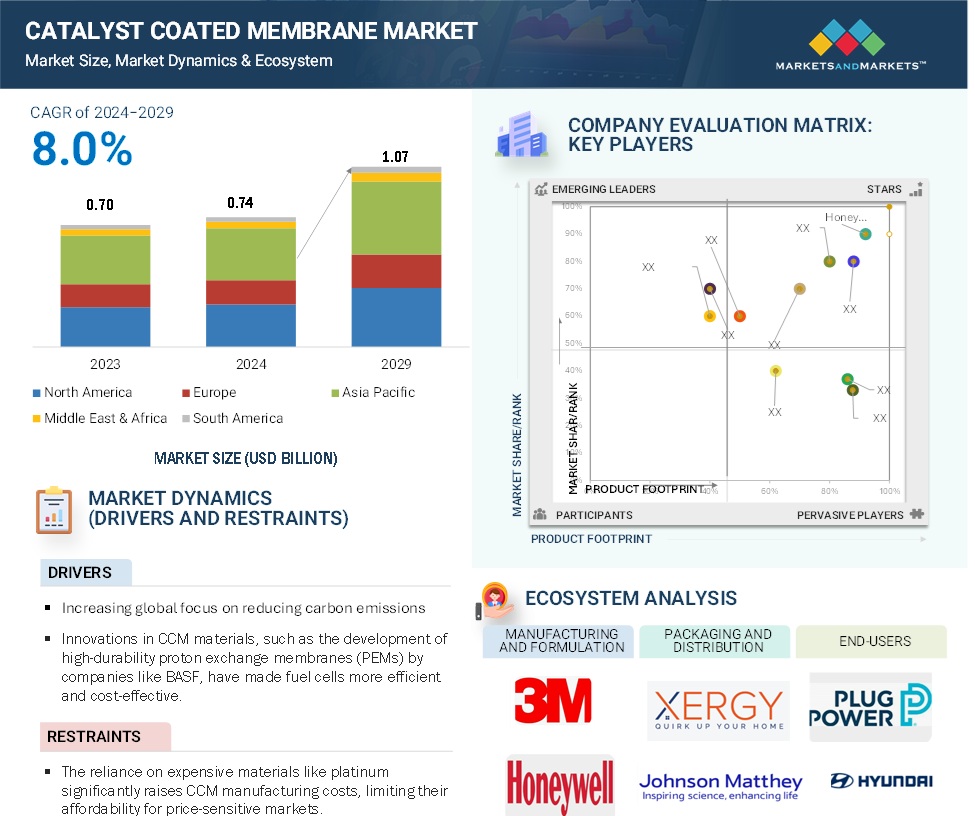
The Catalyst Coated Membrane market is projected to reach USD 1.07 billion by 2029, at a CAGR of 8.0% from USD 0.74 billion in 2024 during the forecast period. Catalyst-coated membrane market grew immensely during previous years, and the reason lies in the support of multiple interrelated factors. Most important of all is world attention to clean energy along with carbon emissions reduction. Fuel cells, which utilize CCMs, are the next-generation green energy technologies. Notable examples are the global mass adoption of fuel cell electric vehicles by renowned automotive manufacturing giants like Toyota and Hyundai, aligning these with targets on carbon reduction worldwide. With these carbon-emitting vehicles, there has been increasing demand for CCMs, considered the most important fuel cell material. Furthermore, sound policies by governments and incentives towards clean energy have been crucial drivers in the CCM market. For instance, the Hydrogen Strategy of the European Union and initiatives from the U.S. Department of Energy on hydrogen infrastructure and fuel cell technology have pushed investments in the sector further upping the demand for CCMs. The technological advancements have also added up to the growth of the market. Companies like BASF have unveiled high-durability proton exchange membranes, which have made fuel cells more efficient and cost-effective by improving their performance with regard to ion conductivity and chemical stability. Stationary power generation is another fast-growing demand source for CCMs: companies like Bloom Energy have expanded the fuel cell systems to be used continuously in power supply as backup and off-grid applications. The increasing importance of CCMs in providing reliable power solutions has further been augmented by the rise in popularity of distributed energy systems that reduce transmission losses and improve energy security through on-site generation of power. Companies investing in such areas are like Johnson Matthey, where new advanced materials are coming, which would improve efficiency and cost-effectiveness in fuel cell systems. All these factors have positioned the CCM market in a very excellent position about this change of the energy source of the world and are critical to attaining low-carbon sustainability.
Attractive Opportunities In The Electronics Chemicals Catalyst Coated Membrane Market
To know about the assumptions considered for the study, Request for Free Sample Report
Catalyst Coated Membrane Market Dynamics
Driver: Coated Membranes drives the Future of Clean Energy with Fuel Cell Innovations
The Catalyst coated membrane market in 2023 grows mainly on an increase in fuel cell uptake worldwide as the world is changing to clean energy solutions in an increasing effort to combat climate change. The governments put stringent carbon-emission targets; thus, they promote zero-emission energy technologies, and fuel cells have become core parts of these efforts that promise an efficient and environmentally friendly energy production process. Fuel cells can thus be seen in their application in fuel cell electric vehicles-an industry that has gained tremendous moment and advancement. Companies such as Toyota and Hyundai are automobile companies that have been considered leaders in incorporating CCMs into their FCEVs to revolutionize the transportation system with clean systems of sustainable energy.
Stationary power generation is another significant growth driver for the market aside from automotive applications. In the residential and commercial sectors, fuel cells are used more for backup power systems, and Bloom Energy has been one of the companies able to provide efficient solutions for such systems. Such systems ensure energy security and align with global sustainability goals.
Government policies are driving the growth of the CCM market. For example, there is strong policy support for hydrogen-based technologies reflected in the European Union's Hydrogen Strategy and the U.S. Department of Energy's hydrogen programs, which strive to develop solid hydrogen ecosystems that support innovation and mass-scale fuel cell adoption across sectors.
Advances in ion-exchange membrane technology are also significantly increasing the performance of modern fuel cell systems. For example, BASF has been able to develop very long-lasting proton exchange membrane solutions with better efficiency, conductivity, and lifetimes. Such technological advancements are important to make fuel cells more feasible and scalable. With such trends, Catalyst Coated Membranes become the essential component for achieving a sustainable energy future. All these factors depict the rapidly increasing curve of the Catalyst Coated Membranes market in step with the goal-setting of the world for energy transformation.
Restraints: High Costs and Infrastructure Gaps Impede Growth
The growth prospects for the catalyst-coated membrane (CCM) markets are quite challenging, more so because of the hefty cost of production associated with such membranes. The production cost is mainly due to the critical need for expensive materials in their production, such as the use of platinum, necessary to ensure the efficiency in the fuel cells. This reliance increases the price of fuel cells, thus lessening the competitiveness of this energy solution, particularly on price-sensitive regions. Emerging markets are primarily affected as cost considerations are the guiding principle for technology adoption. For example, FCEVs rely heavily on CCMs and thus are significantly costlier than electric vehicles, creating a barrier to their adoption. Apart from the cost issue, this market is also hampered due to the lack of developed infrastructure pertaining to hydrogen production, storage, and distribution. Hydrogen development is still very weak across Southeast Asia and Africa, wherein places are coming forward toward clean energy technologies. This makes it even more challenging to deploy large-scale fuel cell technologies since the availability of reliable hydrogen supply chains is the basis for their operation.
These challenges underpin critical imperatives for further cost-optimizing strategies and infrastructure build out. Innovation focused at reduction of dependence on expensive materials would also be essential, supported by collaborative efforts toward more resilient hydrogen infrastructure build. Resolving these issues would free up the full potential locked into catalyst-coated membranes in a way that catalytically accelerates the global transition toward a fuel cell-based energy system.
Opportunity: Catalyst-Coated Membranes Paving the Way for Hydrogen-Powered Clean Energy Revolution
The shift toward a clean energy economy and increased awareness about the future of hydrogen-based energy has created considerable business opportunities in the market of catalyst-coated membranes (CCM). Some of the more promising segments in terms of increasing demand would be from automotive. Big automobile manufacturers, Honda and Hyundai, have shown tremendous efforts to be innovation leaders with the introduction of fuel cell electric vehicles. These vehicles mark the most important step towards making transportation a low-carbon sector, and hence this will be a very promising route for CCM implementation in the sector. Outside automobile applications, stationary power generation will be another high-growth area, as innovations in distributed energy systems find an increasing number of takers both in urban and rural areas. The latter is driven by the increasing need for reliable, clean energy solutions that can cater to diverse geographical and industrial needs.
Huge investment in research and development at companies such as Johnson Matthey and Ballard Power Systems will continue to drive innovation into new membrane materials. Improved cost efficiency, durability, and performance are key directions and are improving the commercial potential of fuel cells in any application. Collaborative development is also an important area, which builds market share. Strategic partnerships between material suppliers and energy companies are addressing specific industry challenges while broadening the scope of fuel cell technologies. These collaborations not only help in the development of tailored solutions but also accelerate the adoption of CCMs in new and emerging markets.
Challenge: Balancing Production Scalability and Quality
The catalyst coated membrane market is still a potentially dynamic area, but many critical challenges are inherent which could obstruct the growth of the industry. An important issue is the large-scale production, including the improvement of membrane quality and performance, in order to meet the emerging growth momentum. For example, manufacturers like 3M struggle to find a balance between the capacity expansion of production and stringent quality control to ensure the long-term durability and efficiency of their products. The supply chain vulnerability also affects the market as it is affected by sourcing and using rare, expensive materials like platinum, raising environmental concerns and affecting the cost-effectiveness of CCMs in general. Another significant challenge is that there are no universal standards for fuel cell technology and membrane performance. Differences in the regulatory framework across regions have caused discrepancies that slow the global adoption of CCMs and fuel cell systems. Coordinated efforts between industry stakeholders, such as manufacturers, policymakers, and research institutions, are necessary to formulate strong solutions that will provide support for consistent growth and reliability in the market.
Electronics Chemicals Catalyst Coated Membrane Market Ecosystem
Prominent companies in this market include well-established, financially stable service providers of Catalyst coated membrane . These companies have been operating in the market for several years and possess diversified service product portfolios and strong global sales and marketing networks.
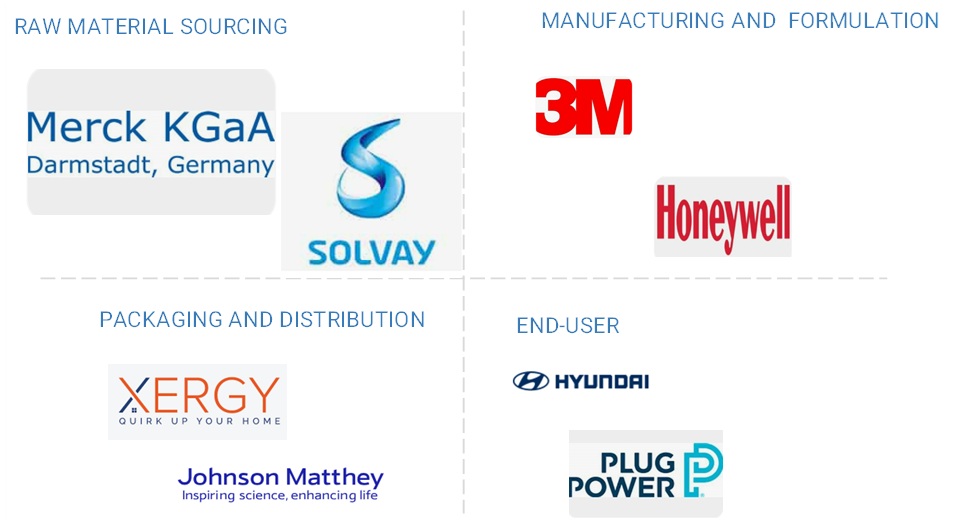
Source: Secondary Research, Interviews with Experts, and MarketsandMarkets Analysis
Proton Exchange Membranes Drive Growth in the Catalyst-Coated Membranes Market with Their Essential Role in Fuel Cell Technology.
Proton exchange membranes represent the major market share because of their critical nature in application. Fuel cell technology finds widespread usage today, mainly on account of its use in automobile and portable power as well as stationary applications. PEMs are valuable materials that hold great properties: high ion conductivity, chemical stability, and mechanical strength for efficient clean energy production and operation at low temperature. This helps PEMs to perform efficient and reliable energy conversion that is required for the global shift towards renewable energy and reduced carbon emissions. The high demand of fuel cell vehicles from giant companies like Toyota and Hyundai is one of the rapidly expanding applications of PEMs in the automobile industry for a cleaner transport solution. Yet another crucial application of PEMs lies in stationary power systems, such as in Bloom Energy, for developing backup power solutions to deliver energy resilience and sustainability both for residences and for business.
Support through regulatory incentives toward widescale adoption of PEMs has been on promoting the production of hydrogen and clean energy. The governments worldwide are driving policies to encourage the adoption of zero-emission technologies that have created an enabling environment for the use of PEMs. Such is an example of the hydrogen strategy by the European Union. Fuel cell technology investment advancement efforts initiated by the U.S. Other examples of regulatory incentives include the Department of Energy. Other breakthroughs in membrane material and manufacturing techniques are always leading the way to progress improvements in performance and cost-effectiveness of PEMs. Firms such as BASF and Johnson Matthey have also performed research to make the PEM stronger and cheaper while ensuring these membranes are at the top of innovations in clean energy. Such continuous development only strengthens the position of PEMs at the top of the catalyst-coated membranes market, on the way to a cleaner and more sustainable future energy.
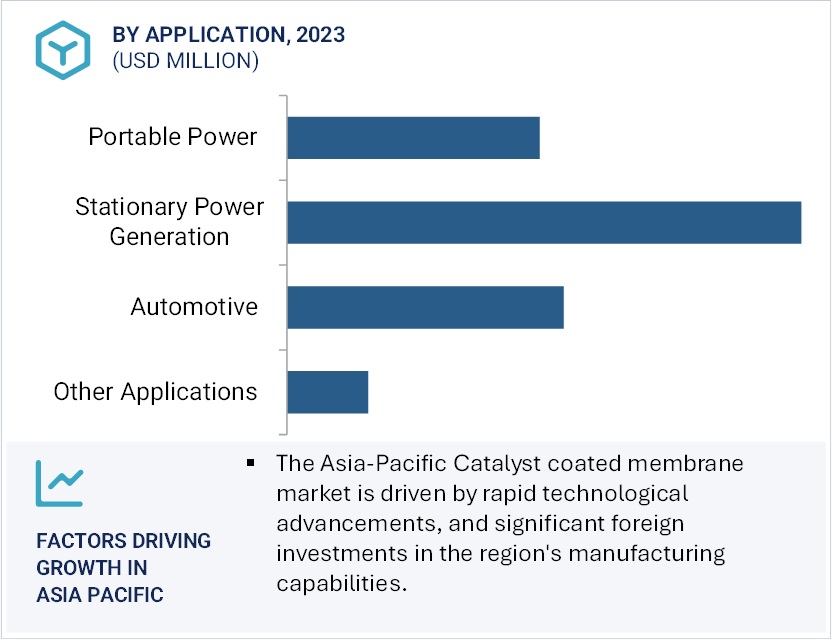
fuel cell electric vehicle accounted for the largest application of the Catalyst coated membrane market in 2024 in terms of value.
The fastest growing application for CCMs is the fuel cell electric vehicle. This growth is being driven by the general trends toward carbon emission reduction and a shift to cleaner energy sources across the globe. FCEVs are critical in terms of energy conversion and operation; therefore, CCMs should be highly efficient and reliable for automotive applications.
The rapid shift in the automobile industry towards FCEVs is supported through massive investment by big giants such as Toyota, Hyundai, and General Motors. Companies are investing to advance the hydrogen fuel cell technology. For example, new models of FCEVs and government programs for building hydrogen refueling infrastructure remain key drivers for this market. Second, integration of fuel cell systems is being developed towards commercial and stationary applications used both commercially and residentially, on demand with good quality power. Therefore, driven by the urgent needs to offer reliable and ecological alternatives to power, Bloom Energy has initiated stationary projects and launched its fuel cell technology products as a source for producing electricity for clean backup purposes in stationery applications.
Advances in CCM technology, including higher durability, conductivity, and cost-effectiveness of a membrane, are driving some of these growth paths. Companies like Johnson Matthey and Ballard Power Systems are constantly working on R&D initiatives, which are critical in continuing to enhance these technologies to deliver better performance for the power systems of the future. Enhancements that make fuel cells a competitive clean energy option beyond traditional energy sources contribute to aggregate carbon emission reductions.
Based on region, North America was the largest market in 2023.
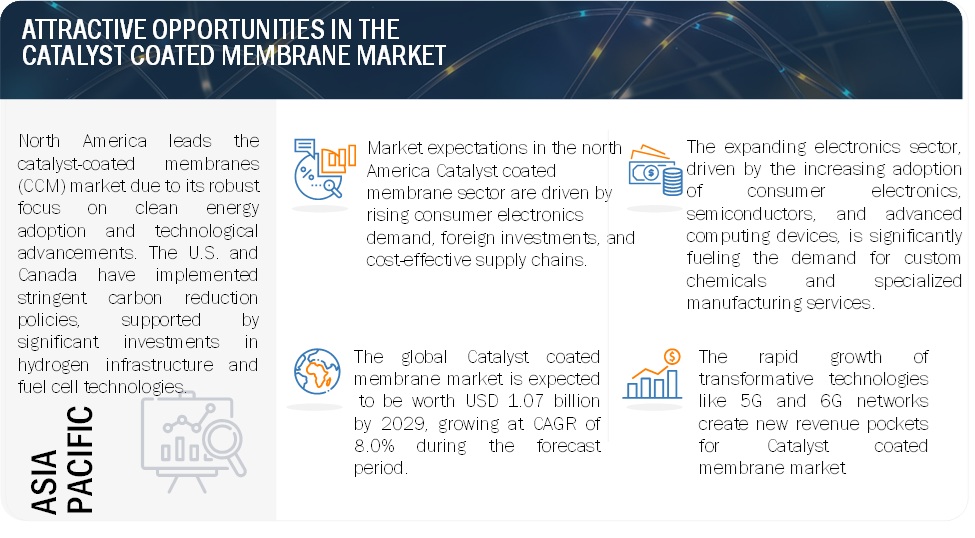
North America is currently ranking the highest in the market shares of catalyst-coated membranes, mainly due to promises toward clean energy and state-of-the-art technological improvement. This region, mainly followed by the U.S. and Canada, has been quite progressive while initiating policies to curtail carbon emissions and enhance more sustainable energy. Hydrogen-infrastructure and fuel cell technology are very prominent investments, as aided by government incentives for low carbon solutions. For instance, the renewed focus of the U.S. Department of Energy on hydrogen production programs and clean vehicle programs shows this thrust for energy innovation. North America has a very strong automotive industry that aids the market, as large manufacturers like General Motors and Toyota are heavily investing in FCEVs. These FCEVs, based on the advanced CCMs, would look to achieve higher energy efficiency and minimal emissions. Another big consumer of CCMs is the aerospace industry, requiring lightweight, strong, and high-performance materials to help save fuel and comply with environmental standards. In addition, CCMs are also crucial in renewable energy systems like electrolyzers, which play an important role in the generation of green hydrogen. This technology has gained more importance as industries and governments focus on sustainable production of energy.
Further regional leadership from CCMs can also be seen through ongoing innovation in membrane durability, ion conductivity, and chemical stability. Such innovation contributes to greater efficiency and effectiveness of CCMs. Increased public awareness of an imperative for a greener economy both spurs further interest from consumers and builds stronger support for policy efforts. Both contribute to the continuation of leadership for North America in this shift towards a more sustainable, low-carbon future.
To know about the assumptions considered for the study, download the pdf brochure
Key Market Players
- 3M (US)
- Xergy (US)
- Genport srl (Italy)
- Honeywell International Inc. (US)
- Johnson Matthey (UK)
- SiM Composites (Canada)
- VS Particle (Netherlands)
- Sainergy (US)
- GAIA (US)
- LAUFENBERG GMBH (Germany)
- Ionomr Innovations Inc. (Canada)
- Hyundai (Japan)
PPG Industries is a well-known manufacturer of specialized materials and coatings worldwide. PPG was established in 1883 and has a long history of development and invention. Performance Coatings, Industrial Coatings, and Glass are the company's three primary business segments. Products from PPG are utilized in a number of sectors, including as consumer electronics, automotive, aerospace, and construction. PPG has a significant global footprint in more than 70 countries and employs about 50,000 people. The business is well-known for its well-known brands, which include Masaba, Sigma Coatings, and PPG Paints. PPG is known for its innovation and customer satisfaction, and it has continuously produced solid financial results.
Recent Developments in Catalyst Coated Membrane Market
- In march 2024, Ionomr Innovations Inc. has unveiled a Catalyst Coated Membrane (CCM) leveraging its Aemion® Anion Exchange Membranes (AEMs) for cost-effective, sustainable green hydrogen production. These CCMs are free from iridium and toxic perfluorinated substances, offering a safer and more eco-friendly alternative to conventional materials.
- In may 2024, Hyundai Motor, Kia, and W. L. Gore & Associates have partnered to develop advanced polymer electrolyte membranes (PEMs) for next-generation hydrogen fuel cell systems. The collaboration aims to enhance PEM performance and durability, critical for fuel cell electric commercial vehicles, by enabling efficient proton conduction and improving overall system reliability.
To speak to our analyst for a discussion on the above findings, click Speak to Analyst
Frequently Asked Questions (FAQ):
What are the factors influencing the growth of the Catalyst coated membrane market?
Increasing global focus on reducing carbon emissions and achieving sustainability has driven demand for hydrogen-based energy solutions and fuel cell technologies. Countries are investing heavily in renewable energy projects, accelerating catalyst coated membrane adoption.
Define Catalyst coated membrane market?
The Catalyst Coated Membranes Market focuses on advanced membranes coated with catalysts to boost fuel cell performance and efficiency for applications in transportation, power generation, and portable energy. Key applications include automotive fuel cells for clean vehicles, stationary power for backup and distributed energy, and portable power for devices. The main types include Proton Exchange Membranes, PEM for high efficiency; Anion Exchange Membranes, AEM for a cost-effective and flexible one; and specialized composite or mixed ion-exchange membranes depending on specific needs.
Which region is expected to have the largest market share in the Catalyst coated membrane market?
The Asia-Pacific region will acquire the largest share of the Catalyst coated membrane market during the forecast period.
What are the major market players covered in the report?
The key players in this market are 3M (US), Xergy (US), Genport srl (Italy), Honeywell International Inc. (US), Johnson Matthey (UK), SiM Composites (Canada), VS Particle (Netherlands), Sainergy (US), GAIA (US), and LAUFENBERG GMBH (Germany) etc.
How big is the global Catalyst coated membrane market?
The Catalyst Coated Membrane market is projected to reach USD 1.07 billion by 2029, at a CAGR of 8.0% from USD 0.74 billion in 2024.
 Exclusive indicates content/data unique to MarketsandMarkets and not available with any competitors.
Catalyst Coated Membrane Market














Growth opportunities and latent adjacency in Catalyst Coated Membrane Market