Data Center AI Video Surveillance Market by Component (Hardware, Software, Services), Data Center Type (Enterprise/Edge, Colocation, Hyperscale), and End-User Industry (Cloud & Hyperscale Providers, BFSI, Retail & E-commerce) - Global Forecast to 2032


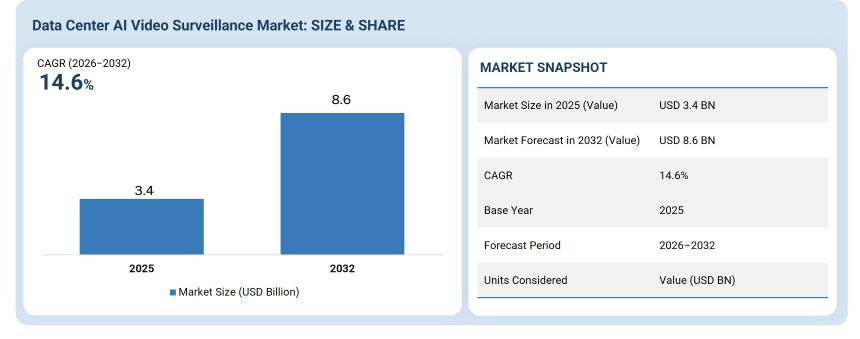
The global data center AI video surveillance market was valued at USD 3.40 billion in 2025 and is projected to reach USD 8.76 billion by 2032, expanding at a compound annual growth rate of 14.6% over the 2026–2032 forecast period. This robust growth is driven by the explosive proliferation of hyperscale and colocation data centers worldwide, escalating physical security threats to critical digital infrastructure, and the maturation of AI-powered computer vision platforms capable of real-time anomaly detection, behavioral analytics, and predictive threat intelligence — all at a scale and accuracy that legacy CCTV infrastructure simply cannot match.
Asia Pacific is the fastest-growing region, driven by aggressive hyperscale data center buildouts in China and India, government-backed smart infrastructure programs, and rapid adoption of AI-enabled physical security platforms across Southeast Asia. North America holds the largest revenue base, underpinned by the concentration of hyperscale cloud providers, stringent federal compliance mandates (FISMA, NIST CSF), and early-mover advantage in AI-powered video management software. Europe is experiencing steady, regulation-led demand growth aligned with GDPR-compliant surveillance architectures and expanding colocation capacity, particularly in Frankfurt, London, Amsterdam, and Paris (FLAP-D markets).
Top 10 Key Takeaways
- North America holds the largest share of the data center AI video surveillance market, driven by the world's highest concentration of hyperscale cloud campuses and stringent federal physical security mandates.
- Asia Pacific is the fastest-growing region, led by China's state-funded data center expansion, India's Digital India and BharatNet initiatives, and Southeast Asia's emerging hyperscale corridor.
- The hardware segment — specifically AI-embedded edge cameras — leads current revenue generation, while cloud-based Video Surveillance as a Service (VSaaS) is the fastest-growing deployment mode.
- Cloud and hyperscale providers are the dominant end-user vertical, with BFSI and Government & Defense representing the next two largest demand pockets.
- Generative AI integration into video analytics platforms is the most disruptive near-term technology shift, enabling synthetic threat scenario training and dramatically reducing false-positive rates.
- The EU AI Act and US NIST AI Risk Management Framework are the principal regulatory forces reshaping procurement criteria, vendor accountability, and data governance requirements.
- NVIDIA (Metropolis), Axis Communications, Hanwha Vision, Genetec, and Avigilon (Motorola Solutions) are among the most active competitive players shaping the market's technology trajectory.
- The near-term opportunity is the rapid migration from legacy analog CCTV to AI-native IP surveillance architectures at existing hyperscale campuses, driven by cost-per-incident economics.
- The near-term risk is regulatory fragmentation: diverging AI surveillance rules across the US, EU, and China may force vendors to maintain multiple compliance frameworks, increasing deployment cost and complexity.
- The strategic implication is clear — data center operators that converge physical and cyber security onto a unified AI surveillance platform today will gain a measurable resilience and compliance advantage by 2027.
Why the Data Center AI Video Surveillance Market Matters Now
Data centers are no longer simply rooms filled with servers. They are the foundational nervous system of the global digital economy — processing everything from financial transactions and healthcare records to AI model training and sovereign government workloads. This criticality has made them high-value targets: physical intrusions, insider threats, equipment tampering, and coordinated attacks on infrastructure campuses have multiplied in frequency and sophistication. Simultaneously, data center operators are under mounting compliance pressure from frameworks such as FISMA, SOC 2 Type II, ISO 27001, and the European GDPR, all of which demand verifiable, auditable physical access controls.
The convergence of three macro forces has created the conditions for this market's rapid expansion. First, the AI revolution itself: GPU-dense AI training clusters are now co-located alongside hyperscale compute, creating facilities worth billions of dollars that require next-generation physical security architecture — not analog cameras and human guards. Second, digital transformation has dramatically expanded the data center footprint, with edge micro data centers proliferating in hospitals, telecom exchanges, and manufacturing plants, each requiring scalable surveillance coverage. Third, sustainability and energy efficiency mandates are driving smarter facility management, where AI video analytics increasingly serves a dual purpose — security monitoring and real-time operational efficiency optimization (cooling anomaly detection, human traffic flow optimization).
Against this backdrop, the data center AI video surveillance market has transitioned from a peripheral IT budget line item to a board-level infrastructure priority. The question for most data center operators is no longer whether to upgrade, but how fast and on which technology platform. AI-powered video management platforms from vendors such as NVIDIA Metropolis, Genetec, and Avigilon are now deeply embedded in the security architectures of the world's largest hyperscale campuses, and the replacement cycle for aging analog infrastructure is compressing rapidly.
Data Center AI Video Surveillance Market Trends
The most consequential trend reshaping this market is the integration of generative AI into video analytics engines. Traditionally, video surveillance relied on rule-based motion detection or supervised machine learning models trained on relatively small datasets. Generative AI changes this fundamentally: platforms can now simulate novel threat scenarios synthetically, train detection models on data that does not yet exist in the real world, and dramatically reduce false-positive alert rates — a persistent problem that has eroded operator trust in traditional video analytics. Vendors such as BriefCam (Canon Group) and Intellicheck are embedding LLM-based reasoning into their platforms to enable natural language querying of video archives, a capability that significantly accelerates post-incident forensic investigation.
A second structural trend is the rapid shift toward edge AI processing. Rather than streaming high-definition video to centralized analytics servers — a bandwidth- and latency-intensive approach — modern AI-embedded cameras perform inference at the point of capture. This edge-first architecture is particularly well-suited to large data center campuses where hundreds of cameras must operate in real time, and where network congestion or cloud connectivity disruptions cannot be allowed to create security blind spots. Axis Communications, Hanwha Vision, and Bosch Security Systems have all released edge AI camera lines purpose-built for high-density, mission-critical environments.
The convergence of physical security and cybersecurity is another defining trend. Data center security operations centers (SOCs) are increasingly integrating video surveillance feeds with network intrusion detection systems, access control logs, and environmental sensor data into unified security information and event management (SIEM) platforms. This convergence — sometimes called 'cyber-physical security' — enables correlation of a physical tailgating event at a server hall door with a simultaneous anomalous network login, enabling far faster threat response. Zero-trust security architecture is the ideological backbone of this convergence, treating every human, device, and physical access event as unverified until proven otherwise.
Finally, the rise of autonomous drone-based perimeter monitoring is beginning to reshape outdoor campus surveillance at the largest hyperscale facilities. Automated drone programs now patrol the perimeters of major data center campuses in the United States and Asia Pacific, providing on-demand aerial surveillance capability that supplements fixed camera networks and substantially reduces reliance on manned security patrols.
Data Center AI Video Surveillance Market Drivers
The single most powerful demand driver is the exponential growth of hyperscale and colocation data center construction globally. According to industry reports, global data center construction spending surpassed USD 50 billion in 2024, with major hyperscale campuses being built across Northern Virginia, Dublin, Singapore, and the UAE. Each new facility requires a comprehensive, scalable surveillance architecture from day one — making greenfield deployments a consistent and substantial revenue stream for AI video surveillance vendors.
Regulatory and compliance pressure is the second major driver. In the United States, the Federal Risk and Authorization Management Program (FedRAMP), NIST Cybersecurity Framework, and the Department of Defense's Physical Security of DoD Installations directives impose specific requirements on surveillance coverage, retention periods, and audit trails for government-adjacent data center facilities. In the European Union, the Network and Information Security Directive (NIS2), which came into force in October 2024, elevated physical security requirements for operators of essential services — a category that explicitly includes data center and infrastructure providers. These regulatory signals are shortening procurement decision cycles and increasing average deal sizes.
The economic argument for AI over human security personnel is increasingly compelling. A single experienced security guard monitoring a bank of screens can realistically track four to six camera feeds simultaneously with any reliability. An AI video analytics platform can monitor hundreds of feeds in real time, 24/7, with consistent accuracy — and flag anomalies for human review rather than requiring continuous human attention. The total cost of ownership comparison, especially when factoring in labor, training, and error costs, consistently favors AI-native platforms over time, particularly at scale.
The maturation and falling cost of key enabling technologies — AI accelerator chips, high-resolution IP cameras, and cloud video management infrastructure — have materially lowered the barrier to deployment. What required a six-figure capital investment five years ago can now be deployed as a subscription-based managed service, opening the market to mid-tier colocation operators and enterprise edge data center operators who previously could not justify the upfront cost.
Data Center AI Video Surveillance Market Challenges
The most significant restraint on market growth is regulatory fragmentation across jurisdictions. The EU AI Act, passed in 2024, classifies certain AI surveillance applications — particularly real-time biometric identification in public or semi-public spaces — as high-risk or even prohibited, depending on application context. While data centers are not public spaces, the Act's broad language around biometric surveillance creates legal uncertainty for vendors deploying facial recognition at European data center access points. The divergence between EU, US, and Chinese regulatory frameworks effectively requires multinational vendors to maintain differentiated product SKUs and compliance documentation for each market, adding cost and complexity.
Cybersecurity risk associated with connected surveillance devices is an under-appreciated challenge in the data center context. Internet-connected IP cameras have a documented history of being compromised and enrolled in botnets — the Mirai botnet attack, which leveraged compromised IP cameras to launch one of the largest DDoS attacks in history, remains a cautionary reference. In an environment as sensitive as a data center, a compromised surveillance camera creates both a physical security gap and a potential network intrusion vector. This dual risk requires vendors to invest heavily in device hardening, firmware update mechanisms, and security certification — costs that are typically passed through to buyers.
Integration complexity remains a practical adoption barrier, particularly in legacy data center environments. Many existing facilities operate a patchwork of analog CCTV infrastructure, proprietary access control systems, and siloed environmental monitoring platforms accumulated over a decade or more. Migrating these heterogeneous environments to a unified AI video surveillance architecture requires significant professional services engagement, system integration expertise, and often partial hardware replacement — factors that lengthen sales cycles and compress project margins.
Data Center AI Video Surveillance Market — Industry & Application Growth
Cloud and hyperscale data center operators represent the single largest and fastest-scaling end-user vertical in this market. Facilities operated by Amazon Web Services, Microsoft Azure, Google Cloud, Meta, and Alibaba Cloud collectively span tens of millions of square feet of raised floor and server hall space globally — each square foot requiring perimeter surveillance, access control validation, and interior monitoring. The scale of these campuses makes AI-native video surveillance not merely preferable but operationally essential; human-only security models are simply impractical at hyperscale. These operators are also early adopters of advanced capabilities — including autonomous drone perimeter patrols, federated AI analytics, and integration with digital twin facility models — that then cascade down to smaller operators.
The Banking, Financial Services, and Insurance (BFSI) vertical represents the second most significant end-user segment. Financial institutions operate private data centers for core banking, trading systems, and customer data infrastructure — environments subject to extremely stringent physical access controls mandated by regulators, including the US Office of the Comptroller of the Currency, the PRA in the UK, and the European Central Bank's TIBER-EU threat intelligence framework. AI surveillance deployments in BFSI data centers are typically high-value, long-cycle engagements involving deep integration with identity management and access control systems.
Government and Defense represent a structurally important vertical, characterized by non-negotiable compliance requirements and long contract terms. US federal data center facilities must comply with Physical Security of Sensitive Compartmented Information Facilities (SCIF) standards, while NATO and allied nation facilities are governed by their own classified physical security standards. These requirements drive demand for certified, domestically manufactured surveillance hardware and software — creating a significant competitive moat for vendors with appropriate government security clearances and supply chain provenance documentation.
Telecom and IT Services providers constitute another meaningful demand pocket, as they operate thousands of Points of Presence, exchange facilities, and enterprise-facing data centers globally — each requiring scalable, remotely manageable surveillance infrastructure. The edge data center segment, which encompasses micro data centers serving 5G base stations, industrial IoT hubs, and content delivery network nodes, is expected to be among the highest-growth application areas through 2032 as the edge computing buildout accelerates.
Data Center AI Video Surveillance Market — Segment Insights
By Component
Hardware commands the largest share of market revenue, reflecting the fundamental infrastructure investment required when transitioning from analog CCTV systems to AI-capable IP camera networks. AI-embedded edge cameras — devices with onboard neural processing units capable of running inference workloads locally — are the centerpiece of modern data center surveillance architectures. Video analytics appliances and NVRs complement camera hardware, while servers and storage underpin on-premises analytics deployments at the largest facilities.
Within software, Video Surveillance as a Service (VSaaS) is the fastest-growing sub-segment by a significant margin. The shift from perpetual-license VMS software to cloud-delivered subscription services is driven by multi-site data center operators seeking centralized visibility across distributed footprints without the overhead of managing on-premises software infrastructure. Leading VSaaS platforms offer AI analytics, remote access, and automated compliance reporting as standard capabilities — making the value proposition highly compelling relative to on-premises alternatives.
By Technology
Computer vision and deep learning form the technological backbone of current market deployments, enabling the foundational capabilities of object detection, person identification, and motion anomaly flagging. Behavioral analytics — the ability to detect unusual patterns of movement or activity rather than simply the presence of people — is the most commercially differentiated technology layer, as it enables proactive threat identification rather than post-incident review. Facial recognition remains commercially significant, particularly in North America and the Asia Pacific, despite facing regulatory headwinds in Europe.
Generative AI represents the fastest-evolving technology dimension in the market. While deployments remain nascent relative to conventional computer vision, the ability to use synthetic data generation for model training, natural language video querying, and LLM-driven incident narrative generation is attracting intense R&D investment from both incumbent vendors and a new cohort of AI-native startups. Thermal and infrared imaging is a high-growth complementary technology in data center perimeter applications where conventional cameras face limitations in low-light or smoke-filled environments.
By Deployment Mode
On-premises deployment remains the dominant mode, particularly among hyperscale and government data center operators, where data sovereignty, air-gapped network requirements, and latency sensitivity make cloud-dependent surveillance architectures operationally impractical. These operators invest in high-performance local analytics infrastructure and vendor-managed appliances, often integrated directly into the facility's building management system.
Hybrid deployment — combining on-premises AI inference for real-time alerting with cloud-based archiving, analytics, and compliance reporting — is the fastest-growing deployment model. This architecture allows operators to maintain low-latency security response while leveraging cloud scalability for storage, audit trails, and multi-site dashboard visibility. Pure cloud-based VSaaS is growing rapidly among mid-market colocation operators and enterprise edge data center managers who lack the IT resources to manage on-premises video infrastructure.
By Data Center Type
Hyperscale data centers are the primary revenue engine for this market, driven by their sheer scale, complexity, and the financial stakes of a security incident at a facility that might underpin thousands of enterprise customer workloads. These facilities deploy comprehensive, multi-layered surveillance architectures — outdoor perimeter, parking and logistics, server hall access points, cooling infrastructure, and power distribution areas — resulting in camera counts that can run to the hundreds or even thousands per campus.
Edge and enterprise data centers are the fastest-growing type segment by deployment count, though average deal size is smaller than hyperscale. The rapid proliferation of edge compute nodes — driven by 5G deployment, autonomous vehicle infrastructure, and industrial IoT — is creating an enormous addressable market of small, distributed facilities each requiring lightweight, remotely managed AI surveillance capabilities. Colocation data centers represent a structurally important segment, as multi-tenant facilities must balance security investment across shared infrastructure in a way that satisfies diverse customer compliance requirements.
Key Segmentation Conclusions
- Hardware — specifically AI-embedded edge cameras — leads revenue, while VSaaS is the fastest-growing sub-segment within software.
- Computer vision and deep learning are the dominant technology layer; generative AI is the fastest-evolving and most disruptive emerging technology.
- On-premises deployment leads by revenue share; hybrid deployment is growing fastest among multi-site operators.
- Hyperscale data centers are the largest end-use type; edge/enterprise data centers are the fastest-growing deployment category.
- Cloud and hyperscale providers lead by end-user industry; BFSI and Government & Defense are the next two most significant verticals with distinct compliance-driven procurement profiles.
Data Center AI Video Surveillance Market — Regional Analysis
North America
North America is the dominant revenue region in the data center AI video surveillance market. The US alone houses the majority of the world's hyperscale data center capacity — concentrated in Northern Virginia's 'Data Center Alley', the Dallas-Fort Worth metroplex, Phoenix, and the Pacific Northwest — creating a persistent and large-scale demand base for AI surveillance infrastructure. At USD 1.38 billion in 2025, growing to USD 3.52 billion by 2032 at a CAGR of 14.3%, North America's market is characterized by high average deal values, long-term government contract vehicles, and a mature ecosystem of system integrators. Federal compliance requirements — FISMA, FedRAMP, the DoD's physical security directives, and the CISA guidelines for critical infrastructure protection — are the primary procurement accelerants. Canada contributes meaningfully, with data center investments expanding in Toronto, Montreal, and Calgary, driven by its position as a politically stable, energy-abundant, and data-sovereignty-friendly jurisdiction for US companies. Mexico is an emerging but smaller contributor, benefiting from nearshoring trends that are driving new enterprise data center investments in Queretaro and Mexico City.
Europe
Europe's data center AI video surveillance market stood at USD 0.72 billion in 2025 and is forecast to reach USD 1.76 billion by 2032, growing at a 13.7% CAGR. The region's growth is fundamentally shaped by regulation — NIS2, the EU AI Act, and GDPR collectively define the compliance envelope within which surveillance technologies must operate. The FLAP-D markets (Frankfurt, London, Amsterdam, Paris, Dublin) account for the majority of European data center capacity and surveillance procurement. Germany's dual position as Europe's largest economy and a highly regulated AI environment makes it a particularly significant market — German data center operators invest substantially in privacy-compliant, GDPR-by-design surveillance architectures. The United Kingdom, post-Brexit, is developing its own AI governance framework while maintaining strong demand for advanced physical security at its London-area data center clusters. Nordic markets are growing rapidly, driven by investments from hyperscale operators attracted by renewable energy access and cold climates that reduce cooling costs — facilities in Sweden and Finland are particularly active.
Asia Pacific
Asia Pacific is the highest-growth region in the data center AI video surveillance market, with a value of USD 0.98 billion in 2025 projected to expand to USD 2.72 billion by 2032 at a CAGR of 15.7% — the fastest of any region. China dominates the regional market scale, with state-backed hyperscale investments under the 'Digital China' national strategy and massive new campus developments in Inner Mongolia, Guizhou, and along the eastern seaboard, driving surveillance infrastructure procurement at an extraordinary pace. Chinese surveillance technology vendors, including Dahua Technology and Hikvision, also play a significant role in APAC deployments beyond China's borders, though their presence is increasingly restricted in Western markets due to security concerns. India is the region's most important high-growth market outside China: the government's Digital India initiative, expanding private sector data center investment by Adani, Reliance Jio, and NTT Data, and rising demand from domestic BFSI and e-commerce sectors are creating a rapidly scaling addressable market. Japan and South Korea represent mature, technologically sophisticated markets with strong demand for advanced AI analytics. Singapore and Australia serve as Asia Pacific hub markets with significant colocation and cloud infrastructure, attracting global hyperscale tenants.
Rest of World
The Rest of World region — encompassing Latin America, the Middle East, and Africa — represented USD 0.32 billion in 2025 and is projected to reach USD 0.76 billion by 2032 at a CAGR of 13.1%. The Middle East is the most significant and fastest-growing sub-region, driven by the UAE and Saudi Arabia's ambitious data center expansion programs: Saudi Vision 2030 explicitly targets the development of world-class digital infrastructure, and hyperscale campuses from NEOM and the King Salman Energy Park are creating substantial new demand for advanced surveillance systems. Dubai's position as a regional hub for financial services and logistics is driving colocation data center investments. Brazil leads demand in Latin America, with São Paulo's growing hyperscale ecosystem and BFSI sector creating meaningful procurement opportunities. South Africa is the primary growth market in Africa, underpinned by the continent's largest economy and an expanding financial services industry.
Regional Outlook — Key Points
- North America is the largest and most compliance-driven regional market; federal mandates are the primary demand accelerant.
- Asia Pacific is the fastest-growing region, with China and India driving the majority of growth through state-backed digital infrastructure expansion.
- Europe's growth is regulation-led, shaped by NIS2, GDPR, and the EU AI Act; FLAP-D data center markets account for the bulk of regional procurement.
- The Middle East — particularly the UAE and Saudi Arabia — is the most dynamic Rest of World sub-market, fueled by Vision 2030 and regional hyperscale buildouts.
- Regional CAGR differentiation reflects underlying data center growth rates, regulatory environment intensity, and technology adoption maturity rather than population or GDP alone.
Country-Specific Insights
The United States is the single largest national market globally, underpinned by the world's largest concentration of hyperscale data centers, the most stringent federal physical security compliance requirements, and the most mature commercial ecosystem of AI video surveillance vendors and system integrators. US federal agencies — DoD, DHS, and intelligence community data centers — represent a distinct, high-value procurement segment governed by unique certification requirements, including CMMC (Cybersecurity Maturity Model Certification) for defense contractors.
China's market is distinctive in its combination of extraordinary scale and state coordination. The Chinese government's national data center master plan has created coordinated investment in large-scale surveillance infrastructure across newly built hyperscale campuses, often integrating physical surveillance with national ID and facial recognition systems that would not be permissible in Western jurisdictions. China's domestic surveillance technology industry — led by Hikvision and Dahua — serves both the domestic market and, increasingly, BRI (Belt and Road Initiative) partner nations.
India is the most strategically important emerging national market. The government's Production Linked Incentive (PLI) scheme for IT hardware, combined with the rapid growth of the domestic cloud services market and expanding BFSI digital infrastructure, is creating demand for AI surveillance across a widening base of data center types. India's data localization requirements — embedded in the Digital Personal Data Protection Act — are also incentivizing both domestic and multinational operators to build additional local data center capacity.
Germany stands out within Europe as the market where regulatory compliance pressure is highest and where procurement processes are most rigorous. German data center operators invest substantially in privacy-by-design surveillance architectures, and the German Federal Office for Information Security (BSI) plays an active role in defining the technical standards that surveillance vendors must meet to qualify for government-adjacent deployments.
Singapore functions as the de facto Asia Pacific hub for multinational data center operators — a role that makes it disproportionately important relative to its geographic size. Data center surveillance investments in Singapore frequently serve as reference architectures replicated across APAC campuses of the same operator.
Country-Level Conclusions — Key Points
- The United States leads globally by market value; federal compliance requirements — FISMA, FedRAMP, CMMC — are the primary procurement accelerant for the highest-value contract vehicles.
- China is the largest Asia Pacific market with distinctive state-coordinated investment patterns and a domestic surveillance technology ecosystem of global scale.
- India is the most important high-growth emerging national market, driven by Digital India, BFSI sector expansion, and data localization mandates.
- Germany sets the compliance tone for European procurement; BSI certification is increasingly a de facto requirement for government-adjacent data center surveillance deployments.
- Singapore and the UAE function as regional strategic hubs where reference architecture deployments have an outsized influence on procurement decisions across broader regional markets.
Key Company Insights — Data Center AI Video Surveillance Market
The competitive landscape is populated by a diverse set of players spanning hardware manufacturers, software platform vendors, and managed security service providers. Leading companies in the data center AI video surveillance market include:
- Axis Communications
- Hanwha Vision
- Dahua Technology
- Bosch Security Systems
- Honeywell International
- Johnson Controls (Tyco Security Products)
- Genetec
- Milestone Systems
- NVIDIA (Metropolis Platform)
- IBM Security
- Cisco Systems
- Verkada
- Avigilon (Motorola Solutions)
- BriefCam (Canon Group)
- Intellicheck
NVIDIA has emerged as a pivotal platform player through its Metropolis AI video analytics framework, which provides a software development kit enabling security vendors and enterprise operators to build, deploy, and scale AI-powered video analytics applications on NVIDIA GPU hardware — a strategy that positions NVIDIA at the center of the ecosystem rather than in direct competition with camera hardware vendors. Axis Communications continues to lead in AI-embedded edge camera hardware, with its ARTPEC chip family specifically designed for on-camera deep learning inference. Genetec and Milestone Systems are the dominant enterprise VMS platform providers, each investing heavily in open-architecture AI integration that allows camera hardware agnosticism — a critical competitive differentiator in heterogeneous data center environments.
Avigilon, now operating under Motorola Solutions, has benefited from integration with Motorola's broader public safety technology portfolio and is aggressively marketing its Avigilon Alta cloud surveillance platform to colocation and enterprise data center operators. Verkada represents the most prominent of a new cohort of cloud-native, hardware-inclusive surveillance platform vendors that have grown rapidly by offering simplified deployment and management experiences that appeal to IT-centric data center operations teams. BriefCam (Canon Group) has carved a strong niche in the post-incident forensic analytics segment, with its Synopsis technology enabling rapid video review and investigation.
Key Company Strategy Conclusions
- NVIDIA's Metropolis platform strategy is redefining the competitive architecture of the market — from a hardware-centric to a software-and-platform-centric model.
- AI-embedded edge camera hardware is the fastest-evolving hardware segment, with Axis, Hanwha, and Bosch competing intensely on inference performance, power efficiency, and weather/environmental hardening.
- VMS platform vendors (Genetec, Milestone) are investing in open AI integration architectures to preserve hardware-agnostic positioning and avoid being commoditized by camera hardware vendors' proprietary analytics stacks.
- Cloud-native VSaaS players (Verkada, Eagle Eye Networks) are disrupting the traditional capex-heavy deployment model and are growing fastest among mid-market and enterprise data center operators.
- Strategic M&A is accelerating: the acquisitions of Avigilon by Motorola Solutions and BriefCam by Canon signal that large technology and imaging conglomerates view AI video surveillance as a high-value adjacency worth acquiring rather than building organically.
Recent Developments
- In January 2025, NVIDIA announced expanded integration of its Metropolis AI video analytics platform with major VMS vendors, including Genetec and Milestone Systems, enabling certified AI model deployment at the edge across multi-vendor camera estates — a significant step toward standardized AI analytics interoperability for enterprise data center operators.
- In November 2024, Axis Communications launched the AXIS Q6135-LE PTZ Network Camera, purpose-designed for large-area outdoor perimeter surveillance at data center campuses, featuring onboard ARTPEC-8 deep learning processing and extended low-light sensitivity for 24/7 coverage without supplemental lighting infrastructure.
- In October 2024, the EU NIS2 Directive came into force, formally elevating physical security requirements for operators of essential services in EU member states — a regulatory development that is directly accelerating AI video surveillance procurement decisions at European colocation data centers.
- In September 2024, Motorola Solutions completed the integration of Avigilon's Alta cloud surveillance platform with its CommandCentral public safety suite, expanding the platform's addressable market to government-operated and government-adjacent data center facilities.
- In March 2025, Genetec announced the release of Security Center 5.12, featuring native integration with generative AI tools enabling natural language search of video archives and automated incident report generation — capabilities that materially reduce the time required for post-incident forensic investigation at data center security operations centers.
Real-World Use Cases
In 2024, Equinix deployed an enhanced AI-powered video surveillance architecture across selected North American IBX data center facilities, integrating Axis AI-embedded cameras with Genetec's Security Center VMS platform and NVIDIA Metropolis analytics. The deployment was designed to address the dual challenge of increasing camera density without proportionally increasing the security operations team headcount, and to enable real-time anomaly flagging for tailgating, unattended object detection, and unauthorized zone access at server hall entry points. Equinix reported that AI analytics reduced the rate of human-reviewed false-positive alerts compared to its prior rule-based system, enabling security personnel to focus investigative attention on higher-confidence incidents — a meaningful operational efficiency gain at the scale at which Equinix operates.
In 2023, a major European financial institution operating a private data center campus in Frankfurt deployed a behavioral analytics-driven surveillance upgrade as part of a broader NIS2 compliance remediation program. The solution, built on Milestone Systems' XProtect VMS with integrated AI behavioral analytics modules, replaced a legacy analog CCTV infrastructure that could not provide the audit trail granularity required under the NIS2 physical security provisions. The deployment covered server halls, power distribution units, cooling infrastructure zones, and loading dock areas — with automated alerts integrated into the facility's SIEM platform for correlated cyber-physical incident response. The project was cited in the institution's external audit report as a materially strengthened physical security control.
Also Read: Data Center Busways Market Report
Data Center AI Video Surveillance Market Segmentation
The data center AI video surveillance market is segmented along five primary dimensions, each reflecting a distinct commercial and technical decision axis. By component, the market spans hardware (cameras, appliances, servers), software (VMS, AI analytics platforms, VSaaS), and services (professional services, managed security, support). By technology, the market encompasses computer vision and deep learning, generative AI, facial recognition and biometric access, behavioral analytics, thermal imaging, and emerging LiDAR-integrated surveillance. By deployment mode, the market is divided between on-premises, cloud-based (VSaaS), and hybrid architectures — with hybrid representing the fastest-growing configuration among multi-site operators.
By data center type, the market covers hyperscale, colocation, enterprise and edge, and government and secured facility data centers — each with distinct security architecture requirements, budget cycles, and compliance mandates. By end-user industry, cloud and hyperscale providers lead current revenue generation, followed by BFSI, Telecom and IT Services, Government and Defense, Healthcare, and Retail and E-Commerce. The regional segmentation — North America, Europe, Asia Pacific, and Rest of World — reflects differentiated growth dynamics driven by data center construction rates, regulatory environments, and technology adoption maturity levels.
Segmentation — Key Points
- Hardware leads by component revenue; VSaaS is the fastest-growing sub-segment within software.
- Behavioral analytics is the most commercially differentiated technology layer; generative AI is the fastest-evolving.
- Hybrid deployment is growing fastest among multi-site operators; on-premises remains dominant at hyperscale and government facilities.
- Hyperscale data centers dominate by procurement scale; edge data centers represent the fastest-growing deployment type by unit count.
- Cloud and hyperscale providers are the leading end-user vertical; BFSI and Government & Defense are the next most significant, each with structurally high compliance-driven demand.
Conclusion & Future Outlook
The data center AI video surveillance market stands at an inflection point. The combination of an accelerating global data center buildout, escalating physical security threats to critical digital infrastructure, and the maturation of AI-powered video analytics platforms has created a structural demand shift that will sustain double-digit growth through 2032. The convergence of physical and cyber security — long discussed as a theoretical aspiration — is becoming an operational reality as AI surveillance platforms integrate with SIEM, identity management, and network security infrastructure. Over the forecast period, generative AI will fundamentally reshape video analytics, enabling synthetic model training, natural language querying, and automated incident reporting that will further reduce the human labor required to operate surveillance at scale. Autonomous drone patrols, digital twin integration, and federated learning for privacy-preserving analytics are the next wave of innovation that will define competitive differentiation.
For data center operators, the strategic imperative is clear: organizations that invest in AI-native, open-architecture surveillance platforms today — rather than extending the life of legacy analog infrastructure — will be materially better positioned for both compliance and resilience through 2030 and beyond. For vendors, the competitive battle is shifting from hardware specification sheets to platform ecosystem depth, AI model performance, and the ability to demonstrate measurable reduction in security incidents and compliance audit costs. For investors and strategy teams evaluating this space, the data center AI video surveillance market represents one of the most defensible and structurally sound growth opportunities in the broader physical security technology landscape.
Frequently Asked Questions (FAQ)
1. How big is the data center AI video surveillance market?
The global data center AI video surveillance market was valued at USD 3.40 billion in 2025 and is projected to reach USD 8.76 billion by 2032. Growth is driven by the proliferation of hyperscale data centers, escalating physical security threats, and the commercial maturation of AI-powered computer vision platforms capable of real-time threat detection at scale.
2. What is the data center AI video surveillance market growth rate?
The market is projected to grow at a compound annual growth rate (CAGR) of 14.6% over the 2026–2032 forecast period. Asia Pacific is the fastest-growing region, while North America maintains the largest revenue base. The strong CAGR reflects both the replacement of legacy analog infrastructure and net-new deployments at newly constructed hyperscale and edge data center facilities globally.
3. Which segment leads the data center AI video surveillance market?
By component, the hardware segment — and specifically AI-embedded edge cameras — commands the largest revenue share, driven by the fundamental infrastructure investment required to transition from analog CCTV to AI-capable IP networks. By end-user industry, cloud and hyperscale providers are the dominant vertical, given the scale and complexity of their physical security requirements. By deployment mode, on-premises leads by revenue, though hybrid and cloud-based VSaaS are growing most rapidly.
4. Who are the key players in the data center AI video surveillance market?
Leading players include Axis Communications, Hanwha Vision, Dahua Technology, Bosch Security Systems, Honeywell International, Johnson Controls (Tyco), Genetec, Milestone Systems, NVIDIA (Metropolis Platform), IBM Security, Cisco Systems, Verkada, Avigilon (Motorola Solutions), BriefCam (Canon Group), and Intellicheck. The competitive landscape spans hardware manufacturers, AI analytics platform providers, VMS software vendors, and cloud-native VSaaS players.
5. What factors are driving the data center AI video surveillance market?
Key demand drivers include: the accelerating global hyperscale and colocation data center construction cycle; escalating regulatory and compliance requirements (NIS2, FISMA, FedRAMP, ISO 27001) mandating verifiable physical access controls; the compelling total cost of ownership advantage of AI analytics over human-only monitoring at scale; and the falling cost of key enabling technologies including AI-embedded cameras, edge inference accelerators, and cloud video management infrastructure. The convergence of physical and cyber security architectures is also creating new procurement urgency as data center operators seek unified, correlated threat detection capabilities.
Request a Customized Study
MarketsandMarkets offers in-depth, customized research on the data center AI video surveillance market — including segment-level data, country-specific analysis, competitive benchmarking, and technology landscape assessment tailored to your strategic objectives. Speak with our analyst team to request a sample report, customize the geographic or segmentation scope, or commission a bespoke study aligned to your investment or go-to-market requirements.
 Exclusive indicates content/data unique to MarketsandMarkets and not available with any competitors.
Table of Contents
1 Introduction
1.1 Study Objectives
1.2 Market Definition and Scope
1.3 Inclusions and Exclusions
1.4 Study Scope
1.4.1 Markets Covered
1.4.2 Geographic Segmentation
1.4.3 Years Considered
1.5 Currency Considered
1.6 Stakeholders
2 Research Methodology
2.1 Research Approach
2.2 Secondary Research
2.3 Primary Research
2.4 Market Size Estimation: Bottom-up and Top-down
2.5 Data Triangulation
2.6 Assumptions
3 Executive Summary
4 Premium Insights
5 Market Overview
5.1 Introduction
5.2 Market Dynamics
5.2.1 Drivers
5.2.2 Restraints
5.2.3 Opportunities
5.2.4 Challenges
5.3 Value Chain Analysis
5.4 Ecosystem Analysis
5.5 Investment & Funding Scenario
5.6 Pricing Analysis
5.7 Trends/Disruptions Impacting Customer Business
5.8 Technology Analysis
5.8.1 Key Technologies (AI/ML, Computer Vision, Edge AI)
5.8.2 Complementary Technologies (Thermal Imaging, LiDAR)
5.8.3 Adjacent Technologies (Digital Twins, 5G Connectivity)
5.9 Porter's Five Forces Analysis
5.10 Key Stakeholders & Buying Criteria
5.11 Case Study Analysis
5.12 Trade Analysis
5.13 Patent Analysis
5.14 Key Conferences & Events
5.15 Regulatory Landscape
5.16 Impact of AI/Gen AI on the Market
5.17 Impact of 2025 US Tariffs
6 Industry Trends
6.1 Integration of Generative AI for Anomaly Detection
6.2 Shift Toward Edge AI Processing in Data Center Perimeters
6.3 Zero-Trust Security Architecture Driving Behavioral Analytics
6.4 Convergence of Physical Security and Cybersecurity
6.5 Rise of Multi-Sensor Fusion (Video + Access Control + Environmental)
7 Strategic Disruption & Technology Adoption Landscape
7.1 AI-Powered Predictive Threat Intelligence
7.2 Cloud-Managed VSaaS (Video Surveillance as a Service) Adoption
7.3 Autonomous Drone-Based Perimeter Monitoring
7.4 Federated Learning for Privacy-Preserving Surveillance
7.5 Digital Twin Integration for Security Operations Centers
8 Customer Landscape & Buyer Behavior
8.1 Decision-Making Process
8.2 Buyer Stakeholder Map (CISO, Facilities, IT, Procurement)
8.3 Adoption Barriers
8.4 Vendor Selection Criteria
9 Data Center AI Video Surveillance Market, By Component
9.1 Hardware
9.1.1 IP Cameras (Fixed, PTZ, Fisheye)
9.1.2 AI-Embedded Edge Cameras
9.1.3 Network Video Recorders (NVRs)
9.1.4 Video Analytics Appliances
9.1.5 Servers & Storage
9.2 Software
9.2.1 Video Management Software (VMS)
9.2.2 AI/ML Analytics Platforms
9.2.3 Video Surveillance as a Service (VSaaS)
9.3 Services
9.3.1 Professional Services (Installation, Integration)
9.3.2 Managed Security Services
9.3.3 Support & Maintenance
10 Data Center AI Video Surveillance Market, By Technology
10.1 Computer Vision & Deep Learning
10.2 Generative AI for Threat Simulation
10.3 Facial Recognition & Biometric Access
10.4 Behavioral Analytics
10.5 Thermal & Infrared Imaging
10.6 LiDAR-Integrated Surveillance
11 Data Center AI Video Surveillance Market, By Deployment Mode
11.1 On-Premises
11.2 Cloud-Based (VSaaS)
11.3 Hybrid
12 Data Center AI Video Surveillance Market, By Data Center Type
12.1 Hyperscale Data Centers
12.2 Colocation Data Centers
12.3 Enterprise/Edge Data Centers
12.4 Government & Secured Facility Data Centers
13 Data Center AI Video Surveillance Market, By End-User Industry
13.1 Cloud & Hyperscale Providers
13.2 BFSI (Banking, Financial Services & Insurance)
13.3 Telecom & IT Services
13.4 Government & Defense
13.5 Healthcare
13.6 Retail & E-Commerce
13.7 Others (Energy, Manufacturing)
14 Data Center AI Video Surveillance Market, By Region
14.1 North America
14.1.1 United States
14.1.2 Canada
14.1.3 Mexico
14.2 Europe
14.2.1 Germany
14.2.2 United Kingdom
14.2.3 France
14.2.4 Italy
14.2.5 Spain
14.2.6 Nordics
14.3 Asia Pacific
14.3.1 China
14.3.2 Japan
14.3.3 India
14.3.4 South Korea
14.3.5 Australia
14.3.6 Singapore
14.4 Rest of World
14.4.1 Brazil
14.4.2 UAE & Saudi Arabia
14.4.3 South Africa
15 Competitive Landscape
15.1 Overview
15.2 Key Player Strategies / Right to Win
15.3 Revenue Analysis
15.4 Market Share Analysis
15.5 Company Evaluation Matrix for Key Players
15.5.1 Stars
15.5.2 Emerging Leaders
15.5.3 Pervasive Players
15.5.4 Participants
15.6 Company Evaluation Matrix for Startups/SMEs
15.6.1 Progressive Companies
15.6.2 Responsive Companies
15.6.3 Dynamic Companies
15.6.4 Starting Blocks
15.7 Competitive Benchmarking
15.8 Competitive Scenario
15.8.1 Product Launches
15.8.2 Deals (Partnerships, Acquisitions, Collaborations)
16 Company Profiles
16.1 Axis Communications
16.2 Hanwha Vision
16.3 Dahua Technology
16.4 Bosch Security Systems
16.5 Honeywell International
16.6 Johnson Controls (Tyco)
16.7 Genetec
16.8 Milestone Systems
16.9 NVIDIA (Metropolis Platform)
16.10 IBM Security
16.11 Cisco Systems
16.12 Verkada
16.13 Avigilon (Motorola Solutions)
16.14 BriefCam (Canon Group)
16.15 Intellicheck
17 Appendix
17.1 Discussion Guide
17.2 KnowledgeStore
17.3 Customization Options
17.4 Related Reports
17.5 Author Details
SECTION 2 — MARKET NUMBERS (Reference — Used by AI to Wr













Growth opportunities and latent adjacency in Data Center AI Video Surveillance Market