Data Center Air Treatment Market, by Product Type (Pre-filters, fine filters, HEPA and EPA filters), Technology (Mechanical filtration, molecular filtration, air handling), Hyperscale, colocation, enterprise, edge and Region- Global Forecast to 2032


Data Center Air Treatment Market Summary
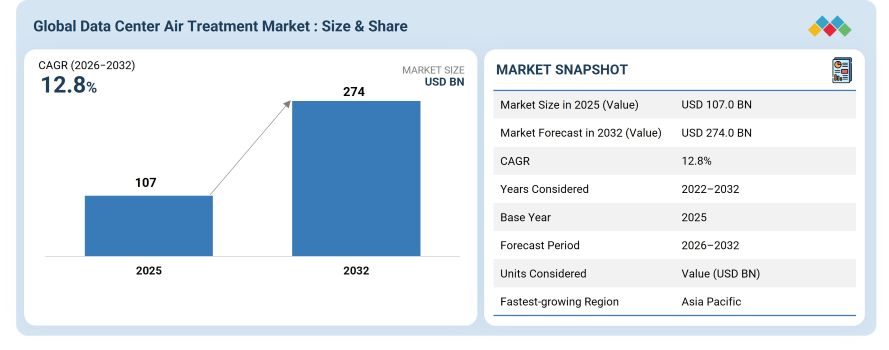
The global Data Center Air Treatment Market is gaining importance as operators invest in reliable air filtration, contamination control, humidity management, and indoor environmental monitoring to protect sensitive IT equipment. For the specialised data-centre air-filter segment, the market is estimated at approximately USD 107 million in 2025 and is projected to reach USD 274 million by 2032, registering a CAGR of approximately 12.8% during 2026–2032. This forecast provides a measurable baseline for the filtration portion of the wider air-treatment ecosystem; the broader market also includes air purification, gas-phase filtration, humidity control, and air-quality management equipment.
Rising data centre construction, AI-driven computing workloads, increasing rack densities, and the expansion of hyperscale and colocation facilities are supporting demand. Dust, airborne particles, corrosive gases, and humidity fluctuations can affect server reliability, cooling performance, and equipment lifespan. Consequently, operators are investing in advanced Data Center Air Filtration Systems, Data Center Air Purification Systems, and automated environmental monitoring. IoT sensors, AI-enabled analytics, and digital building management platforms are helping operators monitor air quality, identify filter loading, optimise airflow, and schedule maintenance. As digital infrastructure expands, data centre air treatment is becoming an important part of facility reliability and operational efficiency.
Key Market Trends & Insights
- North America is a leading market: The United States has a substantial hyperscale and colocation data centre base, supporting demand for particulate filtration, chemical filtration, and humidity management.
- Asia Pacific is a high-growth region: China, India, Japan, Singapore, and Australia are expanding data centre infrastructure, increasing demand for specialised air-quality management.
- Fine filtration is an important product category: Fine filters help control dust and airborne particles that can accumulate on server components, cooling coils, and electrical equipment.
- Gas-phase filtration is gaining attention: Chemical filtration helps protect sensitive equipment from corrosive airborne contaminants, particularly in industrial and coastal environments.
- AI infrastructure is changing air-treatment requirements: High-density AI facilities require careful control of airflow, temperature, humidity, and contamination, even as liquid cooling reduces some room-air heat loads.
- Predictive maintenance is emerging: IoT sensors and automated monitoring platforms can track differential pressure, particulate levels, humidity, and filter condition to improve maintenance planning.
Market Size & Forecast
- Base year market size (2025): Approximately USD 107 million for the specialised data-centre air-filter segment.
- Forecast value by 2032: Approximately USD 274 million.
- CAGR (2026–2032): Approximately 12.8%.
- Growth factors: New data centre construction, increasing replacement-filter demand, contamination control, AI infrastructure expansion, and growing use of advanced filtration technologies.
The forecast is based on a published estimate for the Data Center Air Filter Market. It is narrower than the complete Data Center HVAC Air Treatment market, which can also include air handling units, humidity control equipment, air purification systems, and environmental monitoring. These adjacent categories are covered qualitatively in this article rather than added to the filter-market value.
Data Center Air Treatment Market Top 10 Key Takeaways
- The specialised data centre air-filter market is estimated to reach approximately USD 274 million by 2032.
- The market is projected to grow at a CAGR of approximately 12.8% during 2026–2032.
- North America remains an important market because of its large hyperscale, colocation, and enterprise data centre base.
- Asia Pacific is expected to record strong growth as digital infrastructure investment accelerates.
- Fine particulate filtration is essential for protecting servers, cooling equipment, and electrical infrastructure.
- Gas-phase filtration is gaining importance in locations exposed to corrosive gases and industrial pollution.
- AI workloads are increasing the importance of reliable environmental control in high-density computing facilities.
- IoT-based monitoring and automated filter management can improve maintenance efficiency and air-quality performance.
- Humidity control and contamination management remain important for equipment reliability, even in facilities adopting liquid cooling.
- Companies offering integrated filtration, monitoring, and energy-efficient air-treatment solutions are positioned to benefit from rising demand.
Product Insights
Data Center Air Filtration Systems represent the core product category within the specialised air-treatment equipment market. These systems remove airborne particles such as dust, fibres, soot, and other contaminants that can accumulate on server components, fans, heat exchangers, and cooling equipment. Fine filters are widely used because they provide a balance between particle removal efficiency, airflow resistance, and operating cost. Pre-filters are commonly installed upstream to capture larger particles and extend the service life of more efficient downstream filters.
High-efficiency particulate air filters, efficient particulate air filters, and specialised clean-zone filtration products are used where stricter contamination control is required. The selection of filtration efficiency depends on outside-air conditions, building design, air-recirculation arrangements, and equipment sensitivity. Excessively restrictive filters can increase fan energy consumption, so operators must balance filtration performance with pressure drop and airflow requirements.
Data Center Air Purification Systems and gas-phase filtration products are becoming increasingly relevant in locations where airborne molecular contaminants may cause corrosion. Chemical filtration media can be designed to remove gases such as sulphur compounds and other pollutants that may affect sensitive electronic components. Facilities located near industrial areas, highways, coastal environments, or regions with high pollution levels may require additional contamination-control measures.
Humidity control systems form another important part of the wider Data Center HVAC Air Treatment market. Humidifiers and dehumidifiers help maintain suitable environmental conditions and reduce the risk of static electricity, condensation, and moisture-related equipment problems. Air handling units, computer room air handlers, and precision air-conditioning systems also contribute to the overall environmental-control architecture.
AI-enabled monitoring is improving product performance. Intelligent systems can assess filter loading, airflow, temperature, and humidity to identify maintenance requirements. These capabilities support condition-based filter replacement instead of relying entirely on fixed maintenance intervals.
Technology / Component Insights
The Data Center Air Treatment Market depends on filtration media, air handling equipment, humidity-control components, sensors, control systems, and facility-management software. Mechanical filtration technologies include panel filters, pleated filters, bag filters, rigid box filters, and high-efficiency filters. These products capture particles at different sizes and efficiency levels, depending on the operational requirements of the facility.
Gas-phase filtration uses specialised chemical media to remove airborne molecular contaminants. This technology is relevant where corrosive gases may affect copper, silver, circuit boards, and other electronic components. Molecular filtration can be integrated into air-handling systems or deployed as dedicated contamination-control equipment.
Humidity management technologies include humidification, dehumidification, moisture sensing, and automated environmental controls. Air handling units and precision cooling equipment regulate air distribution and environmental conditions. Differential-pressure sensors help monitor filter loading, while particulate sensors and gas detectors provide information about air quality.
IoT and AI are becoming important in modern air-quality management. Connected sensors can collect real-time information on temperature, relative humidity, particulate concentration, pressure drop, and airflow. AI-based analytics can identify abnormal patterns, estimate filter replacement requirements, and support predictive maintenance. Building management systems can coordinate filtration, cooling, ventilation, and humidity-control equipment through automated control strategies.
Cloud-based monitoring platforms allow operators to view conditions across multiple data centre sites. This is particularly useful for hyperscale operators managing facilities across different geographic regions. Future innovation is expected to focus on low-pressure-drop filtration media, longer-lasting chemical filters, automated contamination detection, digital twins, and integrated environmental-management platforms.
Application Insights
Hyperscale data centres represent a major application area for advanced air-treatment solutions. These facilities operate large numbers of servers and networking systems, requiring consistent environmental conditions and reliable contamination control. Their scale creates demand for high-capacity filtration systems, replacement media, air-quality monitoring, and automated maintenance.
Colocation data centres are another important application segment. Operators provide infrastructure to multiple enterprise and cloud customers, making uptime and equipment protection central to their business models. Effective filtration and humidity management help reduce contamination risks across shared infrastructure. Enterprise data centres, including facilities operated by banks, manufacturers, healthcare organisations, and government agencies, also require reliable air treatment to protect critical computing equipment.
AI and high-performance computing facilities are creating additional opportunities. High-density racks generate substantial heat, and operators are adopting a combination of advanced air cooling and liquid cooling. Liquid cooling can reduce the amount of heat released into the room air, but it does not eliminate the need for air treatment. Electrical rooms, backup systems, control spaces, and residual air-cooled equipment still require environmental management.
Edge data centres and modular facilities represent emerging applications. These smaller installations may be located in industrial buildings, telecommunications sites, transport infrastructure, and remote locations where dust and environmental conditions vary. Compact filtration, automated monitoring, and low-maintenance air-treatment products can support these deployments.
Regional Insights
North America
North America is an important market for data centre air treatment because of its extensive hyperscale, colocation, enterprise, and cloud infrastructure. The United States leads regional demand, supported by data centre investment, AI infrastructure expansion, and the concentration of major cloud service providers. Facilities in areas exposed to wildfire smoke, dust, industrial emissions, and seasonal humidity changes require appropriate filtration and environmental monitoring. Canada offers opportunities through data centre construction, cloud infrastructure, and demand for reliable facilities in major technology and business centres. Mexico is attracting data centre investment, particularly around industrial and commercial hubs, where filtration and humidity management are important for equipment protection. Energy-efficiency requirements and industry guidance on environmental conditions also influence facility design.
Europe
Europe represents a significant market for advanced air filtration and contamination control. Germany, the United Kingdom, France, Italy, Spain, and the Nordic countries have established data centre markets or expanding digital infrastructure investment. Germany's industrial base and cloud infrastructure demand support the use of particulate and molecular filtration. The United Kingdom benefits from hyperscale and colocation demand, particularly around major connectivity hubs. France is expanding data centre infrastructure, while Italy and Spain are attracting investment in digital infrastructure and cloud services. Nordic markets benefit from favourable conditions for energy-efficient data centre operation, although outdoor air quality and humidity still need to be managed. EU energy-efficiency and sustainability policies encourage operators to consider filtration pressure drop, fan energy consumption, and overall facility performance.
Asia Pacific
Asia Pacific is expected to experience strong growth as China, India, Japan, South Korea, Australia, and Singapore expand digital infrastructure. China has a large data centre ecosystem supported by cloud computing, artificial intelligence, and industrial digitalisation. India is attracting investment in hyperscale and colocation facilities, driven by cloud adoption, digital services, and increasing enterprise computing demand. Japan and South Korea have established technology industries and advanced data centre requirements. Australia is expanding cloud and digital infrastructure, while Singapore remains an important regional data centre hub. Hot, humid climates and urban pollution in several APAC markets increase the importance of humidity management, particulate filtration, and gas-phase contamination control.
Regional Insights Summary
- North America benefits from a large installed data centre base and high demand for replacement filtration products.
- Asia Pacific offers strong growth opportunities through hyperscale construction and cloud infrastructure investment.
- Europe is focused on energy-efficient filtration, environmental performance, and reliable facility operation.
- India, Singapore, Japan, and Australia are important markets for specialised air-quality management.
- Regional product demand varies according to climate, outdoor pollution, facility design, and the use of air-side economisation.
Country-Specific Market Trends
The following country-level CAGRs are indicative analyst estimates for 2026–2032, not independently published national market forecasts. They reflect data centre construction, digital infrastructure investment, environmental conditions, and expected adoption of specialised filtration and air-treatment equipment.
China – 13–15% CAGR
China's data centre market is supported by cloud computing, AI infrastructure, and national digitalisation initiatives. Large facilities require filtration systems to manage dust and airborne contaminants, while industrial and urban pollution can increase demand for molecular filtration in selected locations. Domestic suppliers and international filtration companies are competing to provide high-capacity air-treatment solutions.
Japan – 10–12% CAGR
Japan's demand is supported by cloud infrastructure, enterprise digitalisation, and the expansion of advanced computing facilities. High standards for operational reliability encourage investment in particulate filtration, humidity management, and automated environmental monitoring.
Canada – 9–11% CAGR
Canada offers opportunities through hyperscale and colocation expansion, enterprise cloud adoption, and investment in digital infrastructure. Seasonal temperature and humidity variations make environmental monitoring and suitable filtration important for data centre operators.
Mexico – 11–13% CAGR
Mexico is developing as a data centre investment destination due to digital services, industrial activity, and connectivity demand. New facilities require reliable HVAC air treatment, particulate control, and humidity management, particularly in locations with dust and high outdoor temperatures.
United States – 10–12% CAGR
The United States is expected to remain a leading market because of its large data centre installed base and ongoing AI infrastructure investment. Demand is supported by new hyperscale facilities, replacement filters, chemical filtration, and automated air-quality monitoring.
Germany – 9–11% CAGR
Germany's market is supported by industrial digitalisation, cloud infrastructure, and data centre development. Energy efficiency, environmental control, and equipment reliability are important considerations for operators.
France – 9–11% CAGR
France is expected to see demand from cloud infrastructure, colocation facilities, and enterprise digitalisation. Data centre operators are likely to invest in particulate filtration, humidity management, and energy-efficient air handling.
Country-Level Insights Summary
- China and India offer strong demand opportunities from expanding digital infrastructure.
- The United States remains a major market for advanced filtration and replacement products.
- Japan and Germany emphasise reliable operation and environmental control.
- Canada and France offer opportunities through data centre investment and enterprise cloud adoption.
- Mexico is an emerging market where new facilities are expected to require modern HVAC and contamination-control systems.
Key Data Center Air Treatment Market Company Insights
The competitive landscape includes filtration manufacturers, air-treatment specialists, HVAC equipment suppliers, and environmental-control technology providers. Companies are focusing on improved filtration efficiency, lower pressure drop, longer service life, chemical contamination control, and integrated monitoring.
Camfil is a prominent filtration supplier with products for data centre environments, including particulate and molecular filtration solutions. Its strategy focuses on indoor air quality, energy efficiency, and protection against airborne contaminants. AAF International, part of Daikin Industries, supplies air filtration products and filtration systems for commercial and industrial applications. Its portfolio supports data centre air-quality and HVAC requirements.
Parker Hannifin, including its filtration-related businesses, provides filtration technologies and contamination-control solutions. Its capabilities are relevant to specialised air filtration and industrial environments. Freudenberg Filtration Technologies develops filtration media and systems for industrial and commercial applications, with an emphasis on performance and energy efficiency. MANN+HUMMEL offers filtration and air-quality technologies and has identified data centres as an application area for environmental solutions.
Other relevant companies include Donaldson Company, which supplies filtration products for industrial and specialised applications, and Nederman, which focuses on industrial air filtration and environmental technology. Purafil specialises in gas-phase air filtration and molecular contamination control, making its technology relevant to facilities where corrosive airborne gases are a concern. Koch Filter also supplies commercial and industrial air filtration products.
AI adoption is creating opportunities for suppliers to collaborate with HVAC controls and building-management technology providers. Companies that combine filtration products with monitoring, pressure-drop measurement, and predictive maintenance capabilities can offer greater value to data centre operators.
Company Strategy Summary
- Camfil focuses on particulate and molecular filtration for sensitive data centre environments.
- AAF International benefits from its broader HVAC and air-filtration capabilities.
- Parker Hannifin and its filtration businesses provide specialised contamination-control technologies.
- Freudenberg and MANN+HUMMEL focus on advanced filtration media and energy-efficient solutions.
- Donaldson, Nederman, Purafil, and Koch Filter address industrial filtration and specialised air-quality requirements.
Recent Developments
The data centre air-treatment industry is evolving through product development, manufacturing investment, and growing attention to contamination control. Camfil has continued to position specialised particulate and molecular filtration as part of its data centre solutions, reflecting the importance of protecting electronic equipment from airborne contaminants.
In September 2025, Camfil announced the addition of HEPA and ULPA filter manufacturing capability at its Manesar facility in India. This investment supports regional production capabilities for high-efficiency filtration products and reflects demand for specialised filtration across industrial and technology applications.
The expansion of AI data centres is also encouraging suppliers and facility operators to evaluate filtration alongside liquid cooling and high-density air management. As liquid cooling changes the distribution of heat within data halls, operators still need to manage air quality in residual air-cooled zones, electrical rooms, and other facility spaces.
Market Segmentation
The Data Center Air Treatment Market can be segmented by product, technology or component, application, and region. By product, the market includes pre-filters, fine filters, HEPA and EPA filters, gas-phase filtration products, air purification systems, humidity control systems, air handling units, and air-quality monitoring equipment. Fine filtration and replacement filter media represent important product categories, while gas-phase filtration is gaining attention in locations exposed to corrosive contaminants.
By technology and component, the market includes mechanical particulate filtration, chemical and molecular filtration, high-efficiency filtration, humidification, dehumidification, air handling, environmental sensors, and automated control systems. Mechanical filtration captures airborne particles, while gas-phase filtration targets molecular contaminants. IoT sensors and AI-based platforms support real-time monitoring, predictive maintenance, and automated environmental management.
By application, the market covers hyperscale data centres, colocation facilities, enterprise data centres, edge data centres, modular data centres, and high-performance computing facilities. Hyperscale and colocation facilities are important demand centres because of their large installed capacity and continuous operating requirements. Edge facilities provide emerging opportunities for compact filtration and environmental-control systems.
By region, the market includes North America, Europe, Asia Pacific, Latin America, and the Middle East and Africa. North America benefits from its established data centre ecosystem, while Asia Pacific is supported by new infrastructure investment. Europe focuses on reliable, energy-efficient facility operation, and emerging markets are creating opportunities through new cloud and colocation projects.
Segmentation Summary
- By product: Pre-filters, fine filters, HEPA and EPA filters, gas-phase filtration, air purification, and humidity-control systems.
- By technology/component: Mechanical filtration, molecular filtration, air handling, humidity management, sensors, and automated controls.
- By application: Hyperscale, colocation, enterprise, edge, modular, and high-performance computing data centres.
- By function: Particulate removal, airborne molecular contamination control, humidity regulation, and air-quality monitoring.
- By region: North America, Europe, Asia Pacific, Latin America, and the Middle East and Africa.
Conclusion
The Data Center Air Treatment Market is becoming increasingly important as data centre operators prioritise equipment reliability, contamination control, and efficient facility operation. The expansion of AI computing, cloud infrastructure, and high-density server environments is creating demand for advanced filtration, molecular contamination control, and automated environmental monitoring. Although liquid cooling is reducing the amount of heat released into the room air in some AI facilities, air treatment remains necessary for residual air-cooled equipment, electrical rooms, and other critical spaces.
AI, IoT, and automation are expected to improve air-quality management through predictive filter replacement, real-time environmental monitoring, and intelligent control of ventilation and humidity systems. Suppliers that combine high-performance filtration media with low pressure drop, monitoring capabilities, and energy-efficient system design will be well positioned to serve data centre operators.
Through 2032, the market's growth will be supported by new facility construction as well as recurring demand for replacement filters and maintenance. Businesses that invest in integrated air-treatment strategies can improve equipment protection, support operational continuity, and manage facility energy consumption more effectively.
FAQs
1. What is the Data Center Air Treatment Market size?
The specialised Data Center Air Filter Market is estimated at approximately USD 107 million in 2025 and is projected to reach around USD 274 million by 2032. The broader air-treatment ecosystem also includes humidity control, air handling, and gas-phase purification.
2. What is the expected growth rate of the Data Center Air Treatment Market?
The specialised data centre air-filter segment is projected to grow at a CAGR of approximately 12.8% during 2026–2032.
3. What are the key drivers of the Data Center Air Treatment Market?
Key drivers include data centre construction, AI infrastructure expansion, the need to control airborne particles and corrosive gases, equipment reliability requirements, and increasing adoption of IoT-enabled environmental monitoring.
4. Which region is expected to lead the Data Center Air Treatment Market?
North America is an important regional market due to its large hyperscale and colocation data centre base. Asia Pacific is expected to offer strong growth opportunities through new digital infrastructure investment.
5. Which companies are key participants in the Data Center Air Treatment Market?
Key companies include Camfil, AAF International, Parker Hannifin, Freudenberg Filtration Technologies, MANN+HUMMEL, Donaldson Company, Nederman, Purafil, and Koch Filter.
Revenue
Revenue in the Data Center Air Treatment Market is generated through the sale of pre-filters, fine filters, HEPA and EPA filters, gas-phase filtration media, air purification systems, humidity-control equipment, and related monitoring technologies. Replacement filters and media create recurring revenue because data centre operators must maintain filtration performance throughout the facility lifecycle. Additional revenue opportunities come from system installation, filter housing upgrades, environmental monitoring, maintenance services, and specialised contamination-control solutions. Suppliers offering long-life filtration media, energy-efficient products, and integrated monitoring systems can strengthen customer relationships and increase recurring business.
Investment & Funding
Investment in the Data Center Air Treatment Market is supported by global data centre construction, AI infrastructure expansion, and the need to improve facility reliability. Filtration manufacturers are investing in production capacity, advanced filter media, high-efficiency products, and regional manufacturing facilities to serve growing demand. Investment is also directed toward automated air-quality monitoring, IoT sensors, predictive maintenance software, and energy-efficient air handling. Data centre operators are increasingly evaluating air treatment as part of broader infrastructure investment decisions, particularly where equipment protection, energy consumption, and operational uptime are important. Asia Pacific is expected to attract additional investment as new hyperscale and colocation facilities are developed.
Mergers & Acquisitions (M&A)
Mergers and acquisitions in the Data Center Air Treatment Market are likely to focus on expanding filtration portfolios, strengthening molecular contamination-control capabilities, and increasing regional manufacturing reach. Filtration companies may acquire specialist media manufacturers, air-quality monitoring businesses, or industrial filtration suppliers to broaden their product offerings. Strategic partnerships between HVAC manufacturers, filter suppliers, and digital building-management providers can also improve integrated air-treatment solutions. As data centre operators seek more comprehensive environmental management, acquisitions that provide specialised filtration technology, recurring replacement-media revenue, and monitoring capabilities may become increasingly attractive.
Recent Development
- Camfil's India manufacturing expansion: In September 2025, Camfil announced additional HEPA and ULPA filter manufacturing capability at its Manesar facility, supporting regional availability of high-efficiency filtration products.
- Growing demand for molecular filtration: Data centre operators are paying greater attention to gas-phase filtration to protect sensitive electronic equipment from corrosive airborne contaminants.
- AI-driven environmental monitoring: IoT sensors and analytics platforms are increasingly being applied to monitor particulate levels, humidity, airflow, and filter pressure drop.
- Integration with liquid cooling: The growth of liquid-cooled AI infrastructure is changing room-air heat loads, but filtration remains necessary for residual air-cooled equipment and supporting facility areas.
- Energy-efficient filter development: Filtration suppliers continue to focus on media and system designs that balance particle capture, service life, and pressure drop to help reduce fan energy consumption.
 Exclusive indicates content/data unique to MarketsandMarkets and not available with any competitors.











Growth opportunities and latent adjacency in Data Center Air Trea