Data Center Busbar Trunking Market by Type (Open-Channel/Track Busway, Enclosed/Sandwich-Type Busway, Plug-In Tap-Off Systems, Rising/Vertical Busway), Application, End User - Global Forecast to 2032


Data Center Busbar Trunking Market to 2032: Size, Share & Growth Report
The global Data Center Busbar Trunking market is projected to grow from USD 2.1 billion in 2026 to USD 4.5 billion by 2032, at a CAGR of approximately 13.5% during 2026–2032. Growth is driven by AI rack power density requiring busway over traditional cable tray distribution, vendor capacity and product investment targeting AI-ready busway systems, and modular, tap-off-anywhere architecture reducing deployment time and disruption.
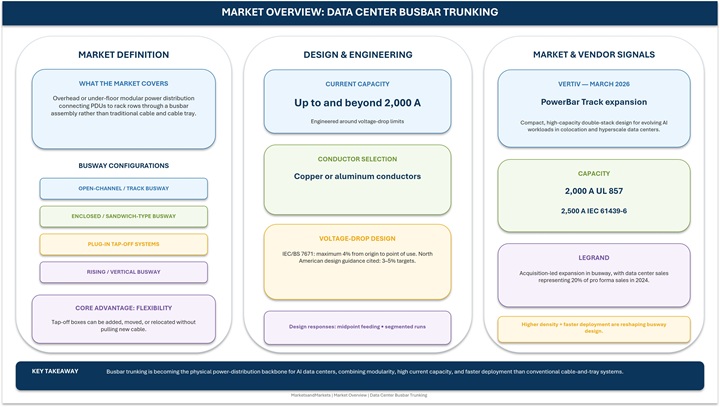
Data center busbar trunking, commonly called busway, is the overhead or under-floor power distribution system that connects power distribution units to rack rows through a modular busbar assembly rather than traditional cable and cable tray. The market spans open-channel/track busway, enclosed (sandwich-type) busway, plug-in tap-off systems, and rising/vertical busway, engineered around voltage-drop limits, current ratings up to and beyond 2,000 amps, and copper or aluminum conductor selection.
Busway's core advantage over cable is flexibility: operators can add, move, or relocate tap-off boxes along the busway without pulling new cable, letting data centers scale rack density and layout without re-engineering the underlying power distribution. Starline Track Busway and Schneider Electric's Canalis system are among the most widely deployed busway platforms in data center environments, representing the two dominant architectural approaches — open-channel track systems that eliminate bolted joints entirely, and enclosed, sandwich-type construction using silver-plated copper busbars with dual-layer insulation. Regulatory standards constrain how these systems can be engineered: IEC/BS 7671 limits total voltage drop to a maximum of 4% from the origin of installation to the point of use, while NFPA 70E and ASHRAE guidelines in North America recommend 3–5% design targets, pushing engineers toward techniques such as feeding from a midpoint or segmenting long distribution runs.
Vendor investment in the category has accelerated sharply alongside AI data center buildout. Vertiv expanded its PowerBar Track busway family with a compact, high-capacity double-stack design in March 2026, supporting up to 2,000A under UL 857 and 2,500A under IEC 61439-6, specifically to address rapidly evolving AI workloads in colocation and hyperscale data centers. Legrand has pursued the most aggressive acquisition-led growth strategy in the category, consolidating regional busway specialists as its data center segment already accounted for 20% of the company's proforma sales in 2024. The Data Center Busbar Trunking market is where the physical power distribution backbone of AI infrastructure is being redesigned for higher density and faster deployment — and the vendors that can combine architectural innovation with manufacturing scale will capture the category's growth.
Top 10 Key Takeaways
- North America holds the largest market share, driven by the concentration of hyperscale AI data center campuses and Starline's (Legrand's) and Vertiv's dominant position in the region's open-channel busway market.
- Asia Pacific is the fastest-growing region, propelled by Legrand's active regional acquisition strategy, including its 2025 purchase of Malaysia-based Linkk Busway Systems, and rapidly expanding hyperscale and colocation data center buildout.
- Open-channel/track busway leads by type revenue, reflecting its widespread deployment across North American hyperscale and colocation facilities; enclosed (sandwich-type) busway is the fastest-growing type as operators in Europe and Asia Pacific increasingly specify enclosed designs for higher power density and environmental protection.
- Hyperscale data centers dominate by application; colocation facilities are the fastest-growing application as shared facility operators compete for AI tenant workloads that increasingly require busway rather than legacy cable tray distribution.
- Vertiv's March 2026 launch of its PowerBar Track double-stack busway system, supporting up to 2,000A under UL 857 and 2,500A under IEC 61439-6, illustrates how quickly vendors are re-engineering busway architecture for AI-driven power density.
- Legrand's data center segment already accounted for 20% of the company's proforma sales in 2024, and the company pursued eight or more busway and data center infrastructure acquisitions during 2025 alone.
- Regulatory voltage-drop limits — a maximum of 4% under IEC/BS 7671 and 3–5% design targets recommended by NFPA 70E and ASHRAE — directly shape busway distribution engineering, pushing operators toward midpoint feeding and segmented distribution runs.
- Siemens' LData busbar trunking system, engineered to transmit more than double the electricity of comparable systems while enabling easier energy monitoring without data cables, illustrates how architectural innovation is extending beyond simple current-carrying capacity.
- The near-term opportunity lies in vendor consolidation through acquisition, as Legrand's multi-continent busway acquisition strategy demonstrates the scale of regional expansion opportunity still available in a historically fragmented category.
- The near-term risk is the higher upfront cost of busway systems relative to traditional cable and cable tray distribution, which can be a harder sell in cost-sensitive enterprise and edge data center deployments than in mission-critical hyperscale environments.
Why the Data Center Busbar Trunking Market Matters Now
Data centers are outgrowing the power distribution architecture that served them for the past two decades. As one 2026 industry technical guide explains, the main advantage of busway systems over traditional power cables is flexibility: operators can add, move, or remove tap-off boxes along the busway without pulling new cable, making busway the default choice as hyperscale and colocation operators need to add capacity and reconfigure rack layouts continuously rather than design a static power distribution plan once and leave it unchanged for the facility's operating life.
This matters commercially because the category's two dominant platforms, Starline Track Busway and Schneider Electric's Canalis system, represent genuinely different engineering philosophies competing for the same AI-driven demand: Starline's open-channel, torque-free design eliminates bolted joints at busway connections entirely, while Canalis uses sandwich-type construction with silver-plated copper busbars, dual-layer Mylar insulation, and a proprietary double-headed bolt connection technology engineered to fracture at a precise torque. Eaton's PowerWave busway offers a third approach, using CouplerTek integral coupling technology to minimize keep-out zones and simplify field jointing—giving data center engineers a genuine choice among competing joint and architecture philosophies rather than a single industry standard.
The market covers open-channel/track busway, enclosed (sandwich-type) busway, plug-in tap-off systems, and rising/vertical busway. Out of scope are traditional cable and cable tray power distribution systems, busbar condition monitoring and sensing technology evaluated independently of the busway hardware itself, and general low-voltage panel boards and switchgear.
The market connects to the
Generator Sales Market — https://www.marketsandmarkets.com/Market-Reports/generator-sales-market-47544335.html
Power Monitoring Market — https://www.marketsandmarkets.com/Market-Reports/power-monitoring-market-197503460.html
DERMS Architecture and Edge Control Market — https://www.marketsandmarkets.com/Market-Reports/derms-architecture-and-edge-control-market-206649623.html
Circuit Breaker Monitoring Systems Market — https://www.marketsandmarkets.com/Market-Reports/circuit-breaker-monitoring-systems-market-133358428.html
Power Device Analyzer Market — https://www.marketsandmarkets.com/Market-Reports/power-device-analyzer-market-259267665.html
Report Scope
|
Report Metric |
Details |
|
Market Size in 2026 (Value) |
USD 2.1 Billion |
|
Market Forecast in 2032 (Value) |
USD 4.5 Billion |
|
Growth Rate |
CAGR of 13.5% from 2026–2032 |
|
Years Considered |
2022–2032 |
|
Base Year |
2025 |
|
Forecast Period |
2026–2032 |
|
Units Considered |
Value (USD Billion) |
|
Report Coverage |
Revenue forecast, company ranking, competitive landscape, growth factors, and trends |
|
Top Companies |
• Legrand (Starline) |
|
Growth Drivers |
• AI rack power density requiring busway over traditional cable tray distribution |
|
Segments Covered |
• By Type: Open-Channel/Track Busway, Enclosed/Sandwich-Type Busway, Plug-In Tap-Off Systems, Rising/Vertical Busway |
|
Regional Scope |
North America, Europe, Asia Pacific, Rest of World |
Market Trends Shaping Data Center Busbar Trunking
The defining trend is the shift from cable tray distribution to modular busway as the data center default. Busbars minimize voltage drops and energy losses over longer distances than traditional wiring, and their modular design allows easy scaling as the data center grows, simplifying the addition of new equipment—advantages that have made busway the preferred architecture for new hyperscale and colocation construction rather than an optional upgrade.
A second trend is double-stack and high-density busway architecture preserving valuable white space. Vertiv's PowerBar Track double-stack design enables higher power density while optimizing valuable white space, addressing rapidly evolving AI workloads within colocation and hyperscale data centers through a flexible, modular architecture that supports future growth without consuming additional floor area.
A third trend is vendor consolidation through acquisition, reshaping the competitive landscape. Legrand pursued an aggressive multi-continent acquisition strategy through 2024 and 2025, including Power Bus Way in Toronto and Linkk Busway Systems in Malaysia, with CEO Benoît Coquart confirming the data center segment already accounted for 20% of the group's proforma sales in 2024 — consolidation that is concentrating manufacturing scale and regional reach inside a smaller number of larger vendors.
A fourth trend is torque-free and integral coupling joint technology simplifying field installation. Starline's open-channel design eliminates bolted joints at busway connections entirely, while Eaton's PowerWave busway uses CouplerTek integral coupling technology to minimize keep-out zones and simplify field jointing — both approaches aimed at reducing the installation complexity and human error risk associated with traditional bolted busway connections.
A fifth trend is monitoring-integrated busway products blurring the line with condition monitoring. Siemens' LData busbar trunking system was designed specifically to enable easier energy monitoring without data cables, reflecting how busway hardware vendors are increasingly building sensing and monitoring capability directly into the trunking product itself rather than leaving it to a separate aftermarket monitoring layer.
Market Drivers Accelerating Growth
The first driver is AI rack power density requiring busway over traditional cable tray distribution: as rack power requirements rise, the flexibility to add, move, or remove tap-off boxes without pulling new cable becomes essential for hyperscale and colocation operators who must reconfigure capacity continuously rather than design a static power plan once.
The second driver is vendor capacity and product investment specifically targeting AI-ready busway systems, exemplified by Vertiv's March 2026 double-stack PowerBar Track launch and Legrand's sustained multi-continent acquisition strategy, both aimed squarely at capturing AI data center power distribution demand.
The third driver is modular, tap-off-anywhere architecture reducing deployment time and disruption: open-channel busway systems let operators install or relocate tap-off boxes along the busway during active operation, minimizing the downtime and disruption that traditional cable-based reconfiguration would otherwise require.
Market Challenges and Restraints
The most significant restraint is regulatory voltage-drop constraints requiring careful distribution engineering. IEC/BS 7671 limits total voltage drop to a maximum of 4% from the origin of installation to the furthest point of utilization, while NFPA 70E and ASHRAE guidelines in North America recommend 3–5% design targets — constraints that require techniques such as feeding from a midpoint or segmenting long distribution runs, adding engineering complexity relative to simpler, shorter cable runs.
A second restraint is the higher upfront cost of busway systems relative to traditional cable and cable tray distribution, particularly for cost-sensitive enterprise and edge data center deployments where the flexibility busway offers may not justify the incremental capital cost as clearly as it does in mission-critical hyperscale and colocation environments.
A third challenge is balancing torque-free joint technology against the proven reliability of traditional bolted connections, as newer approaches such as Starline's open-channel design and Eaton's CouplerTek integral coupling must establish long-term reliability track records comparable to decades-proven bolted busway connections. A related challenge is copper versus aluminum conductor trade-offs at rising current ratings: as busway systems scale toward 2,000–2,500A capacity, the cost, weight, and conductivity differences between copper and aluminum conductors become a more consequential engineering and procurement decision.
Segment Insights
By Type
Open-channel/track busway leads by type revenue, anchored by Starline Track Busway's widespread deployment across North American hyperscale and colocation facilities and its torque-free, bolted-joint-free architecture that has become a de facto reference design for the category.
Enclosed (sandwich-type) busway is the fastest-growing type, propelled by systems such as Schneider Electric's Canalis and Siemens' LData gaining share in Europe and Asia Pacific, where enclosed designs' environmental protection and higher power density are increasingly specified for new hyperscale construction.
By Application
Hyperscale data centers dominate by application, anchored by the largest, highest-current busway deployments needed to distribute power across gigawatt-scale AI training campuses.
Colocation facilities are the fastest-growing application, as shared facility operators competing for AI tenant workloads increasingly specify busway rather than legacy cable tray distribution to offer the rapid reconfiguration flexibility AI tenants require.
Key segmentation insights:
- Open-channel/track busway leads type revenue; enclosed (sandwich-type) busway grows fastest on European and Asia Pacific specification trends.
- Hyperscale data centers dominate by application; colocation facilities grow fastest as shared facilities compete for AI tenant workloads.
- Hyperscale cloud providers lead end users; colocation operators grow fastest as busway becomes standard for AI-ready facility specification.
- The vertically integrated busway platform model and the best-of-breed regional specialist model represent two competing routes to market.
- AI rack power density growth and vendor consolidation through acquisition are the structural drivers converting busway demand into recurring, production-scale revenue.
Regional Analysis: Data Center Busbar Trunking Market by Region
North America
North America holds the largest share, valued at roughly USD 0.88 billion in 2026 and projected to reach about USD 1.73 billion by 2032, growing at a CAGR of approximately 11.9%. The United States dominates through the concentration of hyperscale AI data center campuses and Starline's (Legrand's) and Vertiv's leading position in the region's open-channel busway market, reinforced by Legrand's 2024 acquisition of Toronto-based Power Bus Way. Canada contributes through growing hyperscale and colocation data center investment.
Europe
Europe is valued at approximately USD 0.50 billion in 2026 and forecast to reach around USD 1.05 billion by 2032, expanding at a CAGR of approximately 12.9%. Germany anchors the region through Siemens' LData busbar trunking system, engineered to transmit more than double the electricity of comparable systems; the United Kingdom and France contribute through growing enterprise and colocation data center investment, with regional engineering practice shaped directly by the IEC/BS 7671 voltage-drop standard.
Asia Pacific
Asia Pacific is the fastest-growing region, valued at roughly USD 0.59 billion in 2026 and projected to reach about USD 1.5 billion by 2032, growing at a CAGR of approximately 16.9%. Malaysia contributes directly through Legrand's 2025 acquisition of Linkk Busway Systems, a reference specialist in power busbars for data centers' grey space; China continues to expand domestic busbar manufacturing and data center demand; and India adds growing enterprise and hyperscale busway adoption.
Rest of World
The Rest of World market is valued at USD 0.13 billion in 2026 and is projected to reach about USD 0.23 billion by 2032, growing at a CAGR of approximately 10.2%. The Middle East contributes through growing sovereign AI data center infrastructure investment, while Latin America adds expanding regional colocation and enterprise busway adoption.
Key Company Insights
The competitive landscape spans three tiers: global electrical equipment conglomerates with integrated busway product lines, specialized regional busbar manufacturers, and busway-focused vendors expanding through acquisition. Leading players include Legrand (Starline), Vertiv, Schneider Electric, Eaton, Siemens AG, ABB Ltd., Rittal, Delta Electronics, Chint Group, C&S Electric, Anord Mardix, Methode Electronics, Godrej (Busbar Division), EAE Elektrik, and Oriental Copper.
- Legrand / Starline (Universal Electric, open-channel busway)
- Vertiv (PowerBar Track double-stack busway)
- Schneider Electric (Canalis enclosed busway)
- Eaton (PowerWave busway, CouplerTek technology)
- Siemens AG (LData busbar trunking system)
- ABB Ltd. (busway systems)
- Rittal (busbar trunking systems)
- Delta Electronics (busway systems)
- Chint Group (busbar systems)
- C&S Electric (busbar systems)
- Anord Mardix (busway systems for data centers)
- Methode Electronics (busbar components)
- Godrej (busbar division)
- EAE Elektrik (busbar trunking systems)
- Oriental Copper (busbar conductor materials)
Legrand, through its Starline (Universal Electric) brand, holds the most prominent position in North American open-channel busway, and has pursued the most aggressive acquisition-led growth strategy in the category, consolidating regional busway specialists including Linkk Busway Systems in Malaysia and Power Bus Way in Toronto to extend its global manufacturing and distribution footprint. Vertiv competes directly in AI data center busway innovation, having launched its double-stack PowerBar Track system in March 2026 specifically to address rapidly evolving AI workloads in colocation and hyperscale facilities.
Schneider Electric anchors the enclosed, sandwich-type busway tier through its Canalis system, engineered with silver-plated copper busbars, dual-layer Mylar insulation, and proprietary EZ Joint Pak connection technology. Eaton competes with its PowerWave busway and CouplerTek integral coupling technology, designed to minimize keep-out zones and simplify field jointing. Siemens differentiates through its LData system's integrated monitoring capability, while ABB, Rittal, Delta Electronics, Chint Group, C&S Electric, and Anord Mardix compete across established industrial and data center busway product lines. Methode Electronics, Godrej, EAE Elektrik, and Oriental Copper round out the competitive field as specialized component and regional manufacturing players serving both data center and broader industrial busbar applications.
Key company strategy insights:
- Legrand's acquisition-led strategy, consolidating regional busway specialists across North America and Asia Pacific, gives it the broadest global footprint assembled through M&A rather than organic development alone.
- Vertiv's March 2026 double-stack busway launch positions it directly at the center of AI data center power density growth.
- Schneider Electric's Canalis enclosed architecture and Eaton's CouplerTek integral coupling represent two distinct engineering philosophies competing for the same AI-driven demand.
- Siemens' LData system's built-in monitoring capability illustrates how busway hardware vendors are converging with the condition-monitoring layer rather than leaving it to separate aftermarket providers.
- ABB, Rittal, Delta Electronics, Chint Group, C&S Electric, and Anord Mardix compete on regional manufacturing scale and established industrial busway product depth.
Recent Developments
- March 2026: Vertiv announced the expansion of its PowerBar Track busway family with a compact, high-capacity double-stack design supporting up to 2,000A under UL 857 and 2,500A under IEC 61439-6, built to address rapidly evolving AI workloads in colocation and hyperscale data centers.¹
- February 2026: Legrand reported record 2025 revenue growth of 13%, driven substantially by continued strong data center demand and its ongoing busway and data center infrastructure acquisition strategy.²
- June 2025: Legrand acquired Linkk Busway Systems, an Asian reference specialist in power busbars for data centers, based in Malaysia — its third acquisition of the year and second in the data center segment.³
- December 2024: Legrand acquired Power Bus Way, a leading North American specialist in cable bus power busbars for data centers based in Toronto, Canada — its fifth data center-related acquisition of the year.4
Sources:
¹ Vertiv / PRNewswire, March 3, 2026 — Vertiv Announces Scalable, High-Capacity Double Stack Busway System That Preserves White Space for Growing AI Data Center Demands
² Legrand, February 2026 — Full-Year 2025 Results
³ Legrand, June 2025 — Legrand Strengthens Its Positions as World Champion in Datacenters With the Acquisition of Linkk Busway Systems in Asia
4 Legrand, December 2024 — Legrand Announces the Acquisition of Power Bus Way in Datacenters in North America
Real-World Use Cases
- Vertiv's PowerBar Track double-stack busway system delivers power distribution capacity of up to 2,000A under UL standard 857 and up to 2,500A under IEC 61439-6, with options for copper and aluminum conductors, targeting colocation and hyperscale data centers operating AI workloads. The system's open-track architecture allows operators to install or relocate tap-off boxes along the busway during active operation, illustrating how modular, reconfigurable power distribution has become a baseline requirement rather than a premium feature for AI-ready facilities.5
- Siemens introduced its LData busbar trunking system, specially designed for data centers wanting to improve efficiency, availability, and adaptability, engineered to be suitable for the transmission of more than double the electricity of comparable systems while enabling easier energy monitoring without data cables. The system illustrates how a single busway product can simultaneously address raw current-carrying capacity and the monitoring and visibility requirements operators increasingly demand from their power distribution infrastructure.6
Sources:
5 Vertiv / PRNewswire, March 3, 2026 — Vertiv Announces Scalable, High-Capacity Double Stack Busway System That Preserves White Space for Growing AI Data Center Demands
6 Siemens — New Busbar Trunking System Enables Higher Energy Efficiency for Data Centers of Tomorrow
Market Segmentation
The Data Center Busbar Trunking market segments across three interlocking axes. By type, it spans open-channel/track busway, enclosed (sandwich-type) busway, plug-in tap-off systems, and rising/vertical busway — four categories reflecting different architectural approaches to joint technology, environmental protection, and installation flexibility. By application, it covers hyperscale data centers, colocation facilities, enterprise data centers, and edge data centers. By end user, it serves hyperscale cloud providers, colocation operators, enterprise IT, and system integrators/EPC contractors.
These axes interlock: a hyperscale cloud provider (end user) specifies Vertiv's double-stack PowerBar Track open-channel busway (type: open-channel/track busway) to distribute power across a high-density AI training campus (application: hyperscale data centers) — three axes converging in a single, high-capacity power distribution deployment.
Key segmentation insights:
- Open-channel/track busway leads type revenue; enclosed (sandwich-type) busway grows fastest on European and Asia Pacific specification trends.
- Hyperscale data centers dominate by application; colocation facilities grow fastest as shared facilities compete for AI tenant workloads.
- Hyperscale cloud providers lead end users; colocation operators grow fastest as busway becomes standard for AI-ready facility specification.
- The vertically integrated busway platform model and the best-of-breed regional specialist model represent two competing routes to market.
- AI rack power density growth and vendor consolidation through acquisition are the structural drivers of market growth through 2032.
Opportunities and Future Outlook
Through 2032, data center busbar trunking will mature from a specialized, premium alternative to cable distribution into the default power distribution architecture for new hyperscale, colocation, and enterprise data center construction. The forces driving the market — AI rack power density requiring the flexibility only busway can provide, sustained vendor product and acquisition investment led by Vertiv and Legrand, and modular tap-off-anywhere architecture reducing deployment disruption — are structural and mutually reinforcing, even as regulatory voltage-drop constraints and higher upfront costs introduce near-term adoption friction in cost-sensitive segments. Continued double-stack and high-density architectural innovation, alongside deeper integration with condition monitoring, will be the next catalysts separating vendors that can deliver premium, differentiated systems from those competing purely on standard product cost.
For data center electrical engineers, facilities directors, and investors, the Data Center Busbar Trunking market is where the physical power distribution backbone of AI infrastructure is being redesigned for higher density and faster deployment, and the vendors that can combine architectural innovation with manufacturing scale will determine how quickly the next generation of AI data centers can be built and reconfigured.
Frequently Asked Questions (FAQ)
1. How big is the Data Center Busbar Trunking market?
The Data Center Busbar Trunking market is projected to grow from USD 2.1 billion in 2026 to about USD 4.5 billion by 2032. North America accounts for the largest share, driven by the concentration of hyperscale AI data center campuses and Starline's and Vertiv's dominant position in the region.
2. What is the Data Center Busbar Trunking market growth rate?
The market is forecast to grow at a CAGR of approximately 13.5% from 2026 to 2032. Asia Pacific is the fastest-growing region at around 16.9%, driven by Legrand's regional acquisition strategy and expanding data center buildout.
3. Which segment leads the Data Center Busbar Trunking market?
By type, open-channel/track busway leads; enclosed (sandwich-type) busway grows fastest. By application, hyperscale data centers lead; colocation facilities grow fastest.
4. Who are the key players in the Data Center Busbar Trunking market?
Leading players include Legrand (Starline), Vertiv, Schneider Electric, Eaton, Siemens AG, ABB Ltd., Rittal, Delta Electronics, Chint Group, C&S Electric, Anord Mardix, Methode Electronics, Godrej, EAE Elektrik, and Oriental Copper.
5. What are the factors driving the Data Center Busbar Trunking market?
The primary drivers are AI rack power density requiring busway over traditional cable tray distribution, vendor capacity and product investment targeting AI-ready busway systems, and modular, tap-off-anywhere architecture reducing deployment time and disruption.
Speak With Our Analyst
The Data Center Busbar Trunking market is where the physical power distribution backbone of AI infrastructure is being redesigned in real time, and vendor-level detail on architectural approach, joint technology, and application-specific requirements is where strategic decisions are won or lost. MarketsandMarkets can help you go deeper: request a sample of the full study, speak with our analyst about your specific questions, or customize the scope to your target types, applications, and geographies. Reach out to explore how this intelligence can inform your power distribution strategy, vendor selection, or investment thesis.
 Exclusive indicates content/data unique to MarketsandMarkets and not available with any competitors.
TABLE OF CONTENTS
1 Introduction
1.1 Study Objectives
1.2 Market Definition and Scope
1.2.1 Inclusions and Exclusions
1.3 Study Scope
1.3.1 Markets Covered
1.3.2 Geographic Segmentation
1.3.3 Years Considered
1.4 Currency Considered
1.5 Stakeholders
2 Research Methodology
2.1 Research Approach
2.1.1 Secondary Research
2.1.2 Primary Research
2.1.2.1 Breakdown of Primaries
2.2 Market Size Estimation
2.2.1 Bottom-Up Approach
2.2.2 Top-Down Approach
2.3 Data Triangulation
2.4 Research Assumptions
2.5 Limitations and Risk Assessment
3 Executive Summary
4 Premium Insights
4.1 Attractive Opportunities in the Data Center Busbar Trunking Market
4.2 Market, By Type
4.3 Market, By Region
4.4 Market, By Application
5 Market Overview
5.1 Introduction
5.2 Market Dynamics
5.2.1 Drivers
5.2.1.1 AI Rack Power Density Requiring Busway Over Traditional Cable Tray Distribution
5.2.1.2 Vendor Capacity and Product Investment Targeting AI-Ready Busway Systems
5.2.1.3 Modular, Tap-Off-Anywhere Architecture Reducing Deployment Time and Disruption
5.2.2 Restraints
5.2.2.1 Regulatory Voltage-Drop Constraints Requiring Careful Distribution Engineering
5.2.2.2 Higher Upfront Cost Relative to Traditional Cable and Cable Tray Distribution
5.2.3 Opportunities
5.2.3.1 Vendor Consolidation Through Acquisition Creating Regional Expansion Opportunity
5.2.3.2 Double-Stack and High-Density Architectural Innovation Creating a Premium Upgrade Cycle
5.2.4 Challenges
5.2.4.1 Balancing Torque-Free Joint Technology Against Proven Bolted-Connection Reliability
5.2.4.2 Copper vs. Aluminum Conductor Trade-Offs at Rising Current Ratings
5.3 Value Chain Analysis
5.4 Ecosystem Analysis
5.5 Investment and Funding Scenario
5.6 Pricing Analysis
5.7 Trends and Disruptions Impacting Customer Business
5.8 Technology Analysis
5.8.1 Key Technologies (Open-Channel/Track Busway, Enclosed/Sandwich-Type Busway, Plug-In Tap-Off Systems)
5.8.2 Complementary Technologies (Torque-Free Joints, Integral Coupling, Spring-Loaded Clamping)
5.8.3 Adjacent Technologies (Copper/Aluminum Conductor Engineering, Integrated Monitoring, Rising/Vertical Busway)
5.9 Porter's Five Forces Analysis
5.10 Key Stakeholders and Buying Criteria
5.11 Case Study Analysis
5.12 Key Conferences and Events
5.13 Regulatory Landscape
5.13.1 IEC/BS 7671 Maximum Voltage Drop Requirements
5.13.2 NFPA 70E and ASHRAE Voltage Drop Design Guidelines
5.13.3 UL 857 and IEC 61439-6 Busway System Safety Standards
5.13.4 Uptime Institute Tier Certification Power Distribution Requirements
5.14 Impact of AI on the Market
5.15 Impact of 2025 US Tariffs on Supply Chains
6 Industry Trends
6.1 From Cable Tray Distribution to Modular Busway as the Data Center Default
6.2 Double-Stack and High-Density Busway Architecture Preserving Valuable White Space
6.3 Vendor Consolidation Through Acquisition Reshaping the Competitive Landscape
6.4 Torque-Free and Integral Coupling Joint Technology Simplifying Field Installation
6.5 Monitoring-Integrated Busway Products Blurring the Line With Condition Monitoring
6.6 Regional Manufacturing Expansion Following Hyperscale and Colocation Buildout
7 Technology Adoption and Strategic Disruption Landscape
7.1 Open-Channel/Track Busway vs. Enclosed (Sandwich-Type) Busway Architecture
7.2 Bolted Joint Connections vs. Torque-Free and Integral Coupling Technology
7.3 Copper Conductors vs. Aluminum Conductors at High Current Ratings
7.4 Standard Single-Tier Busway vs. Double-Stack and Modular High-Density Systems
8 Customer Landscape and Buyer Behavior
8.1 Decision-Making Process — Data Center Electrical Engineer, Facilities Director, EPC Contractor
8.2 Voltage Drop and Power Density Engineering as Primary Design Constraints
8.3 ROI Framework: Deployment Speed, White Space Efficiency, Total Cost of Ownership, Scalability
8.4 Build vs. Buy: Vendor-Integrated Busway Platforms vs. Best-of-Breed Component Sourcing
9 Data Center Busbar Trunking Market, By Type
9.1 Introduction
9.2 Open-Channel/Track Busway
9.3 Enclosed (Sandwich-Type) Busway
9.4 Plug-In Tap-Off Systems
9.5 Rising/Vertical Busway
10 Data Center Busbar Trunking Market, By Application
10.1 Introduction
10.2 Hyperscale Data Centers
10.3 Colocation Facilities
10.4 Enterprise Data Centers
10.5 Edge Data Centers
11 Data Center Busbar Trunking Market, By End User
11.1 Introduction
11.2 Hyperscale Cloud Providers
11.3 Colocation Operators
11.4 Enterprise IT
11.5 System Integrators and EPC Contractors
12 Data Center Busbar Trunking Market, By Region
12.1 Introduction
12.2 North America
12.2.1 United States
12.2.2 Canada
12.3 Europe
12.3.1 Germany
12.3.2 United Kingdom
12.3.3 France
12.3.4 Rest of Europe
12.4 Asia Pacific
12.4.1 China
12.4.2 Malaysia
12.4.3 India
12.4.4 Rest of Asia Pacific
12.5 Rest of World
12.5.1 Middle East
12.5.2 Latin America
13 Competitive Landscape
13.1 Overview
13.2 Key Player Strategies / Right to Win
13.3 Revenue Analysis
13.4 Market Share Analysis
13.5 Company Evaluation Matrix
13.6 Competitive Benchmarking
13.7 Competitive Scenario
14 Company Profiles
14.1 Legrand / Starline (Universal Electric, Open-Channel Busway)
14.2 Vertiv (PowerBar Track Double-Stack Busway)
14.3 Schneider Electric (Canalis Enclosed Busway)
14.4 Eaton (PowerWave Busway, CouplerTek Technology)
14.5 Siemens AG (LData Busbar Trunking System)
14.6 ABB Ltd. (Busway Systems)
14.7 Rittal (Busbar Trunking Systems)
14.8 Delta Electronics (Busway Systems)
14.9 Chint Group (Busbar Systems)
14.10 C&S Electric (Busbar Systems)
14.11 Anord Mardix (Busway Systems for Data Centers)
14.12 Methode Electronics (Busbar Components)
14.13 Godrej (Busbar Division)
14.14 EAE Elektrik (Busbar Trunking Systems)
14.15 Oriental Copper (Busbar Conductor Materials)
15 Appendix
15.1 Discussion Guide
15.2 KnowledgeStore: Subscription Portal
15.3 Customization Options
15.4 Related Reports
15.5 Author Details

















Growth opportunities and latent adjacency in Data Center Busbar Trunking Market