Data Center EMC Filtration Market by Product (Single-phase EMC, Three-phase, DC, Power-line, Chokes, Connectors), Technology (Passive, Common-mode, Differential-mode, Harmonic, High-frequency), Type (Hyperscale, Colocation, Enterprise, Edge) – Forecast to 2032


Data Center EMC Filtration Market Summary
The Data Center EMC Filtration Market is gaining importance as data center operators expand high-density computing infrastructure, AI workloads, cloud platforms, and advanced power distribution systems. Electromagnetic compatibility (EMC) filtration helps control electromagnetic interference (EMI) and radio-frequency interference (RFI) generated by power supplies, UPS systems, variable-frequency drives, cooling equipment, servers, and other electrical infrastructure. These filters help protect sensitive electronic equipment, maintain signal integrity, and support reliable data center operations.
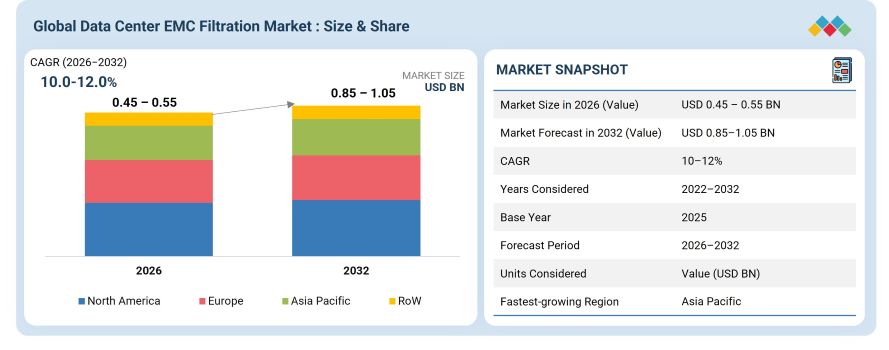
For this analysis, the global data-center-specific EMC filtration market is estimated at approximately USD 0.45–0.55 billion in 2026 and is projected to reach USD 0.85–1.05 billion by 2032, representing an indicative CAGR of approximately 10–12%. This estimate reflects the expected growth of EMC filtration applications within data center electrical infrastructure rather than the entire global EMC filtration industry. The broader EMC filtration market was estimated at USD 1.26 billion in 2025 by MarketsandMarkets, illustrating the wider component market from which data center applications form a specialised segment.
Increasing AI computing capacity, higher rack power density, cloud infrastructure expansion, industrial automation, and digital transformation are creating demand for reliable power quality and electromagnetic interference control. As data centers integrate advanced GPUs, high-speed networking equipment, liquid cooling systems, and increasingly sophisticated power electronics, the importance of EMC filtration is expected to increase through 2032.
Secondary Keywords – Data Center EMC Filtration Market: Data Center EMI Filtration Market, Data Center EMC Filters Market, EMI Shielding Filters Market, RF Interference Filters Market, EMC Power Filters Market, RFI Suppression Filters Market.
Key Market Trends & Insights
- Leading region: North America is a major demand center, supported by hyperscale data center development, cloud infrastructure investment, AI computing expansion, and advanced electrical infrastructure.
- Fastest-growing region: Asia Pacific is expected to record strong growth through 2032, driven by data center construction, digitalization, cloud adoption, and investments in AI infrastructure across China, India, Japan, and Singapore.
- Dominant product segment: Power-line EMC filters are expected to represent a leading product category because they help suppress conducted electromagnetic noise in electrical distribution and power conversion equipment.
- Emerging technology trends: High-current filters, three-phase EMC filters, DC filters, harmonic mitigation, compact filter designs, and high-frequency interference suppression are gaining importance.
- AI and automation impact: AI data centers use high-performance processors, dense power distribution, and advanced cooling systems. These technologies increase the complexity of electrical environments and strengthen the need for effective EMC and power-quality management.
- Infrastructure reliability: Data center operators are prioritizing uptime, equipment protection, redundancy, and power-system stability, creating opportunities for integrated EMC filtration solutions.
Market Size & Forecast
- Base year: 2026.
- Estimated 2026 market size: USD 0.45–0.55 billion.
- Projected 2032 market value: USD 0.85–1.05 billion.
- Indicative CAGR: 10–12% during 2026–2032.
- Growth factors: AI and cloud data center expansion, increasing rack power density, advanced UPS and power distribution systems, high-speed networking, liquid cooling infrastructure, and growing focus on electrical reliability.
The estimated growth trajectory reflects the increasing importance of EMC filtration in data center power infrastructure. The adoption of high-performance computing systems and advanced power electronics is expected to create demand for filters that can manage conducted and radiated interference while supporting efficient and reliable equipment operation.
Data Center EMC Filtration Market Top 10 Key Takeaways
- The Data Center EMC Filtration Market is expected to expand as hyperscale, colocation, and enterprise data center infrastructure increases.
- The estimated market value is USD 0.45–0.55 billion in 2026, with a potential increase to USD 0.85–1.05 billion by 2032.
- The market is projected to register an indicative CAGR of 10–12% during 2026–2032.
- AI data centers are increasing demand for reliable electrical infrastructure and electromagnetic interference control.
- Power-line EMC filters are expected to remain an important product category.
- Three-phase filters and high-current filtering solutions are gaining relevance in high-capacity power distribution systems.
- North America represents a major market due to hyperscale investments and advanced data center infrastructure.
- Asia Pacific is expected to offer significant growth opportunities because of digital transformation and expanding cloud infrastructure.
- Integration of EMC filters with UPS systems, power distribution units, cooling equipment, and power conversion systems is creating new opportunities.
- Manufacturers are focusing on compact designs, higher power ratings, improved thermal performance, and compliance with electromagnetic compatibility requirements.
Product Insights
The Data Center EMC Filtration Market can be segmented into single-phase EMC filters, three-phase EMC filters, DC filters, power-line filters, filter connectors, chokes, and customised filtration solutions. Among these, power-line and three-phase EMC filters are expected to account for a significant share of data center-specific demand because they support electrical infrastructure that operates continuously and supplies power to sensitive computing equipment.
Three-phase EMC filters are particularly relevant for UPS systems, power distribution equipment, cooling infrastructure, and industrial electrical systems. They help reduce conducted electromagnetic noise generated by switching devices, power converters, and motor drives. As data centers increase their electrical capacity, demand for filters that can operate under higher current and voltage conditions is expected to rise.
DC filters are also becoming relevant as data center architectures evolve. Battery energy storage systems, DC power distribution, power conversion equipment, and emerging high-voltage DC infrastructure can create specialised filtering requirements. Filter connectors and compact integrated solutions offer additional opportunities where equipment manufacturers need to save space and simplify installation.
The growing adoption of AI servers and high-performance computing equipment is encouraging product innovation. Manufacturers are focusing on high-current capabilities, low insertion loss, thermal stability, compact dimensions, and reliable performance across demanding electrical environments. Customised EMC filtration solutions are likely to gain importance as data center operators adopt different power architectures and equipment configurations.
Technology / Component Insights
Technology development in the Data Center EMC Filtration Market is centred on electromagnetic noise suppression, power quality, high-frequency interference control, and integration with advanced electrical systems. Traditional passive EMC filters use combinations of inductors, capacitors, and other components to attenuate unwanted electrical noise. These designs remain important for power supplies, UPS equipment, power distribution systems, and cooling infrastructure.
Three-phase filtering technology is important in high-capacity data center electrical networks, while DC filters are increasingly relevant to battery systems and direct-current power architectures. Common-mode and differential-mode noise suppression technologies help address different types of interference. Filter design must also account for current ratings, operating temperature, installation conditions, and the electrical characteristics of connected equipment.
AI, IoT, and cloud computing influence this market indirectly but significantly. AI workloads increase computing density and electrical demand, while IoT-enabled monitoring systems provide operational information about power distribution, equipment temperature, and system performance. Data center infrastructure management platforms can use this information to identify unusual operating conditions and support preventive maintenance.
Automation is also improving the design, testing, and manufacturing of EMC filtration components. Advanced simulation, automated quality inspection, and digital engineering tools can help manufacturers optimise filter performance and reduce product development cycles. Through 2032, innovation is expected to focus on higher power density, compact filter architectures, improved thermal management, and solutions designed for next-generation power distribution.
Application Insights
Power distribution and conditioning represent important application areas for the Data Center EMC Filtration Market. EMC filters are used in electrical equipment that supplies, converts, and distributes power to servers, networking systems, storage infrastructure, and cooling equipment. Their role is to limit electromagnetic disturbances that may affect connected systems and contribute to operational instability.
UPS systems are another important application. These systems provide backup power and often use power electronic components that can generate electromagnetic noise. EMC filters help manage interference within the electrical environment and support compatibility between UPS equipment and sensitive IT loads.
Cooling infrastructure is creating additional opportunities. Fans, pumps, compressors, variable-frequency drives, and liquid cooling distribution systems rely on electrical and electronic components. Their operation can introduce conducted or radiated disturbances, making appropriate filtering and system-level EMC design important.
Other applications include power distribution units, switchgear, battery energy storage systems, server power supplies, networking equipment, and monitoring systems. As AI data centers deploy higher-density racks and advanced cooling architectures, demand for application-specific EMC filtration is expected to increase.
Regional Insights
North America
North America is a major market for data center EMC filtration, supported by the presence of hyperscale cloud operators, colocation providers, enterprise data centers, and AI infrastructure developers. The United States represents the largest demand center in the region because of its extensive data center ecosystem and continued investment in high-performance computing. Increasing electricity demand, power infrastructure modernisation, and the deployment of advanced UPS and power distribution equipment are creating opportunities for EMC filter suppliers.
Canada is benefiting from cloud infrastructure investment, data center development, and demand for reliable digital services. Its availability of energy resources and growing technology ecosystem support new infrastructure projects. Mexico is also attracting interest as digital infrastructure expands and businesses invest in cloud services, telecommunications, and industrial digitalization. Across North America, demand is influenced by uptime requirements, electrical safety considerations, and electromagnetic compatibility standards.
Europe
Europe represents an important market because of its established industrial technology sector, data center infrastructure, and regulatory focus on electrical equipment performance. Germany is a major market supported by industrial automation, enterprise data centers, and engineering capabilities. The United Kingdom and France have strong cloud, colocation, and telecommunications infrastructure, while Italy and Spain are seeing growing investment in digital infrastructure.
The Nordic countries offer opportunities through data center projects supported by renewable energy availability and favourable climatic conditions. European equipment manufacturers must consider applicable EMC requirements, including the EU EMC Directive 2014/30/EU, when designing and placing relevant electrical and electronic equipment on the market. Demand is also supported by energy efficiency initiatives, data sovereignty requirements, and investment in regional cloud infrastructure.
Asia Pacific
Asia Pacific is expected to provide significant growth opportunities through 2032. China has a large data center ecosystem and continues to invest in cloud computing, AI, telecommunications, and digital infrastructure. Japan and South Korea have advanced electronics and semiconductor industries, alongside growing demand for high-performance computing and enterprise digital services.
India is emerging as an important data center investment destination, supported by cloud adoption, digital services, AI infrastructure, and government-led digitalization initiatives. Singapore remains a strategic regional data center hub, while Australia is experiencing demand from cloud operators, enterprises, and government digital services. Across the region, investment in hyperscale facilities, colocation infrastructure, and advanced power systems is expected to strengthen demand for EMC filtration.
Regional Insights – Key Points
- North America benefits from hyperscale investment, AI computing expansion, and established data center infrastructure.
- Europe is supported by industrial technology capabilities, EMC compliance requirements, and cloud infrastructure development.
- Asia Pacific is expected to record strong growth due to data center construction and digital transformation.
- China, India, Japan, Singapore, and South Korea are important regional demand centers.
- Increasing rack power density and advanced power distribution architectures are common demand drivers across all major regions.
Country-Specific Market Trends
The country-level growth rates below are indicative analyst estimates for data-center-specific EMC filtration demand, rather than published standalone country-market forecasts. They reflect differences in data center investment, digital infrastructure expansion, and adoption of advanced power systems.
China – Estimated CAGR: 12–14%
China is expected to remain a significant growth market due to investment in cloud computing, AI infrastructure, telecommunications, and large-scale data center facilities. Expansion of domestic technology ecosystems and demand for high-performance computing are creating opportunities for high-current EMC filters, power-line filters, and customised electrical interference solutions.
Japan – Estimated CAGR: 8–10%
Japan's demand is supported by enterprise digital transformation, advanced manufacturing, semiconductor development, and data center modernisation. Operators are focusing on infrastructure reliability, energy efficiency, and high-quality electrical systems, supporting demand for advanced EMC filtration components.
United States – Estimated CAGR: 10–12%
The United States is expected to remain a major market due to hyperscale cloud investment, AI computing capacity expansion, and increasing deployment of high-density data center infrastructure. Demand is expected to focus on three-phase filters, power-line EMC filters, and solutions for UPS and power distribution equipment.
Canada – Estimated CAGR: 8–10%
Canada's market is supported by cloud adoption, colocation development, enterprise infrastructure modernisation, and investment in digital services. Data center operators are expected to prioritise reliable power systems and electrical compatibility as facilities expand.
Mexico – Estimated CAGR: 9–11%
Mexico is benefiting from increasing digital infrastructure investment, telecommunications expansion, and growing demand for cloud services. Industrial development and nearshoring trends may also support enterprise data center requirements and related electrical infrastructure.
Germany – Estimated CAGR: 8–10%
Germany's demand is linked to industrial digitalization, enterprise data centers, manufacturing automation, and advanced engineering. EMC filtration is important for maintaining compatibility across power electronics, industrial control systems, and data center electrical infrastructure.
France – Estimated CAGR: 8–10%
France is supported by cloud infrastructure development, enterprise digital transformation, telecommunications investment, and demand for reliable data center operations. Modernisation of electrical infrastructure and attention to EMC compliance are expected to support market development.
Country-Level Insights – Key Points
- China is expected to benefit from large-scale digital infrastructure and AI computing investment.
- Japan's demand is supported by advanced electronics, enterprise infrastructure, and data center modernisation.
- The United States remains a major opportunity because of hyperscale and AI data center expansion.
- Canada and Mexico offer growth opportunities through cloud adoption and regional digital infrastructure investment.
- Germany and France are important European markets due to industrial technology capabilities and data center development.
Key Data Center EMC Filtration Company Insights
The competitive landscape includes manufacturers of EMC filters, power-quality components, electrical protection systems, and specialised electromagnetic interference suppression products. Companies compete through product reliability, power ratings, thermal performance, customisation, certification, and integration with power distribution equipment.
TDK Corporation is an established supplier of electronic components and EMC-related products, including components and filter solutions for power and electronic systems. Its technology focus includes materials engineering, miniaturisation, and high-performance electronic components.
TE Connectivity provides connectivity and electronic component solutions, including products for demanding industrial and infrastructure applications. Its strategy emphasises reliable connectivity, power distribution, and engineered components.
Delta Electronics operates across power electronics, industrial automation, and data center infrastructure. Its experience in power systems and thermal management creates opportunities for integrated solutions in high-performance computing environments.
Schaffner Group, now part of TE Connectivity, has a recognised presence in EMC filtering and power-quality solutions. Its product expertise is relevant to industrial equipment and applications where electromagnetic compatibility is critical.
Schurter supplies circuit protection, connectors, and EMC-related components for electronic and industrial applications. Its focus includes compact components, electrical safety, and application-specific engineering.
Eaton provides power management technologies, including UPS systems and electrical distribution equipment used in data centers. Its broader infrastructure portfolio creates opportunities for coordinated power protection and reliability solutions.
Schneider Electric offers data center power management, UPS, and infrastructure solutions. Its digital monitoring and energy management capabilities support the development of more integrated electrical infrastructure.
MTE Corporation specialises in power quality and harmonic mitigation solutions, including products relevant to electrical systems with nonlinear loads and power electronic equipment.
Company Strategy – Key Points
- TDK focuses on component innovation, materials technology, and high-performance electronic solutions.
- TE Connectivity combines connectivity expertise with engineered components for industrial and infrastructure applications.
- Delta Electronics leverages power electronics and data center infrastructure capabilities.
- Schurter and MTE target specialised filtering, protection, and power-quality applications.
- Eaton and Schneider Electric compete through broader power management, UPS, and digital infrastructure portfolios.
Recent Developments
The market is being influenced by developments in AI data center power infrastructure, high-density electrical distribution, and advanced cooling technologies. Rather than treating every infrastructure announcement as a dedicated EMC filter launch, these developments are important because they change the electrical conditions in which EMC filtration products must operate.
One important development is the shift toward higher-density AI computing racks. Higher electrical loads and fast-changing power demand increase the need for carefully engineered power distribution and interference control. This is encouraging suppliers to evaluate higher-current filtering solutions and improved thermal performance.
Another development is the growing adoption of liquid cooling systems. Pumps and variable-frequency drives used in cooling infrastructure can introduce electrical noise and harmonic distortion. Data center design guidance increasingly highlights the importance of power-quality management and suitable filtering for these systems.
A third development is the evolution of data center power architectures, including higher-voltage distribution and emerging DC power approaches. These changes create opportunities for specialised DC filters, improved power conversion designs, and integrated electromagnetic compatibility solutions.
Market Segmentation
The Data Center EMC Filtration Market can be segmented by product, technology or component, application, and region. By product, the market includes single-phase EMC filters, three-phase EMC filters, DC filters, power-line filters, filter connectors, chokes, and customised filtration products. Power-line and three-phase filters are expected to represent important categories because of their use in UPS systems, power distribution units, and electrical infrastructure.
By technology and component, the market includes passive filtering, common-mode and differential-mode suppression, harmonic filtering, high-frequency interference suppression, inductors, capacitors, and integrated filter assemblies. Manufacturers are increasingly developing compact and high-current products for advanced power electronics and high-density computing infrastructure.
By application, the market includes UPS systems, power distribution units, server power supplies, cooling systems, battery energy storage, switchgear, networking infrastructure, and other electrical equipment. By region, the market covers North America, Europe, Asia Pacific, Latin America, and the Middle East and Africa, with demand influenced by data center investment, cloud infrastructure, AI adoption, and regional power-system development.
Market Segmentation – Key Points
- By Product: Single-phase EMC filters, three-phase EMC filters, DC filters, power-line filters, chokes, and filter connectors.
- By Technology: Passive filtering, common-mode suppression, differential-mode suppression, harmonic filtering, and high-frequency noise attenuation.
- By Application: UPS systems, power distribution units, server power supplies, cooling infrastructure, battery systems, and networking equipment.
- By Data Center Type: Hyperscale, colocation, enterprise, edge, and telecommunications data centers.
- By Region: North America, Europe, Asia Pacific, Latin America, and the Middle East and Africa.
Conclusion
The Data Center EMC Filtration Market is expected to gain strategic importance as data centers expand their computing capacity and adopt more advanced electrical architectures. AI workloads, cloud infrastructure, high-density servers, advanced cooling systems, and automated power management are increasing the complexity of electromagnetic environments within modern facilities.
The market is estimated to reach USD 0.85–1.05 billion by 2032, supported by an indicative CAGR of 10–12% from 2026. This growth outlook reflects the expected expansion of data-center-specific EMC filtration demand and should not be interpreted as a published market total for the broader EMC filtration industry.
For manufacturers, opportunities will centre on high-current filters, three-phase solutions, DC filtering, compact designs, and application-specific products for UPS, power distribution, and cooling infrastructure. Suppliers that combine electrical engineering expertise with reliable product performance, customisation, and compliance support will be well positioned to address evolving requirements.
As AI and digital transformation reshape data center infrastructure, EMC filtration will remain an important component of electrical reliability, equipment compatibility, and long-term operational resilience.
FAQs
1. What is the Data Center EMC Filtration Market size?
For this analysis, the global Data Center EMC Filtration Market is estimated at USD 0.45–0.55 billion in 2026 and is projected to reach USD 0.85–1.05 billion by 2032. These are indicative estimates for the data-center-specific segment.
2. What is the expected growth rate of the Data Center EMC Filtration Market?
The market is expected to register an indicative CAGR of approximately 10–12% during 2026–2032, driven by AI data center expansion, higher power density, cloud infrastructure, and demand for reliable electrical systems.
3. What are the key drivers of the Data Center EMC Filtration Market?
Major drivers include hyperscale data center construction, AI and high-performance computing, increasing rack power density, advanced UPS systems, liquid cooling infrastructure, power electronics, and the need to reduce electromagnetic interference.
4. Which region is expected to lead the Data Center EMC Filtration Market?
North America is a major demand center due to its established hyperscale and colocation ecosystem. Asia Pacific is expected to offer strong growth opportunities through data center investment and digital transformation.
5. Who are the key companies in the Data Center EMC Filtration Market?
Important suppliers and relevant industry participants include TDK Corporation, TE Connectivity, Delta Electronics, Schaffner Group, Schurter, Eaton, Schneider Electric, and MTE Corporation.
Revenue
Revenue in the Data Center EMC Filtration Market is generated through sales of single-phase and three-phase EMC filters, DC filters, power-line filters, chokes, filter connectors, and customised electromagnetic interference suppression products. Additional revenue opportunities come from engineered solutions, technical design support, testing, certification assistance, and integration with UPS systems, power distribution equipment, and cooling infrastructure. As data center operators expand AI computing capacity and upgrade electrical systems, suppliers may benefit from higher demand for specialised, high-current, and application-specific filtration products.
Investment & Funding
Investment in the Data Center EMC Filtration Market is expected to be influenced by the expansion of hyperscale facilities, AI infrastructure, cloud computing, and advanced power management systems. Manufacturers are likely to direct capital toward research and development, automated production, high-frequency filter design, thermal management, testing capabilities, and product customisation. Investment opportunities also exist in suppliers developing compact filters for high-density power electronics and DC power architectures. Private equity, strategic investors, and industrial technology groups may show interest in businesses with specialised EMC expertise, established customer relationships, and exposure to data center infrastructure supply chains.
Mergers & Acquisitions (M&A)
Mergers and acquisitions in the broader EMC filtration and power management industries are likely to focus on expanding product portfolios, acquiring specialised engineering capabilities, and strengthening regional distribution networks. Companies operating in electrical protection, power quality, connectors, industrial automation, and data center infrastructure may pursue strategic acquisitions to improve their position in high-growth digital infrastructure markets. The integration of Schaffner into TE Connectivity illustrates how EMC filtration capabilities can complement a wider portfolio of connectivity and engineered component solutions. Further consolidation could involve niche filter manufacturers, power electronics specialists, and providers of advanced testing and compliance services.
Recent Development
- AI data center expansion: Increasing deployment of GPU-based computing infrastructure is driving demand for reliable electrical distribution and improved electromagnetic compatibility.
- Higher-density power systems: New data center power architectures are creating demand for high-current filters and solutions designed for advanced UPS and power conversion equipment.
- Liquid cooling adoption: Wider use of pumps, drives, and coolant distribution units is increasing attention to harmonic distortion and electromagnetic noise management.
- DC power infrastructure: Development of battery energy storage and higher-voltage DC distribution is creating opportunities for specialised DC filtering technologies.
- Digital monitoring and predictive maintenance: Integration of IoT-enabled monitoring and infrastructure management platforms is improving visibility into electrical system performance and supporting preventive maintenance.
 Exclusive indicates content/data unique to MarketsandMarkets and not available with any competitors.











Growth opportunities and latent adjacency in Data Center EMC Filtration Market