Data Center Fire Protection Market Size, Share, Trends & Growth by System Type (Gaseous Suppression, Water-based, Aerosol Suppression, Foam-based), Detection Technology (Heat and Flame Detectors, Conventional and Addressable Smoke Detectors), and Service - Global Forecast to 2032


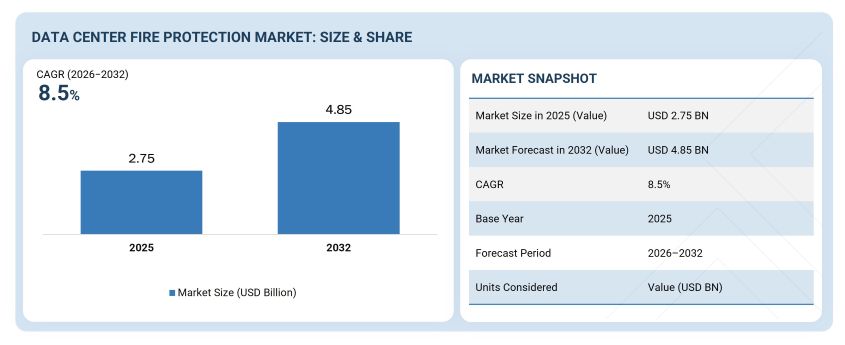
The global data center fire protection market was valued at USD 2.75 billion in 2025 and is projected to reach USD 4.85 billion by 2032, expanding at a compound annual growth rate (CAGR) of 8.5% over the forecast period 2026–2032. This sustained growth trajectory is driven by the accelerated pace of hyperscale data center construction globally, the proliferation of GPU-dense AI compute clusters that generate substantially higher thermal loads than traditional IT infrastructure, and tightening regulatory frameworks—most notably NFPA 75 and 76 in North America and EN 15004 across the European Union—that leave operators with little room to defer investment in advanced fire detection and suppression systems.
Asia Pacific is the fastest-growing region, driven by massive hyperscale investments in China, India's rapidly expanding digital infrastructure, and Singapore's position as a Southeast Asian data hub. North America retains the largest market base, underpinned by the concentration of hyperscale operators (AWS, Microsoft Azure, Google Cloud, Meta) in the United States and stringent NFPA 75/76 compliance requirements that mandate advanced fire protection systems.
Top 10 Key Takeaways
- North America holds the largest market share, anchored by the hyperscale buildouts of major cloud service providers and the strict enforcement of NFPA-mandated fire protection codes.
- Asia Pacific is the fastest-growing region, with China, India, and Singapore driving investment in new-build data center campuses that require full fire protection integration from the ground up.
- Gaseous suppression systems—particularly clean agent solutions—dominate the suppression segment, valued for their ability to extinguish fires without damaging sensitive IT equipment.
- Aspirating smoke detection systems, including VESDA-based solutions, are the leading detection technologies, enabling pre-fire intervention before ignition and equipment damage occur.
- The AI/ML infrastructure boom is a major near-term demand catalyst, as GPU clusters and high-density compute nodes operate at significantly elevated thermal densities requiring purpose-designed protection.
- Environmental regulation, including the Kigali Amendment's HFC phasedown, is reshaping FM-200/HFC-227ea procurement, while PFAS-related supply transitions are separately accelerating evaluation of Novec 1230 alternatives, fluoroketones, and inert gas systems.
- Johnson Controls, Honeywell, Siemens, Kidde Global Solutions, and Fike Corporation are among the leading players shaping competitive dynamics through product innovation and strategic partnerships.
- Edge data centers represent the most significant emerging installation opportunity, with distributed micro-facilities being deployed globally in support of latency-sensitive applications.
- High upfront capital costs for advanced clean agent systems and the complexity of retrofitting legacy facilities remain the primary near-term adoption barriers.
- Companies that integrate fire protection with DCIM and BMS platforms—enabling unified situational awareness—are positioned to capture premium pricing and long-term service revenue.
Why the Data Center Fire Protection Market Demands Attention Now
Data centers are the foundational infrastructure of the modern digital economy—hosting everything from enterprise applications and financial transaction platforms to AI model training workloads and streaming content delivery. Yet for all their technological sophistication, they remain fundamentally physical environments where fire risk is real, consequential, and growing. The average cost of a data center outage has climbed steadily over the past decade, and fire-related incidents—while less frequent than power failures—carry a disproportionate potential for catastrophic and irreversible loss of both equipment and data.
The macro context shaping this market is defined by three converging forces. First, the AI investment cycle is producing a new class of compute infrastructure: liquid-cooled GPU clusters packed into facilities at power densities that would have been unthinkable five years ago. These environments pose fundamentally different fire risk profiles than conventional server rooms, and the fire protection industry is developing detection and suppression solutions calibrated for them. Second, sustainability mandates are reshaping agent selection: the phasedown of hydrofluorocarbons under the Kigali Amendment directly affects HFC-based agents such as FM-200/HFC-227ea, while 3M's PFAS manufacturing exit has separately accelerated customer evaluation of Novec 1230 alternatives. Third, the digitalization of fire protection through integration with DCIM platforms, BMS systems, and AI-powered predictive analytics is creating a new services paradigm beyond the initial installation.
For C-suite and strategy leaders evaluating capital allocation, the data center fire protection market sits at the intersection of infrastructure resilience, regulatory compliance, and technology transition—making it both a near-term operational priority and a longer-term strategic investment theme.
Data Center Fire Protection Market Trends
The most consequential trend reshaping the market is the transition from single-agent gaseous suppression systems toward hybrid protection architectures. As AI workloads drive power densities above 30 kW per rack—and in some GPU clusters well beyond 100 kW—the assumption that a single suppression technology can adequately address all fire scenarios within a modern facility has become untenable. Operators are increasingly deploying layered approaches: VESDA-based very early detection combined with pre-action water mist for aisle containment and clean agent systems for targeted server room suppression.
AI-powered detection is moving from concept to deployment. Traditional ionization and photoelectric smoke detectors, calibrated for the smoke characteristics of conventional combustion, perform poorly in the early stages of a lithium-ion or PCB fire. Modern aspirating smoke detection systems, combined with machine learning algorithms trained on data center-specific fire signatures, can now identify pre-combustion thermal events with far greater accuracy than conventional technologies—dramatically reducing the time between ignition and suppression activation.
Clean agent innovation is accelerating in response to two separate pressures: HFC phasedown requirements affecting agents such as FM-200/HFC-227ea, and PFAS-related supply changes affecting Novec 1230 availability. Specialty chemical suppliers and system integrators are therefore positioning fluoroketone-based alternatives and inert gas blends that can support data center fire suppression requirements while aligning with increasingly strict environmental procurement criteria.
Modular fire protection—purpose-built for prefabricated and containerized data centers—is emerging as a distinct product category. As operators deploy edge infrastructure in distributed locations that lack dedicated facilities teams, fire protection must be pre-engineered, self-monitoring, and remotely manageable. Vendors that can offer factory-integrated fire protection within modular data center pods are capturing a fast-growing slice of the new-build market.
Key Drivers of the Data Center Fire Protection Market
The primary driver accelerating market growth is the relentless expansion of hyperscale and colocation data center infrastructure. Major cloud providers—AWS, Microsoft Azure, Google Cloud, and Meta—have collectively committed large-scale capital programs to new data center capacity through 2030. Each new campus represents a large, multi-system fire protection installation opportunity spanning detection, suppression, and ongoing inspection, testing, and maintenance services. Colocation providers including Equinix, Digital Realty, and NTT Global Data Centers are similarly expanding footprints across every major market, often under long-term lease agreements with hyperscale tenants whose standards-compliance requirements flow through to fire protection specifications.
Regulatory mandates are functioning as a non-discretionary demand signal. NFPA 75 (Protection of Information Technology Equipment) and NFPA 76 (Protection of Telecommunications Facilities) in the United States are regularly updated to reflect evolving facility designs, and compliance is effectively mandatory for facilities seeking insurance coverage at commercially reasonable rates. In Europe, EN 15004 governs gaseous suppression systems and EN 54 governs fire detection systems, while national authorities define additional local requirements. In Asia Pacific, China's GB 50370 and related GB standards guide gas fire-extinguishing system design, while Singapore's data center compliance environment is shaped by SCDF fire-safety requirements, green data center standards, and sustainability-linked approval criteria. These regulatory frameworks create a baseline floor of demand that is largely insensitive to macroeconomic cycles.
The AI infrastructure build-out is elevating the criticality of fire protection investment beyond what would be expected from data center construction volumes alone. A single GPU training cluster costing tens of millions of dollars represents a loss exposure that makes a comprehensive fire protection installation—typically a small fraction of total facility cost—an obvious priority. The thermal characteristics of dense GPU arrays also create fire risk scenarios that standard protection systems were not designed to handle, driving upgrade and reconfiguration investments at existing facilities.
The global expansion of edge computing is extending the addressable market into a new installation tier. Unlike hyperscale facilities where fire protection engineers are deeply embedded in the design team, edge deployments often involve standardized modular infrastructure deployed at hundreds or thousands of locations—telecom towers, retail sites, industrial facilities—by operators who need turnkey, low-maintenance solutions. This is creating demand for a new class of purpose-built, compact, and remotely monitored fire protection products.
Market Challenges and Restraints
High upfront capital expenditure remains the most significant barrier to adoption of advanced fire protection systems, particularly for smaller enterprise data center operators and colocation providers in cost-competitive emerging markets. A comprehensive clean agent suppression installation for a mid-size data center can run to several million dollars when engineering, equipment, installation, commissioning, and regulatory approval costs are aggregated. For operators managing margins under pressure from power and real estate costs, fire protection upgrades often compete with other capital priorities.
HFC phasedown regulation is creating a transition cost burden that complicates investment decisions. Operators that installed FM-200/HFC-227ea systems over the past two decades are weighing whether to refill with approved inventories, retrofit to alternative chemistries, or move toward inert gas and other compliant suppression architectures. Separately, PFAS-related supply transitions affecting Novec 1230 have increased the need for early procurement planning, agent availability checks, and system compatibility reviews.
The skills gap in fire safety engineering for modern data center environments is a systemic constraint on market growth. Designing fire protection for a high-density AI compute environment requires understanding of both fire physics and data center operational requirements—a combination that is scarce in the labor market. The industry's ability to execute on the available opportunity is partially bounded by the pace at which it can develop qualified engineers, a challenge that is particularly acute in rapidly expanding markets such as India and Southeast Asia.
Retrofitting legacy facilities presents complex engineering and operational challenges. Many enterprise data centers built in the 1990s and 2000s were designed with fire protection systems that are now technically obsolete, yet replacing them requires temporary service disruption, complex permitting, and coordination with facility operations teams who are understandably reluctant to risk any interruption to uptime commitments.
End-User Industry and Application Growth in the Data Center Fire Protection Market
The IT and telecommunications sector is the foundational end-user vertical, accounting for the largest share of market demand. Hyperscale cloud operators and major telecom carriers represent the largest individual procurement volumes, and their fire protection specifications effectively set market-wide standards that cascade to smaller operators and system integrators. The pace of AI-driven capacity expansion within this vertical is accelerating demand well ahead of prior forecast trajectories.
Banking, financial services, and insurance (BFSI) is among the most demanding end-user segments in terms of specification rigor. Financial regulators in major markets require operational resilience standards that treat fire as a Tier-1 risk, and large financial institutions typically mandate redundant fire protection systems, frequent inspection cycles, and detailed documentation that exceeds minimum code requirements. This creates a premium-priced, service-intensive revenue stream for vendors with the compliance capabilities to serve it.
Government and defense facilities represent a stable and specification-intensive segment. Data sovereignty requirements and security classification constraints mean that government data centers are rarely outsourced to commercial colocation providers, driving in-house fire protection installations with long service contract tails. Defense facilities often operate to MIL-SPEC standards that exceed civilian codes, creating additional specification complexity and margin opportunity.
Healthcare and life sciences is a growing segment, driven by the digitalization of electronic health records (EHR), the expansion of genomics and clinical trial data management, and the increasing use of AI in drug discovery—all of which require substantial and compliant data center infrastructure. HIPAA in the United States and GDPR in Europe add a data protection dimension that reinforces the business case for fire protection investment: a fire event that destroys patient records carries regulatory as well as operational consequences.
Data Center Fire Protection Market: Segment Insights
By System Type
Gaseous suppression systems lead the suppression technology segment by a substantial margin, and the clean agent sub-category within gaseous systems is the dominant choice for server room and network closet applications. The core advantage of clean agents—their ability to extinguish a fire without leaving residue that damages sensitive electronic equipment—makes them effectively the only commercially viable option for IT-dense spaces where water or foam would cause secondary losses that could equal or exceed fire damage. CO2 systems, while cost-effective, are generally restricted to unmanned spaces due to asphyxiation hazards. Pre-action water mist systems are gaining adoption as a complementary layer for larger facilities, particularly in spaces where the risk of deluge activation from non-fire events (pipe failures, accidental activation) makes standard wet-pipe sprinklers unacceptable.
Within the rapidly evolving suppression segment, fluoroketone-based agents and inert gas blends are the fastest-growing sub-categories, displacing incumbent HFC-based agents in both new installations and retrofit projects. The European market is leading this transition, as stricter F-gas regulations create earlier phase-out timelines than the U.S. market. Vendors that have invested early in PFAS-free agent chemistries and established supply chains for inert gas blends are well positioned to capture share as the transition accelerates globally.
By Detection Technology
Aspirating smoke detection systems, including VESDA-based solutions, represent the leading detection technology segment for data center applications. Their ability to sample air continuously from multiple points within a server rack or raised-floor plenum and detect sub-visible smoke particles before visible combustion makes them well suited to environments where early intervention is critical to preventing equipment loss. Major data center operators increasingly specify aspirating detection as a baseline requirement rather than a premium upgrade, reflecting the economics of early versus late detection.
Multi-criteria detection—combining smoke, heat, and video analytics—is the fastest-growing detection technology segment, driven by the integration of AI-based fire detection algorithms that dramatically reduce false alarm rates while improving sensitivity. High false alarm rates have historically been a significant operational problem in data centers, where every suppression system activation carries the risk of downtime and agent discharge costs. AI-enhanced detection platforms from vendors including Siemens and Honeywell are addressing this pain point directly, creating a compelling upgrade path for existing installations.
By Data Center Type
Hyperscale data centers represent the largest installation segment by revenue, driven by the scale, density, and compliance sophistication of major cloud operator campuses. A single hyperscale campus may host multiple independent fire protection zones across tens of thousands of square meters of compute space, with comprehensive detection, suppression, and monitoring systems throughout. The concentration of procurement among a relatively small number of hyperscale operators also means that specifications adopted by a single major cloud provider can reshape market standards rapidly.
Edge data centers are the fastest-growing installation segment, albeit from a much smaller base. The economics of edge infrastructure—many small, distributed sites rather than a few large campuses—favor modular, factory-integrated fire protection solutions over custom-engineered systems. As edge deployments scale from hundreds to potentially large distributed site portfolios, this segment is expected to generate a disproportionate share of growth in the modular product and remote monitoring services sub-markets.
By Service
Inspection, testing, and maintenance (ITM) services represent the largest and most economically resilient service segment, generating recurring revenue through mandatory inspection cycles required by NFPA standards, insurance requirements, and local authority mandates. The ITM segment is structurally attractive for vendors because it is tied to the installed base rather than new construction activity, providing revenue continuity through capital expenditure cycles. As the global installed base of data center fire protection systems grows, the ITM revenue pool expands proportionally.
Design and engineering services are the fastest-growing service segment, reflecting the increasing complexity of fire protection design for AI-era data center environments. High-density GPU deployments, liquid cooling systems, and non-standard facility configurations are straining the capacity of general-purpose fire protection engineering firms, creating demand for specialists with deep data center domain expertise. Vendors that combine product supply with in-house engineering capabilities are capturing margin-rich design contracts that also anchor subsequent installation and ITM business.
Key Segmentation Takeaways
- Clean agent gaseous systems dominate suppression, but fluoroketone and inert gas alternatives are the fastest-growing sub-categories as HFC phase-out accelerates.
- Aspirating smoke detection systems, including VESDA-based deployments, are the de facto standard for server room applications; AI-enhanced multi-criteria detection is the key growth frontier.
- Hyperscale data centers drive the largest revenue volumes; edge data centers represent the fastest-growing installation opportunity.
- ITM services provide structural revenue resilience through mandatory inspection cycles tied to the growing installed base.
- Design and engineering services are increasingly specialized and margin-rich, driven by the complexity of AI-era facility fire protection.
Regional Analysis: Data Center Fire Protection Market
North America
North America is the largest regional market for data center fire protection, with the United States serving as the dominant country within the region. The U.S. hosts the world's largest concentration of hyperscale data center capacity, with major campus developments clustered in Northern Virginia, Dallas-Fort Worth, Phoenix, Chicago, and the Pacific Northwest. The North American data center fire protection market was valued at USD 1.18 billion in 2025 and is forecast to reach USD 2.05 billion by 2032, at a CAGR of 8.2% during 2026-2032. NFPA 75 and NFPA 76 serve as the primary regulatory frameworks, with compliance effectively mandatory for commercially insured facilities. Canada's growing data center sector, particularly in Ontario, Quebec, and British Columbia, is adding to regional demand, supported by cooler-climate siting advantages and renewable energy availability.
Europe
Europe is the second-largest regional market, with a diverse regulatory landscape that drives both complexity and compliance rigor. The European data center fire protection market was valued at USD 0.72 billion in 2025 and is expected to reach USD 1.18 billion by 2032, growing at a CAGR of 7.3% over the forecast period. Germany is the largest single market within the region, home to a concentration of enterprise data centers and colocation facilities serving Central European financial and industrial sectors, with Frankfurt consistently ranked among Europe's top tier-1 data center hubs. The United Kingdom, despite post-Brexit regulatory divergence, maintains stringent fire protection standards under BS 6266, and the London-Slough corridor remains a major European data center cluster. The Netherlands—particularly Amsterdam—is a critical European internet exchange point and home to significant colocation density. France, Spain, and the Nordics are growing markets, with Scandinavian countries attracting hyperscale investment for their renewable energy supply and natural cooling advantages. EU F-gas regulation is the most impactful environmental driver in Europe, mandating HFC phasedowns on a timeline that is accelerating the transition to fluoroketone and inert gas alternatives faster than any other region.
Asia Pacific
Asia Pacific is the fastest-growing regional market, driven by a combination of massive data center investment programs in China and India, and the established role of Singapore, Japan, and South Korea as mature data center hubs. The Asia Pacific data center fire protection market was valued at USD 0.63 billion in 2025 and is projected to reach USD 1.24 billion by 2032, at a CAGR of 10.1%, the highest rate of any region. China's data center market is subject to government directives on energy efficiency and fire safety that are driving modernization of both new and existing facilities; fire protection standards under GB 50370 and associated GB/T standards are increasingly aligned with international best practices. India's data center sector is experiencing exceptional growth, fueled by digital public infrastructure programs, hyperscale investment from global operators, and the expansion of domestic cloud services, all creating greenfield fire protection installation opportunities. Singapore continues to attract premium-tier facilities despite land constraints, with new data center capacity guided by the Green Data Centre Roadmap, sustainability-linked approval criteria, and strict energy and safety expectations. Japan and South Korea represent mature but steadily growing markets with high compliance standards and significant enterprise data center demand from financial and manufacturing sectors.
Rest of World
The Rest of World region, comprising Latin America, the Middle East, and Africa, represents the smallest share of the current market but is growing at a CAGR of 8.1%, reaching USD 0.38 billion by 2032 from USD 0.22 billion in 2025. The Middle East is the most dynamic sub-region, with the UAE and Saudi Arabia executing ambitious digital infrastructure programs. The UAE's position as a regional business hub has made Dubai and Abu Dhabi significant data center markets, with Tier-3 and Tier-4 facilities built to international fire protection standards under the Dubai Civil Defence (DCD) regulatory framework. Saudi Arabia's Vision 2030 program includes substantial data center infrastructure investment, with NEOM and Riyadh emerging as focal points. In Latin America, Brazil is the largest market, with São Paulo hosting the majority of the region's enterprise and colocation capacity, while Mexico's emerging data center market around Mexico City and Querétaro is benefiting from nearshoring-led digital infrastructure investment. South Africa serves as the primary market on the African continent, though the broader sub-Saharan market is at an early stage of development that will create greenfield opportunities over the forecast period.
Regional Outlook Takeaways
- North America's dominance is sustained by hyperscale concentration and stringent NFPA compliance requirements that preclude under-investment in fire protection.
- Europe's growth is significantly shaped by EU F-gas regulation, making it the leading market for next-generation clean agent adoption.
- Asia Pacific's exceptional CAGR reflects the greenfield nature of much of its new capacity, where fire protection is specified at the design stage rather than retrofitted.
- The Middle East—particularly the UAE and Saudi Arabia—is the standout growth market within the Rest of World region.
- In aggregate, all regions are growing above pre-pandemic trend rates, reflecting the structural nature of AI- and cloud-driven data center demand.
Country-Level Insights
The United States is the world's largest single-country data center fire protection market. The Northern Virginia corridor alone hosts more data center capacity than most countries, and the pace of new construction remains exceptional despite power grid constraints. U.S. fire protection procurement is heavily influenced by FM Global guidelines, which often exceed NFPA minimums, and by the specifications of hyperscale operators whose procurement decisions set effective market standards. The U.S. market is also the most technologically advanced in terms of VESDA and AI-enhanced detection adoption.
Germany stands as Europe's most significant market due to its concentration of enterprise data centers serving the financial, automotive, and manufacturing sectors. Frankfurt's status as a European internet exchange hub drives colocation demand, and German Occupational Safety and Health regulations (combined with EN 15004 requirements) create one of the most compliance-intensive operating environments globally. German buyers are early adopters of inert gas suppression systems, favored for their environmental profile.
China presents the most complex regulatory and commercial environment in the Asia Pacific region. Government-mandated data localization requirements mean that all hyperscale operators serving the Chinese market must deploy domestically, creating sustained domestic demand. The government's push to relocate data center capacity from energy-scarce coastal provinces to western regions with renewable energy access is also creating a wave of new-build installations where fire protection is specified from the ground up. Local players such as CITIC Telecom and GDS Services are significant buyers alongside international operators.
India is the most rapidly evolving large market globally. The country's National Data Center Policy, combined with hyperscale investments from Amazon, Microsoft, Google, and domestic players including Adani Enterprises and Reliance Jio, is creating construction volumes that are challenging the capacity of local fire protection engineering firms. International vendors are partnering with Indian engineering firms to participate in this opportunity, and the market is expected to grow at rates that will make India a top-5 global data center fire protection market by the end of the forecast period.
Singapore occupies a unique position as a small but high-value market. The city-state has resumed selective data center capacity growth under sustainability-linked requirements, with the Green Data Centre Roadmap guiding energy efficiency, green energy adoption, and higher operating standards. This selectivity means that Singapore's facilities are among the most technologically advanced globally, and fire protection specifications reflect that premium positioning. The Infocomm Media Development Authority (IMDA), alongside building and fire-safety authorities, plays an active role in shaping standards that align with international best practices.
Country-Level Conclusions
- The U.S. remains the world's most important single-country market by revenue, driven by hyperscale concentration and FM Global compliance standards.
- Germany's enterprise data center sector and stringent regulatory environment make it Europe's leading market for premium fire protection specifications.
- China's data localization requirements and government-driven capacity relocation programs are creating sustained greenfield installation demand.
- India is the highest-growth large country market globally, with international vendors competing to establish engineering and service delivery capabilities at scale.
- Singapore's selective permitting approach ensures that new capacity is among the most advanced globally, sustaining demand for best-in-class fire protection.
Key Company Insights
The data center fire protection market is served by a relatively concentrated group of global fire protection conglomerates alongside specialized players with deep domain expertise. The competitive landscape is defined by technology leadership in suppression chemistry and detection intelligence, service network breadth for ITM and commissioning, and the ability to integrate fire protection into the broader facility management technology stack.
Leading companies operating in this market include:
- Johnson Controls International
- Siemens AG
- Honeywell International Inc.
- Kidde Global Solutions
- Hochiki Corporation
- Fike Corporation
- Amerex Corporation
- Minimax Viking GmbH
- Victaulic Company
- Eurofyre Ltd
- Marioff Corporation / Spectrum Safety Solutions
- WAGNER Group GmbH
- Tyco Fire Protection Products (Johnson Controls)
- Vulcan Fire Protection
- Nohmi Bosai Ltd
Johnson Controls, through its Tyco Fire Protection Products division, maintains a broad portfolio spanning clean agent suppression, detection, and emergency control systems, with significant data center reference installations across North America, Europe, and Asia Pacific. Siemens Fire Safety has invested heavily in AI-enhanced detection, integrating its Sinteso fire detection platform with building automation and DCIM systems to deliver unified situational awareness. Honeywell's data center fire protection offering spans its Gent and Notifier detection brands alongside suppression products, with the company actively positioning its building technologies portfolio as an integrated risk management solution rather than a discrete fire protection product line.
Specialist players such as WAGNER Group have built strong positions in aspirating smoke detection and oxygen reduction systems, with WAGNER's OxyReduct technology offering a prevention-first approach that reduces oxygen concentration in protected spaces to levels that preclude ignition without requiring suppression agent discharge. Fike Corporation maintains particular strength in clean agent systems and has been active in developing FM-200 and CO2 replacement products. Marioff (HI-FOG) is a recognized leader in high-pressure water mist systems for data centers, with an installed base spanning financial institutions, telecommunications facilities, and colocation providers globally.
Key Company Strategy Takeaways
- Portfolio integration—combining detection, suppression, and DCIM/BMS connectivity—is the dominant strategic direction among the largest market participants.
- Clean agent chemistry investment is a critical differentiator as HFC phase-out creates pressure to qualify and supply compliant replacement agents.
- Service network scale and ITM capability are increasingly used as competitive differentiators to lock in recurring revenue from the growing installed base.
- Specialist players with deep domain expertise (WAGNER in aspiration; Marioff in water mist; Fike in clean agent alternatives) are sustaining strong positions despite scale competition from diversified conglomerates.
- Partnerships with DCIM software providers and hyperscale operators are becoming a key route to market for both detection and suppression system vendors.
Recent Developments
- In December 2024, Lone Star completed the acquisition of Carrier's Commercial and Residential Fire business, forming Kidde Global Solutions as a standalone fire and life-safety platform. The transaction reshaped the competitive landscape by moving Kidde, Edwards, and related fire brands outside Carrier's ownership, strengthening the need to present Kidde as an independent competitor in the data center fire protection market.
- In July 2024, Sentinel Capital Partners completed the carve-out of Carrier's Industrial Fire business, creating Spectrum Safety Solutions. The new platform includes Marioff, Autronica, Det-Tronics, and other industrial fire brands, reinforcing its position in high-pressure water mist, industrial detection, and mission-critical fire protection applications, including data center and critical infrastructure environments.
- In 2024, Singapore advanced its Green Data Centre Roadmap to support sustainable growth in digital infrastructure while maintaining higher efficiency and operating expectations for new capacity. For fire protection suppliers, the roadmap supports demand for integrated systems that align with safety, energy-efficiency, remote monitoring, and high-resilience requirements in premium data center facilities.
- In 2024 and 2025, data center operators accelerated reviews of suppression-agent roadmaps as HFC phasedown requirements and PFAS-related supply transitions affected long-term procurement planning. This shift increased the commercial relevance of FM-200 replacement strategies, Novec 1230 alternatives, fluoroketone-based agents, and inert gas systems across new-build and retrofit projects.
- In 2025, hyperscale and colocation operators continued to expand high-density AI infrastructure, increasing demand for layered fire protection architectures that combine aspirating smoke detection, pre-action water-based systems, clean agent or inert gas suppression, and centralized building-management integration. This supports broader vendor positioning around resilience, compliance, and lifecycle service revenue.
Representative Use Cases and Deployment Patterns
Large European colocation facilities are increasingly using scheduled maintenance windows to replace legacy HFC-based suppression systems with lower-impact clean agent or inert gas alternatives. These projects typically require phased agent replacement, discharge testing, detection recalibration, and tenant communication to avoid service disruption. The strongest deployment models combine aspirating smoke detection with clean agent or inert gas suppression so operators can improve response speed while aligning with EU F-gas compliance and internal sustainability targets.
High-resilience financial services and government data centers are also evaluating prevention-first architectures for vaults, trading infrastructure, records environments, and other mission-critical rooms. Oxygen reduction systems maintain a reduced-oxygen environment that limits ignition potential before a suppression event is triggered. This approach is most relevant where suppressant discharge, false alarms, or even short operational interruptions could create significant business-continuity, regulatory, or security exposure.
Data Center Fire Protection Market Segmentation
The data center fire protection market is structured across five primary segmentation dimensions that reflect the multidimensional nature of buying decisions within data center operations. System type captures the suppression and detection technology choices that form the core of any fire protection installation. Detection technology reflects the growing differentiation between conventional and advanced detection approaches. Data center type acknowledges the significant operational and specification differences between hyperscale campuses, colocation facilities, enterprise data centers, and the emerging edge tier. End-user industry segmentation maps demand to the sectors that own or operate data center infrastructure. Service segmentation captures the growing economic weight of recurring ITM, design, and compliance services relative to one-time equipment installations.
Within system type, gaseous suppression—and specifically clean agent systems—remains the dominant technology for IT-intensive spaces, while detection innovation is rapidly shifting toward aspirating and AI-enhanced multi-criteria platforms. The regulatory transition away from HFC agents is the most significant near-term dynamic shaping product mix across both new installations and the installed base retrofit cycle. Data center type segmentation highlights the structural importance of hyperscale as a revenue driver and edge as a growth catalyst, while end-user segmentation points to IT/telecom, BFSI, and government as the verticals most likely to invest ahead of minimum compliance requirements. The service dimension reflects the shift toward lifecycle-value selling models that are increasingly characterizing the competitive strategies of leading players.
Segmentation Takeaways
- Clean agent gaseous systems and aspirating smoke detection represent the technology backbone of data center fire protection, with the transition away from legacy HFC agents as the defining near-term product shift.
- The hyperscale segment drives the largest share of total market revenue; edge is the fastest-growing installation type.
- BFSI and government are the most specification-intensive end-user segments, creating premium-priced revenue opportunities for vendors with deep compliance expertise.
- Service revenue—particularly ITM—is structurally growing as the global installed base expands and annual inspection obligations scale with it.
- Multi-dimensional segmentation complexity means that the most defensible competitive positions combine technology leadership, regulatory expertise, and geographic service network depth.
Conclusion and Future Outlook
The data center fire protection market is entering a period of exceptional complexity and opportunity. The AI investment cycle is simultaneously expanding the addressable market through the sheer volume of new data center construction and raising the technical bar for fire protection solutions, as GPU-dense compute environments demand detection and suppression capabilities that were not engineered for conventional IT infrastructure. The regulatory environment is equally dynamic: HFC phasedowns under the Kigali Amendment are forcing agent transitions across FM-200/HFC-227ea installations, while PFAS-related supply changes are increasing customer evaluation of Novec 1230 alternatives and other compliant suppression architectures.
Through 2032 and beyond, the market will be shaped by the maturation of AI-powered detection—moving from a premium feature to a standard expectation—and by the integration of fire protection into the broader digital operations layer of data center management. Vendors that can demonstrate not just that their systems suppress fires effectively but that they contribute to operational resilience, compliance automation, and sustainability metrics will be best positioned to win long-term strategic relationships with the hyperscale operators, colocation providers, and enterprise IT organizations that define the demand landscape. For investors and strategic planners, the data center fire protection market combines the defensive characteristics of a compliance-driven baseline with the growth dynamics of a sector being structurally reshaped by technology transition.
Frequently Asked Questions (FAQ)
Q1: How big is the data center fire protection market?
The global data center fire protection market was valued at USD 2.75 billion in 2025 and is projected to reach USD 4.85 billion by 2032. The market spans fire detection systems, gaseous and water-based suppression systems, and associated design, installation, and maintenance services, with demand driven by the rapid global expansion of data center infrastructure and tightening fire safety regulations.
Q2: What is the data center fire protection market growth rate?
The global data center fire protection market is projected to grow at a CAGR of 8.5% during the forecast period 2026–2032. Asia Pacific is the fastest-growing region, expanding at a CAGR of 10.1%, driven by hyperscale investments in China, India, and Southeast Asia. North America, while the largest market, grows at a CAGR of 8.2%, sustained by regulatory compliance requirements and continuous hyperscale capacity expansion.
Q3: Which segment leads the data center fire protection market?
Clean agent gaseous suppression systems lead the market by system type, valued for their ability to extinguish fires in IT-dense environments without causing secondary equipment damage from water or residue. For detection technology, aspirating smoke detection systems, including VESDA-based solutions, are the dominant technologies. Hyperscale data centers represent the largest installation segment by revenue, accounting for the bulk of new-build procurement.
Q4: Who are the key players in the data center fire protection market?
The leading players in the global data center fire protection market include Johnson Controls International (Tyco), Honeywell International, Siemens AG, Kidde Global Solutions, Fike Corporation, WAGNER Group GmbH, Marioff / Spectrum Safety Solutions, Hochiki Corporation, Minimax Viking, and Nohmi Bosai. These companies compete across detection systems, clean agent suppression, water mist technology, and managed inspection and maintenance services.
Q5: What are the key factors driving the data center fire protection market?
The primary drivers are the global hyperscale data center construction boom led by major cloud providers, stringent and regularly updated fire safety regulations (NFPA 75/76, EN 15004, GB 50370), the thermal risk elevation created by AI/GPU compute deployments, and the regulatory phasedown of HFC-based suppression agents. PFAS-related supply transitions affecting Novec 1230 are also pushing operators to evaluate replacement chemistries and inert gas alternatives. The expansion of edge computing is creating a new and fast-growing installation segment.
Speak with Our Analysts
The data center fire protection market is evolving at a pace that demands granular, up-to-date intelligence—at the segment, regional, and country level—to support procurement decisions, competitive strategy, and capital allocation. MarketsandMarkets provides proprietary market sizing, competitive benchmarking, technology adoption curves, and regulatory impact assessments tailored to your specific geographic and end-user focus. Request a report sample, speak with our analyst team, or customize the scope to match your strategic priorities.
 Exclusive indicates content/data unique to MarketsandMarkets and not available with any competitors.
TABLE OF CONTENTS
1 Introduction
1.1 Study Objectives
1.2 Market Definition and Scope
1.3 Inclusions and Exclusions
1.4 Study Scope
1.4.1 Markets Covered
1.4.2 Geographic Segmentation
1.4.3 Years Considered
1.5 Currency Considered
1.6 Stakeholders
2 Research Methodology
2.1 Research Approach
2.2 Secondary Research
2.3 Primary Research
2.3.1 Primary Interviews Conducted
2.3.2 Key Industry Insights from Primary Research
2.4 Market Size Estimation
2.4.1 Bottom-Up Approach
2.4.2 Top-Down Approach
2.5 Data Triangulation
2.6 Assumptions
3 Executive Summary
4 Premium Insights
5 Market Overview
5.1 Introduction
5.2 Market Dynamics
5.2.1 Drivers
5.2.1.1 Rapid Expansion of Hyperscale and Colocation Data Centers
5.2.1.2 Rising Regulatory Mandates for Fire Safety (NFPA 75, 76; EN 15004)
5.2.1.3 Increasing Adoption of High-Density Computing and Liquid Cooling
5.2.1.4 Surge in AI/GPU Cluster Deployments Elevating Thermal Risk
5.2.2 Restraints
5.2.2.1 High Initial Capital Expenditure for Advanced Suppression Systems
5.2.2.2 Complexity of Retrofitting Legacy Facilities
5.2.3 Opportunities
5.2.3.1 Edge Data Centers as an Emerging Installation Segment
5.2.3.2 Integration of AI-Driven Early Warning and Detection Systems
5.2.3.3 Sustainable Clean Agent Alternatives Replacing HFCs
5.2.4 Challenges
5.2.4.1 Phasedown of HFC-Based Agents Under Kigali Amendment
5.2.4.2 Skills Gap in Fire Safety Engineering for Modern Data Centers
5.3 Value Chain Analysis
5.4 Ecosystem Analysis
5.5 Investment and Funding Scenario
5.6 Pricing Analysis
5.6.1 Average Selling Price Trends, by Suppression System Type
5.6.2 Pricing Impact of Clean Agent Phasedowns
5.7 Trends and Disruptions Impacting Customer Business
5.8 Technology Analysis
5.8.1 Key Technologies (Clean Agent Systems, Aspirating Smoke Detection including VESDA, FM-200 Alternatives, Fluoroketones, and Inert Gases)
5.8.2 Complementary Technologies (Liquid Cooling, DCIM, BMS Integration)
5.8.3 Adjacent Technologies (Thermal Imaging, Digital Twins for Fire Modeling)
5.9 Porter's Five Forces Analysis
5.10 Key Stakeholders and Buying Criteria
5.11 Case Study Analysis
5.12 Trade Analysis
5.13 Patent Analysis
5.14 Key Conferences and Events
5.15 Regulatory Landscape
5.15.1 NFPA 75 and NFPA 76 (United States)
5.15.2 EN 15004 and EN 54 (European Union)
5.15.3 BS 6266 (United Kingdom)
5.15.4 GB 50370 and GB/T Standards (China)
5.15.5 Kigali Amendment – HFC Phasedown Implications
5.16 Impact of AI and Generative AI on the Market
5.17 Impact of 2025 US Tariffs on Supply Chain and Pricing
6 Industry Trends
6.1 Transition from Gaseous to Hybrid Suppression Architectures
6.2 AI-Powered Early Detection: Aspirating Smoke Detection, VESDA-Based Systems, and Beyond
6.3 Clean Agent Innovation: Fluoroketone and Inert Gas Alternatives
6.4 Integration with Data Center Infrastructure Management (DCIM) Platforms
6.5 Modular and Prefabricated Fire Protection for Edge and Micro Data Centers
6.6 Sustainability and Green Fire Protection Credentials (ESG-Linked Procurement)
7 Regulatory and Compliance Landscape
7.1 North America: NFPA 70, 75, 76; UL Standards; FM Global Guidelines
7.2 Europe: CENELEC EN 15004; CPR Regulation; Local Authority Variants
7.3 Asia Pacific: China GB Standards; India BIS; Singapore SCDF Fire Code and Green Data Centre Standards
7.4 Middle East and Africa: NFPA Adoption Variants; SASO; DCD Regulations (UAE)
7.5 Impact of Environmental Regulations on Agent Selection
8 Customer Landscape and Buyer Behavior
8.1 Decision-Making Process and Buying Journey
8.2 Key Buyer Stakeholders (Facilities Management, Data Center Operations, EH&S, Procurement)
8.3 Adoption Barriers and How Vendors Overcome Them
8.4 Preference Mapping: New Build vs. Retrofit Deployments
9 Data Center Fire Protection Market, By System Type
9.1 Introduction
9.2 Gaseous Suppression Systems
9.2.1 CO2 Systems
9.2.2 Clean Agent Systems (FM-200 Alternatives, Fluoroketones, and Inert Gases)
9.2.3 Inert Gas Systems (IG-541, IG-55, IG-100)
9.3 Water-Based Systems
9.3.1 Pre-Action Sprinkler Systems
9.3.2 Mist and Fine Water Spray Systems
9.4 Aerosol Suppression Systems
9.5 Foam-Based Systems
10 Data Center Fire Protection Market, By Detection Technology
10.1 Introduction
10.2 Aspirating Smoke Detection Systems, including VESDA-Based Solutions
10.3 Conventional and Addressable Smoke Detectors
10.4 Heat and Flame Detectors
10.5 Multi-Criteria / Video-Based Fire Detection
10.6 Linear Heat Detection (LHD) for Under-Floor and Overhead Cable Runs
11 Data Center Fire Protection Market, By Data Center Type
11.1 Introduction
11.2 Hyperscale Data Centers
11.3 Colocation Data Centers
11.4 Enterprise / On-Premises Data Centers
11.5 Edge Data Centers
11.6 Modular Data Centers
12 Data Center Fire Protection Market, By End-User Industry
12.1 Introduction
12.2 IT and Telecommunications
12.3 Banking, Financial Services, and Insurance (BFSI)
12.4 Government and Defense
12.5 Healthcare and Life Sciences
12.6 Retail and E-Commerce
12.7 Energy and Utilities
12.8 Media and Entertainment
13 Data Center Fire Protection Market, By Service
13.1 Introduction
13.2 Design and Engineering Services
13.3 Installation and Commissioning
13.4 Inspection, Testing, and Maintenance (ITM)
13.5 Training and Compliance Consulting
14 Data Center Fire Protection Market, By Region
14.1 Introduction
14.2 North America
14.2.1 United States
14.2.2 Canada
14.3 Europe
14.3.1 Germany
14.3.2 United Kingdom
14.3.3 France
14.3.4 Italy
14.3.5 Spain
14.3.6 Netherlands
14.3.7 Nordics
14.3.8 Rest of Europe
14.4 Asia Pacific
14.4.1 China
14.4.2 Japan
14.4.3 India
14.4.4 South Korea
14.4.5 Singapore
14.4.6 Australia
14.4.7 Rest of Asia Pacific
14.5 Rest of World
14.5.1 Brazil
14.5.2 Mexico
14.5.3 UAE
14.5.4 Saudi Arabia
14.5.5 South Africa
14.5.6 Rest of RoW
15 Competitive Landscape
15.1 Overview
15.2 Key Player Strategies and Right to Win
15.3 Revenue Analysis of Key Players
15.4 Market Share Analysis
15.5 Company Evaluation Matrix – Key Players
15.5.1 Stars
15.5.2 Emerging Leaders
15.5.3 Pervasive Players
15.5.4 Participants
15.6 Company Evaluation Matrix – Startups and SMEs
15.6.1 Progressive
15.6.2 Responsive
15.6.3 Dynamic
15.6.4 Starting Blocks
15.7 Competitive Benchmarking
15.8 Competitive Scenario
15.8.1 Product Launches (2023–2025)
15.8.2 Deals, Partnerships, and Acquisitions (2023–2025)
16 Company Profiles
16.1 Johnson Controls International
16.2 Siemens AG
16.3 Honeywell International Inc.
16.4 Kidde Global Solutions
16.5 Hochiki Corporation
16.6 Fike Corporation
16.7 Amerex Corporation
16.8 Minimax Viking GmbH
16.9 Victaulic Company
16.10 Eurofyre Ltd
16.11 Marioff Corporation / Spectrum Safety Solutions
16.12 WAGNER Group GmbH
16.13 Tyco Fire Protection Products (Johnson Controls)
16.14 Vulcan Fire Protection
16.15 Nohmi Bosai Ltd
17 Appendix
17.1 Discussion Guide
17.2 KnowledgeStore
17.3 Customization Options
17.4 Related Reports
17.5 Author Details













Growth opportunities and latent adjacency in Data Center Fire Protection Market