Data Center Fuel Cell & Alternative Backup Power Market Size, Share, Trends & Growth Report by Technology (SOFC, PEM Fuel Cells, Battery Storage Systems, Hybrid Microgrids), Power Source, Data Center Type, Application, End-use Environment, and Region – Global Forecast to 2032


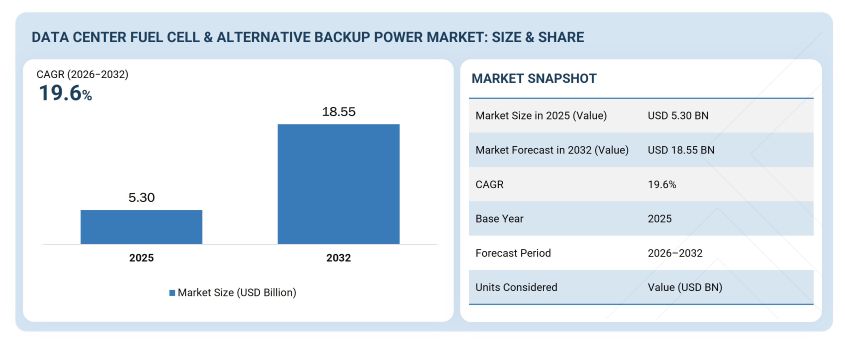
The global data center fuel cell & alternative backup power market is estimated at USD 5.30 billion in 2025 and is projected to reach USD 18.55 billion by 2032, growing at a CAGR of 19.6% during the forecast period. The rapid rise of AI workloads, hyperscale computing infrastructure, and grid-constrained data center expansion is reshaping how operators think about power resilience. Fuel cells, hydrogen-ready systems, battery energy storage, and hybrid microgrids are moving from experimental deployments to commercially viable alternatives as operators prioritize uptime, sustainability, and faster power availability.
The following numbers were derived via MnM-style triangulation and are used throughout the article. Numbers are directionally indicative; refer to the underlying study for precise figures.
Asia Pacific is projected to emerge as the fastest-growing regional market due to hyperscale data center construction across China, India, Singapore, and Southeast Asia, combined with growing grid reliability concerns and sustainability mandates. North America currently represents the largest installed base because of aggressive AI infrastructure expansion, strong hyperscaler investments, and early adoption of onsite fuel cell deployments by major colocation operators.
TOP 10 KEY TAKEAWAYS
- North America remains the leading regional market due to hyperscaler concentration and early fuel cell adoption.
- Asia Pacific is emerging as the fastest-growing region as AI infrastructure accelerates across China, India, and Southeast Asia.
- Hyperscale data centers represent the dominant deployment environment for alternative backup power systems.
- Solid oxide fuel cells are gaining significant traction for continuous onsite power generation.
- Sustainability regulations are accelerating the transition away from diesel generator dependency.
- Grid interconnection delays are becoming a major catalyst for “bring-your-own-power” data center models.
- Hydrogen-ready infrastructure strategies are reshaping long-term power planning decisions.
- Major technology companies are increasingly partnering with energy providers for resilient onsite power deployment.
- High capital investment and hydrogen infrastructure limitations remain key adoption barriers.
- The market is evolving from backup-only systems toward integrated microgrid-based energy architectures.
Extended Market Introduction
The modern data center industry is entering a new energy era. AI clusters, high-density GPU deployments, cloud-native workloads, and real-time analytics infrastructure are driving unprecedented electricity demand across hyperscale campuses. Traditional grid expansion timelines are struggling to keep pace, forcing operators to rethink how they source, manage, and secure power for mission-critical operations. The result is a growing shift toward decentralized, low-emission, and resilient onsite energy systems.
Fuel cells and alternative backup power technologies are increasingly being viewed not simply as emergency power assets but as strategic infrastructure layers capable of supporting continuous operations, reducing dependency on constrained grids, and improving long-term sustainability performance. Operators are moving beyond legacy diesel-centric architectures and evaluating cleaner alternatives that align with ESG commitments while supporting operational scalability.
The growing convergence between AI infrastructure and energy infrastructure is reshaping procurement priorities across the digital economy. Data center developers are now making energy availability a primary site-selection criterion. This trend is influencing investments across fuel cells, battery energy storage systems, microgrids, hydrogen infrastructure, and renewable integration platforms.
Another important shift is the emergence of integrated energy ecosystems around data centers. Large operators are increasingly evaluating combinations of fuel cells, battery storage, renewable energy assets, and advanced energy management software to create resilient, semi-autonomous energy environments. This transition is also encouraging collaboration between utilities, energy technology providers, hyperscalers, and industrial gas companies.
Market Trends
One of the defining trends shaping the data center fuel cell & alternative backup power market is the rapid emergence of “grid-independent” or “bring-your-own-power” strategies. Data center developers are increasingly deploying onsite generation solutions because grid interconnection delays can stretch across multiple years in key markets. Fuel cells are attractive because they can be deployed faster than traditional utility-scale infrastructure and can operate continuously with lower emissions profiles compared with diesel systems.
AI infrastructure growth is also fundamentally changing power density requirements inside facilities. Modern GPU clusters consume dramatically higher levels of electricity and require highly resilient uptime architectures. This is pushing operators toward modular energy systems that can scale incrementally alongside computing demand.
Hydrogen readiness is becoming another major trend. While natural gas currently dominates many commercial fuel cell deployments, operators are increasingly planning for future hydrogen compatibility as governments strengthen decarbonization policies. Hydrogen-powered backup systems are gaining attention because they provide a pathway toward low-emission long-duration backup power.
Battery energy storage integration is also accelerating. Operators increasingly view batteries not merely as UPS replacements but as dynamic energy optimization assets capable of load balancing, peak shaving, and renewable integration. Hybrid architectures combining batteries with fuel cells are becoming more common in next-generation data center designs.
The market is also witnessing deeper partnerships between energy technology companies and hyperscalers. Recent collaborations involving Bloom Energy, Equinix, and cloud infrastructure operators illustrate how alternative power solutions are becoming central to AI infrastructure planning.
Market Drivers
AI-driven data center expansion
The explosion of AI applications is dramatically increasing demand for reliable, scalable power infrastructure. GPU-intensive workloads require continuous, high-density energy delivery, and this is pushing data center developers toward onsite power generation models that reduce exposure to utility constraints.
Grid reliability and interconnection bottlenecks
In several major markets, utilities are struggling to deliver timely grid connections for new data center projects. Operators increasingly view alternative power systems as a strategic necessity rather than an optional resilience enhancement. Fuel cells provide faster deployment cycles and predictable onsite generation capabilities.
Sustainability and emissions reduction goals
Environmental regulations and corporate sustainability commitments are encouraging operators to reduce reliance on diesel generators. Fuel cells, especially hydrogen-ready platforms, are viewed as viable lower-emission alternatives that support long-term decarbonization strategies.
Digital infrastructure decentralization
Edge computing growth is driving demand for modular and distributed power architectures. Smaller edge facilities often require compact, low-maintenance, and highly reliable energy systems that can operate independently in locations with unstable grid conditions.
Government incentives and clean energy policies
Governments across North America, Europe, and the Asia Pacific are supporting hydrogen infrastructure development, fuel cell commercialization, and low-carbon industrial transformation. These policies are indirectly supporting data center energy modernization initiatives.
Market Challenges / Restraints
Despite strong momentum, the market faces several adoption barriers. One of the biggest challenges remains the high upfront cost associated with fuel cell deployment and supporting infrastructure. Many operators continue to evaluate whether long-term operational benefits justify near-term capital expenditure.
Hydrogen supply chain maturity also remains uneven across regions. While hydrogen-ready infrastructure receives growing attention, large-scale commercial availability of green hydrogen remains limited in many markets. This creates uncertainty around long-term fuel sourcing strategies.
Another major challenge involves operational integration. Fuel cells, batteries, microgrids, and renewable assets require sophisticated orchestration systems to maintain reliability and optimize performance. Operators must also develop new technical competencies related to energy management and hydrogen safety.
Regulatory complexity can also slow adoption. Permitting requirements for alternative energy systems differ significantly across jurisdictions, and uncertainty around emissions rules or interconnection standards may delay projects.
Finally, some operators remain cautious about scaling newer technologies across mission-critical facilities. While pilot deployments continue to expand, long-term reliability validation remains a priority for conservative infrastructure buyers.
Industry / Application Growth
Hyperscale AI facilities
Hyperscale data centers represent the most important growth environment for alternative backup power technologies. AI model training, inference clusters, and cloud infrastructure expansion are driving unprecedented power requirements. Operators increasingly need scalable onsite energy systems that can be deployed rapidly.
Colocation providers
Colocation operators are under growing pressure to differentiate through sustainability, uptime resilience, and energy availability. Many providers are evaluating fuel cells and hybrid energy systems to attract hyperscale tenants seeking guaranteed power capacity.
Edge computing infrastructure
Edge facilities often operate in locations with constrained grid infrastructure or variable utility reliability. Fuel cells and advanced battery systems provide resilient distributed power capabilities suitable for latency-sensitive edge applications.
Enterprise data centers
Large enterprises in sectors such as financial services, healthcare, telecommunications, and manufacturing are modernizing backup power systems to support digital transformation initiatives and stricter business continuity requirements.
Government and defense infrastructure
Public-sector facilities increasingly prioritize resilient and low-emission energy architectures for mission-critical digital operations. Fuel cells and hybrid microgrids align well with resilience-focused infrastructure strategies.
Segment Insights
Data Center Fuel Cell & Alternative Backup Power Market, By Technology
Solid oxide fuel cells currently represent the leading technology segment because of their high efficiency, scalability, and ability to provide continuous onsite generation. Their growing adoption among hyperscale and colocation operators reflects increasing confidence in commercial deployment maturity.
Hydrogen-compatible fuel cell systems are expected to emerge as one of the fastest-growing technology areas as operators prepare for long-term decarbonization goals and governments accelerate hydrogen ecosystem investments.
By Power Source
Natural gas-based systems currently dominate the market because they leverage existing infrastructure and support near-term deployment scalability. Operators view natural gas as a practical transition fuel while hydrogen infrastructure continues to mature.
Hydrogen-based systems are expected to witness the fastest growth due to rising sustainability targets, clean energy policies, and interest in long-duration zero-emission backup power architectures.
By Data Center Type
Hyperscale data centers account for the largest share of demand because they face the greatest power density challenges and are leading investment activity in AI infrastructure expansion.
Edge data centers are expected to experience the fastest growth as distributed computing requirements increase across telecom, manufacturing, autonomous systems, and smart city deployments.
By Application
Backup power remains the dominant application area because uptime resilience continues to be the primary operational requirement for mission-critical data center environments.
Primary onsite power generation is expected to expand rapidly as operators increasingly deploy fuel cells as continuous power sources rather than standby-only systems.
By End-use Environment
Colocation environments currently represent a major deployment segment because operators are aggressively differentiating on energy reliability and sustainability performance.
AI-focused hyperscale campuses are expected to emerge as the fastest-growing end-use environment because of rapidly increasing compute density and energy consumption intensity.
Key Segmentation Conclusions
- Solid oxide fuel cells are leading commercial adoption across hyperscale environments.
- Hydrogen-ready systems are emerging as a major long-term growth opportunity.
- Hyperscale facilities remain the largest deployment environment.
- Edge infrastructure is creating strong demand for modular resilient power systems.
- Primary onsite generation is becoming increasingly important alongside backup power.
Regional Analysis
North America
The United States remains the global center of hyperscale AI infrastructure expansion, driving strong adoption of on-site power solutions. Operators across Virginia, Texas, California, Arizona, and Ohio are increasingly evaluating fuel cells and hybrid microgrids to overcome grid interconnection delays and sustainability pressures. Canada is also emerging as an attractive market because of renewable energy availability and favorable climate conditions for data center cooling. Mexico is witnessing growing interest in distributed backup power for industrial and cloud infrastructure projects.
North America accounted for approximately USD 2.35 billion in 2025 and is projected to reach nearly USD 8.10 billion by 2032, expanding at a CAGR of 19.3% during the forecast period.
Europe
Europe’s market is being shaped by aggressive decarbonization goals, energy security concerns, and stringent emissions regulations. Germany, the UK, France, and the Nordics are investing heavily in sustainable digital infrastructure. The region is also benefiting from hydrogen economy initiatives and strong policy support for low-carbon energy technologies. Nordic countries continue to attract data center investment because of renewable energy access and cooling advantages.
Europe represented around USD 1.10 billion in 2025 and is forecast to reach approximately USD 3.45 billion by 2032, growing at a CAGR of 17.7%.
Asia Pacific
Asia Pacific is rapidly becoming one of the most strategically important markets for alternative data center power infrastructure. China continues expanding hyperscale cloud infrastructure, while India is experiencing strong growth in digital infrastructure investment. Singapore, Japan, South Korea, and Australia are also accelerating the deployment of resilient energy architectures to support AI and cloud expansion. Government support for hydrogen development and smart infrastructure modernization is strengthening the regional outlook.
Asia Pacific stood at nearly USD 1.45 billion in 2025 and is projected to climb to around USD 5.65 billion by 2032, registering the fastest CAGR of 21.5%.
Rest of World
The Rest of the World market is gaining momentum as Middle Eastern countries diversify into digital infrastructure and AI ecosystems. The UAE and Saudi Arabia are investing in hyperscale data center campuses supported by energy diversification strategies. Brazil remains a major Latin American growth center, while South Africa is seeing interest in resilient power systems due to electricity reliability concerns.
Rest of the World accounted for approximately USD 0.40 billion in 2025 and is anticipated to reach nearly USD 1.35 billion by 2032, growing at a CAGR of 19.0%.
Regional Outlook Summary
- North America remains the largest installed base for fuel-cell-powered data center infrastructure.
- Asia Pacific is experiencing the fastest expansion due to hyperscale and AI investments.
- Europe’s growth is strongly linked to sustainability regulations and hydrogen policies.
- Middle Eastern markets are emerging as important future demand centers.
- Grid reliability concerns are influencing adoption patterns across all regions.
Country-Specific Insights
United States
The US market is benefiting from explosive AI infrastructure investment, utility interconnection bottlenecks, and growing interest in decentralized power systems. Large hyperscalers increasingly prioritize energy-secure campuses capable of independent operation.
China
China’s aggressive cloud infrastructure expansion and industrial hydrogen investments are creating favorable conditions for alternative backup power adoption. Government-backed technology localization initiatives are also supporting domestic fuel cell development.
India
India’s rapidly growing digital economy, expanding colocation sector, and increasing AI investments are driving demand for resilient power infrastructure. Energy reliability concerns further strengthen the market opportunity.
Japan
Japan’s hydrogen economy roadmap and longstanding expertise in fuel cell technologies position the country as a major innovation hub for advanced backup power systems.
Singapore
Singapore’s land and energy constraints are encouraging operators to adopt highly efficient power architectures and advanced energy optimization strategies.
Germany
Germany’s industrial energy transition agenda and focus on low-carbon infrastructure are supporting the adoption of fuel cells and hybrid microgrid solutions.
UAE
The UAE is investing heavily in AI infrastructure, sustainable digital ecosystems, and smart city initiatives, creating opportunities for resilient energy systems integrated with large-scale data center developments.
Country-Level Conclusions
- The US remains the leading innovation and deployment market.
- China and India are driving Asia Pacific expansion momentum.
- Japan continues to lead hydrogen and fuel cell innovation initiatives.
- European markets are prioritizing low-carbon digital infrastructure.
- Gulf economies are emerging as strategic AI infrastructure hubs.
Key Company Insights
The competitive landscape includes a mix of fuel cell manufacturers, power infrastructure providers, energy management companies, and hyperscale technology operators. Partnerships between digital infrastructure firms and energy technology vendors are becoming increasingly important as operators seek scalable onsite power solutions.
Major Companies
- Bloom Energy
- FuelCell Energy
- Cummins
- Caterpillar
- Equinix
- Microsoft
- Schneider Electric
- Vertiv
- Eaton
- Ballard Power Systems
- Doosan Fuel Cell
- Siemens Energy
Companies are increasingly focusing on integrated energy ecosystems rather than standalone backup products. Strategic partnerships involving fuel cells, battery storage, hydrogen infrastructure, and AI-based energy optimization platforms are becoming central competitive differentiators.
The market is also witnessing stronger collaboration between cloud providers and energy technology firms. Several hyperscalers are exploring long-term agreements with fuel cell providers to secure power availability amid growing grid constraints.
Another major strategic trend is investment in hydrogen readiness. Vendors are increasingly promoting systems capable of transitioning from natural gas to hydrogen blends over time, helping customers align near-term deployment needs with future sustainability targets.
Key Company Strategy Conclusions
- Partnerships are becoming central to market positioning.
- Fuel cell providers are targeting hyperscale AI campuses aggressively.
- Hydrogen compatibility is emerging as a critical differentiator.
- Hybrid energy architectures are gaining strategic importance.
- Energy orchestration software is becoming a key competitive layer.
Recent Developments
- In August 2025, Equinix expanded its collaboration with Bloom Energy to deploy more than 100 MW of solid oxide fuel cells across multiple data centers.
- In January 2026, Bloom Energy released its Data Center Power Report, highlighting rising demand for on-site power generation across hyperscale infrastructure.
- In October 2025, Oracle expanded collaboration with Bloom Energy to support AI cloud infrastructure deployments using fuel cell technology.
- In February 2026, reports highlighted growing industry interest in hydrogen fuel cells for long-duration data center backup applications following large-scale pilot demonstrations.
- In 2025, Equinix announced multiple advanced energy partnerships involving fuel cells and future nuclear power sourcing strategies for AI-ready facilities.
Real-World Use Cases / Case Studies
In 2025, Equinix expanded its deployment of solid oxide fuel cells through its partnership with Bloom Energy across multiple US facilities. The initiative focused on supporting AI-ready data center expansion while reducing dependence on constrained utility infrastructure. Equinix positioned the deployment as part of a broader sustainability and resilience strategy intended to support long-term digital infrastructure growth.
In late 2025, Microsoft and Caterpillar demonstrated a multi-megawatt hydrogen fuel cell backup system for data center operations in Wyoming. The project explored hydrogen as a potential replacement for diesel backup generators while validating long-duration operational capabilities for mission-critical infrastructure.
Market Segmentation
The data center fuel cell & alternative backup power market is segmented across multiple technologies, applications, infrastructure, and geographic dimensions. From a technology perspective, solid oxide fuel cells, PEM fuel cells, battery storage systems, microturbines, and hybrid microgrid architectures represent the primary commercial categories. Different technologies serve distinct operational requirements ranging from continuous onsite generation to emergency backup resilience.
From a deployment perspective, hyperscale facilities remain the largest adoption environment because of their intensive energy requirements and large-scale AI infrastructure investments. Colocation providers represent another critical customer category as they compete on sustainability and uptime differentiation. Edge data centers are also becoming increasingly important because distributed digital infrastructure requires compact and resilient power systems.
Application segmentation highlights the market’s evolution from conventional backup architectures toward integrated energy ecosystems. While backup power remains foundational, operators increasingly use fuel cells and battery systems for continuous generation, load balancing, and microgrid enablement.
Segmentation Summary
- Technology diversity is increasing rapidly across the market.
- Hyperscale facilities remain the dominant deployment category.
- Edge infrastructure is creating new distributed energy opportunities.
- Backup power applications continue to lead commercial demand.
- Integrated microgrids are emerging as strategic infrastructure models.
Conclusion / Future Outlook
The data center fuel cell & alternative backup power market is evolving from a niche resilience segment into a core pillar of next-generation digital infrastructure strategy. AI workloads, hyperscale expansion, grid bottlenecks, and sustainability pressures are collectively driving operators toward decentralized and intelligent energy architectures.
Fuel cells, hydrogen systems, battery storage, and AI-enabled energy orchestration platforms are expected to play an increasingly central role in how future data centers are designed and operated. Companies capable of delivering scalable, reliable, and low-emission power solutions will be well-positioned to benefit from the accelerating transformation of the global digital infrastructure ecosystem.
FAQ
1. How big is the data center fuel cell & alternative backup power market?
The global data center fuel cell & alternative backup power market is estimated at USD 5.30 billion in 2025 and is projected to reach USD 18.55 billion by 2032.
2. What is the growth rate of the data center fuel cell & alternative backup power market?
The market is projected to grow at a CAGR of 19.6% during the forecast period from 2026 to 2032.
3. Which segment leads the data center fuel cell & alternative backup power market?
Hyperscale data centers currently represent the leading deployment segment due to their high energy density requirements and rapid AI infrastructure expansion.
4. Who are the key players in the data center fuel cell & alternative backup power market?
Major players include Bloom Energy, FuelCell Energy, Equinix, Schneider Electric, Vertiv, and Cummins.
5. What factors are driving the market?
The market is primarily driven by AI-related data center expansion, growing grid constraints, sustainability mandates, increasing need for resilient power infrastructure, and rising adoption of on-site energy systems.
 Exclusive indicates content/data unique to MarketsandMarkets and not available with any competitors.
TABLE OF CONTENT
1 INTRODUCTION
1.1 STUDY OBJECTIVES
1.2 MARKET DEFINITION AND SCOPE
1.3 MARKET INCLUSIONS AND EXCLUSIONS
1.4 MARKET SCOPE
1.4.1 MARKETS COVERED
1.4.2 GEOGRAPHIC SCOPE
1.4.3 YEARS CONSIDERED
1.5 CURRENCY CONSIDERED
1.6 STAKEHOLDERS
2 RESEARCH METHODOLOGY
2.1 RESEARCH APPROACH
2.2 SECONDARY RESEARCH
2.3 PRIMARY RESEARCH
2.4 MARKET SIZE ESTIMATION
2.4.1 BOTTOM-UP APPROACH
2.4.2 TOP-DOWN APPROACH
2.5 DATA TRIANGULATION
2.6 ASSUMPTIONS
2.7 LIMITATIONS
3 EXECUTIVE SUMMARY
4 PREMIUM INSIGHTS
4.1 ATTRACTIVE OPPORTUNITIES IN THE DATA CENTER FUEL CELL & ALTERNATIVE BACKUP POWER MARKET
4.2 AI DATA CENTER EXPANSION DRIVING ONSITE POWER ADOPTION
4.3 HYPERSCALE OPERATORS SHIFTING TOWARD GRID-INDEPENDENT POWER ARCHITECTURES
4.4 REGIONAL HOTSPOTS FOR FUEL CELL DEPLOYMENT
4.5 TECHNOLOGY ROADMAP FOR LOW-CARBON BACKUP POWER SYSTEMS
5 MARKET OVERVIEW
5.1 INTRODUCTION
5.2 MARKET DYNAMICS
5.2.1 DRIVERS
5.2.1.1 AI-driven data center expansion increasing demand for resilient power infrastructure
5.2.1.2 Grid congestion and interconnection delays accelerating onsite generation adoption
5.2.1.3 Sustainability mandates driving diesel generator replacement initiatives
5.2.2 RESTRAINTS
5.2.2.1 High upfront infrastructure costs
5.2.2.2 Hydrogen supply chain limitations
5.2.3 OPPORTUNITIES
5.2.3.1 Green hydrogen integration for hyperscale campuses
5.2.3.2 Microgrid-enabled modular data centers
5.2.4 CHALLENGES
5.2.4.1 Regulatory uncertainty for alternative power permitting
5.2.4.2 Scalability constraints for long-duration backup systems
5.3 VALUE CHAIN ANALYSIS
5.4 ECOSYSTEM ANALYSIS
5.5 INVESTMENT AND FUNDING SCENARIO
5.6 PRICING ANALYSIS
5.7 TECHNOLOGY ANALYSIS
5.7.1 KEY TECHNOLOGIES
5.7.2 COMPLEMENTARY TECHNOLOGIES
5.7.3 ADJACENT TECHNOLOGIES
5.8 PORTER’S FIVE FORCES ANALYSIS
5.9 KEY STAKEHOLDERS AND BUYING CRITERIA
5.10 CASE STUDY ANALYSIS
5.11 PATENT ANALYSIS
5.12 REGULATORY LANDSCAPE
5.13 KEY CONFERENCES AND EVENTS
5.14 IMPACT OF AI/GEN AI ON THE MARKET
5.15 IMPACT OF 2025 US TARIFFS AND ENERGY POLICIES
6 INDUSTRY TRENDS
6.1 RISE OF “BRING-YOUR-OWN-POWER” DATA CENTERS
6.2 FUEL CELLS AS PRIMARY POWER SOURCES FOR AI WORKLOADS
6.3 HYDROGEN-READY DATA CENTER INFRASTRUCTURE
6.4 BATTERY ENERGY STORAGE INTEGRATION WITH FUEL CELLS
6.5 SMALL MODULAR REACTOR (SMR) AND MICROGRID CONVERGENCE
6.6 EDGE DATA CENTER POWER MODERNIZATION
7 STRATEGIC DISRUPTION & TECHNOLOGY ADOPTION LANDSCAPE
7.1 TRANSITION FROM DIESEL TO LOW-EMISSION BACKUP POWER
7.2 SOLID OXIDE FUEL CELL (SOFC) ADOPTION TRENDS
7.3 PEM FUEL CELL DEPLOYMENT OUTLOOK
7.4 DIGITAL ENERGY MANAGEMENT AND AI-DRIVEN POWER OPTIMIZATION
7.5 RENEWABLE ENERGY + BACKUP POWER HYBRIDIZATION
7.6 LONG-DURATION ENERGY STORAGE EVOLUTION
8 CUSTOMER LANDSCAPE & BUYER BEHAVIOR
8.1 DATA CENTER OPERATOR PROCUREMENT PRIORITIES
8.2 HYPERSCALER VS COLOCATION BUYING PATTERNS
8.3 TOTAL COST OF OWNERSHIP CONSIDERATIONS
8.4 ENERGY RESILIENCE AND UPTIME REQUIREMENTS
8.5 SUSTAINABILITY-LED PROCUREMENT STRATEGIES
8.6 ADOPTION BARRIERS
9 DATA CENTER FUEL CELL & ALTERNATIVE BACKUP POWER MARKET, BY TECHNOLOGY
9.1 INTRODUCTION
9.2 SOLID OXIDE FUEL CELLS (SOFC)
9.3 PROTON EXCHANGE MEMBRANE (PEM) FUEL CELLS
9.4 MOLTEN CARBONATE FUEL CELLS (MCFC)
9.5 LITHIUM-ION BATTERY ENERGY STORAGE
9.6 FLOW BATTERIES
9.7 NATURAL GAS MICROTURBINES
9.8 HYBRID MICROGRID SYSTEMS
10 DATA CENTER FUEL CELL & ALTERNATIVE BACKUP POWER MARKET, BY POWER SOURCE
10.1 INTRODUCTION
10.2 NATURAL GAS-BASED SYSTEMS
10.3 HYDROGEN-BASED SYSTEMS
10.4 BIOGAS-BASED SYSTEMS
10.5 RENEWABLE-POWER-COUPLED SYSTEMS
11 DATA CENTER FUEL CELL & ALTERNATIVE BACKUP POWER MARKET, BY DATA CENTER TYPE
11.1 INTRODUCTION
11.2 HYPERSCALE DATA CENTERS
11.3 COLOCATION DATA CENTERS
11.4 ENTERPRISE DATA CENTERS
11.5 EDGE DATA CENTERS
12 DATA CENTER FUEL CELL & ALTERNATIVE BACKUP POWER MARKET, BY APPLICATION
12.1 INTRODUCTION
12.2 PRIMARY POWER GENERATION
12.3 BACKUP POWER SYSTEMS
12.4 PEAK SHAVING & LOAD BALANCING
12.5 GRID-INDEPENDENT OPERATIONS
12.6 MICROGRID ENABLEMENT
13 DATA CENTER FUEL CELL & ALTERNATIVE BACKUP POWER MARKET, BY REGION
13.1 INTRODUCTION
13.2 NORTH AMERICA
13.2.1 US
13.2.2 CANADA
13.2.3 MEXICO
13.3 EUROPE
13.3.1 GERMANY
13.3.2 UK
13.3.3 FRANCE
13.3.4 ITALY
13.3.5 NORDICS
13.4 ASIA PACIFIC
13.4.1 CHINA
13.4.2 JAPAN
13.4.3 INDIA
13.4.4 SOUTH KOREA
13.4.5 SINGAPORE
13.4.6 AUSTRALIA
13.5 REST OF WORLD
13.5.1 MIDDLE EAST
13.5.2 LATIN AMERICA
13.5.3 AFRICA
14 COMPETITIVE LANDSCAPE
14.1 OVERVIEW
14.2 KEY PLAYER STRATEGIES / RIGHT TO WIN
14.3 REVENUE ANALYSIS
14.4 MARKET SHARE ANALYSIS
14.5 COMPANY EVALUATION MATRIX: KEY PLAYERS
14.6 COMPANY EVALUATION MATRIX: STARTUPS/SMEs
14.7 COMPETITIVE BENCHMARKING
14.8 COMPETITIVE SCENARIO
14.8.1 PRODUCT LAUNCHES
14.8.2 DEALS & PARTNERSHIPS
14.8.3 EXPANSIONS
14.8.4 INVESTMENTS
15 COMPANY PROFILES
15.1 Bloom Energy
15.2 FuelCell Energy
15.3 Cummins
15.4 Caterpillar
15.5 Microsoft
15.6 Equinix
15.7 Schneider Electric
15.8 Vertiv
15.9 Eaton
15.10 Ballard Power Systems
15.11 Doosan Fuel Cell
15.12 Panasonic
15.13 Mitsubishi Heavy Industries
15.14 Siemens Energy
15.15 Hitachi Energy
16 APPENDIX
16.1 DISCUSSION GUIDE
16.2 KNOWLEDGESTORE
16.3 CUSTOMIZATION OPTIONS
16.4 RELATED REPORTS
16.5 AUTHOR DETAILS













Growth opportunities and latent adjacency in Data Center Fuel Cell & Alternative Backup Power Market