Data Center Hose Market by Product (EPDM Rubber, Silicone, Fluoropolymer, Thermoplastic, Metallic, Composite Hoses), Component (Coolant Transfer Hoses, Reinforced Hoses, Hose Assemblies, Quick-disconnect-compatible Solutions) – Global Forecast to 2032


Data Center Hose Market Summary
The Data Center Hose Market is developing alongside the global expansion of digital infrastructure and the growing adoption of liquid cooling technologies. Data center hoses are specialized flexible conduits that transport water-based or other compatible coolants between cooling distribution units (CDUs), manifolds, server racks, cold plates, pumps, and heat exchangers. They are designed to withstand continuous operation, temperature fluctuations, pressure, and exposure to specific coolant formulations while maintaining leak resistance and fluid cleanliness.
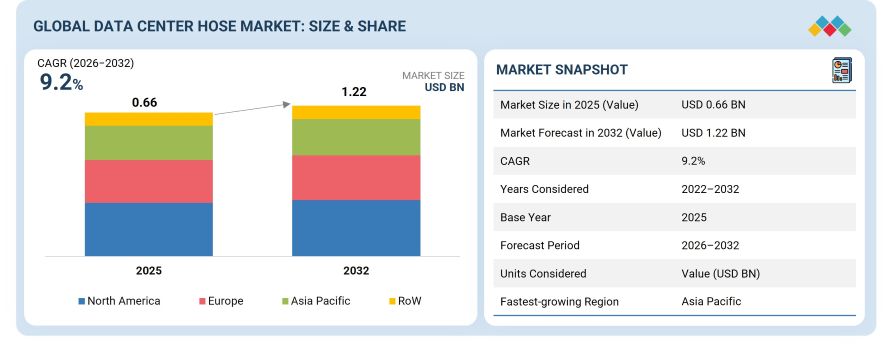
The global Data Center Liquid Cooling Hose Market was valued at approximately USD 660 million in 2025 and is projected to reach around USD 1.22 billion by 2032, registering a CAGR of approximately 9.2% during 2026–2032. The expansion of AI infrastructure, GPU-intensive computing, cloud services, and hyperscale facilities is increasing demand for high-performance coolant transfer systems. Data center operators are increasingly prioritizing hose flexibility, low extractables, chemical compatibility, flame resistance, and long-term reliability to protect expensive IT equipment and maintain uptime.
The market includes EPDM rubber hoses, silicone hoses, fluoropolymer hoses, thermoplastic hoses, metallic hoses, and engineered composite solutions. EPDM-based products are particularly relevant for water-glycol cooling loops, while specialized polymer and composite designs address applications requiring particular chemical, thermal, or cleanliness characteristics. Manufacturers are also developing larger-diameter and compact hose designs to accommodate different flow requirements and increasingly dense rack configurations.
Key Market Trends & Insights
Growing adoption of liquid cooling
Direct-to-chip liquid cooling and other liquid-based thermal-management approaches are creating demand for specialized hoses that connect servers, cold plates, manifolds, and cooling distribution units.
Asia Pacific remains a major demand center
China, Japan, India, Singapore, and South Korea are investing in data center capacity, cloud infrastructure, and AI computing. These investments support demand for cooling infrastructure and associated fluid-transfer components.
EPDM hoses maintain a strong position
EPDM rubber hoses are widely considered for water-glycol cooling applications because of their flexibility, durability, and compatibility with selected coolant formulations.
AI infrastructure is changing hose requirements
High-density GPU servers and AI accelerators increase thermal loads, encouraging the adoption of reliable, high-flow, low-permeability hose assemblies.
Smart monitoring is becoming more important
IoT sensors, leak-detection systems, pressure monitoring, and automated facility-management platforms are helping operators identify cooling-system problems before they affect server operations.
Sustainability is influencing product development
Data center operators are seeking efficient cooling systems that reduce energy and water consumption. Hose manufacturers are responding with longer-life materials, improved coolant cleanliness, and products designed for reliable operation in closed-loop systems.
Market Size & Forecast
- Base year market size (2025): Approximately USD 660 million.
- Forecast value by 2032: Approximately USD 1.22 billion.
- CAGR (2026–2032): Approximately 9.2%.
- Key growth factors: AI server deployment, hyperscale data center construction, rising rack power density, liquid-cooling adoption, cloud computing expansion, and investment in high-performance computing infrastructure.
The market is expected to expand as liquid cooling becomes increasingly important for managing heat generated by advanced processors and high-density server configurations. The replacement of conventional cooling arrangements with more sophisticated liquid-cooling loops is also expected to create opportunities for hose assemblies, connectors, fittings, and related fluid-management components.
Data Center Hose Market Top 10 Key Takeaways
- The global Data Center Liquid Cooling Hose Market was valued at approximately USD 660 million in 2025.
- The market is projected to reach around USD 1.22 billion by 2032.
- The market is expected to grow at a CAGR of approximately 9.2% during 2026–2032.
- AI data centers and GPU-intensive workloads are increasing demand for advanced liquid-cooling infrastructure.
- EPDM hoses are important for water-glycol coolant transfer applications.
- Direct-to-chip cooling is creating opportunities for compact, flexible, and high-reliability hose assemblies.
- Asia Pacific represents a major growth center because of expanding data center investment.
- North America remains strategically important due to hyperscale cloud providers and AI infrastructure development.
- IoT-enabled leak detection and predictive maintenance are increasing the importance of monitoring-compatible cooling systems.
- Product differentiation increasingly depends on coolant compatibility, low contamination, pressure resistance, flexibility, and long service life.
Product Insights
The Data Center Hose Market is segmented by material, construction, diameter, pressure rating, and application. EPDM rubber hoses represent a leading product category because they offer flexibility, resistance to aging, and suitability for many water-glycol coolant applications. Their ability to support compact routing between server components and cooling distribution infrastructure makes them relevant to both new installations and data center retrofits. Specialized EPDM formulations are also being developed to reduce unwanted material interaction with coolants and help maintain fluid cleanliness.
Silicone hoses are used where flexibility and temperature performance are important, while fluoropolymer hoses such as PTFE- and FEP-based products can serve applications requiring specific chemical-resistance and low-contamination characteristics. Thermoplastic and multilayer composite hoses are also gaining attention as manufacturers seek to balance flexibility, pressure performance, durability, and installation efficiency. Metallic flexible hoses can be considered in selected applications requiring particular mechanical or temperature characteristics.
Demand is also increasing for complete hose assemblies with connectors, fittings, and quick-disconnect interfaces. These assemblies can simplify installation and maintenance while reducing the risk of incorrect connections. As rack designs become more compact, manufacturers are focusing on smaller bend radii, kink resistance, optimized internal diameters, and dependable sealing performance.
Technology / Component Insights
Technology development in the Data Center Hose Market is closely connected to advances in liquid cooling systems. Direct-to-chip cooling uses cold plates attached to processors and other heat-generating components. Hoses transport coolant between these cold plates, rack manifolds, and cooling distribution units. The performance of the complete cooling loop depends on the compatibility and reliability of each component, making hose selection an important part of system engineering.
Coolant distribution units regulate the circulation of cooling fluid and connect facility-level cooling infrastructure with IT equipment. Hoses used around CDUs must support the required flow rate, operating pressure, temperature range, and coolant chemistry. Quick-disconnect couplings, manifolds, pumps, valves, sensors, and heat exchangers also influence hose specifications.
AI and IoT technologies are increasingly being integrated into data center facility management. Sensors can monitor temperature, pressure, flow, and leakage conditions, while software platforms analyze operational data to identify abnormal performance. AI-based analytics can support predictive maintenance by identifying patterns that may indicate a developing leak, blockage, or pressure fluctuation. Although these technologies do not replace the need for high-quality hoses, they increase the importance of designing hose assemblies that work reliably within monitored and automated cooling systems.
Future innovation is likely to focus on improved coolant compatibility, lower permeability, reduced extractables, enhanced flame resistance, recyclable or lower-impact materials, and longer service life. Standardized connections and easier replacement procedures will also remain important as operators scale liquid-cooled infrastructure.
Application Insights
AI data centers are an important growth application for the Data Center Hose Market. AI training and inference workloads rely on high-performance GPUs and specialized accelerators that generate substantial heat. As operators deploy more powerful server configurations, liquid cooling is becoming an increasingly attractive approach for transferring heat away from processors and maintaining stable operating conditions. Hoses connect the cooling components and enable the circulation of coolant through the system.
High-performance computing facilities represent another important application. Scientific research, engineering simulation, financial modeling, and advanced analytics require powerful computing clusters. These facilities often operate at high utilization levels, making reliable thermal management essential. Liquid-cooling hose assemblies support the movement of coolant through racks and associated heat-transfer equipment.
Cloud and hyperscale data centers also contribute to demand as providers expand server capacity and improve energy efficiency. Colocation facilities are adopting advanced cooling solutions to support customers with high-density computing requirements. Enterprise data centers may adopt liquid cooling selectively, particularly when upgrading infrastructure for AI, analytics, or specialized workloads.
Immersion cooling and rear-door heat exchanger systems offer additional opportunities, although hose requirements vary by system design. In immersion cooling, hoses may be used in auxiliary fluid-transfer and heat-rejection loops rather than as direct connections to individual servers. Future opportunities will depend on the expansion of liquid-cooling deployments, retrofit activity, and the standardization of cooling architectures.
Regional Insights
North America
North America is a strategically important market because of its established hyperscale data center ecosystem, strong cloud computing industry, and investment in AI infrastructure. The United States accounts for substantial demand through data center construction, GPU clusters, cloud platforms, and colocation expansion. Large technology companies and data center operators are investing in facilities designed to support AI training and inference, increasing demand for liquid-cooling infrastructure and associated hose assemblies.
Canada is benefiting from digital infrastructure investment, cloud adoption, and demand for data center capacity in major technology and business centers. Its climate conditions can support different cooling strategies, but high-density AI deployments still require carefully engineered thermal management. Mexico is emerging as a developing market as businesses expand digital services, manufacturing-related computing, and regional connectivity. Its data center market is supported by nearshoring, enterprise digitalization, and investment in telecommunications infrastructure.
Europe
Europe's Data Center Hose Market is supported by cloud adoption, data sovereignty requirements, digital transformation, and sustainability priorities. Germany is a major market because of its industrial base, enterprise IT infrastructure, and data center activity. The United Kingdom and France also have established data center ecosystems, supported by cloud services, financial services, telecommunications, and AI investment.
Italy and Spain are attracting infrastructure investment as operators seek additional capacity and access to regional digital markets. The Nordics offer opportunities through renewable energy availability, cooler climates, and growing interest in sustainable data center operations. European regulations and energy-efficiency policies are encouraging operators to improve facility performance, monitor resource consumption, and adopt efficient cooling technologies. These priorities can support demand for reliable liquid-cooling components, including hoses designed for long operating life and reduced maintenance.
Asia Pacific
Asia Pacific is a major growth center for the Data Center Hose Market due to rapid digitalization, cloud adoption, expanding internet usage, and investment in AI computing. China is expanding domestic data center capacity and advanced computing infrastructure, while Japan and South Korea are investing in high-performance computing, semiconductor-related digital infrastructure, and enterprise cloud services.
India is attracting investment in hyperscale facilities, colocation centers, and digital infrastructure as cloud adoption and AI-related demand increase. Singapore remains an important regional data center hub, with development shaped by land, energy, and sustainability considerations. Australia is also expanding its data center ecosystem to support cloud services, enterprise digitalization, and regional connectivity.
Government initiatives supporting digital economies, AI research, and domestic technology infrastructure are strengthening regional demand. As data center operators in the region deploy higher-density servers, demand for coolant distribution systems and specialized flexible hoses is expected to increase.
Regional Insights Summary
- Asia Pacific is a major growth center, supported by data center expansion in China, India, Japan, Singapore, and South Korea.
- North America benefits from hyperscale cloud investment and the rapid deployment of AI computing infrastructure.
- Europe is emphasizing energy efficiency, sustainability, and reliable cooling technologies.
- The United States is a key demand market for advanced liquid-cooling hose assemblies.
- Emerging data center markets in India, Mexico, Spain, and Australia offer additional opportunities as digital infrastructure expands.
Country-Specific Market Trends
Country-level demand is shaped by data center construction, AI infrastructure investment, cloud adoption, energy policy, and the pace of liquid-cooling deployment. The following CAGRs are indicative analyst estimates for country-level hose demand, not separately published market forecasts. They are intended to show relative growth potential within the global market outlook.
China is expected to record an indicative CAGR of approximately 10%–12% through 2032 as domestic cloud providers, technology companies, and AI infrastructure developers expand computing capacity. Japan is projected to grow at around 8%–10%, supported by enterprise digitalization, high-performance computing, and demand for reliable data center infrastructure.
In North America, the United States is expected to record an indicative CAGR of approximately 9%–11%, driven by hyperscale facilities, AI server deployments, and cloud infrastructure investment. Canada is projected to grow at around 8%–10%, supported by data center development and digital services. Mexico may record growth of approximately 8%–10% as nearshoring, connectivity, and enterprise technology investment support new facilities.
In Europe, Germany is expected to register an indicative CAGR of approximately 8%–10%, supported by industrial digitalization, cloud services, and data center investment. France is projected to grow at around 8%–10%, with demand supported by hyperscale and colocation development, AI adoption, and digital infrastructure modernization. Actual country performance will depend on project pipelines, electricity availability, cooling architecture choices, and the proportion of new facilities adopting liquid cooling.
Country-Level Insights
- China benefits from domestic AI infrastructure development and expanding cloud capacity.
- Japan's demand is supported by advanced computing, enterprise modernization, and reliable infrastructure requirements.
- The United States remains a major market for high-density AI data center cooling solutions.
- Canada and Mexico offer opportunities through digital infrastructure expansion and regional connectivity.
- Germany and France are investing in data center capacity while emphasizing energy efficiency and sustainable operations.
Key Data Center Hose Company Insights
Competition in the Data Center Hose Market is shaped by material science, product reliability, coolant compatibility, engineering support, and the ability to supply specialized hose assemblies. Companies are developing solutions for direct-to-chip cooling, coolant distribution units, rack manifolds, and other liquid-cooling applications. Product strategies increasingly focus on reducing contamination risks, improving flexibility, supporting different flow requirements, and simplifying installation.
Gates Corporation has introduced its Data Master product family for data center cooling applications, including solutions designed for compact connections and larger flow requirements. Continental offers data cooling hose products for applications such as direct-to-chip cooling and connections between manifolds and server blades. Polyhose provides data center cooling hose solutions and participates in the Open Compute Project ecosystem. Parker Hannifin has fluid-conveyance products relevant to thermal management and liquid-cooling applications, while Danfoss supplies components and technologies used across cooling and fluid systems.
Other relevant companies include CEJN, Colder Products Company (CPC), Alfagomma, Tudertechnica, and Abbott Rubber. Their market participation spans hose products, quick-connect systems, fluid handling, and engineered assemblies. Competition is likely to intensify as data center operators seek qualified suppliers capable of meeting application-specific performance and reliability requirements.
Company Strategy Insights
- Gates is expanding its Data Master hose family for data center cooling applications.
- Continental is developing specialized data cooling products for coolant transfer and server connections.
- Polyhose is positioning its products within the data center liquid-cooling ecosystem.
- Parker Hannifin and Danfoss bring broader fluid-management and thermal-management capabilities to the market.
- CEJN and Colder Products Company focus on connection technologies that support reliable fluid transfer and maintenance.
Recent Developments
Product development is increasingly focused on the performance requirements of AI data centers and liquid-cooled server racks. Gates has developed its Data Master family, including EPDM-based hose solutions designed for coolant cleanliness, flexibility, and demanding data center environments. The range includes products for narrower connections and larger-diameter, higher-flow requirements.
Continental has introduced data cooling hose solutions such as ExtremeFlex DataGuard and FlexCool Jumper. These products address coolant transfer in direct-to-chip cooling systems and connections between manifolds and server blades. Polyhose has also highlighted its Quantum Cool data center cooling solutions for applications involving racks, CDUs, manifolds, and mission-critical cooling infrastructure.
These developments illustrate a broader industry shift toward application-specific hose products rather than relying solely on general-purpose industrial hoses. Product differentiation increasingly centers on material performance, coolant purity, pressure capability, flexibility, and system integration.
Market Segmentation
The Data Center Hose Market can be segmented by product, technology or component, application, and region. By product, the market includes EPDM rubber hoses, silicone hoses, fluoropolymer hoses, thermoplastic hoses, metallic hoses, and composite or multilayer hoses. EPDM products are important for selected water-glycol cooling loops, while fluoropolymer and silicone products address applications with specific chemical, temperature, or cleanliness requirements. Metallic and composite hoses serve selected applications where mechanical or operating conditions require different construction characteristics.
By technology and component, the market includes flexible coolant transfer hoses, hose assemblies, reinforced hoses, quick-disconnect-compatible hoses, and specialized low-permeability fluid lines. These components are used alongside CDUs, manifolds, pumps, cold plates, heat exchangers, valves, and monitoring systems. By application, the market covers AI data centers, high-performance computing facilities, cloud and hyperscale data centers, colocation facilities, enterprise data centers, and selected immersion-cooling support systems.
By region, the market is divided into North America, Europe, Asia Pacific, Latin America, and the Middle East and Africa. Asia Pacific and North America are important demand centers, while Europe represents a significant market shaped by digital infrastructure investment and energy-efficiency requirements. Regional growth varies according to data center construction, liquid-cooling adoption, local manufacturing capabilities, and investment in AI infrastructure.
Segmentation Summary
- By product: EPDM rubber, silicone, fluoropolymer, thermoplastic, metallic, and composite hoses.
- By technology/component: Coolant transfer hoses, reinforced hoses, hose assemblies, and quick-disconnect-compatible solutions.
- By application: AI data centers, HPC, cloud and hyperscale facilities, colocation, enterprise data centers, and immersion-cooling support.
- By end user: Hyperscale operators, colocation providers, cloud service providers, enterprises, and research institutions.
- By region: North America, Europe, Asia Pacific, Latin America, and the Middle East and Africa.
Conclusion
The Data Center Hose Market is expected to expand as liquid cooling becomes increasingly important for managing the thermal requirements of AI servers, GPUs, and high-performance computing infrastructure. The market's projected growth from approximately USD 660 million in 2025 to USD 1.22 billion by 2032 reflects the increasing importance of specialized fluid-transfer components in modern data centers.
AI will influence the market indirectly but significantly by increasing rack power density and creating demand for more sophisticated cooling architectures. IoT-based monitoring, predictive maintenance, and automated facility management will further strengthen the focus on leak prevention, coolant cleanliness, and system reliability. Manufacturers that invest in advanced materials, engineered assemblies, application-specific designs, and partnerships with cooling-system providers will be better positioned to capture emerging opportunities. For data center operators, selecting reliable hoses is a strategic decision that can affect uptime, maintenance costs, cooling performance, and the long-term reliability of critical IT infrastructure.
FAQs
1. What is the size of the Data Center Hose Market?
The global specialist Data Center Liquid Cooling Hose Market was valued at approximately USD 660 million in 2025 and is projected to reach around USD 1.22 billion by 2032.
2. What is the expected growth rate of the Data Center Hose Market?
The market is expected to grow at a CAGR of approximately 9.2% during the 2026–2032 forecast period, supported by AI data center expansion and increasing adoption of liquid cooling.
3. What are the key factors driving the Data Center Hose Market?
Major growth drivers include AI and GPU server deployment, rising rack power density, hyperscale data center construction, cloud computing, HPC workloads, and demand for reliable liquid-cooling infrastructure.
4. Which region is expected to lead the Data Center Hose Market?
Asia Pacific is a major demand and growth center because of expanding data center capacity in China, India, Japan, Singapore, and South Korea. North America also represents a strategically important market due to hyperscale and AI infrastructure investment.
5. Who are the key companies in the Data Center Hose Market?
Key companies include Gates Corporation, Continental, Polyhose, Parker Hannifin, Danfoss, CEJN, Colder Products Company, Alfagomma, Tudertechnica, and Abbott Rubber.
Revenue
Revenue in the Data Center Hose Market is generated through the sale of standard and customized hoses, engineered hose assemblies, fittings, connectors, and related fluid-transfer products. Suppliers serve data center operators, cooling-system manufacturers, engineering contractors, equipment integrators, and distributors. Revenue opportunities are expanding as new AI-focused facilities require more sophisticated liquid-cooling infrastructure. Replacement demand, system upgrades, and maintenance requirements also contribute to recurring sales. Suppliers offering complete assemblies, application engineering, and technical support may be able to differentiate themselves beyond basic hose pricing.
Investment & Funding
Investment in the Data Center Hose Market is closely linked to broader spending on AI infrastructure, hyperscale data centers, liquid-cooling technologies, and advanced thermal management. Manufacturers are investing in material development, production capacity, quality testing, and product engineering to meet growing demand for coolant-compatible hoses. Investment opportunities also exist in quick-disconnect technologies, leak detection, fluid monitoring, and integrated cooling systems. Companies that can demonstrate product reliability, consistent manufacturing quality, and compatibility with emerging cooling architectures may attract strategic partnerships and long-term supply agreements.
Mergers & Acquisitions (M&A)
Mergers and acquisitions in the Data Center Hose Market are likely to be influenced by the need for specialized materials, fluid-handling expertise, engineered assemblies, and access to data center customers. Hose manufacturers may seek acquisitions or partnerships with suppliers of connectors, fittings, seals, and thermal-management components to offer more complete solutions. Larger industrial technology companies may also pursue targeted investments that strengthen their position in data center cooling and high-performance fluid transfer. Rather than relying only on large-scale acquisitions, the market may see technology licensing, distribution agreements, and strategic collaborations between hose manufacturers and cooling-system integrators.
Recent Development
- Gates Corporation: Its Data Master cooling hose family addresses data center applications with products designed for coolant cleanliness, flexibility, and reliable operation in compact or high-flow systems.
- Continental: Its data cooling hose portfolio includes ExtremeFlex DataGuard and FlexCool Jumper products for coolant transfer and server-level connections.
- Polyhose: Its Quantum Cool solutions target liquid-cooling applications across racks, coolant distribution units, manifolds, and data center infrastructure.
- Parker Hannifin: Its fluid-conveyance portfolio includes hose solutions used in liquid-cooling and thermal-management applications, including server and rack connections.
- Industry-wide development: Manufacturers are increasingly emphasizing coolant compatibility, low contamination, leak resistance, and hose flexibility to support high-density AI and HPC cooling systems.
 Exclusive indicates content/data unique to MarketsandMarkets and not available with any competitors.











Growth opportunities and latent adjacency in Data Center Hose Market