Data Center LED Lighting Market Size, Share, Trends & Growth Report by Product Type (Linear Fixtures, Troffers and Panels, Smart/Intelligent Fixtures), Installation Type (New Installations, Retrofit & Upgrades), and Control System (Wired Control Systems, Wireless Control Systems) - Global Forecast to 2032


Data Center LED Lighting Market Overview
The global data center LED lighting market is undergoing a structural transformation, expanding from an estimated valuation of $950 Million in 2025 to a projected $1,850 Million by 2032, registering a robust compound annual growth rate (CAGR) of 10.00% during the forecast period from 2026 to 2032; this strong trajectory is fundamentally driven by the global surge in high-density facility development, escalating power usage effectiveness mandates, and the comprehensive integration of smart, sensor-laden systems required to support artificial intelligence workloads.
North America represents the largest market base in 2025, driven by the massive footprint of domestic hyperscalers and a mature corporate IT landscape. The Asia Pacific region is projected to experience the fastest compound annual growth rate through 2032, propelled by explosive investments in cloud infrastructure, government-led digital initiatives, and rapid scaling of server infrastructure across emerging economies.
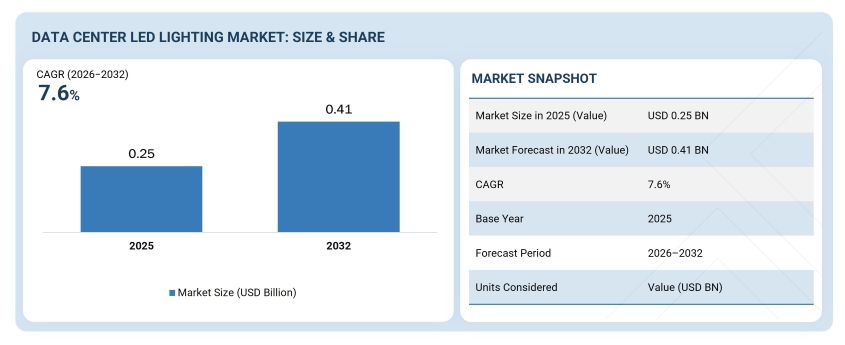
TOP 10 KEY TAKEAWAYS
- Dominant Regional Footprint: North America commands the highest market share at the beginning of the forecast window, sustained by the sheer concentration of Tier IV hyperscale installations operated by major cloud providers.
- Fastest-Growing Territory: The Asia Pacific region leads global growth velocity, fueled by greenfield data facility construction across major digital hubs and industrial tech corridors.
- Prevalent Product Architecture: Intelligent linear fixtures equipped with multi-sensor bundles are surpassing legacy, static systems to become the structural baseline for modern white space illumination.
- Leading Deployment Vertical: Hyperscale installations represent the largest and fastest-growing operator segment, drastically shifting procurement patterns toward volume-driven, standardized components.
- Pivotal Technology Shift: The industry is transitioning from standalone, decoupled fixtures to interconnected wireless mesh frameworks governed by centralized data infrastructure platforms.
- Regulatory Momentum: Global compliance standards focusing on facility energy reduction and building decarbonization are forcing legacy operations to completely replace incandescent and fluorescent structures.
- Primary Corporate Competitors: Market execution remains concentrated among established architectural illumination manufacturers who are rapidly pivoting toward specialized, high-temperature computing environment applications.
- Near-Term Commercial Opportunity: Large-scale commercial brownfield data center transformations represent an immediate avenue for high-margin retrofitting services and intelligent hardware provisioning.
- Critical System Risk: Disrupted international component delivery paths and regional trade restrictions present operational hazards for fast-tracked facility construction timelines.
- Executive Strategic Implication: Enterprise technology buyers must align their environmental sustainability planning with structural engineering specifications, transforming illumination from an overhead cost into an active operations optimization metric.
EXTENDED MARKET INTRODUCTION
Modern digital infrastructure demands structural efficiency at every layer of deployment. Historically viewed as a secondary consideration in data facility planning, internal illumination frameworks are undergoing significant scrutiny as operators seek to eliminate every possible vector of unnecessary power utilization. The contemporary high-density computing site operates under extreme physical conditions, requiring constant ambient temperature regulation, sophisticated power management, and real-time environment monitoring. Introducing legacy lighting options into these sensitive spaces introduces parasitic thermal loads, inflating mechanical cooling requirements and directly worsening energy efficiency metrics. Consequently, solid-state lighting systems have evolved from a simple facility upgrade into a critical element of modern data center architectural design.
The market landscape is shifting rapidly due to macroeconomic forces including global digital transformation initiatives, the dramatic rise of artificial intelligence processing infrastructure, and aggressive institutional sustainability targets. As organizations scale up their technical resources, they confront a highly regulated corporate landscape where power allocations are strictly monitored by regional governance bodies. Every watt saved on non-computing processes is immediately repurposed to support high-performance server arrays, directly enhancing facility output and financial returns. Solid-state luminaire systems offer an ideal mechanism to achieve these efficiency gains, providing high lumen-per-watt ratios while seamlessly integrating with automated facility monitoring applications. This operational intersection has successfully moved illumination from basic building maintenance budgets directly into strategic IT asset portfolio discussions.
Integrating next-generation lighting layouts is no longer an isolated choice for building systems managers, but rather a vital element of broader digital enterprise environments. These interconnected facility systems work together to ensure that operational metrics match strict uptime requirements. In an era where corporate transparency requires detailed reporting on carbon reduction metrics, the measurable energy drops achieved by replacing legacy building fixtures with smart solid-state arrays offer clear proof of environmental responsibility. The following comprehensive market analysis outlines the underlying industry dynamics, technical shifts, regional movements, and strategic competitor initiatives that will define this critical infrastructure sector over the next seven years.
DATA CENTER LED LIGHTING MARKET TRENDS
The continuous advancement of automated building environments represents the most prominent operational trend shaping the modern solid-state facility illumination landscape. Modern infrastructure layouts are rapidly abandoning disconnected, manual light switches in favor of dynamic platforms that respond directly to real-time technician movement, ambient room conditions, and overall server rack utility status. These advanced lighting platforms rely on high-density sensor networks embedded right within the light fixtures, turning each unit into an active node for gathering facility environment data. These sensors continuously monitor temperature variations, humidity changes, and air circulation patterns right at the ceiling boundary, supplying critical data directly to centralized building management systems.
Another prominent development is the widespread shift toward software-defined lighting configurations across massive hyper-scale network campuses. Facility managers no longer rely on physical rewiring projects to adjust internal lighting arrays when server hall floorplans are reconfigured. Instead, cloud-integrated dashboards allow technicians to establish custom scheduling rules, adjust light outputs for specific maintenance corridors, and create isolated lighting zones with simple software adjustments. This trend aligns perfectly with the broader industry evolution toward completely unmanned operations, where human entry into core server spaces is minimized. Illumination is kept at absolute zero or very low standby settings until proximity detection systems register a technician entering for emergency server maintenance.
Sustainability reporting mandates are also forcing a re-evaluation of product lifecycles and material sourcing across the commercial lighting manufacturing sector. Major facility developers are requiring detailed environmental product declarations from their hardware suppliers, tracking the total embedded carbon footprint from raw material extraction through end-of-life component disposal. This corporate pressure is accelerating the adoption of modular fixture configurations, allowing individual components like internal drivers or LED strips to be quickly swapped out without scrapping the entire aluminum housing shell. Furthermore, manufacturers are incorporating recycled polymers and low-impact metals into their premium product lineups to satisfy the strict green purchasing requirements of global technology enterprises.
DATA CENTER LED LIGHTING MARKET DRIVERS
The overarching global commitment to lowering data center power usage effectiveness ratings is a powerful commercial catalyst driving market expansion. Government organizations and regional regulatory authorities are establishing strict limits on how much power can be consumed by non-computational infrastructure systems, making high efficiency ratings non-negotiable for new facility operating licenses. Because industrial cooling systems consume the largest percentage of auxiliary power, removing internal heat sources is a top priority for facilities engineers. Solid-state luminaires generate significantly less radiant heat compared to legacy fluorescent systems, reducing the ambient thermal load within server galleries and yielding measurable drops in facility cooling costs.
The rapid expansion of the hyperscale data center serves as another critical driver for ongoing market volume expansion. The unparalleled scale of cloud infrastructure deployments requires rapid procurement of highly standardized, reliable building components that can be installed quickly across multiple identical project sites. Hyperscale developers prefer pre-configured, modular solid-state fixtures that connect directly into factory-built power tracks or structural overhead cable raceways, which helps minimize onsite manual labor costs. This high-volume procurement pattern provides commercial lighting manufacturers with long-term, predictable order pipelines, enabling economies of scale that reduce overall component pricing.
Furthermore, the growing regulatory emphasis on worker safety standards within high-intensity processing environments is accelerating the transition away from outdated lighting systems. Industrial operations environments present distinct workplace visibility challenges, characterized by narrow server aisles, high equipment stacks, and complex overhead cable configurations. Improper illumination can lead to costly maintenance errors, personal accidents, or missed equipment warnings during critical system diagnostics. Modern solid-state systems deliver exceptionally high color rendering indices and uniform light distribution profiles, completely eliminating dark zones and minimizing eye fatigue for onsite field teams. This focus on operational precision is prompting data facility operators to implement comprehensive solid-state upgrades.
MARKET CHALLENGES / RESTRAINTS
The high upfront capital cost associated with purchasing and installing sophisticated, sensor-enabled solid-state lighting arrays remains a significant barrier for many budget-conscious enterprise operators. While the long-term operational savings and reduced utility costs of LED hardware are well understood, the immediate cash requirements for premium luminaires, intelligent controller gateways, and centralized monitoring software can strain corporate facilities budgets. This financial hesitation is particularly pronounced among small-to-medium enterprise data center operators, who often work with restricted capital allocations and struggle to justify complex lighting retrofits when competing directly against core IT server and storage upgrades.
System compatibility hurdles and complex integration challenges with older building management platforms present another persistent industry restraint. Many older data facilities operate on legacy building automation frameworks that rely on traditional, analog communication protocols. Introducing advanced, digital solid-state control networks into these environments requires expensive signal translation components, custom software patches, and extensive configuration by specialized integration technicians. When these multi-generation technology systems fail to communicate correctly, operators may experience dropped signals, erratic dimming behavior, or security vulnerabilities, which often delays full system rollouts.
Furthermore, the constant threat of technical obsolescence creates a cautious purchasing environment among corporate infrastructure investors. The solid-state electronics industry evolves rapidly, with chip efficiencies, communication protocols, and software features advancing significantly every few years. Facility procurement managers frequently express concern that investing heavily in a specific smart lighting ecosystem today could lock them into an obsolete system within a short period, missing out on superior future innovations. This technology anxiety leads to extended evaluation cycles and delayed project approvals, slowing down overall market conversion rates.
DATA CENTER LED LIGHTING INDUSTRY / APPLICATION GROWTH
The hyperscale infrastructure sector represents the primary driver of high-volume growth within the data center illumination landscape, changing how manufacturers design and distribute commercial products. These massive facility campuses require lighting installations that span hundreds of thousands of square feet, requiring highly uniform, repeatable procurement practices. Hyperscale infrastructure developers focus closely on total cost of ownership models, evaluating products based on long-term performance stability, minimal maintenance requirements, and effortless software integration. This intense operational focus has led to specialized product designs tailored specifically for large-scale, automated computing environments.
In parallel, the third-party colocation services segment is experiencing rapid expansion, driven by corporate clients seeking to transition away from managing their own on-premise IT spaces. Colocation providers operate in a fiercely competitive commercial environment where demonstrating top-tier efficiency ratings is an important marketing advantage for attracting eco-conscious corporate tenants. High-quality solid-state lighting systems are frequently highlighted during client facility tours as visible proof of the provider's commitment to peak operational efficiency and modern facility management. Furthermore, multi-tenant operators use smart lighting zones to easily measure and allocate specific energy costs to different customer cages.
Concurrently, the rapid growth of the edge data center market is creating unique micro-lighting opportunities across decentralized infrastructure footprints. Edge installations are typically smaller, unstaffed facilities positioned near urban centers to minimize data transmission latency for real-time applications. These remote environments require lighting solutions that can operate reliably for years without local maintenance support. Integrated smart LED configurations are ideally suited for these installations, offering remote monitoring capabilities that keep illumination completely turned off until automated entry alarms signal that a regional technician has arrived onsite for emergency repairs.
SEGMENT INSIGHTS
The global data center LED lighting market is segmented based on product type into linear fixtures, high-bay and low-bay luminaires, troffers and panels, smart/intelligent fixtures, and downlights. The linear fixtures category holds the primary market share due to its perfect structural alignment with standard server rack containment aisles and overhead cable routing trays. These versatile systems deliver focused, uniform illumination directly into narrow equipment corridors, ensuring maximum visibility for technicians working on complex network wiring connections. The modular, connectable design of modern linear configurations allows for rapid structural installation over extended rows of equipment racks, reducing manual electrical labor during initial site buildouts.
Conversely, the smart/intelligent fixtures category is projected to experience the fastest market growth during the forecast window. This accelerating segment is propelled by the widespread industry adoption of data-driven building automation systems and internet-of-things device networks. Modern intelligent luminaires feature factory-integrated wireless microchip components, daylight harvesting sensors, and advanced occupancy radar systems directly inside the light housing. This advanced configuration transforms simple lighting hardware into an active data collection network, enabling micro-zoned power controls and supplying detailed room utilization metrics back to analytics software.
Based on installation type, the market is bifurcated into new installations and retrofit projects. The new installations segment represents the largest overall revenue contributor, driven by the historic wave of global greenfield hyperscale facility construction. These multi-megawatt facilities are designed from the ground up to incorporate the most advanced building systems, completely bypassing older lighting designs in favor of high-efficiency solid-state arrays. The retrofit and upgrade segment, however, is growing at an accelerated rate as older enterprise data centers face intense regulatory pressure to modernize their infrastructure, improve efficiency scores, and lower operational overhead to remain competitive with modern cloud alternatives.
When analyzed by control system architecture, the market is divided into wired systems, wireless setups, and automated lighting management platforms. Wired configurations currently account for a substantial market share, particularly across high-security corporate data complexes that require physical, shielded cabling to prevent any potential electronic interference or unauthorized network access. However, automated lighting management platforms are rapidly expanding their market presence, driven by user demand for intuitive, centralized software dashboards that can automate illumination cycles across multiple global sites from a single operating location.
- Linear fixture architectures remain the preferred choice for structural server aisle illumination due to their highly uniform light distribution.
- Intelligent, sensor-embedded luminaire systems are growing rapidly as data center operators prioritize deep software integration.
- Greenfield construction projects represent the largest source of volume procurement for solid-state equipment suppliers globally.
- Retrofit upgrade projects are accelerating across older enterprise corporate facilities to satisfy tightening environmental compliance standards.
- Centralized management platforms are increasingly replacing isolated, manual controls to enable remote, multi-site facility management.
DATA CENTER LED LIGHTING MARKET - REGIONAL ANALYSIS
North America
The North American data center LED lighting market continues to represent the largest operational base globally, with a market valuation established at $320 Million in 2025 that is projected to scale steadily to $580 Million by 2032, advancing at a calculated CAGR of 8.87% throughout the forecast period. This dominant market presence is rooted in the high concentration of technology pioneers, major cloud providers, and institutional financial firms driving massive infrastructure projects across the United States, Canada, and secondary development zones in Mexico. Regional expansion is heavily influenced by strict state-level building codes, such as California’s Title 24 energy efficiency standards, which mandate the implementation of advanced lighting controls and automatic occupancy sensing across all major commercial facilities. Furthermore, the rapid growth of high-density infrastructure clusters in Northern Virginia, the Silicon Valley region, and the Dallas-Fort Worth metroplex ensures a steady demand for high-performance, industrial-grade solid-state equipment. Enterprise operators throughout this geography are focused on deploying intelligent, network-managed lighting ecosystems that can integrate smoothly with advanced datacenter infrastructure management platforms, helping them meet corporate carbon-neutral goals while maintaining peak operational uptimes.
Europe
The European regional market exhibits a highly sophisticated regulatory environment, with its market size valued at $245 Mn in 2025 and expected to reach $410 Mn by 2032, expanding at a CAGR of 7.63% over the seven-year timeline. Growth across major European data hubs—including Germany, the United Kingdom, France, Italy, Spain, and the highly active Nordic cluster—is driven by comprehensive sustainability mandates like the European Union's Corporate Sustainability Reporting Directive and the Energy Efficiency Directive. These strict legal structures require data facility operators to publicly document their absolute energy usage reductions, turning solid-state lighting conversions into an immediate priority for compliance teams. In the key FLAP-D markets (Frankfurt, London, Amsterdam, Paris, Dublin), where power grid capacity is increasingly limited, saving every kilowatt-hour of non-computing power is vital for expanding available server capacity. The Nordic countries are seeing significant development of large greenfield facilities, attracted by natural cold climates and abundant renewable energy resources; these advanced sites are standardizing highly durable, smart LED fixtures designed to operate reliably in high-humidity, air-cooled server galleries.
Switzerland LED Lighting Market
The Switzerland LED lighting market is benefiting from the growing emphasis on energy efficiency, sustainable building practices, and smart lighting technologies across commercial, industrial, and infrastructure applications. The adoption of LED lighting solutions is gaining importance as businesses and facility operators seek to reduce electricity consumption, minimize maintenance requirements, and improve long-term operational efficiency. Inspired by the trends highlighted in the Data Center LED Lighting Market report by MarketsandMarkets , demand for advanced LED lighting systems in Switzerland is also supported by the modernization of existing facilities and the development of energy-efficient data centers. The integration of intelligent lighting controls, occupancy sensors, and automated lighting management systems is creating opportunities for manufacturers to deliver flexible and sustainable solutions. As organizations increasingly prioritize energy optimization and environmental performance, LED lighting is expected to remain an important component of Switzerland’s transition toward smarter and more efficient buildings.
Asia Pacific
The Asia Pacific data center LED lighting market is positioned as the fastest-growing geographical region in the world, surging from a valuation of $290 Mn in 2025 to a projected $670 Mn by 2032, expanding at an exceptional CAGR of 12.71% during the forecast period. This explosive growth is powered by rapid digital transformation initiatives across China, Japan, India, South Korea, Australia, and Singapore. Government-led infrastructure programs, such as India’s Digital India initiative and China’s massive national cloud computing development projects, are driving the construction of mega-sized data campus networks. The region’s tropical climates present distinct environmental challenges for server operations, making the heat-reduction advantages of LED luminaires particularly valuable for lowering cooling costs. Singapore, despite its strict limits on new facility footprints, remains a critical hub for high-efficiency, premium technology installations that maximize space utilization. The accelerating expansion of local e-commerce networks, regional mobile banking platforms, and localized 5G connectivity is forcing colocation providers to build out high-density facilities rapidly, driving a massive volume of orders for modular, easy-to-install solid-state lighting packages.
Rest of World
The Rest of World regional market is experiencing a notable infrastructure transformation, climbing from a market size of $95 Mn in 2025 to $190 Mn by 2032, representing a solid CAGR of 10.41% as developers invest heavily in emerging digital economies. This diverse geographical segment covers key growth pockets across Latin America, led by Brazil and Chile, alongside major technology investments in the Middle East, centered around the United Arab Emirates and Saudi Arabia, as well as developing communication hubs in South Africa. In the Middle East, ambitious national transformation strategies such as Saudi Vision 2030 are driving massive investments in sustainable, tier-standard smart cities and cloud hubs. These advanced desert facilities require highly reliable building systems that can withstand extreme external temperatures, making robust solid-state lighting systems essential. In Latin America, the rapid growth of regional cloud nodes by global technology companies is stimulating the local colocation market, creating a steady stream of new construction projects that adopt modern LED installations from day one to ensure long-term energy savings and international sustainability certifications.
- North America maintains the largest revenue share of the solid-state lighting market, supported by extensive cloud infrastructure networks.
- Asia Pacific represents the global leader in growth rate, fueled by extensive greenfield developments across emerging digital economies.
- European market development is deeply shaped by comprehensive regional energy efficiency legislation and mandatory carbon disclosure rules.
- Middle Eastern infrastructure investments are prioritizing sustainable, high-specification data complexes to align with national economic modernization programs.
- Regional grid capacity challenges across major data hubs are driving operators to prioritize energy-efficient lighting upgrades.
COUNTRY-SPECIFIC INSIGHTS
Within the North American market, the United States stands as the single largest country-level consumer of industrial solid-state lighting systems, due to the continuous physical expansion of data infrastructure across several key states. The regulatory landscape in the US is a mix of federal environmental guidelines and highly strict local energy rules, forcing facility developers to implement advanced digital dimming systems and granular occupancy sensors. American procurement trends show a strong preference for pre-wired, modular linear fixtures that can integrate directly into intelligent power tracks, reducing the need for costly onsite electrical labor. Furthermore, major American cloud providers are increasingly mandating strict sustainability criteria for all sub-tier equipment suppliers, accelerating the adoption of fixtures made with eco-friendly materials and circular manufacturing processes.
In Europe, Germany occupies a leading position due to its strict adherence to industrial efficiency metrics and its central role as a primary European connectivity hub. German data center developments are governed by rigorous energy conservation laws, which set ambitious targets for non-computational utility reduction and require operators to deploy highly advanced building automation systems. German engineering teams prioritize maximum hardware reliability and long-term performance stability, preferring premium solid-state products that feature advanced thermal management systems and top-tier driver electronics. This focus on premium quality has created a strong market for intelligent lighting arrays that can communicate smoothly with localized factory control networks and centralized facility dashboards.
Across the Asia Pacific region, India is emerging as a critical growth country for data center infrastructure investments, driven by the rapid growth of mobile data usage, corporate cloud adoption, and a supportive government policy environment. The Indian market is transitioning quickly from older, analog building designs to modern, hyper-scale facilities that incorporate international efficiency standards from day one. Because regional power costs can be erratic and ambient tropical temperatures strain facility cooling systems, Indian operators are highly focused on implementing low-heat solid-state lighting arrays to reduce secondary cooling loads. This economic environment is encouraging global lighting manufacturers to expand their local assembly operations and develop cost-effective, durable product lines tailored to the regional climate.
- United States infrastructure planning is heavily influenced by regional building codes that mandate automated lighting controls.
- German project developers demonstrate a strong preference for high-end, intelligent solid-state hardware that supports long-term operational efficiency.
- The Indian market is scaling up rapidly, with operators adopting energy-efficient lighting configurations to lower overall facility cooling costs.
- Chinese infrastructure expansions are standardizing component procurement to accelerate the construction of ultra-large cloud campuses.
- Singapore's strict land constraints are driving development toward high-density, vertical data facilities that require highly specialized lighting layouts.
KEY COMPANY INSIGHTS
The global data center LED lighting market features a mix of traditional commercial lighting giants, specialized industrial fixture manufacturers, and energy management firms expanding their facility infrastructure portfolios. Prominent market participants include Signify Holding, Acuity Brands, Inc., Eaton Corporation plc, Zumtobel Group AG, Osram Licht AG, Hubbell Incorporated, Cree Lighting, Dialight plc, Legrand SA, and Schneider Electric SE. These established organizations compete by leveraging extensive distribution networks, strong relationships with global engineering firms, and significant research and development budgets dedicated to advancing solid-state efficiency and digital control systems.
Strategic corporate initiatives are increasingly focused on developing connected product lines that transform basic light fixtures into multi-functional internet-of-things devices. Major manufacturers are forming partnerships with building automation software developers and network infrastructure providers to deliver fully integrated facility management systems. By embedding advanced wireless chips and multi-sensor bundles directly into their standard linear and high-bay product lines, these companies enable data center operators to deploy facility-wide sensor networks without installing separate communication wiring. This software-driven approach allows manufacturers to move beyond simple hardware sales into long-term service relationships based on data analytics and ongoing energy optimization.
Furthermore, leading market players are actively pursuing geographic expansion and production scaling to satisfy the high-volume procurement needs of global hyper-scale developers. Companies are investing in automated regional manufacturing facilities, expanding local distribution centers near major data center hubs, and acquiring specialized component startups to strengthen their supply chains. This corporate consolidation is driven by the need to secure critical electronic components, lower production costs, and provide consistent, reliable product delivery timelines across multiple international construction sites.
- Leading lighting manufacturers are focusing on connected technology lines to turn standard luminaires into intelligent data collection points.
- Strategic partnerships between hardware producers and building software providers are driving the adoption of integrated facility management systems.
- Component modularity has become a major R&D focus, helping suppliers satisfy strict customer requirements for circular product lifecycles.
- Production facility expansions are being systematically aligned with major regional data center clusters to ensure reliable product delivery.
- Corporate acquisition strategies are targeting specialized wireless controls and sensor startups to accelerate time-to-market for smart lighting lines.
RECENT DEVELOPMENTS
- In March 2025, Signify Holding expanded its specialized industrial solid-state portfolio by introducing a high-temperature linear series designed specifically for high-density computing environments, featuring advanced thermal resistance up to sixty-five degrees Celsius.
- In November 2025, Acuity Brands, Inc. announced a comprehensive integration agreement with a leading data center infrastructure management software company, enabling real-time lighting power optimization metrics to be monitored through a centralized enterprise dashboard.
- In January 2026, Legrand SA finalized the acquisition of a regional wireless controls manufacturer, aiming to incorporate advanced mesh networking capabilities directly into its upcoming lines of modular data center rack luminaires.
- In February 2026, Dialight plc launched its next-generation high-bay luminaire series, delivering an industry-leading efficiency rating of two hundred lumens per watt, targeted directly at heavy-duty infrastructure and large-scale data storage facilities.
REAL-WORLD USE CASES / CASE STUDIES
In 2025, a major global colocation provider completed a comprehensive lighting infrastructure modernization project across its primary data center campus in Frankfurt, Germany, selecting Signify’s interact wireless connected lighting system to replace its aging fluorescent arrays. The facility operator required an energy-efficient illumination upgrade that could be deployed without interrupting active customer server racks or risking data network downtime. By installing sensor-embedded linear LED fixtures that communicate over a secure wireless mesh network, the site successfully eliminated its manual lighting schedule controls and introduced dynamic, occupancy-triggered illumination zones. The verified operational outcome included a documented seventy-two percent reduction in lighting-specific energy consumption alongside a measurable improvement in local Power Usage Effectiveness ratings, providing a repeatable model for the company’s planned retrofits across its broader European facility portfolio.
MARKET SEGMENTATION
The data center LED lighting market requires a comprehensive segmentation approach to accurately capture the diverse purchasing habits, technical specifications, and regional requirements that define this global industry. Analyzing this sector through multiple separate lenses allows manufacturers, project developers, and investment analysts to identify specific high-value opportunities and tailor their product developments to changing operational preferences. The primary segmentation dimensions include product classification, installation approach, control mechanism architecture, and the specific end-user facility environment. Each axis represents a distinct commercial viewpoint, revealing the complex interplay between initial capital budgets, long-term efficiency goals, and facility engineering standards.
When evaluated by product classification, the market separates into targeted architectural options designed to address unique spatial layouts within the modern data facility. Linear configurations are carefully tailored for the narrow pathways of server containment zones, high-bay and low-bay units provide powerful illumination for expansive support areas and generator rooms, while troffers and panels fit into corporate administrative spaces. This product division matches the distinct physical zones found within a tier-standard facility, where lighting needs shift from high-intensity visibility to energy-saving standby states.
The installation type and control system segmentations further clarify the market, highlighting the balance between updating older corporate real estate and building out brand-new cloud infrastructure campuses. Retrofit developments require flexible, easily integrated lighting components that can adapt to older electrical wiring and legacy building management protocols without requiring expensive building modifications. On the software side, the choice between wired control systems and advanced wireless platforms reflects the varied security priorities and architectural configurations of different operators, balancing physical system safety against the ease of software-defined configuration.
- Product segmentation reflects the distinct functional zones within data facilities, dividing hardware by its specific spatial and operational role.
- Installation analysis highlights the commercial divide between fast-moving greenfield construction projects and complex brownfield retrofits.
- Control system categories distinguish between traditional wired setups and highly flexible, software-defined wireless mesh configurations.
- End-user segmentation separates procurement patterns by facility scale, contrasting ultra-large hyperscale campuses with compact edge installations.
- The continuous integration of sensor networks is blending product and control segments, transforming standard fixtures into active software nodes.
CONCLUSION / FUTURE OUTLOOK
The future of the data center LED lighting market is fundamentally tied to the ongoing transformation of global digital infrastructure into autonomous, highly efficient environments. Over the forecast period, solid-state lighting arrays will continue to evolve beyond simple building fixtures, becoming core elements of intelligent building management platforms. The integration of advanced artificial intelligence software and predictive data models will allow facility managers to optimize illumination profiles based on real-time server rack activity, maintenance schedules, and localized climate variations. This data-driven approach ensures that energy consumption is minimized across every square foot of the facility, directly supporting corporate commitments to peak operational efficiency.
Furthermore, as the development of decentralized edge processing installations accelerates globally, the demand for highly reliable, zero-maintenance building components will reach unprecedented levels. Solid-state lighting systems, with their exceptional operational lifespans and robust electronic designs, are perfectly positioned to meet the rigid requirements of these remote, unstaffed facilities. The commercial importance of adopting advanced lighting solutions will become increasingly clear for data center operators seeking to balance strict international environmental regulations against the high power demands of next-generation computing hardware. Organizations that invest early in flexible, sensor-rich solid-state ecosystems will secure a durable competitive advantage through optimized operational costs and verifiable sustainability performance.
FAQ
1. How big is the data center LED lighting market?
The global data center LED lighting market is valued at $950 Mn in 2025 and is projected to expand significantly to reach a valuation of $1,850 Mn by 2032. This steady market growth is driven by the rapid construction of high-density hyperscale facilities and strict corporate energy efficiency mandates worldwide.
2. What is the data center LED lighting market growth rate?
The market is calculated to expand at a steady compound annual growth rate (CAGR) of 10.00% during the forecast period from 2026 to 2032. This accelerating growth curve reflects the widespread industry transition from legacy building fixtures to intelligent, sensor-enabled solid-state lighting networks.
3. Which segment leads the data center LED lighting market?
The linear fixtures category commands the largest product segment share, owing to its ideal suitability for illuminating narrow server containment aisles and overhead utility raceways. On an installation basis, new greenfield construction projects represent the leading driver of high-volume hardware procurement globally.
4. Who are the key players in the data center LED lighting market?
Primary market participants include major international lighting and energy management corporations such as Signify Holding, Acuity Brands, Inc., Eaton Corporation plc, Zumtobel Group AG, Osram Licht AG, Hubbell Incorporated, and Legrand SA. These organizations are focusing on developing connected lighting lines featuring embedded environment sensors.
5. What are the factors driving the data center LED lighting market?
The primary market drivers include the global push to lower facility Power Usage Effectiveness ratings, the massive expansion of cloud service networks, and tightening regulatory standards for workplace safety and carbon emissions tracking. Additionally, the heat-reduction benefits of solid-state systems help lower data center cooling costs.
 Exclusive indicates content/data unique to MarketsandMarkets and not available with any competitors.
TABLE OF CONTENTS
1 Introduction
1.1 Study Objectives
1.2 Market Definition and Scope
1.2.1 Inclusions and Exclusions
1.3 Study Scope
1.3.1 Markets Covered
1.3.2 Geographic Segmentation
1.3.3 Years Considered
1.4 Currency Considered
1.5 Stakeholders
2 Research Methodology
2.1 Research Approach
2.2 Secondary Research
2.3 Primary Research
2.4 Market Size Estimation: Bottom-up and Top-down
2.5 Data Triangulation
2.6 Assumptions
3 Executive Summary
4 Premium Insights
5 Market Overview
5.1 Introduction
5.2 Market Dynamics
5.2.1 Drivers
5.2.2 Restraints
5.2.3 Opportunities
5.2.4 Challenges
5.3 Value Chain Analysis
5.4 Ecosystem Analysis
5.5 Investment & Funding Scenario
5.6 Pricing Analysis
5.7 Trends/Disruptions Impacting Customer Business
5.8 Technology Analysis
5.8.1 Key Technologies
5.8.2 Complementary Technologies
5.8.3 Adjacent Technologies
5.9 Porter's Five Forces
5.10 Key Stakeholders & Buying Criteria
5.11 Case Study Analysis
5.12 Trade Analysis
5.13 Patent Analysis
5.14 Key Conferences & Events
5.15 Regulatory Landscape
5.16 Impact of AI/Gen AI on the Market
5.17 Impact of 2025 US Tariff
6 Industry Trends
7 Strategic Disruption / Technology Adoption Landscape
8 Customer Landscape & Buyer Behavior
8.1 Decision-Making Process
8.2 Buyer Stakeholders
8.3 Adoption Barriers
9 Data Center LED Lighting Market, By Product Type
9.1 Introduction
9.2 Linear Fixtures
9.3 High-Bay and Low-Bay Luminaires
9.4 Troffers and Panels
9.5 Smart/Intelligent Fixtures
9.6 Downlights and Accent Lighting
10 Data Center LED Lighting Market, By Installation Type
10.1 Introduction
10.2 New Installations
10.3 Retrofit & Upgrades
11 Data Center LED Lighting Market, By Control System
11.1 Introduction
11.2 Wired Control Systems
11.3 Wireless Control Systems
11.4 Automated & Intelligent Lighting Management Systems (LMS)
12 Data Center LED Lighting Market, By End-User / Data Center Type
12.1 Introduction
12.2 Hyperscale Data Centers
12.3 Colocation Providers
12.4 Enterprise Data Centers
12.5 Edge Data Centers
13 Data Center LED Lighting Market, By Region
13.1 Introduction
13.2 North America
13.2.1 US
13.2.2 Canada
13.2.3 Mexico
13.3 Europe
13.3.1 Germany
13.3.2 UK
13.3.3 France
13.3.4 Italy
13.3.5 Spain
13.3.6 Nordics
13.3.7 Rest of Europe
13.4 Asia Pacific
13.4.1 China
13.4.2 Japan
13.4.3 India
13.4.4 South Korea
13.4.5 Australia
13.4.6 Singapore
13.4.7 Rest of APAC
13.5 Rest of World
13.5.1 Latin America
13.5.2 Middle East
13.5.3 Africa
14 Competitive Landscape
14.1 Overview
14.2 Key Player Strategies / Right to Win
14.3 Revenue Analysis
14.4 Market Share Analysis
14.5 Company Evaluation Matrix for Key Players
14.6 Company Evaluation Matrix for Startups/SMEs
14.7 Competitive Benchmarking
14.8 Competitive Scenario
14.8.1 Product Launches
14.8.2 Deals
15 Company Profiles
15.1 Signify Holding
15.2 Acuity Brands, Inc.
15.3 Eaton Corporation plc
15.4 Zumtobel Group AG
15.5 Osram Licht AG
15.6 Hubbell Incorporated
15.7 Cree Lighting
15.8 Dialight plc
15.9 Legrand SA
15.10 Schneider Electric SE
15.11 ABB Ltd
15.12 Digital Lumens, Inc.
15.13 Ideal Industries, Inc.
15.14 Cooper Lighting Solutions
15.15 Orwell Group
16 Appendix
16.1 Discussion Guide
16.2 KnowledgeStore
16.3 Customization Options
16.4 Related Reports
16.5 Author Details













Growth opportunities and latent adjacency in Data Center LED Lighting Market