Data Center Microgrid Market Size, Share, Trends & Growth Report by Component (Power Generation Systems, Energy Storage Systems, Switchgear and Distribution Infrastructure), Power Source (Natural Gas, Solar PV, Fuel Cells), and Grid Connectivity (Grid-Connected Microgrids) - Global Forecast to 2032


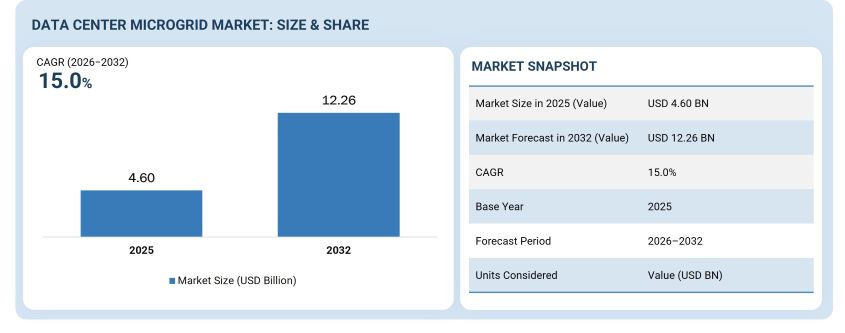
The global data center microgrid market is projected to grow from USD 4.60 billion in 2025 to USD 12.26 billion by 2032, at a CAGR of 15.0% during the forecast period. Rising AI workloads, mounting electricity demand from hyperscale facilities, grid reliability concerns, and sustainability mandates are reshaping the energy architecture of modern data centers. Operators are increasingly investing in intelligent microgrid infrastructure that combines onsite generation, battery storage, renewable energy, and advanced energy management software to ensure resilience, reduce operating risk, and accelerate deployment timelines.
Asia Pacific is projected to emerge as the fastest-growing regional market due to hyperscale data center expansion across India, Southeast Asia, Singapore, and China, combined with rising grid instability concerns and renewable energy integration initiatives. North America is expected to maintain the largest installed base through the forecast period because of aggressive AI infrastructure investments, high hyperscale concentration, and increasing adoption of onsite power systems by leading cloud operators.
Top 10 Key Takeaways
- North America remains the largest regional market due to hyperscale cloud concentration and strong AI infrastructure investments.
- Asia Pacific is emerging as the fastest-growing region driven by rapid digitalization and data localization initiatives.
- Hyperscale data centers continue to dominate adoption because of their massive power requirements and uptime expectations.
- Hybrid microgrids integrating renewable energy and battery storage are becoming the preferred deployment model.
- AI-driven energy optimization platforms are transforming power management strategies inside data centers.
- Utility interconnection delays are accelerating the shift toward onsite and grid-independent power systems.
- Sustainability regulations and carbon reduction commitments are influencing procurement decisions.
- Fuel cells and advanced battery systems are gaining traction as alternatives to conventional diesel backup systems.
- Strategic partnerships between utilities, technology vendors, and data center operators are intensifying.
- Long-term competitiveness increasingly depends on power resilience, energy flexibility, and carbon-aware infrastructure design.
Extended Market Introduction
The digital economy is entering a new infrastructure cycle. Artificial intelligence, edge computing, digital banking, streaming services, industrial automation, and connected devices are generating unprecedented levels of data traffic. Behind this digital acceleration lies a rapidly expanding global data center ecosystem that now faces one of its biggest operational challenges: reliable and scalable power availability.
Data center microgrids are becoming a strategic solution to this challenge. Instead of relying entirely on centralized utility grids, operators are building localized energy ecosystems that combine distributed generation, renewable energy, battery storage, intelligent controls, and energy optimization platforms. This shift is no longer limited to sustainability goals. It is increasingly tied to uptime assurance, operational resilience, and the need to accelerate AI-ready capacity deployment.
The market is also benefiting from wider macroeconomic and policy trends. Governments are emphasizing energy security and grid modernization, while enterprises are under growing pressure to reduce emissions and strengthen business continuity. As a result, microgrids are moving from a niche resilience technology to a core infrastructure layer within hyperscale and colocation facilities.
Data Center Microgrid Market Trends
One of the most important trends shaping the data center microgrid market is the explosive rise of AI-oriented infrastructure. AI training clusters consume significantly more electricity than conventional computing environments, forcing operators to rethink traditional energy strategies. Power availability is increasingly determining where data centers can be built and how quickly they can become operational.
Another major trend is the growing adoption of onsite power generation. Data center operators are increasingly deploying natural gas generators, fuel cells, and renewable energy systems as primary or supplemental energy sources rather than using them solely for backup applications. This shift is particularly visible in regions where utility interconnection timelines are extending due to grid congestion.
Battery energy storage systems are also becoming central to next-generation microgrid architectures. Modern facilities are integrating lithium-ion and alternative storage technologies to optimize peak shaving, support renewable integration, improve grid flexibility, and reduce dependence on diesel generators.
The market is also witnessing increased interest in DC microgrids and intelligent energy management platforms. Advanced software tools powered by AI and machine learning are helping operators optimize power flows, cooling systems, and carbon intensity in real time. These platforms are enabling predictive maintenance, dynamic workload balancing, and energy-aware computing strategies.
Sustainability is another defining trend. Hyperscalers and colocation operators are under pressure from investors, regulators, and enterprise customers to achieve ambitious net-zero targets. As a result, renewable integration, carbon-aware energy procurement, and low-emission backup systems are becoming essential components of data center design strategies.
Market Drivers
Growing AI and Hyperscale Infrastructure Demand
AI infrastructure expansion is fundamentally changing electricity demand patterns within the data center industry. GPU-intensive workloads require extremely high-density computing environments that consume substantially more power than conventional server deployments. This is driving operators toward microgrid systems that can deliver scalable and resilient power capacity.
Utility Grid Constraints and Interconnection Delays
Many regions are experiencing grid congestion, transmission bottlenecks, and lengthy utility approval timelines. These challenges are delaying data center deployments and increasing project uncertainty. Microgrids provide operators with greater energy independence and allow facilities to become operational faster.
Sustainability and Carbon Reduction Goals
Global enterprises are increasingly prioritizing clean energy procurement and carbon reduction initiatives. Data center operators are adopting renewable-integrated microgrids to reduce emissions while improving operational resilience. The ability to combine solar, battery storage, and intelligent load management is becoming a major competitive differentiator.
Need for Operational Resilience
Downtime remains one of the most significant operational risks for digital infrastructure operators. Power disruptions can result in substantial financial and reputational losses. Microgrids enhance resilience by enabling islanded operation, redundancy, and real-time energy optimization.
Market Challenges and Restraints
Despite strong momentum, the data center microgrid market faces several adoption barriers. One of the primary challenges is the high upfront capital investment required for integrated energy infrastructure. Advanced microgrids involve complex combinations of generation systems, storage technologies, power electronics, and software platforms.
Regulatory complexity also remains a concern. Policies governing distributed energy systems, grid interconnection, emissions, and utility participation vary widely across countries and regions. Navigating these frameworks can increase project timelines and implementation costs.
Technology integration challenges are another restraint. Operators must ensure compatibility between legacy infrastructure, intelligent energy management systems, and evolving AI workloads. Cybersecurity is becoming increasingly important as energy systems become more digitized and interconnected.
Supply chain constraints could also affect deployment timelines. Components such as transformers, switchgear, advanced semiconductors, and battery systems are facing strong demand across multiple industries, creating procurement challenges for large-scale projects.
Industry and Application Growth
Hyperscale cloud providers represent the most influential demand segment in the data center microgrid market. Their rapid expansion strategies, combined with aggressive AI infrastructure investments, are accelerating adoption of advanced energy systems. These companies require extremely high uptime, energy flexibility, and scalable power architectures.
Colocation providers are also emerging as major adopters. Enterprise customers increasingly prefer colocation facilities with strong sustainability credentials and resilient energy infrastructure. Microgrids help operators differentiate their facilities while meeting customer expectations for reliability and environmental performance.
Telecommunications operators are another important growth area. The expansion of edge computing, low-latency applications, and digital connectivity infrastructure is increasing demand for distributed microgrid-enabled facilities.
Government and defense organizations are investing in resilient digital infrastructure capable of operating independently during grid disruptions or emergencies. Healthcare and financial services sectors are also prioritizing microgrid-enabled facilities because of the critical nature of their operations.
Segment Insights
Data Center Microgrid Market, By Component
Power generation systems currently lead the market because they form the core foundation of microgrid infrastructure. Natural gas generators, fuel cells, and renewable energy assets are increasingly being deployed as integrated onsite power solutions to support high-density computing environments.
Energy management systems and intelligent controllers are expected to witness the fastest growth. Operators are adopting AI-enabled energy optimization platforms to improve power efficiency, support predictive maintenance, and optimize renewable integration.
Data Center Microgrid Market, By Power Source
Natural gas-based systems currently dominate adoption because they provide reliable baseload power and support continuous operations for hyperscale facilities. Many operators view gas-powered systems as a practical bridge between conventional infrastructure and future low-carbon architectures.
Fuel cells and hybrid renewable systems are gaining traction rapidly as sustainability pressures intensify. Operators are exploring hydrogen-ready technologies and renewable-integrated architectures to align with long-term carbon reduction goals.
Data Center Microgrid Market, By Data Center Type
Hyperscale data centers account for the largest market share due to their massive energy consumption requirements and aggressive AI expansion strategies. These facilities are increasingly designed with integrated microgrid capabilities from the earliest planning stages.
Edge data centers are projected to grow at the fastest pace. Demand for low-latency applications, industrial IoT, and localized digital infrastructure is driving deployment of compact and resilient microgrid-enabled facilities.
Data Center Microgrid Market, By Grid Connectivity
Grid-connected microgrids remain the dominant deployment model because they allow operators to balance utility power usage with onsite generation and storage. These systems provide flexibility while maintaining grid support capabilities.
Hybrid operating models that support both grid-connected and islanded functionality are becoming increasingly important. Operators want the ability to maintain operations during outages while optimizing costs during normal grid conditions.
Data Center Microgrid Market, By End User
Cloud service providers represent the leading end-user segment due to large-scale investments in AI infrastructure and sustainability-focused operations. These organizations are prioritizing resilient and flexible power systems to support long-term expansion.
Government, defense, and healthcare segments are witnessing rapid growth because of increasing concerns related to energy security, operational continuity, and cyber resilience.
Key Segmentation Takeaways
- Hyperscale facilities remain the primary demand center for advanced microgrid deployments.
- Intelligent energy management systems are becoming essential for operational optimization.
- Hybrid renewable systems are gaining momentum as sustainability targets intensify.
- Edge infrastructure expansion is creating new distributed microgrid opportunities.
- Cloud providers continue to shape purchasing trends and technology priorities.
Regional Analysis
North America
North America remains the largest regional market for data center microgrids due to the strong concentration of hyperscale operators, AI infrastructure investments, and advanced energy technology providers. The United States dominates regional demand, particularly in major digital infrastructure hubs such as Northern Virginia, Texas, Arizona, and California. Canada is emerging as an important market because of renewable energy availability and supportive sustainability initiatives, while Mexico is benefiting from growing nearshoring investments and digital infrastructure expansion.
The North American market is projected to grow from USD 1.82 billion in 2025 to USD 4.76 billion by 2032 at a CAGR of 14.7%. Strong adoption of onsite generation systems, battery storage, and intelligent energy management platforms continues to support regional growth.
Europe
Europe is witnessing steady adoption of data center microgrids as sustainability regulations and energy security concerns reshape infrastructure planning. Germany, the United Kingdom, France, and the Nordics remain leading markets because of advanced digital economies and strong renewable energy integration initiatives.
The European market is expected to expand from USD 1.04 billion in 2025 to USD 2.54 billion by 2032 at a CAGR of 13.6%. Demand is being driven by stricter carbon reduction policies, rising energy costs, and increasing focus on resilient digital infrastructure.
Asia Pacific
Asia Pacific is emerging as the fastest-growing regional market. China, India, Japan, Singapore, South Korea, and Australia are witnessing rapid hyperscale and colocation capacity expansion. Governments across the region are emphasizing digital transformation, data localization, and AI ecosystem development.
The Asia Pacific market is projected to increase from USD 1.31 billion in 2025 to USD 3.89 billion by 2032 at a CAGR of 16.8%. Rising electricity demand, grid constraints, and aggressive investments in digital infrastructure are accelerating adoption of microgrid solutions.
Rest of World
The Rest of World market is gaining momentum as emerging economies invest in digital infrastructure modernization. Brazil is witnessing increasing colocation activity, while the UAE and Saudi Arabia are investing heavily in smart city and AI initiatives. South Africa is exploring resilient power strategies due to grid reliability concerns.
The Rest of World market is expected to grow from USD 0.43 billion in 2025 to USD 1.07 billion by 2032 at a CAGR of 13.9%. Growing cloud adoption and energy resilience requirements continue to create opportunities across Latin America, the Middle East, and Africa.
Regional Outlook Summary
- North America remains the largest installed base due to hyperscale concentration.
- Asia Pacific is emerging as the fastest-growing region because of AI infrastructure expansion.
- Europe is emphasizing sustainability-driven infrastructure modernization.
- Middle Eastern investments in AI and smart cities are creating new opportunities.
- Grid reliability concerns are accelerating adoption across emerging markets.
Country-Specific Insights
The United States continues to lead the global market because of large-scale AI investments, advanced cloud ecosystems, and strong presence of hyperscale operators. Utility interconnection constraints are accelerating interest in onsite generation and advanced microgrids.
China is rapidly expanding digital infrastructure to support AI, cloud computing, and industrial digitalization. The country is also investing heavily in renewable energy integration and advanced energy technologies.
India is becoming a strategic growth market driven by rising data localization requirements, digital public infrastructure, and rapid cloud adoption. Major cities are attracting new colocation investments supported by renewable energy initiatives.
Singapore remains an important regional hub because of its strong connectivity ecosystem and sophisticated data center environment. Energy efficiency and sustainability are major priorities due to land and power limitations.
The UAE and Saudi Arabia are investing aggressively in AI-ready infrastructure as part of broader economic diversification and digital transformation strategies.
Country-Level Takeaways
- The United States remains the innovation center for hyperscale microgrid adoption.
- China and India are driving large-scale regional expansion.
- Singapore is prioritizing energy-efficient digital infrastructure.
- Gulf countries are investing heavily in resilient AI ecosystems.
- Renewable integration is becoming central to country-level strategies.
Key Company Insights
The competitive landscape includes a mix of electrical infrastructure providers, energy technology companies, power equipment manufacturers, and intelligent software platform vendors. Leading players are focusing on integrated energy ecosystems that combine distributed generation, battery storage, automation, and AI-driven optimization capabilities.
Leading Companies
- Schneider Electric
- Eaton
- Siemens
- ABB
- Bloom Energy
- Caterpillar
- Cummins
- Vertiv
- Delta Electronics
- Huawei Digital Power
- Rolls-Royce Power Systems
- Enchanted Rock
- Hitachi Energy
- GE Vernova
- Mitsubishi Electric
Market participants are increasingly forming partnerships with hyperscale operators and utility providers to accelerate deployment timelines and improve energy resilience. Several vendors are also expanding their portfolios around fuel cells, battery storage, and AI-enabled energy management systems.
Technology differentiation is becoming a critical competitive factor. Companies are investing heavily in software-defined energy management, predictive analytics, and modular infrastructure designs that support rapid scaling.
Sustainability positioning is also influencing competition. Vendors capable of supporting low-carbon energy architectures, renewable integration, and carbon-aware optimization are strengthening their market presence.
Key Company Strategy Takeaways
- Integrated energy ecosystems are becoming the primary competitive differentiator.
- AI-enabled optimization software is gaining strategic importance.
- Fuel cells and storage technologies are attracting major investments.
- Partnerships with hyperscalers are intensifying across the value chain.
- Sustainability-focused positioning is influencing procurement decisions.
Recent Developments
- In January 2025, Bloom Energy highlighted growing adoption of onsite power solutions for data centers to address rising AI-driven electricity demand.
- In 2025, Schneider Electric emphasized expanding microgrid and energy management capabilities focused on resilient digital infrastructure.
- In 2026, multiple hyperscale operators accelerated AI-oriented data center expansion projects incorporating advanced cooling and flexible power architectures.
- In 2026, energy technology vendors increased investments in battery storage and hybrid renewable systems for large-scale digital infrastructure projects.
Real-World Use Cases and Case Studies
Equinix has continued expanding its use of distributed energy and fuel-cell-based infrastructure to strengthen energy resilience and sustainability across selected facilities. The company has collaborated with energy technology partners to reduce dependence on conventional grid power while improving operational continuity and lowering emissions exposure.
Several hyperscale operators in the United States are increasingly deploying hybrid onsite power architectures that combine gas generation, battery storage, and intelligent energy management systems. These deployments are designed to support AI-intensive workloads while reducing the risks associated with utility interconnection delays and grid congestion.
Market Segmentation
The data center microgrid market is segmented across multiple dimensions reflecting the growing complexity of modern digital infrastructure. By component, the market includes generation systems, energy storage, controllers, and intelligent energy management platforms. By power source, the market covers natural gas, fuel cells, solar PV, battery storage, and hybrid renewable systems.
From an infrastructure perspective, the market spans hyperscale, colocation, enterprise, and edge data centers. Connectivity models include grid-connected, islanded, and hybrid microgrids capable of dynamic operational flexibility. End-user demand is being driven primarily by cloud providers, telecom operators, government agencies, healthcare organizations, and industrial enterprises.
Segmentation Summary
- Generation systems remain foundational to market deployment strategies.
- Hybrid renewable architectures are gaining momentum.
- Hyperscale facilities dominate current adoption.
- Edge deployments are creating distributed growth opportunities.
- Cloud providers remain the most influential customer segment.
Conclusion and Future Outlook
The data center microgrid market is evolving from a resilience-focused niche into a strategic infrastructure category central to the future of AI-driven digital economies. Rising electricity demand, grid constraints, sustainability mandates, and operational resilience requirements are fundamentally reshaping how data centers are powered.
Through the forecast period, AI, automation, predictive analytics, and intelligent energy orchestration platforms will play an increasingly important role in optimizing energy consumption and infrastructure efficiency. Organizations capable of integrating resilient power systems with scalable digital infrastructure strategies will be better positioned to compete in an increasingly power-constrained environment.
FAQ
1. How big is the data center microgrid market?
The global data center microgrid market is projected to grow from USD 4.60 billion in 2025 to USD 12.26 billion by 2032. Rising AI infrastructure investments, energy resilience requirements, and sustainability goals are major contributors to market expansion.
2. What is the data center microgrid market growth rate?
The market is expected to grow at a CAGR of 15.0% during the forecast period from 2026 to 2032. Strong investments in hyperscale infrastructure and onsite energy systems are accelerating adoption globally.
3. Which segment leads the data center microgrid market?
Hyperscale data centers currently represent the leading segment because of their large-scale power requirements and aggressive AI deployment strategies. Cloud providers remain the primary adopters of advanced microgrid technologies.
4. Who are the key players in the data center microgrid market?
Key companies operating in the market include Schneider Electric, Eaton, Siemens, ABB, Bloom Energy, Caterpillar, Cummins, Vertiv, Delta Electronics, GE Vernova, and Hitachi Energy.
5. What factors are driving the data center microgrid market?
Major growth drivers include increasing AI-related electricity demand, utility grid constraints, sustainability initiatives, energy resilience requirements, and rising investments in distributed energy systems.
 Exclusive indicates content/data unique to MarketsandMarkets and not available with any competitors.













Growth opportunities and latent adjacency in Data Center Microgrid Market