Data Center Onsite & Behind-the-Meter Power Market by Technology (Heavy-Duty Gas Turbines, Aeroderivative Turbines, Reciprocating Engines, Fuel Cells), Application, End User - Global Forecast to 2032


Data Center Onsite & Behind-the-Meter Power Market to 2032: Size, Share & Growth Report
The global Data Center Onsite & Behind-the-Meter Power market is projected to grow from USD 18 billion in 2026 to USD 87 billion by 2032, at a CAGR of approximately 30% during 2026–2032. Growth is driven by gas turbine backlogs extending to 2031 creating urgent demand for faster alternatives, Caterpillar's record power generation growth confirming data center-driven demand, and fuel cells demonstrating a unique speed-to-power advantage for AI infrastructure.
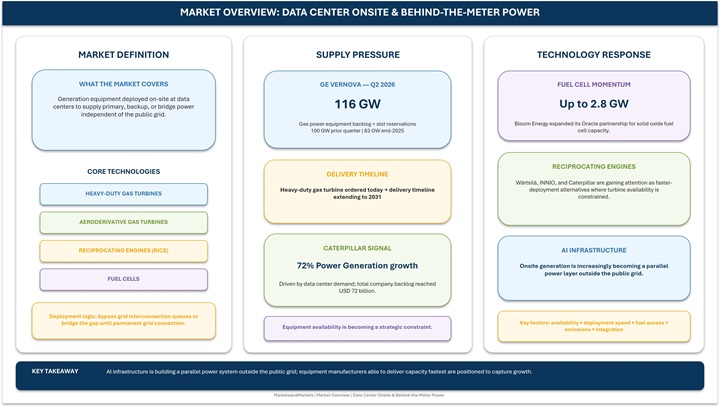
Data Center Onsite & Behind-the-Meter Power covers the generation equipment deployed on-site at data centers to supply primary, backup, or bridge power independent of the public grid. The market spans heavy-duty gas turbines, aeroderivative gas turbines, reciprocating engines (RICE), and fuel cells, deployed either to bypass grid interconnection queues entirely or to bridge the gap while a permanent grid connection is completed.
Every major onsite generation technology is now backlogged simultaneously at a scale without precedent. GE Vernova closed the second quarter of 2026 with a combined gas power equipment backlog and slot-reservation total of 116 GW, up from 100 GW in the prior quarter and 83 GW at the end of 2025 — more than three times the total US electricity generating capacity added in all of 2024. A heavy-duty gas turbine ordered today will not arrive until 2031. Caterpillar posted its first-ever USD 20 billion revenue quarter, with its Power Generation segment growing 72% on data center demand and total company backlog reaching USD 72 billion; CEO Joe Creed said plainly, “no one is slowing down at the moment — if we can get more units out, they're asking us to give them more units.”
Fuel cells have emerged as a distinct, fast-scaling category: Bloom Energy expanded its partnership with Oracle in April 2026 to supply up to 2.8 GW of solid oxide fuel cell capacity, with Bloom's Chief Commercial Officer Aman Joshi describing the deal as “advancing its position as the standard for onsite power.” Reciprocating engines from Wärtsilä, INNIO, and Caterpillar are simultaneously absorbing gigawatt-scale orders that would otherwise have gone to backlogged turbines, offering 12-to-18-month lead times against 5 or more years for heavy-frame equipment. The Data Center Onsite & Behind-the-Meter Power market is where AI infrastructure is building a parallel power system outside the public grid — and the equipment manufacturers that can deliver capacity fastest will capture the category's growth.
Top 10 Key Takeaways
- North America holds the overwhelming majority of market share, reflecting the concentration of both hyperscale AI data center demand and gas-advantaged regions such as Texas and Appalachia where onsite generation projects are concentrating.
- Asia Pacific is the fastest-growing region, propelled by hyperscalers and developers beginning to replicate proven US onsite and behind-the-meter generation strategies as data center investment expands internationally.
- Heavy-duty gas turbines lead by technology revenue, anchored by GE Vernova's 116 GW combined backlog and slot-reservation total; fuel cells are the fastest-growing technology as Bloom Energy's gigawatt-scale master agreements scale rapidly from a smaller base.
- Primary/continuous onsite power (Bring-Your-Own-Power) dominates by application; bridge power (interim grid-wait generation) is the fastest-growing application as developers deploy temporary onsite capacity while permanent grid interconnection is completed.
- GE Vernova closed Q2 2026 with a combined gas power equipment backlog and slot-reservation total of 116 GW, up from 100 GW in the prior quarter, with turbines ordered today not arriving until 2031.
- Caterpillar posted its first-ever USD 20 billion revenue quarter, with Power Generation segment growth of 72% driven by data center demand and total company backlog reaching USD 72 billion.
- Bloom Energy expanded its partnership with Oracle in April 2026 to supply up to 2.8 GW of solid oxide fuel cell capacity, with an initial 1.2 GW already contracted and under active deployment.
- Reciprocating engines from Wärtsilä, INNIO, and Caterpillar are absorbing gigawatt-scale orders that would otherwise have gone to backlogged turbines, offering 12-to-18-month lead times versus 5 or more years for heavy-frame equipment.
- The near-term opportunity lies in fleet-based, multi-technology onsite generation strategies, exemplified by Crusoe Energy Systems' Abilene, Texas campus combining GE Vernova aeroderivative turbines with Caterpillar Titan turbines at a single site.
- The near-term risk is that every onsite generation technology category is now backlogged simultaneously, meaning developers increasingly cannot simply switch to an alternative technology to escape long lead times.
Why the Data Center Onsite & Behind-the-Meter Power Market Matters Now
The scale of equipment demand has moved well past what any single supplier anticipated. On its July 22, 2026 earnings call, GE Vernova confirmed that a heavy-duty gas turbine ordered today will not arrive until 2031, with the company's combined gas power equipment backlog and slot-reservation agreements reaching 116 GW — up from 100 GW the prior quarter and 83 GW at the end of 2025. That is not a story about natural gas prices; it is a story about manufacturing capacity becoming the pacing factor for the entire AI data center buildout, more decisive than fuel cost or even capital availability.
This matters commercially because the entire onsite generation ecosystem is scaling simultaneously rather than sequentially. Caterpillar's Power Generation segment grew 72% in a single quarter on data center demand, delivering the company's first-ever USD 20 billion revenue quarter; CEO Joe Creed said the company simply cannot make units fast enough, noting “no one is slowing down at the moment.” Bloom Energy, meanwhile, has converted fuel cells from a niche backup technology into a gigawatt-scale primary power option, with its Chief Commercial Officer Aman Joshi describing the company's expanded Oracle partnership as “advancing its position as the standard for onsite power.”
The market covers heavy-duty gas turbines, aeroderivative gas turbines, reciprocating engines, and fuel cells. Out of scope are nuclear power generation technologies evaluated separately, grid-connected utility-scale power plants not co-located with or dedicated to a specific data center, and battery energy storage systems evaluated independently of onsite generation equipment. The market connects to the
Generator Sales Market — https://www.marketsandmarkets.com/Market-Reports/generator-sales-market-47544335.html
Power Monitoring Market — https://www.marketsandmarkets.com/Market-Reports/power-monitoring-market-197503460.html
DERMS Architecture and Edge Control Market — https://www.marketsandmarkets.com/Market-Reports/derms-architecture-and-edge-control-market-206649623.html
Circuit Breaker Monitoring Systems Market — https://www.marketsandmarkets.com/Market-Reports/circuit-breaker-monitoring-systems-market-133358428.html
Power Device Analyzer Market — https://www.marketsandmarkets.com/Market-Reports/power-device-analyzer-market-259267665.html
Report Scope
|
Report Metric |
Details |
|
Market Size in 2026 (Value) |
USD 18 Billion |
|
Market Forecast in 2032 (Value) |
USD 87 Billion |
|
Growth Rate |
CAGR of 30% from 2026–2032 |
|
Years Considered |
2022–2032 |
|
Base Year |
2025 |
|
Forecast Period |
2026–2032 |
|
Units Considered |
Value (USD Billion) |
|
Report Coverage |
Revenue forecast, company ranking, competitive landscape, growth factors, and trends |
|
Top Companies |
• GE Vernova |
|
Growth Drivers |
• Gas turbine backlogs extending to 2031 creating urgent demand for faster alternatives |
|
Segments Covered |
• By Technology: Heavy-Duty Gas Turbines, Aeroderivative Gas Turbines, Reciprocating Engines, Fuel Cells |
|
Regional Scope |
North America, Europe, Asia Pacific, Rest of World |
North America, Europe, Asia Pacific, Rest of World
Market Trends Shaping Data Center Onsite & Behind-the-Meter Power
The defining trend is the shift from grid-dependent power planning to multi-technology onsite generation portfolios. Developers are no longer choosing a single onsite technology; they are assembling portfolios spanning turbines, reciprocating engines, and fuel cells simultaneously, reflecting the reality that no single technology category can meet AI data center power timelines alone given how backlogged every category has become.
A second trend is reciprocating engines filling the gap left by backlogged heavy-duty turbines. Wärtsilä, INNIO, and Caterpillar have collectively absorbed gigawatt-scale orders that would have gone to turbines if slots were available, with RICE engines offering 12-to-18-month lead times versus 5 or more years for heavy-frame turbines, synchronizing in 30 seconds, and commissioning unit-by-unit — qualities that match AI workload variability in ways large turbines cannot replicate.
A third trend is fuel cells scaling from pilot deployments to gigawatt-scale master agreements. Bloom Energy's expanded Oracle partnership, covering up to 2.8 GW of solid oxide fuel cell capacity with an initial 1.2 GW already contracted and under deployment, illustrates how quickly fuel cells have moved from a niche backup technology into a primary power option for hyperscale AI infrastructure.
A fourth trend is fleet-based site strategies combining multiple generation technologies simultaneously. Crusoe Energy Systems' Abilene, Texas campus for Oracle and OpenAI combines GE Vernova LM2500XPRESS aeroderivative turbines with Caterpillar Titan 350 turbines in a single fleet-based onsite generation strategy, illustrating how sophisticated developers are engineering around individual technology backlogs rather than waiting on any single supplier.
A fifth trend is equipment manufacturers converting backlogs into multi-year capacity expansion investment. GE Vernova signed 20 GW of new gas orders in a single quarter and raised its full-year revenue guidance to USD 45.5 billion to USD 46.5 billion, while Caterpillar's Power Generation segment backlog reached USD 72 billion — both companies are now investing directly in manufacturing capacity expansion to convert backlog into deliverable equipment faster.
Market Drivers Accelerating Growth
The first driver is gas turbine backlogs extending to 2031: GE Vernova's combined gas power equipment backlog and slot-reservation total reached 116 GW in Q2 2026, up from 100 GW the prior quarter, with a heavy-duty turbine ordered today not arriving until 2031 — creating urgent demand for faster-to-deploy reciprocating engines and fuel cells as alternatives.
The second driver is Caterpillar's record power generation growth, with the segment growing 72% on data center demand and delivering the company's first-ever USD 20 billion revenue quarter, directly confirming that data center-driven demand for onsite generation equipment is broad-based across multiple equipment categories, not concentrated in gas turbines alone.
The third driver is fuel cells demonstrating a unique speed-to-power advantage: Bloom Energy's expanded 2.8 GW partnership with Oracle, with an initial 1.2 GW already contracted and deploying, shows how fuel cells can scale to gigawatt levels faster than combustion-based alternatives while avoiding some of the emissions and permitting complexity that larger gas turbine installations face.
Market Challenges and Restraints
The most significant restraint is heavy-duty turbine lead times extending to 2031 regardless of capital available. Even hyperscalers with virtually unlimited capital cannot purchase their way to a faster heavy-duty gas turbine delivery date, since GE Vernova, Siemens Energy, and Mitsubishi Power's combined manufacturing capacity, not capital, is now the binding constraint on how quickly this specific equipment category can be delivered.
A second restraint is rising onsite natural gas demand straining regional supply and pipeline capacity. A single Bloom Energy fuel cell gigawatt requires roughly 150 million cubic feet of gas per day, and concentrated onsite generation demand in gas-advantaged regions such as Texas and Appalachia is increasingly constrained by pipeline access rather than equipment availability alone.
A third challenge is behind-the-meter generation importing fuel-price and emissions risk onto operator balance sheets that grid-connected power does not carry, requiring data center operators to manage commodity price exposure and emissions compliance directly rather than through a utility intermediary. A related challenge is that every generation technology category is now backlogged simultaneously — turbines, fuel cells, and reciprocating engines alike — meaning developers increasingly cannot simply switch to an alternative technology to escape long lead times the way they could when only one category was constrained.
Segment Insights
By Technology
Heavy-duty gas turbines lead by technology revenue, anchored by GE Vernova's 116 GW combined backlog and slot-reservation total and the technology's position as the largest-scale, most efficient onsite generation option for gigawatt-class data center campuses.
Fuel cells are the fastest-growing technology, propelled directly by Bloom Energy's expanded 2.8 GW master agreement with Oracle and the technology's unique ability to scale to gigawatt levels with lower emissions and permitting complexity than combustion-based alternatives.
By Application
Primary/continuous onsite power (Bring-Your-Own-Power) dominates by application, anchored by the largest, most capital-intensive deployments where operators choose to bypass grid interconnection entirely rather than wait years for a conventional connection.
Bridge power (interim grid-wait generation) is the fastest-growing application, as developers increasingly deploy temporary onsite capacity specifically to begin operations while a permanent grid interconnection is completed in parallel.
Key segmentation insights:
- Heavy-duty gas turbines lead technology revenue; fuel cells grow fastest on gigawatt-scale master agreements.
- Primary/continuous onsite power dominates by application; bridge power grows fastest as developers deploy interim capacity during grid connection.
- Hyperscale cloud/AI providers lead end users; colocation providers grow fastest as shared facilities pursue dedicated onsite generation.
- The single-technology deployment model and the fleet-based, multi-technology deployment model represent two competing routes to market.
- Simultaneous backlogs across every generation technology category are the structural driver of market growth through 2032.
Regional Analysis: Data Center Onsite & Behind-the-Meter Power Market by Region
North America
North America holds the overwhelming majority of the market, valued at roughly USD 13.5 billion in 2026 and projected to reach about USD 61 billion by 2032, growing at a CAGR of approximately 28.6%. The United States dominates through the concentration of hyperscale AI data center demand and gas-advantaged regions such as Texas and Appalachia, anchored by GE Vernova, Caterpillar, and Bloom Energy's leading equipment positions and projects such as Crusoe Energy Systems' fleet-based Abilene, Texas campus. Canada contributes through growing enterprise and colocation onsite generation interest.
Europe
Europe is valued at approximately USD 2.16 billion in 2026 and forecast to reach around USD 11.8 billion by 2032, expanding at a CAGR of approximately 32.7%. Germany anchors the region through Siemens Energy's heavy-duty gas turbine manufacturing base; the United Kingdom and Ireland contribute through growing hyperscale onsite and behind-the-meter generation interest as regional grid capacity constraints intensify.
Asia Pacific
Asia Pacific is the fastest-growing region, valued at roughly USD 1.62 billion in 2026 and projected to reach about USD 11.6 billion by 2032, growing at a CAGR of approximately 38.8%. Japan and South Korea contribute through Mitsubishi Power's heavy-duty gas turbine manufacturing base and growing hyperscale data center investment; China continues to expand domestic onsite generation capacity alongside rapidly growing data center power demand.
Rest of World
The Rest of World market is valued at USD 0.72 billion in 2026 and is projected to reach about USD 2.6 billion by 2032, growing at a CAGR of approximately 23.9%. The Middle East contributes through growing sovereign AI data center onsite generation investment, while Latin America adds early-stage exploration of behind-the-meter power for regional data center demand.
Key Company Insights
The competitive landscape spans three tiers: heavy-duty and aeroderivative gas turbine manufacturers, reciprocating engine and fuel cell suppliers, and systems integrators assembling fleet-based, multi-technology onsite generation strategies. Leading players include GE Vernova, Siemens Energy, Mitsubishi Power, Bloom Energy, Caterpillar Inc., Cummins Inc., Generac Holdings, Wärtsilä, INNIO Group, FTAI Aviation, Solaris Energy Infrastructure, Crusoe Energy Systems, American Electric Power, Oracle Corporation, and Kohler Co.
- GE Vernova (heavy-duty and aeroderivative gas turbines)
- Siemens Energy (heavy-duty gas turbines)
- Mitsubishi Power (heavy-duty gas turbines)
- Bloom Energy (solid oxide fuel cells)
- Caterpillar Inc. (reciprocating engines, Titan turbines)
- Cummins Inc. (reciprocating engines and generators)
- Generac Holdings (onsite and backup generation)
- Wärtsilä (reciprocating engines)
- INNIO Group (Jenbacher reciprocating engines)
- FTAI Aviation (aeroderivative turbine solutions)
- Solaris Energy Infrastructure (mobile and modular gas turbine power)
- Crusoe Energy Systems (fleet-based onsite generation integrator)
- American Electric Power (utility, fuel cell co-location customer)
- Oracle Corporation (hyperscaler customer)
- Kohler Co. (onsite and backup power generation)
GE Vernova anchors the market's largest single equipment position, closing Q2 2026 with a combined gas power equipment backlog and slot-reservation total of 116 GW and a company-wide backlog of USD 176 billion, having signed 20 GW of new gas orders in the quarter alone. Siemens Energy and Mitsubishi Power compete directly in the heavy-duty turbine tier, together with GE Vernova making up the largest announced onsite generation equipment category. Caterpillar holds the clearest position across both reciprocating engines and aeroderivative turbines, posting its first-ever USD 20 billion revenue quarter with Power Generation segment growth of 72% and a USD 72 billion backlog.
Bloom Energy anchors the fuel cell tier, having expanded its Oracle partnership to up to 2.8 GW in April 2026 following an earlier 1 GW supply agreement with American Electric Power in November 2024 described at the time as the largest commercial procurement of fuel cells in the world. Wärtsilä, INNIO Group, Cummins, and Generac compete across the reciprocating engine and generator tier that has absorbed gigawatt-scale orders diverted from backlogged turbine suppliers, while FTAI Aviation and Solaris Energy Infrastructure specialize in aeroderivative and modular gas turbine solutions respectively. Crusoe Energy Systems represents the fleet-based systems integration model, combining equipment from multiple manufacturers at a single site, as demonstrated at its Abilene, Texas campus for Oracle and OpenAI.
Key company strategy insights:
- GE Vernova holds the clearest position in heavy-duty and aeroderivative gas turbines, backed by the largest disclosed backlog in the industry.
- Caterpillar's dual position across reciprocating engines and turbines gives it exposure to both the largest existing category and the fastest-growing alternative to backlogged heavy-duty equipment.
- Bloom Energy's gigawatt-scale Oracle master agreement establishes fuel cells as a credible primary power technology, not merely a backup power niche.
- Wärtsilä, INNIO Group, and Cummins compete on reciprocating engine lead-time advantages relative to backlogged heavy-duty turbines.
- Crusoe Energy Systems' fleet-based, multi-vendor integration model illustrates how sophisticated developers are engineering around individual supplier backlogs.
Recent Developments
- July 2026: GE Vernova closed its second quarter with a combined gas power equipment backlog and slot-reservation total of 116 GW, up from 100 GW the prior quarter, confirming on its earnings call that turbines ordered today will not arrive until 2031.¹
- August 2026: Caterpillar reported its first-ever USD 20 billion revenue quarter, with Power Generation segment growth of 72% driven by data center demand and total company backlog reaching USD 72 billion.²
- April 2026: Bloom Energy and Oracle expanded their strategic partnership to deploy up to 2.8 GW of fuel cell capacity, with an initial 1.2 GW already contracted and under active deployment.³
- November 2024: Bloom Energy signed a supply agreement with American Electric Power for up to 1 GW of fuel cells, described at the time as the largest commercial procurement of fuel cells in the world.4
Sources:
¹ Energy News Beat, August 2026 — GE Vernova's Gas Turbine Backlog Hits 116 GW. What Does This Mean for the AI Market?
² 24/7 Wall St., August 2026 — Behind-the-Meter Energy Stocks Fall Tuesday: FTAI Aviation Down 7%, GE Vernova Down 6%, Caterpillar Down 4%
³ Bloom Energy, April 13, 2026 — Bloom Energy and Oracle Expand Strategic Partnership to Deploy up to 2.8 GW to Accelerate AI Infrastructure Build-Out
4 Business Wire, November 14, 2024 — Bloom Energy Announces Gigawatt Fuel Cell Procurement Agreement With AEP to Power AI Data Centers
Real-World Use Cases
- Bloom Energy's expanded partnership with Oracle, covering up to 2.8 GW of solid oxide fuel cell capacity, has already deployed an initial 1.2 GW across Oracle projects in the United States. “By rapidly deploying Bloom's reliable, efficient fuel cell energy, we are quickly meeting the demands of our customers across the United States,” said Mahesh Thiagarajan, Executive Vice President of Oracle Cloud Infrastructure, while Bloom's Chief Commercial Officer Aman Joshi described the expanded deal as “advancing its position as the standard for onsite power.”5
- Crusoe Energy Systems' Abilene, Texas campus for Oracle and OpenAI combines GE Vernova LM2500XPRESS aeroderivative turbines with Caterpillar Titan 350 turbines in a single fleet-based onsite generation strategy, illustrating how sophisticated developers are diversifying across multiple equipment suppliers and technology types at a single site rather than depending on any one manufacturer's backlogged production line.6
Sources:
5 DatacenterDynamics, May 7, 2026 — Oracle Expands Fuel Cell Supply Deal With Bloom Energy to 2.8GW
6 Rabobank, July 28, 2026 — Data Centers Are Building a Parallel Energy System in the US
Market Segmentation
The Data Center Onsite & Behind-the-Meter Power market segments across three interlocking axes. By technology, it spans heavy-duty gas turbines, aeroderivative gas turbines, reciprocating engines, and fuel cells — four categories reflecting different lead times, scale, and emissions profiles. By application, it covers primary/continuous onsite power, backup/standby power, and bridge power. By end user, it serves hyperscale cloud/AI providers, colocation providers, and enterprise data center operators.
These axes interlock: a hyperscale cloud provider (end user) deploys Bloom Energy's solid oxide fuel cells (technology: fuel cells) as primary, continuous power (application: primary/continuous onsite power) for a gigawatt-scale AI training campus — three axes converging in a single, behind-the-meter power deployment.
Key segmentation insights:
- Heavy-duty gas turbines lead technology revenue; fuel cells grow fastest on gigawatt-scale master agreements.
- Primary/continuous onsite power dominates by application; bridge power grows fastest as developers deploy interim capacity during grid connection.
- Hyperscale cloud/AI providers lead end users; colocation providers grow fastest as shared facilities pursue dedicated onsite generation.
- The single-technology deployment model and the fleet-based, multi-technology deployment model represent two competing routes to market.
- Simultaneous backlogs across every generation technology category are the structural driver of market growth through 2032.
Opportunities and Future Outlook
Through 2032, data center onsite and behind-the-meter power will mature from an emergency bypass strategy into a standard, co-planned component of AI infrastructure development. The forces driving the market — gas turbine backlogs extending to 2031, Caterpillar's record power generation growth confirming broad-based demand, and fuel cells proving out at gigawatt scale — are structural and mutually reinforcing, even as simultaneous backlogs across every technology category and rising onsite gas demand introduce real near-term friction. Continued reciprocating engine adoption and fleet-based, multi-technology site strategies will be the next catalysts converting today's supply-constrained scramble into a more predictable, diversified onsite generation discipline.
For chief power officers, VP data center development leads, and investors, the Data Center Onsite & Behind-the-Meter Power market is where AI infrastructure is building a parallel power system outside the public grid in real time, and the equipment manufacturers that can deliver capacity fastest — across turbines, reciprocating engines, and fuel cells alike — will determine how quickly the next generation of AI data centers can actually be powered.
Frequently Asked Questions (FAQ)
1. How big is the Data Center Onsite & Behind-the-Meter Power market?
The Data Center Onsite & Behind-the-Meter Power market is projected to grow from USD 18 billion in 2026 to about USD 87 billion by 2032. North America accounts for the overwhelming majority of the market, driven by the concentration of hyperscale AI data center demand and gas-advantaged regions.
2. What is the Data Center Onsite & Behind-the-Meter Power market growth rate?
The market is forecast to grow at a CAGR of approximately 30% from 2026 to 2032. Asia Pacific is the fastest-growing region at around 38.8%, driven by hyperscalers and developers replicating proven US onsite generation strategies.
3. Which segment leads the Data Center Onsite & Behind-the-Meter Power market?
By technology, heavy-duty gas turbines lead; fuel cells grow fastest. By application, primary/continuous onsite power dominates; bridge power grows fastest.
4. Who are the key players in the Data Center Onsite & Behind-the-Meter Power market?
Leading players include GE Vernova, Siemens Energy, Mitsubishi Power, Bloom Energy, Caterpillar Inc., Cummins Inc., Generac Holdings, Wärtsilä, INNIO Group, FTAI Aviation, Solaris Energy Infrastructure, Crusoe Energy Systems, American Electric Power, Oracle Corporation, and Kohler Co.
5. What are the factors driving the Data Center Onsite & Behind-the-Meter Power market?
The primary drivers are gas turbine backlogs extending to 2031 creating urgent demand for faster alternatives, Caterpillar's record power generation growth confirming data center-driven demand, and fuel cells demonstrating a unique speed-to-power advantage for AI infrastructure.
Speak With Our Analyst
The Data Center Onsite & Behind-the-Meter Power market is where AI infrastructure is building a parallel power system outside the public grid in real time, and equipment-level detail on turbine backlogs, reciprocating engine lead times, and fuel cell scalability is where strategic decisions are won or lost. MarketsandMarkets can help you go deeper: request a sample of the full study, speak with our analyst about your specific questions, or customize the scope to your target technologies, applications, and geographies. Reach out to explore how this intelligence can inform your power procurement strategy, vendor selection, or investment thesis.
 Exclusive indicates content/data unique to MarketsandMarkets and not available with any competitors.
TABLE OF CONTENTS
1 Introduction
1.1 Study Objectives
1.2 Market Definition and Scope
1.2.1 Inclusions and Exclusions
1.3 Study Scope
1.3.1 Markets Covered
1.3.2 Geographic Segmentation
1.3.3 Years Considered
1.4 Currency Considered
1.5 Stakeholders
2 Research Methodology
2.1 Research Approach
2.1.1 Secondary Research
2.1.2 Primary Research
2.1.2.1 Breakdown of Primaries
2.2 Market Size Estimation
2.2.1 Bottom-Up Approach
2.2.2 Top-Down Approach
2.3 Data Triangulation
2.4 Research Assumptions
2.5 Limitations and Risk Assessment
3 Executive Summary
4 Premium Insights
4.1 Attractive Opportunities in the Data Center Onsite & Behind-the-Meter Power Market
4.2 Market, By Technology
4.3 Market, By Region
4.4 Market, By Application
5 Market Overview
5.1 Introduction
5.2 Market Dynamics
5.2.1 Drivers
5.2.1.1 Gas Turbine Backlogs Extending to 2031 Creating Urgent Demand for Faster Alternatives
5.2.1.2 Caterpillar's Record Power Generation Growth Confirming Data Center-Driven Demand
5.2.1.3 Fuel Cells Demonstrating a Unique Speed-to-Power Advantage for AI Infrastructure
5.2.2 Restraints
5.2.2.1 Heavy-Duty Turbine Lead Times Extending to 2031 Regardless of Capital Available
5.2.2.2 Rising Onsite Natural Gas Demand Straining Regional Supply and Pipeline Capacity
5.2.3 Opportunities
5.2.3.1 Reciprocating Engines Offering 12-to-18-Month Lead Times Versus 5-Plus Years for Turbines
5.2.3.2 Fleet-Based, Multi-Technology Onsite Generation Strategies Creating Systems Integration Value
5.2.4 Challenges
5.2.4.1 Behind-the-Meter Generation Importing Fuel-Price and Emissions Risk Onto Operator Balance Sheets
5.2.4.2 Every Generation Technology Category Now Backlogged Simultaneously
5.3 Value Chain Analysis
5.4 Ecosystem Analysis
5.5 Investment and Funding Scenario
5.6 Pricing Analysis
5.7 Trends and Disruptions Impacting Customer Business
5.8 Technology Analysis
5.8.1 Key Technologies (Heavy-Duty Gas Turbines, Aeroderivative Turbines, Reciprocating Engines, Fuel Cells)
5.8.2 Complementary Technologies (Fleet-Based Hybrid Generation, Modular Power Deployment)
5.8.3 Adjacent Technologies (Grid Interconnection Bypass, Combined-Cycle Power Plants)
5.9 Porter's Five Forces Analysis
5.10 Key Stakeholders and Buying Criteria
5.11 Case Study Analysis
5.12 Key Conferences and Events
5.13 Regulatory Landscape
5.13.1 EPA Emissions Standards for Onsite Gas Generation
5.13.2 FERC Co-Located Load and Behind-the-Meter Generation Policy
5.13.3 State-Level Natural Gas Pipeline Capacity Allocation Rules
5.13.4 Air Permitting Requirements for Fuel Cell and Reciprocating Engine Installations
5.14 Impact of AI on the Market
5.15 Impact of 2025 US Tariffs on Supply Chains
6 Industry Trends
6.1 From Grid-Dependent Power Planning to Multi-Technology Onsite Generation Portfolios
6.2 Reciprocating Engines Filling the Gap Left by Backlogged Heavy-Duty Turbines
6.3 Fuel Cells Scaling From Pilot Deployments to Gigawatt-Scale Master Agreements
6.4 Fleet-Based Site Strategies Combining Multiple Generation Technologies Simultaneously
6.5 Equipment Manufacturers Converting Backlogs Into Multi-Year Capacity Expansion Investment
6.6 Onsite Generation Concentrating in Gas-Advantaged Regions Such as Texas and Appalachia
7 Technology Adoption and Strategic Disruption Landscape
7.1 Heavy-Duty Gas Turbines vs. Aeroderivative Turbines for Onsite Data Center Power
7.2 Reciprocating Engines vs. Gas Turbines for Fast-Deployment Onsite Generation
7.3 Solid Oxide Fuel Cells vs. Combustion-Based Onsite Generation Technologies
7.4 Single-Technology Sites vs. Fleet-Based, Multi-Technology Onsite Generation Strategies
8 Customer Landscape and Buyer Behavior
8.1 Decision-Making Process — Chief Power Officer, VP Data Center Development, Procurement Director
8.2 Equipment Lead Time as a Primary Technology Selection Criterion
8.3 ROI Framework: Speed to Power, Fuel Price Exposure, Emissions Compliance, Total Cost of Ownership
8.4 Build vs. Buy: Direct Equipment Procurement vs. Third-Party Onsite Power Development Partnerships
9 Data Center Onsite & Behind-the-Meter Power Market, By Technology
9.1 Introduction
9.2 Heavy-Duty Gas Turbines
9.3 Aeroderivative Gas Turbines
9.4 Reciprocating Engines (RICE)
9.5 Fuel Cells
10 Data Center Onsite & Behind-the-Meter Power Market, By Application
10.1 Introduction
10.2 Primary/Continuous Onsite Power (Bring-Your-Own-Power)
10.3 Backup/Standby Power
10.4 Bridge Power (Interim Grid-Wait Generation)
11 Data Center Onsite & Behind-the-Meter Power Market, By End User
11.1 Introduction
11.2 Hyperscale Cloud and AI Providers
11.3 Colocation Providers
11.4 Enterprise Data Center Operators
12 Data Center Onsite & Behind-the-Meter Power Market, By Region
12.1 Introduction
12.2 North America
12.2.1 United States
12.2.2 Canada
12.3 Europe
12.3.1 Germany
12.3.2 United Kingdom
12.3.3 Ireland
12.3.4 Rest of Europe
12.4 Asia Pacific
12.4.1 China
12.4.2 Japan
12.4.3 South Korea
12.4.4 Rest of Asia Pacific
12.5 Rest of World
12.5.1 Middle East
12.5.2 Latin America
13 Competitive Landscape
13.1 Overview
13.2 Key Player Strategies / Right to Win
13.3 Revenue Analysis
13.4 Market Share Analysis
13.5 Company Evaluation Matrix
13.6 Competitive Benchmarking
13.7 Competitive Scenario
14 Company Profiles
14.1 GE Vernova (Heavy-Duty and Aeroderivative Gas Turbines)
14.2 Siemens Energy (Heavy-Duty Gas Turbines)
14.3 Mitsubishi Power (Heavy-Duty Gas Turbines)
14.4 Bloom Energy (Solid Oxide Fuel Cells)
14.5 Caterpillar Inc. (Reciprocating Engines, Titan Turbines)
14.6 Cummins Inc. (Reciprocating Engines and Generators)
14.7 Generac Holdings (Onsite and Backup Generation)
14.8 Wärtsilä (Reciprocating Engines)
14.9 INNIO Group (Jenbacher Reciprocating Engines)
14.10 FTAI Aviation (Aeroderivative Turbine Solutions)
14.11 Solaris Energy Infrastructure (Mobile and Modular Gas Turbine Power)
14.12 Crusoe Energy Systems (Fleet-Based Onsite Generation Integrator)
14.13 American Electric Power (Utility, Fuel Cell Co-Location Customer)
14.14 Oracle Corporation (Hyperscaler Customer)
14.15 Kohler Co. (Onsite and Backup Power Generation)
15 Appendix
15.1 Discussion Guide
15.2 KnowledgeStore: Subscription Portal
15.3 Customization Options
15.4 Related Reports
15.5 Author Details

















Growth opportunities and latent adjacency in Data Center Onsite & Behind-the-Meter Power Market