Data Center Optical Transceiver Market Size, Share, Trends & Growth Report by Form Factor (Pluggable, Quad Pluggable, Octal Pluggable, Co-Packaged Optics), Data Rate (100–800+ Gigabit), Wavelength, Fiber Type (Single-Mode, Multimode), Data Center Type, and Region – Global Forecast to 2032


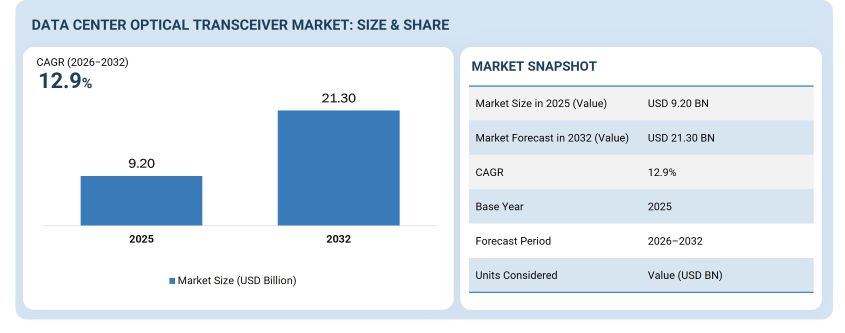
The global data center optical transceiver market was valued at USD 9.2 billion in 2025 and is projected to reach USD 21.3 billion by 2032, advancing at a compound annual growth rate (CAGR) of 12.9% during the forecast period 2026 to 2032. This growth trajectory is fundamentally shaped by the explosive acceleration of AI-driven workloads, which demand unprecedented bandwidth across GPU clusters, spine-leaf fabrics, and long-haul interconnects — rendering legacy copper and lower-speed optical solutions structurally insufficient for next-generation data center architectures.
Asia Pacific is the fastest-growing region, propelled by massive hyperscale data center buildouts in China, India, and Southeast Asia, combined with state-backed digital infrastructure programs and surging AI compute demand. North America commands the largest revenue base, anchored by the hyperscale capex of Amazon Web Services, Microsoft Azure, Google Cloud, and Meta — all of which are in active multi-year upgrades to 400G and 800G optical interconnect architectures.
Top 10 Key Takeaways
- North America holds the largest revenue share, driven by the hyperscale capital expenditure of AWS, Microsoft Azure, Google Cloud, and Meta.
- Asia Pacific is the fastest-growing region, fueled by aggressive data center capacity expansion in China, India, and Southeast Asia.
- The 400G data rate segment currently leads by volume, while 800G and 1.6T are the fastest growing, driven by AI/ML cluster interconnect requirements.
- Hyperscale data centers represent the dominant application vertical, with cloud service providers and colocation operators also registering strong demand.
- Silicon photonics is the fastest-growing technology platform, displacing legacy DFB-based architectures in high-density, power-constrained environments.
- QSFP-DD and OSFP form factors are displacing older QSFP28 modules as the industry standard for 400G and above deployments.
- Co-Packaged Optics (CPO) represents the most disruptive near-term technology shift, with commercial deployments beginning to emerge by 2025–2026.
- Key companies — including Coherent Corp., Lumentum, InnoLight, and Sumitomo Electric — are accelerating R&D investment in 1.6T-capable product lines.
- The primary near-term risk is supply chain concentration in China-based manufacturing, heightened by 2025 US tariff policies affecting optoelectronic components.
- Businesses that proactively qualify for next-generation transceiver platforms and diversify their optical supply chains will secure a decisive competitive advantage through the forecast period.
Market Overview: Why Data Center Optical Transceivers Matter Now
Data center optical transceivers are no longer a commodity line item — they have become a strategic infrastructure enabler. As AI model training and inference workloads migrate to massive GPU clusters requiring terabit-scale east-west bandwidth, the transceiver has emerged as a critical throughput bottleneck and a primary driver of data center capex allocation. The transition from 100G to 400G is largely complete among hyperscale’s, while 800G is moving rapidly from qualification to volume deployment, and 1.6T is already on product roadmaps from multiple vendors.
The macro tailwinds converging on this market are unusually powerful and reinforcing. Generative AI adoption is forcing hyperscale’s to reconfigure entire data center fabrics for GPU-dense computing. Simultaneously, sustainability mandates are pushing operators toward higher-bandwidth, lower-power-per-bit optical solutions. Regulatory frameworks in the EU and the United States are accelerating digital infrastructure investment while setting energy efficiency standards that favor optical over copper interconnects. The net effect is a structural demand upgrade cycle that is expected to persist well beyond the immediate AI investment wave.
At the same time, the supply side is undergoing its own transformation. Silicon photonics is maturing from a niche technology into the dominant manufacturing platform for high-volume transceiver production. Co-Packaged Optics is moving from laboratory demonstration to early commercial deployment, with implications for the entire value chain — from chip designers to module makers to system integrators. These structural shifts are creating both opportunities for incumbents willing to invest in next-generation platforms and risk for those wedded to legacy architectures.
Market Trends Shaping the Data Center Optical Transceiver Industry
The most consequential trend reshaping the data center optical transceiver market is the acceleration of AI GPU cluster connectivity requirements. Training large language models (LLMs) and multimodal AI systems at scale demands that thousands of GPU nodes communicate with near-zero latency across intra-cluster fabrics. This is driving a direct pull for 400G, 800G, and, increasingly, 1.6T transceivers in QSFP-DD and OSFP form factors — form factors that deliver the port density and power efficiency that AI data center architects require. Companies like NVIDIA, with its NVLink and InfiniBand ecosystems, and hyperscale’s designing proprietary AI fabrics, are effectively setting the pace of transceiver generation transitions.
Co-Packaged Optics represents the next architectural inflection point. Rather than plugging optical modules into switch front panels, CPO integrates photonic engines directly onto switch ASIC packages, dramatically reducing electrical signaling loss and power consumption at high data rates. Intel, Broadcom, and several startups are actively developing CPO-ready platforms, and hyperscale interest is intensifying as 1.6T and beyond become engineering priorities. The transition to CPO will not eliminate pluggable transceivers — both form factors will coexist — but it will reshape the competitive landscape and the share of value captured at different layers of the optical interconnect stack.
Silicon photonics is redefining manufacturing economics. By leveraging standard CMOS fabs to produce photonic integrated circuits (PICs), silicon photonics dramatically reduces the bill-of-materials cost for high-speed transceivers and enables integration of multiple optical functions on a single die. Coherent Corp., Intel Optical, and a growing number of fabless designers are scaling silicon photonics platforms. The technology is particularly well-suited for 400G and above, where the density and cost advantages over III-V semiconductor approaches become decisive.
The 800G standard is in active volume ramp. Following the IEEE 802.3df standard ratification, multiple vendors have launched or are sampling 800G QSFP-DD and OSFP modules with silicon photonics or EML-based implementations. Hyperscale’s including Meta and Microsoft are actively qualifying 800G platforms for deployment in AI training clusters, with volume procurement expected to accelerate through 2025 and 2026. The pipeline behind 800G — 1.6T, using eight lanes of 200G signaling — is already in qualification at leading vendors.
Market Drivers: Forces Accelerating Optical Transceiver Demand
The most powerful demand driver is the sustained and accelerating capital expenditure of hyperscale cloud operators in data center infrastructure. Amazon, Microsoft, Google, and Meta collectively announced or committed well over USD 200 billion in combined data center capex in 2024 alone, much of it earmarked for AI compute build-out. Every GPU cluster deployment translates directly into transceiver procurement, as connecting thousands of GPU nodes requires tens of thousands of high-speed optical links. This hyperscale capex cycle shows no sign of abating through the forecast period.
Generative AI and large-scale machine learning are not merely stimulating demand — they are fundamentally changing the bandwidth profile required. Unlike traditional cloud workloads, where east-west traffic follows relatively predictable patterns, AI training workloads are all-to-all communication intensive, requiring every GPU to communicate with every other GPU in a cluster simultaneously. This demands flat, high-bandwidth fabrics that optical transceivers uniquely enable at scale. The shift from 100G to 400G to 800G is being pulled forward on AI timelines, not traditional data center refresh cycles.
Edge computing and distributed data center architectures are broadening the addressable market. As latency-sensitive applications — autonomous vehicles, industrial IoT, real-time video processing — push computing closer to the network edge, the number of distinct data center locations requiring optical interconnect is expanding rapidly. This is creating demand for transceivers in smaller form factors and at shorter reach specifications, supplementing the hyperscale volume that has historically dominated the market.
National digital infrastructure programs across Asia Pacific, the Middle East, and Europe are generating a new layer of structural demand. India's Digital India initiative, Saudi Arabia's Vision 2030 data center investments, and the EU's Digital Decade policy framework are collectively funding new data center construction at a pace that has no historical precedent outside of China's build-out in the 2015–2020 period. Each of these programs creates a multi-year pipeline of optical transceiver demand that is largely incremental to the hyperscale capex cycle.
Market Challenges and Restraints
Supply chain concentration poses the most immediate structural risk. A significant share of global optical transceiver manufacturing — particularly for high-volume, cost-sensitive segments — is concentrated in China. The 2025 US tariff landscape, including expanded tariffs on photonic components and optical networking equipment, has forced hyperscalers and system integrators to begin qualifying alternative supply sources in Taiwan, Japan, South Korea, and Vietnam. This supply chain reorientation is costly, time-consuming, and creates near-term margin pressure across the industry.
The power consumption challenge is intensifying as data rates scale. An 800G transceiver consumes meaningfully more power than a 400G device, and at the port densities required by AI clusters, the aggregate thermal load becomes a significant constraint on deployment density and data center cooling economics. Vendors are investing heavily in lower-power silicon photonics and co-packaged architectures to address this, but the power-per-bit reduction curve has not fully kept pace with bandwidth escalation.
Interoperability and standards fragmentation create friction in procurement and deployment. While IEEE and OIF standards bodies have made significant progress with 400G and 800G standards, the diversity of MSA specifications, vendor-specific implementations, and proprietary coherent DSP platforms means that operators cannot assume plug-and-play compatibility across vendor ecosystems. This increases qualification burden and slows the speed at which new generations can be deployed at scale.
Price erosion in legacy segments creates margin pressure for vendors. As 400G approaches commodity status, average selling prices in that segment are declining sharply, even as the cost to develop and qualify 800G and 1.6T products is rising. Vendors with insufficient scale or differentiated technology are being squeezed between falling ASPs in mature segments and escalating R&D costs in next-generation platforms.
Industry and Application Vertical Growth
Hyperscale data centers are, by a significant margin, the defining application vertical for this market. Amazon Web Services, Microsoft Azure, Google Cloud Platform, and Meta Platform's internal data center operations collectively account for the largest share of optical transceiver procurement globally. Their AI infrastructure build-outs — training clusters running on NVIDIA H100 and Blackwell GPUs, connected via 400G and 800G optical fabrics — are the single largest volume pull for next-generation transceivers. These operators also set product generation timelines; when AWS or Meta begins qualifying 800G modules, the rest of the industry follows.
Cloud service providers beyond the top four hyperscalers — including Oracle Cloud, IBM Cloud, Alibaba Cloud, and Tencent Cloud — represent the second tier of demand and are growing rapidly as enterprise AI adoption broadens the addressable cloud market. These operators are typically one generation behind the hyperscalers in transceiver generation but represent significant additional volume for 400G and early-stage 800G deployments.
Colocation data center operators — led by Equinix, Digital Realty, NTT, and CyrusOne — are a growing and distinct demand center. As enterprises accelerate hybrid cloud strategies and locate workloads in third-party facilities, colocation operators are upgrading their interconnect fabrics to match hyperscaler-grade bandwidth specifications. This is expanding the 400G addressable market into the enterprise-adjacent colocation segment, which was historically dominated by lower-speed products.
Edge computing facilities and telecom central offices represent a smaller but structurally expanding application segment. The deployment of 5G networks and multi-access edge compute (MEC) nodes is creating a distributed layer of compute facilities that require compact, low-power optical transceivers for fronthaul, midhaul, and backhaul connectivity. This segment's growth complements the core hyperscale story and diversifies the market's demand base.
Segment Insights: Data Center Optical Transceiver Market
Data Center Optical Transceiver Market, By Form Factor
The QSFP-DD (Quad Small Form Factor Pluggable Double Density) form factor currently leads the market in revenue terms, having become the de facto standard for 400G deployments across hyperscale and cloud operator environments. Its eight-lane electrical interface and backward compatibility with QSFP28 infrastructure made it the natural transition vehicle from 100G to 400G, and its adoption has been near-universal among switch silicon providers and system integrators. The installed base of QSFP-DD infrastructure is now substantial enough to sustain strong replacement demand through the mid-point of the forecast period.
The OSFP (Octal Small Form Factor Pluggable) form factor is gaining momentum as the fastest-growing segment, driven by its ability to accommodate higher-power, higher-bandwidth transceivers — specifically for 800G and 1.6T applications — without the thermal limitations that constrain QSFP-DD at these speeds. NVIDIA and several hyperscalers have standardized on OSFP for their latest AI switch platforms, creating a pull that is beginning to shift vendor product roadmaps toward OSFP as the primary platform for next-generation deployments. Co-Packaged Optics, while nascent, is the most strategically watched emerging form factor.
Data Center Optical Transceiver Market, By Data Rate
The 400G data rate segment holds the dominant position in the current market, reflecting both the maturity of the technology and the breadth of its deployment across hyperscale, cloud, and colocation environments. 400G has moved from early adopter to mainstream procurement in the 2023–2025 timeframe, and average selling prices have declined substantially as manufacturing scale has increased. The segment's leading position reflects both volume and the fact that a large portion of the installed base upgrades from 100G are being executed today.
The 800G segment is growing at the fastest rate from a percentage perspective, as hyperscaler AI infrastructure procurement shifts decisively toward this generation. Multiple vendors have moved 800G from sampling to volume shipment, and the qualification timelines at major cloud operators are compressing as the urgency around AI cluster capacity escalates. Beyond 800G, the 1.6T segment — while still in early development — is already attracting design-win commitments from leading hyperscalers, and vendors are investing in the DSP and photonics platforms needed to address this next data rate inflection.
Data Center Optical Transceiver Market, By Technology
DFB (Distributed Feedback Laser)-based single-mode transceivers currently command the broadest deployment across data rates from 100G to 400G in enterprise and cloud environments, owing to their established manufacturing maturity, well-understood reliability profiles, and broad vendor availability. Single-mode DFB solutions have been the workhorse of data center interconnect at distances beyond 100 meters, and the installed base supporting this technology continues to generate meaningful demand for both new deployments and replacement cycles.
Silicon photonics-based transceivers are the fastest-growing technology category, leveraging CMOS manufacturing economics to deliver high integration density, lower power consumption per bit, and a scalable platform for reaching 800G and 1.6T data rates. The economics of silicon photonics become increasingly compelling at 400G and above, where the cost advantages over III-V semiconductor approaches compound with each generation. Leading vendors — including Intel Optical, Coherent Corp., and a cohort of fabless designers — are scaling silicon photonics production capacity aggressively to meet the AI-driven demand surge.
Data Center Optical Transceiver Market, By Application
Hyperscale data centers represent the leading application segment by a wide margin, driven by the AI infrastructure investments of Amazon, Microsoft, Google, and Meta. These operators procure transceivers at a scale that sets the market's pace and direction, and their qualification decisions effectively determine which product generations achieve volume status and which technologies achieve commercial viability. The concentration of demand in this vertical creates strong pricing leverage for hyperscalers but also creates a reliable, high-volume demand signal for vendors aligned with their roadmaps.
Edge computing facilities are the fastest-growing application segment within the market, albeit from a smaller base. The proliferation of edge compute nodes driven by 5G deployment, autonomous systems, and real-time AI inference applications is creating a distributed and geographically diverse demand for optical transceivers in form factors and reach specifications that differ from the hyperscale core. The growth of this segment is expected to accelerate as enterprise AI inference workloads increasingly migrate toward edge architectures through the forecast period.
Key Segmentation Conclusions
- QSFP-DD is the dominant form factor today; OSFP is the fastest-growing form factor for 800G and above, with Co-Packaged Optics as the most watched emerging platform.
- 400G leads by volume; 800G is the fastest-growing data rate segment, with 1.6T on the near-term commercial horizon.
- Silicon photonics is displacing DFB-based architectures as the preferred manufacturing platform for next-generation, high-density transceiver designs.
- Hyperscale data centers dominate application demand; edge computing is the fastest-growing application vertical from a growth rate perspective.
- Coherent optical technology — historically confined to long-haul telecom — is beginning to penetrate the data center interconnect market for high-capacity, medium-reach applications.
Regional Analysis: Data Center Optical Transceiver Market
North America
North America is the largest regional market for data center optical transceivers, reflecting the extraordinary concentration of hyperscale cloud infrastructure in the United States. The hyperscale campuses of Amazon, Microsoft, Google, and Meta span tens of millions of square feet across Virginia, Iowa, Oregon, and Texas, and these operators are in continuous, multi-year optical upgrade cycles. The AI computing wave has further compressed upgrade timelines, with 400G deployments now standard and 800G qualifications accelerating. Canada is emerging as a meaningful supplementary market, with its renewable energy advantages attracting hyperscale campuses and positioning it as a preferred location for energy-intensive AI compute. Mexico is earlier in its data center development cycle but is benefiting from nearshoring trends and cross-border enterprise connectivity investment. North America was valued at approximately USD 3.2 billion in 2025 and is expected to reach USD 7.1 billion by 2032, growing at a CAGR of 12.1% during the forecast period.
Europe
Europe represents the third-largest regional market, shaped by a distinct set of regulatory and structural dynamics that distinguish it from North America and Asia Pacific. The EU's AI Act, the Data Act, and the European Green Deal are creating a compliance environment that is simultaneously driving data localization (supporting new data center construction) and imposing energy efficiency requirements that favor high-bandwidth, low-power-per-bit optical solutions. Germany leads European demand, with Frankfurt serving as a pan-European colocation and interconnection hub. The United Kingdom, France, and the Netherlands are also significant markets, with active hyperscale and colocation build-outs. The Nordic region — particularly Sweden and Finland — has emerged as a preferred location for renewable-powered hyperscale campuses. Europe was valued at approximately USD 1.7 billion in 2025 and is projected to reach USD 3.6 billion by 2032, at a CAGR of 11.2%.
Asia Pacific
Asia Pacific is the fastest-growing regional market, driven by a convergence of government-backed digital infrastructure programs, rising domestic cloud demand, and aggressive AI investment by both hyperscalers and domestic technology champions. China remains the dominant market within the region, with Alibaba Cloud, Tencent Cloud, Huawei Cloud, and ByteDance all executing large-scale data center build-outs. Domestic transceiver manufacturers — including Accelink, InnoLight, Eoptolink, and HG Genuine — have established significant production scale, making China a uniquely vertically integrated market. India is the fastest-growing sub-market within APAC, fueled by the Digital India initiative, growing hyperscale campuses from AWS, Google, and Microsoft, and a rapidly digitalizing enterprise sector. Singapore and Japan serve as regional interconnection hubs with strong demand for high-performance optical interconnects. Asia Pacific was valued at approximately USD 3.8 billion in 2025 and is projected to grow to USD 9.6 billion by 2032, at a CAGR of 14.2%.
Rest of World
The Rest of World segment — encompassing Latin America, the Middle East, and Africa — is the smallest but an increasingly active market, driven by sovereign digital ambition and data center investment programs that have no precedent in these regions. Saudi Arabia's Vision 2030 initiative includes major commitments to cloud and AI infrastructure, with hyperscalers including AWS, Microsoft, and Google establishing Middle East Points of Presence. The UAE, anchored by Dubai and Abu Dhabi, is the most mature data center market in the region, with active colocation and cloud operator investment. Brazil is the leading Latin American market, with Equinix, Ascenty, and domestic players expanding footprint to serve the region's growing enterprise cloud demand. South Africa is the most advanced sub-Saharan African data center market but remains small in absolute terms. The Rest of World region was valued at approximately USD 0.5 billion in 2025 and is expected to reach USD 1.0 billion by 2032, growing at a CAGR of 10.4%.
Regional Outlook Summary
- North America is the largest market, driven by hyperscale AI infrastructure investment from Amazon, Microsoft, Google, and Meta.
- Asia Pacific is the fastest-growing region, led by China's vertically integrated transceiver supply chain and India's rapidly expanding digital infrastructure.
- Europe's growth is regulation-shaped, with data localization requirements and green energy mandates driving differentiated demand patterns.
- The Middle East — particularly Saudi Arabia and the UAE — is emerging as a structurally significant new market driven by sovereign AI ambition.
- The Rest of World segment, while smallest in absolute terms, is growing on the back of first-wave data center builds that create durable long-term demand.
Country-Specific Insights
United States
The US is the global epicenter of AI data center investment, with Northern Virginia (Data Center Alley), the Pacific Northwest, and Texas functioning as the world's highest-density transceiver deployment environments. Federal initiatives — including the CHIPS and Science Act and DOE data center efficiency standards — are shaping both the pace of build-out and the technology specifications required. Hyperscale procurement teams at AWS, Microsoft, and Google effectively co-develop transceiver roadmaps with leading vendors, making US procurement decisions the de facto global standard-setting mechanism for the industry.
China
China combines the world's largest domestic transceiver manufacturing base with an enormous and rapidly growing end-market. Domestic champions — Alibaba Cloud, Tencent Cloud, and Huawei Cloud — are executing hyperscale build-outs that rival their US counterparts in scale. The government's "Eastern Data, Western Computing" initiative is driving data center construction into inland provinces, creating new demand nodes. Chinese transceiver vendors benefit from close proximity to end customers, deep supply chain integration, and government support for domestic technology development.
India
India is the most dynamic emerging market for data center optical transceivers, transitioning from a minor market to a significant volume contributor within the forecast period. AWS, Google, Microsoft, and Oracle have all committed to multi-billion-dollar Indian data center investments. The Indian government's National Data Center Policy and the production-linked incentive schemes for electronics manufacturing are both stimulating demand and beginning to attract supply chain investment. Mumbai, Chennai, Hyderabad, and Pune are the primary data center hubs, with capacity expanding rapidly.
Germany
Germany's position as Europe's manufacturing and financial hub makes Frankfurt the continent's most important data center interconnection point and a consistently strong market for optical transceivers. German industrial companies — in automotive, chemicals, and machinery — are the most advanced European adopters of private cloud and edge computing, creating enterprise-driven transceiver demand alongside the hyperscale and colocation layers. The German government's data sovereignty requirements effectively mandate domestic data center operations for critical workloads, providing structural demand support.
Singapore
Singapore occupies a strategically outsized position in the Asia Pacific optical transceiver market, serving as the primary interconnection hub for Southeast Asia and a preferred hyperscale location due to its political stability, infrastructure quality, and connectivity. Following a temporary data center moratorium lifted in 2022, Singapore has seen a wave of new hyperscale campuses, with Amazon, Google, and Microsoft all expanding aggressively. Its role as a financial center and regional headquarters location for multinational corporations creates sustained enterprise demand alongside the hyperscale volume.
Country-Level Conclusions
- The United States functions as the global standard-setting market, where hyperscale procurement decisions define product generation timelines for the entire industry.
- China combines the world's largest transceiver manufacturing base with a massive and fast-growing domestic end market, making it both the leading supplier and a leading consumer.
- India is the fastest-growing national market in absolute capex terms, driven by hyperscale investment commitments and a rapidly digitalizing economy.
- Germany anchors European demand as the continent's primary data center interconnection hub and the most digitally advanced industrial economy.
- Singapore's role as Southeast Asia's connectivity hub gives it structural transceiver demand that exceeds what its physical size would suggest.
Key Company Insights: Data Center Optical Transceiver Market
The data center optical transceiver market is served by a mix of vertically integrated photonics companies, specialized module manufacturers, and system integrators with optical networking divisions. Leading players include Coherent Corp. (incorporating II-VI and Finisar), Lumentum Holdings, InnoLight Technology, Sumitomo Electric Industries, Fujitsu Optical Components, Accelink Technologies, HG Genuine (HiSense Broadband), Eoptolink Technology, Source Photonics, Broadcom, Marvell Technology, and Cisco Systems.
- Coherent Corp. (incorporating II-VI and Finisar)
- Lumentum Holdings
- InnoLight Technology
- Sumitomo Electric Industries
- Fujitsu Optical Components
- Accelink Technologies
- HG Genuine (HiSense Broadband)
- Eoptolink Technology
- Source Photonics
- SENKO Advanced Components
- Broadcom Inc.
- Marvell Technology
- Cisco Systems
- Intel Optical
- Inphi (part of Marvell)
Coherent Corp. has pursued an aggressive integration strategy following the merger of II-VI and Finisar, positioning itself as a full-stack photonics supplier spanning chips, components, and transceivers across 400G, 800G, and coherent platforms. The company is investing heavily in silicon photonics and co-packaged optics R&D to maintain a technology lead in the AI-driven upgrade cycle. Lumentum, meanwhile, has refocused its data center transceiver business around high-performance indium phosphide components and silicon photonics platforms for next-generation applications. InnoLight Technology has emerged as a formidable volume player, having secured design wins at multiple top four hyperscalers for 400G QSFP-DD modules and actively sampling 800G OSFP solutions. Accelink and Eoptolink represent the scale and cost competitiveness of Chinese module manufacturers, which have captured substantial share in the 100G-to-400G transition and are investing in 800G capability. Broadcom's optical connectivity group and Marvell's DSP division occupy a unique position — they supply silicon intelligence inside many third-party transceiver modules, giving them embedded influence over next-generation product specifications. Cisco's investment in optical networking reflects its strategy to offer end-to-end data center fabric solutions, including proprietary optical technology developed through its Silicon One and CPAK programs.
Key Company Strategy Conclusions
- Coherent Corp. is pursuing a full-stack integration strategy, combining chips, component, and module capabilities to capture value across the optical transceiver supply chain.
- InnoLight Technology has emerged as a key volume supplier to hyperscalers, competing aggressively in the 400G market and investing in next-generation 800G platforms.
- Chinese module makers — Accelink, Eoptolink, and HG Genuine — are leveraging manufacturing scale to compete on cost in the 100G–400G range while upgrading capabilities for 800G.
- Broadcom and Marvell occupy strategic positions as DSP and silicon suppliers, embedding their technology inside modules produced by multiple competing module vendors.
- The competitive landscape is consolidating at the chip and component level while fragmenting at the module level, creating a tiered structure with distinct competitive dynamics at each layer.
Recent Developments
- In January 2025, Coherent Corp. announced commercial availability of its 800G OSFP transceivers based on silicon photonics for hyperscale data center deployments, targeting AI cluster interconnect applications.
- In February 2025, Lumentum Holdings announced a partnership to supply 800G EML chips to multiple Asian transceiver module manufacturers, expanding its component revenue beyond captive use.
- In March 2025, InnoLight Technology reported volume shipments of 400G QSFP-DD DR4 modules to a major North American hyperscaler, marking a significant design-win milestone.
- In April 2025, Marvell Technology unveiled its 1.6T optical DSP platform at OFC 2025, designed to enable the next generation of co-packaged and pluggable transceiver solutions for AI data center fabrics.
- In May 2025, Broadcom launched its next-generation optical connectivity chip with integrated silicon photonics support, targeting co-packaged optics deployments in 51.2T switch platforms.
Real-World Use Cases
In 2024, Meta Platforms announced the deployment of 800G optical transceivers across its AI Research SuperCluster (RSC) infrastructure, transitioning its highest-density GPU training clusters from 400G to 800G interconnects. The migration was driven by the bandwidth demands of training large multimodal AI models, where 400G links had become the binding constraint on cluster scaling efficiency. Meta worked with multiple transceiver vendors to qualify 800G OSFP modules meeting its power and reliability specifications, and the deployment demonstrated that 800G technology had reached the maturity required for production-grade hyperscale operations.
In 2023 and 2024, Equinix — one of the world's largest colocation data center operators — executed a systematic upgrade of its IBX interconnection fabric across key North American and European campuses from 100G to 400G optical infrastructure, supported by its ecosystem of network service providers and cloud on-ramp partners. The upgrade was motivated by the growing bandwidth demands of enterprise hybrid cloud architectures and the increasing concentration of AI workloads among Equinix's customer base. The deployment covered thousands of cross-connect ports across dozens of data centers and required coordination with multiple transceiver vendors and switch suppliers.
Market Segmentation: Data Center Optical Transceiver Market
The data center optical transceiver market is segmented across five primary dimensions, reflecting the multi-layered purchasing decision that operators make when specifying optical interconnect infrastructure. By form factor, the market spans the full hierarchy from legacy SFP/SFP+ at the access layer through QSFP28 and QSFP-DD at the 100G–400G tier to OSFP for 800G and above, with Co-Packaged Optics emerging as a distinct architectural category. By data rate, the market stratifies from sub-100G legacy infrastructure through the volume 400G tier to the rapidly growing 800G generation and the nascent 1.6T market. By technology platform, the key dimension is the shift from VCSEL-based multimode and DFB-based single-mode architectures toward silicon photonics and EML-based designs, with coherent optical technology penetrating the data center interconnect market from the telecom domain. By application, the market bifurcates between hyperscale and cloud operator demand — which drives volume and technology direction — and the broader enterprise, colocation, and edge computing demand that accounts for diversification. By region, the market is shaped by the North American hyperscaler concentration, the Asian manufacturing and demand integration, European regulatory differentiation, and the emerging Rest of World markets.
Segmentation Summary
- The form factor transition from QSFP-DD to OSFP is the most commercially significant near-term segmentation shift, driven by the power and density requirements of 800G and above.
- Data rate segmentation reveals a two-speed market: 400G in high-volume, commoditizing terrain; 800G and 1.6T in high-growth, high-margin early-adoption phase.
- Technology segmentation underscores silicon photonics as the dominant platform for the next generation, with coherent technology expanding from long-haul into data center reach applications.
- Application segmentation highlights the structural primacy of hyperscale and cloud demand while flagging edge computing as the fastest-growing incremental demand vector.
- Regional segmentation reveals that APAC is the most dynamic demand growth region, while North America sets the pace of technology generation adoption.
Conclusion and Future Outlook
The data center optical transceiver market is entering one of its most transformative periods since the transition from 10G to 100G. Artificial intelligence is not merely a demand driver — it is redefining the architectural requirements for optical interconnect from the inside out. As GPU clusters scale from hundreds to thousands to tens of thousands of accelerators, the bandwidth, latency, and power efficiency requirements of their optical fabric escalate correspondingly, pulling transceiver technology forward at a pace that exceeds the historical cycle. The shift to 800G, the emergence of 1.6T, and the transition toward co-packaged optics are not incremental improvements — they are step-change transitions that will reshape competitive positions across the value chain.
Through the forecast period to 2032, the market's trajectory is anchored by three durable structural forces: the hyperscaler AI capex cycle, the broadening of data center demand across cloud, colocation, and edge tiers, and the geographic expansion of digital infrastructure investment into Asia, the Middle East, and Latin America. For businesses operating in this space — whether as transceiver vendors, chip designers, system integrators, or end-user operators — the strategic imperative is clear: invest early in next-generation platforms, qualify supply chains against geopolitical and tariff risk, and align roadmaps with the hyperscaler decision-makers who will ultimately determine which technologies achieve volume status. The companies that navigate this transition with speed and precision will be disproportionate beneficiaries of a market poised to more than double over the next seven years.
Frequently Asked Questions (FAQ)
Q1. How big is the data center optical transceiver market?
The global data center optical transceiver market was valued at approximately USD 9.2 billion in 2025. The market is projected to grow to USD 21.3 billion by 2032, driven primarily by AI infrastructure build-outs at hyperscale cloud operators and the industry-wide transition to 400G and 800G optical interconnect architectures.
Q2. What is the data center optical transceiver market growth rate?
The data center optical transceiver market is expected to grow at a CAGR of 12.9% from 2026 to 2032. Asia Pacific is the fastest-growing region, projected to outpace the global average on the strength of China, India, and Southeast Asia digital infrastructure investment. North America, as the largest regional market, is also growing at a robust pace driven by hyperscaler AI capex.
Q3. Which segment leads the data center optical transceiver market?
The 400G data rate segment currently leads the market by revenue volume, having reached mainstream deployment status across hyperscale and cloud operator environments. By form factor, QSFP-DD is the dominant module standard. By application, hyperscale data centers — operated by Amazon, Microsoft, Google, and Meta — account for the largest share of procurement globally.
Q4. Who are the key players in the data center optical transceiver market?
The leading players in the data center optical transceiver market include Coherent Corp. (incorporating II-VI and Finisar), Lumentum Holdings, InnoLight Technology, Sumitomo Electric Industries, Accelink Technologies, Eoptolink Technology, Source Photonics, Broadcom, Marvell Technology, and Cisco Systems. Chinese module manufacturers — InnoLight, Accelink, Eoptolink, and HG Genuine — have captured significant share in the 100G–400G volume market and are competing actively in 800G.
Q5. What are the factors driving the data center optical transceiver market?
The primary growth drivers are the AI-driven hyperscaler capex cycle, which is pulling forward the adoption of 400G, 800G, and 1.6T optical interconnect; the expansion of cloud and colocation data center capacity globally; the proliferation of edge computing nodes tied to 5G deployment; and national digital infrastructure investment programs across Asia Pacific, the Middle East, and Europe. Silicon photonics maturation, which is reducing cost per bit at high data rates, is a complementary technology driver enabling both demand growth and supply scale.
 Exclusive indicates content/data unique to MarketsandMarkets and not available with any competitors.
TABLE OF CONTENTS
1 Introduction
1.1 Study Objectives
1.2 Market Definition and Scope
1.3 Inclusions and Exclusions
1.4 Study Scope
1.4.1 Markets Covered
1.4.2 Geographic Segmentation
1.4.3 Years Considered
1.5 Currency Considered
1.6 Stakeholders
2 Research Methodology
2.1 Research Approach
2.2 Secondary Research
2.3 Primary Research
2.4 Market Size Estimation
2.4.1 Bottom-Up Approach
2.4.2 Top-Down Approach
2.5 Data Triangulation
2.6 Assumptions
3 Executive Summary
4 Premium Insights
5 Market Overview
5.1 Introduction
5.2 Market Dynamics
5.2.1 Drivers
5.2.2 Restraints
5.2.3 Opportunities
5.2.4 Challenges
5.3 Value Chain Analysis
5.4 Ecosystem Analysis
5.5 Investment & Funding Scenario
5.6 Pricing Analysis
5.7 Trends/Disruptions Impacting Customer Business
5.8 Technology Analysis
5.8.1 Key Technologies
5.8.2 Complementary Technologies
5.8.3 Adjacent Technologies
5.9 Porter’s Five Forces Analysis
5.10 Key Stakeholders & Buying Criteria
5.11 Case Study Analysis
5.12 Trade Analysis
5.13 Patent Analysis
5.14 Key Conferences & Events
5.15 Regulatory Landscape
5.16 Impact of AI/Gen AI on the Market
5.17 Impact of 2025 US Tariff on the Market
6 Industry Trends
6.1 800G/1.6T Transceiver Adoption Trends
6.2 Co-Packaged Optics (CPO) Transition
6.3 Silicon Photonics Integration
6.4 Pluggable vs. Co-Packaged Optics Trade-off
6.5 AI/ML Workload-Driven Bandwidth Escalation
6.6 Power Consumption and Thermal Management Trends
7 Technology Adoption & Standards Landscape
7.1 IEEE 802.3 Standards Roadmap
7.2 OIF CEI Standards and Implementation Agreements
7.3 MSA (Multi-Source Agreement) Framework
7.4 OpenROADM and Coherent Technology Standards
7.5 Technology Readiness Levels: 400G, 800G, 1.6T
8 Customer Landscape & Buyer Behavior
8.1 Decision-Making Process
8.2 Buyer Stakeholders
8.3 Adoption Barriers
8.4 Procurement Patterns Among Hyperscale’s vs. Colocation Providers
9 Data Center Optical Transceiver Market, By Form Factor
9.1 Introduction
9.2 SFP/SFP+/SFP28
9.3 QSFP/QSFP28/QSFP56
9.4 QSFP-DD (Double Density)
9.5 OSFP (Octal Small Form Factor Pluggable)
9.6 CFP/CFP2/CFP4/CFP8
9.7 Co-Packaged Optics (CPO)
10 Data Center Optical Transceiver Market, By Data Rate
10.1 Introduction
10.2 Less than 100G
10.3 100G
10.4 400G
10.5 800G
10.6 1.6T and Above
11 Data Center Optical Transceiver Market, By Technology
11.1 Introduction
11.2 VCSEL-Based Multimode Transceivers
11.3 DFB (Distributed Feedback Laser)-Based Single-Mode Transceivers
11.4 Silicon Photonics-Based Transceivers
11.5 EML (Electro-Absorption Modulated Laser)-Based Transceivers
11.6 Coherent Optical Transceivers
12 Data Center Optical Transceiver Market, By Application
12.1 Introduction
12.2 Hyperscale Data Centers
12.3 Enterprise Data Centers
12.4 Cloud Service Providers
12.5 Edge Computing Facilities
12.6 Colocation Data Centers
12.7 Telecom Central Offices / DCI
13 Data Center Optical Transceiver Market, By Region
13.1 Introduction
13.2 North America
13.2.1 United States
13.2.2 Canada
13.2.3 Mexico
13.3 Europe
13.3.1 Germany
13.3.2 United Kingdom
13.3.3 France
13.3.4 Italy
13.3.5 Spain
13.3.6 Nordics
13.3.7 Rest of Europe
13.4 Asia Pacific
13.4.1 China
13.4.2 Japan
13.4.3 India
13.4.4 South Korea
13.4.5 Australia
13.4.6 Singapore
13.4.7 Rest of Asia Pacific
13.5 Rest of World
13.5.1 Brazil
13.5.2 UAE
13.5.3 Saudi Arabia
13.5.4 South Africa
13.5.5 Rest of Row
14 Competitive Landscape
14.1 Overview
14.2 Key Player Strategies / Right to Win
14.3 Revenue Analysis
14.4 Market Share Analysis
14.5 Company Evaluation Matrix for Key Players
14.5.1 Stars
14.5.2 Emerging Leaders
14.5.3 Pervasive Players
14.5.4 Participants
14.6 Company Evaluation Matrix for Startups/SMEs
14.6.1 Progressive
14.6.2 Responsive
14.6.3 Dynamic
14.6.4 Starting Blocks
14.7 Competitive Benchmarking
14.8 Competitive Scenario
14.8.1 Product Launches
14.8.2 Deals
15 Company Profiles
15.1 II-VI Incorporated (Coherent Corp.)
15.2 Lumentum Holdings
15.3 InnoLight Technology
15.4 Finisar (part of Coherent Corp.)
15.5 Sumitomo Electric Industries
15.6 Fujitsu Optical Components
15.7 Accelink Technologies
15.8 HG Genuine (HiSense Broadband)
15.9 Eoptolink Technology
15.10 Source Photonics
15.11 SENKO Advanced Components
15.12 Broadcom Inc. (optical transceiver division)
15.13 Marvell Technology (optical DSP)
15.14 Cisco Systems (optical networking)
15.15 Inphi (part of Marvell)
16 Appendix
16.1 Discussion Guide
16.2 KnowledgeStore
16.3 Customization Options
16.4 Related Reports
16.5 Author Details













Growth opportunities and latent adjacency in Data Center Optical Transceiver Market