Data Center Painting, Coatings & ESD Flooring Market Size, Share, Trends & Growth Report by Architectural & Structural Paints and Coatings, Anti-Corrosion, Fire-Retardant Intumescent, Thermally Conductive, Antimicrobial, ESD Flooring Systems – Global Forecast to 2032


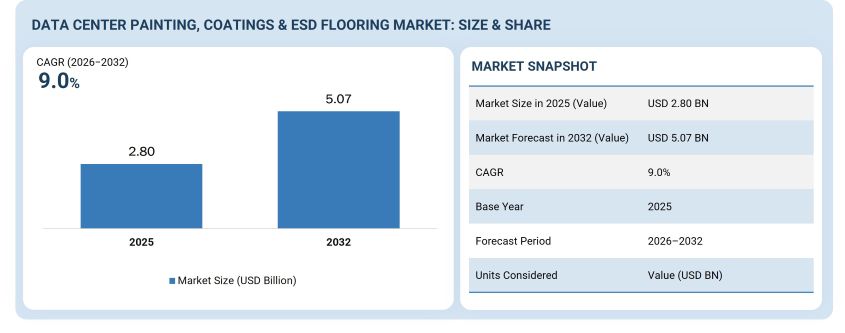
The global data center painting, coatings & ESD flooring market was valued at USD 2.80 billion in 2025 and is projected to reach USD 5.07 billion by 2032, growing at a compound annual growth rate (CAGR) of 9.0% during the 2026–2032 forecast period. This growth is being driven by an unprecedented wave of data center construction worldwide — fueled by hyperscale cloud expansion, AI infrastructure investment, and the proliferation of edge computing —where specialized coatings and electrostatic dissipative flooring have become critical to facility safety, operational resilience, and regulatory compliance.
Asia Pacific is the fastest-growing region, propelled by massive hyperscale data center construction in China and India, rapid digital infrastructure build-outs in Singapore and South Korea, and government-backed initiatives supporting AI and cloud capacity. North America retains the largest regional base, anchored by the US’s deep concentration of Tier III/IV and hyperscale facilities operated by cloud hyperscalers such as Amazon Web Services, Microsoft Azure, and Google Cloud.
Top 10 Key Takeaways
- North America holds the largest share of the global data center painting, coatings & ESD flooring market, anchored by a dense concentration of hyperscale and Tier III/IV facilities across Northern Virginia, Silicon Valley, Texas, and the Pacific Northwest.
- Asia Pacific is the fastest-growing region, driven by large-scale data center build programs in China, India, Singapore, and South Korea, underpinned by government AI and cloud infrastructure policies.
- ESD flooring systems represent the dominant product segment, given that electrostatic discharge control is a non-negotiable specification across virtually every data center tier and geography.
- Epoxy-based coating technology leads among formulation categories, valued for its chemical resistance, durability, and compatibility with stringent cleanroom and server hall environments.
- Hyperscale data centers are the fastest-growing end-user tier, with the AI-driven facility construction boom accelerating demand for large-volume coating and flooring specifications.
- Cloud and hyperscale providers are the leading end-user segment, with Amazon Web Services, Microsoft Azure, and Google driving the single largest volume of facility construction and fit-out globally.
- The transition to low-VOC and zero-VOC coating formulations is the defining regulatory technology shift, with EU REACH, EPA VOC standards, and LEED certification requirements reshaping procurement preferences.
- Fire-retardant intumescent coatings represent a high-growth niche, as Tier IV and hyperscale operators increasingly specify passive fire protection as a non-negotiable layer of infrastructure defense.
- The near-term strategic opportunity lies in the Middle East, where Saudi Arabia's Vision 2030 and UAE digital economy initiatives are driving a first wave of large-scale, high-specification data center construction.
- The primary near-term risk is raw material cost volatility — particularly for epoxy resins and specialty conductive additives — amplified by the 2025 US tariff policy affecting chemical and coating intermediates imported from key Asian and European suppliers.
Market Introduction
Data centers are no longer simple rooms that house servers. They are precision-controlled environments where every surface — walls, floors, structural steel — must perform to exacting standards. Coatings and flooring materials are integral to that performance. A poorly specified floor in a server hall can generate static discharges that corrupt data and destroy sensitive electronic components. An undersized fire-retardant coating on structural steelwork can compromise physical resilience in a facility designed for 99.9999% uptime. As facilities grow more critical and more complex, the materials that protect them have become a specialized discipline in their own right.
The macroeconomic context driving this market is well-documented. Global digital data creation is growing at a pace that demands continuous expansion of compute, storage, and network infrastructure. The AI wave that gathered momentum through 2023 and 2024 has translated directly into announced capital expenditure commitments from hyperscalers that dwarf previous investment cycles. Microsoft's multi-billion-dollar expansion with OpenAI, Amazon's declared USD 150 billion in AWS infrastructure investment through the decade, and Google's accelerated data center build programs across North America, Europe, and Asia Pacific are representative of a structural, multi-year demand signal. Each new megawatt of commissioned capacity requires compliant, durable surfaces.
At the same time, sustainability regulations are actively reshaping what materials can be used. European VOC directives, US EPA emissions standards, and global green building certification frameworks such as LEED and BREEAM are pushing operators and specifiers toward low-emission coating systems, water-based formulations, and environmentally certified ESD flooring products. Operators pursuing LEED Platinum certification — which is increasingly a corporate sustainability requirement rather than a differentiator — face tighter constraints on the entire palette of surface materials used in new and retrofit construction. This creates a technology refresh cycle layered on top of the structural growth in new capacity.
Data Center Painting, Coatings & ESD Flooring Market Trends
The single most consequential trend reshaping this market is the AI-driven hyperscale construction wave. When a facility is designed to house GPU clusters running continuous AI inference and training workloads, the thermal density per rack increases dramatically compared to conventional server deployments. Higher thermal density translates to more aggressive humidity cycling, greater heat stress on surfaces, and more intensive airflow patterns — all of which place greater demands on coating adhesion, thermal stability, and flooring resilience. Coating suppliers are responding with next-generation thermally conductive formulations and epoxy floor systems engineered specifically for high-density computing environments.
Low-VOC and zero-VOC coating formulations are transitioning from a premium option to a market baseline. The combination of tightening EU REACH compliance requirements, US EPA National Volatile Organic Compound Emission Standards, and the proliferation of LEED v4 and BREEAM 'Excellent' certified data centers has created a pull-through demand for low-emission coatings that mainstream suppliers are now competing aggressively to fulfill. Several major coatings manufacturers, including Sherwin-Williams and AkzoNobel, have announced reformulation programs across their industrial coatings lines with explicit data center applications in mind.
The edge computing infrastructure build-out is introducing a geographically fragmented but cumulatively significant demand channel. Unlike hyperscale facilities concentrated in a handful of major markets, edge data centers are being deployed in secondary cities, industrial zones, airports, hospitals, and retail environments across every major geography. Each deployment requires the same ESD flooring and compliant coating specifications as a large-scale facility — but at smaller volumes with faster turnaround timelines. This is driving demand for pre-mixed ESD floor systems, ready-to-apply coating kits, and technical support services calibrated for contractors who may not be fluent in data center specifications.
Smart coatings — formulations with functional properties beyond passive protection, including environmental sensors, thermal indicators, or self-healing chemistries — remain an emerging category but are attracting increasing R&D investment from major coatings houses. For data center applications, the most immediate commercially relevant manifestation is in coatings that can signal moisture intrusion or surface degradation without requiring physical inspection — a meaningful capability in facilities where maintenance access to active server environments is tightly controlled.
The 2025 US tariff environment has introduced near-term pricing complexity. Several key raw materials in specialty coating formulations — including epoxy resin intermediates, conductive carbon additives, and fluoropolymer components — are sourced from China or pass through supply chains affected by tariff adjustments announced in early 2025. This is accelerating nearshoring and supply chain diversification conversations among both coatings manufacturers and major data center operators with direct procurement teams.
Market Drivers
The primary demand driver is the structural expansion of global data center capacity. The AI compute cycle, cloud migration tailwinds, and the buildout of 5G-enabled edge infrastructure are collectively pushing unprecedented volumes of new construction starts. Every square foot of new facility generates direct demand for surface preparation, primer systems, wall and ceiling coatings, and ESD or conductive floor treatments. The International Data Corporation and industry trackers consistently project continued double-digit growth in data center capital expenditure through the end of this decade, providing a durable demand floor for this market.
Electrostatic discharge control requirements are a regulatory non-negotiable across data center tiers. ANSI/ESD S20.20 and IEC 61340 standards govern ESD management in electronic environments, and Uptime Institute certification processes effectively mandate compliant flooring specifications at every tier level. This creates a specification-driven demand that is largely price-inelastic — operators cannot substitute non-compliant materials without risking certification, insurance coverage, and equipment warranty validity. The regulatory mandate effectively floors demand regardless of the economic cycle.
Fire protection requirements are becoming more stringent as facility values and densities increase. NFPA 75 in North America and EN 1047-2 in Europe set the framework for fire protection of IT equipment, with implications for intumescent coatings on structural steel elements, cable penetration seals, and fire-rated wall systems. Hyperscale operators with multi-hundred-million-dollar equipment inventories are increasingly treating passive fire protection as a core engineering specification rather than a cost-reduction target. This is elevating average specification values and driving premiumization in the fire-retardant coatings sub-segment.
Sustainability certification requirements are reshaping material specifications across both new construction and retrofit cycles. LEED v4's Materials and Resources credits explicitly address VOC content, recycled content, and chemical safety of building materials — including interior coatings and flooring. BREEAM's equivalent categories influence specifications across European and UK data centers. For operators targeting certification, the materials bill of a facility is a direct input to certification scoring, creating a procurement incentive to specify compliant products even where local regulations do not yet mandate it.
The retrofit and maintenance cycle represents a growing share of total demand. As the installed base of data centers ages — particularly the large cohort of facilities built during the 2010–2018 construction wave — coating maintenance, recoating, and floor system replacement create a recurrent revenue stream for manufacturers. Maintenance cycles for epoxy floor systems in high-traffic data centers typically run at five to eight years, depending on traffic patterns and cleaning regimes, generating a predictable pull-through demand independent of new construction.
Market Challenges & Restraints
Raw material cost volatility remains the most acute operational challenge for coatings manufacturers serving this segment. Epoxy resins, specialty conductive fillers, and fluoropolymer components are subject to supply chain disruptions and price swings driven by petrochemical feedstock dynamics, freight costs, and — most recently — tariff policy. When raw material costs spike, manufacturers face a binary choice between margin compression and price increases that risk losing specifications to competing systems. Neither outcome is structurally comfortable, and the 2025 tariff environment has reactivated this challenge after a period of relative input cost stability.
Downtime constraints during retrofit and refurbishment projects create significant adoption barriers. Unlike greenfield construction, where surface treatments can be applied in an unoccupied facility, retrofit work in operating data centers must be performed in active environments with equipment running. Many coating systems — particularly solvent-borne epoxies and polyurethanes — require cure times, ventilation conditions, and surface preparation regimes incompatible with live data center operations. This forces operators to use less technically optimal formulations, accept higher scheduling costs, or defer maintenance beyond optimal cycles. The market for truly fast-cure, ultra-low-VOC, minimal-downtime coating systems for active facilities remains underpenetrated relative to its potential.
Technical specification complexity creates barriers at the procurement and contractor level. Data center surface specifications require an understanding of electrostatic control requirements, fire ratings, chemical compatibility with cleaning agents used in server environments, and the interactions between different system layers. Many general contractors and facility management teams lack the in-house expertise to evaluate competing systems on technical merit, creating a tendency to default to incumbent suppliers or lowest-cost bids — neither of which necessarily produces the best outcome. This knowledge gap is a structural headwind to premiumization and product innovation diffusion.
Competitive pressure from locally manufactured low-cost alternatives — particularly in Asia Pacific and the Middle East — is a persistent challenge for international branded coatings and flooring suppliers. While specification standards at Tier III/IV and hyperscale facilities increasingly require internationally certified products, Tier I/II and smaller edge deployments are more price-sensitive and more susceptible to substitution with locally produced systems that may not carry equivalent certifications or performance guarantees.
Industry / Application Growth Analysis
Cloud and hyperscale provider facilities are the dominant demand vertical and the engine of growth throughout the forecast period. The construction programs announced by Amazon Web Services, Microsoft Azure, Google Cloud, and Meta Platforms represent the largest pipeline of high-specification data center builds in history. These operators apply rigorous materials standards across their global portfolios — typically prescriptive specifications developed by internal engineering teams that mandate specific ESD flooring resistance ranges, coating VOC limits, and fire-retardant performance thresholds. The scale and standardization of hyperscale procurement create a high-volume, repeat-purchase demand channel that is the primary growth engine for this market.
Colocation operators are the second-largest and most geographically diversified end-user segment. Companies such as Equinix, Digital Realty, NTT Global Data Centers, and CyrusOne operate multi-campus portfolios across dozens of markets, each subject to the tenant specifications of hyperscale cloud and enterprise customers co-locating within their facilities. Colo operators face the additional complexity of managing surface specifications across facilities of varying ages, in jurisdictions with varying regulatory requirements, while meeting the standards of diverse tenants. This creates demand for both new construction specifications and retrofit capabilities.
Banking, financial services, and insurance institutions maintain some of the most demanding data center environments globally, characterized by Tier IV specifications, 24/7 operational continuity requirements, and sensitivity to equipment failure from electrostatic events. BFSI data centers are typically smaller in footprint than hyperscale facilities but command premium specifications, and the sector's regulatory environment — including guidelines from central banks and financial regulators on physical infrastructure resilience — reinforces specification discipline.
Government and defense data centers represent a specialized and growing segment, particularly in North America, the UK, and increasingly in the Gulf Cooperation Council states. These facilities frequently operate under classified specifications, require materials with specific chemical composition certifications, and demand coatings and flooring systems certified to military or government standards beyond those applicable to commercial facilities. The defense modernization programs and national AI infrastructure initiatives announced across multiple governments through 2024–2025 represent a meaningful pipeline of new government data center capacity.
Healthcare & life sciences is an emerging growth vertical, as hospital systems, pharmaceutical companies, and genomics organizations build out dedicated data infrastructure for AI-assisted diagnostics, electronic health records, and drug discovery compute workloads. Healthcare data centers require antimicrobial coating properties in addition to standard ESD control and fire protection, adding a functional layer to specifications that supports premium product positioning by manufacturers with antimicrobial coating credentials.
Segment Insights: Data Center Painting, Coatings & ESD Flooring Market
Data Center Painting, Coatings & ESD Flooring Market, By Product Type
ESD flooring systems hold the leading position within the product type segmentation. Electrostatic control is a foundational requirement across every data center tier and geography — it is one of the few truly non-negotiable specifications in facility design. ESD flooring systems, whether epoxy-based, polyurethane, or conductive vinyl, are specified in virtually every new data center build and drive significant replacement volume in existing facilities. The combination of mandatory technical standards, wide geographic applicability, and recurrent replacement demand establishes ESD flooring as the highest-volume product category in this market.
Fire-retardant intumescent coatings represent the fastest-growing product segment. The increasing capital density of hyperscale and AI-optimized facilities — where a single data hall may house hundreds of millions of dollars of equipment — is elevating the strategic importance of passive fire protection for structural steelwork, cable trays, and wall penetrations. Intumescent coating specifications at new hyperscale campuses are becoming more comprehensive and are being applied at greater thicknesses and across larger surface areas than in previous-generation facilities. This trend, combined with the volume of new construction, is driving above-average growth in this sub-segment relative to the broader market.
Data Center Painting, Coatings & ESD Flooring Market, By Coating Technology
Epoxy-based coatings and flooring systems dominate the coating technology segmentation. Epoxy's combination of chemical resistance, mechanical durability, strong adhesion to concrete and steel substrates, and compatibility with conductive additive systems makes it the technology of choice for data center floor systems, equipment plinths, and utility areas. The material's decades-long track record in industrial and cleanroom environments gives specifiers and contractors high confidence in performance outcomes, supporting its continued dominant position.
Hybrid epoxy-polyurethane systems are the fastest-growing coating technology category. These dual-layer systems combine the adhesion and chemical resistance of an epoxy base coat with the UV stability, surface hardness, and aesthetic quality of a polyurethane topcoat. For data center applications, the hybrid approach addresses a key limitation of pure epoxy topcoats — yellowing under artificial lighting and relative brittleness under point-load impact — while preserving the electrostatic control properties of the epoxy layer. Leading manufacturers, including Flowcrete, Sika, and Stonhard, have expanded their hybrid system portfolios in response to growing specifier preference.
Data Center Painting, Coatings & ESD Flooring Market, By Data Center Tier
Tier 3 data centers constitute the largest demand segment by volume within the tier-based segmentation. Tier 3 facilities — characterized by N+1 redundancy and concurrent maintainability — represent the dominant configuration type across the global installed base, combining the scale and specification rigor required for enterprise and cloud workloads with a construction economics that has supported widespread deployment. The extensive and geographically diverse Tier 3 installed base generates the highest aggregate demand for both new construction surface treatments and maintenance and retrofit coating cycles.
Hyperscale data centers are the fastest-growing tier segment by a significant margin. The hyperscale construction wave driven by AI infrastructure investment is producing facilities of unprecedented scale — individual campuses exceeding one million square feet of raised floor — where the volume of coatings and ESD flooring specified in a single project can exceed the total annual volume of an entire Tier II market in a secondary geography. The concentration of multiple hyperscale campuses within a single forecast period creates acute demand spikes in supply chains, and manufacturers with established hyperscale customer relationships are capturing a disproportionate share of this growth.
Data Center Painting, Coatings & ESD Flooring Market, By End User
Cloud and hyperscale providers are the leading end-user segment. Amazon Web Services, Microsoft Azure, Google Cloud, and Meta's global infrastructure teams drive the highest single-entity volumes of data center construction globally, and their specifications — developed by well-resourced internal engineering teams — set de facto industry benchmarks that influence procurement decisions across the broader market. The consistency and scale of hyperscale procurement provide volume predictability that is highly attractive for coating and flooring manufacturers seeking to build dedicated supply chains and customer service capabilities.
Edge data center operators represent the fastest-growing end-user segment within the framework of distributed deployment models. The proliferation of edge infrastructure across telecoms, retail, healthcare, and industrial environments is creating a large number of smaller deployments — each requiring compliant ESD flooring and surface coatings — distributed across geographies and verticals that were not previously significant demand sources for specialist data center coatings. The aggregated volume from edge deployments is growing rapidly, even as individual project sizes remain modest.
Segmentation Summary
- ESD flooring systems are the largest product category, anchored by non-negotiable electrostatic control standards across all tiers and geographies.
- Fire-retardant intumescent coatings are the fastest-growing product sub-segment, driven by higher capital densities in hyperscale and AI-optimized facilities.
- Epoxy-based technology leads across both flooring and coating applications, valued for durability, chemical resistance, and electrostatic compatibility.
- Hybrid epoxy-polyurethane systems are gaining share as the fastest-growing coating technology, addressing UV stability and impact resilience limitations of pure epoxy topcoats.
- Hyperscale data centers are the fastest-growing tier segment, with individual campus-scale projects creating acute volume demand that disproportionately benefits large, established suppliers.
Regional Analysis: Data Center Painting, Coatings & ESD Flooring Market
North America
North America is the largest regional market for data center painting, coatings, and ESD flooring, accounting for the dominant share of global demand. The US is the epicenter of hyperscale data center construction, with Northern Virginia (the 'Data Center Alley'), Phoenix, Dallas-Fort Worth, Silicon Valley, and Chicago each hosting major campus expansion programs by Amazon Web Services, Microsoft, Google, and Meta. The US market benefits from a deep base of Tier III and Tier IV facilities, active retrofit cycles in the large installed base, and a regulatory environment — including EPA VOC standards and NFPA 75 fire protection requirements — that consistently reinforces premium product specifications. Canada is an emerging supplementary market, with Québec and Ontario attracting investment driven by renewable energy access and data sovereignty considerations. Mexico is developing as a nearshore colocation market, with Monterrey and Mexico City seeing meaningful data center investment from both domestic and North American operators. North America's market was valued at approximately USD 0.98 billion in 2025 and is projected to reach USD 1.72 billion by 2032, growing at a CAGR of 8.4% over the forecast period.
Europe
Europe is the second-largest regional market, characterized by a high-specification regulatory environment, mature construction practices, and a growing concentration of hyperscale investment in selected markets. Germany and the United Kingdom are the two largest national markets, with Frankfurt and London serving as the continent's primary data center hubs due to their connectivity infrastructure, financial ecosystem proximity, and established operator presence. The Netherlands — particularly Amsterdam — remains a critical European data center hub, although growth there has been constrained by municipal power grid capacity limits and planning moratoriums, redirecting some investment to Paris, Madrid, and Warsaw. The EU REACH regulation and VOC Directive (2004/42/EC), combined with BREEAM and LEED certification requirements prevalent in European data center specifications, have accelerated the adoption of water-based, low-VOC coatings systems ahead of the global curve. Sustainability certifications are a competitive differentiator in the European colocation market, reinforcing demand for compliant surface materials. The Nordic markets — Sweden, Finland, Denmark — are attracting hyperscale investment for their renewable energy availability, providing a modest but growing demand pocket for specialized coatings and flooring. Europe's market was valued at approximately USD 0.67 billion in 2025 and is projected to reach USD 1.10 billion by 2032, growing at a CAGR of 7.3% over the forecast period.
Asia Pacific
Asia Pacific is the fastest-growing regional market, fueled by an extraordinary expansion of digital infrastructure across its major economies. China is executing on its national AI and cloud strategy, with government-supported hyperscale data center campuses in Inner Mongolia, Guizhou, Ningxia, and Beijing-Tianjin representing massive surface treatment requirements. India's data center market is experiencing a structurally transformative moment, driven by the government's data localization policies, the PLI scheme for digital infrastructure, and hyperscale investment from Amazon, Microsoft, and Google, particularly in Mumbai, Chennai, Hyderabad, and Pune. Singapore continues to attract premium, high-specification data center investment despite space and power constraints, with strict environmental regulations reinforcing demand for green-certified coating systems. South Korea, with its Samsung and SK Hynix semiconductor ecosystem, hosts a dense concentration of technically demanding IT facilities. Japan remains a Tier I market supported by its large enterprise base and the infrastructure requirements of its automotive and manufacturing AI transformation programs. Australia is seeing hyperscale investment from all major cloud providers in Sydney and Melbourne, with emerging deployments in Perth and Brisbane. Asia Pacific's market was valued at approximately USD 0.82 billion in 2025 and is projected to reach USD 1.68 billion by 2032, growing at a CAGR of 10.8% over the forecast period.
Rest of World
The Rest of World region — encompassing the Middle East, Latin America, and Africa — represents the smallest regional base but contains some of the most strategically important emerging demand pockets. The United Arab Emirates, particularly Dubai and Abu Dhabi, has established itself as the Middle East's data center capital, with the region's first hyperscale campuses operated by Microsoft (Abu Dhabi), AWS (UAE), and Google (Qatar) representing a new wave of premium-specification construction. Saudi Arabia's Vision 2030 digital transformation agenda includes ambitious data center development targets, with NEOM and the broader Saudi Cloud initiative representing multi-year demand pipelines. Brazil is the dominant Latin American market, with São Paulo hosting the continent's largest data center concentration and attracting increasing hyperscale investment. South Africa serves as the primary African gateway, with both domestic demand and pan-African connectivity requirements supporting continued data center investment in the Johannesburg-Cape Town corridor. The Rest of World market was valued at approximately USD 0.33 billion in 2025 and is projected to reach USD 0.57 billion by 2032, growing at a CAGR of 8.1% over the forecast period.
Regional Summary
- North America is the largest regional market, anchored by the world's most concentrated hyperscale data center ecosystem in Northern Virginia and growing new markets in Phoenix, Dallas, and Chicago.
- Asia Pacific is the fastest-growing region at a CAGR of 10.8%, with China and India individually representing transformative infrastructure build programs supported by government AI and cloud policy.
- Europe is progressing with regulatory discipline as a defining characteristic — EU REACH, VOC directives, and BREEAM certification requirements are structurally elevating the technical baseline for coating specifications.
- The Middle East — particularly UAE and Saudi Arabia — is the most strategically important emerging demand pocket within Rest of World, with first-generation hyperscale campuses now under construction across the region.
- The retrofit and maintenance cycle is a growing share of total demand in North America and Europe, where the large installed base of facilities built 2010–2020 is entering its first major surface treatment refresh cycle.
Country-Specific Insights
The US is the single most important national market, accounting for the majority of North American — and a significant share of global — demand. The concentration of hyperscale campuses in Northern Virginia (where more than 70% of global internet traffic is reported to transit), combined with the deep enterprise and financial services data center base in New York and Chicago, creates a uniquely dense specification market. US data centers are increasingly subject to LEED Platinum certification requirements as part of corporate ESG commitments, which directly specify low-VOC interior coatings and certified flooring systems. The 2025 tariff environment is creating near-term cost headwinds for imported coating materials, which is encouraging domestic production investment by major suppliers.
Germany is Europe's largest national data center market and the continent's most technically demanding specification environment. Frankfurt's position as Europe's primary internet exchange — DE-CIX handles some of the world's highest internet traffic volumes — anchors a hyperscale and colocation ecosystem of global significance. German buyers are among the most specification-rigorous in the world, applying DIN standards alongside international IEC and ANSI ESD requirements and demanding full material safety data sheets as standard procurement practice. BASF Coatings, headquartered in Germany, maintains a structural advantage in this market through proximity, technical support infrastructure, and established relationships with German engineering contractors.
India is the highest-growth national market within the Asia Pacific region over the forecast period. The government's Production Linked Incentive scheme for data infrastructure, RBI data localization requirements, and the Digital India initiative are collectively creating a regulatory and policy-driven demand surge. Mumbai alone has multiple hyperscale campus projects under simultaneous construction, with procurement volumes for ESD flooring and coatings being placed at a scale unprecedented in India's data center history. The domestic coatings industry — represented by players such as Asian Paints and Berger Paints — is developing data center-specific product lines to compete with international suppliers at the specification table.
Singapore's data center market is defined by precision rather than volume. Physical space constraints, a strict data center sustainability framework imposed by the Infocomm Media Development Authority, and the presence of some of Asia's most demanding enterprise and financial services tenants create a market where specification quality and compliance credentials are the primary competitive variables. Sustainability credentials are a de facto requirement — Singapore's data center operators must demonstrate compliance with the Singapore Green Data Centre Standard, which includes provisions for materials used in facility construction and fit-out.
Saudi Arabia is the most rapidly expanding data center market in the Middle East, with Vision 2030's digital economy targets backing a pipeline of data center investment that spans hyperscale, government, and enterprise segments. The NEOM smart city project, Aramco's digital transformation program, and the government's SAFCSP cloud infrastructure initiative are generating large-scale data center construction programs where international coating and ESD flooring standards are being applied — in many cases for the first time at this scale in the Kingdom's construction market.
Country-Level Conclusions
- The US leads all national markets, with Northern Virginia's hyperscale concentration and growing LEED certification requirements structurally reinforcing premium coating specifications.
- Germany is Europe's most technically demanding national market, where DIN standards, strict procurement practices, and a sophisticated engineering contractor ecosystem set a high baseline for specifications.
- India is the highest-growth national market globally over the forecast period, propelled by a combination of government data localization policy, hyperscale investment, and a rapidly developing domestic coatings supply base.
- Singapore's data center market is defined by regulatory precision and sustainability certification requirements, making it a key reference market for high-specification ESD and low-VOC coating systems.
- Saudi Arabia is the fastest-evolving emerging national market, with Vision 2030-backed hyperscale and government data center programs introducing international coating standards at scale in the Gulf region.
Key Company Insights
The data center painting, coatings, and ESD flooring market features a blend of global coatings majors with broad industrial product portfolios and specialized flooring systems providers with deep data center-specific expertise. The leading players include Sherwin-Williams, PPG Industries, AkzoNobel, Jotun Group, Hempel A/S, RPM International (through Flowcrete and Stonhard subsidiaries), BASF Coatings, Sika AG, Altro Group, Nora Systems, Fosroc International, GCP Applied Technologies, and Remmers Group, among others.
- Sherwin-Williams
- PPG Industries
- AkzoNobel
- Jotun Group
- Hempel A/S
- RPM International (Flowcrete / Stonhard)
- BASF Coatings
- Sika AG
- Altro Group
- Nora Systems (Interface)
- Fosroc International
- GCP Applied Technologies
- Remmers Group
Sherwin-Williams has been systematically expanding its industrial and protective coatings capabilities through both organic product development and the integration of its Valspar acquisition, which significantly deepened its industrial coatings technology portfolio. The company has been developing low-VOC formulations across its industrial lines and is actively positioning these for data center specifications in North America and internationally.
RPM International, through its Flowcrete and Stonhard subsidiaries, occupies a distinctive position as one of the few companies with both a global sales footprint and deep technical specialization in resin flooring systems for data centers and electronic manufacturing environments. Flowcrete has published data center-specific ESD flooring specification guides and has established itself as a reference supplier for several major hyperscale operators.
Sika AG has pursued an aggressive acquisition strategy to build a comprehensive construction chemicals and flooring platform, with the integration of MBCC Group (former BASF Construction Chemicals) in 2023 significantly enhancing its product range and geographic coverage. Sika's data center segment is a stated focus for its industrial flooring and protective coatings teams.
AkzoNobel has maintained a strong position in the European market through its Interpon powder coatings line and its Interseal range of protective coatings, both of which find application in data center structural and equipment coating specifications. The company's commitment to sustainable formulation development — including progress toward its 2025 sustainability targets — aligns well with the direction of regulatory requirements in its primary markets.
BASF Coatings continues to invest in thermally conductive and specialty functional coatings for electronics and industrial applications, with R&D programs that have direct applicability to data center surface treatment requirements. Its proximity to the European automotive and electronics manufacturing sectors provides access to the leading edge of functional coating development.
Key Company Strategy Conclusions
- Flowcrete (RPM International) and Stonhard are the most specialized competitive presences in ESD and resin flooring for data centers, with technical guides and hyperscale reference installations reinforcing their specification authority.
- Sika AG's acquisition-driven growth strategy has produced one of the broadest construction chemicals and flooring portfolios globally, positioning it as a formidable full-range competitor across both new construction and retrofit segments.
- Sherwin-Williams and PPG Industries leverage their North American distribution depth and contractor relationships to maintain leading shares in architectural and structural coating applications within US data centers.
- Sustainability-driven portfolio reformulation is the dominant strategic theme among European-headquartered players, with AkzoNobel and Hempel publishing explicit low-VOC and circular economy product roadmaps.
- Emerging competition from locally manufactured systems in the Asia Pacific and the Middle East is a strategic threat for international suppliers at the Tier I/II segment, though Tier III/IV and hyperscale specifications continue to favor certified international products.
Recent Developments
- In January 2025, Sika AG completed its integration of the acquired MBCC Group businesses across Asia Pacific, adding production capacity and technical support infrastructure for flooring and protective coating systems in China, India, and Singapore.
- In March 2025, Sherwin-Williams announced an expanded portfolio of water-based, low-VOC industrial coatings under its Macropoxy and Pro Industrial lines, with explicit targeting data center fit-out applications in North America.
- In November 2024, RPM International's Flowcrete business published an updated global specification guide for ESD flooring in data center environments, aligned with the latest ANSI/ESD S20.20-2021 standard revision.
- In September 2024, AkzoNobel released a reformulated range of its Interpon powder coatings series with enhanced thermal performance properties, targeting equipment enclosure and structural component applications in high-density server environments.
Real-World Use Cases & Case Studies
In 2024, Equinix, the world's largest colocation data center operator, worked with Flowcrete to specify and install ESD epoxy floor systems across new data hall expansions at its International Business Exchange (IBX) facilities in Singapore and Frankfurt. The project required ESD flooring systems compliant with IEC 61340 standards, with surface resistivity specifications tailored to the mixed colocation and cloud tenant environment. Flowcrete's Peran SD and Deckshield SD systems were selected based on their proven performance in high-traffic data hall environments and their compatibility with the facilities' LEED certification programs.
In 2023, a major hyperscale cloud provider constructing a new campus in Northern Virginia specified AkzoNobel's Interpon powder coating systems for structural steel components and equipment enclosures across the facility, alongside a Sika-supplied ESD floor system for the primary data halls. The project required full VOC compliance documentation for LEED Platinum certification submission, and both material suppliers provided environmental product declarations (EPDs) as part of the specification package. The project represented one of the largest single-project volumes for specialty data center coatings and flooring in the US market during the year.
Market Segmentation
The data center painting, coatings, and ESD flooring market is segmented across five primary axes that collectively capture the commercial structure of demand. By product type, the market spans architectural and structural coatings, anti-corrosion systems, fire-retardant intumescent coatings, thermally conductive formulations, antimicrobial coatings, and ESD and conductive flooring systems — with ESD flooring representing the largest single category. The coating technology segmentation captures the chemistry dimension, with epoxy-based systems as the foundational technology and hybrid epoxy-polyurethane systems as the fastest-growing category based on their superior performance profile for data center server hall environments.
The data center tier segmentation is commercially important because specification complexity, product performance requirements, and acceptable price points vary significantly across Tier I/II, Tier III, Tier IV, hyperscale, and edge deployments. Tier III represents the largest existing installed base and the greatest volume of recurring maintenance demand, while hyperscale represents the fastest-growing tier and the highest-value specifications per project. By end user, cloud and hyperscale providers lead, followed by colocation operators, BFSI, and government segments. The regional segmentation, discussed in detail above, completes the picture, with North America holding the largest base and Asia Pacific growing fastest.
Segmentation Conclusions
- ESD flooring systems are the largest product category, driven by mandatory electrostatic control standards applicable to every data center tier.
- Epoxy technology dominates across flooring and coating applications, with hybrid epoxy-polyurethane systems growing fastest as specifiers seek combined performance benefits.
- Hyperscale facilities generate the highest per-project specification values, making the hyperscale segment a disproportionate revenue contributor relative to facility count.
- Cloud and hyperscale providers lead the end-user segmentation, with their global construction programs setting de facto specification benchmarks for the broader market.
- The coating technology and tier-based segmentations are commercially linked — more demanding tiers consistently drive specification upgrades toward higher-performance coating and flooring chemistries.
Conclusion & Future Outlook
The data center painting, coatings, and ESD flooring market is entering a structurally accelerated growth phase that will be sustained through the end of this decade by two reinforcing forces: the AI-driven hyperscale construction wave and the tightening regulatory landscape around materials sustainability. The AI infrastructure build-out is creating demand at a pace and scale that markets for specialized construction materials have rarely encountered — and the requirements placed on surface materials in these AI-optimized facilities are more exacting than in previous-generation deployments. Coatings manufacturers and flooring system suppliers that invest in product development for high-density, high-thermal-load data center environments, and that establish certified supply chains capable of meeting hyperscale procurement volumes, are positioned to capture disproportionate value from this growth wave.
Over the 2026–2032 forecast period, the integration of functional properties — thermal conductivity, environmental sensing, self-healing chemistries — into conventional coating systems will increasingly separate premium from commodity offerings. AI-assisted predictive maintenance in data center facilities is creating demand for surfaces that can signal degradation before it becomes a liability, a capability that smart coating formulations are beginning to make commercially viable. Simultaneously, the sustainability certification cycle is compressing the timeline for low-VOC and water-based formulations to become the market standard rather than the premium option. Companies that align their product development roadmaps to both the performance requirements of hyperscale operators and the sustainability mandates of the regulatory environment will find themselves at the intersection of the market's two strongest demand currents.
Frequently Asked Questions (FAQ)
Q1. How big is the data center painting, coatings & ESD flooring market?
The global data center painting, coatings & ESD flooring market was valued at approximately USD 2.80 billion in 2025. It is projected to grow to USD 5.07 billion by 2032. The market's growth is primarily driven by unprecedented global data center construction activity, AI infrastructure investment, and the expansion of edge and hyperscale computing capacity.
Q2. What is the growth rate of the data center painting, coatings & ESD flooring market?
The market is projected to grow at a CAGR of 9.0% during the 2026–2032 forecast period. Asia Pacific is the fastest-growing region, with a projected CAGR of 10.8%, driven by large-scale data center construction in China, India, and Singapore. North America, as the largest regional market, grows at a CAGR of 8.4% over the same period.
Q3. Which segment leads the data center painting, coatings & ESD flooring market?
ESD flooring systems are the leading product segment, given that electrostatic discharge control is a mandatory specification across virtually every data center tier and geography under standards including ANSI/ESD S20.20 and IEC 61340. Within end-user verticals, cloud and hyperscale providers are the dominant segment, driving the largest single volumes of data center construction globally.
Q4. Who are the key players in the data center painting, coatings & ESD flooring market?
Key players include Sherwin-Williams, PPG Industries, AkzoNobel, Jotun Group, Hempel A/S, RPM International (through Flowcrete and Stonhard subsidiaries), BASF Coatings, Sika AG, Altro Group, Nora Systems, Fosroc International, GCP Applied Technologies, and Remmers Group. RPM International's Flowcrete and Stonhard brands are among the most specialized in ESD and resin flooring systems for data center applications.
Q5. What are the key factors driving the data center painting, coatings & ESD flooring market?
The primary drivers are the structural expansion of global data center capacity fueled by AI infrastructure investment and cloud migration; mandatory electrostatic discharge control standards under ANSI/ESD S20.20 and IEC 61340; increasingly stringent fire protection requirements under NFPA 75 and EN 1047-2; sustainability certification requirements such as LEED and BREEAM specifying low-VOC coatings; and the growing retrofit and maintenance cycle for the large installed base of data centers constructed during the previous decade.
 Exclusive indicates content/data unique to MarketsandMarkets and not available with any competitors.
TABLE OF CONTENT
1 Introduction
1.1 Study Objectives
1.2 Market Definition and Scope
1.3 Inclusions and Exclusions
1.4 Study Scope
1.4.1 Markets Covered
1.4.2 Geographic Segmentation
1.4.3 Years Considered
1.5 Currency Considered
1.6 Stakeholders
2 Research Methodology
2.1 Research Approach
2.2 Secondary Research
2.3 Primary Research
2.4 Market Size Estimation
2.4.1 Bottom-Up Approach
2.4.2 Top-Down Approach
2.5 Data Triangulation
2.6 Assumptions and Limitations
3 Executive Summary
3.1 Market Snapshot, By Product Type
3.2 Market Snapshot, By Coating Technology
3.3 Market Snapshot, By Data Center Tier
3.4 Market Snapshot, By Application
3.5 Market Snapshot, By End User
3.6 Market Snapshot, By Region
4 Premium Insights
4.1 Attractive Opportunities in the Data Center Painting, Coatings & ESD Flooring Market
4.2 Data Center Painting, Coatings & ESD Flooring Market, By Product Type
4.3 Data Center Painting, Coatings & ESD Flooring Market, By Region and CAGR
4.4 Data Center Painting, Coatings & ESD Flooring Market — Investment Hotspots
5 Market Overview
5.1 Introduction
5.2 Market Dynamics
5.2.1 Drivers
5.2.2 Restraints
5.2.3 Opportunities
5.2.4 Challenges
5.3 Value Chain Analysis
5.4 Ecosystem Analysis
5.5 Investment & Funding Scenario
5.6 Pricing Analysis
5.7 Trends & Disruptions Impacting Customer Business
5.8 Technology Analysis
5.8.1 Key Technologies
5.8.2 Complementary Technologies
5.8.3 Adjacent Technologies
5.9 Porter's Five Forces Analysis
5.10 Key Stakeholders & Buying Criteria
5.11 Case Study Analysis
5.12 Trade Analysis
5.13 Patent Analysis
5.14 Key Conferences & Events
5.15 Regulatory Landscape
5.16 Impact of AI and Generative AI on the Market
5.17 Impact of 2025 US Tariffs on the Market
6 Industry Trends
6.1 Introduction
6.2 Shift Toward Low-VOC and Zero-VOC Coating Formulations
6.3 Adoption of Thermally Conductive and Heat-Dissipating Coatings
6.4 Rise of Intumescent and Fire-Retardant Paint Systems for Critical Infrastructure
6.5 Epoxy and Polyurethane ESD Flooring as Standard Practice
6.6 Influence of Hyperscale Data Center Expansion on Specification Volumes
6.7 Integration of Smart Coatings with Environmental Monitoring Systems
7 Regulatory & Compliance Landscape
7.1 Introduction
7.2 ANSI/ESD S20.20 and IEC 61340 Standards for Electrostatic Control
7.3 NFPA 75 and EN 1047-2: Fire Protection Requirements for IT Facilities
7.4 LEED, BREEAM, and Green Building Standards Influencing Coatings Selection
7.5 EU REACH and VOC Directives (2004/42/EC) for Coatings Formulations
7.6 US EPA National Volatile Organic Compound Emission Standards
7.7 Uptime Institute Tier Standards and Finish Material Requirements
7.8 Regional Compliance Variability — APAC and Middle East
8 Customer Landscape & Buyer Behavior
8.1 Introduction
8.2 Decision-Making Process
8.3 Key Buyer Stakeholders: Facility Managers, EHS Teams, Procurement Leads
8.4 Adoption Barriers
8.5 Vendor Selection Criteria
8.6 Total Cost of Ownership Considerations
9 Data Center Painting, Coatings & ESD Flooring Market, By Product Type
9.1 Introduction
9.2 Architectural & Structural Paints and Coatings
9.3 Anti-Corrosion Coatings
9.4 Fire-Retardant Intumescent Coatings
9.5 Thermally Conductive Coatings
9.6 Antimicrobial Coatings
9.7 ESD (Electrostatic Dissipative) Flooring Systems
9.8 Conductive Flooring Systems
10 Data Center Painting, Coatings & ESD Flooring Market, By Coating Technology
10.1 Introduction
10.2 Epoxy-Based Coatings and Flooring
10.3 Polyurethane Coatings
10.4 Acrylic Coatings
10.5 Alkyd Coatings
10.6 Powder Coatings
10.7 Hybrid Systems (Epoxy-Polyurethane)
11 Data Center Painting, Coatings & ESD Flooring Market, By Data Center Tier
11.1 Introduction
11.2 Tier I & II Data Centers
11.3 Tier III Data Centers
11.4 Tier IV Data Centers
11.5 Hyperscale Data Centers
11.6 Edge Data Centers
12 Data Center Painting, Coatings & ESD Flooring Market, By End User
12.1 Introduction
12.2 Colocation & Wholesale Data Center Operators
12.3 Cloud & Hyperscale Providers
12.4 Telecom & Network Operators
12.5 Banking, Financial Services & Insurance (BFSI)
12.6 Government & Defense
12.7 Healthcare & Life Sciences
12.8 Media, Entertainment & Gaming
12.9 Others (Retail, Manufacturing, Energy)
13 Data Center Painting, Coatings & ESD Flooring Market, By Region
13.1 Introduction
13.2 North America
13.2.1 US
13.2.2 Canada
13.2.3 Mexico
13.3 Europe
13.3.1 Germany
13.3.2 United Kingdom
13.3.3 France
13.3.4 Netherlands
13.3.5 Sweden & Nordics
13.3.6 Rest of Europe
13.4 Asia Pacific
13.4.1 China
13.4.2 Japan
13.4.3 India
13.4.4 Singapore
13.4.5 Australia
13.4.6 South Korea
13.4.7 Rest of Asia Pacific
13.5 Rest of World
13.5.1 Middle East (UAE, Saudi Arabia, Qatar)
13.5.2 Latin America (Brazil, Others)
13.5.3 Africa (South Africa, Others)
14 Competitive Landscape
14.1 Overview
14.2 Key Player Strategies / Right to Win
14.3 Revenue Analysis of Key Players
14.4 Market Share Analysis
14.5 Company Evaluation Matrix for Key Players
14.5.1 Stars
14.5.2 Emerging Leaders
14.5.3 Pervasive Players
14.5.4 Participants
14.6 Company Evaluation Matrix for Startups/SMEs
14.6.1 Progressive Companies
14.6.2 Responsive Companies
14.6.3 Dynamic Companies
14.6.4 Starting Blocks
14.7 Competitive Benchmarking
14.8 Competitive Scenario
14.8.1 Product Launches & Developments
14.8.2 Deals (Partnerships, Collaborations, Acquisitions)
15 Company Profiles
15.1 Sherwin-Williams
15.2 PPG Industries
15.3 AkzoNobel
15.4 Jotun Group
15.5 Hempel A/S
15.6 RPM International
15.7 BASF Coatings
15.8 Sika AG
15.9 Flowcrete Group (part of RPM International)
15.10 Stonhard (part of RPM International)
15.11 Altro Group
15.12 Nora Systems (Interface)
15.13 Fosroc International
15.14 GCP Applied Technologies
15.15 Remmers Group
16 Appendix
16.1 Discussion Guide
16.2 KnowledgeStore: Subscription Portal
16.3 Customization Options
16.4 Related Reports
16.5 Author Details













Growth opportunities and latent adjacency in Data Center Painting, Coatings & ESD Flooring Market