Data Center Power Management Market Size, Share, Trends & Growth Report by Uninterruptible Power Supply (UPS) Systems, Power Distribution Units (PDUs), Automatic Transfer Switches (ATS), Busway and Busbar Systems, DCIM and Power Management Software – Global Forecast to 2032


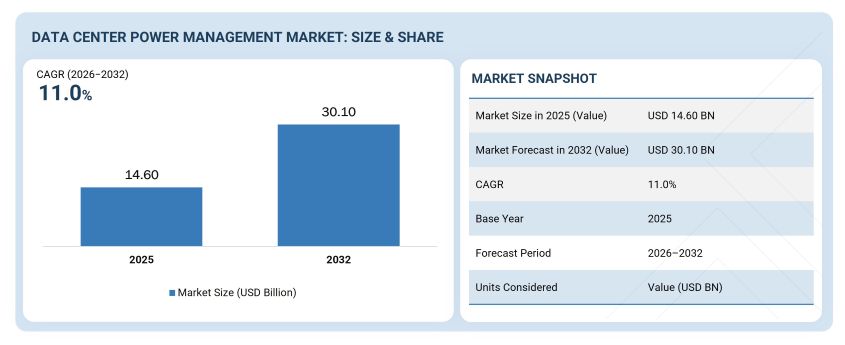
The global data center power management market was valued at USD 14.60 billion in 2025 and is projected to reach USD 30.10 billion by 2032, expanding at a compound annual growth rate (CAGR) of 11.0% during the forecast period 2026 to 2032. This robust trajectory is driven by the intersection of two powerful forces: the extraordinary surge in AI workload deployments — which are fundamentally redefining power density requirements at the rack and facility level, and the intensifying regulatory pressure on data center operators to hit ambitious energy efficiency and carbon-neutrality targets. As hyperscalers, colocation providers, and enterprise IT teams rush to scale capacity without proportionally scaling energy consumption, power management solutions have evolved from back-of-house infrastructure to boardroom-level strategic priorities.
Asia Pacific is the fastest-growing region, propelled by China's hyperscale build-out, India's rapidly expanding digital infrastructure programs, and aggressive government-led data center investment across Southeast Asia, collectively delivering the highest regional CAGR through 2032. North America holds the largest market base, anchored by the US concentration of hyperscale campuses, a mature colocation ecosystem, and accelerating AI-infrastructure capex from cloud giants. Europe follows with steady, regulation-driven growth shaped by the EU Energy Efficiency Directive and ambitious green data center commitments across Germany, the UK, and the Nordic corridor.
Top 10 Key Takeaways
- North America is the largest regional market, anchored by the US dense hyperscale campus ecosystem and aggressive AI infrastructure investment.
- Asia Pacific is the fastest-growing region, led by China, India, and Singapore, where government-backed digital infrastructure programs are accelerating data center buildouts at an unprecedented pace.
- Uninterruptible Power Supply (UPS) systems represent the dominant hardware component, driven by rising redundancy requirements and the transition from lead-acid to lithium-ion battery chemistries.
- DCIM and power management software is the fastest-growing sub-segment, as operators prioritize real-time visibility, AI-driven load optimization, and integration with cooling and facilities management platforms.
- Hyperscale data centers are the leading end-user vertical, consuming the largest share of advanced power management hardware and software due to their scale, power density, and operational complexity.
- AI-driven predictive power management, using machine learning to forecast load spikes, pre-position power capacity, and automate failover, is the defining technology shift of the current cycle.
- Regulatory force: The EU Energy Efficiency Directive, the US DOE data center efficiency initiatives, and Singapore's green data center masterplan are the most impactful near-term policy levers reshaping procurement decisions.
- Key companies shaping the competitive landscape include Schneider Electric, Eaton, Vertiv, ABB, and Siemens, alongside a rising cohort of Asia Pacific-based challengers such as Huawei and Delta Electronics.
- Near-term opportunity: Edge data center proliferation, driven by 5G rollouts, autonomous vehicle infrastructure, and IoT at scale, is opening a high-volume, distributed deployment wave for compact, efficient power management solutions.
- Near-term risk: Utility grid interconnection constraints and transformer supply chain bottlenecks are emerging as critical gating factors for new hyperscale developments, creating potential revenue timing risk for power management vendors.
Why the Data Center Power Management Market Matters Now
Few infrastructure markets are under as much simultaneous pressure as power management for data centers. The physical reality is stark: where a standard enterprise server rack of a decade ago consumed between 3 and 5 kilowatts, an AI-optimized rack loaded with the latest GPU clusters can now draw 40, 60, or even 100 kilowatts. This density surge cascades through every layer of the power chain, from utility feeds and on-site generators through UPS systems, busway distribution, and intelligent PDUs all the way to the rack level. Getting that power chain right, efficiently, and reliably, has become one of the most consequential engineering and procurement challenges in modern enterprise infrastructure.
The macro context is amplified by this urgency. Global data traffic continues its near-exponential climb, fueled by generative AI applications, video streaming, cloud migration, and the expanding digitalization of traditional industries. Simultaneously, sustainability commitments, from corporate net-zero pledges to binding government regulations, demand that this surge in compute power be delivered with markedly lower carbon intensity. The result is a market pulled in two directions at once: toward higher capacity and toward higher efficiency. Power management technologies, particularly software-defined management platforms and next-generation UPS architectures, sit precisely at this intersection.
For buyers, whether hyperscale operators designing a 500-megawatt campus, colocation providers retrofitting a legacy facility, or enterprise IT teams managing a distributed edge fleet, the stakes are measurable in both dollars and watts. Energy accounts for the single largest operating cost in most data center business models, making power management technology not merely a reliability investment but a direct margin lever. Vendors and technology providers that can offer intelligent, modular, software-integrated power architectures are finding themselves at the center of some of the largest infrastructure capex decisions of the decade.
Data Center Power Management Market Trends
The most consequential trend in reshaping the data center power management market is the transition from static, hardware-centric power infrastructure to dynamic, software-defined power architectures. Legacy power chains were designed for predictability: fixed-load servers, known redundancy ratios, and stable power draw profiles. The AI workload era has shattered this predictability. GPU-dense clusters running training jobs can swing from idle to full draw within seconds, creating load spikes that traditional UPS and PDU designs were never engineered to handle gracefully. Intelligent power management software, increasingly AI-native rather than merely AI-assisted, is becoming the critical layer that makes high-density, variable-load environments operationally sustainable.
A second trend with major commercial implications is the rapid adoption of lithium-ion battery technology within UPS systems. For years, valve-regulated lead-acid (VRLA) batteries dominated data center UPS deployments by default. Lithium-ion alternatives offer meaningfully longer service lives, smaller footprints, lighter weight, and faster recharge cycles. While the upfront cost premium has historically been a barrier, total cost of ownership calculations increasingly favor lithium-ion, particularly for high-availability applications where battery replacement and maintenance costs are factored in over a ten-year horizon. Several leading UPS manufacturers have repositioned their flagship product lines around lithium-ion in recent years, and adoption in new hyperscale builds has accelerated accordingly.
The rise of high-density rack deployments, increasingly defined as anything above 30 kW per rack, with leading-edge AI builds targeting 60–100 kW, is forcing a comprehensive rethink of power distribution architecture. Traditional power distribution units were designed for general-purpose compute loads. High-density AI racks demand intelligent, hot-swappable PDUs with real-time per-outlet metering, remote power cycling, and integration with facility management systems. This is creating a bifurcated PDU market: a commoditized baseline tier for standard workloads and a premium intelligent tier growing at a faster rate.
Renewable energy integration has moved from a corporate social responsibility aspiration to an operational engineering reality in the most advanced data center portfolios. Hyperscalers and larger colocation operators are increasingly deploying on-site solar, battery energy storage systems (BESS), and fuel cell installations that must be managed in harmony with utility feeds and traditional backup power. This creates new complexity, and new opportunities, for power management platforms that can orchestrate across multiple generation and storage sources in real time. The convergence of IT power management and energy management systems (EMS) is blurring vendor boundaries and opening opportunities for solution providers who can span both domains.
Finally, the convergence of IT and operational technology (OT) within the data center power stack is creating demand for unified monitoring and control platforms. Historically, the IT team managed servers and network while the facilities team managed power, cooling, and physical infrastructure. These silos are breaking down, driven by the economic pressure to optimize every kilowatt and the technical feasibility of unified DCIM platforms that provide a single pane of glass across compute, power, and cooling. Vendors who can deliver credible, integrated IT/OT power management platforms are capturing disproportionate share in new builds and major retrofits.
Data Center Power Management Market Drivers
The single most powerful demand driver in the current market cycle is the explosive growth of AI infrastructure investment. The deployment of large language models, diffusion models, and other generative AI systems requires orders-of-magnitude more compute, and therefore more power than traditional enterprise workloads. Major hyperscalers have publicly committed hundreds of billions of dollars in data center capex over multi-year periods, with AI-optimized facilities accounting for a disproportionate share of new construction. Each new AI-dedicated data center represents a large, high-value power management procurement, spanning UPS, intelligent PDUs, busway, and the software layer needed to manage variable-load GPU clusters safely and efficiently.
Rising power densities are a structural driver independent of the AI cycle. Even in general-purpose compute environments, server power draw per rack has climbed steadily as processor cores multiply and memory densities increase. This density inflation creates a continuous replacement cycle for power infrastructure: equipment designed for 5-kW racks becomes inadequate in a 20-kW environment. Operators who resist upgrading face efficiency penalties, stranded cooling capacity, and elevated risk of power-related downtime. This obsolescence dynamic supports recurring revenue streams for power management vendors beyond initial builds.
Regulatory and sustainability mandates have evolved into a genuine market driver rather than a compliance cost. The European Union's Energy Efficiency Directive now requires large data centers above a capacity threshold to report power usage effectiveness (PUE), renewable energy usage, and water usage effectiveness, with reporting requirements that effectively create organizational incentives to deploy best-in-class power management tools. In Singapore, a moratorium on new data center construction has been replaced by a green data center framework that makes energy efficiency a license-to-operate condition. In the US, voluntary but influential initiatives from the DOE and EPA create reputational and procurement advantages for operators who can demonstrate efficiency leadership. Across these geographies, the effect is to expand the total addressable market for power management software and analytics, as compliance reporting requires measurement and monitoring infrastructure that goes beyond basic hardware.
The relentless expansion of colocation and hyperscale capacity, measured in terms of new campuses, new sites, and new geographic markets, provides a durable volume driver for the power management ecosystem. Unlike enterprise data center investment, which can be deferred in an economic downturn, hyperscale and colocation buildouts are driven by long-term contracted demand from cloud customers who have committed to multi-year capacity reservations. This contracted demand pipeline gives large data center operators visibility to justify major, multi-year power infrastructure investments, creating stable procurement volumes for their power management vendors.
Data Center Power Management Market Challenges and Restraints
The capital intensity of advanced power management systems remains a genuine barrier, particularly in the mid-market enterprise segment. A full-facility deployment of intelligent UPS systems, high-density intelligent PDUs, and an integrated DCIM software platform can represent a multi-million-dollar investment that competes with server refresh, network upgrade, and security spending for constrained IT budgets. The return on investment case, while robust over a 5–10-year horizon, requires a level of financial modeling sophistication that not all IT buyers can or will undertake, slowing adoption outside the hyperscale and large colocation tiers.
Legacy infrastructure integration poses a persistent technical challenge. A considerable proportion of the installed base of enterprise data centers runs power infrastructure that is decades old UPS systems, switchgear, and distribution panels that predate modern digital management capabilities and were never designed for software integration. Retrofitting modern DCIM and power management software onto this legacy hardware requires either expensive middleware, hardware replacement, or acceptance of partial functionality. Vendors who can offer credible integration pathways for brownfield environments have a meaningful advantage in this segment, but the technical complexity remains a drag on adoption speed.
Grid reliability and utility interconnection constraints are emerging as structural challenges for the largest data center developments. In multiple high-demand markets, Northern Virginia, Hillsboro, Phoenix, London, Dublin, Singapore, and Frankfurt among them, the pace of data center construction has outrun the local utility's ability to provide grid connections at the requested power levels on the requested timelines. This creates project delays that affect not just construction schedules but power management procurement cycles, as equipment orders tied to commissioning dates get pushed. Some operators are responding by investing in on-site generation and microgrid capabilities, which ironically expand the scope of the power management market but add procurement complexity.
Cybersecurity vulnerabilities in networked power infrastructure represent a risk that is increasingly taken seriously by operators and regulators alike. Modern intelligent PDUs, UPS systems with network management cards, and DCIM platforms are internet-accessible devices that, if compromised, could allow an attacker to disrupt power to critical IT loads. The disclosure of vulnerabilities in several widely deployed power management devices in recent years has raised the stakes. This creates a non-trivial security evaluation burden for procurement teams and may slow adoption of newer, more connected power management architectures in security-sensitive sectors such as government, defense, and critical infrastructure.
Data Center Power Management Market, By End User — Industry and Application Growth
Cloud service providers and hyperscalers represent the dominant end-user vertical, commanding the largest share of advanced power management investment and driving the highest-value individual procurements in the market. The hyperscale model, characterized by massive single-site builds, extreme standardization, and continuous capacity expansion, creates ideal conditions for sophisticated power management: large enough to justify purpose-built solutions, standardized enough to benefit from automation, and operationally intensive enough to demand real-time analytics. The AI infrastructure wave, which has disproportionately concentrated at hyperscale operators including the major public cloud providers, is accelerating power management investment in this segment significantly beyond prior growth trajectories.
The BFSI sector represents a substantial and growing end-user segment with distinct requirements shaped by regulatory obligations and zero-tolerance availability standards. Financial institutions, particularly tier-1 banks, exchanges, and payment processors, operate under regulatory frameworks that mandate specific standards for data center resilience, including power infrastructure. The combination of mandatory compliance, high availability SLAs, and concentrated compute infrastructure makes BFSI one of the most consistent and higher-margin end-user verticals for power management vendors.
Healthcare and life sciences is an emerging high-growth end user, driven by the digitalization of medical records, the growth of genomics and medical imaging data, and the migration of clinical decision support systems to data center or cloud environments. Healthcare data centers are subject to strict availability requirements, downtime in a hospital environment has clinical as well as regulatory consequences, making resilient power infrastructure a non-negotiable requirement. The increasing compute intensity of AI-assisted diagnostics and drug discovery is additionally driving power density in this sector toward levels previously seen only in research and hyperscale environments.
Telecom operators running network function virtualization (NFV) and 5G core infrastructure represent a specialized and rapidly growing segment. The shift from dedicated network hardware to virtualized workloads running on standard data center infrastructure has pulled telecom into the mainstream data center power management market, requiring the same level of UPS redundancy, intelligent distribution, and software visibility as enterprise and colocation environments. Edge deployments associated with 5G, micro data centers located in central offices, base stations, and street-level nodes, present a particularly dynamic growth opportunity, as they require compact, exceptionally reliable power management solutions at volume and at locations that are geographically dispersed and often unmanned.
Government and defense represent a segment characterized by high specification, long procurement cycles, and strong preference for domestic or allied-nation supply chains. Public sector data center investments, while often moving more slowly than commercial equivalents, tend to be large in scope and to involve comprehensive power management upgrades as part of multi-year modernization programs. Increased government investment in AI, cybersecurity, and digital public services in major economies including the US, the UK, Germany, and India is expanding the addressable market in this segment.
Data Center Power Management Market Segment Insights
By Component
Uninterruptible Power Supply system’s represent the largest component segment within the data center power management market. UPS systems sit at the critical junction between utility power and IT load, providing both the last line of defense against outages and, in modern architectures, a platform for energy storage and dynamic load management. The dominance of this segment reflects the non-negotiable requirement for power continuity in any data center environment, from edge micro deployments to hyperscale campuses. Leading UPS deployments in current-generation hyperscale facilities are three-phase modular systems in the megawatt range, offering scalability and online maintenance capability that previous generations could not match.
DCIM and power management software is the fastest-growing component, as data center operators increasingly recognize that hardware alone cannot deliver the efficiency, visibility, and automation that modern operations require. Software platforms that integrate power monitoring with cooling management, asset tracking, and capacity planning are transitioning from optional add-ons to core operational infrastructure. The category is being further accelerated by AI-native analytics engines that can identify inefficiencies, predict failures, and recommend redistribution with a level of sophistication that human operators cannot replicate at scale.
By Power Rating
The greater-than-1 MVA segment leads in terms of revenue, a direct reflection of the hyperscale-dominated demand environment. New hyperscale builds routinely require multi-megawatt UPS installations and high-capacity power distribution infrastructure capable of serving tens of thousands of servers from a single deployment. The unit values in this segment are correspondingly high, and the procurement processes involve long lead times and close collaboration between the operator and the power management vendor during the design phase.
The less-than-100-kVA segment is the fastest-growing by unit volume, driven by the proliferation of edge data centers. As 5G infrastructure, autonomous systems, and industrial IoT create demand for compute capacity at the network edge, in locations that may range from urban microcells to remote industrial sites, there is a corresponding need for compact, rugged, reliable power management solutions at a scale that was previously served by simple UPS systems with no management capability. Intelligent edge-ready power solutions represent a high-growth, high-volume opportunity that many traditional hyperscale-focused power management vendors are now actively pursuing.
By Data Center Type
Hyperscale data centers account for the dominant revenue share across the power management market, reflecting both the scale of individual deployments and the intensity of investment per megawatt of capacity. Hyperscale operators are the industry's most sophisticated buyers: they develop detailed technical specifications, run rigorous competitive sourcing processes, and have the engineering depth to evaluate and integrate complex power management solutions on scale. The hyperscale segment is also where the most technically advanced solutions, including AI-driven power analytics, software-defined distribution, and integrated liquid cooling power management, are first deployed and refined.
Edge data centers represent the fastest-growing segment by number of sites and deployment frequency, even if average transaction values are lower than hyperscale. The distributed nature of edge deployment, combined with the unmanned or lightly staffed operating model, places a premium on reliability, remote manageability, and the ability to operate in diverse physical environments. This is driving demand for next-generation compact UPS and PDU solutions that incorporate wireless management, self-diagnostics, and remote firmware update capabilities as standard features rather than options.
By Deployment Mode
On-premises deployment remains the largest segment by installed base, reflecting the historical pattern of enterprise data center ownership and the continuing preference of regulated industries, particularly BFSI and healthcare, for maintaining direct physical control over critical power infrastructure. On-premises deployments tend to involve longer refresh cycles and higher hardware standardization, creating both a stable recurring revenue stream and a gradual but ongoing hardware replacement cycle as aging infrastructure is modernized.
Cloud-based or managed service delivery of power management software is the fastest-growing deployment mode, as colocation and edge operators seek to reduce the overhead of managing on-premises software platforms. The software-as-a-service model for DCIM and power analytics is enabling smaller operators and distributed edge deployments to access sophisticated power management capabilities without the capital and IT overhead of traditional on-premises deployments, materially expanding the total addressable software market beyond the largest operators.
Key segmentation conclusions:
- UPS systems dominate hardware revenue; DCIM/software is the fastest-growing component sub-segment.
- Greater-than-1 MVA power ratings lead to revenue, driven by hyperscale; sub-100 kVA leads in unit growth, driven by edge.
- Hyperscale data centers are the highest-value end-user type; edge data centers are the highest-velocity growth segment by deployment count.
- On-premises deployment is the largest mode by installed base; cloud-delivered power management software is the fastest-growing mode.
- Cloud service providers and hyperscalers represent the dominant end-user vertical by value; healthcare and telecom/5G are the fastest-growing adjacent verticals.
Data Center Power Management Market, Regional Analysis
North America
North America is the largest regional market for data center power management. The US is home to the highest concentration of hyperscale data center capacity anywhere in the world, with major campus clusters in Northern Virginia, Phoenix, Silicon Valley, Chicago, and the Pacific Northwest serving as the backbone of global cloud infrastructure. The US market alone accounts for the overwhelming majority of North American demand, driven by the capex programs of the five largest hyperscalers, a mature colocation sector anchored by operators such as Equinix, Digital Realty, and Iron Mountain, and a large enterprise installed base undergoing continuous modernization. North America's market was valued at approximately USD 5.82 billion in 2025 and is projected to reach USD 11.96 billion by 2032, reflecting a CAGR of 10.8%. Canada contributes a growing share of regional demand, supported by strong renewable energy availability, particularly hydroelectric power, which makes it an increasingly attractive location for sustainability-focused hyperscale builds. Mexico is an early-stage but rapidly developing market, with nearshoring-driven investment in manufacturing IT infrastructure creating demand in Monterrey, Guadalajara, and Mexico City.
Europe
Europe is the second largest regional market, underpinned by a regulatory environment that is among the most demanding globally for data center energy efficiency and sustainability compliance. Germany, the UK, and France together represent the largest European demand centers, hosting significant hyperscale capacity, major financial sector data centers, and growing colocation ecosystems. The EU Energy Efficiency Directive's data center provisions, which require large facilities to disclose power and water usage effectiveness and renewable energy ratios, have directly stimulated investment in power management software and monitoring infrastructure, as operators require measurement capability before they can report. The Nordic countries, particularly Sweden, Norway, Denmark, and Finland, are fast-growing sub-markets, attracting hyperscale investment from the global cloud providers because of their abundant renewable energy, cool climates that reduce cooling costs, and stable regulatory environments. Europe's market was valued at approximately USD 3.41 billion in 2025 and is forecast to reach USD 6.52 billion by 2032, growing at a CAGR of 9.7%. The region's CAGR is moderated by high upfront infrastructure maturity, while the regulatory tailwinds ensure sustained steady growth throughout the forecast period.
Asia Pacific
Asia Pacific is the fastest-growing regional market, propelled by the combination of China's massive domestic hyperscale build-out, India's accelerating data center infrastructure investment driven by the Digital India initiative and growing domestic cloud adoption, and the dense hyperscale concentration in Singapore, South Korea, Japan, and Australia. China remains the dominant volume market in the region, with local hyperscalers including Alibaba Cloud, Tencent Cloud, and Huawei Cloud investing heavily in new capacity while navigating government guidance on power usage efficiency and geographic distribution of data center capacity away from water-stressed eastern urban centers. India presents one of the most dynamic demand stories globally, with announced greenfield data center investments from domestic and international operators representing tens of gigawatts of planned capacity, each requiring comprehensive power management infrastructure. Singapore maintains its status as Southeast Asia's premium data center hub despite government-mandated capacity ceilings, with a tightly managed green data center framework ensuring that new builds are among the most power-efficient in the region. The Asia Pacific market was valued at approximately USD 4.28 billion in 2025 and is expected to reach USD 9.47 billion by 2032, delivering a CAGR of 12.0%, the highest of any region globally.
Rest of World
The Rest of World region encompasses the Middle East, Africa, and Latin America, collectively representing the smallest current market share but exhibiting meaningful growth dynamics, particularly in the Gulf Cooperation Council countries. The UAE, led by Abu Dhabi, Dubai and Saudi Arabia are the most active investment markets in the Middle East, driven by government-sponsored smart city and digital infrastructure programs, sovereign wealth fund participation in data center assets, and the region's emergence as a hub for AI and cloud investment. Saudi Arabia's Vision 2030 program has explicitly identified digital infrastructure as a national priority, and multiple hyperscale campuses are under construction or in planning in Riyadh and Jeddah. In Latin America, Brazil is the dominant market, with São Paulo hosting the largest concentration of data center capacity on the continent; Mexico, Colombia, and Chile are secondary but growing markets. South Africa serves as the primary hub for sub-Saharan African demand, though connectivity investment across the continent is beginning to support distributed capacity in Kenya, Nigeria, and Egypt. The Rest of World market was valued at approximately USD 1.09 billion in 2025 and is projected to reach USD 2.15 billion by 2032, at a CAGR of 10.2%.
Regional outlook summary:
- Asia Pacific leads regional growth at a CAGR of 12.0%, driven by China, India, and Singapore.
- North America holds the largest market base, underpinned by hyperscale concentration and enterprise modernization spend.
- Europe's regulatory environment, particularly the EU Energy Efficiency Directive, is a unique structural driver of power management software and monitoring investment.
- Middle East and Gulf markets represent the highest-growth pocket within Rest of World, with government-sponsored hyperscale investment from the UAE and Saudi Arabia.
- Latin America and South Asia are early staged but accelerating markets with multi-year investment pipelines establishing a foundation for substantial long-term demand.
Country-Specific Insights
The US remains the global reference market for data center power management technology and procurement practice. Northern Virginia, which hosts more data center capacity than any other geography on Earth, is an indicator market for industry trends: when hyperscale operators change power density standards or adopt new efficiency technologies there, the rest of the global industry typically follows within 12 to 24 months. The US DOE's voluntary data center energy efficiency initiatives, combined with several state-level green building codes, create a soft-regulatory environment that nudges operators toward best-in-class power infrastructure. Increasingly, power management decisions in the US are being made in the context of sustainability reporting obligations, as large operators are publicly traded companies with investor relations obligations tied to ESG metrics including carbon intensity and PUE.
China represents the largest single-country data center power management market outside the US. The government's 'Eastern Data and Western Computing' policy initiative is a defining structural force, mandating the geographic redistribution of data center capacity from energy-constrained coastal cities to western provinces with lower energy costs and greater renewable energy availability. This migration is creating a large wave of new data center construction requiring comprehensive power management systems from the ground up, rather than retrofits of existing infrastructure. China's domestic power management vendors particularly Huawei and Delta Electronics are well positioned in this market, though international vendors maintain strong positions at multinational-owned or internationally financed facilities.
India is the most dynamically changing country market, transitioning rapidly from an enterprise-colocation environment to a multi-player hyperscale market. State governments including Maharashtra, Telangana, and Tamil Nadu have established dedicated data center policies offering land, power, and tax incentives to attract investment. The national government's push to mandate domestic data storage for certain categories of data has created additional demand for domestic data center capacity. The power management opportunity in India is substantial but complicated by the variable reliability of the national grid in some regions, which creates demand for robust UPS and backup generation solutions with higher redundancy ratios than mature Western markets require.
Singapore's data center market is a case study in quality-over-quantity development. Government-mandated capacity ceilings have created an environment where only the most power-efficient, best-engineered facilities receive approval to develop. This raises the floor on power management standards: operators who cannot demonstrate best-in-class PUE and water usage effectiveness do not receive development permits. The practical effect is a market that systematically adopts the most advanced available power management technology, making Singapore a reference site for regional best practice.
Germany is Europe's largest and most technically demanding data center market, characterized by high engineering standards, strong regulatory compliance culture, and significant industrial data center demand alongside commercial cloud infrastructure. German enterprise buyers tend to make long, thorough procurement evaluations with detailed technical specifications, which tends to favor established vendors with deep engineering support capabilities. The Frankfurt data center cluster is among Europe's most important internet exchange points, and the power management infrastructure serving it reflects the highest available reliability standards.
Country-level conclusions:
- The US market is the global reference for technology adoption innovations validated in Northern Virginia typically diffuse globally within 12–24 months.
- China's 'Eastern Data and Western Computing' initiative is creating a large wave of greenfield data center construction requiring comprehensive power management solutions.
- India's transition from colocation-led to hyperscale-led capacity growth is the most significant country-level demand inflection point in the Asia Pacific region.
- Singapore's regulatory-driven quality ceiling for data centers creates a systematic bias toward best-in-class power management technology, making it a regional best-practice benchmark.
- Germany's rigorous procurement standards and high engineering expectations make it Europe's most demanding and most reference-worthy data center power management market.
Key Company Insights — Data Center Power Management Market
The data center power management market is served by a combination of large, diversified electrical infrastructure groups that have built or acquired comprehensive data center power portfolios, and specialized pure-play vendors whose entire product range is focused on data center applications. The competitive landscape has undergone significant consolidation over the past decade, with hyperscale procurement scale creating strong incentives for operators to standardize on a small number of preferred vendors across UPS, PDU, DCIM, and distribution hardware. Leading players in the market include:
- Schneider Electric SE
- Eaton Corporation plc
- Vertiv Holdings Co.
- ABB Ltd.
- Siemens AG
- Legrand SA
- Honeywell International Inc.
- General Electric (GE Vernova)
- Emerson Electric Co.
- Huawei Technologies Co. Ltd.
- Delta Electronics Inc.
- Rittal GmbH & Co. KG
- Cummins Inc.
- ATEN International Co. Ltd.
- Cyber Power Systems Inc.
Schneider Electric has built the most comprehensive data center power management portfolio in the market, spanning its EcoStruxure IT platform for DCIM analytics, the Galaxy-series three-phase UPS line, its APC-branded single-phase and small-system solutions, and its Uniflair cooling infrastructure. The company has invested heavily in AI-driven predictive analytics capabilities within EcoStruxure and has announced strategic partnerships with cloud providers to offer cloud-delivered data center management services. Schneider's scale gives it the unique ability to serve from edge to hyperscale within a single vendor relationship, which is a significant competitive advantage in large enterprise and colocation accounts.
Eaton has sharpened its data center focus, emphasizing its three-phase Bluebolt and 93PM UPS product lines and its intelligent PDU range alongside its eMobility and power quality software platforms. Eaton's acquisition strategy has targeted software and analytics capabilities, reflecting a broader industry shift in which hardware margins are under pressure while software and services command premium pricing. The company's strong position in North American enterprise data centers provides a stable base from which it is expanding its hyperscale and international colocation presence.
Vertiv, which was originally carved out of Emerson as a standalone entity and went public in 2020, has executed an aggressive growth strategy built around the global hyperscale investment cycle. Vertiv's Liebert-branded UPS and thermal management products, combined with its Avocent data center infrastructure management platform, give it a broad solution footprint. The company has made significant investments in manufacturing capacity for liquid cooling and high-density power solutions to address the AI infrastructure demand surge and has published detailed commentary on the AI-driven demand tailwind it is experiencing.
ABB and Siemens bring large-scale electrical engineering and industrial automation capabilities to the data center segment, competing primarily in the medium and high-voltage power distribution and switchgear space that serves the grid connection and facility-level power distribution layers of large data centers. Both companies have invested in digitalization capabilities ABB's Ability platform and Siemens' Xcelerator ecosystem that increasingly extend into data center energy management and predictive maintenance.
Huawei and Delta Electronics represent the strongest challengers from the Asia Pacific region, with Huawei particularly aggressive in marketing its modular data center and integrated power management solutions to hyperscale operators and carriers in China, the Middle East, and emerging markets across Asia, Africa, and Latin America. Delta Electronics brings strong power electronics engineering capability and a growing share of the DCIM software market.
Key company strategies summary:
- Comprehensive portfolio vendors (Schneider Electric, Eaton, Vertiv) are investing in AI-driven DCIM software to shift mix toward higher-margin software and services revenue.
- Industrial conglomerates (ABB, Siemens) are competing on grid-to-rack integration and digitalized switchgear capabilities.
- Asia Pacific challengers (Huawei, Delta) are leveraging regional manufacturing scale and government relationships to expand share in high-growth geographies.
- Product innovation focus has shifted from hardware efficiency increments to software intelligence: predictive analytics, AI-powered load optimization, and cloud-delivered management are the primary battlegrounds.
- M&A activity has been concentrated on software, analytics, and services capabilities rather than hardware, reflecting the market's evolution toward intelligent, software-defined power management.
Recent Developments
- In Q1 2025, Vertiv Holdings announced plans to significantly expand manufacturing capacity for liquid cooling and high-density power distribution systems in the US and Europe, citing accelerating demand from AI data center customers as the primary driver of the expansion.
- In late 2024, Schneider Electric released an updated version of its EcoStruxure IT platform incorporating generative AI capabilities for anomaly detection and automated power capacity planning, targeting hyperscale and large colocation operator customers.
- In 2024, Eaton expanded its partnership network with several leading data center integrators and EPC contractors in the Middle East and Southeast Asia, targeting the wave of new hyperscale construction planned for those regions.
- In 2024, ABB launched its next-generation modular uninterruptible power supply platform designed specifically for high-density AI workloads, featuring faster recharge capability and enhanced compatibility with lithium-ion battery modules.
- In early 2025, Delta Electronics announced an expanded DCIM software suite with enhanced integration capabilities for liquid cooling control systems, reflecting the growing need for unified power and thermal management as high-density deployments proliferate.
Real-World Use Cases and Case Studies
In 2023 and continuing through 2024, Equinix, the world's largest colocation and interconnection provider advanced its deployment of Schneider Electric's EcoStruxure IT platform across its global IBX data center portfolio. The deployment was aimed at achieving unified real-time power monitoring and predictive analytics across facilities on multiple continents, enabling Equinix to identify efficiency opportunities, automate capacity planning workflows, and provide customers with granular energy reporting to support their own sustainability disclosures. The initiative is part of Equinix's publicly stated commitment to achieving climate neutrality by 2030, and power management software has been identified as a core enabling technology for meeting its PUE reduction targets.
Microsoft's data center expansion program in the US and Europe has featured large-scale deployments of intelligent UPS and power distribution infrastructure sized for AI workloads. In Boydton, Virginia campus one of the largest data center clusters in North America Microsoft has incorporated high-density power management infrastructure capable of supporting rack power densities significantly above conventional enterprise norms, as the facility serves AI and large-scale cloud workloads requiring GPU-dense compute configurations. Microsoft has publicly described the power management and cooling infrastructure requirements for AI data centers as fundamentally different from previous-generation cloud infrastructure, requiring close collaboration with power vendors from the early design phase.
Data Center Power Management Market Segmentation
The data center power management market is structured across five primary segmentation dimensions, each of which captures a distinct aspect of market demand and competitive dynamics. By component, the market encompasses the full spectrum of hardware and software elements that together constitute a data center power management system: UPS systems forming the backbone of power continuity, PDUs providing the final-mile intelligent distribution layer, automatic transfer switches managing source transitions, busway and busbar systems enabling flexible distribution architecture, DC power systems serving telecommunications and specialized computing loads, generator sets providing extended backup capability, and DCIM software platforms providing the intelligence layer across all physical components. The interplay between hardware and software components is increasingly the defining commercial dynamic, as operators seek integrated solutions where monitoring, control, and analytics are tightly coupled to physical infrastructure.
By power rating, the market segments from sub-100 kVA solutions serving edge and small enterprise deployments through the large, multi-megawatt infrastructure that serves hyperscale campuses. The distribution of demand across power ratings is shifting as average rack densities increase equipment designed for the load profiles of five years ago is being retired or repositioned, creating a continuous demand for higher-rating equipment across the installed base. By data center type, hyperscale, colocation, enterprise, edge, and modular data centers each exhibit distinct procurement patterns, redundancy requirements, and technology preferences. By deployment mode, the on-premises/colocation/managed-service split is evolving as DCIM, and power analytics software increasingly migrate to cloud-delivered service models. By end user, the diversity of verticals from cloud hyperscalers to healthcare to BFSI to government creates a segmented demand profile where each vertical has distinct specification requirements, procurement processes, and growth dynamics.
Segmentation summary:
- The hardware-software integration trend is the most commercially significant segmentation dynamic, as comprehensive solution providers outperform pure hardware vendors.
- Power rating segmentation is shifting toward higher kVA brackets as rack density inflation drives equipment replacement cycles.
- Data center type segmentation reveals the sharpest growth differential between edge (high unit volume, low unit value) and hyperscale (high unit value, growing volume).
- Deployment mode is bifurcating between large operators who prefer on-premises DCIM and SMEs who adopt cloud-delivered power management software.
- End-user segmentation highlights cloud hyperscalers as the dominant demand driver while healthcare, telecom, and government offer the most distinct upside growth vectors.
Conclusion and Future Outlook
The data center power management market is entering a phase of accelerated transformation that goes well beyond the historic pattern of incremental hardware refresh cycles. The convergence of AI-driven workload intensity, sustainability regulation, and software-defined infrastructure is reshaping the market's competitive dynamics, technology roadmaps, and end-user procurement priorities in ways that will define the industry through 2032 and beyond. Power management is no longer a utilities function that sits at the periphery of data center strategy it is a central enabler of the AI infrastructure era, a direct lever on operating economics, and an increasingly important sustainability reporting metric for publicly traded operators.
Looking ahead to 2032, the markets where growth will be most significant are well signposted: AI-dedicated facilities will continue to set new benchmarks for power density and demand for intelligent management solutions; edge computing infrastructure will expand the geographic and physical footprint of deployable power management technology far beyond traditional data center boundaries; and the software layer encompassing DCIM, AI-driven analytics, and cloud-delivered management services will capture a growing share of total market value as the intelligence embedded in power infrastructure becomes as commercially important as the hardware itself. For businesses seeking to position themselves in this market whether as vendors, investors, integrators, or buyers the strategic imperative is clear: invest in understanding the technology roadmap, the regulatory environment, and the competitive dynamics before the inflection points become obvious.
Frequently Asked Questions — Data Center Power Management Market
Q1: How big is the data center power management market?
The global data center power management market was valued at USD 14.60 billion in 2025 and is projected to reach USD 30.10 billion by 2032. This represents more than a doubling of market size over the forecast period, driven by AI infrastructure investment, rising power densities, and accelerating sustainability mandates across major geographies.
Q2: What is the data center power management market growth rate?
The market is expected to expand at a CAGR of 11.0% during the forecast period of 2026 to 2032. Asia Pacific is the fastest-growing region, projected to deliver a CAGR of 12.0%, while North America, as the largest base market, is forecast to grow at 10.8% over the same period.
Q3: Which segment leads the data center power management market?
By component, UPS systems represent the dominant hardware segment, driven by mandatory power continuity requirements and the industry-wide transition to lithium-ion battery technology. By end user, cloud service providers and hyperscalers represent the leading vertical, commanding the largest share of advanced power management investment due to the scale and power density of their deployments.
Q4: Who are the key players in the data center power management market?
The market is led by Schneider Electric, Eaton, Vertiv, ABB, and Siemens — diversified electrical infrastructure companies with comprehensive data center power portfolios. Asia Pacific challengers including Huawei and Delta Electronics have built significant market positions, particularly in high-growth regional markets. Legrand, Honeywell, GE Vernova, Emerson, Rittal, Cummins, and Cyber Power Systems are among the other prominent participants.
Q5: What are the factors driving the data center power management market?
The primary drivers are: the explosive growth of AI workload deployments requiring orders-of-magnitude higher rack power densities; the relentless expansion of hyperscale and colocation capacity globally; stringent energy efficiency regulations including the EU Energy Efficiency Directive and Singapore's green data center framework; and the industry-wide adoption of AI-driven software platforms for real-time power monitoring, predictive analytics, and autonomous load optimization.
 Exclusive indicates content/data unique to MarketsandMarkets and not available with any competitors.
TABLE OF CONTENTS
1 Introduction
1.1 Study Objectives
1.2 Market Definition and Scope
1.3 Inclusions and Exclusions
1.4 Study Scope
1.4.1 Markets Covered
1.4.2 Geographic Segmentation
1.4.3 Years Considered
1.5 Currency Considered
1.6 Stakeholders
2 Research Methodology
2.1 Research Approach
2.2 Secondary Research
2.2.1 Key Secondary Sources
2.3 Primary Research
2.3.1 Primary Interview Breakdown, By Designation
2.3.2 Primary Interview Breakdown, By Region
2.4 Market Size Estimation
2.4.1 Bottom-Up Approach
2.4.2 Top-Down Approach
2.5 Data Triangulation
2.6 Assumptions and Limitations
3 Executive Summary
4 Premium Insights
4.1 Attractive Opportunities in the Data Center Power Management Market
4.2 Data Center Power Management Market, By Region
4.3 Asia Pacific: Market by Component and Country
4.4 Data Center Power Management Market — Investment Hotspots
5 Market Overview
5.1 Introduction
5.2 Market Dynamics
5.2.1 Drivers
5.2.1.1 Explosive Growth in AI Workloads and High-Performance Computing
5.2.1.2 Rising Data Center Power Densities Driving UPS and DCIM Demand
5.2.1.3 Stringent Energy Efficiency Regulations and Net-Zero Commitments
5.2.1.4 Rapid Expansion of Hyperscale and Colocation Data Center Capacity
5.2.2 Restraints
5.2.2.1 High Capital Expenditure and Long Payback Periods
5.2.2.2 Complexity of Legacy Infrastructure Integration
5.2.3 Opportunities
5.2.3.1 Edge Data Center Proliferation Creating New Deployment Wave
5.2.3.2 AI-Driven Predictive Power Management and Autonomous Operations
5.2.3.3 Liquid Cooling Integration with Power Management Systems
5.2.4 Challenges
5.2.4.1 Grid Reliability and Utility Interconnection Constraints
5.2.4.2 Cybersecurity Vulnerabilities in Networked Power Infrastructure
5.3 Value Chain Analysis
5.4 Ecosystem Analysis
5.5 Investment and Funding Scenario
5.6 Pricing Analysis
5.7 Trends and Disruptions Impacting Customer Business
5.8 Technology Analysis
5.8.1 Key Technologies
5.8.2 Complementary Technologies
5.8.3 Adjacent Technologies
5.9 Porter's Five Forces Analysis
5.10 Key Stakeholders and Buying Criteria
5.11 Case Study Analysis
5.12 Trade Analysis
5.13 Patent Analysis
5.14 Key Conferences and Events
5.15 Regulatory Landscape
5.16 Impact of AI/Generative AI on the Data Center Power Management Market
5.17 Impact of 2025 US Tariffs on the Market
6 Industry Trends
6.1 Shift Toward Modular and Scalable Power Architecture
6.2 Software-Defined Power Management and DCIM Integration
6.3 Rise of High-Density Rack Power Deployments (>30 kW per Rack)
6.4 Adoption of Lithium-Ion and Advanced Battery Technologies in UPS
6.5 Renewable Energy Integration and On-Site Generation
6.6 AI-Powered Predictive Analytics for Power Load Optimization
6.7 Convergence of IT and OT in Power Infrastructure Management
7 Strategic Disruption and Technology Adoption Landscape
7.1 Generative AI and Large Language Models: Power Consumption Implications
7.2 Direct Liquid Cooling: Intersection with Power Delivery Architecture
7.3 400V DC Power Distribution: Status and Adoption Trajectory
7.4 Digital Twins for Power Infrastructure Modeling
7.5 Microgrid and Energy Storage Integration in Campus Data Centers
7.6 Open Compute Project (OCP) Standards and Their Power Management Implications
8 Customer Landscape and Buyer Behavior
8.1 Decision-Making Process and Procurement Cycles
8.2 Buyer Stakeholders — IT, Facilities, Finance, and Sustainability Teams
8.3 Adoption Barriers and Friction Points
8.4 Key Selection Criteria by Segment
8.5 Customer Feedback and Satisfaction Benchmarks
9 Data Center Power Management Market, By Component
9.1 Introduction
9.2 Uninterruptible Power Supply (UPS) Systems
9.3 Power Distribution Units (PDUs)
9.4 Automatic Transfer Switches (ATS)
9.5 Busway and Busbar Systems
9.6 DC Power Systems
9.7 Generator Sets
9.8 DCIM and Power Management Software
10 Data Center Power Management Market, By Power Rating
10.1 Introduction
10.2 Less Than 100 kVA
10.3 100–500 kVA
10.4 500 kVA–1 MVA
10.5 Greater Than 1 MVA
11 Data Center Power Management Market, By Data Center Type
11.1 Introduction
11.2 Hyperscale Data Centers
11.3 Colocation Data Centers
11.4 Enterprise Data Centers
11.5 Edge Data Centers
11.6 Modular Data Centers
12 Data Center Power Management Market, By End User
12.1 Introduction
12.2 Cloud Service Providers and Hyperscalers
12.3 Telecom and IT Enterprises
12.4 Banking, Financial Services, and Insurance (BFSI)
12.5 Healthcare and Life Sciences
12.6 Government and Defense
12.7 Retail and E-Commerce
12.8 Manufacturing and Industrial
12.9 Media and Entertainment
13 Data Center Power Management Market, By Deployment Mode
13.1 Introduction
13.2 On-Premises
13.3 Colocation
13.4 Cloud-Based (Managed Services)
14 Data Center Power Management Market, By Region
14.1 Introduction
14.2 North America
14.2.1 US
14.2.2 Canada
14.2.3 Mexico
14.3 Europe
14.3.1 Germany
14.3.2 UK
14.3.3 France
14.3.4 Italy
14.3.5 Spain
14.3.6 Nordics
14.3.7 Rest of Europe
14.4 Asia Pacific
14.4.1 China
14.4.2 Japan
14.4.3 India
14.4.4 South Korea
14.4.5 Australia
14.4.6 Singapore
14.4.7 Rest of Asia Pacific
14.5 Rest of World
14.5.1 Middle East
14.5.2 Africa
14.5.3 Latin America
15 Competitive Landscape
15.1 Overview
15.2 Key Player Strategies and Right to Win
15.3 Revenue Analysis of Key Players
15.4 Market Share Analysis
15.5 Company Evaluation Matrix — Key Players
15.5.1 Stars
15.5.2 Emerging Leaders
15.5.3 Pervasive Players
15.5.4 Participants
15.6 Company Evaluation Matrix — Startups/SMEs
15.6.1 Progressive Companies
15.6.2 Responsive Companies
15.6.3 Dynamic Companies
15.6.4 Starting Blocks
15.7 Competitive Benchmarking
15.8 Competitive Scenario
15.8.1 Product Launches (2023–2025)
15.8.2 Deals, Partnerships, and Acquisitions (2023–2025)
16 Company Profiles
16.1 Schneider Electric SE
16.2 Eaton Corporation plc
16.3 Vertiv Holdings Co.
16.4 ABB Ltd.
16.5 Siemens AG
16.6 Legrand SA
16.7 Honeywell International Inc.
16.8 General Electric (GE Vernova)
16.9 Emerson Electric Co.
16.10 Huawei Technologies Co. Ltd.
16.11 Delta Electronics Inc.
16.12 Rittal GmbH & Co. KG
16.13 Cummins Inc.
16.14 ATEN International Co. Ltd.
16.15 Cyber Power Systems Inc.
17 Appendix
17.1 Discussion Guide
17.2 KnowledgeStore: MnM's Subscription Portal
17.3 Customization Options
17.4 Related Reports
17.5 Author Details













Growth opportunities and latent adjacency in Data Center Power Management Market