Data Center Power Procurement Market by Procurement Model (Virtual PPA, Physical/Behind-the-Meter PPA, Retail/Green Tariff, Direct Asset Co-Development), Service Type, End User - Global Forecast to 2032


Data Center Power Procurement Market to 2032: Size, Share & Growth Report
The global Data Center Power Procurement market is projected to grow from USD 1.3 billion in 2026 to USD 4.5 billion by 2032, at a CAGR of approximately 23% during 2026–2032. Growth is driven by gigawatt-scale PPA commitments becoming the new procurement benchmark, grid interconnection queue bottlenecks pushing hyperscalers toward direct asset co-development, and rising price complexity and regulatory change driving demand for specialized advisory.
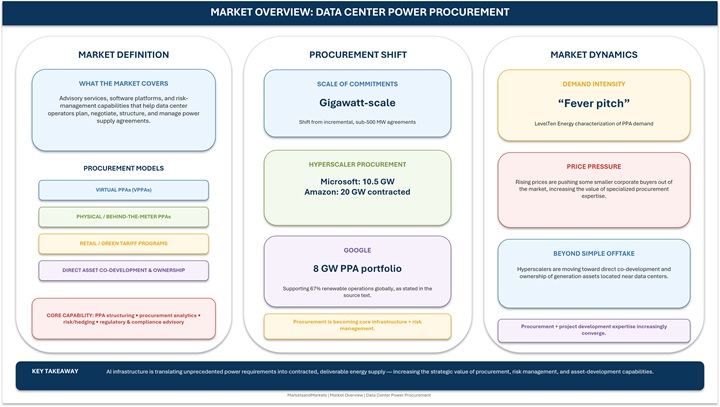
Data Center Power Procurement covers the advisory services, software platforms, and risk management capabilities that help hyperscale, colocation, and enterprise data center operators plan, negotiate, structure, and manage the power supply agreements their facilities depend on. The market spans virtual power purchase agreements (VPPAs), physical/behind-the-meter power purchase agreements, retail/green tariff programs, and direct asset co-development and ownership, delivered through PPA advisory and structuring, procurement software and analytics platforms, risk management and price hedging services, and regulatory and compliance advisory.
Corporate renewable procurement has fundamentally shifted from incremental, sub-500 MW agreements to gigawatt-scale commitments, a change driven directly by the exponential energy requirements of AI infrastructure. Between 2021 and 2024, the dominant hyperscaler strategy was securing renewable energy through standard power purchase agreements; starting in late 2025 and accelerating into 2026, that procurement benchmark was reset by a series of massive agreements, converting energy procurement from a corporate sustainability initiative into a core infrastructure and risk management discipline. Microsoft has committed to 10.5 GW of renewable energy PPAs, Amazon has positioned itself as the world's largest corporate renewable energy purchaser with 20 GW contracted, and Google's PPA portfolio now totals 8 GW, supporting 67% renewable operations globally.
Demand for specialized procurement expertise remains intense even as the market matures: data center operator and hyperscaler demand for power purchase agreements continues at what LevelTen Energy characterizes as a “fever pitch,” even as rising prices push some smaller corporate buyers out of the market entirely. At the same time, hyperscalers are increasingly moving beyond simple offtake agreements toward direct co-development and ownership of generation assets sited next to their data centers, a strategic shift that requires fundamentally different procurement and project development expertise than negotiating a standard PPA. The Data Center Power Procurement market is where AI infrastructure's power needs are being translated into contracted, deliverable energy supply — and the advisory firms and platforms that can navigate this increasingly complex, multi-technology landscape will capture the category's growth.
Top 10 Key Takeaways
- North America holds the largest market share, driven by the concentration of hyperscale AI data center campuses and the leading US-focused PPA pricing and advisory platforms, including LevelTen Energy.
- Asia Pacific is the fastest-growing region, propelled by expanding hyperscaler renewable procurement activity across new markets, exemplified by TotalEnergies' December 2025 21-year PPA with Google to supply Malaysian data center operations.
- Virtual power purchase agreements (VPPAs) lead by procurement-model revenue, reflecting their established, geographically flexible structure; direct asset co-development and ownership is the fastest-growing model as hyperscalers shift from passive offtake toward active infrastructure development.
- PPA advisory and structuring leads by service-type revenue; procurement software and analytics platforms are the fastest-growing service type as pricing transparency tools address a historically opaque market.
- Hyperscale cloud providers lead end users, with Microsoft committing to 10.5 GW of renewable energy PPAs, Amazon contracting 20 GW as the world's largest corporate renewable buyer, and Google's PPA portfolio reaching 8 GW supporting 67% renewable operations globally.
- Corporate renewable procurement has shifted from incremental, sub-500 MW agreements to gigawatt-scale commitments starting in late 2025 and accelerating into 2026, converting energy procurement from a sustainability initiative into a core infrastructure discipline.
- US renewable PPA prices reached record highs in 2026, with data center and hyperscaler demand continuing at a “fever pitch” even as rising costs push some smaller corporate buyers out of the market, according to LevelTen Energy.
- Hyperscalers are increasingly directly funding and co-developing generation assets sited next to their data centers rather than relying solely on traditional offtake agreements, a strategic shift that began in late 2024 and 2025 to bypass grid interconnection and transmission constraints.
- The near-term opportunity lies in nuclear-renewable convergence, as hyperscaler energy portfolios increasingly combine traditional renewable PPAs with emerging nuclear offtake agreements, requiring advisory expertise spanning both technology categories.
- The near-term risk is regulatory uncertainty: pending revisions to the Greenhouse Gas Protocol's Scope 2 hourly-matching accounting standard, US Foreign Entity of Concern tax credit rules, and Section 232 tariff investigations are each adding cost and complexity to procurement decisions.
Why the Data Center Power Procurement Market Matters Now
Hyperscalers have fundamentally shifted their strategy from passive energy consumers to active infrastructure developers. As one 2026 industry analysis describes it, power availability, not capital, is now the primary constraint on AI infrastructure expansion, marking a definitive break from hyperscalers' prior reliance on traditional procurement instruments alone. Between 2021 and 2024, the dominant strategy was securing renewable energy through power purchase agreements — an approach effective for carbon-neutrality goals but insufficient to solve the physical bottlenecks of transmission capacity and interconnection queues that increasingly determine how quickly new AI data center capacity can be energized.
This matters commercially because power purchase agreements themselves are evolving into far more complex risk-sharing structures than the standardized instruments of just a few years ago. As one solar industry trade publication put it in March 2026, hyperscale data center operators are increasingly “trading fixed pricing for physical delivery and grid-bypass certainty,” with the industry shifting toward energy parks that integrate solar and battery storage behind the meter specifically to bypass sluggish federal interconnection queues. LevelTen Energy has observed that a handful of the largest energy buyers — Google being the prime example — have acquired renewable energy developers outright in order to meet the growing expectation that data centers provide their own energy generation before connecting to the grid.
The market covers virtual power purchase agreements, physical/behind-the-meter power purchase agreements, retail/green tariff programs, and direct asset co-development and ownership. Out of scope are the underlying power generation assets themselves sold as capital equipment, general corporate renewable energy certificate trading unrelated to data center load, and utility-scale transmission infrastructure evaluated independently of a specific data center procurement agreement. The market connects to the Generator Sales Market — https://www.marketsandmarkets.com/Market-Reports/generator-sales-market-47544335.html
Power Monitoring Market — https://www.marketsandmarkets.com/Market-Reports/power-monitoring-market-197503460.html
DERMS Architecture and Edge Control Market — https://www.marketsandmarkets.com/Market-Reports/derms-architecture-and-edge-control-market-206649623.html
Circuit Breaker Monitoring Systems Market — https://www.marketsandmarkets.com/Market-Reports/circuit-breaker-monitoring-systems-market-133358428.html
Power Device Analyzer Market — https://www.marketsandmarkets.com/Market-Reports/power-device-analyzer-market-259267665.html
Report Scope
|
Report Metric |
Details |
|
Market Size in 2026 (Value) |
USD 1.3 Billion |
|
Market Forecast in 2032 (Value) |
USD 4.5 Billion |
|
Growth Rate |
CAGR of 23% from 2026–2032 |
|
Years Considered |
2022–2032 |
|
Base Year |
2025 |
|
Forecast Period |
2026–2032 |
|
Units Considered |
Value (USD Billion) |
|
Report Coverage |
Revenue forecast, company ranking, competitive landscape, growth factors, and trends |
|
Top Companies |
• LevelTen Energy |
|
Growth Drivers |
• Gigawatt-scale PPA commitments becoming the new procurement benchmark |
|
Segments Covered |
• By Procurement Model: Virtual PPA, Physical/Behind-the-Meter PPA, Retail/Green Tariff, Direct Asset Co-Development/Ownership |
|
Regional Scope |
North America, Europe, Asia Pacific, Rest of World |
Market Trends Shaping Data Center Power Procurement
The defining trend is the shift from sub-500 MW tranches to gigawatt-scale procurement benchmarks. Between 2021 and 2024, hyperscaler PPAs, while significant, were typically executed in smaller tranches — Google's 150 MW PPA with Ørsted in Texas in April 2023 and its 90 MW agreement with Engie in October 2024 were representative of the era. Starting in late 2025 and accelerating into 2026, the procurement benchmark was reset by a series of massive, gigawatt-scale agreements that have become the new normal.
A second trend is the shift from passive energy consumer to active infrastructure developer. Hyperscalers have moved from simply procuring renewable energy credits to deploying a sophisticated, integrated portfolio spanning on-site generation, grid-interactive controls, and advanced grid components, with the strategic inflection point occurring in late 2024 and 2025 as hyperscalers began directly financing and co-developing generation assets rather than relying solely on offtake agreements.
A third trend is behind-the-meter energy parks bypassing interconnection queues. As the grid struggles to meet generative AI power requirements, the industry is shifting toward energy parks that integrate solar and battery storage directly behind the meter, letting data center operators bypass sluggish federal interconnection queues rather than wait years for conventional grid connection approval.
A fourth trend is nuclear offtake agreements entering the same portfolio as renewable PPAs. Technology companies committed more than USD 10 billion to nuclear partnerships in a single recent period, with roughly 22 gigawatts of nuclear projects now in development globally — a nuclear-AI convergence that complements, rather than replaces, traditional wind and solar PPAs within a single, increasingly multi-technology procurement portfolio.
A fifth trend is pricing transparency platforms addressing a historically opaque market. LevelTen Energy published its first-ever Operational Project PPA Pricing Market Transparency Report in 2026, extending pricing transparency beyond new-build project PPAs into the historically opaque operational asset segment — a direct response to rising development costs and interconnection and permitting backlogs that have left many buyers priced out of traditional new-build procurement pathways.
Market Drivers Accelerating Growth
The first driver is gigawatt-scale PPA commitments becoming the new procurement benchmark: Microsoft's 10.5 GW renewable energy PPA commitment, Amazon's 20 GW contracted position as the world's largest corporate renewable buyer, and Google's 8 GW portfolio together illustrate how procurement scale has grown by orders of magnitude compared with the sub-500 MW tranches typical before 2025.
The second driver is grid interconnection queue bottlenecks pushing hyperscalers toward direct asset co-development: rather than treating the grid as an external service provider, hyperscalers are increasingly funding and co-developing generation assets directly, a strategy shift that requires substantially more sophisticated procurement and project development advisory than negotiating a standard offtake agreement.
The third driver is rising price complexity and regulatory change: pending Greenhouse Gas Protocol Scope 2 hourly-matching revisions, Foreign Entity of Concern tax credit qualification rules, and Section 232 tariff investigations are each adding cost and complexity to procurement decisions, directly increasing demand for specialized regulatory and compliance advisory alongside traditional PPA structuring services.
Market Challenges and Restraints
The most significant restraint is rising PPA prices pushing smaller buyers out of the market. US renewable PPA prices reached record highs in 2026, and rising energy costs have pushed some smaller corporate buyers out of the market entirely, even as demand from data center operators and hyperscalers continues at what LevelTen Energy describes as a “fever pitch” — concentrating procurement activity increasingly among a small number of buyers with the balance-sheet scale to absorb higher costs.
A second restraint is regulatory uncertainty creating deal hesitation even among well-resourced buyers. Corporate buyers are pausing or adjusting procurement strategies due to proposed updates to Greenhouse Gas Protocol Scope 2 standards that may introduce more stringent hourly-matching accounting, while tariff uncertainty, ongoing Section 232 investigations, and pending Foreign Entity of Concern guidance are each adding direct development costs and compliance complexity to the PPA bottom line.
A third challenge is shifting from passive offtake negotiation to direct asset co-development expertise, since financing, co-developing, or owning power generation assets requires fundamentally different capability — project development, construction risk management, long-term asset management — than negotiating a standard power purchase agreement. A related challenge is ensuring price transparency in a historically opaque, bilaterally negotiated market, particularly for operational (non-new-build) assets where public pricing benchmarks have traditionally been scarce.
Segment Insights
By Procurement Model
Virtual power purchase agreements (VPPAs) lead by procurement-model revenue, reflecting their established position as the dominant hyperscale procurement instrument due to the geographic flexibility they offer compared with physical delivery structures.
Direct asset co-development and ownership is the fastest-growing procurement model, propelled directly by hyperscalers' strategic shift from passive energy consumers to active infrastructure developers, funding and co-developing generation assets sited next to their data centers to guarantee availability and bypass grid interconnection bottlenecks.
By Service Type
PPA advisory and structuring leads by service-type revenue, anchored by the complex, bespoke negotiation every gigawatt-scale procurement agreement requires across pricing, delivery, and risk-sharing terms.
Procurement software and analytics platforms are the fastest-growing service type, driven directly by pricing transparency tools such as LevelTen Energy's Operational Project PPA Pricing Report addressing a market that has historically lacked public benchmarking data.
Key segmentation insights:
- VPPAs lead procurement-model revenue; direct asset co-development/ownership grows fastest as hyperscalers become active infrastructure developers.
- PPA advisory/structuring leads service-type revenue; procurement software/analytics platforms grow fastest on pricing transparency demand.
- Hyperscale cloud providers lead end users; colocation operators grow fastest as shared facilities pursue dedicated power procurement strategies.
- The third-party advisory engagement model and the in-house procurement team build-out model represent two competing routes to market.
- Gigawatt-scale procurement benchmarks and the shift toward direct asset co-development are the structural drivers of market growth through 2032.
Regional Analysis: Data Center Power Procurement Market by Region
North America
North America holds the largest share, valued at roughly USD 0.62 billion in 2026 and projected to reach about USD 1.97 billion by 2032, growing at a CAGR of approximately 21.1%. The United States dominates through the concentration of hyperscale AI data center campuses and leading PPA pricing platforms such as LevelTen Energy, whose pricing data spans major US markets including CAISO, ERCOT, MISO, PJM, and SPP. Canada contributes through growing enterprise and colocation renewable procurement activity.
Europe
Europe is valued at approximately USD 0.36 billion in 2026 and forecast to reach around USD 1.21 billion by 2032, expanding at a CAGR of approximately 22.2%. Denmark and Germany anchor the region through Ørsted's and RWE's established renewable development and PPA counterparty positions; the United Kingdom contributes through growing enterprise and hyperscale procurement activity, with LevelTen Energy's European PPA Price Index tracking price offers across 16 European countries.
Asia Pacific
Asia Pacific is the fastest-growing region, valued at roughly USD 0.25 billion in 2026 and projected to reach about USD 1.14 billion by 2032, growing at a CAGR of approximately 29.0%. Malaysia contributes directly through TotalEnergies' December 2025 21-year PPA with Google to supply the Citra Energies solar plant's output to Google's regional data center operations, part of Malaysia's Corporate Green Power Programme; Japan and Australia add growing hyperscale renewable procurement activity as regional data center investment accelerates.
Rest of World
The Rest of World market is valued at USD 0.07 billion in 2026 and is projected to reach about USD 0.18 billion by 2032, growing at a CAGR of approximately 18.5%. The Middle East contributes through growing sovereign AI data center power procurement activity, while Latin America adds expanding regional corporate renewable procurement adoption.
Key Company Insights
The competitive landscape spans three tiers: PPA marketplace and pricing transparency platforms, specialized energy procurement advisory firms, and the renewable and nuclear energy developers that serve as PPA counterparties. Leading players include LevelTen Energy, Edison Energy, Schneider Electric Energy & Sustainability Services, CustomerFirst Renewables, 3Degrees, Empower, Pexapark, TotalEnergies, NextEra Energy Resources, Ørsted, Engie, Constellation Energy, RWE, Google, and Microsoft.
- LevelTen Energy (PPA marketplace and pricing transparency platform)
- Edison Energy (energy procurement advisory)
- Schneider Electric Energy & Sustainability Services (procurement advisory)
- CustomerFirst Renewables (renewable energy procurement advisory)
- 3Degrees (procurement advisory)
- Empower (PPA advisory and software)
- Pexapark (PPA pricing and risk analytics platform)
- TotalEnergies (renewable developer, PPA counterparty)
- NextEra Energy Resources (renewable developer, PPA counterparty)
- Ørsted (renewable developer, PPA counterparty)
- Engie (renewable developer, PPA counterparty)
- Constellation Energy (utility/nuclear PPA counterparty)
- RWE (renewable developer, PPA counterparty)
- Google (hyperscaler in-house procurement, renewable developer acquisitions)
- Microsoft (hyperscaler in-house procurement) LevelTen Energy anchors the market's pricing transparency and marketplace tier, publishing quarterly PPA Price Index data spanning major US and European markets alongside its 2026 Operational Project PPA Pricing Market Transparency Report, the first to bring pricing transparency to the previously opaque operational asset segment. Edison Energy, Schneider Electric Energy & Sustainability Services, CustomerFirst Renewables, 3Degrees, and Empower compete as specialized procurement advisory firms helping corporate buyers structure and negotiate PPA agreements, while Pexapark anchors the European PPA pricing and risk analytics tier. TotalEnergies, NextEra Energy Resources, Ørsted, Engie, RWE, and Constellation Energy represent the renewable and nuclear developer tier that serves as the counterparty to hyperscaler PPAs — TotalEnergies' December 2025 21-year agreement with Google in Malaysia and Ørsted's and Engie's earlier Texas deals with Google illustrate how these developers compete directly for hyperscaler offtake commitments. Google and Microsoft, meanwhile, represent the hyperscaler tier increasingly building in-house procurement capability and, in Google's case, acquiring renewable energy developers outright to secure behind-the-meter generation ahead of grid connection. Key company strategy insights:
- LevelTen Energy holds the clearest position in PPA pricing transparency and marketplace matching, extending into the previously underserved operational asset segment.
- Edison Energy, Schneider Electric Energy & Sustainability Services, CustomerFirst Renewables, 3Degrees, and Empower compete on advisory depth and multi-technology procurement expertise.
- Pexapark's European PPA pricing and risk analytics position complements LevelTen Energy's stronger US market presence.
- TotalEnergies, Ørsted, Engie, RWE, and NextEra Energy Resources compete directly for hyperscaler offtake commitments as renewable development counterparties.
- Google's strategy of acquiring renewable energy developers outright, rather than only signing offtake agreements, illustrates how the largest hyperscalers are moving up the value chain into direct asset ownership.
Recent Developments
- June 2026: LevelTen Energy published its first-ever Operational Project PPA Pricing Market Transparency Report, bringing pricing transparency to operational solar and wind PPAs across CAISO, ERCOT, MISO, PJM, and SPP.¹
- April 2026: Utility Dive reported that US renewable PPA prices reached record highs, with data center and hyperscaler demand continuing at a “fever pitch” even as rising costs pushed some smaller buyers out of the market.²
- March 2026: pv magazine USA reported that AI data centers are rewriting the solar PPA playbook, with hyperscale operators increasingly trading fixed pricing for physical delivery and grid-bypass certainty through behind-the-meter energy parks.³
- December 2025: TotalEnergies signed a 21-year power purchase agreement with Google to supply 1 TWh of certified renewable power from the Citra Energies solar plant in Malaysia, supporting Google's regional data center operations.4 Sources: ¹ LevelTen Energy, 2026 — Unlock Operational Project PPA Pricing Insights ² Utility Dive, April 17, 2026 — US Renewable Power Purchase Agreements Reach Record Prices: LevelTen ³ pv magazine USA, March 13, 2026 — AI Datacenters Rewrite the Solar PPA Playbook 4 TotalEnergies SE, SEC Form 6-K, December 16, 2025 — Malaysia: TotalEnergies Signs New Renewable Power Agreement With Google to Supply Data Centers
Real-World Use Cases
- TotalEnergies and Google signed a 21-year power purchase agreement in December 2025 covering 1 TWh (equivalent to 20 MW) of certified renewable power from the Citra Energies solar plant in Malaysia's Kedah province, awarded to TotalEnergies and local partner MK Land under Malaysia's Corporate Green Power Programme. The agreement, which builds on a separate TotalEnergies PPA announced the prior month to supply Google's US data centers, illustrates how hyperscalers are replicating proven procurement structures across multiple geographies as they expand data center footprints internationally.5
- Google's PPA portfolio, now totaling 8 GW and supporting 67% renewable operations globally, illustrates the scale a single hyperscaler's procurement strategy can reach when built incrementally over multiple years and geographies — spanning early deals such as its 942 MW SB Energy solar agreement in November 2022 through to the smaller, geographically targeted Texas deals with Ørsted and Engie, and now gigawatt-scale international agreements such as the Malaysia deal with TotalEnergies.6 Sources: 5 TotalEnergies SE, SEC Form 6-K, December 16, 2025 — Malaysia: TotalEnergies Signs New Renewable Power Agreement With Google to Supply Data Centers 6 Introl Blog, March 6, 2026 — Power Purchase Agreements (PPAs) for AI Data Centers
Market Segmentation
The Data Center Power Procurement market segments across three interlocking axes. By procurement model, it spans virtual PPAs, physical/behind-the-meter PPAs, retail/green tariff programs, and direct asset co-development/ownership — four categories reflecting different levels of physical delivery and asset control. By service type, it covers PPA advisory/structuring, procurement software/analytics platforms, risk management/hedging services, and regulatory/compliance advisory. By end user, it serves hyperscale cloud providers, colocation operators, enterprise data center operators, and government/sovereign AI programs.
These axes interlock: a hyperscale cloud provider (end user) engages LevelTen Energy's pricing analytics platform (service type: procurement software/analytics) to structure a virtual power purchase agreement (procurement model: virtual PPA) for a gigawatt-scale AI training campus — three axes converging in a single, structured power procurement engagement.
Key segmentation insights:
- VPPAs lead procurement-model revenue; direct asset co-development/ownership grows fastest as hyperscalers become active infrastructure developers.
- PPA advisory/structuring leads service-type revenue; procurement software/analytics platforms grow fastest on pricing transparency demand.
- Hyperscale cloud providers lead end users; colocation operators grow fastest as shared facilities pursue dedicated power procurement strategies.
- The third-party advisory engagement model and the in-house procurement team build-out model represent two competing routes to market.
- Gigawatt-scale procurement benchmarks and the shift toward direct asset co-development are the structural drivers of market growth through 2032.
Opportunities and Future Outlook
Through 2032, data center power procurement will mature from a sustainability-driven PPA function into a core infrastructure and risk management discipline planned alongside compute and construction from day one. The forces driving the market — gigawatt-scale procurement benchmarks replacing sub-500 MW tranches, hyperscalers' strategic shift toward direct asset co-development, and rising regulatory complexity demanding specialized advisory — are structural and mutually reinforcing, even as rising PPA prices and pending regulatory changes introduce near-term friction for smaller buyers. Continued pricing transparency innovation, exemplified by LevelTen Energy's extension into operational asset PPAs, and deepening nuclear-renewable portfolio convergence will be the next catalysts shaping how AI infrastructure secures the power it needs.
For chief sustainability officers, VP energy leads, and investors, the Data Center Power Procurement market is where AI infrastructure's power needs are being translated into contracted, deliverable energy supply in real time, and the advisory firms and platforms that can navigate this increasingly complex, multi-technology landscape will determine how reliably the next generation of AI data centers gets powered.
Frequently Asked Questions (FAQ)
1. How big is the Data Center Power Procurement market?
The Data Center Power Procurement market is projected to grow from USD 1.3 billion in 2026 to about USD 4.5 billion by 2032. North America accounts for the largest share, driven by the concentration of hyperscale AI data center campuses and leading PPA pricing platforms.
2. What is the Data Center Power Procurement market growth rate?
The market is forecast to grow at a CAGR of approximately 23% from 2026 to 2032. Asia Pacific is the fastest-growing region at around 29.0%, driven by expanding hyperscaler renewable procurement activity across new markets.
3. Which segment leads the Data Center Power Procurement market?
By procurement model, virtual PPAs lead; direct asset co-development/ownership grows fastest. By service type, PPA advisory/structuring leads; procurement software/analytics platforms grow fastest.
4. Who are the key players in the Data Center Power Procurement market?
Leading players include LevelTen Energy, Edison Energy, Schneider Electric Energy & Sustainability Services, CustomerFirst Renewables, 3Degrees, Empower, Pexapark, TotalEnergies, NextEra Energy Resources, Ørsted, Engie, Constellation Energy, RWE, Google, and Microsoft.
5. What are the factors driving the Data Center Power Procurement market?
The primary drivers are gigawatt-scale PPA commitments becoming the new procurement benchmark, grid interconnection queue bottlenecks pushing hyperscalers toward direct asset co-development, and rising price complexity and regulatory change driving demand for specialized advisory.
Speak With Our Analyst
The Data Center Power Procurement market is where AI infrastructure's power needs are being translated into contracted, deliverable energy supply in real time, and advisory-level detail on procurement model selection, pricing transparency, and application-specific requirements is where strategic decisions are won or lost. MarketsandMarkets can help you go deeper: request a sample of the full study, speak with our analyst about your specific questions, or customize the scope to your target procurement models, service types, and geographies. Reach out to explore how this intelligence can inform your power procurement strategy, vendor selection, or investment thesis.
 Exclusive indicates content/data unique to MarketsandMarkets and not available with any competitors.
TABLE OF CONTENTS
1 Introduction
1.1 Study Objectives
1.2 Market Definition and Scope
1.2.1 Inclusions and Exclusions
1.3 Study Scope
1.3.1 Markets Covered
1.3.2 Geographic Segmentation
1.3.3 Years Considered
1.4 Currency Considered
1.5 Stakeholders
2 Research Methodology
2.1 Research Approach
2.1.1 Secondary Research
2.1.2 Primary Research
2.1.2.1 Breakdown of Primaries
2.2 Market Size Estimation
2.2.1 Bottom-Up Approach
2.2.2 Top-Down Approach
2.3 Data Triangulation
2.4 Research Assumptions
2.5 Limitations and Risk Assessment
3 Executive Summary
4 Premium Insights
4.1 Attractive Opportunities in the Data Center Power Procurement Market
4.2 Market, By Procurement Model
4.3 Market, By Region
4.4 Market, By Service Type
5 Market Overview
5.1 Introduction
5.2 Market Dynamics
5.2.1 Drivers
5.2.1.1 Gigawatt-Scale PPA Commitments Becoming the New Procurement Benchmark
5.2.1.2 Grid Interconnection Queue Bottlenecks Pushing Hyperscalers Toward Direct Asset Co-Development
5.2.1.3 Rising Price Complexity and Regulatory Change Driving Demand for Specialized Advisory
5.2.2 Restraints
5.2.2.1 Rising PPA Prices Pushing Smaller Buyers Out of the Market
5.2.2.2 Regulatory Uncertainty Creating Deal Hesitation Even Among Well-Resourced Buyers
5.2.3 Opportunities
5.2.3.1 Nuclear-Renewable Convergence Creating a More Complex Multi-Technology Procurement Portfolio
5.2.3.2 Operational Asset PPAs Emerging as a Distinct, Underserved Market Segment
5.2.4 Challenges
5.2.4.1 Shifting From Passive Offtake Negotiation to Direct Asset Co-Development Expertise
5.2.4.2 Ensuring Price Transparency in a Historically Opaque, Bilaterally Negotiated Market
5.3 Value Chain Analysis
5.4 Ecosystem Analysis
5.5 Investment and Funding Scenario
5.6 Pricing Analysis
5.7 Trends and Disruptions Impacting Customer Business
5.8 Technology Analysis
5.8.1 Key Technologies (PPA Marketplace Platforms, Pricing Transparency Analytics, Risk Modeling Software)
5.8.2 Complementary Technologies (24/7 Hourly Carbon-Free Energy Matching, Portfolio Optimization Tools)
5.8.3 Adjacent Technologies (Behind-the-Meter Generation Development, Grid Interconnection Analytics)
5.9 Porter's Five Forces Analysis
5.10 Key Stakeholders and Buying Criteria
5.11 Case Study Analysis
5.12 Key Conferences and Events
5.13 Regulatory Landscape
5.13.1 Greenhouse Gas Protocol Scope 2 Hourly Matching Standard Revisions
5.13.2 US Foreign Entity of Concern (FEOC) Tax Credit Qualification Rules
5.13.3 Section 232 Tariff Investigations Affecting Renewable Project Development Costs
5.13.4 Corporate Green Power Program Frameworks (Malaysia CGPP and Regional Equivalents)
5.14 Impact of AI on the Market
5.15 Impact of 2025 US Tariffs on Supply Chains
6 Industry Trends
6.1 From Sub-500 MW Tranches to Gigawatt-Scale Procurement Benchmarks
6.2 From Passive Energy Consumer to Active Infrastructure Developer
6.3 Behind-the-Meter Energy Parks Bypassing Interconnection Queues
6.4 Nuclear Offtake Agreements Entering the Same Portfolio as Renewable PPAs
6.5 Pricing Transparency Platforms Addressing a Historically Opaque Market
6.6 Regulatory Complexity Elevating Procurement From Sustainability Function to Risk Discipline
7 Technology Adoption and Strategic Disruption Landscape
7.1 Virtual PPAs vs. Physical/Behind-the-Meter Power Purchase Agreements
7.2 New-Build Project PPAs vs. Operational Asset PPAs
7.3 Third-Party Advisory Engagement vs. In-House Procurement Team Build-Out
7.4 Offtake-Only Contracting vs. Direct Co-Development and Asset Ownership
8 Customer Landscape and Buyer Behavior
8.1 Decision-Making Process — Chief Sustainability Officer, VP Energy, Corporate Development Lead
8.2 Multi-Technology Portfolio Diversification Across Renewables, Nuclear, and Storage
8.3 ROI Framework: Price Certainty, Delivery Reliability, Regulatory Compliance, Speed to Power
8.4 Build vs. Buy: Third-Party PPA Advisory vs. In-House Energy Procurement Teams
9 Data Center Power Procurement Market, By Procurement Model
9.1 Introduction
9.2 Virtual Power Purchase Agreements (VPPAs)
9.3 Physical/Behind-the-Meter Power Purchase Agreements
9.4 Retail/Green Tariff Programs
9.5 Direct Asset Co-Development and Ownership
10 Data Center Power Procurement Market, By Service Type
10.1 Introduction
10.2 PPA Advisory and Structuring
10.3 Procurement Software and Analytics Platforms
10.4 Risk Management and Price Hedging Services
10.5 Regulatory and Compliance Advisory (Scope 2, FEOC)
11 Data Center Power Procurement Market, By End User
11.1 Introduction
11.2 Hyperscale Cloud Providers
11.3 Colocation Operators
11.4 Enterprise Data Center Operators
11.5 Government and Sovereign AI Programs
12 Data Center Power Procurement Market, By Region
12.1 Introduction
12.2 North America
12.2.1 United States
12.2.2 Canada
12.3 Europe
12.3.1 Germany
12.3.2 United Kingdom
12.3.3 Denmark
12.3.4 Rest of Europe
12.4 Asia Pacific
12.4.1 Malaysia
12.4.2 Japan
12.4.3 Australia
12.4.4 Rest of Asia Pacific
12.5 Rest of World
12.5.1 Middle East
12.5.2 Latin America
13 Competitive Landscape
13.1 Overview
13.2 Key Player Strategies / Right to Win
13.3 Revenue Analysis
13.4 Market Share Analysis
13.5 Company Evaluation Matrix
13.6 Competitive Benchmarking
13.7 Competitive Scenario
14 Company Profiles
14.1 LevelTen Energy (PPA Marketplace and Pricing Transparency Platform)
14.2 Edison Energy (Energy Procurement Advisory)
14.3 Schneider Electric Energy & Sustainability Services (Procurement Advisory)
14.4 CustomerFirst Renewables (Renewable Energy Procurement Advisory)
14.5 3Degrees (Procurement Advisory)
14.6 Empower (PPA Advisory and Software)
14.7 Pexapark (PPA Pricing and Risk Analytics Platform)
14.8 TotalEnergies (Renewable Developer, PPA Counterparty)
14.9 NextEra Energy Resources (Renewable Developer, PPA Counterparty)
14.10 Ørsted (Renewable Developer, PPA Counterparty)
14.11 Engie (Renewable Developer, PPA Counterparty)
14.12 Constellation Energy (Utility/Nuclear PPA Counterparty)
14.13 RWE (Renewable Developer, PPA Counterparty)
14.14 Google (Hyperscaler In-House Procurement and Renewable Developer Acquisitions)
14.15 Microsoft (Hyperscaler In-House Procurement)
15 Appendix
15.1 Discussion Guide
15.2 KnowledgeStore: Subscription Portal
15.3 Customization Options
15.4 Related Reports
15.5 Author Details

















Growth opportunities and latent adjacency in Data Center Power Procurement Market