Data Center Power Quality & Harmonic Filter Market Size, Share & Growth Report by Filter Type, Component (Harmonic Filters, Static VAR Compensators, UPS Systems, Power Quality Meters & Analyzers, Monitoring Software), Data Center Type, Power Rating – Global Forecast to 2032


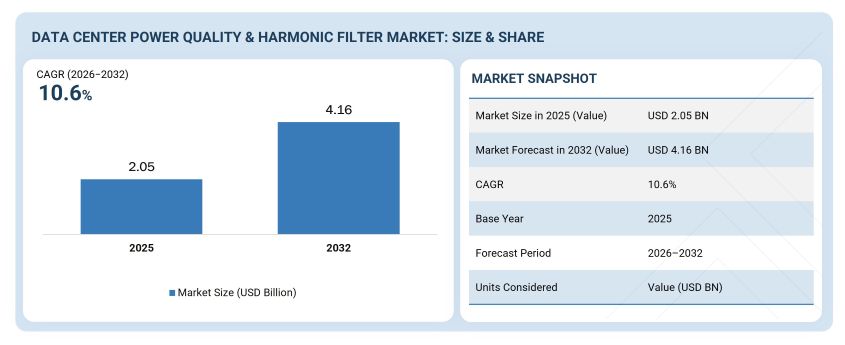
The global data center power quality & harmonic filter market is projected to grow from USD 2.05 billion in 2025 to USD 4.16 billion by 2032, at a CAGR of 10.6% during the forecast period. The market is being reshaped by the rapid expansion of AI infrastructure, rising rack power density, hyperscale data center investments, and increasing focus on uninterrupted power reliability. As GPU-intensive computing environments place unprecedented stress on electrical systems, operators are investing heavily in harmonic mitigation, power conditioning, intelligent monitoring, and next-generation energy management platforms to maintain uptime, efficiency, and regulatory compliance.
Asia Pacific is projected to emerge as the fastest-growing regional market due to aggressive hyperscale data center construction in China, India, Southeast Asia, and Australia, coupled with increasing AI infrastructure deployment and grid reliability concerns. North America currently holds the largest installed base, supported by extensive hyperscale capacity, GPU-driven AI workloads, and strong adoption of advanced power quality infrastructure among major cloud and colocation operators.
TOP 10 KEY TAKEAWAYS
- North America remains the leading regional market due to hyperscale concentration and advanced AI infrastructure deployment.
- Asia Pacific is emerging as the fastest-growing region because of accelerated digital infrastructure investments.
- Active harmonic filters are becoming the preferred solution for high-density AI workloads.
- Hyperscale data centers continue to dominate demand for advanced power quality systems.
- AI-ready power infrastructure is reshaping procurement priorities across colocation operators.
- Real-time power monitoring and analytics platforms are becoming standard across modern facilities.
- Sustainability and energy efficiency mandates are accelerating adoption of intelligent power management systems.
- Edge data centers are creating new opportunities for compact and modular harmonic mitigation solutions.
- Integration complexity in legacy facilities remains one of the major operational challenges.
- Companies focusing on integrated power, cooling, and software ecosystems are gaining competitive advantage.
EXTENDED MARKET INTRODUCTION
The modern data center is no longer just a facility for housing servers. It has become a critical layer of national digital infrastructure supporting AI training, cloud computing, streaming platforms, industrial automation, fintech ecosystems, and enterprise digital transformation. As power consumption inside data centers continues to rise, electrical reliability has become a board-level priority for operators, investors, and governments alike.
The growing adoption of AI accelerators and GPU clusters is fundamentally changing electrical load behavior inside data centers. AI servers create highly dynamic and nonlinear power demand patterns that introduce harmonics, voltage distortion, transient instability, and thermal stress into power systems. This is forcing operators to rethink traditional UPS architectures, power distribution systems, and harmonic mitigation strategies. Solutions such as active harmonic filters, intelligent PDUs, real-time power monitoring systems, and digital twin-enabled infrastructure management are moving from optional upgrades to operational necessities.
The market is also benefiting from broader trends tied to sustainability, energy efficiency, and grid modernization. Data center operators are under pressure to reduce energy waste while maintaining continuous uptime. Governments and utilities are introducing stricter power quality standards, while hyperscale operators are increasingly integrating renewable energy sources into their infrastructure. These developments are expanding the need for advanced power conditioning systems capable of stabilizing fluctuating loads and improving energy utilization efficiency.
MARKET TRENDS
One of the defining trends shaping the market is the rise of AI-ready data center infrastructure. Traditional enterprise workloads created relatively stable electrical demand profiles, but AI environments behave differently. GPU clusters can generate rapid power fluctuations, placing stress on transformers, switchgear, UPS systems, and distribution networks. Vendors are increasingly developing harmonic mitigation systems specifically designed for high-density AI facilities.
Another major trend is the convergence of power quality systems with intelligent monitoring software. Data center operators are moving beyond standalone hardware deployments toward integrated platforms capable of continuous monitoring, predictive diagnostics, and automated corrective actions. AI-enabled analytics are helping facilities identify harmonic distortion patterns, detect anomalies, and improve operational reliability.
Modular and prefabricated infrastructure deployment is also gaining momentum. Hyperscale operators increasingly favor modular electrical systems because they reduce deployment timelines and improve scalability. Vendors are responding with integrated power skids, modular UPS architectures, and compact harmonic filtering solutions that can be rapidly deployed in greenfield and brownfield environments.
Sustainability has become another strategic trend influencing procurement behavior. As data centers pursue lower PUE targets and renewable energy integration, power quality management is becoming essential for improving energy efficiency and stabilizing distributed energy systems. Operators are increasingly evaluating harmonic filtering technologies as part of broader ESG and decarbonization strategies.
The market is also witnessing deeper integration between power infrastructure and liquid cooling systems. AI-driven facilities require advanced cooling technologies, which in turn introduce new electrical load dynamics. Vendors are developing coordinated cooling-and-power architectures to address harmonics, transient loads, and thermal management challenges simultaneously.
MARKET DRIVERS
The explosive growth of hyperscale and AI data centers is one of the strongest drivers supporting market expansion. Major cloud providers and colocation operators are investing aggressively in facilities optimized for AI inference and training workloads. These environments demand extremely reliable and clean power because even minor electrical disturbances can impact compute performance, reduce hardware lifespan, or trigger downtime.
Another important driver is the increasing sensitivity of modern IT equipment. Advanced processors, AI accelerators, storage systems, and networking hardware require stable voltage and low harmonic distortion to function efficiently. As facilities deploy denser server racks, the need for sophisticated harmonic filtering and power conditioning technologies continues to grow.
Regulatory pressure is also influencing adoption patterns. Standards such as IEEE 519 and IEC 61000 are encouraging facilities to improve harmonic management and power quality compliance. Utilities and grid operators are becoming more focused on harmonic pollution and grid stability as large-scale data centers place increasing stress on electrical networks.
Digital transformation across industries is indirectly accelerating demand for reliable data center infrastructure. Sectors such as banking, healthcare, manufacturing, telecom, and e-commerce increasingly depend on uninterrupted digital services. This dependency is pushing operators to strengthen electrical resiliency and invest in advanced power quality systems.
The expansion of edge computing is creating additional demand opportunities. Edge facilities often operate in environments with unstable grid conditions or space constraints, increasing the need for compact and intelligent harmonic mitigation systems capable of supporting localized digital infrastructure.
MARKET CHALLENGES / RESTRAINTS
Despite strong growth prospects, the market faces several operational and economic challenges. One of the most significant barriers is the high upfront cost associated with advanced harmonic filtering systems and integrated power quality infrastructure. Large-scale deployments often require extensive redesign of electrical architecture, particularly in older facilities.
Integration complexity is another major concern. Many legacy data centers were not designed to support modern AI workloads or advanced harmonic mitigation systems. Retrofitting existing environments can be technically challenging, especially when facilities must remain operational during upgrades.
The shortage of skilled electrical and infrastructure professionals is creating deployment bottlenecks in several regions. Advanced power quality systems require specialized engineering expertise for installation, commissioning, and ongoing maintenance. As demand accelerates, labor availability may become a limiting factor.
Cybersecurity is emerging as an additional challenge. Modern power monitoring systems increasingly rely on connected digital platforms, cloud-based analytics, and remote management capabilities. Operators must ensure that these systems remain protected against cyber threats and operational vulnerabilities.
Supply chain volatility also remains a concern. Electrical components such as transformers, semiconductors, switchgear, and power electronics continue to experience procurement challenges in some markets. These disruptions can delay project timelines and increase infrastructure costs.
INDUSTRY / APPLICATION GROWTH
Hyperscale cloud providers represent one of the most important growth engines for the market. These operators require scalable and resilient electrical infrastructure capable of supporting massive AI and cloud workloads. Harmonic filtering technologies are becoming increasingly important in maintaining stability across high-density computing environments.
Colocation providers are also investing aggressively in advanced power quality systems. Enterprise customers expect carrier-neutral facilities to deliver near-continuous uptime and consistent performance. This expectation is driving demand for sophisticated monitoring systems, intelligent PDUs, and high-efficiency harmonic mitigation technologies.
Financial services organizations remain a major application segment because of their dependence on uninterrupted digital operations. Trading systems, payment platforms, and banking infrastructure require stable power environments with minimal electrical disturbances.
Healthcare and pharmaceutical sectors are emerging as strategic growth areas as digital diagnostics, AI-driven imaging, and cloud-based medical systems expand globally. These environments require highly reliable power systems to support mission-critical applications.
Telecommunications operators are another important customer group. The growth of 5G networks, edge computing, and distributed digital infrastructure is increasing demand for compact and modular power quality solutions that can operate in remote or space-constrained environments.
SEGMENT INSIGHTS
Data Center Power Quality & Harmonic Filter Market, By Filter Type
Active harmonic filters are currently leading the market because they provide dynamic and real-time harmonic compensation across highly variable load conditions. Their ability to adapt to changing electrical environments makes them particularly suitable for hyperscale and AI-driven data centers.
Hybrid harmonic filters are witnessing the fastest growth as operators seek a balance between performance, flexibility, and cost optimization. These systems combine the advantages of active and passive filtering technologies while improving scalability for modern facilities.
Data Center Power Quality & Harmonic Filter Market, By Component
Harmonic filters and intelligent monitoring systems account for the dominant share of deployments because they directly address power distortion and infrastructure reliability concerns. Operators increasingly prioritize integrated ecosystems that combine filtering, monitoring, and predictive analytics.
Monitoring software and AI-enabled analytics platforms are emerging as the fastest-growing component category. Facilities are moving toward software-defined infrastructure management models that improve visibility and operational intelligence.
Data Center Power Quality & Harmonic Filter Market, By Data Center Type
Hyperscale data centers represent the largest deployment category because of their massive electrical infrastructure requirements and aggressive AI expansion strategies. Large cloud operators continue to invest heavily in resilient and scalable power systems.
Edge data centers are emerging as the fastest-growing segment due to the expansion of low-latency applications, distributed computing architectures, and localized digital services. Compact harmonic filtering solutions are becoming increasingly important in these facilities.
Data Center Power Quality & Harmonic Filter Market, By Power Rating
The high-capacity power rating category dominates the market because hyperscale and AI facilities require advanced electrical infrastructure capable of supporting large and fluctuating workloads.
Medium-capacity modular systems are gaining traction rapidly as colocation and edge operators prioritize flexible deployment architectures and scalable infrastructure models.
Data Center Power Quality & Harmonic Filter Market, By Application
UPS harmonic mitigation remains the leading application area because UPS systems are central to maintaining uninterrupted operations across modern data centers.
Real-time power monitoring is emerging as the fastest-growing application as operators increasingly adopt predictive maintenance, AI-enabled analytics, and intelligent infrastructure management solutions.
Key Segmentation Conclusions
- Active harmonic filters remain the preferred technology for AI-ready infrastructure.
- Hyperscale facilities continue to dominate overall market demand.
- Edge deployments are accelerating demand for modular systems.
- Monitoring software is becoming central to infrastructure strategy.
- Integrated ecosystems combining hardware and analytics are gaining momentum.
REGIONAL ANALYSIS
North America
The United States remains the global center of hyperscale and AI infrastructure investment, supported by major cloud providers, semiconductor ecosystems, and digital platform operators. Canada is gaining traction because of renewable energy availability and favorable cooling conditions, while Mexico is seeing growing colocation investments tied to digital transformation and nearshoring trends. The North American market was valued at USD 0.72 billion in 2025 and is projected to reach USD 1.43 billion by 2032 at a CAGR of 10.3%, driven by aggressive AI data center expansion and increasing investment in resilient power infrastructure.
Europe
Europe continues to focus heavily on sustainability, energy efficiency, and regulatory compliance. Germany, the United Kingdom, France, and the Nordics remain major data center hubs because of strong digital infrastructure and renewable energy integration. Operators across Europe are increasingly prioritizing harmonic mitigation and intelligent power monitoring as part of broader decarbonization and grid stability initiatives. The European market is estimated at USD 0.48 billion in 2025 and is expected to reach USD 0.87 billion by 2032 at a CAGR of 8.8%, supported by stringent energy efficiency regulations and continued investments in colocation infrastructure.
Asia Pacific
Asia Pacific is witnessing unprecedented growth in hyperscale and colocation data center investments. China, India, Singapore, Japan, South Korea, and Australia are emerging as critical digital infrastructure hubs driven by cloud adoption, AI deployment, and expanding internet ecosystems. Governments across the region are supporting digital economy initiatives while enterprises accelerate migration toward cloud-native architectures. The Asia Pacific market is projected to grow from USD 0.64 billion in 2025 to USD 1.46 billion by 2032 at a CAGR of 12.5%, making it the fastest-growing regional market during the forecast period.
Rest of World
The Rest of World region is benefiting from rising digital infrastructure investments across the Middle East, Latin America, and parts of Africa. Countries such as the UAE and Saudi Arabia are aggressively developing AI and cloud infrastructure as part of broader economic diversification strategies, while Brazil and South Africa are strengthening regional colocation ecosystems. The Rest of World market is expected to expand from USD 0.21 billion in 2025 to USD 0.40 billion by 2032 at a CAGR of 9.4%, supported by emerging hyperscale deployments and improving regional connectivity.
Regional Outlook Summary
- North America maintains leadership through hyperscale AI infrastructure investments.
- Europe emphasizes sustainability and regulatory compliance.
- Asia Pacific leads future expansion due to digital economy acceleration.
- Middle Eastern countries are becoming strategic AI infrastructure hubs.
- Edge computing is expanding regional demand diversity.
COUNTRY-SPECIFIC INSIGHTS
The United States continues to dominate global hyperscale infrastructure deployment because of strong cloud ecosystems, semiconductor innovation, and AI investment momentum. Major operators are increasingly redesigning power architectures to accommodate GPU-intensive workloads and higher rack densities.
China remains one of the most strategically important markets due to large-scale digital infrastructure expansion and government-backed AI initiatives. Domestic cloud providers are rapidly scaling hyperscale facilities, increasing demand for advanced power quality systems.
India is emerging as a high-growth opportunity because of accelerating cloud adoption, data localization policies, and increasing enterprise digitalization. Colocation investments are rising across Mumbai, Chennai, Hyderabad, and other major technology hubs.
Singapore continues to serve as a critical regional colocation hub despite energy efficiency constraints and sustainability regulations. Operators are prioritizing highly efficient and compact power quality solutions to maximize infrastructure performance.
Germany and the Nordics remain important European markets because of renewable energy integration, advanced industrial infrastructure, and strong emphasis on sustainable data center operations.
Country-Level Conclusions
- The United States remains the global innovation hub for AI infrastructure.
- China continues to accelerate hyperscale development.
- India is becoming a strategic colocation destination.
- Singapore prioritizes efficiency-focused infrastructure deployment.
- European markets emphasize sustainable and compliant operations.
KEY COMPANY INSIGHTS
The competitive landscape is dominated by diversified power infrastructure providers, data center specialists, and digital energy management companies. Major players are increasingly expanding their capabilities through acquisitions, AI-enabled software integration, modular infrastructure development, and partnerships with hyperscale cloud operators.
Key companies operating in the market include:
- Schneider Electric
- Vertiv
- Eaton
- ABB
- Siemens
- Legrand
- Socomec
- Hitachi Energy
- Delta Electronics
- Huawei
- Mitsubishi Electric
- Janitza
Many vendors are shifting toward integrated platform strategies that combine power infrastructure, thermal management, software analytics, and AI-driven optimization. Strategic acquisitions are becoming increasingly common as companies attempt to strengthen capabilities in liquid cooling, modular infrastructure, and intelligent energy management.
Partnership activity is also accelerating across the ecosystem. Vendors are collaborating with GPU manufacturers, cloud providers, and infrastructure operators to develop AI-ready power and cooling architectures. These partnerships are expected to play a central role in shaping next-generation data center infrastructure.
Key Company Strategy Conclusions
- Integrated infrastructure ecosystems are becoming a major differentiator.
- AI-enabled monitoring platforms are central to product strategy.
- Modular deployment capabilities are gaining importance.
- Partnerships with hyperscale operators are increasing.
- Sustainability-focused innovation is influencing product development.
RECENT DEVELOPMENTS
- In May 2025, Schneider Electric published a dedicated power quality eGuide for data centers highlighting the growing operational impact of harmonic distortion and voltage fluctuations in AI-driven facilities.
- In November 2025, Eaton agreed to acquire Boyd Thermal to strengthen its liquid cooling and data center power management portfolio.
- In November 2025, Schneider Electric expanded its partnership with Switch to support prefabricated AI data center power infrastructure deployment.
- In March 2024, Vertiv joined the NVIDIA Partner Network to strengthen AI-ready infrastructure collaboration.
- In December 2024, Vertiv acquired centrifugal chiller technology capabilities to support high-performance computing and AI infrastructure environments.
REAL-WORLD USE CASES / CASE STUDIES
In 2024, Vertiv expanded its collaboration with NVIDIA to develop integrated cooling and power infrastructure solutions for high-density AI computing environments. The initiative focused on supporting liquid-cooled AI systems capable of handling increasingly demanding GPU workloads. The partnership was designed to improve power stability, thermal management, and infrastructure scalability for next-generation AI facilities.
In 2025, Schneider Electric expanded its work with Switch to deploy prefabricated power infrastructure modules for AI-driven data centers. The deployment focused on enabling faster scaling of high-density computing environments while improving operational efficiency and power quality management capabilities.
MARKET SEGMENTATION
The data center power quality & harmonic filter market is evolving into a highly diversified ecosystem shaped by filter technologies, infrastructure architectures, monitoring platforms, power ratings, and deployment environments. Hyperscale operators are increasingly adopting integrated ecosystems that combine active harmonic filtering, intelligent monitoring, modular switchgear, and AI-driven analytics into unified infrastructure platforms.
The market is also becoming more application-specific. AI training facilities require highly responsive harmonic mitigation systems capable of supporting dynamic electrical loads, while colocation facilities prioritize operational efficiency and uptime optimization. Edge deployments increasingly focus on compactness, modularity, and simplified integration.
Regional variations further influence segmentation dynamics. Mature markets often prioritize modernization and efficiency optimization, while emerging markets focus on scalable infrastructure deployment and digital economy expansion. Vendors are responding with increasingly customizable and software-centric offerings tailored to varying customer requirements.
Segmentation Summary
- AI workloads are reshaping infrastructure requirements across all segments.
- Software integration is becoming central to competitive differentiation.
- Hyperscale and edge deployments require distinct infrastructure approaches.
- Modular architectures are expanding rapidly across regions.
- Sustainability goals are influencing procurement priorities.
CONCLUSION / FUTURE OUTLOOK
The data center power quality & harmonic filter market is entering a transformative growth phase driven by AI infrastructure expansion, digital transformation, and rising demand for resilient power systems. As data centers evolve into increasingly power-intensive environments, harmonic mitigation and intelligent power management technologies will become foundational infrastructure layers rather than optional enhancements.
AI, automation, predictive analytics, and digital twin technologies are expected to redefine infrastructure management strategies over the coming years. Vendors capable of delivering integrated ecosystems combining power quality management, cooling optimization, and real-time operational intelligence are likely to gain significant competitive advantage. The market’s long-term trajectory remains closely tied to global AI adoption, hyperscale investment momentum, and the growing importance of reliable digital infrastructure.
FAQ SECTION
1. How big is the data center power quality & harmonic filter market?
The global data center power quality & harmonic filter market is estimated at USD 2.05 billion in 2025 and is projected to reach USD 4.16 billion by 2032. Growth is being driven primarily by AI infrastructure expansion, rising rack densities, and increasing demand for resilient electrical systems in hyperscale and colocation facilities.
2. What is the data center power quality & harmonic filter market growth rate?
The market is expected to grow at a CAGR of 10.6% during the 2026–2032 forecast period. Expansion of AI-ready infrastructure and increasing adoption of intelligent power quality management systems are among the major contributors supporting this growth trajectory.
3. Which segment leads the data center power quality & harmonic filter market?
Hyperscale data centers currently represent the leading segment because of their large-scale electrical infrastructure requirements and growing deployment of AI computing environments. Active harmonic filters also remain a dominant technology category due to their adaptability in dynamic load conditions.
4. Who are the key players in the data center power quality & harmonic filter market?
Major players include Schneider Electric, Vertiv, Eaton, ABB, Siemens, Legrand, and Hitachi Energy.
5. What factors are driving the data center power quality & harmonic filter market?
Key growth drivers include AI data center expansion, increasing rack power density, rising demand for uninterrupted uptime, sustainability initiatives, and growing adoption of intelligent infrastructure management systems. Regulatory standards related to power quality and grid stability are also accelerating deployment.
 Exclusive indicates content/data unique to MarketsandMarkets and not available with any competitors.
TABLE OF CONTENTS
1 INTRODUCTION
1.1 STUDY OBJECTIVES
1.2 MARKET DEFINITION
1.3 MARKET SCOPE
1.3.1 MARKETS COVERED
1.3.2 GEOGRAPHIC SCOPE
1.3.3 YEARS CONSIDERED
1.4 CURRENCY CONSIDERED
1.5 STAKEHOLDERS
1.6 SUMMARY OF CHANGES
2 RESEARCH METHODOLOGY
2.1 RESEARCH DATA
2.1.1 SECONDARY DATA
2.1.2 PRIMARY DATA
2.2 MARKET SIZE ESTIMATION
2.2.1 BOTTOM-UP APPROACH
2.2.2 TOP-DOWN APPROACH
2.3 DATA TRIANGULATION
2.4 RESEARCH ASSUMPTIONS
2.5 LIMITATIONS
3 EXECUTIVE SUMMARY
4 PREMIUM INSIGHTS
4.1 ATTRACTIVE OPPORTUNITIES IN THE DATA CENTER POWER QUALITY & HARMONIC FILTER MARKET
4.2 MARKET, BY FILTER TYPE
4.3 MARKET, BY DATA CENTER TYPE
4.4 MARKET, BY POWER RATING
4.5 MARKET, BY REGION
4.6 AI DATA CENTER BUILDOUT IMPACT ON POWER QUALITY INFRASTRUCTURE
5 MARKET OVERVIEW
5.1 INTRODUCTION
5.2 MARKET DYNAMICS
5.2.1 DRIVERS
5.2.1.1 Rapid expansion of AI and hyperscale data centers
5.2.1.2 Rising power density and harmonic distortion in GPU clusters
5.2.1.3 Increasing demand for uptime and power reliability
5.2.1.4 Stringent grid compliance and IEEE standards
5.2.2 RESTRAINTS
5.2.2.1 High installation and retrofit costs
5.2.2.2 Integration complexity in legacy facilities
5.2.3 OPPORTUNITIES
5.2.3.1 Edge and modular data center expansion
5.2.3.2 Smart power monitoring and AI-enabled harmonic analytics
5.2.4 CHALLENGES
5.2.4.1 Skilled workforce shortages
5.2.4.2 Thermal and space constraints in brownfield facilities
5.3 VALUE CHAIN ANALYSIS
5.4 ECOSYSTEM ANALYSIS
5.5 INVESTMENT & FUNDING SCENARIO
5.6 PRICING ANALYSIS
5.7 TECHNOLOGY ANALYSIS
5.7.1 ACTIVE HARMONIC FILTERS
5.7.2 PASSIVE HARMONIC FILTERS
5.7.3 HYBRID FILTERS
5.7.4 DIGITAL POWER QUALITY MONITORING
5.8 PORTER'S FIVE FORCES ANALYSIS
5.9 KEY BUYING CRITERIA
5.10 CASE STUDY ANALYSIS
5.11 TRADE ANALYSIS
5.12 PATENT ANALYSIS
5.13 REGULATORY LANDSCAPE
5.13.1 IEEE 519
5.13.2 IEC 61000 SERIES
5.13.3 ENERGY EFFICIENCY AND GRID STABILITY REGULATIONS
5.14 IMPACT OF AI/GEN AI ON THE MARKET
5.15 IMPACT OF 2025 US TARIFFS
6 INDUSTRY TRENDS
6.1 AI-DRIVEN POWER DENSITY ESCALATION
6.2 LIQUID COOLING AND ITS EFFECT ON POWER INFRASTRUCTURE
6.3 DIGITAL TWIN ADOPTION FOR POWER QUALITY MANAGEMENT
6.4 SUSTAINABILITY AND ENERGY EFFICIENCY INITIATIVES
6.5 MODULAR POWER INFRASTRUCTURE DEPLOYMENT
6.6 INTEGRATION OF REAL-TIME POWER ANALYTICS
7 TECHNOLOGY ADOPTION & COMPLIANCE LANDSCAPE
7.1 SMART POWER QUALITY MANAGEMENT SYSTEMS
7.2 AI-ENABLED POWER MONITORING
7.3 DCIM INTEGRATION
7.4 CYBERSECURITY FOR POWER MANAGEMENT SYSTEMS
7.5 GRID INTERCONNECTION AND COMPLIANCE REQUIREMENTS
8 CUSTOMER LANDSCAPE & BUYER BEHAVIOR
8.1 BUYER DECISION-MAKING PROCESS
8.2 KEY BUYER STAKEHOLDERS
8.3 PROCUREMENT PRIORITIES
8.4 ADOPTION BARRIERS
8.5 SERVICE AND MAINTENANCE EXPECTATIONS
9 DATA CENTER POWER QUALITY & HARMONIC FILTER MARKET, BY FILTER TYPE
9.1 INTRODUCTION
9.2 ACTIVE HARMONIC FILTERS
9.3 PASSIVE HARMONIC FILTERS
9.4 HYBRID HARMONIC FILTERS
10 DATA CENTER POWER QUALITY & HARMONIC FILTER MARKET, BY COMPONENT
10.1 INTRODUCTION
10.2 HARMONIC FILTERS
10.3 STATIC VAR COMPENSATORS
10.4 UPS SYSTEMS
10.5 POWER QUALITY METERS & ANALYZERS
10.6 MONITORING SOFTWARE
10.7 SWITCHGEAR & POWER DISTRIBUTION UNITS
11 DATA CENTER POWER QUALITY & HARMONIC FILTER MARKET, BY DATA CENTER TYPE
11.1 INTRODUCTION
11.2 HYPERSCALE DATA CENTERS
11.3 COLOCATION DATA CENTERS
11.4 ENTERPRISE DATA CENTERS
11.5 EDGE DATA CENTERS
12 DATA CENTER POWER QUALITY & HARMONIC FILTER MARKET, BY POWER RATING
12.1 INTRODUCTION
12.2 BELOW 500 KVA
12.3 500 KVA–1 MVA
12.4 1–5 MVA
12.5 ABOVE 5 MVA
13 DATA CENTER POWER QUALITY & HARMONIC FILTER MARKET, BY APPLICATION
13.1 INTRODUCTION
13.2 UPS HARMONIC MITIGATION
13.3 POWER FACTOR CORRECTION
13.4 VOLTAGE STABILIZATION
13.5 REAL-TIME POWER MONITORING
13.6 CRITICAL LOAD PROTECTION
14 DATA CENTER POWER QUALITY & HARMONIC FILTER MARKET, BY REGION
14.1 INTRODUCTION
14.2 NORTH AMERICA
14.2.1 UNITED STATES
14.2.2 CANADA
14.2.3 MEXICO
14.3 EUROPE
14.3.1 GERMANY
14.3.2 UNITED KINGDOM
14.3.3 FRANCE
14.3.4 ITALY
14.3.5 SPAIN
14.3.6 NORDICS
14.4 ASIA PACIFIC
14.4.1 CHINA
14.4.2 JAPAN
14.4.3 INDIA
14.4.4 SOUTH KOREA
14.4.5 SINGAPORE
14.4.6 AUSTRALIA
14.5 REST OF WORLD
14.5.1 BRAZIL
14.5.2 UAE
14.5.3 SAUDI ARABIA
14.5.4 SOUTH AFRICA
15 COMPETITIVE LANDSCAPE
15.1 OVERVIEW
15.2 KEY PLAYER STRATEGIES
15.3 REVENUE ANALYSIS
15.4 MARKET SHARE ANALYSIS
15.5 COMPANY EVALUATION MATRIX: KEY PLAYERS
15.6 COMPANY EVALUATION MATRIX: STARTUPS/SMES
15.7 COMPETITIVE BENCHMARKING
15.8 COMPETITIVE SCENARIO
15.8.1 PRODUCT LAUNCHES
15.8.2 PARTNERSHIPS
15.8.3 ACQUISITIONS
15.8.4 EXPANSIONS
16 COMPANY PROFILES
16.1 Schneider Electric
16.2 Vertiv
16.3 Eaton
16.4 ABB
16.5 Siemens
16.6 Legrand
16.7 Socomec
16.8 Hitachi Energy
16.9 Delta Electronics
16.10 Huawei
16.11 Mitsubishi Electric
16.12 Janitza
16.13 Piller Power Systems
16.14 Riello UPS
16.15 Toshiba
17 APPENDIX
17.1 DISCUSSION GUIDE
17.2 KNOWLEDGESTORE
17.3 CUSTOMIZATION OPTIONS
17.4 RELATED REPORTS
17.5 AUTHOR DETAILS













Growth opportunities and latent adjacency in Data Center Power Quality & Harmonic Filter Market