Data Center Prefabricated Electrical Room Market Size, Share, Trends & Growth Report by Configuration Type (MV Electrical Room, LV Electrical Room), Indoor Climate-Controlled, Outdoor Weatherproof, Hyperscale, Colocation, Cloud Service Providers, BFSI - Global Forecast to 2032


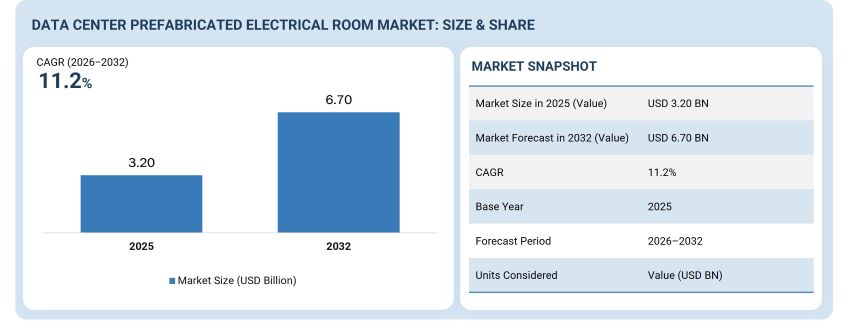
The global data center prefabricated electrical room market was valued at approximately USD 3.2 billion in 2025 and is projected to reach USD 6.7 billion by 2032, advancing at a compound annual growth rate (CAGR) of 11.2% during the forecast period 2026–2032. This growth trajectory is shaped most directly by the accelerating demand for AI-ready data center capacity, which is compressing construction timelines to competitive breaking points and making factory-integrated, pre-tested electrical rooms not just a convenience but a strategic imperative for hyperscale operators and colocation providers racing to bring compute capacity online.
Triangulation Note: The Data Center Prefabricated Electrical Room market is defined as factory-built, pre-wired, and pre-tested walk-in electrical enclosures (eHouses, ePODs, power modules, modular switchrooms) deployed within or adjacent to data center facilities, incorporating medium-voltage and/or low-voltage switchgear, transformers, UPS interfaces, bus ducts, protection relays, and control systems as integrated units. This market is scoped as a sub-segment of the broader data center electrical infrastructure space, with the parent data center power market (MnM, 2025) sized at ~USD 35 billion globally.
Regional capture ratio applied: Prefabricated electrical rooms (as distinct from field-installed equipment) represent a structurally growing but still minority share of total data center electrical spend — currently estimated at approximately 8–10% of the addressable electrical infrastructure capex universe, rising to approximately 12–14% by 2032 as factory-build adoption accelerates under hyperscale timeline pressure, on-site labor constraints, and AI workload expansion.
Asia Pacific is the fastest-growing region, driven by China's massive hyperscale build program under the "East Data West Computing" initiative, India's surging cloud infrastructure investment, and Southeast Asia's emergence as a preferred data center hub for global hyperscalers. North America holds the largest absolute base, anchored by US hyperscale campuses operated by the major cloud service providers, where compressed construction timelines and on-site labor costs are the primary levers favoring factory-built prefabricated electrical rooms.
Top 10 Key Takeaways
- North America is the largest regional market, underpinned by the US hyperscale and colocation build wave, high on-site labor costs, and the dominance of cloud service providers that favor standardized electrical room packages.
- Asia Pacific is the fastest-growing region, with China, India, and Singapore driving investment in digital infrastructure at a pace that makes prefabrication the only viable path to meeting build timelines.
- Hyperscale data centers are the dominant end-user segment, demanding high-power-rated prefabricated electrical rooms with MV/LV integration, redundant bus architectures, and factory acceptance testing against Tier III and Tier IV uptime standards.
- The 5 MVA–20 MVA power rating band is the fastest-growing segment, driven by AI GPU cluster builds requiring dense, high-fault-current electrical distribution infrastructure within tight campus footprints.
- SF6-free switchgear integration is the defining technology shift, with EU regulatory pressure under the 2024 F-Gas Regulation recast accelerating the transition to clean-air and vacuum-insulated alternatives inside factory-built rooms.
- Edge data center rollouts are creating a new, high-volume low-power-rating segment, where containerized prefabricated electrical rooms are deployed rapidly at the network edge to support 5G densification and autonomous systems.
- Schneider Electric, ABB, Eaton, Siemens, and Vertiv are the leading competitive players, collectively shaping product roadmaps around AI-ready power architectures, digital twin integration, and factory cycle-time reduction.
- Compressed construction timelines — increasingly measured in months, not years, for hyperscale campuses — represent the single most powerful near-term demand catalyst in this market.
- The 2025 US tariff environment introduces near-term supply chain friction on imported electrical components and enclosures, creating both risk (cost inflation) and opportunity (reshoring and domestic manufacturing investment).
- Standardization-versus-customization tension remains the primary adoption barrier, particularly for enterprise data center buyers with bespoke facility architectures who have not yet committed to repeatable prefabricated room specifications.
Why This Market Matters Right Now
The data center industry is undergoing the fastest capacity expansion in its history. The scale of AI compute infrastructure announced by the largest cloud service providers through 2025 represents hundreds of billions of dollars in capital expenditure — and at the heart of every facility investment is a fundamental question about how to get electrical infrastructure in the ground quickly, reliably, and at scale. The traditional model — field-built electrical rooms assembled piece by piece on site by local contractors — is no longer fast enough, consistent enough, or cost-effective enough to meet the pace of modern hyperscale deployment. Prefabricated electrical rooms, built in controlled factory environments, tested before shipment, and dropped into position on site in days rather than months, have moved from a premium niche to a mainstream procurement category.
This market sits at the intersection of several macro forces that are reshaping digital infrastructure globally. The AI workload wave is not just generating demand for more data centers — it is generating demand for fundamentally different power architectures, with rack densities that have increased from 4–10 kW in a traditional server configuration to 60–100 kW per rack for GPU-dense AI clusters, and projections suggesting 200–300 kW racks within the forecast period. That leap in power density flows directly upstream: it requires more robust medium-voltage feed architectures, higher-fault-current switchgear, more sophisticated bus duct systems, and more intelligent protection relay configurations — all of which are better engineered and tested in a factory environment than assembled on a construction site.
Meanwhile, the sustainability agenda is adding another layer of technical complexity. Europe's 2024 F-Gas Regulation recast has set firm timelines for the elimination of sulfur hexafluoride (SF6) from new medium-voltage switchgear installations, accelerating the market's transition to vacuum-insulated and clean-air alternatives. Carbon-neutral commitments from hyperscalers are translating into procurement requirements that favour energy-efficient designs, lower lifecycle emissions, and real-time energy monitoring — all of which are more feasible to integrate in a factory-built room than a field-assembled one.
Market Trends Shaping the Data Center Prefabricated Electrical Room Landscape
The most consequential trend in this market is the wholesale shift from site-built to factory-integrated electrical infrastructure. Through 2023 and into 2025, the major hyperscale operators have progressively moved toward preferred-supplier frameworks with key electrical room vendors, signing multi-year master supply agreements that guarantee allocation of prefabricated electrical room capacity across their global build pipelines. ABB's strategic partnership with Microsoft for standardized MV switchgear packages in next-generation data center campuses, announced as part of ABB's broader hyperscale-focused strategy, illustrates this structural shift toward ecosystem integration between equipment manufacturers and facility operators.
The rise of all-in-one power modules — units that integrate medium-voltage switchgear, step-down transformer, UPS interface, low-voltage distribution, and monitoring systems into a single factory-tested assembly — represents a step change in the value proposition of prefabrication. Vertiv's MegaMod product line and Schneider Electric's EcoStruxure Pod Data Centre solutions, both launched or significantly expanded in 2024–2025, reflect the same underlying logic: reduce the number of integration touchpoints on site, and the risk of commissioning errors and project overruns drops proportionally. The June 2025 launch of Schneider Electric's Prefabricated Modular EcoStruxure Pod Data Center, which consolidates liquid cooling, high-power busway, and high-density racks into a unified assembly, marks how far the convergence of power and thermal infrastructure has progressed.
Digital integration is a third defining trend. The most advanced prefabricated electrical rooms now ship with embedded IoT sensor suites, digital secondary instrumentation, and cloud-connected monitoring platforms that feed directly into data center infrastructure management (DCIM) systems and digital twin environments. Schneider Electric's March 2025 collaboration with NVIDIA and ETAP to develop digital twin technology for AI data centers explicitly extends this capability into the design phase — enabling operators to virtually commission and stress-test an electrical room's behavior before the physical unit leaves the factory.
SF6-free technology is reshaping the medium-voltage switchgear inside prefabricated rooms. Schneider Electric's Ringmaster AirSeT, launched in October 2024, and ABB's UniGear ZS2 clean-air GIS are now the reference designs for European hyperscale procurements. The regulatory pressure is unambiguous: under the EU's 2024 recast F-Gas Regulation, the pathway for SF6-containing equipment in new installations is being systematically closed off, making clean-air alternatives the default specification for any factory-built electrical room destined for a European data center campus.
Market Drivers
Hyperscale and AI-driven data center expansion is the primary demand engine. The compute requirements of large language models, AI inference workloads, and high-performance computing clusters are driving a generation of data center campuses that dwarf their predecessors in power draw, facility scale, and build complexity. Hyperscale operators including Amazon Web Services, Microsoft Azure, and Google Cloud have collectively announced data center investment plans measured in tens of billions of dollars annually through the late 2020s. Every new facility requires a substantial electrical infrastructure package — and the combination of timeline pressure, quality consistency requirements, and labor market constraints is systematically pushing that infrastructure toward the factory-build model.
On-site construction labor constraints compound the timeline pressure. The World Resources Institute and industry construction analysts have noted that power availability constraints are already extending data center construction timelines by 24 to 72 months, and shortages of experienced electrical contractors capable of assembling mission-critical switchgear in the field are a contributing factor. Prefabricated electrical rooms directly address this gap by offloading skilled electrical assembly work to controlled factory environments, and reducing the on-site installation scope to civil works and final cable connections.
Power density escalation is driving a hardware refresh cycle for electrical infrastructure even within existing facilities. AI computing racks requiring 50 kW, 100 kW, and higher per rack cannot be served by the low-fault-current, low-capacity distribution systems installed for traditional compute loads. Data center operators planning AI compute expansions frequently find that their existing electrical rooms must be replaced or augmented — and the brownfield retrofit use case is increasingly being served by prefabricated electrical room modules that can be installed adjacent to existing facilities with minimal disruption to ongoing operations.
Supply chain standardization pressure from hyperscale buyers is driving a preference for factory-certified, pre-tested assemblies over field-assembled alternatives. When a facility developer is managing a multi-campus, multi-geography build program with standardized electrical specifications, factory-built prefabricated rooms deliver a consistency of quality, documentation, and test record that field assembly cannot match at scale.
Market Challenges and Restraints
The most cited adoption friction is the logistics and transportation complexity of large-format prefabricated electrical rooms. A walk-in eHouse containing medium-voltage switchgear, step-down transformers, and UPS equipment can weigh tens of tonnes and exceed standard road transport dimensions, requiring oversized load permitting, specialized haulage equipment, and careful site access planning. In dense urban environments or geographically challenging sites — a growing proportion of edge and emerging-market deployments — these logistics constraints can limit or eliminate the deployment of the largest room configurations.
Standardization versus customization tension remains a structural challenge. Data center design has historically been highly bespoke, with engineering teams at hyperscale operators, colocation providers, and enterprise IT departments each developing proprietary specifications that reflect specific uptime targets, geographic utility conditions, and equipment preferences. Adopting factory-built prefabricated electrical rooms requires a degree of design standardization that not all buyers are yet comfortable with — particularly for first-time adopters who have not yet developed the specification templates, factory acceptance test protocols, and change management processes that make large-scale prefabrication deployments successful.
The 2025 US tariff environment has introduced new supply chain uncertainty. Tariffs on electrical components imported from key manufacturing hubs — including transformers, switchgear panels, and bus duct systems from Asian suppliers — are adding cost pressure at a moment when the industry is already managing materials inflation. Near-term, this is compressing margins for some suppliers and prompting buyers to reassess sourcing strategies. Medium-term, it is likely to accelerate domestic manufacturing investment in North America, which several major vendors have already signalled.
Interoperability with legacy power infrastructure creates adoption friction in brownfield deployments. Connecting a factory-built prefabricated electrical room to an existing medium-voltage feed, an in-service UPS bank, or an aging switchboard of a different manufacturer requires detailed engineering work that can partially offset the efficiency gains of prefabrication. The industry's move toward open communication protocols and standardized interfaces (IEC 61850 for protection and control communications, for example) is addressing this challenge, but the installed base of non-interoperable legacy equipment remains a real constraint.
Industry and Application Growth: Key Verticals Driving Demand
Cloud service providers and hyperscale operators are the dominant vertical and the source of the most transformative demand growth in this market. The economics of hyperscale construction — where a single campus can exceed 500 MW of IT load capacity and require hundreds of discrete electrical room units across multiple power trains — make factory-build economics extraordinarily compelling. The consistency, documentation, and test quality of factory-built rooms reduce the commissioning risk on projects where a single electrical failure during energization can delay facility turn-up by weeks and cost millions. Amazon Web Services, Microsoft, Google, Meta, and their global peers are the reference customers that set the tone for the entire market's product specifications and procurement processes.
Colocation providers represent the second-largest vertical and a segment with distinct procurement dynamics. Companies such as Equinix, Digital Realty, NTT Global Data Centers, and CyrusOne are executing aggressive multi-geography expansion programs, each requiring standardized, replicable electrical room solutions that can be deployed consistently across campuses in different countries with different utility configurations. The colocation model — where the facility operator must guarantee Tier III or Tier IV power uptime to multiple tenants simultaneously — places an especially high premium on the factory acceptance testing and redundancy engineering that prefabricated electrical rooms offer.
BFSI (banking, financial services, and insurance) is a critical vertical, both for its scale of data center infrastructure and for the stringent uptime requirements and regulatory compliance expectations that financial institutions impose on their electrical systems. Banks and financial market infrastructure providers operating mission-critical trading, clearing, and core banking systems cannot tolerate power interruptions measured in seconds, let alone minutes. Prefabricated electrical rooms with pre-verified redundancy architectures, arc-flash protection, and documented test records align naturally with the governance frameworks these organizations operate under.
Healthcare and life sciences is an emerging growth vertical, driven by the digitalization of clinical systems, medical imaging data, and genomic data platforms, all of which require data center infrastructure that meets both IT uptime standards and healthcare sector regulatory requirements. The combination of strict uptime needs and complex compliance documentation — where factory test records for every electrical component are valuable audit evidence — creates a natural fit for the prefabricated electrical room model.
Government and defense agencies are deploying sovereign cloud and on-premises data center infrastructure at scale, driven by data sovereignty requirements, classified workload segregation, and national security considerations. In regions including the US, UK, France, and India, government-sponsored data center programs are specifying factory-built electrical infrastructure that meets certified production standards and carries full documentation trails.
Segment Insights
By Configuration Type
The integrated MV/LV electrical room — incorporating both medium-voltage switchgear and low-voltage distribution in a single factory-built assembly, with or without an integrated step-down transformer — is the leading configuration segment. The integration of both voltage levels into a single factory-tested unit provides operators with a single vendor responsibility, a single factory acceptance test scope, and a single logistics shipment for a complete power train section, which reduces coordination costs and risk in large-scale build programs. The depth of engineering integration that this configuration requires, covering protection coordination across both voltage levels, automatic transfer scheme integration, and bus duct interface design, is precisely what differentiates premium vendors in this market.
The all-in-one power module, which extends integration to include UPS systems, battery energy storage, and in some configurations liquid cooling interfaces, is the fastest-growing configuration segment. It is being driven almost entirely by hyperscale and AI data center operators who are seeking to reduce the number of discrete factory-build shipments and on-site assembly touchpoints per power train. Vertiv's MegaMod platform and Schneider Electric's EcoStruxure Pod Data Centre family are the reference architectures in this space, both launched or significantly expanded in 2024 and 2025. The value proposition is compelling: a fully factory-tested, complete power module that arrives on site ready for final civil and cabling connections, with no remaining high-risk electrical assembly work to be performed by field crews.
By Power Rating
The 1 MVA–5 MVA power rating band currently represents the largest segment by revenue, serving the broadest range of use cases from enterprise data centers and mid-scale colocation deployments to edge and regional facilities. The installed base is deep, specifications are relatively mature, and the supplier ecosystem is well-developed at this rating range.
The 5 MVA–20 MVA band is the fastest-growing segment, powered directly by the AI GPU cluster build wave. A single AI compute hall powering thousands of high-density GPU racks requires electrical room assemblies at this rating scale, and the volume of such builds being initiated by hyperscale operators through 2025 and into the forecast period is driving double-digit growth in this segment. The engineering complexity at this rating range — particularly around short-circuit withstand capacity, protective relay coordination, and harmonic management for variable-frequency loads — is also a differentiator that favors established vendors with deep MV engineering capability.
By Enclosure Type
The walk-in indoor/climate-controlled enclosure is the leading enclosure type by revenue, as it accommodates the broadest range of switchgear and transformer configurations and is the preferred format for permanent on-campus installations at hyperscale and colocation facilities. Climate control — typically HVAC designed to IEC 62271-200 temperature class specifications — is a standard inclusion in premium configurations.
The outdoor weatherproof walk-in enclosure is the fastest-growing enclosure type, driven by the surge in prefabricated and modular data center deployments and edge data center rollouts where a fully climate-controlled dedicated switchroom is either economically infeasible or physically impractical. This format is purpose-designed for rapid outdoor deployment, with IP65 or higher ingress protection ratings, anti-corrosion coatings, and integrated thermal management, and is seeing particular adoption in edge rollouts across Asia Pacific, the Middle East, and Africa where construction infrastructure is less developed.
By Data Center Type
Hyperscale data centers hold the dominant share of the prefabricated electrical room market and are expected to maintain that position through 2032, driven by the continued scale and pace of investment from the major cloud providers. Hyperscale projects regularly specify tens to hundreds of electrical room units per campus, making them the single most important demand concentration in the market.
Edge data centers are the fastest-growing data center type by segment CAGR, as 5G network densification, autonomous vehicle infrastructure, and ultra-low-latency application requirements drive the deployment of compact, rapidly deployable computing nodes at the network edge. The electrical infrastructure requirements for edge deployments are a natural fit for containerized and skid-mounted prefabricated electrical rooms — units that can be manufactured to standard specifications, transported on standard flatbed trailers, and energized within days of site arrival.
Key segmentation conclusions:
- Integrated MV/LV rooms dominate by configuration; all-in-one power modules are the fastest-growing configuration format.
- The 5 MVA–20 MVA power rating band is growing fastest, driven by AI GPU cluster builds.
- Hyperscale remains the dominant data center type by revenue; edge is the fastest growing.
- Cloud/hyperscale end-users are the primary vertical; BFSI and healthcare are high-value secondary verticals.
- Outdoor weatherproof enclosures are gaining ground rapidly, particularly for edge and emerging-market deployments.
Regional Analysis
North America
North America is the world's largest market for data center prefabricated electrical rooms, anchored by the United States, which concentrates the majority of the world's hyperscale cloud capacity in key markets including Northern Virginia (Loudoun County), the Dallas–Fort Worth Metroplex, Chicago, Phoenix, Seattle, and the San Francisco Bay Area. The US market is being driven by an unprecedented wave of AI infrastructure investment: Microsoft has committed approximately USD 80 billion in data center capital expenditure for fiscal year 2025, Amazon Web Services unveiled a USD 10 billion Mississippi build plan in January 2025, and Meta confirmed a USD 65 billion North American expansion program targeting 1.2 million GPUs. Each of these programs requires extensive prefabricated electrical infrastructure, and the combination of US labor costs, shortage of experienced on-site electrical contractors, and timeline pressure makes factory-built electrical rooms the default specification for projects of this scale. Canada is growing as a data center hub, particularly in Ontario and Quebec, where low-cost hydropower and cooler climates attract operators. Mexico is emerging as a nearshore build location driven by proximity to the US market and competitive construction costs. The North American market was valued at approximately USD 1.23 billion in 2025 and is expected to grow to approximately USD 2.48 billion by 2032, advancing at a CAGR of approximately 10.5% during the forecast period.
Europe
Europe's data center market is defined by three intersecting forces: regulatory intensity, sustainability ambition, and geographic concentration in a handful of mature hub markets. The Netherlands (Amsterdam), the United Kingdom (London), Ireland (Dublin and surrounds), Germany (Frankfurt, Berlin, Hamburg), and France (Paris) remain the dominant European data center markets, each attracting hyperscale and colocation investment for varied reasons — connectivity, tax environment, renewable energy availability, and customer proximity among them. The SF6-free switchgear requirement under the EU's 2024 F-Gas Regulation recast is having a direct impact on the specification of prefabricated electrical rooms for European deployments, accelerating the adoption of Schneider Electric's Ringmaster AirSeT and ABB's clean-air switchgear alternatives. The EU Taxonomy for sustainable activities and EN 50600 data center standards are also shaping procurement specifications, pushing operators toward electrical rooms with built-in energy monitoring and sustainability reporting capabilities. The Nordics — Sweden, Denmark, Norway, and Finland — are growing rapidly as sustainability-led data center markets, with hyperscale investment attracted by renewable energy abundance and cool ambient temperatures that reduce mechanical cooling load. Europe's prefabricated electrical room market was valued at approximately USD 810 million in 2025 and is expected to reach approximately USD 1.56 billion by 2032, growing at a CAGR of approximately 9.8%.
Asia Pacific
Asia Pacific is the fastest-growing regional market and is on track to surpass North America in absolute market size within the 2030s. China is executing the world's most ambitious digital infrastructure program; its "East Data West Computing" initiative is redistributing data center capacity from coastal urban centers to less energy-constrained western provinces, generating enormous demand for prefabricated electrical rooms that can be rapidly deployed in regions where local electrical construction capability is less mature. Chinese vendors including TGOOD Global and Kehua Tech are significant market participants domestically, competing with global players on price and lead time. India is the region's highest-growth sub-market outside China, driven by a surge in cloud adoption, the Reliance Industries data center program, and partnerships between global hyperscalers and Indian conglomerates. Singapore remains the ASEAN region's premier data center hub, though a government moratorium on new builds (since lifted with conditions) has redirected some investment to Malaysia, Indonesia, and Thailand. Japan and South Korea are mature, technically demanding markets where earthquake-resistant construction and high reliability standards command premium specifications. The Asia Pacific market was valued at approximately USD 920 million in 2025 and is expected to grow to approximately USD 2.14 billion by 2032, at a CAGR of approximately 12.8% — the highest of any region.
Rest of World
The Rest of World segment covers three distinct markets with different demand dynamics. The Middle East — particularly the UAE (Dubai and Abu Dhabi) and Saudi Arabia (Riyadh and NEOM-related projects) — is emerging as one of the world's most active data center investment zones, driven by government-backed AI and digital economy programs, Vision 2030 in Saudi Arabia, and the UAE's ambition to be the region's AI hub. Schneider Electric's May 2025 acquisition of a 75% stake in Motivair specifically to support liquid cooling and high-density data center solutions in Saudi Arabia signals the strategic importance of this market. Latin America, led by Brazil and Mexico, is seeing growing cloud infrastructure investment from global hyperscalers establishing regional presence. Africa, particularly South Africa, is at an early stage of data center infrastructure development, with prefabricated electrical rooms gaining traction as a practical solution in markets where construction supply chains for traditional site-built electrical infrastructure are less reliable. The Rest of World market was valued at approximately USD 240 million in 2025 and is expected to reach approximately USD 520 million by 2032, advancing at a CAGR of approximately 11.7%.
Regional outlook summary:
- North America holds the largest absolute market base and grows solidly, driven by the US hyperscale investment wave.
- Asia Pacific is the fastest-growing region at ~12.8% CAGR, with China and India as the primary growth engines.
- Europe grows at a measured pace shaped by regulatory requirements, sustainability mandates, and the SF6 phase-out.
- The Middle East is the most dynamic emerging sub-market within Rest of World, attracting hyperscale and sovereign cloud investment.
- Across all regions, the shift from field-built to factory-built electrical rooms is accelerating — the question is not if, but how fast.
Country-Specific Insights
United States — The US is simultaneously the largest and most mature market for prefabricated electrical rooms. The concentration of hyperscale campuses in Northern Virginia, Dallas, Phoenix, and Chicago is driving volume deployments at the largest power ratings. US-specific dynamics include the growing influence of the Inflation Reduction Act's clean energy incentives on backup power and on-site generation choices, and the 2025 tariff environment's impact on imported electrical components. The US is also the primary driver of 800 VDC power architecture development, where partnerships between semiconductor companies (Infineon, NVIDIA) and electrical equipment manufacturers are setting the next standard for high-density electrical room design.
China — China's market is defined by scale, speed, and domestic vendor strength. The government's "East Data West Computing" program and national AI infrastructure mandates have created a data center construction program that rivals or exceeds that of the entire rest of the world in pace. Chinese-manufactured prefabricated electrical rooms — from TGOOD, Kehua, and other domestic vendors — compete strongly on cost and lead time for domestic deployments. International vendors maintain a presence in premium hyperscale and multinational enterprise accounts.
India — India is the breakout growth market of the current forecast period. A combination of government Digital India support, a rapidly expanding middle class consuming digital services, and hyperscale investment from Amazon, Google, Microsoft, and domestic conglomerates including Reliance and Tata is generating a construction pipeline that is taxing the country's electrical contracting workforce. This labor constraint is one of the most powerful adoption drivers for prefabricated electrical rooms in any market globally.
Germany — Germany is Europe's largest data center market and has the most developed industrial ecosystem for electrical equipment manufacturing. The Frankfurt campus is the largest data center hub in Europe by capacity. Germany's strict building code requirements, sustainability mandates, and the EU's F-Gas Regulation recast create a demanding but well-defined regulatory context for prefabricated electrical room deployment.
UAE and Saudi Arabia — The UAE's data center market is anchored by Dubai and Abu Dhabi, with major campuses operated by Equinix, Khazna Data Centers (in which Mubadala has a stake), and global cloud providers. Saudi Arabia's Vision 2030 program is generating ambitious data center investment, with HUMAIN (Saudi Arabia's new national AI company) entering into major hyperscale partnerships that will require substantial electrical infrastructure.
Country-level conclusions:
- The US remains the global benchmark for prefabricated electrical room technology standards and volume deployment.
- China's domestic market is dominated by local vendors at mid-market price points; international vendors compete at the premium/hyperscale end.
- India's construction labor shortage is the single most powerful adoption driver for prefabrication in any emerging market globally.
- Germany and the Netherlands are the European technology and regulatory bellwethers for the transition to SF6-free switchgear.
- The UAE and Saudi Arabia are the highest-growth individual country markets within Rest of World, each supported by sovereign capital at scale.
Key Company Insights
The data center prefabricated electrical room market is led by a concentrated group of global electrical equipment manufacturers, each with deep engineering capability, global manufacturing footprints, and established relationships with hyperscale and colocation operators. The leading players are:
Schneider Electric, ABB, Eaton, Siemens, Vertiv, Legrand (Anord Mardix), Rittal, Delta Electronics, Huawei Digital Power, TGOOD Global, Powell Industries, Mitsubishi Electric, nVent, Kehua Tech, and S&C Electric Company.
Schneider Electric maintains a leadership position through its EcoStruxure platform, which connects prefabricated electrical rooms to a broader DCIM and digital twin ecosystem. The June 2025 launch of its new EcoStruxure Pod Data Centre solutions, specifically engineered for next-generation AI cluster architectures and integrating liquid cooling, high-power busway, and high-density rack systems, demonstrates continued product leadership. The company's USD 240 million R&D and advanced manufacturing investment announced in 2024, and its May 2025 acquisition of a majority stake in Motivair for liquid cooling capabilities, signal an aggressive strategy to lead the convergence of power and thermal infrastructure.
ABB has reinforced its hyperscale credentials through its strategic partnership with Microsoft for standardized MV switchgear packages. Its UniGear Digital product family — featuring integrated IoT sensors, digital secondary instrumentation, and cloud connectivity — and the UniGear ZS2 clean-air GIS are the reference MV switchgear architectures for premium European deployments. ABB's June 2025 introduction of the AI-ready MegaFlex UL 415V UPS and its March 2025 minority investment in DG Matrix (solid-state power electronics) signal continued product innovation at both ends of the voltage spectrum.
Eaton's June 2025 partnership with Siemens Energy — designed to fast-track data center construction through integrated on-site power generation and standardized modular systems — is one of the most strategically significant recent market developments. The partnership directly addresses the grid-connection delay problem that is one of the industry's most acute bottlenecks, combining Eaton's grid-to-chip power management expertise with Siemens Energy's generation and transmission capability.
Vertiv's July 2024 introduction of the MegaMod CoolChip, an integrated prefabricated module combining UPS, PDUs, switchgear, and liquid cooling, illustrates the continued integration of thermal and electrical infrastructure in factory-built units. TGOOD Global and Kehua Tech are the dominant players in China, with TGOOD producing over 7,000 switchgear units annually and offering eHouse solutions with factory lead times measured in weeks rather than months.
Key company strategy conclusions:
- The leading vendors are converging power and cooling into unified factory-built modules, reducing the number of integration touchpoints on site.
- Digital integration — DCIM connectivity, digital twin compatibility, IoT instrumentation — has shifted from a premium option to a baseline expectation for hyperscale accounts.
- Preferred supplier programs with hyperscale operators are concentrating volume with a handful of vendors and raising the barriers to entry for smaller players.
- The SF6-free technology transition is a non-negotiable product roadmap requirement for European market access and is being adopted proactively by all leading vendors globally.
- M&A activity (Schneider–Motivair, ABB–DG Matrix, Eaton–Siemens Energy partnership) reflects vendors assembling the broader solution capability needed to serve as a sole source of power train responsibility for hyperscale clients.
Recent Developments
- In June 2025, Schneider Electric launched its new EcoStruxure Pod Data Centre and Rack Solutions suite, a prefabricated modular system that integrates liquid cooling, high-power busway, and high-density NetShelter Racks — specifically engineered to support AI and HPC workloads in hyperscale data center campuses.
- In June 2025, Eaton and Siemens Energy announced a strategic partnership to fast-track data center construction by combining Eaton's modular power management systems with Siemens Energy's on-site power generation capability — a collaboration that Eaton stated could reduce data center deployment timelines by up to two years.
- In March 2025, Schneider Electric, in collaboration with NVIDIA and ETAP, developed digital twin technology specifically designed for AI data center electrical infrastructure, enabling virtual commissioning and performance optimization before physical deployment.
- In October 2024, Schneider Electric launched the Ringmaster AirSeT, a next-generation SF6-free digital medium-voltage switchgear designed for integration into smart grids and data center prefabricated electrical rooms as a direct replacement for SF6-containing alternatives.
- In July 2024, Vertiv introduced the MegaMod CoolChip, a high-density prefabricated modular data center power system integrating UPS, PDUs, switchgear, and liquid cooling in a single factory-tested unit.
Real-World Use Cases
ABB eHouse Deployments for Hyperscale Data Center Campuses: ABB has delivered its Electrical House (eHouse) solution across multiple hyperscale data center campus projects globally, providing factory-built, walk-in MV/LV switchroom buildings that integrate medium-voltage switchgear, step-down transformers, low-voltage panels, and control systems. In the US market specifically, ABB's electrification business has deployed eHouse solutions for large-scale campus builds where the combination of on-site labor costs, schedule pressure, and uptime requirements made factory-built electrical rooms the preferred engineering approach. ABB reports that its eHouse solutions are factory-tested and shipped ready for fast, reliable deployment, reducing on-site labor scope to civil works and final cable terminations — and by choosing this approach, clients have been able to focus engineering resources on business goals rather than on-site construction management.
TGOOD Modular Substation eHouse Deployments in China's "East Data West Computing" Program: TGOOD Global has been a primary supplier of eHouse and modular substation solutions to data center projects in China, including deployments supporting the government-backed "East Data West Computing" initiative. TGOOD's ehouse systems are engineered for rapid factory turnaround — with some standard designs available to depart the factory in as few as six weeks — and are built to IEC-based international standards with compliance to specific regional code requirements through local subsidiaries. The company's production of over 7,000 switchgear units annually delivers manufacturing economies of scale that enable cost-competitive pricing for the high-volume deployments characteristic of China's hyperscale infrastructure build program. Factory testing at TGOOD is stated to reduce commissioning times on site by an average of 50%, directly addressing the deployment timeline pressure that is the primary adoption driver in this market.
Market Segmentation Overview
The data center prefabricated electrical room market is structured around five primary segmentation dimensions, each reflecting a distinct set of commercial and technical considerations that buyers and vendors navigate in every project.
Configuration type is the most commercially meaningful segmentation axis. The four configurations — medium-voltage electrical room, low-voltage electrical room, integrated MV/LV electrical room, and all-in-one power module — range from relatively straightforward, single-voltage room assemblies at one end to highly integrated, multi-system factory-assembled power trains at the other. The market is migrating toward greater integration over time, driven by hyperscale buyers who prize single-vendor accountability and reduced on-site assembly scope. Power rating drives both market size concentration and growth dynamics: the mid-range 1–5 MVA band carries the largest installed base, but the 5–20 MVA band is where the most compelling growth is occurring, fueled by AI cluster builds. Enclosure type reflects the deployment environment: indoor climate-controlled enclosures dominate permanent installations at hyperscale campuses, while outdoor weatherproof and containerized formats are growing fastest in edge and emerging-market contexts. Data center type captures the diversity of end-user requirements, from the standardization-oriented hyperscale market to the bespoke, high-resilience enterprise segment. End-user industry reflects the regulatory compliance requirements and uptime targets that shape specification depth: cloud providers and hyperscalers represent volume at scale, BFSI and healthcare command premium specifications and documentation requirements, and government programs add sovereign procurement and security classification dimensions.
Segmentation summary:
- Configuration type is the most commercially differentiating axis, with all-in-one power modules representing the market's highest-growth format.
- Power rating above 5 MVA is the fastest-growing band, reflecting AI workload power density escalation.
- Enclosure type reflects deployment environment diversity: indoor for permanent hyperscale use, outdoor/containerized for edge and emerging market use.
- Hyperscale is the dominant data center type by revenue, with edge delivering the highest CAGR over the forecast period.
- Cloud/hyperscale is the dominant end-user vertical; BFSI and healthcare add high-value revenue from specification-intensive procurement programs.
Conclusion and Future Outlook
The data center prefabricated electrical room market is in a structural growth phase that is unlikely to moderate within the forecast period. The fundamental drivers — AI workload expansion, hyperscale capital deployment, on-site labor constraints, and sustainability mandates — are each multi-year, structural forces rather than cyclical phenomena. The market is not merely growing; it is being redefined. The integration of electrical rooms with cooling systems, digital twins, and AI-driven energy management is transforming them from passive electrical enclosures into intelligent, connected nodes in the broader data center power management ecosystem.
AI will reshape the market's product architecture over the forecast period in two distinct ways. In the near term, AI workloads are the demand engine — every new GPU cluster build requires a prefabricated electrical room package, and the pace of AI infrastructure investment shows no sign of slowing. In the medium term, AI will be embedded in the electrical rooms themselves: predictive maintenance algorithms monitoring protection relay health, digital twin environments simulating fault scenarios before they occur, and AI-driven power orchestration systems balancing load across multiple electrical room units on a hyperscale campus in real time. Vendors that can deliver this AI-in-the-room capability alongside the physical engineering excellence of the factory-built unit will command premium pricing and preferred supplier status.
For organizations evaluating their data center infrastructure strategy through 2032, the direction of travel is clear. Factory-built, pre-tested, digitally integrated prefabricated electrical rooms are not the future of data center power infrastructure — they are already the present for the most demanding operators in the market. The question for the rest of the industry is how quickly to follow, and with which supplier partners.
Frequently Asked Questions (FAQ)
Q1. How big is the data center prefabricated electrical room market?
The global data center prefabricated electrical room market was valued at approximately USD 3.2 billion in 2025. With sustained growth driven by AI data center expansion, hyperscale investment programs, and the structural shift toward factory-integrated electrical infrastructure, the market is projected to reach approximately USD 6.7 billion by 2032. This represents more than a doubling of market value in seven years, underpinned by strong demand across all major geographies.
Q2. What is the data center prefabricated electrical room market growth rate?
The market is projected to grow at a CAGR of approximately 11.2% during the forecast period from 2026 to 2032. Asia Pacific is the fastest-growing region at approximately 12.8% CAGR, while North America, as the largest base market, grows at approximately 10.5% CAGR. The overall market growth rate reflects the broad-based acceleration of data center construction globally, combined with a structural shift toward factory-built electrical infrastructure within that construction activity.
Q3. Which segment leads the data center prefabricated electrical room market?
Hyperscale data centers are the dominant end-user segment and the primary demand concentration in this market, driven by the scale and timeline pressure of cloud provider and AI infrastructure investment programs. From a configuration standpoint, the integrated MV/LV electrical room is the leading format by revenue, while the all-in-one power module is the fastest-growing format. North America holds the largest regional share, and the cloud/hyperscale vertical accounts for the majority of demand by both revenue and unit volume.
Q4. Who are the key players in the data center prefabricated electrical room market?
The competitive landscape is led by global electrical equipment manufacturers with deep MV/LV engineering capability and established hyperscale relationships. The leading players include Schneider Electric, ABB, Eaton, Siemens, Vertiv, Legrand (Anord Mardix), Rittal, Delta Electronics, Huawei Digital Power, TGOOD Global, Powell Industries, Mitsubishi Electric, nVent, Kehua Tech, and S&C Electric Company. Schneider Electric and ABB hold the strongest positions in premium and hyperscale segments; TGOOD and Kehua are dominant in China; and Eaton's partnership with Siemens Energy on integrated on-site power and modular data center construction represents one of the most significant competitive moves of 2025.
Q5. What are the factors driving the data center prefabricated electrical room market?
The primary drivers are the AI-driven hyperscale data center expansion, which is generating unprecedented demand for high-power-rating electrical infrastructure at compressed construction timelines; the structural shortage of skilled on-site electrical contractors in key markets including the US and India, which makes factory-built electrical assemblies an operational necessity; the escalation of power density requirements for GPU-dense AI compute halls, which requires higher-fault-current and more sophisticated electrical distribution systems than legacy field-built approaches can deliver consistently; and sustainability and regulatory mandates — including the EU F-Gas Regulation recast driving SF6-free switchgear adoption — that favor the quality consistency and documentation depth of factory-built solutions.
 Exclusive indicates content/data unique to MarketsandMarkets and not available with any competitors.
Table of Contents
1. Introduction
- 1 Study Objectives
-
2 Market Definition and Scope
- 2.1 Inclusions
- 2.2 Exclusions
-
3 Study Scope
- 3.1 Markets Covered
- 3.2 Geographic Segmentation
- 3.3 Years Considered
- 4 Currency Considered
- 5 Stakeholders
2. Research Methodology
- 1 Research Approach
- 2 Secondary Research
-
3 Primary Research
- 3.1 Key Industry Insights
- 3.2 Breakdown of Primary Research Respondents — by Company Type, Designation, and Region
-
4 Market Size Estimation
- 4.1 Bottom-Up Approach
- 4.2 Top-Down Approach
- 5 Data Triangulation
- 6 Assumptions
- 7 Limitations
3. Executive Summary
4. Premium Insights
- 1 Attractive Opportunities in the Data Center Prefabricated Electrical Room Market
- 2 Market, by Configuration Type
- 3 Market, by Power Rating
- 4 Market, by End-User Industry
- 5 Market, by Region
5. Market Overview
- 1 Introduction
-
2 Market Dynamics
-
2.1 Drivers
- 2.1.1 Accelerating Hyperscale and AI Data Center Expansion
- 2.1.2 Pressure to Compress Construction Timelines
- 2.1.3 Rising Power Density Requirements Driving Modular Electrical Integration
- 2.1.4 Shortage of Skilled On-Site Electrical Labor
-
2.2 Restraints
- 2.2.1 High Upfront Capital Expenditure for Factory-Built Solutions
- 2.2.2 Standardization vs. Customization Trade-off
-
2.3 Opportunities
- 2.3.1 Edge and 5G Infrastructure Build-Out
- 2.3.2 Retrofit and Brownfield Modernization
- 2.3.3 Emerging Markets in Asia Pacific, Middle East, and Africa
-
2.4 Challenges
- 2.4.1 Long-Distance Logistics and Oversized Load Permitting
- 2.4.2 Interoperability with Legacy Power Infrastructure
- 2.4.3 SF6-Phase-Out Regulatory Pressure on Medium-Voltage Equipment
- 3 Value Chain Analysis
-
4 Ecosystem Analysis
- 4.1 Raw Material & Component Suppliers
- 4.2 System Integrators & EPC Contractors
- 4.3 Technology Enablers (DCIM, Digital Twin, AI)
- 4.4 End-Users
- 5 Investment & Funding Scenario
-
6 Pricing Analysis
- 6.1 Average Selling Price Trends by Power Rating
- 6.2 Pricing Factors (Voltage Level, Enclosure Type, Accessories)
- 7 Trends/Disruptions Impacting Customer Business
-
8 Technology Analysis
- 8.1 Key Technologies (SF6-Free Switchgear, Digital Secondary Instrumentation, Arc-Flash Resistant Enclosures)
- 8.2 Complementary Technologies (UPS Integration, BESS, Liquid Cooling Interface)
- 8.3 Adjacent Technologies (800 VDC Power Architecture, Solid-State Transformers)
-
9 Porter's Five Forces Analysis
- 9.1 Threat of New Entrants
- 9.2 Bargaining Power of Buyers
- 9.3 Bargaining Power of Suppliers
- 9.4 Threat of Substitutes
- 9.5 Intensity of Rivalry
-
10 Key Stakeholders & Buying Criteria
- 10.1 Buyer Personas (Hyperscale Operators, Colocation Providers, Enterprise IT Teams)
- 10.2 Key Buying Criteria (Reliability, Lead Time, Certifications, Lifecycle Cost)
- 11 Case Study Analysis
- 12 Trade Analysis
- 13 Patent Analysis
- 14 Key Conferences & Events
-
15 Regulatory Landscape
- 15.1 IEC 62271-200 (Factory-Built Substations)
- 15.2 IEC 61439 (Low-Voltage Switchgear and Controlgear Assemblies)
- 15.3 NFPA 70 / NEC (North America)
- 15.4 EU F-Gas Regulation 517/2014 and 2024 Recast (SF6 Phase-Out Timeline)
- 15.5 EN 50600 (Data Center Facilities and Infrastructure)
- 15.6 Uptime Institute Tier Standards
- 16 Impact of AI and Generative AI on the Market
- 17 Impact of 2025 US Tariffs on the Market
-
2.1 Drivers
6. Industry Trends
- 1 Shift from Site-Built to Factory-Integrated Electrical Rooms
- 2 SF6-Free and Eco-Efficient Switchgear Adoption
- 3 Integration of Digital Twins and DCIM in Prefabricated Electrical Rooms
- 4 Rise of Hyperscale-Driven Preferred Supplier Programs
- 5 800 VDC Architecture and Its Implications for Electrical Room Design
- 6 Convergence of Power and Cooling in Prefabricated Modules
- 7 Small Modular Reactor (SMR) and On-Site Power Generation Pairing
- 8 Adoption of Prefabricated Electrical Rooms in Edge and Micro Data Centers
7. Regulatory & Compliance Landscape
- 1 Overview of Global Regulatory Framework
-
2 Regional Regulatory Dynamics
- 2.1 North America (NEC, UL Standards, ASHRAE)
- 2.2 Europe (EU F-Gas Regulation Recast 2024, EU Taxonomy, EN 50600)
- 2.3 Asia Pacific (GB Standards China, BIS India, JIS Japan)
- 2.4 Rest of World (IEC-Based Frameworks, GCC Standards)
- 3 Certification Requirements for Prefabricated Electrical Rooms
- 4 Data Center Energy Efficiency Mandates and Their Influence on Electrical Room Specifications
- 5 Fire Safety and Arc-Flash Protection Standards
- 6 Cybersecurity Standards for Digitally Integrated Electrical Rooms (IEC 62443)
8. Customer Landscape & Buyer Behavior
- 1 Customer Overview
-
2 Decision-Making Process
- 2.1 Need Identification and Specification Phase
- 2.2 Vendor Shortlisting and RFQ Process
- 2.3 Technical Evaluation and Factory Acceptance Testing
- 2.4 Procurement and Contracting Models
-
3 Key Buyer Stakeholders
- 3.1 Data Center Owners / Hyperscale Operators
- 3.2 EPC Contractors and Design-Build Firms
- 3.3 Colocation Providers
- 3.4 Enterprise IT and Facilities Teams
-
4 Adoption Barriers
- 4.1 Site Logistics and Transportation Challenges
- 4.2 Resistance to Standardization in Bespoke Facility Designs
- 4.3 Total Cost of Ownership Perception
- 5 Post-Purchase Behavior: Maintenance, Lifecycle Monitoring, and Upgrade Cycles
9. Data Center Prefabricated Electrical Room Market, by Configuration Type
- 1 Introduction
-
2 Medium-Voltage Electrical Room (MV eRoom)
- 2.1 MV eRoom Market, by Region
-
3 Low-Voltage Electrical Room (LV eRoom)
- 3.1 LV eRoom Market, by Region
-
4 Integrated MV/LV Electrical Room
- 4.1 Integrated MV/LV Market, by Region
-
5 All-in-One Power Module (Switchgear + Transformer + UPS)
- 5.1 All-in-One Power Module Market, by Region
10. Data Center Prefabricated Electrical Room Market, by Power Rating
- 1 Introduction
-
2 Below 1 MVA
- 2.1 Below 1 MVA Market, by Region
-
3 1 MVA – 5 MVA
- 3.1 1–5 MVA Market, by Region
-
4 5 MVA – 20 MVA
- 4.1 5–20 MVA Market, by Region
-
5 Above 20 MVA
- 5.1 Above 20 MVA Market, by Region
11. Data Center Prefabricated Electrical Room Market, by Enclosure Type
- 1 Introduction
-
2 Indoor / Climate-Controlled Enclosure
- 2.1 Indoor Enclosure Market, by Region
-
3 Outdoor / Weatherproof Walk-In Enclosure
- 3.1 Outdoor Enclosure Market, by Region
-
4 Containerized (ISO Container-Based)
- 4.1 Containerized Market, by Region
-
5 Skid-Mounted
- 5.1 Skid-Mounted Market, by Region
12. Data Center Prefabricated Electrical Room Market, by Data Center Type
- 1 Introduction
-
2 Hyperscale Data Center
- 2.1 Hyperscale Market, by Region
-
3 Colocation Data Center
- 3.1 Colocation Market, by Region
-
4 Enterprise Data Center
- 4.1 Enterprise Market, by Region
-
5 Edge Data Center
- 5.1 Edge Market, by Region
13. Data Center Prefabricated Electrical Room Market, by End-User Industry
- 1 Introduction
-
2 IT & Telecom
- 2.1 IT & Telecom Market, by Region
-
3 BFSI
- 3.1 BFSI Market, by Region
-
4 Cloud Service Providers / Hyperscalers
- 4.1 Cloud/Hyperscaler Market, by Region
-
5 Healthcare & Life Sciences
- 5.1 Healthcare Market, by Region
-
6 Government & Defense
- 6.1 Government Market, by Region
-
7 Energy & Utilities
- 7.1 Energy Market, by Region
-
8 Manufacturing & Industrial
- 8.1 Manufacturing Market, by Region
14. Data Center Prefabricated Electrical Room Market, by Region
- 1 Introduction
-
2 North America
- 2.1 North America, by Configuration Type
- 2.2 North America, by Power Rating
- 2.3 North America, by Enclosure Type
- 2.4 North America, by Data Center Type
- 2.5 North America, by End-User Industry
- 2.6 United States
- 2.7 Canada
- 2.8 Mexico
-
3 Europe
- 3.1 Europe, by Configuration Type
- 3.2 Europe, by Power Rating
- 3.3 Europe, by Enclosure Type
- 3.4 Europe, by Data Center Type
- 3.5 Europe, by End-User Industry
- 3.6 Germany
- 3.7 United Kingdom
- 3.8 France
- 3.9 Netherlands
- 3.10 Ireland
- 3.11 Nordics (Sweden, Denmark, Finland, Norway)
- 3.12 Rest of Europe
-
4 Asia Pacific
- 4.1 Asia Pacific, by Configuration Type
- 4.2 Asia Pacific, by Power Rating
- 4.3 Asia Pacific, by Enclosure Type
- 4.4 Asia Pacific, by Data Center Type
- 4.5 Asia Pacific, by End-User Industry
- 4.6 China
- 4.7 Japan
- 4.8 India
- 4.9 Australia
- 4.10 Singapore
- 4.11 South Korea
- 4.12 Rest of Asia Pacific
-
5 Rest of World
- 5.1 Rest of World, by Configuration Type
- 5.2 Rest of World, by Power Rating
- 5.3 Rest of World, by End-User Industry
- 5.4 Middle East (UAE, Saudi Arabia, Qatar)
- 5.5 Latin America (Brazil, Mexico, Rest of Latam)
- 5.6 Africa (South Africa, Rest of Africa)
15. Competitive Landscape
- 1 Overview
- 2 Key Player Strategies / Right to Win
- 3 Revenue Analysis of Key Players
- 4 Market Share Analysis
-
5 Company Evaluation Matrix for Key Players
- 5.1 Stars
- 5.2 Emerging Leaders
- 5.3 Pervasive Players
- 5.4 Participants
-
6 Company Evaluation Matrix for Startups/SMEs
- 6.1 Progressive Companies
- 6.2 Responsive Companies
- 6.3 Dynamic Companies
- 6.4 Starting Blocks
- 7 Competitive Benchmarking
-
8 Competitive Scenario
- 8.1 Product Launches and Enhancements (2023–2025)
- 8.2 Deals (Partnerships, Collaborations, Joint Ventures, M&A)
16. Company Profiles
- 1 Schneider Electric
- 2 ABB
- 3 Eaton
- 4 Siemens
- 5 Vertiv
- 6 Legrand (Anord Mardix)
- 7 Rittal
- 8 Delta Electronics
- 9 Huawei Digital Power
- 10 TGOOD Global
- 11 Powell Industries
- 12 Mitsubishi Electric
- 13 nVent
- 14 Kehua Tech
- 15 S&C Electric Company
17. Appendix
- 1 Discussion Guide
- 2 KnowledgeStore: MarketsandMarkets' Subscription Portal
- 3 Customization Options
- 4 Related Reports
- 5 Author Details













Growth opportunities and latent adjacency in Data Center Prefabricated Electrical Room Market