Data Center Renewable Energy & PPA Market Size, Share, Trends & Growth by Procurement Model (Physical PPAs, Virtual PPAs, Sleeved PPAs, Green Tariffs), Energy Source (Solar, Wind, Hydropower, Nuclear, Geothermal, Hybrid Renewable), and Data Center Type – Global Forecast to 2032 2032


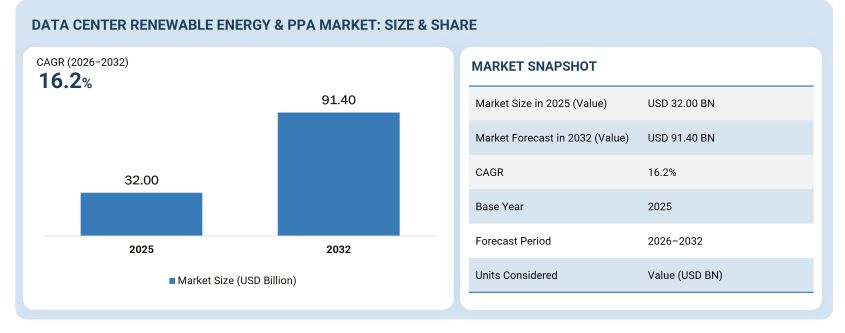
The global data center renewable energy & PPA market was valued at USD 32.0 billion in 2025 and is projected to reach USD 91.4 billion by 2032, growing at a CAGR of 16.2% during the forecast period. Rapid AI infrastructure expansion, hyperscale data center deployments, and aggressive corporate decarbonization targets are fundamentally reshaping how data centers procure electricity. Long-term renewable energy power purchase agreements (PPAs), carbon-free energy sourcing strategies, and grid-resilient energy architectures are becoming central to data center expansion strategies worldwide.
Asia Pacific is projected to emerge as the fastest-growing regional market as hyperscale AI infrastructure investments accelerate across India, Southeast Asia, Australia, and key East Asian economies. North America continues to hold the largest installed base due to the concentration of hyperscale cloud providers, advanced renewable procurement ecosystems, and mature corporate PPA markets.
Top 10 Key Takeaways
- North America remains the largest regional market due to hyperscaler concentration and mature renewable procurement ecosystems.
- Asia Pacific is emerging as the fastest-growing region driven by AI infrastructure investments and digital economy expansion.
- Hyperscale data centers continue to dominate renewable energy procurement activity.
- Virtual PPAs are gaining traction as enterprises seek flexible renewable sourcing models.
- Nuclear-backed clean energy procurement is becoming increasingly important for AI-driven workloads.
- Sustainability regulations and ESG disclosure frameworks are influencing enterprise procurement decisions.
- Battery energy storage integration is becoming a core element of renewable-powered data center operations.
- Google, Amazon, Microsoft, Meta, and Equinix continue to shape global renewable procurement trends.
- Grid constraints and renewable energy availability are emerging as key operational risks.
- Renewable-powered digital infrastructure is evolving from a sustainability initiative into a strategic competitive differentiator.
Extended Market Introduction
The data center renewable energy & PPA market has rapidly evolved from a sustainability-focused niche into a foundational pillar of digital infrastructure strategy. The explosion of AI workloads, cloud computing, edge deployments, and high-density computing environments is placing unprecedented pressure on global electricity systems. At the same time, enterprises, investors, regulators, and customers increasingly expect digital infrastructure operators to align with long-term decarbonization targets and carbon-free energy sourcing commitments.
Hyperscale cloud providers are now among the world’s largest corporate renewable energy buyers. Long-term renewable energy procurement strategies are no longer limited to sustainability reporting; they directly influence site selection, operational resilience, grid access, investor confidence, and customer acquisition. Data center operators are increasingly pursuing a combination of utility-scale solar, wind, battery storage, geothermal, hydropower, and even nuclear-backed procurement structures to ensure reliable low-carbon electricity availability for AI-driven infrastructure growth.
The market is also being shaped by broader macroeconomic and technology trends. AI training clusters require significantly higher power density compared with traditional cloud infrastructure. Governments are simultaneously tightening emissions reporting standards while accelerating clean energy transition policies. As a result, renewable energy PPAs have become strategic tools for securing predictable electricity pricing, reducing Scope 2 emissions exposure, and supporting long-term capacity planning.
Market Trends
One of the defining trends in the data center renewable energy & PPA market is the shift toward around-the-clock carbon-free energy sources. Large cloud and AI infrastructure providers are moving beyond annual renewable matching targets and focusing on hourly carbon-free energy alignment. This transition encouraging investments in energy storage, grid-balancing technologies, advanced forecasting systems, and diversified renewable portfolios.
The rise of AI infrastructure has also intensified interest in alternative clean energy procurement pathways. Nuclear-backed PPAs, geothermal projects, and hybrid solar-plus-storage models are increasingly being explored as hyperscalers attempt to secure firm low-carbon electricity supplies for energy-intensive AI training environments. Recent market activity involving Microsoft, Amazon, Meta, and Google highlights how technology companies are becoming major power market participants rather than passive electricity consumers.
Another major trend is the growing co-location of renewable energy generation with data center infrastructure. Developers are exploring renewable-powered campuses that integrate on-site solar, battery storage, microgrids, and flexible load management systems. This approach is particularly attractive in regions facing grid congestion, permitting delays, or power reliability concerns.
Regional policy developments are also influencing market dynamics. Governments in Europe, Australia, and parts of Asia are increasingly evaluating mandatory renewable sourcing frameworks for large digital infrastructure operators. Sustainability-linked financing, ESG reporting requirements, and carbon accounting frameworks are further accelerating demand for transparent renewable procurement mechanisms.
Digitalization of energy management is emerging as another critical trend. AI-driven energy optimization systems are being deployed to improve cooling efficiency, optimize battery dispatch, forecast renewable generation, and dynamically balance workloads based on electricity market conditions. Data center operators are increasingly integrating energy intelligence platforms into broader operational strategies.
The market is additionally witnessing growing interest in aggregated procurement structures. Smaller colocation operators and enterprise data centers are partnering with renewable developers through consortium-based procurement arrangements that improve purchasing power and contract flexibility.
Market Drivers
The rapid expansion of AI infrastructure remains the single largest growth driver for the data center renewable energy & PPA market. Generative AI training models, inference infrastructure, and high-performance computing workloads require enormous electricity capacity. This surge in energy demand is forcing hyperscalers and colocation providers to secure long-term renewable power arrangements capable of supporting continuous infrastructure expansion.
Corporate decarbonization commitments are also accelerating market adoption. Leading technology firms have announced ambitious carbon neutrality and carbon-free energy targets that directly influence procurement decisions. Renewable PPAs enable organizations to reduce emissions exposure while securing long-term pricing stability in increasingly volatile electricity markets.
Investor pressure is becoming increasingly influential. Institutional investors and ESG-focused stakeholders are closely evaluating how digital infrastructure operators manage energy consumption, emissions intensity, and climate-related risks. Renewable procurement strategies are therefore becoming important components of investor relations and corporate governance frameworks.
Government policy support continues to strengthen the market environment. Renewable energy incentives, carbon reduction initiatives, energy transition programs, and green infrastructure financing mechanisms are improving the economic viability of renewable-powered data center developments. Several countries are also prioritizing grid modernization initiatives that support integration of large-scale renewable capacity.
Electricity price volatility is another important factor. Long-term PPAs provide data center operators with improved pricing visibility and risk mitigation compared with exposure to spot electricity markets. This is particularly relevant in regions experiencing power shortages, transmission bottlenecks, or fuel supply uncertainty.
Customer demand is increasingly influencing procurement behavior as well. Enterprises selecting colocation or cloud providers are placing greater emphasis on sustainability credentials and renewable energy sourcing practices. Renewable-powered digital infrastructure is therefore becoming an important competitive differentiator.
Market Challenges and Restraints
Despite strong momentum, the data center renewable energy & PPA market faces several structural challenges. Grid congestion and transmission constraints are emerging as major obstacles in many leading data center hubs. Renewable generation projects may face long interconnection timelines, limiting the ability of operators to rapidly secure additional clean electricity capacity.
Intermittency remains a significant challenge for renewable-powered infrastructure. AI workloads and hyperscale data centers require highly reliable electricity availability, creating operational complexity when integrating variable renewable generation sources. This is driving increased interest in storage systems, flexible grid architectures, and alternative clean baseload energy solutions.
Regulatory fragmentation across regions creates additional complexity for multinational operators. Renewable accounting methodologies, carbon reporting standards, and electricity market structures vary substantially across countries, complicating procurement strategies and sustainability reporting processes.
The growing competition for renewable energy assets is also intensifying pricing pressure. Large hyperscalers increasingly dominate utility-scale renewable procurement activity, making it difficult for smaller enterprises and regional operators to secure favorable long-term agreements.
Permitting and land acquisition challenges continue to affect both renewable project development and data center construction. Community opposition related to land use, water consumption, and electricity demand can delay infrastructure projects and increase development costs.
Supply chain risks are also affecting the market. Renewable energy infrastructure development depends on global supply chains for solar panels, transformers, battery systems, semiconductors, and grid equipment. Trade restrictions, geopolitical tensions, and manufacturing bottlenecks can disrupt project timelines.
Industry and Application Growth
Cloud service providers remain the most influential end-user group in the data center renewable energy & PPA market. Major hyperscalers continue to expand global data center footprints to support AI services, enterprise cloud adoption, and digital transformation initiatives. Renewable procurement is increasingly integrated into cloud infrastructure expansion strategies.
AI and high-performance computing providers represent one of the fastest-growing application segments. AI model training environments require exceptionally high-density compute clusters, increasing demand for scalable low-carbon electricity procurement models. Renewable-backed energy sourcing is becoming essential for maintaining sustainability commitments while supporting rapid infrastructure growth.
Telecommunications operators are increasingly investing in renewable-powered digital infrastructure as 5G expansion and edge computing deployments accelerate. Distributed data center architecture creates new opportunities for localized renewable integration and microgrid deployment.
BFSI organizations continue to prioritize renewable-powered colocation and cloud services to support ESG goals and operational resilience initiatives. Financial institutions are placing growing emphasis on sustainable IT infrastructure procurement as part of broader corporate sustainability strategies.
Healthcare and life sciences organizations are also emerging as important adopters due to increasing reliance on AI-enabled diagnostics, genomic analysis, digital health platforms, and secure cloud infrastructure. Renewable-powered infrastructure aligns with broader healthcare sustainability initiatives.
Manufacturing and industrial enterprises are increasingly adopting renewable-powered digital infrastructure to support industrial AI, smart manufacturing, digital twins, and real-time analytics environments.
Data Center Renewable Energy & PPA Market, By Procurement Model
Virtual PPAs currently represent one of the most widely adopted procurement structures in the market. Their flexibility enables organizations to procure renewable electricity across multiple regions without requiring direct physical delivery of energy. Large hyperscalers favor these structures because they support aggressive decarbonization targets while enabling broad geographic scalability.
Green tariffs and hybrid procurement structures are experiencing rapid growth as utilities expand renewable offerings tailored for hyperscale infrastructure operators. Enterprises increasingly prefer procurement models that combine renewable sourcing flexibility with predictable operational management.
Data Center Renewable Energy & PPA Market, By Energy Source
Solar energy remains the dominant renewable energy source for data center procurement due to falling installation costs, scalability, and strong project availability across key global markets. Utility-scale solar projects are frequently integrated into long-term corporate procurement agreements for hyperscale campuses.
Nuclear-backed clean energy sourcing is emerging as one of the fastest-growing segments as AI infrastructure operators seek reliable low-carbon baseload power. Interest in advanced nuclear procurement structures is increasing particularly in North America and Europe.
Data Center Renewable Energy & PPA Market, By Data Center Type
Hyperscale data centers continue to dominate renewable energy procurement activity because of their massive electricity requirements and long-term infrastructure planning cycles. These operators are among the largest global buyers of renewable electricity and increasingly influence broader energy market dynamics.
Edge data centers are emerging as a fast-growing segment due to the expansion of low-latency computing environments, AI inference workloads, and distributed digital infrastructure. Renewable-powered edge architectures are gaining importance in remote and energy-constrained environments.
Data Center Renewable Energy & PPA Market, By End User
Cloud service providers currently represent the leading end-user segment due to ongoing investments in AI infrastructure, enterprise cloud platforms, and global digital services. Renewable procurement strategies are deeply embedded within their operational and branding initiatives.
AI-focused infrastructure providers are among the fastest-growing end-user groups as enterprises deploy large-scale GPU clusters and high-density compute environments. Energy availability increasingly determines deployment feasibility for next-generation AI campuses.
Key Segmentation Conclusions
- Virtual PPAs remain the preferred procurement model for global hyperscalers.
- Solar energy continues to dominate renewable procurement portfolios.
- Nuclear-backed procurement structures are gaining strategic relevance.
- Hyperscale data centers represent the largest infrastructure segment.
- AI infrastructure providers are emerging as the fastest-growing end-user category.
Regional Analysis
North America
North America remains the largest regional market due to the concentration of hyperscale cloud providers, mature corporate renewable procurement ecosystems, and large-scale AI infrastructure investments. The United States continues to dominate regional activity, particularly across Virginia, Texas, Arizona, Ohio, and Georgia, where hyperscale campuses are rapidly expanding. Canada is gaining traction due to renewable-rich electricity systems and growing AI infrastructure investments, while Mexico is emerging as a secondary market for regional digital infrastructure expansion.
The North American market was valued at USD 12.8 billion in 2025 and is projected to reach USD 35.6 billion by 2032, growing at a CAGR of 15.7% during the forecast period. The region benefits from advanced PPA markets, large-scale renewable development pipelines, and strong participation from companies such as Amazon Web Services, Microsoft, Google, and Meta.
Europe
Europe remains a highly strategic market driven by strict decarbonization targets, advanced ESG reporting standards, and strong regulatory support for renewable integration. Germany, the United Kingdom, France, and the Nordic countries are leading regional investments in renewable-powered digital infrastructure. Nordic markets are especially attractive because of renewable-rich grids, cooler climates, and access to low-carbon electricity generation.
The European market was valued at USD 8.7 billion in 2025 and is expected to reach USD 22.4 billion by 2032, growing at a CAGR of 14.5%. Sustainability regulations, carbon disclosure requirements, and energy efficiency initiatives continue to encourage renewable procurement adoption among colocation providers and enterprise operators.
Asia Pacific
Asia Pacific is emerging as the fastest-growing regional market as governments and hyperscalers accelerate investments in AI infrastructure, digital economy initiatives, and renewable energy deployment. China, India, Singapore, Australia, Japan, and South Korea are becoming increasingly important regional hubs. India and Southeast Asia are particularly attractive because of rapidly expanding digital populations, cloud adoption, and renewable energy investment pipelines.
The Asia Pacific market was valued at USD 7.4 billion in 2025 and is projected to reach USD 24.8 billion by 2032, reflecting a CAGR of 18.9%. Regional growth is supported by hyperscale campus expansion, renewable-rich industrial corridors, and increasing government focus on sustainable digital infrastructure development.
Rest of World
The Rest of World market is being shaped by emerging opportunities across the Middle East, Latin America, and Africa. The United Arab Emirates and Saudi Arabia are investing heavily in digital infrastructure and renewable energy integration as part of broader economic diversification initiatives. Brazil is becoming a strategic market for renewable-powered infrastructure because of abundant renewable electricity availability. South Africa is also attracting interest as enterprises seek regional cloud infrastructure expansion.
The Rest of World market was valued at USD 3.1 billion in 2025 and is forecast to reach USD 8.6 billion by 2032, growing at a CAGR of 15.6%. Infrastructure modernization, digital transformation programs, and renewable energy development initiatives continue to improve long-term market prospects.
Regional Outlook Summary
- North America maintains leadership due to hyperscaler concentration and mature renewable procurement frameworks.
- Europe remains strongly influenced by sustainability regulations and carbon reduction mandates.
- Asia Pacific is witnessing the fastest infrastructure expansion driven by AI and digital economy investments.
- Middle Eastern countries are increasingly integrating renewable energy into digital infrastructure strategies.
- Renewable energy availability is becoming a key factor influencing global data center location strategies.
Country-Specific Insights
The United States continues to shape global renewable procurement trends due to the scale of hyperscale infrastructure investments and corporate PPA activity. Regions such as Texas and Virginia remain central to renewable-powered data center expansion because of large electricity markets and extensive infrastructure ecosystems.
India is rapidly emerging as a strategic growth market because of accelerating cloud adoption, expanding AI investments, and ambitious renewable energy targets. Domestic and international operators are increasingly evaluating renewable-powered campus opportunities across major industrial and technology corridors.
Singapore continues to influence regional sustainability standards despite land and power constraints. Authorities are emphasizing energy-efficient infrastructure development and low-carbon electricity sourcing to balance digital growth with sustainability goals.
Australia is becoming increasingly important due to large-scale renewable generation potential and rising hyperscale investment activity. Renewable-backed data center procurement is gaining momentum particularly in Sydney and Melbourne.
Nordic countries remain attractive because of abundant renewable electricity resources, favorable climatic conditions, and strong grid sustainability performance. These advantages continue to attract global hyperscale investments.
Country-Level Conclusions
- The United States remains the global center for hyperscale renewable procurement activity.
- India is becoming a major growth engine for sustainable digital infrastructure.
- Singapore is shaping regional sustainability-focused data center policies.
- Australia is emerging as a renewable-rich hyperscale investment destination.
- Nordic countries continue to attract sustainability-focused infrastructure deployments.
Key Company Insights
Leading players in the data center renewable energy & PPA market include Amazon Web Services, Microsoft, Google, Meta, Equinix, Digital Realty, ENGIE, Brookfield Renewable, Schneider Electric, and NextEra Energy. These organizations are shaping global procurement trends through long-term renewable agreements, sustainability partnerships, infrastructure investments, and AI-driven energy optimization initiatives.
- Amazon Web Services
- Microsoft
- Meta
- Equinix
- Digital Realty
- Iron Mountain Data Centers
- Switch
- NextEra Energy
- ENGIE
- Brookfield Renewable
- EDF Renewables
- Ørsted
- Schneider Electric
- Eaton
Google continues to advance its twenty-four-seven carbon-free energy strategy through diversified renewable procurement and energy optimization initiatives. Microsoft has intensified investment in clean electricity sourcing to support AI infrastructure growth and sustainability commitments. Amazon remains one of the world’s largest renewable energy buyers and is increasingly exploring nuclear-backed procurement structures.
Equinix and Digital Realty are expanding renewable procurement capabilities across colocation portfolios while enhancing energy efficiency and sustainability reporting frameworks. Schneider Electric and Eaton continue to support market growth through energy management technologies, electrical infrastructure systems, and grid modernization solutions.
Energy companies such as ENGIE, Brookfield Renewable, EDF Renewables, and Ørsted are increasingly partnering with hyperscale operators to develop utility-scale renewable projects tailored for data center demand profiles. Strategic collaboration between technology providers and energy developers is becoming central to long-term market growth.
Key Company Strategy Conclusions
- Hyperscalers are evolving into major global clean energy market participants.
- Renewable procurement is increasingly integrated into AI infrastructure planning.
- Energy developers are forming long-term strategic partnerships with cloud providers.
- Energy optimization software is becoming a core competitive differentiator.
- Sustainability reporting capabilities are influencing enterprise procurement decisions.
Recent Developments
- In February 2026, BloombergNEF reported that Meta, Amazon, Google, and Microsoft accounted for nearly half of global corporate clean energy procurement activity.
- In March 2026, Reuters reported rising clean energy PPA prices in North America as AI-driven data center demand accelerated renewable procurement activity.
- In June 2025, Amazon entered a nuclear-backed clean energy agreement with Talen Energy to support data center operations.
- In 2025, Microsoft expanded sustainability initiatives focused on reducing the environmental impact of next-generation AI data centers.
- In 2026, Australian policymakers evaluated renewable energy investment requirements for large-scale data centers to address electricity demand growth.
Real-World Use Cases and Case Studies
In 2025, Amazon strengthened its renewable and carbon-free energy strategy through agreements linked to utility-scale renewable and nuclear-backed procurement initiatives supporting data center operations in the United States. The company’s strategy focused on ensuring reliable electricity availability for AI and cloud infrastructure while advancing broader sustainability objectives. The initiative highlighted the growing importance of diversified clean energy procurement models capable of supporting energy-intensive AI workloads.
Google has continued expanding its carbon-free energy strategy across global data center operations through investments in renewable procurement, grid optimization, and energy intelligence technologies. The company’s focus on hourly carbon-free energy alignment reflects the industry’s transition from annual renewable matching toward more sophisticated real-time sustainability approaches. These initiatives are intended to improve operational sustainability while supporting long-term hyperscale infrastructure expansion.
Market Segmentation
The data center renewable energy & PPA market is segmented across procurement model, energy source, data center type, end-user industry, and geography. Procurement models include physical PPAs, virtual PPAs, sleeved agreements, green tariffs, and renewable energy certificates. The growing complexity of global electricity markets is encouraging organizations to adopt diversified procurement portfolios tailored to regional regulatory and operational conditions.
From an energy source perspective, solar and wind continue to dominate renewable procurement activity due to scalability and cost competitiveness. However, the market is increasingly incorporating nuclear, geothermal, hydropower, and hybrid renewable systems to support around-the-clock clean electricity sourcing requirements for AI infrastructure.
By infrastructure type, hyperscale data centers remain the dominant segment due to massive electricity demand and long-term infrastructure planning horizons. Edge data centers and colocation facilities are also expanding renewable procurement activity as distributed digital infrastructure architectures continue to grow.
End-user demand is primarily driven by cloud service providers, AI infrastructure operators, telecommunications companies, BFSI organizations, and industrial enterprises pursuing sustainability-oriented digital transformation initiatives.
Segmentation Summary
- Procurement diversification is becoming a key strategic priority.
- Hybrid renewable portfolios are gaining market traction.
- Hyperscale infrastructure remains the dominant demand center.
- Edge and colocation markets are expanding renewable procurement activity.
- AI infrastructure growth is reshaping long-term electricity source strategies.
Conclusion and Future Outlook
The data center renewable energy & PPA market is entering a transformative growth phase driven by AI infrastructure expansion, global decarbonization initiatives, and evolving electricity market dynamics. Renewable energy procurement is increasingly central to digital infrastructure strategy as operators seek long-term energy security, pricing stability, and sustainability alignment.
Through the forecast period, AI-driven energy demand is expected to accelerate investment in renewable generation, battery storage, advanced grid technologies, and alternative clean energy procurement pathways. Organizations that successfully integrate renewable procurement, energy intelligence, and operational flexibility into infrastructure planning will be better positioned to compete in the rapidly evolving digital economy.
FAQ
1. How big is the data center renewable energy & PPA market?
The global data center renewable energy & PPA market was valued at USD 32.0 billion in 2025 and is projected to reach USD 91.4 billion by 2032. Growth is being driven primarily by AI infrastructure expansion, hyperscale data center deployments, and increasing demand for low-carbon electricity sources.
2. What is the data center renewable energy & PPA market growth rate?
The market is projected to grow at a CAGR of 16.2% during the 2026–2032 forecast period. Long-term renewable procurement strategies, sustainability commitments, and rising electricity demand from AI workloads are supporting market expansion.
3. Which segment leads the data center renewable energy & PPA market?
Hyperscale data centers currently represent the leading segment because of their massive electricity consumption and aggressive renewable procurement strategies. Virtual PPAs and utility-scale renewable sourcing models are particularly popular among large cloud providers.
4. Who are the key players in the data center renewable energy & PPA market?
Major companies operating in the market include Amazon Web Services, Microsoft, Google, Meta, Equinix, Digital Realty, Schneider Electric, ENGIE, Brookfield Renewable, and NextEra Energy. These organizations are actively investing in renewable procurement, energy optimization, and sustainable infrastructure expansion.
5. What factors are driving the data center renewable energy & PPA market?
Key growth drivers include AI infrastructure expansion, hyperscale cloud adoption, corporate decarbonization commitments, ESG reporting requirements, and increasing electricity price volatility. Renewable PPAs also help organizations secure long-term energy pricing visibility and sustainability alignment.
 Exclusive indicates content/data unique to MarketsandMarkets and not available with any competitors.













Growth opportunities and latent adjacency in Data Center Renewable Energy & PPA Market