Data Center Sustainability Market Size, Share & Growth Report by component, technology (Air-based, Liquid, Immersion, AI-Driven Energy, Renewable Energy Systems, Waste Heat Recovery), Data Center Type (Hyperscale, Colocation, Enterprise, Edge) – Global Forecast to 2032


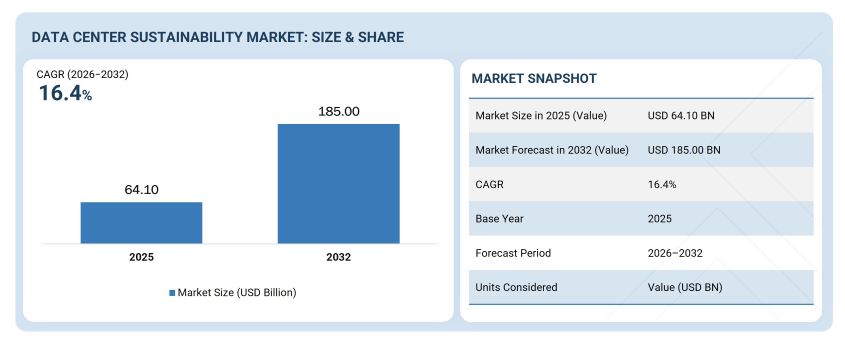
The global data center sustainability market is estimated at USD 64.1 billion in 2025 and is projected to reach USD 185.0 billion by 2032, growing at a CAGR of 16.4% during the forecast period. Growth is being shaped by the rapid rise of AI workloads, escalating energy consumption from hyperscale facilities, tightening environmental regulations, and enterprise commitments toward net-zero operations. Sustainability is no longer a peripheral initiative for data center operators; it has become central to infrastructure planning, cooling design, energy procurement, and long-term digital resilience.
Asia Pacific is projected to emerge as the fastest-growing regional market due to hyperscale expansion in India, Southeast Asia, China, and Australia, coupled with aggressive renewable-energy procurement and rising AI infrastructure investments. North America continues to hold the largest installed base because of the concentration of hyperscale cloud providers, advanced colocation ecosystems, and large-scale sustainability modernization initiatives across the United States and Canada.
Top 10 Key Takeaways
- North America remains the largest regional market because of hyperscale cloud concentration and advanced digital infrastructure.
- Asia Pacific is emerging as the fastest-growing region due to AI infrastructure expansion and aggressive green-energy adoption.
- Liquid cooling is becoming the preferred architecture for AI-intensive facilities.
- Renewable energy procurement has shifted from optional branding to operational necessity.
- Hyperscale data centers continue to dominate sustainability investments.
- AI-driven DCIM platforms are reshaping energy optimization strategies.
- Heat reuse and circular infrastructure models are gaining commercial traction.
- Schneider Electric, Vertiv, Equinix, Microsoft, and Digital Realty remain among the most influential market participants.
- Power availability is becoming one of the largest constraints on data center expansion globally.
- Sustainability performance is increasingly influencing customer procurement and colocation decisions.
Extended Market Introduction
The data center industry is entering a new phase where sustainability is directly linked to competitiveness, scalability, and operational resilience. AI training clusters, cloud-native applications, streaming platforms, and enterprise digitalization programs are driving unprecedented compute demand. At the same time, governments, investors, and enterprise customers are demanding lower emissions, improved energy efficiency, and transparent ESG reporting. As a result, data center operators are redesigning facilities around renewable energy integration, advanced cooling systems, intelligent workload optimization, and circular infrastructure practices.
Sustainability has also become a strategic differentiator for hyperscale’s and colocation providers. Enterprises increasingly evaluate vendors not only on uptime and latency, but also on carbon intensity, water usage efficiency, renewable sourcing, and environmental reporting transparency. This shift is accelerating investments in liquid cooling, immersion cooling, smart energy management platforms, and waste heat recovery systems. Operators that can combine sustainability with reliability are positioning themselves as preferred infrastructure partners for AI-driven economies.
The market is also benefiting from broader macro trends such as national net-zero commitments, AI infrastructure expansion, and the modernization of digital infrastructure. Governments across Europe, Asia Pacific, and North America are introducing stricter reporting standards and sustainability frameworks for digital infrastructure projects. Meanwhile, hyperscale’s are signing large renewable power purchase agreements and investing in low-carbon energy ecosystems to secure long-term power availability.
Market Trends
One of the strongest trends shaping the market is the rapid transition toward liquid cooling and immersion cooling technologies. AI servers and GPU clusters generate far higher thermal loads than conventional enterprise workloads, making traditional air cooling less efficient for modern facilities. Operators are increasingly deploying direct-to-chip liquid cooling, rear-door heat exchangers, and immersion cooling systems to improve thermal efficiency and reduce power usage effectiveness. Industry roadmaps indicate that advanced cooling technologies will become a standard requirement for AI-ready infrastructure.
Another major trend is the integration of renewable energy procurement into long-term infrastructure planning. Hyperscale’s and colocation providers are investing heavily in solar, wind, battery storage, and microgrid ecosystems to reduce exposure to volatile energy markets and regulatory scrutiny. Renewable energy certificates, long-term PPAs, and carbon-free energy sourcing are becoming standard components of sustainability strategies.
AI-enabled infrastructure management is also transforming operational sustainability. Modern DCIM platforms increasingly use predictive analytics, machine learning, and automation to optimize workload placement, cooling efficiency, and power distribution. These intelligent systems allow operators to dynamically balance energy consumption while maintaining reliability requirements.
Heat reuse is emerging as another significant trend, especially in Europe and the Nordics. Several operators are exploring district heating partnerships where waste heat from data centers is redirected to residential and commercial heating systems. Circularity strategies such as hardware recycling, sustainable construction materials, and closed-loop cooling systems are also gaining traction.
The market is also witnessing growth in modular and edge sustainable infrastructure. Edge facilities are being deployed closer to end users to support AI inferencing, industrial automation, and low-latency applications. These smaller facilities are increasingly designed with modular renewable systems and efficient cooling architectures.
Market Drivers
The explosive growth of AI infrastructure is one of the most important drivers accelerating the data center sustainability market. AI workloads consume substantially more power than traditional computing environments, forcing operators to rethink cooling systems, energy sourcing, and workload optimization strategies. As AI adoption expands across healthcare, finance, manufacturing, and cloud services, sustainability is becoming essential to maintaining scalable infrastructure growth.
Enterprise sustainability commitments are another major growth catalyst. Large corporations increasingly require their infrastructure providers to support environmental reporting goals and carbon-reduction initiatives. Sustainability metrics now influence procurement decisions across colocation, cloud hosting, and managed services.
Regulatory pressure continues to intensify globally. European sustainability regulations, energy efficiency directives, and ESG reporting requirements are encouraging operators to modernize facilities. Similar policy momentum is emerging in Asia Pacific and North America as governments seek to balance digital infrastructure expansion with climate commitments.
Power availability is also reshaping infrastructure planning. In several major markets, utilities are struggling to meet rapidly growing data center demand. This has accelerated investments in renewable generation, battery storage, microgrids, and alternative energy systems.
Investor pressure is another important factor. Infrastructure investors increasingly evaluate environmental performance as part of long-term asset quality assessment. Sustainable facilities often achieve stronger financing conditions and improved long-term valuation perceptions.
Market Challenges and Restraints
Despite strong momentum, the market faces several structural challenges. One of the largest barriers is the high upfront cost associated with advanced cooling systems, renewable integration, and energy-efficient infrastructure modernization. Smaller operators often face capital constraints when attempting to transition toward sustainable architecture.
Power grid limitations remain a critical issue across several major markets. In regions with constrained utility infrastructure, obtaining sufficient power capacity for new facilities can delay project timelines and increase operational uncertainty.
Water consumption is another major concern. Although advanced cooling technologies improve energy efficiency, certain cooling approaches require significant water resources. In water-stressed regions, operators must balance sustainability goals with resource availability.
Supply chain volatility also creates operational risks. The rapid expansion of AI infrastructure has increased demand for GPUs, cooling components, transformers, and power equipment. Procurement delays can impact on construction schedules and sustainability deployment timelines.
Regulatory fragmentation presents another challenge. Sustainability frameworks vary significantly across regions, making compliance and reporting increasingly complex for multinational operators.
Industry and Application Growth
Cloud service providers continue to represent the most influential end-user category in the market. Hyperscale’s are aggressively expanding AI infrastructure capacity while simultaneously pursuing carbon-neutral and renewable-powered operations. Sustainability has become tightly integrated with cloud expansion strategies.
The BFSI sector is also emerging as a strong adopter of sustainable infrastructure solutions. Financial institutions increasingly prioritize green hosting environments to support ESG objectives and regulatory compliance initiatives.
Healthcare organizations are adopting sustainable data center solutions such as digital health platforms, AI diagnostics, and connected care ecosystems expand. Sustainability is becoming important not only for compliance but also for operational resilience.
Government and defense agencies are increasingly modernizing infrastructure with sustainability objectives in mind. Several national digital infrastructure strategies now emphasize energy efficiency, renewable integration, and resilient power systems.
Manufacturing and industrial operators are also driving demand through smart factory initiatives, industrial AI deployments, and IoT-enabled operations. Sustainable edge infrastructure is becoming important for real-time industrial workloads.
Segment Insights
Data Center Sustainability Market, By Component
Solutions remain the leading segment because operators are prioritizing cooling systems, renewable integration technologies, monitoring platforms, and power management infrastructure to improve sustainability performance. Advanced infrastructure modernization initiatives are driving strong demand for integrated sustainability platforms.
Services are witnessing strong growth as organizations seek consulting, deployment, and optimization expertise for complex sustainability transitions. Enterprises increasingly rely on external partners to manage energy optimization and ESG reporting initiatives.
Data Center Sustainability Market, By Technology
Liquid cooling is emerging as the dominant technology trend because AI-driven workloads generate thermal densities that conventional air systems struggle to handle efficiently. Operators are increasingly deploying direct-to-chip and immersion cooling systems to support high-density computing.
AI-driven energy management systems are among the fastest-growing technology categories as operators adopt predictive analytics and automation to improve efficiency, reduce waste, and optimize power distribution.
Data Center Sustainability Market, By Data Center Type
Hyperscale facilities remain the leading segment due to the concentration of cloud and AI workloads among major technology companies. Large-scale operators possess the capital resources needed to deploy renewable energy systems and advanced cooling infrastructure.
Edge data centers are experiencing rapid growth because low-latency AI applications and distributed digital services require localized computing infrastructure with efficient energy architectures.
Data Center Sustainability Market, By End User
Cloud service providers continue to dominate the market because hyperscale’s are leading investments in renewable energy sourcing, sustainable construction, and advanced cooling technologies.
Healthcare and manufacturing sectors are witnessing strong growth as digital transformation initiatives increase demand for sustainable and resilient computing infrastructure.
Key Segmentation Conclusions
- Hyperscale infrastructure continues to dominate sustainability investment activity.
- Liquid cooling technologies are reshaping infrastructure design strategies.
- AI-driven monitoring and optimization platforms are becoming mainstream.
- Renewable integration solutions are moving into core infrastructure planning.
- Edge infrastructure is accelerating demand for modular sustainable systems.
Regional Analysis
North America
The United States remains the global center of hyperscale infrastructure investment, supported by major cloud providers, AI expansion programs, and advanced colocation ecosystems. Sustainability initiatives are increasingly focused on renewable power procurement, low-carbon construction, and advanced cooling technologies. Canada is benefiting from clean-energy availability and cooler climates, while Mexico is emerging as a strategic nearshore digital infrastructure market.
North America accounted for approximately USD 23.8 billion in 2025 and is projected to reach nearly USD 66.9 billion by 2032, growing at a CAGR of 15.9% during the forecast period.
Europe
Europe continues to lead in sustainability regulation and environmental reporting frameworks. Germany, the United Kingdom, France, and the Nordics remain major hubs for sustainable infrastructure investment. Heat reuse initiatives, renewable integration, and energy-efficiency mandates are particularly influential across European markets. The Nordic region benefits from renewable-rich energy ecosystems and naturally cooler climates that support efficient operations.
Europe represented approximately USD 16.4 billion in 2025 and is expected to reach around USD 43.2 billion by 2032, expanding at a CAGR of 14.8%.
Asia Pacific
Asia Pacific is experiencing rapid expansion as China, India, Singapore, Japan, South Korea, and Australia accelerate digital infrastructure investment. Government-backed sustainability initiatives, hyperscale expansion, and AI-driven demand are reshaping the regional landscape. India and Southeast Asia are emerging as important growth centers due to increasing cloud adoption and large-scale digitalization initiatives.
Asia Pacific stood at nearly USD 18.7 billion in 2025 and is forecast to grow to approximately USD 59.8 billion by 2032, registering the fastest CAGR of 18.1%.
Rest of World
The Rest of World market is being driven by emerging investments across Latin America, the Middle East, and Africa. Brazil is strengthening its role as a regional digital infrastructure hub, while the UAE and Saudi Arabia are investing heavily in AI-ready sustainable facilities. South Africa is also emerging as a strategic connectivity and colocation destination.
The Rest of World market reached roughly USD 5.2 billion in 2025 and is expected to rise to nearly USD 15.1 billion by 2032, growing at a CAGR of 16.4%.
Regional Outlook Summary
- North America remains the largest installed base for sustainable data center infrastructure.
- Europe leads in sustainability regulation and environmental compliance.
- Asia Pacific is the fastest-growing regional market.
- Middle Eastern markets are becoming important AI infrastructure investment hubs.
- Renewable energy availability increasingly influences location strategy.
Country-Specific Insights
The United States remains the most influential market because of hyperscale concentration, AI infrastructure investments, and strong renewable procurement activity. Operators are increasingly focusing on liquid cooling and low-carbon energy sourcing to address power availability challenges.
Germany continues to play a major role in Europe due to industrial digitalization, sustainability regulation, and enterprise cloud modernization. The country is also investing in efficient district heating integration models.
India is emerging as one of the most dynamic markets because of expanding cloud adoption, government-backed digital initiatives, and rising demand for AI infrastructure. Renewable integration and efficient cooling solutions are becoming major priorities.
Singapore remains strategically important despite land and power constraints because it serves as a critical regional connectivity hub. Sustainability requirements are influencing future expansion approvals.
Saudi Arabia and the UAE are accelerating investments in AI-ready sustainable infrastructure as part of broader economic diversification and smart-city programs.
Country-Level Conclusions
- The United States continues to dominate hyperscale sustainability investments.
- Germany leads in regulatory-driven modernization initiatives.
- India is becoming a high-growth AI infrastructure destination.
- Singapore emphasizes sustainability-led infrastructure governance.
- Gulf economies are integrating sustainability into digital transformation strategies.
Key Company Insights
The competitive landscape includes infrastructure providers, hyperscale operators, cooling technology vendors, and energy management specialists. Leading companies are investing aggressively in renewable sourcing, AI-enabled optimization, and next-generation cooling systems.
Major Companies
- Schneider Electric
- Vertiv
- Equinix
- Digital Realty
- Eaton
- ABB
- Siemens
- Huawei
- Microsoft
- Amazon Web Services
- Delta Electronics
- Cisco Systems
- STULZ
- Johnson Controls
Several leading players are expanding partnerships around renewable energy procurement and AI-ready infrastructure. Schneider Electric and Vertiv continue to invest in liquid cooling innovation, while Equinix and Digital Realty are expanding sustainability reporting frameworks and renewable energy initiatives.
Hyperscale’s such as Microsoft, Google, and Amazon Web Services are pursuing carbon-free energy sourcing strategies while integrating AI optimization tools into infrastructure management. These companies are also investing in modular energy systems and advanced cooling architecture.
ABB, Siemens, Eaton, and Delta Electronics are strengthening their positions through intelligent power management systems, smart grid integration, and AI-driven infrastructure analytics.
Key Company Strategy Summary
- Cooling innovation remains a major competitive focus area.
- Renewable procurement partnerships are accelerating globally.
- AI-enabled optimization platforms are becoming strategic differentiators.
- ESG reporting capabilities increasingly influence enterprise contracts.
- Infrastructure resilience and sustainability are converging into unified strategies.
Recent Developments
- In May 2026, Australian policymakers discussed proposals requiring data centers to support renewable energy investments as AI-driven electricity demand accelerated.
- In April 2026, multiple technology companies expanded initiatives around renewable-powered AI infrastructure and carbon-aware energy procurement strategies.
- In 2025, several hyperscale operators accelerated deployment of liquid cooling systems to support high-density AI workloads and reduce energy intensity.
- In 2025, global colocation providers expanded sustainability-focused infrastructure strategies amid rising power constraints and increasing enterprise ESG requirements.
Real-World Use Cases and Case Studies
In 2025, multiple hyperscale operators accelerated the deployment of liquid cooling technologies across AI-focused facilities to support increasingly dense GPU clusters. These deployments were designed to reduce cooling energy requirements while enabling higher rack densities and improved thermal management. Several operators also integrated AI-driven DCIM platforms to dynamically optimize cooling efficiency and workload allocation. Industry analysis suggests that these systems are becoming foundational for next-generation AI infrastructure.
In 2025, leading colocation providers across Europe and the Nordics expanded waste-heat recovery initiatives connected to district heating systems. These projects were implemented to improve energy efficiency and support national sustainability targets while reducing community-level environmental impact. Heat reuse strategies are increasingly viewed as commercially viable due to rising energy costs and regulatory support for circular infrastructure ecosystems.
Market Segmentation
The data center sustainability market is segmented across components, technologies, data center types, end users, and regions. Component segmentation includes sustainability solutions and services focused on cooling, power management, monitoring, and renewable integration. Technology segmentation covers air cooling, liquid cooling, immersion cooling, AI-driven management systems, and waste heat recovery technologies.
By data center type, the market includes hyperscale, colocation, enterprise, and edge facilities. Hyperscale facilities dominate because of the scale of AI and cloud investments, while edge facilities are gaining traction due to low-latency digital applications. End-user segmentation includes cloud service providers, BFSI, healthcare, manufacturing, government, retail, and telecom sectors.
Segmentation Summary
- Cooling technologies remain central to sustainability transformation.
- Hyperscale operators dominate spending and innovation activity.
- Edge deployments are driving demand for modular infrastructure.
- AI optimization is reshaping infrastructure management practices.
- Renewable integration is becoming foundational across all segments.
Conclusion and Future Outlook
The data center sustainability market is expected to remain one of the most strategically important infrastructure sectors throughout the forecast period. AI expansion, cloud growth, and digital transformation are significantly increasing compute demand, forcing operators to prioritize efficiency, renewable integration, and advanced cooling architectures.
Future growth will increasingly depend on the ability of operators to balance scalability with sustainability. AI-enabled optimization, circular infrastructure strategies, liquid cooling, and renewable energy ecosystems are expected to define next-generation data center design. Organizations that invest early in sustainable digital infrastructure will be better positioned to manage regulatory expectations, customer procurement requirements, and long-term operational resilience.
FAQ
1. How big is the data center sustainability market?
The data center sustainability market is valued at approximately USD 64.1 billion in 2025 and is projected to reach around USD 185.0 billion by 2032. Growth is being driven by AI infrastructure expansion, renewable energy integration, and increasing sustainability regulation.
2. What is the growth rate of the data center sustainability market?
The market is projected to grow at a CAGR of 16.4% during the 2026–2032 forecast period. Expansion is supported by rising cloud demand, hyperscale investments, and advanced cooling adoption.
3. Which segment leads the data center sustainability market?
Hyperscale data centers currently represent the leading segment because of large-scale investments from cloud and AI infrastructure providers. These operators are aggressively deploying renewable energy systems and advanced cooling technologies.
4. Who are the key players in the data center sustainability market?
Major companies include Schneider Electric, Vertiv, Equinix, Digital Realty, Eaton, ABB, Siemens, Microsoft, Google, Amazon Web Services, Huawei, Cisco Systems, Delta Electronics, STULZ, and Johnson Controls.
5. What factors are driving the data center sustainability market?
Key drivers include AI workload growth, enterprise sustainability commitments, renewable energy procurement, ESG compliance requirements, and increasing adoption of efficient cooling technologies.
 Exclusive indicates content/data unique to MarketsandMarkets and not available with any competitors.













Growth opportunities and latent adjacency in Data Center Sustainability Market