Digital Twin in Energy & Utilities Market by Twin Type (Asset, Process and System, Grid and Network, Plant and Facility), Deployment Mode, End User, and Region — Global Forecast to 2032


Digital Twin in Energy & Utilities Market 2032: Size, Share & Growth Report
The digital twin in energy & utilities market is estimated to be USD 8.15 billion in 2026 and is projected to reach USD 18.66 billion by 2032, growing at a CAGR of 14.8% from 2026 to 2032, fueled by AI data center load growth compounding grid complexity that utilities were already struggling to manage from renewable integration and aging infrastructure alone.
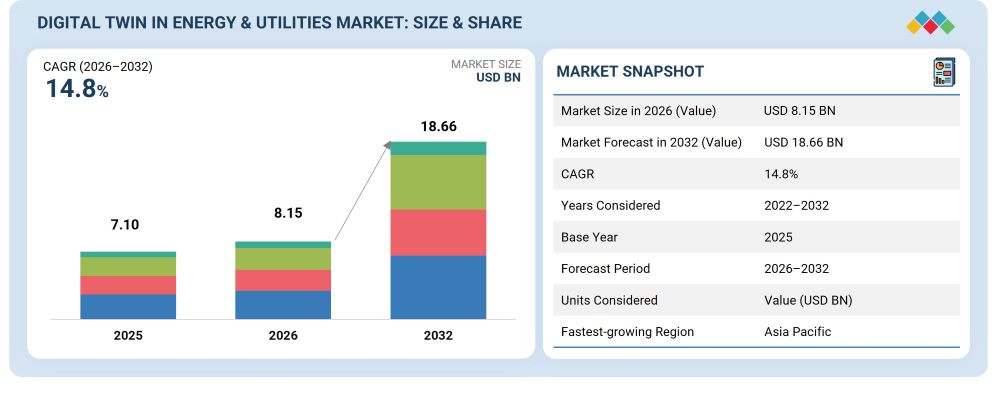
The digital twin in energy and utilities market marks a shift in which grid digital twins move beyond static visualization and planning tools toward continuously updated, software-defined models that utilities depend on to manage genuinely bidirectional, increasingly volatile power flows in real time.
For instance, GE Vernova launched its GridBeats APS automation and protection system at Distributech 2026 in February, a software-defined platform that consolidates multiple substation functions onto a common hardware base, reducing device footprints as electricity networks expand globally and become more complex, with GE Vernova positioning the launch directly against rising grid demand from data centers, industry, transport, and buildings.
Siemens is pursuing this same software-defined substation shift through its own digital twin architecture: the company unveiled a fully virtualized protection and control solution for transmission and industrial grids at the same Distributech 2026 event, explicitly framing digital twin technology as a tool that lets utilities identify risks before construction, minimize errors, optimize maintenance schedules, and speed up deployment at the substation level, rather than treating digital twins as a purely visual planning aid.
Vendors are also under growing pressure from an entirely new source of grid-complexity demand: AI data center power requirements arriving faster than utilities can physically build new transmission capacity. Hitachi Energy expanded its digitalization portfolio in July 2026, spanning digital transformers, substations, industrial IoT platforms, and cybersecurity, explicitly framing AI-driven load growth as now compounding the grid complexity that utilities were already struggling to manage from the energy transition alone.
Top 10 Key Takeaways
- North America has the largest installed base, driven by advanced digital infrastructure, high IIoT penetration on energy assets, and aggressive federal grid modernization investment.
- Asia Pacific is the fastest-growing region, propelled by expanding renewable energy integration and rapidly growing utility digitalization investment across China, Japan, and India.
- Grid and network twins lead by twin type, reflecting their central role modeling increasingly bidirectional, renewable-heavy power flows across transmission and distribution networks.
- Asset twins represent a fast-growing twin type, as utilities increasingly deploy digital twins for individual transformers, turbines, and substation equipment rather than grid-wide models alone.
- Software-defined substation platforms are consolidating multiple functions onto common hardware, exemplified by GE Vernova's GridBeats APS reducing device footprints as networks expand.
- Utilities and grid operators lead by end user, reflecting their direct responsibility for managing the bidirectional power flows and aging infrastructure that digital twins are built to address.
- AI data center load growth is compounding grid complexity beyond what the energy transition alone was already creating, accelerating utility investment in digital twin technology.
- The largest near-term opportunity is AI-driven predictive grid modeling, extending digital twins from visualization tools toward genuinely autonomous, anticipatory grid management action.
- Vendor portfolios are expanding from substation hardware into full digitalization suites, exemplified by Hitachi Energy's expansion spanning transformers, substations, IoT platforms, and cybersecurity.
- The primary near-term restraint is high integration cost connecting legacy analog grid assets to digital twin platforms, particularly across aging infrastructure not originally built for digital connectivity.
Why the Digital Twin in Energy & Utilities Market Matters Now
Utilities have historically managed grid operations through a comparatively simple, one-directional model, adequate when electricity flowed predictably from centralized generation to end users and planning tools only needed to model that single direction of flow. Digital twins are scaling into essential grid infrastructure today because that simplicity has disappeared: electricity now flows in multiple directions as distributed renewable generation, electric vehicles, and battery storage reshape the grid, and AI data center demand is compounding this complexity further, with power requirements arriving faster than utilities can physically build new transmission lines to meet them.
The market covers the software platforms and services used to create continuously updated virtual representations of energy and utility infrastructure, spanning asset twins, process and system twins, grid and network twins, and plant and facility twins across on-premises, cloud, and hybrid deployment modes. It includes established grid automation and industrial software majors that have built dedicated energy-sector digital twin platforms, and broader digital twin technology providers extending general-purpose platforms into utility-specific applications. The scope excludes generic asset management or SCADA systems without genuine simulation or predictive modeling capability, and digital twin platforms built for other industries without energy-sector-specific functionality. The market connects to the broader smart grid market, the grid modernization market, and the industrial IoT market.
The market's structure reflects a hardware-heritage-versus-software-native divide. The largest grid automation majors such as Siemens, GE Vernova, and Hitachi Energy extend decades of substation and grid hardware expertise into digital twin platforms, trading pure software agility for deep integration with the physical equipment their twins model. Broader digital twin technology providers such as AVEVA, Microsoft, and Bentley Systems bring software-native simulation and cloud platform expertise into energy-sector applications, trading energy-specific hardware integration depth for cross-industry platform scale. Utilities increasingly favor vendors offering both software-defined substation hardware and the digital twin software layered on top, rather than sourcing each component from a different specialist.
Report Scope
|
Report Metric |
Details |
|
Market Size in 2025 (Value) |
USD 7.10 Billion |
|
Market Forecast in 2032 (Value) |
USD 18.66 Billion |
|
Growth Rate |
CAGR of 14.8% from 2026-2032 |
|
Years Considered |
2022-2032 |
|
Base Year |
2025 |
|
Forecast Period |
2026-2032 |
|
Units Considered |
Value (USD Billion) |
|
Report Coverage |
Revenue forecast, company ranking, competitive landscape, growth factors, and trends |
|
Top Companies |
|
|
Growth Drivers |
|
|
Segments Covered |
|
|
Regional Scope |
North America, Europe, Asia Pacific, Rest of World |
Market Trends Shaping Digital Twin in Energy & Utilities
The key trend is software-defined substations replacing fixed-function hardware with common automation platforms. GE Vernova's GridBeats APS, which lets utilities add substation capability through software rather than additional physical devices, exemplifies how the industry is moving away from substations built from many single-purpose hardware units toward platforms where a common hardware base runs multiple applications simultaneously.
Another trend is digital twins evolving from visualization tools into AI-driven predictive grid models. Siemens' framing of its virtualized protection and control solution at Distributech 2026, explicitly designed to let utilities identify risks before construction and optimize maintenance schedules rather than simply display current grid status, reflects a broader shift toward digital twins that actively inform decisions rather than passively represent infrastructure.
A third trend is AI data center demand accelerating grid digital twin investment beyond renewable integration alone. Hitachi Energy's explicit framing that AI-driven load growth is now compounding the grid complexity utilities were already managing from the energy transition demonstrates how digital twin investment justification has broadened considerably beyond its original renewable-integration use case.
A fourth trend is vendor portfolios expanding from substation hardware into full digitalization suites. Hitachi Energy's July 2026 portfolio expansion, spanning digital transformers, substations, industrial IoT platforms, and cybersecurity under a single digitalization umbrella, illustrates how grid automation vendors increasingly compete on breadth of integrated offering rather than depth in any single hardware category alone.
The fifth trend sees IT/OT convergence becoming a prerequisite for utility-wide digital twin deployment. Hitachi Energy's own positioning that substations must evolve into foundational digital hubs supporting fast automation, with IT and OT systems historically kept separate now needing to converge into a unified, secure data environment, reflects growing industry recognition that digital twin value depends on breaking down this long-standing organizational and technical separation.
Market Drivers Accelerating Growth
The first key factor is AI data center load growth compounding grid complexity beyond what the energy transition alone was already creating. As AI facilities demand tens to hundreds of megawatts each, often arriving faster than utilities can build new transmission lines, grid operators need considerably more predictive, digital-twin-driven planning capability than reactive, manually managed grid operations were ever designed to provide at this pace.
The second factor is renewable integration requiring continuous, bidirectional grid visibility and simulation, specifically because variable solar and wind generation fundamentally changed how power flows through the grid. As electricity increasingly flows in multiple directions rather than the traditional one-way path from centralized generation to end users, utilities require considerably more sophisticated digital twin modeling than legacy, one-directional planning tools could ever support.
The third factor is aging grid infrastructure requiring predictive, digital-twin-driven maintenance planning. With much of the grid's core infrastructure originally designed for simplicity rather than today's complex, multidirectional energy flows, utilities gain considerably more confidence in extending asset life and preventing failures through digital twin-based predictive modeling than through traditional, calendar-based maintenance scheduling alone.
Market Challenges and Restraints
The key obstacle is high integration cost connecting legacy analog grid assets to digital twin platforms. With grid infrastructure largely remaining analog and disconnected in many regions, offering limited visibility into real-time asset health or power flows, the cost and complexity of retrofitting sensors and communication pathways onto decades-old equipment remains a genuine barrier to comprehensive digital twin coverage.
Another hurdle is IT/OT convergence complexity slowing utility-wide digital twin deployment, which is a persistent barrier specifically for utilities whose information technology and operational technology systems have historically operated as separate, disconnected environments. Many legacy systems lack the secure communication pathways needed for AI-driven automation, and achieving genuine convergence between these historically separate domains remains an ongoing organizational and technical challenge rather than a straightforward technology upgrade.
The third challenge involves cybersecurity requirements expanding as digital twins deepen IT/OT integration. As grid digitalization accelerates and substations evolve into foundational digital hubs, cybersecurity becomes increasingly central to ensuring reliability, and utilities face a genuine ongoing challenge in securing the expanded attack surface that deeper digital connectivity inevitably introduces.
Segment Insights
By Twin Type
Grid and network twins lead the market by twin type, reflecting their central role modeling increasingly bidirectional, renewable-heavy power flows across transmission and distribution networks at scale.
Asset twins are a fast-growing twin type, as utilities increasingly deploy digital twins for individual transformers, turbines, and substation equipment to support predictive maintenance alongside grid-wide modeling.
By End User
Utilities and grid operators lead the market in end-user share, reflecting their direct responsibility for managing the bidirectional power flows, renewable integration, and aging infrastructure that digital twins are built to address.
Renewable energy developers represent a fast-growing end-user segment, as wind and solar asset owners increasingly adopt digital twins to optimize generation forecasting and integrate variable output into grid operations.
Key segmentation highlights:
- Grid and network twins remain the primary value driver for utility-wide deployment, while asset twins show the fastest growth as predictive maintenance use cases expand.
- Hybrid deployment, combining on-premises operational technology environments with cloud-hosted analytics, is gaining share as utilities balance compliance requirements with simulation scalability.
- Utilities and grid operators account for the largest share of end-user demand, while renewable energy developers represent a fast-growing end-user segment.
- Power generation increasingly serves as a stable, established end-user segment alongside the faster-growing renewable energy developer and grid operator categories.
- Vendor consolidation is compressing the number of distinct point solutions a typical utility needs to integrate and maintain across its digital twin and grid automation stack.
Digital Twin in Energy & Utilities Market by Region
North America
North America holds the largest base, valued at roughly USD 3.02 billion in 2026 and projected to reach about USD 6.69 billion by 2032, growing at a CAGR of 14.2%.
The US leads with key platform vendors including GE Vernova and ETAP, alongside advanced digital infrastructure, high IIoT penetration on energy assets, and aggressive federal investment in grid modernization. Canada also contributes through growing utility digitalization investment tied to expanding regional grid reliability initiatives.
Europe
Europe is advancing in line with the global pace, valued at approximately USD 2.20 billion in 2026 and forecast to reach around USD 4.83 billion by 2032, at a CAGR of 14.0%.
Germany spearheads European adoption through Siemens' home-market leadership in grid automation and digital substation technology. Switzerland contributes through Hitachi Energy's global headquarters presence and its expanding digitalization portfolio, while the UK advances through National Grid's ongoing digital substation upgrades as part of the Great Grid Upgrade.
Asia Pacific
Asia Pacific is the fastest-growing region, valued at roughly USD 2.28 billion in 2026 and projected to reach about USD 5.71 billion by 2032, growing at a CAGR of 16.5%.
China and Japan spearhead regional growth through expanding renewable energy integration and rapidly growing utility digitalization investment. South Korea and India contribute through growing grid modernization programs supporting rising electricity demand and renewable energy capacity expansion.
Rest of World
The Rest of World market reached an estimated USD 0.65 billion in 2026 and is projected to hit about USD 1.39 billion by 2032, growing at a CAGR of 13.5%.
The Middle East is investing in digital twin technology as part of broader national digitalization strategies and large-scale capital investments from state-owned energy companies. Latin America contributes through growing regional grid modernization investment tied to expanding renewable energy capacity.
Key Company Insights
The competitive landscape consists of four tiers: established grid automation and hardware majors extending into digital twin software, broader industrial digital twin platform providers serving multiple sectors including energy, specialized power systems analysis software vendors, and enterprise software majors extending into utility-specific applications. Major players include:
- Siemens AG
- GE Vernova
- AVEVA Group
- Schneider Electric
- Hitachi Energy
- Microsoft Corporation
- ANSYS
- SAP SE
- Emerson Electric Co.
- Bentley Systems
- Dassault Systèmes
- IBM Corporation
- Oracle Corporation
- ETAP
- Rockwell Automation
Siemens AG leads through the scale and depth of its grid automation and digital twin portfolio, unveiling a fully virtualized protection and control solution for transmission and industrial grids at Distributech 2026, explicitly positioning digital twin technology as a tool for identifying risks before construction and optimizing maintenance schedules at the substation level.
GE Vernova has become a leading software-defined substation innovator through its GridBeats portfolio, launching GridBeats APS in February 2026 to consolidate multiple substation functions onto a common hardware platform, directly addressing the device footprint and operational complexity challenges utilities face as electricity networks expand.
Hitachi Energy and AVEVA Group each continue extending focused grid digitalization and industrial simulation expertise into specialized digital twin deployment, with Hitachi Energy's July 2026 portfolio expansion and AVEVA's continued platform evolution both targeting increasingly AI-driven, predictive grid and asset modeling.
Recent Developments
- July 2026: Hitachi Energy expanded its digitalization portfolio, spanning digital transformers, substations, industrial IoT platforms, and cybersecurity, framing AI-driven load growth as now compounding the grid complexity utilities were already managing from the energy transition alone.
- February 2026: GE Vernova launched GridBeats APS, a new automation and protection system within its GridBeats portfolio, designed to simplify grid operations and protection by consolidating multiple substation functions onto a common hardware platform, unveiled at Distributech 2026 in San Diego.
- February 2026: Siemens unveiled a fully virtualized protection and control solution for transmission and industrial grids at Distributech 2026, alongside next-generation routing technology for fault-tolerant data acquisition across substations, emphasizing digital twin technology for risk identification and maintenance optimization.
- April 2026: Hitachi Energy published its grid automation framework for AI and renewables integration, detailing how digital twins can model demand and foresee issues down to the local substation level as grids evolve into foundational digital hubs supporting fast automation.
Real-World Use Cases
GE Vernova's GridBeats APS deployment illustrates how a software-defined approach can let utilities expand substation capability without proportionally expanding physical hardware footprint. By enabling multiple protection and control applications to run on a single common platform rather than requiring separate physical devices for each function, GridBeats APS gives utilities managing rising demand from data centers, industry, transport, and buildings a considerably more space-efficient and operationally simpler path to substation modernization than traditional, hardware-heavy approaches.
Hitachi Energy's expanded digitalization portfolio shows how a grid automation vendor can position digital twin technology as core infrastructure for managing AI-driven load growth rather than treating it as a renewable-integration-specific tool. By explicitly framing AI data center demand as compounding grid complexity beyond what the energy transition alone was creating, and spanning digital transformers, substations, IoT platforms, and cybersecurity under a single portfolio, Hitachi Energy gives utilities a considerably more comprehensive digitalization pathway than adopting point solutions from multiple vendors would provide.
Opportunities and Future Outlook
Through 2032, digital twins in energy and utilities will continue to reshape how grid operators plan, monitor, and manage increasingly complex, bidirectional power infrastructure. The forces driving the market — AI data center load growth, renewable integration, and aging infrastructure maintenance needs — are compounding simultaneously with a new source of demand: AI-driven predictive grid modeling maturing enough to extend digital twins from visualization tools toward genuinely autonomous, anticipatory grid management action. The next phase will be fully converged IT/OT digital twin ecosystems, with software-defined substations, predictive asset models, and grid-wide network twins working together as a default architectural assumption rather than separately deployed point solutions.
The competitive landscape will be defined by hardware integration depth and software platform breadth. Established grid automation majors compete against broader industrial digital twin providers and specialized simulation software vendors for the same utility modernization budgets. For Chief Grid Officers, VP Grid Modernization leaders, and investors, utilities that combine software-defined hardware platforms with genuinely predictive digital twin software will manage outage reduction, maintenance cost, and renewable integration capacity more effectively than those relying on fragmented, visualization-only digital twin tools in an increasingly complex grid environment.
Frequently Asked Questions (FAQ)
1. How big is the digital twin in energy & utilities market?
The digital twin in energy & utilities market was estimated at roughly USD 8.15 billion in 2026 and is projected to reach about USD 18.66 billion by 2032. North America accounts for the largest share, driven by advanced digital infrastructure and aggressive federal grid modernization investment.
2. What is the digital twin in energy & utilities market growth rate?
The market is forecast to grow at a CAGR of approximately 14.8% from 2026 to 2032. Asia Pacific is the fastest-growing region at around 16.5%, driven by expanding renewable energy integration and rapidly growing utility digitalization investment.
3. Which segment leads the digital twin in energy & utilities market?
By twin type, grid and network twins lead the market, while asset twins show the fastest growth. By end user, utilities and grid operators lead, though renewable energy developers represent a fast-growing segment.
4. Who are the key players in the digital twin in energy & utilities market?
Leading players include Siemens AG, GE Vernova, AVEVA Group, Schneider Electric, Hitachi Energy, Microsoft Corporation, ANSYS, SAP SE, Emerson Electric, Bentley Systems, Dassault Systèmes, IBM Corporation, Oracle Corporation, ETAP, and Rockwell Automation.
5. What are the factors driving the digital twin in energy & utilities market?
The primary drivers are AI data center load growth compounding grid complexity, renewable integration requiring continuous bidirectional grid visibility, and aging grid infrastructure requiring predictive, digital-twin-driven maintenance planning.
Speak With Our Analyst
The digital twin in energy & utilities market is where grid modernization and industrial simulation technology converge into a single predictive-infrastructure category, and the segment-level detail on twin type economics, deployment mode, end-user dynamics, and competitive positioning is where strategic decisions are won or lost. MarketsandMarkets can help you go deeper: request a sample of the full study, speak with our analyst about your specific questions, or customize the scope to your target twin types, end users, and geographies. Reach out to explore how this intelligence can inform your grid digitalization strategy, platform selection, or investment thesis.
 Exclusive indicates content/data unique to MarketsandMarkets and not available with any competitors.
1 Introduction
1.1 Study Objectives
1.2 Market Definition and Scope
1.2.1 Inclusions and Exclusions
1.3 Study Scope
1.3.1 Markets Covered
1.3.2 Geographic Segmentation
1.3.3 Years Considered
1.4 Currency Considered
1.5 Stakeholders
2 Research Methodology
2.1 Research Approach
2.1.1 Secondary Research
2.1.2 Primary Research
2.1.2.1 Breakdown of Primaries
2.2 Market Size Estimation
2.2.1 Bottom-Up Approach
2.2.2 Top-Down Approach
2.3 Data Triangulation
2.4 Research Assumptions
2.5 Limitations and Risk Assessment
3 Executive Summary
4 Premium Insights
4.1 Attractive Opportunities in the Digital Twin in Energy & Utilities Market
4.2 Market, By Twin Type
4.3 Market, By Region
4.4 Market, By End User
5 Market Overview
5.1 Introduction
5.2 Market Dynamics
5.2.1 Drivers
5.2.1.1 AI Data Center Load Growth Compounding Grid Complexity Beyond Energy Transition Alone
5.2.1.2 Renewable Integration Requiring Continuous, Bidirectional Grid Visibility and Simulation
5.2.1.3 Aging Grid Infrastructure Requiring Predictive, Digital-Twin-Driven Maintenance Planning
5.2.2 Restraints
5.2.2.1 High Integration Cost Connecting Legacy Analog Grid Assets to Digital Twin Platforms
5.2.2.2 IT/OT Convergence Complexity Slowing Utility-Wide Digital Twin Deployment
5.2.3 Opportunities
5.2.3.1 Software-Defined Substation Platforms Consolidating Multiple Functions Onto Common Hardware
5.2.3.2 AI-Driven Predictive Grid Modeling Extending Digital Twins From Visualization to Autonomous Action
5.2.4 Challenges
5.2.4.1 Cybersecurity Requirements Expanding as Digital Twins Deepen IT/OT Integration
5.2.4.2 Standardization Across Multi-Vendor Substation and Grid Asset Digital Twin Deployments
5.3 Value Chain Analysis
5.4 Ecosystem Analysis
5.5 Investment and Funding Scenario
5.6 Pricing Analysis
5.7 Trends and Disruptions Impacting Customer Business
5.8 Technology Analysis
5.8.1 Key Technologies (Grid Digital Twins, Software-Defined Substations, IEC 61850 Digital Substation Standards)
5.8.2 Complementary Technologies (Industrial IoT Platforms, AI-Driven Predictive Analytics)
5.8.3 Adjacent Technologies (Distributed Energy Resource Management, Grid Automation Software)
5.9 Porter's Five Forces Analysis
5.10 Key Stakeholders and Buying Criteria
5.11 Case Study Analysis
5.12 Key Conferences and Events
5.13 Regulatory Landscape
5.13.1 IEC 61850 Digital Substation Communication Standards
5.13.2 NERC Reliability Standards for Grid Monitoring and Inverter-Based Resources
5.13.3 Regional Grid Modernization and Energy Transition Policy Frameworks
5.14 Impact of AI on the Market
5.15 Impact of 2025 US Tariffs on Supply Chains
6 Industry Trends
6.1 Software-Defined Substations Replacing Fixed-Function Hardware With Common Automation Platforms
6.2 Digital Twins Evolving From Visualization Tools Into AI-Driven Predictive Grid Models
6.3 AI Data Center Demand Accelerating Grid Digital Twin Investment Beyond Renewable Integration Alone
6.4 Vendor Portfolios Expanding From Substation Hardware Into Full Digitalization Suites
6.5 IT/OT Convergence Becoming a Prerequisite for Utility-Wide Digital Twin Deployment
6.6 Vendor Consolidation Building Integrated Grid Automation and Digital Twin Portfolios
7 Technology Adoption and Strategic Disruption Landscape
7.1 Fixed-Function Substation Hardware vs. Software-Defined, Multi-Application Platforms
7.2 Static Visualization Twins vs. AI-Driven Predictive and Autonomous Grid Models
7.3 Single-Vendor Integrated Suites vs. Multi-Vendor Interoperable Digital Twin Deployments
7.4 Build vs. Partner: Utility Digital Twin Sourcing Strategy
8 Customer Landscape and Buyer Behavior
8.1 Decision-Making Process — Chief Grid Officer, VP Grid Modernization, Head of Asset Management
8.2 Build vs. Buy: Large Utilities Co-Developing Platforms; Smaller Utilities Using Vendor Solutions
8.3 ROI Framework: Outage Reduction, Maintenance Cost Avoidance, Renewable Integration Capacity
8.4 Adoption Barriers: Legacy Asset Integration Cost, IT/OT Convergence, Multi-Vendor Standardization
9 Digital Twin in Energy & Utilities Market, By Twin Type
9.1 Introduction
9.2 Asset Twins
9.3 Process and System Twins
9.4 Grid and Network Twins
9.5 Plant and Facility Twins
10 Digital Twin in Energy & Utilities Market, By Deployment Mode
10.1 Introduction
10.2 On-Premises
10.3 Cloud
10.4 Hybrid
11 Digital Twin in Energy & Utilities Market, By End User
11.1 Introduction
11.2 Utilities and Grid Operators
11.3 Power Generation
11.4 Renewable Energy Developers
12 Digital Twin in Energy & Utilities Market, By Region
12.1 Introduction
12.2 North America
12.2.1 United States
12.2.2 Canada
12.3 Europe
12.3.1 Germany
12.3.2 United Kingdom
12.3.3 Switzerland
12.3.4 Rest of Europe
12.4 Asia Pacific
12.4.1 China
12.4.2 Japan
12.4.3 South Korea
12.4.4 India
12.4.5 Rest of Asia Pacific
12.5 Rest of World
12.5.1 Middle East
12.5.2 Latin America
13 Competitive Landscape
13.1 Overview
13.2 Key Player Strategies / Right to Win
13.3 Revenue Analysis
13.4 Market Share Analysis
13.5 Company Evaluation Matrix
13.6 Competitive Benchmarking
13.7 Competitive Scenario
14 Company Profiles
14.1 Siemens AG
14.2 GE Vernova
14.3 AVEVA Group
14.4 Schneider Electric
14.5 Hitachi Energy
14.6 Microsoft Corporation
14.7 ANSYS
14.8 SAP SE
14.9 Emerson Electric Co.
14.10 Bentley Systems
14.11 Dassault Systèmes
14.12 IBM Corporation
14.13 Oracle Corporation
14.14 ETAP
14.15 Rockwell Automation
15 Appendix
15.1 Discussion Guide
15.2 KnowledgeStore: MarketsandMarkets' Subscription Portal
15.3 Customization Options
15.4 Related Reports
15.5 Author Details















Growth opportunities and latent adjacency in Digital Twin in Energy & Utilities Market