Electrochemical Sensor Market Size, Share, Trends and Growth by Type (Potentiometric Sensors, Amperometric Sensors, Conductometric Sensors, Voltammetric Sensors), Portable & Handheld Sensors, Healthcare and Medical Diagnostics, Environmental Monitoring - Global Forecast to 2032


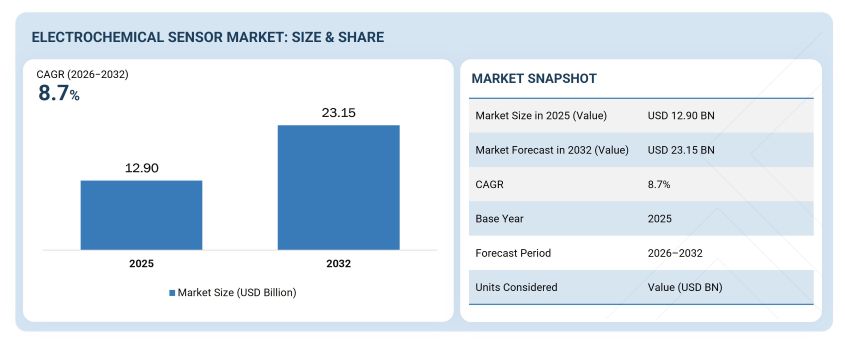
The global electrochemical sensor market was valued at USD 12.90 billion in 2025 and is projected to reach USD 23.15 billion by 2032, expanding at a compound annual growth rate of 8.7% from 2026 to 2032. This sustained growth trajectory is anchored by three converging forces: the rapid proliferation of wearable point-of-care diagnostics redefining chronic disease management, increasingly stringent environmental monitoring regulations governing industrial emissions and ambient air quality across developed and emerging economies alike, and the accelerating integration of electrochemical sensor technologies with Internet of Things platforms and AI-driven analytics that unlock real-time, predictive, and remotely accessible sensing at scale.
Asia Pacific is the fastest-growing region, driven by rapid healthcare infrastructure expansion, aggressive environmental regulation roll-out across China and India, and accelerating adoption of Industry 4.0 automation standards throughout Southeast Asia. North America holds the largest market base, underpinned by its dominant position in continuous glucose monitoring, industrial safety mandates, and a mature ecosystem of sensor OEMs and system integrators. Europe occupies the second-largest revenue position, shaped by the EU Industrial Emissions Directive, REACH chemical regulations, and a dense industrial manufacturing base across Germany, France, and the Nordics.
Top 10 Key Takeaways
- North America holds the largest share of the global electrochemical sensor market, supported by a mature industrial safety ecosystem, well-funded medical diagnostics sector, and strong federal environmental monitoring mandates.
- Asia Pacific is the fastest-growing regional market, led by China, India, South Korea, and Southeast Asian nations driving healthcare digitization, smart city investments, and stringent pollution control programs.
- Potentiometric sensors dominate the product type segment due to their widespread adoption in pH sensing, ion analysis, and laboratory-grade diagnostics across healthcare and industrial verticals.
- Amperometric sensors represent the fastest-growing type segment, propelled by the explosive growth in continuous glucose monitoring and expanding deployment in environmental gas detection.
- Healthcare and medical diagnostics is the leading end-user vertical, with continuous glucose monitoring systems, biosensors for infectious disease detection, and point-of-care testing platforms driving sustained volume and value growth.
- Miniaturization, enabled by chip-based and lab-on-chip architectures, is the defining technology shift reshaping sensor design across all form factors from industrial fixed units to consumer wearables.
- The EU Industrial Emissions Directive, US EPA air quality standards, and WHO Global Digital Health Strategy are the primary regulatory forces elevating demand for precise, real-time electrochemical detection capabilities.
- Key competitive players include Honeywell International, Thermo Fisher Scientific, Emerson Electric, MSA Safety, Siemens Healthineers, Dragerwerk, and AMETEK, with a vibrant startup layer led by companies such as FaradaIC Sensors pursuing chip-based mass-production breakthroughs.
- Near-term market opportunity centers on the intersection of wearable biosensors, AI-integrated signal processing, and the rapid scale-up of smart agricultural and food safety monitoring networks globally.
- The key near-term risk is sensor drift, long-term stability degradation, and the cost burden of multi-analyte calibration, which continue to create friction in high-reliability applications such as critical infrastructure monitoring and implantable medical devices.
Why the Electrochemical Sensor Market Matters Right Now
Electrochemical sensors have become one of the foundational sensing technologies of the modern industrial and healthcare economy. These devices work by converting chemical information, the presence and concentration of specific gases, ions, or biomolecules, into a measurable electrical signal, typically current, voltage, or impedance. Their appeal lies in a combination of properties that most sensing technologies cannot simultaneously offer: high sensitivity at very low analyte concentrations, real-time output, compact form factor, and relatively low unit cost. As industries worldwide digitize their operations and as healthcare systems shift from episodic hospital-based care to continuous remote monitoring, those properties are no longer niche requirements. They are core features for modern system design.
The macro-level context reinforcing this view is compelling. The global push toward net-zero industrial emissions is creating an entirely new demand layer for ambient air quality and industrial process gas monitoring infrastructure. The simultaneous expansion of wearable health technology, from consumer fitness trackers to clinical-grade continuous glucose monitors, is embedding electrochemical sensing into hundreds of millions of devices that reach end users directly. The growth of smart cities and precision agriculture, both heavily reliant on real-time environmental data, is generating sustained demand for distributed sensor networks. And the integration of AI and edge computing into sensing platforms is enabling predictive capability, where sensors do not merely report a reading but anticipate a failure or a health event before it occurs.
The electrochemical sensor market sits at the intersection of all these trends. It is not a niche instrumentation market serving laboratory scientists. It is a broad-based enabling technology market with applications across healthcare, oil and gas, food safety, automotive, environmental compliance, and agriculture. Understanding its trajectory, its dominant segments, its fastest-growing verticals, and its key competitive actors is strategically important for any organization operating in the sensor ecosystem, whether as a manufacturer, systems integrator, end user, or capital allocator.
Electrochemical Sensor Market Trends
Several high-conviction trends are actively reshaping the electrochemical sensor landscape and will determine which players and segments lead through 2032. Understanding these trends is essential context for any strategic decision-making in the space.
Miniaturization through chip-based architectures is arguably the most consequential structural shift underway. Conventional electrochemical sensors are three-dimensional constructs, typically a few centimeters in size with liquid electrolyte chambers, that are bulky, power-hungry, and expensive to manufacture at scale for compact applications. The emergence of Micro ElectroChemical Systems (MECS) technology, pioneered by companies like FaradaIC Sensors, is enabling electrochemical sensing to follow the same miniaturization trajectory as MEMS accelerometers and pressure sensors, collapsing sensor dimensions to chip scale and opening entirely new application categories in IoT nodes and wearable devices. This is a structural demand unlock, not an incremental improvement.
The fusion of electrochemical sensing with IoT connectivity is creating a new class of intelligent distributed sensing networks. Fixed industrial sensors, historically standalone instruments that required physical inspection for data retrieval, are now IP-addressable, cloud-connected devices that stream continuous data into SCADA systems, digital twins, and AI-driven predictive maintenance platforms. This shift is particularly transformative in oil and gas, chemical manufacturing, and water treatment facilities, where real-time gas detection with remote alerting can prevent catastrophic incidents and eliminate costly manual inspection routines.
Nanomaterial integration into electrode design is expanding the sensitivity and selectivity ceiling of electrochemical sensors. Carbon nanotubes, graphene oxide, metal-organic frameworks, and noble metal nanoparticles are now routinely incorporated into electrode coatings to enhance electroactive surface area, improve charge transfer kinetics, and achieve detection limits at parts-per-billion or even parts-per-trillion concentrations. These advances are opening electrochemical sensing to application areas, such as trace heavy metal detection in drinking water and ultra-low-concentration biomarker detection in early-stage cancer diagnostics, that were previously the exclusive domain of bulky laboratory instruments.
Wearable biosensing is transitioning from consumer wellness gadgetry to clinical utility. The continuous glucose monitoring segment, led by Abbott and Dexcom, has already demonstrated that electrochemical sensors embedded in wearable patches can generate clinically actionable data continuously without finger-prick blood draws. The next frontier involves multi-analyte wearable patches capable of simultaneously monitoring glucose, lactate, cortisol, alcohol, and electrolytes in interstitial fluid or sweat, data that collectively provides a comprehensive metabolic snapshot relevant to sports medicine, occupational health, and chronic disease management.
AI-powered signal processing is addressing one of the most persistent challenges in electrochemical sensing: interference from non-target analytes and signal drift over the sensor lifetime. Machine learning models trained on sensor response patterns across multiple analytes can now perform real-time background subtraction, drift correction, and cross-analyte disambiguation with a precision that was previously unachievable without laboratory recalibration. This capability is dramatically extending the practical operational lifetime of deployed sensors in both medical and industrial environments.
Electrochemical Sensor Market Drivers
The expanding global burden of chronic disease is the single most powerful demand driver for medical electrochemical sensing. The International Diabetes Federation estimates that more than 500 million adults worldwide live with diabetes, a condition that requires frequent blood glucose monitoring. Continuous glucose monitoring systems, the largest medical application of electrochemical sensors, are experiencing rapid clinical adoption as evidence accumulates that continuous real-time glucose data improves glycemic control and reduces hospitalization rates. Regulatory bodies including the US Food and Drug Administration and the European Medicines Agency have cleared CGM systems for therapeutic insulin dosing decisions, removing the last barrier to mainstream clinical adoption and creating a durable, recurring demand stream for disposable electrochemical sensor elements.
Tightening environmental regulation across all major economies is creating a mandatory demand floor for industrial and ambient monitoring sensors. In the United States, the Environmental Protection Agency has expanded its National Ambient Air Quality Standards, and Occupational Safety and Health Administration permissible exposure limits for a growing list of industrial gases compel regulated industries to maintain continuous real-time monitoring capabilities. In Europe, the Industrial Emissions Directive and the European Green Deal's air quality strategy are driving plant operators to invest in denser, more capable sensor networks. China's 14th Five-Year Plan targets for air and water quality improvement are similarly forcing deployment of large-scale electrochemical monitoring infrastructure across industrial provinces.
The global Food Safety Modernization Act framework in the United States, along with equivalent legislation in the EU, Canada, and China, is compelling food manufacturers and processors to implement tighter in-line and at-line chemical monitoring. Electrochemical sensors capable of detecting pesticide residues, heavy metal contamination, microbial metabolites, and freshness biomarkers in real time are becoming embedded in food processing and cold chain infrastructure, replacing periodic laboratory testing with continuous inline monitoring.
The oil and gas sector's accelerating investment in process safety management following high-profile industrial accidents has created a substantial and recurring demand base for fixed electrochemical gas detection systems. Hydrogen sulfide, carbon monoxide, and volatile organic compound detection in refineries, offshore platforms, and pipeline infrastructure now operates in a dense fixed-sensor architecture, with regulatory mandates in most jurisdictions specifying instrument performance standards, calibration intervals, and response time requirements that favor electrochemical technologies.
The broadening of precision agriculture, underpinned by government digital farming initiatives across Europe, India, and Southeast Asia, is creating new end markets for soil health electrochemical sensors capable of monitoring nitrate, phosphate, and pH levels in real time. These capabilities are allowing farmers to apply fertilizers with precision rather than by broadcast, reducing input costs, improving yields, and satisfying increasingly strict environmental compliance requirements for nutrient runoff control.
Electrochemical Sensor Market Challenges
Despite the compelling growth drivers, the electrochemical sensor market faces real structural constraints that any strategic assessment must acknowledge. Sensor drift is the most pervasive technical challenge. Electrochemical sensors degrade over time as electrode surfaces become fouled, electrolyte evaporates, or biological recognition elements such as enzymes lose activity. In high-reliability applications including medical implants, safety-critical gas detection, and food quality control, sensor drift translates directly into false readings with potentially serious consequences. Managing drift requires either frequent recalibration, which adds operational cost and complexity, or the deployment of more robust and inherently more expensive sensor designs.
Cross-sensitivity and selectivity limitations remain an active challenge for sensors deployed in complex chemical environments. An electrochemical oxygen sensor may produce erroneous readings in the presence of high concentrations of other reducing gases. A glucose sensor may be interfered with by acetaminophen or ascorbic acid. While advanced electrode materials and AI-assisted signal processing are mitigating these issues, achieving the selectivity required for demanding applications still requires careful sensor design choices that often increase cost and complexity.
The high upfront cost of developing application-specific electrochemical sensor solutions creates a meaningful barrier, particularly for SME end users and emerging market deployments. Custom electrode fabrication, characterization, and regulatory approval processes for medical-grade sensors are capital-intensive. This cost dynamic tends to concentrate innovation activity in large well-funded companies and creates longer technology transfer timelines for smaller-scale applications or geographies where end-user budgets are constrained.
Regulatory fragmentation across geographies creates compliance complexity for global sensor manufacturers. A gas detection sensor meeting OSHA requirements in the United States may require separate conformity assessments to satisfy European ATEX directives or Chinese national standards. Medical biosensors face an even more complex landscape, with FDA 510(k) or PMA pathways in the US, CE marking under the EU In Vitro Diagnostic Regulation, and separate national approvals in Japan, South Korea, and China. Navigating this regulatory patchwork imposes both time and cost burdens that can slow market entry and product commercialization.
Electrochemical Sensor Market, By Industry Application Growth
Healthcare and medical diagnostics is the leading vertical for electrochemical sensor demand, and it is likely to retain that position across the forecast period. Continuous glucose monitoring is the anchor application, but the vertical extends across biosensors for cardiac biomarker detection, lactate monitoring in critical care, point-of-care infectious disease testing (including pathogen-specific biosensor platforms developed for pandemic preparedness), and implantable sensors for intracranial pressure or oxygen monitoring. Healthcare organizations' increasing investment in remote patient monitoring infrastructure is creating new deployment models that embed electrochemical sensing in home-based and ambulatory care settings at scale.
Environmental monitoring is the second-largest vertical and arguably the fastest-growing in terms of installation volume, particularly in Asia Pacific. The application spans urban ambient air quality monitoring networks, industrial stack emissions monitoring, water quality surveillance, and soil contamination assessment at industrial remediation sites. Smart city programs in China, India, and Southeast Asia are funding dense sensor network deployments that install hundreds or thousands of nodes across metropolitan areas, creating large orders for compact, low-power electrochemical air quality sensors.
Industrial safety and process control represents a high-value segment characterized by stringent performance requirements and recurring replacement revenue. Toxic gas detection in chemical plants, refineries, and mining operations is the core application, covering hydrogen sulfide, carbon monoxide, ammonia, chlorine, and oxygen depletion monitoring. The transition to predictive maintenance models, in which sensor networks are integrated with AI platforms to anticipate equipment failures and gas release events before they occur, is elevating the strategic importance of continuous electrochemical monitoring and driving upgrade cycles in installed sensor infrastructure.
Food safety and quality control is an emerging but rapidly accelerating application vertical. Electrochemical sensors are being adopted for inline monitoring of fermentation processes, real-time freshness assessment of perishables based on biogenic amine or volatile metabolite detection, pesticide residue screening at processing facilities, and heavy metal content verification in raw ingredient streams. Regulatory pressure from food safety modernization legislation and growing consumer demand for supply chain transparency are both pushing adoption.
Agriculture is a nascent but strategically important vertical. Electrochemical soil sensors monitoring nitrate, potassium, pH, and moisture content in real time are becoming core components of precision farming platforms. The global push for sustainable agriculture, including the European Farm to Fork Strategy and equivalent programs in India and Brazil, is creating policy tailwinds that will accelerate adoption of real-time soil sensing infrastructure through the forecast period.
Electrochemical Sensor Market Segment Insights
By Type
Potentiometric sensors hold the leading position within the electrochemical sensor market by type. These devices, which measure the voltage difference between an indicator and a reference electrode to determine analyte concentration, are the established workhorse of pH sensing across water treatment, pharmaceutical manufacturing, food processing, and laboratory diagnostics. Their dominance reflects decades of commercial maturity, a well-understood performance envelope, a broad base of compatible instrumentation, and cost structures favorable to high-volume industrial deployment.
Amperometric sensors are the fastest-growing type segment, driven primarily by their central role in continuous glucose monitoring. Amperometric sensors measure current generated by electrochemical oxidation or reduction of target analytes at an electrode, making them highly sensitive and suitable for detecting low analyte concentrations in biological fluids. Beyond glucose monitoring, their adoption is accelerating in environmental gas detection, dissolved oxygen monitoring in bioreactors, and the expanding market for multi-analyte wearable biosensors that track metabolic biomarkers in real time.
By Detection Technology
Enzymatic detection technology leads the detection technology segment, anchored by glucose oxidase-based biosensors that underpin the continuous glucose monitoring market. The specificity imparted by biological recognition elements makes enzymatic sensors the preferred choice for medical diagnostics where false positives carry clinical risk. Their extensive commercial track record and established FDA regulatory pathways reinforce their market position.
Non-enzymatic detection is the fastest-growing detection technology, attracting substantial research investment and early commercial activity. Non-enzymatic sensors rely on nanostructured catalytic electrode materials, including copper oxide, platinum nanoparticles, and graphene composites, to oxidize target analytes without biological enzymes, offering superior stability, longer operational lifetime, and the ability to function in challenging environments where enzyme activity would be compromised. Their growth is particularly notable in food safety and industrial process monitoring applications.
By Form Factor
Fixed and stationary sensors hold the largest share within the form factor segment, reflecting their entrenched position in industrial safety monitoring, water treatment plant instrumentation, and environmental compliance networks. These systems benefit from stable power supplies, easy maintenance access, and direct integration with plant-level control and alarm systems, making them the preferred architecture for safety-critical continuous monitoring.
Wearable sensors are the fastest-growing form factor, reflecting the intersection of advancing flexible electronics, miniaturized power management, and wireless connectivity with the rapid market expansion of consumer and clinical health monitoring. The commercial success of CGM patches and the active development pipeline of multi-analyte sweat and interstitial fluid sensing platforms are driving investment and volume growth in this segment at rates substantially above the market average.
By End-User Industry
Healthcare and medical diagnostics leads across all end-user segments in terms of revenue, reflecting the high unit value of FDA-cleared medical sensing components, the recurring consumable revenue model of CGM systems, and the growing clinical penetration of point-of-care biosensing platforms. The vertical encompasses hospital-based laboratory diagnostics, ambulatory care monitoring, home health management, and the rapidly growing wearable health device segment.
Environmental monitoring is the fastest-growing end-user industry segment by installation volume and system count, driven by government-mandated compliance monitoring infrastructure build-out across Asia Pacific, North America, and Europe. The combination of smart city sensor network deployments, industrial emissions compliance requirements, and water quality surveillance programs is creating multi-year procurement programs that favor scalable, low-maintenance electrochemical sensor solutions.
Segmentation Summary
- Potentiometric sensors dominate by sensor type, while amperometric sensors are growing fastest due to CGM and environmental gas detection expansion.
- Enzymatic detection technology leads commercially, but non-enzymatic nano-material-based detection is the most dynamic innovation frontier and fastest-growing sub-segment.
- Fixed sensors command the largest installed base, while wearable sensors are growing fastest from a rapidly expanding commercial and clinical health monitoring base.
- Healthcare is the dominant end-user vertical by revenue; environmental monitoring is the largest by installation volume and fastest growing through the forecast horizon.
- The food safety and agriculture verticals represent the most underpenetrated end-user opportunity, with strong regulatory tailwinds expected to accelerate adoption through 2032.
Electrochemical Sensor Market Regional Analysis
North America
North America is the largest electrochemical sensor market globally. The region's dominant position reflects a combination of an advanced healthcare diagnostics ecosystem, a large and safety-regulation-intensive industrial sector, and federal policy frameworks that mandate continuous environmental and workplace monitoring across a broad range of industries. The United States is by far the largest individual country market, anchored by the commercial success of Abbott's FreeStyle Libre and Dexcom's G-series continuous glucose monitoring platforms, which collectively cover tens of millions of active users generating a high-volume recurring demand stream for electrochemical sensor elements. Canada's market is shaped by similar healthcare dynamics alongside substantial oil sands and mining sector demand for industrial gas detection. Mexico represents an emerging growth pocket, as its expanding manufacturing sector and growing environmental compliance obligations from the revised USMCA environmental standards create incremental demand. The North America electrochemical sensor market was valued at USD 4.77 billion in 2025 and is expected to reach USD 8.31 billion by 2032, growing at a CAGR of 8.2% over the forecast period.
Europe
Europe is the second-largest electrochemical sensor market, shaped heavily by the regulatory architecture of the European Union and a dense industrial base that operates under some of the world's most stringent environmental and occupational safety standards. Germany is the largest country market, reflecting its position as a global hub for chemical and pharmaceutical manufacturing, automotive production, and industrial automation, all sectors with intensive sensor requirements. The United Kingdom retains a significant market position particularly in life sciences diagnostics and offshore oil and gas monitoring. France, Italy, and Spain together contribute a meaningful share through their pharmaceutical, food processing, and environmental monitoring sectors. The Nordics, particularly Finland and Sweden, are notable for high adoption rates of environmental monitoring infrastructure as part of green industrial transition programs. The EU Industrial Emissions Directive and REACH chemical regulation framework are the defining policy forces, while the European Green Deal's emissions reduction targets are creating a long-cycle demand driver for advanced ambient and industrial monitoring capability. The Europe electrochemical sensor market was valued at USD 3.35 billion in 2025 and is anticipated to reach USD 5.74 billion by 2032 at a CAGR of 8.0%.
Asia Pacific
Asia Pacific is both the fastest-growing and the most strategically dynamic electrochemical sensor regional market. China dominates regional revenue and volume, driven by its massive industrial manufacturing base, rapidly expanding healthcare diagnostics infrastructure, and government mandates under the 14th Five-Year Plan that are forcing large-scale ambient air and water quality monitoring network deployments across all tier-one and tier-two cities. Japan is the second-largest APAC market, characterized by high adoption of precision sensing in automotive, semiconductor, and pharmaceutical manufacturing applications. South Korea's advanced electronics manufacturing ecosystem and growing biosensor research activity make it a significant contributor. India is the fastest-growing APAC country market, with government programs including the National Clean Air Programme, expanding healthcare access initiatives, and growing food safety enforcement driving demand across multiple application verticals simultaneously. Singapore, Australia, and Southeast Asian markets contribute incremental but fast-growing demand, particularly in smart city environmental sensing and pharmaceutical manufacturing quality control. The Asia Pacific electrochemical sensor market was valued at USD 3.61 billion in 2025 and is projected to reach USD 6.96 billion by 2032, growing at a CAGR of 9.8% over the forecast period, the highest rate of any region.
Rest of World
The Rest of World segment, encompassing Latin America, the Middle East, and Africa, represents the smallest revenue base but a meaningful and growing market with localized demand drivers that vary significantly by sub-region. Brazil is the largest individual market within RoW, supported by its extensive agricultural sector's growing adoption of soil electrochemical monitoring, a sizeable food processing industry with emerging in-line sensing requirements, and government investment in environmental monitoring infrastructure tied to Amazon conservation commitments. In the Middle East, the UAE and Saudi Arabia are the primary demand centers, driven by their large oil and gas processing infrastructure's gas detection requirements and healthcare modernization investment under Vision 2030 programs that are rapidly expanding diagnostic testing capabilities in the region. South Africa is the leading African market, with mining safety applications providing a substantial fixed-sensor demand base. The Rest of World electrochemical sensor market was valued at USD 1.17 billion in 2025 and is projected to reach USD 2.14 billion by 2032 at a CAGR of 9.0%.
Regional Outlook Summary
- North America is the largest regional market, with healthcare diagnostics and industrial safety applications jointly anchoring demand across a mature and innovation-intensive ecosystem.
- Europe's growth is regulation-driven, with the EU's environmental and occupational safety framework providing a durable policy mandate for sensor deployment across industrial, municipal, and agricultural sectors.
- Asia Pacific is the fastest-growing region, with China and India the primary volume drivers, South Korea and Japan the technology leaders, and Southeast Asia a rapidly emerging incremental market.
- Rest of World growth is led by Brazil's agricultural sensing expansion, Gulf state oil and gas and healthcare infrastructure investment, and South Africa's mining safety demand base.
- All four regions are experiencing convergent demand from environmental regulation intensification, healthcare digitization, and IoT-enabled industrial automation, with Asia Pacific experiencing these forces with greatest velocity.
Country-Specific Electrochemical Sensor Market Insights
The United States is the most mature and highest-value single-country electrochemical sensor market. Its defining characteristic is the commercial scale of medical biosensing. The CGM market alone has achieved extraordinary penetration, with devices from Abbott (FreeStyle Libre) and Dexcom (G7) now used by millions of Americans for daily diabetes management. Beyond healthcare, the US industrial gas detection market is shaped by OSHA regulations that mandate specific gas monitoring protocols across refining, mining, chemical manufacturing, and confined space entry operations. The EPA's expanding air quality monitoring network and Clean Power Plan requirements are driving municipal and industrial sensor infrastructure investment at the federal and state level.
Germany stands out within Europe as the country with the deepest industrial electrochemical sensor integration. Its chemicals sector, representing the largest in Europe by output, operates under stringent REACH and Industrial Emissions Directive obligations that translate directly into dense fixed monitoring infrastructure. German pharmaceutical manufacturers, subject to EMA Good Manufacturing Practice standards, are significant buyers of high-performance analytical electrochemical sensors for process quality control. The country's engineering-driven approach to quality and precision also makes it an early adopter of advanced sensor technologies across automotive and industrial automation applications.
China's electrochemical sensor market is uniquely large-scale and policy-driven. The central government's 14th Five-Year Plan has set ambitious air quality improvement targets for major cities, creating government procurement programs for environmental monitoring sensor networks of a scale not seen elsewhere. Simultaneously, China's growing middle class is driving healthcare diagnostics demand, including point-of-care testing and CGM device adoption. Domestic manufacturers including BioTech and several tier-two sensor producers are scaling rapidly behind policy protection, though international players retain technology leadership in high-end medical and precision industrial applications.
India is the most exciting emerging country-level opportunity in the global electrochemical sensor market. The National Clean Air Programme, targeting a 20-30% reduction in particulate matter concentrations in 132 non-attainment cities, is creating large public procurement programs for ambient air quality monitoring. India's pharmaceutical sector, the world's third-largest by volume, is a significant buyer of analytical sensors for API manufacturing quality control. And the country's vast agricultural sector, representing the livelihood of more than 600 million people, is in the early stages of adopting precision soil sensing and water quality monitoring technologies supported by government digitization programs.
Saudi Arabia represents the most strategically important RoW country market. Vision 2030's healthcare system expansion program is driving significant investment in medical diagnostics infrastructure including biosensing capability. The country's large oil and gas processing sector, anchored by Saudi Aramco's extensive refining and petrochemical operations, represents one of the largest single-operator industrial gas detection markets globally. The construction of NEOM and other giga-project smart city developments is also creating a new demand layer for embedded environmental electrochemical sensing infrastructure.
Country-Specific Insight Summary
- The US market is defined by the commercial scale of CGM medical biosensing, with industrial safety and EPA environmental compliance providing secondary but substantial demand pillars.
- Germany's chemical, pharmaceutical, and automotive industries make it Europe's most technically demanding single-country electrochemical sensor market, with precision and compliance as the dominant purchase criteria.
- China's government-led environmental monitoring network deployment programs represent the largest coordinated public procurement opportunity in the global electrochemical sensor market.
- India's convergence of Clean Air Programme mandates, pharmaceutical manufacturing growth, and agricultural precision sensing adoption creates a multi-vertical country-level opportunity growing faster than most global benchmarks.
- Saudi Arabia's Vision 2030 healthcare and smart city investment programs, combined with Aramco's industrial gas detection requirements, make it the anchor market for the Rest of World segment.
Key Players in the Electrochemical Sensor Market
The global electrochemical sensor market features a concentrated group of well-established industrial technology and healthcare companies alongside an increasingly active layer of specialized sensor startups. The leading players by market presence and product breadth include Honeywell International Inc., Thermo Fisher Scientific Inc., Emerson Electric Co., MSA Safety Inc., Siemens Healthineers AG, AMETEK Inc., Dragerwerk AG, SGX Sensortech Ltd., Alphasense Ltd., Conductive Technologies Inc., ABB Ltd., Membrapor AG, Metrohm AG, Figaro USA Inc., and FaradaIC Sensors GmbH.
Competitive dynamics in the market are shaped by several strategic themes. Large diversified technology companies such as Honeywell and Emerson leverage their sensor capability within broader automation and process management platforms, competing on integration rather than on sensor technology alone. Honeywell has been actively reinforcing its industrial sensing portfolio, launching advanced electrochemical gas detection sensors with improved operational life for industrial safety applications and expanding into smart building air quality monitoring through its IoT-enabled sensor portfolio. In 2025, Honeywell continued to strengthen its position through strategic partnerships focused on integrating electrochemical gas sensing with cloud-based analytics platforms for industrial safety and environmental applications.
Thermo Fisher Scientific operates at the high-value end of the analytical instruments market, with electrochemical sensing capabilities embedded in laboratory and process analytical systems used by pharmaceutical manufacturers, environmental testing laboratories, and research institutions. Its scale and global service network give it a distribution advantage in regulated industries where after-sales support and calibration services are critical purchasing considerations.
ABB has been expanding its electrochemical sensing collaboration with industrial and energy sector companies to enhance hazardous gas detection and process safety systems, with a particular focus on integrating sensing data into its industrial automation platforms. Siemens has been deepening its position through partnerships that integrate electrochemical sensors into smart city and building management systems, including a partnership direction aimed at cloud-based environmental monitoring platforms announced in 2025.
At the startup and SME layer, FaradaIC Sensors is arguably the most closely watched company. The Berlin-based startup secured EUR 4.5 million in April 2025 in a funding round led by JOIN Capital, with participation from the European Innovation Council, to accelerate commercialization of its Micro ElectroChemical Systems (MECS) technology. MECS enables the fabrication of electrochemical sensing elements on microchips, enabling miniaturization analogous to the MEMS revolution in inertial sensing. If successful, this approach could fundamentally reduce the cost and size of electrochemical gas sensors and unlock mass-market IoT and wearable applications currently served by less capable metal oxide semiconductor alternatives.
Key Company Strategy Summary
- Large diversified players such as Honeywell, Emerson, ABB, and Siemens are competing on platform integration, embedding electrochemical sensing capabilities within broader automation, safety management, and IoT analytics systems.
- Specialist sensor manufacturers including Alphasense, Dragerwerk, and Membrapor are defending technical leadership through sustained R&D investment in sensor materials, electrode design, and performance optimization.
- The startup layer, led by FaradaIC Sensors, is pursuing chip-scale miniaturization approaches that could restructure cost and form-factor economics for gas sensing across IoT and wearable applications.
- Healthcare-focused players including Thermo Fisher and those with CGM-adjacent capabilities are investing in next-generation enzymatic and non-enzymatic electrode materials to extend sensor lifetime and expand analyte coverage in medical and point-of-care biosensing applications.
- Asia Pacific market expansion is a common strategic priority across all major players, with distribution partnerships and local manufacturing investments being the primary market entry modalities given the scale and policy intensity of demand in China and India.
Recent Developments in the Electrochemical Sensor Market
- In April 2025, FaradaIC Sensors GmbH, a Berlin-based startup, raised EUR 4.5 million in a funding round led by JOIN Capital, with co-investment from the European Innovation Council, Forma Prime, and several other European technology investors. The capital is being deployed to scale the company's MECS chip-based electrochemical gas sensing technology toward commercial production, targeting the IoT and wearable device markets currently underserved by conventional large-format sensors.
- In June 2025, Honeywell International launched next-generation electrochemical gas sensors with enhanced sensitivity, faster response times, and extended operational life specifically designed for industrial safety monitoring applications, expanding its fixed-sensor portfolio for oil and gas, chemical, and manufacturing facilities.
- In July 2025, Siemens unveiled a partnership direction aimed at developing a cloud-based platform integrating electrochemical sensor data with AI-based analytics for real-time industrial air quality and CO2 monitoring, targeting smart city and industrial facility applications.
- In October 2025, Siemens launched a redesigned range of room air quality sensors incorporating a traffic-light-style CO2 and VOC indication system for indoor air quality management, targeting commercial building and healthcare facility applications within its building technologies business.
- In 2025, ABB Ltd. expanded its collaborations with energy sector companies to advance electrochemical sensing solutions for hazardous gas detection and process safety systems within its broader industrial safety and automation product ecosystem.
Real-World Use Cases and Case Studies
Abbott's FreeStyle Libre continuous glucose monitoring system represents perhaps the most commercially impactful deployment of electrochemical sensing technology at consumer scale. The system, which uses a factory-calibrated amperometric glucose sensor in a wearable patch worn on the upper arm, had been adopted by over 6 million users globally as of the system's early commercial years, with the FreeStyle Libre 3 iteration, launched progressively from 2022 onward, representing a significant design upgrade in sensor form factor, connectivity, and accuracy. The system eliminates the need for routine finger-prick blood glucose testing and streams real-time glucose readings to a smartphone or reader, enabling patients and clinicians to observe glucose trends and make more informed insulin dosing and dietary decisions. Abbott's success demonstrated that mass-market electrochemical biosensing in a wearable format was commercially and clinically viable, and has since catalyzed a wave of competitive and adjacent product development across the broader biosensing ecosystem.
FaradaIC Sensors' chip-scale MECS gas sensing program, announced as the intended use of the April 2025 EUR 4.5 million funding round, represents a compelling case study in the application of microfabrication technology to the electrochemical sensing domain. The company is applying semiconductor manufacturing processes to produce electrochemical gas sensing elements on microchips, achieving a size reduction of several orders of magnitude compared to conventional liquid electrolyte electrochemical gas sensors. The stated commercial objective is to make electrochemical gas sensing competitive with metal oxide semiconductor sensors in IoT node and wearable device applications, where size, power consumption, and cost have historically excluded electrochemical technology despite its superior sensitivity and selectivity. If the MECS technology achieves commercial scale, it could significantly expand the addressable market for electrochemical gas sensing into consumer electronics, smart home, and precision agriculture monitoring applications.
Electrochemical Sensor Market Segmentation
The electrochemical sensor market is segmented across five principal dimensions that together define the commercial structure of the industry and illuminate where value pools are concentrated and where growth is fastest. By type, the market encompasses potentiometric, amperometric, conductometric, and voltammetric sensor categories, each with distinct operating principles, dominant applications, and competitive dynamics. Potentiometric sensors command the largest revenue share through their ubiquitous deployment in pH and ion sensing across water treatment, pharmaceutical manufacturing, and laboratory diagnostics. Amperometric sensors are the fastest-growing type, anchored by the CGM biosensing market and expanding into environmental gas detection and multi-analyte wearable platforms.
By detection technology, the segmentation runs from enzymatic to non-enzymatic to immunosensor and aptasensor-based approaches. Enzymatic detection dominates current commercial deployment, particularly in medical biosensing, while non-enzymatic nanocomposite approaches represent the frontier of innovation with superior operational stability and expanding application breadth. By form factor, fixed stationary sensors lead in installed base and revenue, while wearable sensors are the most dynamic growth segment, driven by the commercialization of clinical-grade continuous monitoring devices and the emerging consumer health monitoring market.
The end-user industry segmentation spans healthcare and medical diagnostics, environmental monitoring, food safety, industrial safety and process control, agriculture, automotive, and aerospace and defense. Healthcare is the highest-revenue end user; environmental monitoring is the fastest-growing by unit deployment volume; and food safety and agriculture represent the most underpenetrated verticals with the strongest medium-term regulatory and commercial growth catalysts. The regional segmentation, detailed in the regional analysis section, covers North America, Europe, Asia Pacific, and Rest of World, with Asia Pacific distinguished as the fastest-growing region and North America as the largest base.
Market Segmentation Summary
- Five distinct segmentation axes define the market: sensor type, detection technology, form factor, end-user industry, and geography, each with its own distinct leader and fastest-growing segment.
- Potentiometric type and enzymatic detection technology represent the commercially established core of the market; amperometric and non-enzymatic segments represent the highest-growth innovation frontier.
- Fixed sensors dominate installed base; wearable sensors command the highest growth rate driven by CGM and multi-analyte health monitoring platform expansion.
- Healthcare leads by revenue; environmental monitoring leads by deployment volume; food safety and agriculture are the most underserved verticals with the strongest medium-term upside.
- Asia Pacific is the highest-growth regional segment; North America is the highest-revenue regional segment; all regions share converging demand from regulation, digitization, and sustainability investment.
Conclusion and Future Outlook
The electrochemical sensor market is entering a phase of accelerated structural transformation shaped by the convergence of three powerful forces: the deepening integration of AI and edge computing into sensor platforms, the maturation of miniaturized chip-scale sensor architectures, and the broad-based intensification of regulatory and commercial pressures across healthcare, environmental, industrial, and food safety domains. AI is reshaping what electrochemical sensors can do beyond raw measurement. Machine learning models embedded at the edge are enabling real-time drift correction, cross-analyte interference rejection, and predictive alerting without cloud round-trip latency, dramatically extending operational reliability in deployment environments where recalibration or sensor replacement is costly or logistically challenging. This AI-sensor convergence is not a future aspiration; it is actively being commercialized by major players including Honeywell, Siemens, and ABB in industrial and environmental monitoring applications.
Through 2032, growth will be fastest in Asia Pacific, driven by government-backed environmental monitoring infrastructure investment, healthcare digitization, and precision agriculture adoption. But no region will be static. North America's CGM market will continue to expand, with new analyte targets including lactate, ketones, and alcohol creating incremental demand. Europe's Green Deal-driven industrial emissions compliance obligations will sustain multi-year sensor network upgrade cycles. The startup ecosystem, represented by companies such as FaradaIC Sensors, is creating chip-scale miniaturization capabilities that could expand the electrochemical sensing addressable market into IoT, wearable consumer electronics, and smart building applications previously served by less accurate metal oxide semiconductor alternatives. For businesses evaluating this market, whether as technology suppliers, system integrators, end users, or investors, the central strategic message is clear: electrochemical sensing is transitioning from specialized scientific instrumentation to ubiquitous digital infrastructure, and the organizations that position themselves at this intersection stand to benefit from one of the most durable demand growth stories in the global sensor industry.
Frequently Asked Questions: Electrochemical Sensor Market
1. How big is the electrochemical sensor market?
The global electrochemical sensor market was valued at USD 12.90 billion in 2025. Driven by healthcare diagnostics, environmental monitoring, and industrial safety applications, the market is projected to reach USD 23.15 billion by 2032.
2. What is the electrochemical sensor market growth rate?
The global electrochemical sensor market is expected to grow at a CAGR of 8.7% from 2026 to 2032. Asia Pacific is the fastest-growing regional market, projected to expand at approximately 9.8% CAGR over the same period, driven by government-led environmental monitoring programs and healthcare infrastructure investment.
3. Which segment leads the electrochemical sensor market?
Healthcare and medical diagnostics is the leading end-user segment, anchored by continuous glucose monitoring systems and expanding point-of-care biosensing platforms. By sensor type, potentiometric sensors command the largest revenue share, while amperometric sensors are growing fastest. North America holds the largest regional market position globally.
4. Who are the key players in the electrochemical sensor market?
The leading companies in the global electrochemical sensor market include Honeywell International Inc., Thermo Fisher Scientific Inc., Emerson Electric Co., MSA Safety Inc., Siemens Healthineers AG, AMETEK Inc., Dragerwerk AG, SGX Sensortech Ltd., Alphasense Ltd., ABB Ltd., Membrapor AG, Metrohm AG, Conductive Technologies Inc., and FaradaIC Sensors GmbH. These companies compete through product performance, application-specific expertise, IoT integration capability, and global distribution and service networks.
5. What are the key factors driving the electrochemical sensor market?
The primary drivers of the electrochemical sensor market include the expanding global burden of chronic diseases driving continuous glucose monitoring adoption, tightening environmental regulations in North America, Europe, and Asia Pacific mandating real-time industrial and ambient monitoring, the integration of IoT connectivity and AI analytics into sensor platforms enabling predictive monitoring capabilities, advances in nanomaterial-based electrode design extending sensor performance and sensitivity, and the rapid growth of wearable health monitoring devices embedding electrochemical sensing in consumer and clinical platforms at scale.
Learn More with MarketsandMarkets
MarketsandMarkets provides deep, segment-level intelligence on the global electrochemical sensor market, covering granular breakdowns by type, detection technology, form factor, end-user industry, and country, alongside detailed competitive benchmarking and company-level revenue analysis. To explore how this research can inform your market entry strategy, investment thesis, or product roadmap, speak with our analyst, request a complimentary sample report, or customize the research scope to match your specific requirements.
 Exclusive indicates content/data unique to MarketsandMarkets and not available with any competitors.
TABLE OF CONTENTS
1 Introduction
1.1 Study Objectives
1.2 Market Definition and Scope
1.3 Inclusions and Exclusions
1.3.1 Inclusions
1.3.2 Exclusions
1.4 Study Scope
1.4.1 Markets Covered
1.4.2 Geographic Segmentation
1.4.3 Years Considered
1.5 Currency Considered
1.6 Stakeholders
2 Research Methodology
2.1 Research Approach
2.2 Secondary Research
2.3 Primary Research
2.4 Market Size Estimation: Bottom-up and Top-down
2.5 Data Triangulation
2.6 Assumptions
3 Executive Summary
4 Premium Insights
5 Market Overview
5.1 Introduction
5.2 Market Dynamics
5.2.1 Drivers
5.2.2 Restraints
5.2.3 Opportunities
5.2.4 Challenges
5.3 Value Chain Analysis
5.4 Ecosystem Analysis
5.5 Investment and Funding Scenario
5.6 Pricing Analysis
5.7 Trends and Disruptions Impacting Customer Business
5.8 Technology Analysis
5.8.1 Key Technologies
5.8.2 Complementary Technologies
5.8.3 Adjacent Technologies
5.9 Porter's Five Forces Analysis
5.1 Key Stakeholders and Buying Criteria
5.11 Case Study Analysis
5.12 Trade Analysis
5.13 Patent Analysis
5.14 Key Conferences and Events
5.15 Regulatory Landscape
5.16 Impact of AI and Generative AI on the Electrochemical Sensor Market
5.17 Impact of 2025 US Tariffs on the Electrochemical Sensor Market
6 Industry Trends
6.1 Miniaturization and Chip-Based Sensor Architectures
6.2 Integration with IoT and Edge Computing
6.3 Nanotechnology and Advanced Electrode Materials
6.4 AI-Enabled Signal Processing and Predictive Analytics
6.5 Wearable and Point-of-Care Biosensing Expansion
7 Technology Adoption and Regulatory Compliance Landscape
7.1 Overview of Key Regulatory Standards
7.2 OSHA, EPA, and Industrial Safety Frameworks (North America)
7.3 EU Industrial Emissions Directive and REACH Compliance
7.4 WHO Digital Health Strategy and Medical Sensor Approvals
7.5 Asia Pacific Environmental and Safety Mandates
7.6 Adoption Barriers and Compliance Cost Analysis
8 Customer Landscape and Buyer Behavior
8.1 Decision-Making Process
8.2 Buyer Stakeholder Mapping
8.3 Adoption Barriers
8.4 Procurement Channel Analysis
9 Electrochemical Sensor Market, By Type
9.1 Introduction
9.2 Potentiometric Sensors
9.3 Amperometric Sensors
9.4 Conductometric Sensors
9.5 Voltammetric Sensors
10 Electrochemical Sensor Market, By Detection Technology
10.1 Introduction
10.2 Enzymatic Detection
10.3 Non-enzymatic Detection
10.4 Immunosensor-Based Detection
10.5 Aptasensor-Based Detection
11 Electrochemical Sensor Market, By Form Factor
11.1 Introduction
11.2 Portable and Handheld Sensors
11.3 Fixed / Stationary Sensors
11.4 Wearable Sensors
11.5 Lab-on-Chip / Miniaturized Chip-Based Sensors
12 Electrochemical Sensor Market, By End-User Industry
12.1 Introduction
12.2 Healthcare and Medical Diagnostics
12.3 Environmental Monitoring
12.4 Food Safety and Quality Control
12.5 Industrial Safety and Process Control
12.6 Agriculture
12.7 Automotive and Transportation
12.8 Aerospace and Defense
13 Electrochemical Sensor Market, By Region
13.1 Introduction
13.2 North America
13.2.1 United States
13.2.2 Canada
13.2.3 Mexico
13.3 Europe
13.3.1 Germany
13.3.2 United Kingdom
13.3.3 France
13.3.4 Italy
13.3.5 Spain
13.3.6 Nordics
13.3.7 Rest of Europe
13.4 Asia Pacific
13.4.1 China
13.4.2 Japan
13.4.3 India
13.4.4 South Korea
13.4.5 Australia
13.4.6 Singapore
13.4.7 Rest of Asia Pacific
13.5 Rest of World
13.5.1 Brazil
13.5.2 UAE
13.5.3 Saudi Arabia
13.5.4 South Africa
13.5.5 Rest of RoW
14 Competitive Landscape
14.1 Overview
14.2 Key Player Strategies and Right to Win
14.3 Revenue Analysis
14.4 Market Share Analysis
14.5 Company Evaluation Matrix for Key Players
14.5.1 Stars
14.5.2 Emerging Leaders
14.5.3 Pervasive Players
14.5.4 Participants
14.6 Company Evaluation Matrix for Startups/SMEs
14.6.1 Progressive Companies
14.6.2 Responsive Companies
14.6.3 Dynamic Companies
14.6.4 Starting Blocks
14.7 Competitive Benchmarking
14.8 Competitive Scenario
14.8.1 Product Launches
14.8.2 Deals, Partnerships and Expansions
15 Company Profiles
15.1 Honeywell International Inc.
15.2 Thermo Fisher Scientific Inc.
15.3 Emerson Electric Co.
15.4 MSA Safety Inc.
15.5 Siemens Healthineers AG
15.6 AMETEK Inc.
15.7 Dragerwerk AG
15.8 SGX Sensortech Ltd.
15.9 Alphasense Ltd.
15.10 Conductive Technologies Inc.
15.11 ABB Ltd.
15.12 Membrapor AG
15.13 Metrohm AG
15.14 Figaro USA Inc.
15.15 FaradaIC Sensors GmbH
16 Appendix
16.1 Discussion Guide
16.2 KnowledgeStore
16.3 Customization Options
16.4 Related Reports
16.5 Author Details













Growth opportunities and latent adjacency in Electrochemical Sensor Market