Green Manufacturing Market by Technology (Renewable Energy, Waste Reduction, Sustainable Materials, Energy Efficiency), Application (Process Optimization, Emissions Reduction), Industry Vertical, and Region — Global Forecast to 2032


Green Manufacturing Market 2032: Size, Share & Growth Report
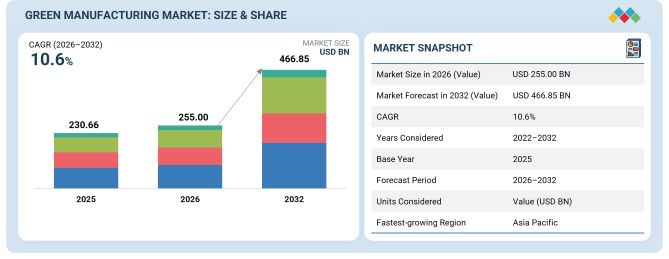
The green manufacturing market is estimated to be USD 255.00 billion in 2026 and is projected to reach USD 466.85 billion by 2032, growing at a CAGR of 10.6% from 2026 to 2032, fueled by manufacturers layering renewable energy, closed-loop recycling, and real-time emissions monitoring into a single decarbonization stack as carbon border taxes move from proposal to actual payment obligation.
Market Overview
The green manufacturing market marks a shift in which sustainability moves from a voluntary corporate-responsibility initiative toward a regulatory and commercial necessity, as manufacturers face EU carbon border taxes that now require actual payments rather than future compliance planning.
For instance, Siemens AG cut CO2 emissions by 60% since 2019, exceeding its original 2025 target a full year early, and now sources 100% renewable electricity across its operations. Schneider Electric has helped its customers avoid 679 million tonnes of CO2 through energy-management and decarbonization technology deployed across manufacturing facilities worldwide.
Upstream in the supply chain, material suppliers are taking a complementary approach: BASF extended its Engineering Plastics Sustainability Toolbox in 2026 to support Bosch's Green Energy Manufacturing initiative, with reduced-carbon-footprint thermoplastics purchased by Bosch expected to cut approximately 1,000 metric tonnes of CO2 equivalent without requiring extensive process modifications, illustrating how upstream suppliers are becoming active participants in downstream manufacturers' decarbonization strategies.
Manufacturers are also under growing pressure from an entirely new regulatory source of demand: the EU Omnibus package, which moved from proposal to adopted law in June 2026, tightening sustainability reporting requirements and pushing manufacturers to formalize carbon-reduction data collection that many had previously tracked informally.
Top 10 Key Takeaways
- Europe has the largest installed base, driven by the region's leading position in carbon-border regulation and early corporate decarbonization commitments.
- Asia Pacific is the fastest-growing region, propelled by expanding manufacturing capacity combined with accelerating government sustainability mandates across China, Japan, and India.
- Renewable energy integration leads by technology adoption, as leading manufacturers increasingly reach 100% renewable electricity sourcing across their operations.
- Automotive manufacturing is adopting most aggressively, reflecting both regulatory pressure and complex multi-tier supply chains that require coordinated decarbonization.
- Real-time emissions monitoring is becoming foundational infrastructure, as manufacturers recognize that carbon reduction cannot be managed without accurate underlying data.
- Closed-loop recycling and waste-to-energy systems are gaining adoption as manufacturers layer multiple decarbonization approaches rather than relying on a single solution.
- Vendor consolidation is accelerating, with platform providers expanding from single-function monitoring tools into broader decarbonization and reporting suites.
- The largest near-term opportunity is product carbon footprint reduction as a supplier differentiation tool, letting upstream material suppliers win downstream manufacturing contracts.
- EU carbon border taxes moving from proposal to actual payment are creating urgent, budget-backed demand rather than voluntary sustainability spending.
- The primary near-term restraint is the high upfront cost of renewable energy retrofits for legacy manufacturing facilities not originally designed for on-site generation.
Why the Green Manufacturing Market Matters Now
Manufacturers have historically treated sustainability as a voluntary corporate-responsibility initiative, adequate when environmental reporting was optional and carbon costs were externalized rather than directly billed. Green manufacturing platforms and technologies exist because that model has broken down: EU carbon border taxes now require actual payments, manufacturing generates a documented 12% of US greenhouse gas emissions, and manufacturers face genuine competitive and regulatory pressure to prove decarbonization progress with verifiable data rather than voluntary disclosure.
The market covers the technologies, materials, and systems used to reduce the environmental footprint of manufacturing operations, spanning renewable energy integration, waste reduction and recycling, sustainable materials, and energy efficiency systems. It includes established industrial automation and energy majors that extend existing platforms with decarbonization capability, and specialized materials and recycling providers supplying the underlying sustainable inputs. The scope excludes purely voluntary corporate social responsibility programs lacking measurable production-process impact and generic environmental, social, and governance reporting software not tied to manufacturing operations directly. The market connects to the broader industrial automation market, the renewable energy market, and the circular economy market.
The market's structure reflects a technology-layering pattern rather than a single dominant solution. The largest manufacturers combine renewable energy procurement, closed-loop recycling, and real-time emissions monitoring into a coordinated reduction stack, trading upfront capital investment for long-term regulatory and cost resilience. Mid-market manufacturers increasingly adopt narrower, single-technology solutions such as renewable energy certificates or targeted waste-reduction programs, trading comprehensive coverage for faster, lower-risk implementation. Automotive and electronics manufacturers sit alongside chemicals and textiles producers as the most aggressive adopter segment, reflecting both regulatory exposure and multi-tier supply chain complexity.
Report Scope
|
Report Metric |
Details |
|
Market Size in 2026 (Value) |
USD 255.00 Billion |
|
Market Forecast in 2032 (Value) |
USD 466.85 Billion |
|
Growth Rate |
CAGR of 10.6% from 2026-2032 |
|
Years Considered |
2022-2032 |
|
Base Year |
2026 |
|
Forecast Period |
2026-2032 |
|
Units Considered |
Value (USD Billion) |
|
Report Coverage |
Revenue forecast, company ranking, competitive landscape, growth factors, and trends |
|
Top Companies |
|
|
Growth Drivers |
|
|
Segments Covered |
|
|
Regional Scope |
North America, Europe, Asia Pacific, Rest of World |
Market Trends Shaping Green Manufacturing
The key trend is manufacturers layering multiple decarbonization approaches into a single reduction stack rather than relying on one solution. Leading facilities combine recycled materials, waste-to-energy systems, and closed-loop material cycles simultaneously, recognizing that no single technology can address the full range of emissions sources across a manufacturing operation.
Another trend is product carbon footprint becoming a genuine supplier selection criterion rather than a marketing claim. BASF's Engineering Plastics Sustainability Toolbox, purchased by Bosch specifically for its reduced Product Carbon Footprint, demonstrates that downstream manufacturers are now selecting upstream material suppliers based on quantified emissions data rather than price and quality alone.
A third trend is real-time emissions monitoring becoming the foundation for carbon reduction programs. Industry practitioners increasingly emphasize that manufacturers cannot reduce what they cannot measure, with platforms like iFactory providing the monitoring infrastructure that underpins every other layer of a decarbonization stack.
A fourth trend is circular economy principles extending from materials sourcing into full product lifecycle design. Manufacturers are increasingly using Life Cycle Assessment to identify the most emission-intensive stage of production and designing products for disassembly and reuse from the outset, rather than treating recyclability as an afterthought.
The fifth trend sees renewable electricity procurement reaching 100% at leading industrial facilities rather than remaining a partial or aspirational target. Siemens's achievement of 100% renewable electricity, alongside a 60% CO2 reduction since 2019 that exceeded its 2025 target a year early, demonstrates that full renewable procurement has moved from long-term ambition to near-term operational reality for leading manufacturers.
Market Drivers Accelerating Growth
The first key factor is EU carbon border taxes now requiring actual payments from manufacturers rather than future compliance planning. As these taxes shift from proposal to enforced payment obligation, manufacturers need considerably more urgent decarbonization investment than voluntary sustainability budgets were ever designed to provide.
The second factor is corporate net-zero commitments accelerating renewable energy procurement, specifically because leading manufacturers have demonstrated that ambitious targets are achievable ahead of schedule. Siemens's early achievement of its 2025 emissions target gives other manufacturers considerably more confidence that aggressive decarbonization timelines are operationally realistic rather than aspirational.
The third factor is circular economy mandates driving recycled-material adoption in production, extending demand well beyond regulatory compliance alone. As manufacturers increasingly need to source recycled plastics, metals, and textiles to meet both regulatory requirements and customer expectations, they require considerably more integrated supply chain partnerships than simple spot-market material purchasing can provide.
Market Challenges and Restraints
The key obstacle is the high upfront cost of renewable energy retrofits for legacy manufacturing facilities not originally designed for on-site generation. Manufacturers operating decades-old facilities face genuine capital cost and engineering complexity when installing solar, wind, or heat-recovery systems, and that upfront investment remains a real barrier despite favorable long-term payback economics.
Another hurdle is limited recycling infrastructure constraining closed-loop material cycles, which is slowing adoption specifically for manufacturers seeking to source recycled inputs at scale. Facilities in regions without mature recycling ecosystems remain understandably constrained in their ability to close material loops, even where downstream demand for recycled content is strong.
The third challenge involves verifying emissions data across multi-tier global supply chains. With manufacturers increasingly required to report Scope 3 emissions spanning suppliers several tiers removed from direct operations, achieving genuine data verification remains a real technical and commercial challenge that emissions-monitoring platforms are only beginning to resolve at scale.
Segment Insights
By Technology
Renewable energy integration leads the market by adoption share, reflecting its foundational role as the technology most directly tied to Scope 2 emissions reduction and corporate net-zero commitments.
Waste reduction and recycling is the fastest-growing technology category, as circular economy mandates and recycled-material sourcing requirements push manufacturers to formalize closed-loop material programs.
By Industry Vertical
Automotive leads the market in adoption intensity, reflecting both regulatory exposure across major manufacturing regions and the complexity of multi-tier supplier networks requiring coordinated decarbonization.
Electronics is the fastest-growing industry vertical, as manufacturers increasingly adopt green materials and energy-efficient production processes to meet both regulatory requirements and environmentally conscious consumer demand.
Key segmentation highlights:
- Renewable energy integration remains the primary entry point for decarbonization investment, while waste reduction and recycling shows the fastest growth in mature adopters.
- Process optimization applications are gaining share fastest, though emissions reduction remains the largest application by current spending.
- Automotive accounts for the largest share of spending, while electronics manufacturers represent the fastest-growing industry vertical.
- Chemicals and textiles manufacturers increasingly serve as early movers in sustainable-materials adoption given direct exposure to raw-material sourcing regulation.
- Vendor consolidation is compressing the number of distinct point solutions a typical manufacturer needs to integrate and maintain across its decarbonization stack.
Green Manufacturing Market by Region
North America
North America holds a substantial base, valued at roughly USD 84.15 billion in 2026 and projected to reach about USD 149.08 billion by 2032, growing at a CAGR of 10.0%.
The US leads with key platform vendors including Honeywell and Rockwell Automation, alongside deep corporate investment in renewable energy procurement and emissions monitoring infrastructure. Canada also contributes through growing interest in clean manufacturing incentive programs.
Europe
Europe holds the largest base, valued at approximately USD 86.70 billion in 2026 and forecast to reach around USD 151.93 billion by 2032, at a CAGR of 9.8%.
Germany spearheads European adoption through Siemens's and BASF's home-market leadership in renewable energy and sustainable materials, and through the EU's role as the primary driver of carbon border tax and Omnibus package regulation. The UK and France contribute through growing automotive and chemicals-sector decarbonization programs.
Asia Pacific
Asia Pacific is the fastest-growing region, valued at roughly USD 61.20 billion in 2026 and projected to reach about USD 126.07 billion by 2032, growing at a CAGR of 12.8%.
China, Japan, and South Korea spearhead regional growth through expanding manufacturing capacity combined with accelerating government sustainability mandates. India advances through growing renewable energy infrastructure investment and expanding electronics manufacturing capacity.
Rest of World
The Rest of World market reached an estimated USD 22.95 billion in 2026 and is projected to hit about USD 39.78 billion by 2032, growing at a CAGR of 9.6%.
The Middle East is investing in green manufacturing as part of broader economic diversification strategies away from fossil-fuel dependence. Latin America contributes through Brazil's growing renewable energy capacity and expanding sustainable materials production.
Key Company Insights
The competitive landscape consists of four tiers: established industrial automation and energy majors, specialized materials and chemicals providers, recycling and waste-management specialists, and digital sustainability software vendors. Major players include:
- Siemens AG
- Schneider Electric
- BASF SE
- ABB
- Honeywell
- Robert Bosch GmbH
- GE Vernova
- Veolia
- Umicore
- Dassault Systèmes
- Rockwell Automation
- 3M
- Interface Inc.
- Waste Management Inc.
- Patagonia
Siemens AG leads through the scale and speed of its own decarbonization achievement, having cut CO2 emissions by 60% since 2019 and reached 100% renewable electricity sourcing, exceeding its original 2025 target a full year early, while extending emissions-monitoring and energy-management capability to manufacturing customers globally.
Schneider Electric has become a leading enabler of customer decarbonization, helping its customers avoid 679 million tonnes of CO2 through energy-management technology and decarbonization consulting deployed across manufacturing facilities worldwide.
BASF SE and Robert Bosch GmbH each continue extending focused materials and industrial expertise into specialized sustainability deployment, with BASF's Engineering Plastics Sustainability Toolbox directly supporting Bosch's Green Energy Manufacturing initiative through reduced-carbon-footprint thermoplastics.
Recent Developments
- August 2026 : BASF extended its Engineering Plastics Sustainability Toolbox to support Bosch's Green Energy Manufacturing initiative, with reduced Product Carbon Footprint thermoplastics purchased by Bosch expected to cut approximately 1,000 metric tonnes of CO2 equivalent in 2026 without requiring extensive process modifications.
- June 2026 : The EU Omnibus package moved from proposal to adopted law, tightening sustainability reporting requirements and formalizing carbon-reduction data collection obligations for manufacturers operating in or selling into the European Union.
- February 2026 : Industry analysis confirmed that Siemens had cut CO2 emissions by 60% since 2019, exceeding its 2025 target a year early and achieving 100% renewable electricity sourcing, while Schneider Electric reported helping customers avoid 679 million tonnes of CO2 through deployed energy-management technology.
- January 2025 : Fujitsu partnered with Sustainable Shared Transport Inc. to deploy a standardized pallet logistics platform aimed at eliminating redundant transport miles and lowering supply chain CO2 emissions across industrial manufacturing operations.
Real-World Use Cases
Siemens's decarbonization program illustrates how a single, coordinated reduction stack can replace fragmented, single-technology sustainability initiatives many manufacturers have historically pursued in isolation. Built on 100% renewable electricity sourcing combined with systematic emissions monitoring, the program let Siemens exceed its original 2025 target a full year early, demonstrating that aggressive decarbonization timelines are operationally achievable rather than aspirational when multiple technology layers are deployed together.
BASF's Engineering Plastics Sustainability Toolbox shows how upstream material suppliers can scale sustainability from a compliance requirement into a genuine competitive differentiator. By providing Bosch with reduced Product Carbon Footprint thermoplastics that cut approximately 1,000 metric tonnes of CO2 equivalent without requiring extensive process modifications, BASF demonstrates how supplier-level decarbonization can deliver measurable downstream impact without disrupting a manufacturer's existing production processes.
Opportunities and Future Outlook
Through 2032, green manufacturing will continue to reshape how manufacturers design, source, and report on increasingly regulated production operations. The forces driving the market — EU carbon border taxes requiring actual payment, corporate net-zero commitments, and circular economy mandates — are compounding simultaneously with a new source of demand: AI-driven carbon monitoring maturing enough to unlock genuinely real-time emissions optimization across multi-tier global supply chains. The next phase will be fully integrated decarbonization stacks, with renewable energy, closed-loop recycling, and real-time monitoring operating as a single coordinated system rather than separate initiatives.
The competitive landscape will be defined by decarbonization speed and supply chain integration depth. Established industrial and energy majors compete alongside specialized materials and recycling providers for the same manufacturer sustainability budgets. For Chief Sustainability Officers, VP Operations leaders, and investors, organizations that deploy unified, verifiable decarbonization platforms will manage carbon tax exposure, strengthen supplier relationships, and differentiate on sustainability more effectively than those relying on fragmented, voluntary initiatives in an increasingly regulated operating environment.
Frequently Asked Questions (FAQ)
1. How big is the green manufacturing market?
The green manufacturing market was estimated at roughly USD 255.00 billion in 2026 and is projected to reach about USD 466.85 billion by 2032. Europe accounts for the largest share, driven by the region's leading position in carbon-border regulation and early corporate decarbonization commitments.
2. What is the green manufacturing market growth rate?
The market is forecast to grow at a CAGR of approximately 10.6% from 2026 to 2032. Asia Pacific is the fastest-growing region at around 12.8%, driven by expanding manufacturing capacity combined with accelerating government sustainability mandates.
3. Which segment leads the green manufacturing market?
By technology, renewable energy integration leads the market, while waste reduction and recycling experiences the fastest growth. By industry vertical, automotive leads, though electronics manufacturers show the fastest growth.
4. Who are the key players in the green manufacturing market?
Leading players include Siemens AG, Schneider Electric, BASF SE, ABB, Honeywell, Robert Bosch GmbH, GE Vernova, Veolia, Umicore, Dassault Systèmes, Rockwell Automation, 3M, Interface Inc., Waste Management Inc., and Patagonia.
5. What are the factors driving the green manufacturing market?
The primary drivers are EU carbon border taxes now requiring actual payments from manufacturers, corporate net-zero commitments accelerating renewable energy procurement, and circular economy mandates driving recycled-material adoption in production.
Speak With Our Analyst
The green manufacturing market is where industrial operations and regulatory-driven decarbonization converge into a single sustainability transformation category, and the segment-level detail on technology economics, application dynamics, industry vertical adoption, and competitive platform positioning is where strategic decisions are won or lost. MarketsandMarkets can help you go deeper: request a sample of the full study, speak with our analyst about your specific questions, or customize the scope to your target technologies, industry verticals, and geographies. Reach out to explore how this intelligence can inform your sustainability strategy, technology selection, or investment thesis.
 Exclusive indicates content/data unique to MarketsandMarkets and not available with any competitors.
TABLE OF CONTENTS
1 Introduction
1.1 Study Objectives
1.2 Market Definition and Scope
1.2.1 Inclusions and Exclusions
1.3 Study Scope
1.3.1 Markets Covered
1.3.2 Geographic Segmentation
1.3.3 Years Considered
1.4 Currency Considered
1.5 Stakeholders
2 Research Methodology
2.1 Research Approach
2.1.1 Secondary Research
2.1.2 Primary Research
2.1.2.1 Breakdown of Primaries
2.2 Market Size Estimation
2.2.1 Bottom-Up Approach
2.2.2 Top-Down Approach
2.3 Data Triangulation
2.4 Research Assumptions
2.5 Limitations and Risk Assessment
3 Executive Summary
4 Premium Insights
4.1 Attractive Opportunities in the Green Manufacturing Market
4.2 Market, By Technology
4.3 Market, By Region
4.4 Market, By Industry Vertical
5 Market Overview
5.1 Introduction
5.2 Market Dynamics
5.2.1 Drivers
5.2.1.1 EU Carbon Border Taxes Now Requiring Actual Payments From Manufacturers
5.2.1.2 Corporate Net-Zero Commitments Accelerating Renewable Energy Procurement
5.2.1.3 Circular Economy Mandates Driving Recycled-Material Adoption in Production
5.2.2 Restraints
5.2.2.1 High Upfront Cost of Renewable Energy Retrofits for Legacy Facilities
5.2.2.2 Limited Recycling Infrastructure Constraining Closed-Loop Material Cycles
5.2.3 Opportunities
5.2.3.1 AI-Driven Carbon Monitoring Unlocking Real-Time Emissions Optimization
5.2.3.2 Product Carbon Footprint Reduction Creating New Supplier Differentiation
5.2.4 Challenges
5.2.4.1 Verifying Emissions Data Across Multi-Tier Global Supply Chains
5.2.4.2 Balancing Sustainability Investment Against Near-Term Cost Pressure
5.3 Value Chain Analysis
5.4 Ecosystem Analysis
5.5 Investment and Funding Scenario
5.6 Pricing Analysis
5.7 Trends and Disruptions Impacting Customer Business
5.8 Technology Analysis
5.8.1 Key Technologies (Renewable Energy Integration, Waste-to-Energy, Closed-Loop Recycling)
5.8.2 Complementary Technologies (Life Cycle Assessment Software, Carbon Monitoring Platforms)
5.8.3 Adjacent Technologies (Digital Twins for Emissions Modeling, IoT-Based Energy Management)
5.9 Porter's Five Forces Analysis
5.10 Key Stakeholders and Buying Criteria
5.11 Case Study Analysis
5.12 Key Conferences and Events
5.13 Regulatory Landscape
5.13.1 EU Carbon Border Adjustment Mechanism (CBAM)
5.13.2 EU Omnibus Package Sustainability Reporting Requirements
5.13.3 US State-Level Emissions Disclosure Regulations
5.14 Impact of AI on the Market
5.15 Impact of 2025 US Tariffs on Supply Chains
6 Industry Trends
6.1 Manufacturers Layering Multiple Decarbonization Approaches Into a Single Reduction Stack
6.2 Product Carbon Footprint Becoming a Supplier Selection Criterion
6.3 Real-Time Emissions Monitoring Becoming the Foundation for Carbon Reduction Programs
6.4 Circular Economy Principles Extending From Materials Into Full Product Lifecycle Design
6.5 Renewable Electricity Procurement Reaching 100% at Leading Industrial Facilities
6.6 Cross-Industry Partnerships Forming to Share Decarbonized Material Supply Chains
7 Technology Adoption and Strategic Disruption Landscape
7.1 On-Site Renewable Generation vs. Renewable Energy Certificate Procurement
7.2 Closed-Loop Recycling vs. Virgin Material Substitution Strategies
7.3 Real-Time Carbon Monitoring vs. Periodic Life Cycle Assessment Reporting
7.4 Build vs. Partner: Manufacturer Decarbonization Sourcing Strategy
8 Customer Landscape and Buyer Behavior
8.1 Decision-Making Process — Chief Sustainability Officer, VP Operations, Chief Financial Officer
8.2 Build vs. Buy: Large Manufacturers Building Proprietary; Mid-Market Using Vendor Platforms
8.3 ROI Framework: Energy Cost Reduction, Carbon Tax Avoidance, Brand Differentiation
8.4 Adoption Barriers: Capital Cost, Supply Chain Verification, Regulatory Complexity
9 Green Manufacturing Market, By Technology
9.1 Introduction
9.2 Renewable Energy Integration
9.3 Waste Reduction and Recycling
9.4 Sustainable Materials
9.5 Energy Efficiency Systems
10 Green Manufacturing Market, By Application
10.1 Introduction
10.2 Process Optimization
10.3 Emissions Reduction
10.4 Resource Management
11 Green Manufacturing Market, By Industry Vertical
11.1 Introduction
11.2 Automotive
11.3 Electronics
11.4 Chemicals
11.5 Textiles
12 Green Manufacturing Market, By Region
12.1 Introduction
12.2 North America
12.2.1 United States
12.2.2 Canada
12.3 Europe
12.3.1 Germany
12.3.2 United Kingdom
12.3.3 France
12.3.4 Rest of Europe
12.4 Asia Pacific
12.4.1 China
12.4.2 Japan
12.4.3 South Korea
12.4.4 India
12.4.5 Rest of Asia Pacific
12.5 Rest of World
12.5.1 Middle East
12.5.2 Latin America
13 Competitive Landscape
13.1 Overview
13.2 Key Player Strategies / Right to Win
13.3 Revenue Analysis
13.4 Market Share Analysis
13.5 Company Evaluation Matrix
13.6 Competitive Benchmarking
13.7 Competitive Scenario
14 Company Profiles
14.1 Siemens AG
14.2 Schneider Electric
14.3 BASF SE
14.4 ABB
14.5 Honeywell
14.6 Robert Bosch GmbH
14.7 GE Vernova
14.8 Veolia
14.9 Umicore
14.10 Dassault Systèmes
14.11 Rockwell Automation
14.12 3M
14.13 Interface Inc.
14.14 Waste Management Inc.
14.15 Patagonia
15 Appendix
15.1 Discussion Guide
15.2 KnowledgeStore: MarketsandMarkets' Subscription Portal
15.3 Customization Options
15.4 Related Reports
15.5 Author Details













Growth opportunities and latent adjacency in Green Manufacturing Market