HSM as a Service Market by Deployment Mode (Public Cloud, Private Cloud, Hybrid Cloud), Service Type (Fully Managed HSM, Hosted Dedicated HSM, Cloud HSM, Payment HSM, Cryptographic Key Management), Application – Global Forecast to 2032


HSM as a Service Market Summary
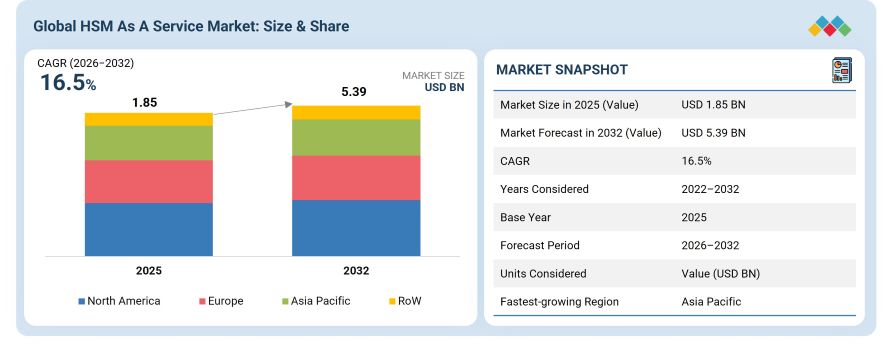
The global HSM as a Service Market is expanding as organizations increasingly adopt cloud-based cryptographic security to protect sensitive information, encryption keys, digital identities, and financial transactions. The market was valued at approximately USD 1.85 billion in 2025 and is projected to reach around USD 5.39 billion by 2032, growing at a CAGR of approximately 16.5% during 2026–2032. Growth is being driven by cloud migration, digital banking, stricter data protection requirements, increasing cyberattacks, and the need for secure key management across distributed IT environments.
Hardware Security Module as a Service (HSMaaS) provides access to dedicated, hardware-backed cryptographic capabilities through cloud-based or managed service models. Instead of purchasing, installing, and maintaining physical HSM appliances, organizations can use hosted infrastructure to generate, store, protect, and manage cryptographic keys. These services support encryption, digital signatures, certificate management, payment processing, public key infrastructure (PKI), and secure application authentication.
The growing adoption of artificial intelligence (AI), Internet of Things (IoT), automation, and digital transformation is increasing the need for reliable cryptographic security. AI applications process sensitive enterprise and customer data, while IoT devices require secure authentication and identity management. Cloud HSM services help organizations protect cryptographic operations without building and operating all the supporting infrastructure themselves. As businesses adopt hybrid and multicloud strategies, demand for scalable, compliant, and remotely managed HSM services is expected to increase through 2032.
Optimized Secondary Keywords in Content
Cloud HSM Market, Hardware Security Module as a Service Market, Cloud-Based Hardware Security Module Market, HSM Cloud Services Market, Managed HSM Services Market, Cloud Cryptographic Security Market, Cryptographic Key Management as a Service Market, Hardware-Based Encryption Services Market, Cloud Key Management Services Market, Hosted Hardware Security Module Market.
Key Market Trends & Insights
- North America leads the market: The region benefits from established cloud infrastructure, high cybersecurity spending, digital payment adoption, and the presence of major cloud and security providers. Financial institutions, government agencies, and technology companies are important customers.
- Asia Pacific offers strong growth opportunities: Digital banking, mobile payments, cloud adoption, government digitalization, and expanding data center infrastructure are increasing demand for cloud cryptographic security in China, India, Japan, Singapore, and South Korea.
- Public cloud deployment is a leading model: Public cloud HSM services provide scalable access to hardware-backed cryptographic operations without requiring organizations to maintain dedicated infrastructure. Hybrid and private cloud models remain important for sensitive workloads and sovereignty requirements.
- BFSI is a major end-user segment: Banks, payment processors, insurance companies, and fintech businesses use HSM services to protect payment transactions, encryption keys, digital certificates, and customer information.
- Post-quantum cryptography is creating new opportunities: Organizations are evaluating cryptographic modernization strategies to prepare for future quantum computing risks. HSM providers are developing support for evolving cryptographic algorithms and secure key lifecycle management.
- AI and automation are strengthening security operations: AI-enabled threat detection, automated key rotation, policy enforcement, and security monitoring are improving the management of cryptographic infrastructure.
Market Size & Forecast
- Base year market size (2025): Approximately USD 1.85 billion.
- Forecast value by 2032: Approximately USD 5.39 billion.
- CAGR (2026–2032): Approximately 16.5%.
- Key growth factors: Cloud migration, cybersecurity threats, digital payments, regulatory compliance, encryption requirements, IoT authentication, and demand for managed cryptographic services.
The HSM as a Service Market is expected to grow as organizations shift from capital-intensive hardware deployments toward flexible service-based security models. Increasing adoption of cloud applications and distributed infrastructure is also encouraging businesses to centralize cryptographic governance while maintaining hardware-level protection for critical keys.
HSM as a Service Market: Top 10 Key Takeaways
- The global HSM as a Service Market was valued at approximately USD 1.85 billion in 2025.
- The market is projected to reach around USD 5.39 billion by 2032.
- The market is expected to grow at a CAGR of approximately 16.5% during 2026–2032.
- North America represents the leading regional market due to established cloud and cybersecurity infrastructure.
- Public cloud is a major deployment model because of its scalability and service-based pricing.
- BFSI is a key end-user segment because of payment security and regulatory requirements.
- Digital banking and electronic payment transactions are increasing demand for hardware-backed cryptographic services.
- Hybrid and multicloud environments are encouraging demand for interoperable HSM services.
- Post-quantum cryptography and automated key lifecycle management are emerging technology priorities.
- AWS, Microsoft, Google Cloud, Thales, Entrust, Fortanix, Futurex, and Utimaco are important market participants.
Product Insights
The HSM as a Service Market includes cloud-based HSM platforms, managed dedicated HSM services, payment HSM services, and cryptographic key management solutions. Cloud-based HSM services represent a major product category because they allow organizations to access hardware-protected cryptographic operations through cloud infrastructure. Customers can generate and manage encryption keys, perform digital signing, and execute cryptographic functions without purchasing and maintaining physical HSM appliances.
Managed HSM services are also gaining importance among organizations that require dedicated security infrastructure but lack the resources to operate it independently. Service providers manage hardware availability, maintenance, monitoring, and infrastructure operations, while customers retain control over key policies and authorized cryptographic activities according to the service model.
Payment HSM services are particularly important for banks, payment processors, and financial technology companies. These solutions support payment-card operations, transaction authentication, PIN processing, and other cryptographic functions. As digital payments and real-time transactions increase, financial institutions require secure and reliable cryptographic infrastructure that can operate continuously.
Other emerging product categories include cloud-based PKI services, managed certificate lifecycle platforms, confidential computing integrations, and quantum-safe cryptographic services. AI-enabled security analytics and automated key management are also influencing product development. These capabilities can help identify unusual access patterns, enforce security policies, and reduce manual administration across complex cloud environments.
Technology / Component Insights
The HSM as a Service Market is driven by advances in hardware-backed encryption, secure key storage, cloud architecture, identity management, and cryptographic automation. Hardware security modules provide tamper-resistant environments for generating, storing, and using cryptographic keys. They perform sensitive operations within a protected hardware boundary, reducing exposure of private keys to general-purpose applications and operating systems.
Cloud HSM services use dedicated or logically isolated hardware infrastructure connected to cloud environments through secure interfaces and APIs. This enables applications to request cryptographic operations while protecting the underlying keys. Depending on the provider and service configuration, customers may access dedicated HSM partitions, single-tenant appliances, or managed clusters.
Bring Your Own Key (BYOK) and Hold Your Own Key (HYOK) approaches are important in enterprise cloud security. BYOK allows customers to introduce or control key material used by cloud services, while HYOK arrangements can retain key control within customer-managed infrastructure. These approaches support organizations with strict security, sovereignty, and compliance requirements.
AI and machine learning are increasingly used to strengthen security monitoring and operational management. Automated systems can detect unusual key usage, identify suspicious access patterns, and support policy enforcement. IoT environments also require scalable cryptographic services to authenticate devices, protect communications, and manage certificates throughout device lifecycles.
Future technology development will focus on post-quantum cryptography, confidential computing, secure multi-cloud integration, automated key rotation, and improved cryptographic agility. As organizations prepare for new cryptographic standards, HSM providers will need to support secure algorithm transitions without disrupting critical applications.
Application Insights
The banking, financial services, and insurance (BFSI) sector is a leading application area for the HSM as a Service Market. Financial institutions use HSM services to secure payment processing, protect customer information, manage encryption keys, and support digital identity systems. Increasing card transactions, mobile banking, online payments, and fintech services are creating demand for reliable cryptographic infrastructure.
IT and telecommunications companies represent another important application segment. Cloud providers, software companies, telecom operators, and digital platforms use HSM services to secure applications, APIs, certificates, and communications. The expansion of 5G networks, cloud-native applications, and connected devices is increasing the importance of scalable key management.
Government and defense organizations use hardware-backed cryptography to protect classified information, digital identities, public services, and sensitive communications. Healthcare providers also require secure encryption and key management to protect electronic health records, medical research, and connected healthcare systems.
The growing adoption of AI applications is creating additional opportunities. Enterprises need to protect model-related data, application credentials, API secrets, and sensitive information used in AI workflows. HSM services can support secure signing, encryption, and identity verification within these environments. Future opportunities will also emerge from autonomous systems, industrial IoT, smart infrastructure, and digital identity platforms.
Regional Insights
North America
North America is the leading regional market for HSM as a Service, supported by advanced cloud infrastructure, high cybersecurity investment, and strong demand from financial services and technology companies. The United States is the primary contributor, with extensive adoption of cloud platforms, digital payments, enterprise encryption, and managed security services. Financial institutions, federal agencies, healthcare providers, and technology companies are important users of cloud cryptographic services.
Regulatory and security frameworks influence demand in the United States. Organizations handling payment data must consider PCI DSS requirements, while federal and government-related workloads may require validated cryptographic modules and appropriate security authorizations. NIST standards and guidance also influence cryptographic security practices.
Canada is experiencing growing demand through financial services, telecommunications, healthcare, and government digitalization. Data protection requirements and cloud adoption are encouraging organizations to strengthen encryption and key management. Mexico offers emerging opportunities through fintech growth, digital banking, telecommunications, and manufacturing-related digital transformation. Its integration with North American technology supply chains may support future adoption.
Europe
Europe represents a significant market due to strict data protection requirements, digital banking adoption, and increasing investment in cloud security. Germany is an important market because of its financial services, industrial technology, automotive, and enterprise IT sectors. The United Kingdom and France also have strong demand from banking, insurance, government, telecommunications, and cloud service providers.
Italy and Spain are expanding digital financial services and cloud adoption, while the Nordic countries are investing in digital infrastructure and secure public services. The European Union's General Data Protection Regulation (GDPR) has strengthened the importance of protecting personal data. The Digital Operational Resilience Act (DORA), applicable from January 2025, has also increased attention to ICT risk management and operational resilience across financial entities.
The EU's NIS2 Directive further strengthens cybersecurity requirements for covered sectors. These regulatory developments are encouraging organizations to improve encryption governance, access control, key management, and security monitoring. Cloud HSM services can support these requirements when implemented with appropriate governance, controls, and compliance measures.
Asia Pacific
Asia Pacific is expected to offer strong growth opportunities as businesses and governments expand digital infrastructure. China is investing in cloud computing, financial technology, digital payments, and domestic cybersecurity capabilities. Japan is adopting cloud security and cryptographic technologies across banking, manufacturing, telecommunications, and government services.
India is a promising market because of rapid digital payments growth, fintech expansion, cloud adoption, and government-led digitalization. Banks, payment service providers, IT companies, and public-sector organizations require secure key management to protect digital transactions and sensitive information. South Korea's advanced technology industry and digital financial ecosystem also support demand.
Singapore is a regional hub for financial services, cloud infrastructure, and cybersecurity, while Australia is investing in secure digital government, banking, and enterprise cloud services. Regional demand is expected to increase as organizations adopt multicloud platforms, connected devices, and AI-driven applications.
Regional Insights Summary
- North America leads through strong cloud adoption, cybersecurity investment, and financial-sector demand.
- Asia Pacific is a major growth opportunity due to fintech expansion, digital payments, and cloud infrastructure investment.
- Europe benefits from GDPR, DORA, NIS2, and growing enterprise focus on operational resilience.
- The United States is a major market for cloud-based cryptographic services and payment HSM deployments.
- India, China, Japan, Singapore, and South Korea are expanding demand through digital transformation and connected infrastructure.
Country-Specific Market Trends
Country-level demand for HSM as a Service is influenced by digital banking, cloud adoption, cybersecurity regulation, data protection requirements, and the maturity of local technology infrastructure. The following CAGRs are indicative analyst estimates for country-level HSMaaS market opportunity during 2026–2032, rather than independently published country forecasts.
China is expected to record an indicative CAGR of approximately 18%–21%, supported by cloud infrastructure development, digital payments, domestic technology investment, and demand for secure financial transactions. Japan is projected to grow at approximately 14%–17%, driven by enterprise cloud adoption, digital identity systems, financial services modernization, and cybersecurity investment.
In North America, the United States is expected to register an indicative CAGR of approximately 16%–18% as financial institutions, government agencies, and cloud-native businesses expand hardware-backed encryption services. Canada may grow at approximately 14%–17%, supported by financial services, healthcare digitalization, and cloud security requirements. Mexico is projected to grow at approximately 13%–16%, with demand emerging from fintech, telecommunications, and enterprise digitalization.
In Europe, Germany is expected to record an indicative CAGR of approximately 14%–16%, supported by industrial digitalization, financial services, and regulatory requirements. France is projected to grow at approximately 14%–17%, driven by banking, government digital services, cloud adoption, and cybersecurity modernization. The actual growth rate in each country will depend on cloud penetration, regulatory implementation, local data sovereignty requirements, and the adoption of managed security services.
Country-Level Insights
- China benefits from expanding cloud infrastructure, fintech services, and domestic cybersecurity investment.
- Japan's demand is supported by financial modernization, enterprise cloud adoption, and secure digital identity.
- The United States remains a major market due to hyperscale cloud services and financial-sector cryptographic requirements.
- Canada and Mexico offer opportunities through fintech, telecommunications, and enterprise digital transformation.
- Germany and France are strengthening demand through regulatory compliance, industrial digitalization, and cloud security investment.
Key HSM as a Service Company Insights
The HSM as a Service Market includes cloud service providers, dedicated HSM manufacturers, cybersecurity vendors, and managed cryptographic service providers. Competition is shaped by hardware security certifications, service availability, cloud integration, key ownership controls, geographic coverage, and support for regulated workloads. Vendors are differentiating their offerings through managed services, dedicated hardware options, multicloud compatibility, and automated cryptographic management.
Amazon Web Services offers AWS CloudHSM and AWS Payment Cryptography for cloud-based cryptographic operations and payment security. Microsoft provides Azure Managed HSM and related key management capabilities for enterprise and cloud workloads. Google Cloud offers Cloud HSM capabilities through Cloud Key Management, while IBM provides hardware-backed cryptographic services for enterprise and regulated environments.
Thales is a major provider of enterprise and cloud HSM solutions, including Luna Cloud HSM and payment security products. Entrust offers nShield as a Service for organizations requiring managed cryptographic infrastructure. Fortanix focuses on data security management and centralized key control across cloud and hybrid environments. Futurex provides managed cryptographic services through its VirtuCrypt platform, while Utimaco offers enterprise and payment HSM technologies with service-based delivery options.
AI adoption across these providers is primarily focused on security analytics, operational monitoring, anomaly detection, and automated policy management rather than replacing hardware cryptographic controls. Vendors are also preparing for post-quantum cryptography and evolving compliance requirements.
Company Strategy Insights
- AWS is expanding cloud-native cryptographic services and payment security capabilities.
- Microsoft is strengthening managed HSM integration with Azure key management and enterprise security.
- Google Cloud focuses on cloud-based key protection and hardware-backed cryptographic operations.
- Thales and Entrust emphasize certified HSM infrastructure, managed services, and enterprise cryptographic governance.
- Fortanix, Futurex, and Utimaco focus on hybrid cloud, dedicated HSM, and specialized cryptographic service models.
Recent Developments
The HSM as a Service industry is moving toward more flexible delivery models that combine dedicated hardware protection with cloud-based management. Cloud providers are expanding services to support multi-region availability, automated key management, and integration with enterprise applications. These developments help organizations deploy cryptographic services across distributed infrastructure.
Payment HSM services are also evolving as financial institutions adopt cloud-based transaction processing and digital payment systems. Providers are introducing service models that reduce the operational burden of maintaining payment security infrastructure while preserving hardware-backed cryptographic controls.
Another important development is the growing focus on post-quantum cryptographic readiness. HSM providers are evaluating support for new cryptographic algorithms and secure migration processes. This is encouraging investment in cryptographic agility, key lifecycle automation, and hardware platforms capable of supporting evolving security requirements.
Market Segmentation
The HSM as a Service Market can be segmented by deployment mode, service type, application, end user, and region. By deployment mode, the market includes public cloud, private cloud, and hybrid cloud services. Public cloud HSM services are widely adopted because they provide scalable access to cryptographic infrastructure with reduced hardware management requirements. Hybrid and private cloud models remain important for organizations that require greater control over key custody, dedicated infrastructure, or data sovereignty.
By service type, the market includes fully managed HSM services, hosted dedicated HSM, cloud HSM infrastructure, payment HSM services, and cryptographic key management services. Fully managed services are attractive to organizations seeking to reduce operational complexity, while dedicated HSM services are relevant for customers with specialized security or performance requirements.
By application, the market covers encryption and decryption, payment processing, digital signing, PKI and certificate management, database encryption, identity management, and secure application authentication. By end user, BFSI represents a major segment, followed by IT and telecommunications, government and defense, healthcare, retail, manufacturing, and other enterprises. By region, the market includes North America, Europe, Asia Pacific, Latin America, and the Middle East and Africa.
Segmentation Summary
- By deployment mode: Public cloud, private cloud, and hybrid cloud.
- By service type: Fully managed HSM, hosted dedicated HSM, cloud HSM, payment HSM, and cryptographic key management.
- By application: Encryption, payment processing, digital signing, PKI, certificate management, and identity security.
- By end user: BFSI, IT and telecom, government and defense, healthcare, retail, manufacturing, and other enterprises.
- By region: North America, Europe, Asia Pacific, Latin America, and the Middle East and Africa.
Conclusion
The HSM as a Service Market is expected to experience sustained growth through 2032 as organizations prioritize secure digital infrastructure, cloud adoption, and hardware-backed cryptographic protection. The market's projected expansion from approximately USD 1.85 billion in 2025 to USD 5.39 billion by 2032 reflects the increasing importance of managed cryptographic services across financial services, government, healthcare, telecommunications, and technology industries.
AI, IoT, and automation will further influence market demand. AI applications require secure data access and credential management, while connected devices need reliable authentication and encryption throughout their operational lifecycles. Automated key rotation, policy enforcement, and anomaly detection will help organizations manage cryptographic operations more efficiently.
Post-quantum cryptography is also expected to become a strategic priority as businesses prepare for future changes in cryptographic standards. Providers that combine certified hardware security, multicloud compatibility, operational resilience, and automated key governance are likely to strengthen their competitive position. For enterprises, HSMaaS will become an increasingly important component of cybersecurity strategy and digital transformation.
FAQs
1. What is the size of the HSM as a Service Market?
The global HSM as a Service Market was valued at approximately USD 1.85 billion in 2025 and is projected to reach around USD 5.39 billion by 2032.
2. What is the expected growth rate of the HSM as a Service Market?
The market is expected to grow at a CAGR of approximately 16.5% during 2026–2032, driven by cloud adoption, cybersecurity requirements, digital payments, and demand for managed cryptographic services.
3. What are the key factors driving the HSM as a Service Market?
Major growth drivers include increasing cyber threats, cloud migration, digital banking, data protection regulations, IoT authentication, encryption requirements, and demand for secure key lifecycle management.
4. Which region leads the HSM as a Service Market?
North America is the leading regional market, supported by advanced cloud infrastructure, cybersecurity spending, financial services, and the presence of major HSM and cloud service providers. Asia Pacific is an important growth opportunity.
5. Who are the key companies in the HSM as a Service Market?
Key companies include Amazon Web Services, Microsoft, Google Cloud, Thales, Entrust, Fortanix, Futurex, Utimaco, and IBM.
Revenue
Revenue in the HSM as a Service Market is generated through subscription-based access, managed cryptographic infrastructure, hosted dedicated HSM services, payment security platforms, and related key management solutions. Recurring service contracts provide vendors with predictable revenue streams, while enterprise agreements and specialized compliance requirements can support higher-value offerings. Revenue growth is influenced by the number of protected workloads, cryptographic transaction volumes, service availability requirements, geographic coverage, and the level of management provided. As businesses expand cloud applications and digital payment systems, demand for scalable hardware-backed encryption services is expected to strengthen.
Investment & Funding
Investment in the HSM as a Service Market is focused on cloud infrastructure, certified hardware security, cryptographic software, service automation, and global availability. Cloud providers and cybersecurity companies are investing in data center capacity, dedicated HSM infrastructure, secure APIs, and integration with enterprise identity and key management platforms. Investment is also increasing in post-quantum cryptography, cryptographic agility, confidential computing, and automated security monitoring. Governments and financial institutions are encouraging stronger digital security capabilities through cybersecurity programs and regulatory requirements. Companies that can deliver certified, scalable, and interoperable cryptographic services are likely to attract strategic investment and enterprise partnerships.
Mergers & Acquisitions (M&A)
Mergers and acquisitions in the HSM as a Service Market are driven by the need to expand cryptographic capabilities, strengthen cloud security portfolios, and improve access to regulated industries. Cybersecurity vendors may acquire specialist companies in key management, PKI, identity security, encryption, and post-quantum cryptography to broaden their service offerings. Cloud providers may also pursue strategic partnerships or technology integrations with HSM manufacturers to support dedicated hardware security across their platforms. The market is likely to see continued collaboration among HSM vendors, payment technology providers, cloud infrastructure companies, and managed security service providers. Such partnerships can improve interoperability, geographic coverage, and compliance support.
Recent Development
- AWS: Continued development of CloudHSM and AWS Payment Cryptography to support cloud-based cryptographic operations and payment security.
- Microsoft: Expanded Azure Managed HSM capabilities and integration with enterprise key management and cloud security services.
- Google Cloud: Continued development of hardware-backed key management and Cloud HSM capabilities for regulated and enterprise workloads.
- Thales: Continued investment in Luna Cloud HSM and enterprise cryptographic management to support cloud and hybrid environments.
- Industry-wide post-quantum readiness: HSM providers are preparing cryptographic platforms for evolving post-quantum algorithms, secure key migration, and cryptographic agility.
 Exclusive indicates content/data unique to MarketsandMarkets and not available with any competitors.











Growth opportunities and latent adjacency in HSM as a Service Market