HVDC / 800V DC Power Architecture for Data Centers Market by Component (Rectification, DC Switchgear, Rack Power Interfaces), Deployment Mode, Application, and Region — Global Forecast to 2032


HVDC / 800V DC Power Architecture for Data Centers Market 2032: Size, Share & Growth Report
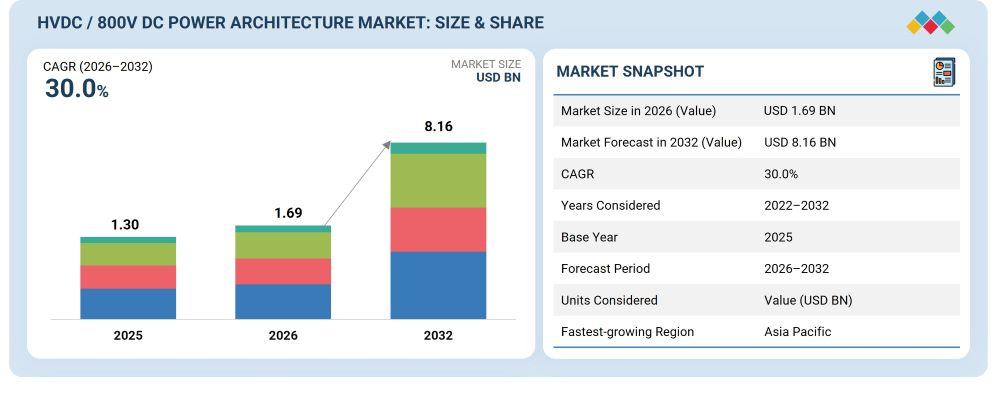
The HVDC / 800V DC power architecture for data centers market is estimated to be USD 1.69 billion in 2026 and is projected to reach USD 8.16 billion by 2032, growing at a CAGR of 30.0% from 2026 to 2032, fueled by AI rack power density exceeding the physical limits of legacy 54V in-rack distribution as GPU-dense racks routinely surpass 200 kilowatts.
Market Overview
The HVDC / 800V DC power architecture market marks a shift in which AI data centers move beyond incremental improvements to legacy AC distribution toward a centralized, high-voltage DC backbone purpose-built for megawatt-class racks that today's copper busbars and multiple conversion stages can no longer physically or economically support.
For instance, Texas Instruments unveiled a complete 800V DC power architecture for next-generation AI data centers at NVIDIA GTC 2026 in March, built on the NVIDIA 800VDC reference design and requiring only two conversion stages from 800V to processor power, with TI's Gallium Nitride-based power conversion ICs achieving efficiencies up to 97.6%.
Delta Electronics is pursuing this same architectural transition from a systems-integration angle rather than semiconductor conversion alone: the company launched an innovative 800V high-voltage direct current power architecture and microgrid solution in May 2026, extending its role as co-author of the 800V DC technical white paper and its earlier co-development of the Panama medium-voltage DC power solution with Alibaba, aiming to optimize energy efficiency from the grid to the chip.
Vendors are also under growing pressure from an entirely new source of demand-side constraint: grid interconnection capacity, not rack-level technology, has become the primary bottleneck limiting deployment pace. Industry analysis indicates that up to half of planned US data center builds have been delayed or canceled not because of 800V DC readiness but because of severe grid constraints and multi-year lead times for critical electrical components, even as the architecture itself reduces internal copper use by up to 45% and improves efficiency by 4% to 5%.
Top 10 Key Takeaways
- North America has the largest installed base, driven by concentrated hyperscaler AI buildout from NVIDIA's ecosystem partners and the region's leading position in reference architecture development.
- Asia Pacific is the fastest-growing region, propelled by China's manufacturing scale for power components and expanding AI data center investment across the region.
- AC-to-DC rectification systems lead by component share, reflecting their foundational role centralizing power conversion that the entire 800V DC architecture depends on.
- DC switchgear and protection represents the fastest-growing component category, as multi-vendor interoperability standards mature and deployment moves from pilots to mass rollout.
- Greenfield builds lead by deployment mode, as new AI-optimized data centers represent the lowest-friction adoption pathway for 800V DC technology from initial design.
- NVIDIA's 31-company ecosystem, spanning silicon providers, power system component makers, and data center power system vendors, has validated commercial readiness across the full supply chain.
- Grid interconnection constraints have emerged as the primary deployment bottleneck, with up to half of planned US data center builds delayed or canceled due to grid capacity rather than rack-level technology.
- The largest near-term opportunity is prefabricated HVDC power blocks, enabling repeatable, factory-tested deployments that reduce commissioning risk relative to custom-engineered installations.
- Copper and efficiency savings are delivering capex-neutral or better economics, with operators reporting that copper savings and simplified busways offset new DC switchgear and protection costs.
- The primary near-term restraint is immature multi-vendor interoperability standards, with safety certification through IEC, NEC, and OCP frameworks still catching up to the pace of deployment.
Why the HVDC / 800V DC Power Architecture Market Matters Now
Data center operators have historically distributed power through a comparatively established chain of AC distribution stepping down from medium voltage to 415VAC with UPS and multiple conversion stages, adequate when rack power densities remained in the tens of kilowatts. HVDC and 800V DC architecture is scaling into mainstream AI infrastructure today because that assumption has broken down: today's NVIDIA GB200 NVL72 and GB300 NVL72 racks already require up to eight power shelves to deliver sufficient power through legacy 54VDC in-rack distribution, and as racks exceed 200 kilowatts and approach 1 megawatt, bulky copper busbars and multiple AC/DC/AC conversion stages hit genuine physical and space constraints that only a centralized, high-voltage DC backbone can resolve.
The market covers the hardware and integration services used to deliver centralized, high-voltage direct current power to AI data centers, spanning AC-to-DC rectification systems, DC switchgear and protection, rack power interfaces and conversion modules, and controls, commissioning, and integration services across greenfield and retrofit deployment modes. It includes established data center power system majors that have launched comprehensive 800V DC reference architectures, and semiconductor and power component suppliers building the underlying conversion and protection technology. The scope excludes legacy 54VDC in-rack distribution systems not part of a centralized 800V architecture, and standalone UPS or battery backup systems not integrated into an HVDC power delivery chain. The market connects to the broader data center power market, the AI data center infrastructure market, and the power semiconductor market.
The market's structure reflects an ecosystem-partnership model rather than any single vendor owning the full stack. NVIDIA has defined the reference architecture and coordinated a 31-company ecosystem spanning silicon providers such as Texas Instruments and Infineon, power system component makers such as Delta and Flex Power, and data center power system vendors such as Eaton, Schneider Electric, and Vertiv, each contributing a distinct layer of the value chain. Hyperscalers such as Meta, Google, and Amazon are co-developing and validating reference designs directly, trading vendor-neutral flexibility for architectures optimized to their own rack power targets, while colocation and enterprise operators increasingly rely on vendor-packaged, pre-validated power blocks rather than custom engineering.
Report Scope
|
Report Metric |
Details |
|
Market Size in 2025 (Value) |
USD 1.30 Billion |
|
Market Forecast in 2032 (Value) |
USD 8.16 Billion |
|
Growth Rate |
CAGR of 30.0% from 2026-2032 |
|
Years Considered |
2022-2032 |
|
Base Year |
2025 |
|
Forecast Period |
2026-2032 |
|
Units Considered |
Value (USD Billion) |
|
Report Coverage |
Revenue forecast, company ranking, competitive landscape, growth factors, and trends |
|
Top Companies |
|
|
Growth Drivers |
|
|
Segments Covered |
|
|
Regional Scope |
North America, Europe, Asia Pacific, Rest of World |
Market Trends Shaping HVDC / 800V DC Power Architecture
The key trend is NVIDIA's reference architecture anchoring a 31-company cross-industry ecosystem rather than any single vendor developing the technology in isolation. NVIDIA's collaboration spans silicon providers including Analog Devices, Infineon, Innoscience, MPS, Navitas, OnSemi, Renesas, ROHM, and Texas Instruments; power system component makers including Delta, Flex Power, Lead Wealth, LiteOn, and Megmeet; and data center power system vendors including Eaton, Schneider Electric, and Vertiv, validating commercial readiness across the entire value chain simultaneously.
Another trend is silicon providers racing to deliver GaN-based 800V-to-low-voltage conversion at scale. Texas Instruments and STMicroelectronics unveiled complete power conversion ICs using Gallium Nitride technology achieving efficiencies up to 97.6% in March 2026, demonstrating that the semiconductor layer critical to the architecture's efficiency gains is moving from prototype to production-ready technology.
A third trend is grid interconnection bottlenecks emerging as the primary constraint beyond rack-level technology. Reports confirm that up to half of planned US data center builds have been delayed or canceled not due to 800V DC readiness but because of severe grid constraints and multi-year lead times for critical electrical components, with PJM data showing AI projects now spend more time waiting for power after approval than in the interconnection queue itself.
A fourth trend is simulation and digital design platforms accelerating gigawatt-scale facility validation. Hitachi's March 2026 launch of an 800V DC power supply simulation platform, intended to accelerate the design and validation of gigawatt-scale AI facilities, reflects growing recognition that digital validation tools are becoming essential infrastructure alongside the physical hardware itself.
The fifth trend sees a phased rollout strategy retrofitting existing AC distribution ahead of full 2027 transition. SemiAnalysis's four-phase rollout tracking shows Phases 1 and 2 retrofitting existing AC distribution to 800VDC at the rack level starting in late 2026 and early 2027, led by hyperscalers including Meta running 600 to 800 kilowatts per rack and Amazon operating at 800 kilowatts on plus and minus 400V, ahead of NVIDIA's full-scale production target aligned to 2027 Kyber rack-scale systems.
Market Drivers Accelerating Growth
The first key factor is AI rack power density exceeding the physical limits of 54V distribution. As today's NVIDIA GB200 NVL72 and GB300 NVL72 racks already require up to eight power shelves under legacy in-rack distribution, and as racks push toward 1 megawatt and beyond, data center operators need considerably more centralized, high-voltage architecture than incremental improvements to existing 54VDC systems can provide.
The second factor is NVIDIA's 31-company ecosystem validating commercial readiness across the supply chain, specifically because coordinated multi-vendor commitment reduces the adoption risk any single operator would face betting on unproven technology. With chip providers, power system component makers, and data center power system vendors all publicly committed to 800V DC roadmaps, operators gain considerably more confidence to commit capital to the architecture than they would evaluating a single vendor's proprietary solution in isolation.
The third factor is copper and efficiency savings delivering capex-neutral or better economics. Operators report that copper savings and simplified busways offset new DC switchgear and protection costs, with the architecture reducing internal copper use by up to 45% and improving efficiency by 4% to 5%, giving finance and infrastructure teams considerably more justification to commit to the transition than a purely sustainability-driven case would provide alone.
Market Challenges and Restraints
The key obstacle is grid interconnection constraints delaying or canceling new data center builds. Even as 800V DC architecture successfully reduces internal copper use and improves efficiency, these gains are nullified if the data center cannot secure grid capacity, and that external bottleneck remains a genuine, largely uncontrollable constraint on deployment pace regardless of how mature the rack-level technology becomes.
Another hurdle is immature multi-vendor interoperability standards across DC switchgear and protection, which is a persistent barrier specifically for operators seeking genuine vendor flexibility rather than single-source lock-in. As standards continue to mature, multi-vendor interoperability remains an evolving rather than fully solved capability, and that uncertainty continues to shape purchasing decisions for operators unwilling to commit to a single vendor's proprietary ecosystem.
The third challenge involves safety certification through IEC, NEC, and OCP standards still catching up to deployment pace. With full global safety certification lagging behind the commercial rollout timeline, operators and vendors face a genuine regulatory and risk-management challenge in deploying at scale ahead of finalized, universally recognized safety frameworks.
Segment Insights
By Component
AC-to-DC rectification systems lead the market by component share, reflecting their foundational role centralizing power conversion that the entire 800V DC architecture depends on before power reaches rack-level distribution.
DC switchgear and protection is the fastest-growing component category, as multi-vendor interoperability standards mature and deployment moves from pilot programs and reference designs into standardized mass rollout.
By Application
Hyperscale AI data centers lead the market in application share, reflecting their position at the forefront of megawatt-class rack deployment and their direct involvement in co-developing NVIDIA's reference architecture.
Colocation data centers represent a fast-growing application, as operators increasingly adopt vendor-packaged, pre-validated 800V DC power blocks to serve AI-focused tenants without the reference-design development resources of hyperscalers.
Key segmentation highlights:
- AC-to-DC rectification systems remain the primary revenue driver as the foundational architecture layer, while DC switchgear and protection shows the fastest growth as standards mature.
- Greenfield builds account for the largest share of deployment, though retrofit of existing facilities is gaining share as the phased rollout strategy extends into 2026 and 2027.
- Hyperscale AI data centers account for the largest share of application demand, while colocation data centers represent a fast-growing application segment.
- Enterprise and edge data centers increasingly serve as a longer-term adoption segment as the architecture matures beyond its initial hyperscale-focused rollout.
- Vendor consolidation is compressing the number of distinct point solutions a typical operator needs to integrate and maintain across its HVDC power architecture stack.
HVDC / 800V DC Power Architecture for Data Centers Market by Region
North America
North America holds the largest base, valued at roughly USD 0.78 billion in 2026 and projected to reach about USD 3.50 billion by 2032, growing at a CAGR of 28.5%.
The US leads with key platform vendors including NVIDIA, Texas Instruments, Vertiv, and Eaton, alongside deep hyperscaler concentration from Meta, Google, and Amazon co-developing reference designs. Canada also contributes through growing data center capacity and grid infrastructure investment supporting regional AI buildout.
Europe
Europe is advancing in line with the global pace, valued at approximately USD 0.34 billion in 2026 and forecast to reach around USD 1.45 billion by 2032, at a CAGR of 27.5%.
Germany spearheads European adoption through Infineon's semiconductor development for centralized 800V DC architecture. Ireland and the UK contribute through growing hyperscale data center investment, while the region's Energy Efficiency Directive PUE requirements are accelerating the transition away from legacy AC systems non-compliant for new builds.
Asia Pacific
Asia Pacific is the fastest-growing region, valued at roughly USD 0.46 billion in 2026 and projected to reach about USD 2.58 billion by 2032, growing at a CAGR of 33.5%.
China spearheads regional growth through manufacturing scale for power components and Delta Electronics' co-development of the Panama medium-voltage DC solution with Alibaba, alongside China's first Data Center 800V DC Power Technology White Paper. Japan and South Korea contribute through growing AI infrastructure investment and semiconductor supply chain participation.
Rest of World
The Rest of World market reached an estimated USD 0.12 billion in 2026 and is projected to hit about USD 0.50 billion by 2032, growing at a CAGR of 27.0%.
The Middle East is investing in HVDC power architecture as part of broader sovereign AI data center development strategies. Latin America contributes through growing regional data center capacity tied to expanding AI infrastructure investment.
Key Company Insights
The competitive landscape consists of four tiers: the reference-architecture ecosystem coordinator, silicon and semiconductor providers, power system component makers, and established data center power system majors. Major players include:
- NVIDIA Corporation
- Texas Instruments
- Delta Electronics
- Vertiv
- Eaton Corporation
- Infineon Technologies
- Schneider Electric
- STMicroelectronics
- Analog Devices
- Navitas Semiconductor
- Hitachi Energy
- Flex
- Monolithic Power Systems
- Renesas Electronics
- ROHM Co., Ltd.
NVIDIA Corporation leads through its role defining the 800V DC reference architecture and coordinating a 31-company ecosystem spanning silicon providers, power system component makers, and data center power system vendors, with full-scale production aligned to 2027 when its Kyber rack-scale systems arrive.
Texas Instruments has become a leading semiconductor enabler through its complete GaN-based 800V power architecture unveiled at NVIDIA GTC 2026, requiring only two conversion stages from 800V to processor power and achieving efficiencies up to 97.6%, positioning it at the center of the architecture's silicon layer.
Delta Electronics and Vertiv each continue extending deep power systems and critical infrastructure expertise into specialized 800V DC deployment, with Delta's May 2026 architecture and microgrid launch and Vertiv's second-half 2026 portfolio release both targeting the NVIDIA Kyber and Rubin Ultra platforms.
Recent Developments
- May 2026: Delta Electronics launched an innovative 800V high-voltage direct current power architecture and microgrid solution to enhance grid resilience in response to growing AI computing power demands, extending its role as co-author of the 800V DC technical white paper.
- March 2026: Texas Instruments unveiled a complete 800V direct current power architecture for next-generation AI data centers built with the NVIDIA 800VDC reference design, showcased at NVIDIA GTC 2026, demonstrating a power architecture requiring only two conversion stages from 800V to processor power.
- March 2026: Hitachi launched an 800V DC power supply simulation platform intended to accelerate the design and validation of gigawatt-scale AI facilities, providing infrastructure and design support for the growing pipeline of HVDC data center projects.
- October 2025: Eaton Corporation collaborated closely with NVIDIA to launch a brand-new 800V DC reference architecture for AI data centers, while Vertiv announced plans to launch a complete 800V DC product line in 2026 to support NVIDIA's Rubin Ultra platform.
Real-World Use Cases
Texas Instruments' NVIDIA GTC 2026 demonstration illustrates how a semiconductor provider can translate a reference architecture into a genuinely simplified, production-ready power conversion chain. By requiring only two conversion stages from 800V to processor power and achieving GaN-based conversion efficiencies up to 97.6%, TI's architecture gives data center designers a concrete blueprint for eliminating the multiple AC/DC/AC conversion stages that legacy 54VDC in-rack distribution requires, directly addressing the space and efficiency constraints that today's GB200 and GB300 NVL72 racks already encounter.
Delta Electronics' co-development of the Panama medium-voltage DC power solution with Alibaba, alongside its May 2026 800V HVDC architecture and microgrid launch, shows how a power systems vendor can extend HVDC benefits beyond the rack itself into broader grid resilience. By combining centralized DC distribution with microgrid capability, Delta gives operators a path to manage the same grid interconnection constraints that are currently delaying or canceling data center builds, addressing the demand-side bottleneck that rack-level technology alone cannot solve.
Opportunities and Future Outlook
Through 2032, HVDC and 800V DC power architecture will continue to reshape how hyperscalers, colocation operators, and vendors approach AI data center power delivery. The forces driving the market — AI rack power density, ecosystem-wide validation, and copper and efficiency economics — are compounding simultaneously with a new source of demand: prefabricated HVDC power blocks maturing enough to unlock genuinely repeatable, factory-tested deployment at the pace new AI capacity requires. The next phase will be fully standardized, multi-vendor interoperable architectures, with grid-level microgrid integration and gigawatt-scale simulation-validated designs coordinating power delivery from the grid to the chip as a default architectural assumption rather than an emerging capability.
The competitive landscape will be defined by ecosystem breadth and grid-integration depth. Silicon providers compete alongside power system component makers and established data center power system majors for the same hyperscaler and colocation infrastructure budgets. For VP Data Center Infrastructure leaders, Chief Power Engineers, and investors, organizations that combine validated reference-architecture components with genuine grid-interconnection strategy will manage deployment risk and capacity timelines more effectively than those relying on rack-level technology alone in an increasingly grid-constrained AI buildout environment.
Frequently Asked Questions (FAQ)
1. How big is the HVDC / 800V DC power architecture for data centers market?
The HVDC / 800V DC power architecture for data centers market was estimated at roughly USD 1.69 billion in 2026 and is projected to reach about USD 8.16 billion by 2032. North America accounts for the largest share, driven by concentrated hyperscaler AI buildout.
2. What is the HVDC / 800V DC power architecture market growth rate?
The market is forecast to grow at a CAGR of approximately 30.0% from 2026 to 2032. Asia Pacific is the fastest-growing region at around 33.5%, driven by China's manufacturing scale for power components and expanding AI data center investment.
3. Which segment leads the HVDC / 800V DC power architecture market?
By component, AC-to-DC rectification systems lead the market, while DC switchgear and protection experiences the fastest growth. By application, hyperscale AI data centers lead, though colocation data centers show strong momentum.
4. Who are the key players in the HVDC / 800V DC power architecture market?
Leading players include NVIDIA Corporation, Texas Instruments, Delta Electronics, Vertiv, Eaton Corporation, Infineon Technologies, Schneider Electric, STMicroelectronics, Analog Devices, Navitas Semiconductor, Hitachi Energy, Flex, Monolithic Power Systems, Renesas Electronics, and ROHM.
5. What are the factors driving the HVDC / 800V DC power architecture market?
The primary drivers are AI rack power density exceeding the physical limits of 54V distribution, NVIDIA's 31-company ecosystem validating commercial readiness, and copper and efficiency savings delivering capex-neutral or better economics.
Speak With Our Analyst
The HVDC / 800V DC power architecture for data centers market is where AI infrastructure demand and power electronics innovation converge into a single facility-architecture category, and the segment-level detail on component economics, deployment mode, application dynamics, and competitive ecosystem positioning is where strategic decisions are won or lost. MarketsandMarkets can help you go deeper: request a sample of the full study, speak with our analyst about your specific questions, or customize the scope to your target components, applications, and geographies. Reach out to explore how this intelligence can inform your data center power strategy, platform selection, or investment thesis.
 Exclusive indicates content/data unique to MarketsandMarkets and not available with any competitors.
1 Introduction
1.1 Study Objectives
1.2 Market Definition and Scope
1.2.1 Inclusions and Exclusions
1.3 Study Scope
1.3.1 Markets Covered
1.3.2 Geographic Segmentation
1.3.3 Years Considered
1.4 Currency Considered
1.5 Stakeholders
2 Research Methodology
2.1 Research Approach
2.1.1 Secondary Research
2.1.2 Primary Research
2.1.2.1 Breakdown of Primaries
2.2 Market Size Estimation
2.2.1 Bottom-Up Approach
2.2.2 Top-Down Approach
2.3 Data Triangulation
2.4 Research Assumptions
2.5 Limitations and Risk Assessment
3 Executive Summary
4 Premium Insights
4.1 Attractive Opportunities in the HVDC / 800V DC Power Architecture Market
4.2 Market, By Component
4.3 Market, By Region
4.4 Market, By Application
5 Market Overview
5.1 Introduction
5.2 Market Dynamics
5.2.1 Drivers
5.2.1.1 AI Rack Power Density Exceeding the Physical Limits of 54V Distribution
5.2.1.2 NVIDIA's 31-Company Ecosystem Validating Commercial Readiness Across the Supply Chain
5.2.1.3 Copper and Efficiency Savings Delivering Capex-Neutral or Better Economics
5.2.2 Restraints
5.2.2.1 Grid Interconnection Constraints Delaying or Canceling New Data Center Builds
5.2.2.2 Immature Multi-Vendor Interoperability Standards Across DC Switchgear and Protection
5.2.3 Opportunities
5.2.3.1 Prefabricated HVDC Power Blocks Enabling Repeatable, Factory-Tested Deployment
5.2.3.2 Retrofit Pathways for Existing AC-Distribution Facilities Ahead of Full New-Build Transition
5.2.4 Challenges
5.2.4.1 Safety Certification Through IEC, NEC, and OCP Standards Still Catching Up to Deployment Pace
5.2.4.2 Talent Shortage in High-Voltage DC Protection and Switchgear Engineering
5.3 Value Chain Analysis
5.4 Ecosystem Analysis
5.5 Investment and Funding Scenario
5.6 Pricing Analysis
5.7 Trends and Disruptions Impacting Customer Business
5.8 Technology Analysis
5.8.1 Key Technologies (Centralized AC-to-800VDC Rectification, GaN-Based Power Conversion, Solid-State Transformers)
5.8.2 Complementary Technologies (DC Switchgear and Protection, Rack Power Interfaces)
5.8.3 Adjacent Technologies (54V In-Rack Distribution, UPS and Battery Backup Systems)
5.9 Porter's Five Forces Analysis
5.10 Key Stakeholders and Buying Criteria
5.11 Case Study Analysis
5.12 Key Conferences and Events
5.13 Regulatory Landscape
5.13.1 Open Compute Project DC Power Guidelines and IEC TS 63268 on HVDC for Data Centers
5.13.2 EU Energy Efficiency Directive PUE Requirements Affecting AC Distribution Compliance
5.13.3 US National Electrical Code Provisions for High-Voltage DC Facility Power
5.14 Impact of AI on the Market
5.15 Impact of 2025 US Tariffs on Supply Chains
6 Industry Trends
6.1 NVIDIA's Reference Architecture Anchoring a 31-Company Cross-Industry Ecosystem
6.2 Silicon Providers Racing to Deliver GaN-Based 800V-to-Low-Voltage Conversion at Scale
6.3 Grid Interconnection Bottlenecks Emerging as the Primary Constraint Beyond Rack-Level Technology
6.4 Simulation and Digital Design Platforms Accelerating Gigawatt-Scale Facility Validation
6.5 Phased Rollout Strategy Retrofitting Existing AC Distribution Ahead of Full 2027 Transition
6.6 Vendor Consolidation Building End-to-End Chip-to-Grid Power and Cooling Portfolios
7 Technology Adoption and Strategic Disruption Landscape
7.1 Legacy 54V In-Rack Distribution vs. Centralized 800V DC Architecture
7.2 Greenfield AI-Optimized Builds vs. Retrofit of Existing AC-Distribution Facilities
7.3 Single-Vendor Integrated Power Blocks vs. Multi-Vendor Interoperable Components
7.4 Build vs. Partner: Hyperscaler HVDC Power Architecture Sourcing Strategy
8 Customer Landscape and Buyer Behavior
8.1 Decision-Making Process — VP Data Center Infrastructure, Chief Power Engineer, Chief Sustainability Officer
8.2 Build vs. Buy: Hyperscalers Co-Developing Reference Designs; Colocation Operators Using Vendor Platforms
8.3 ROI Framework: Copper Cost Avoidance, Conversion-Stage Efficiency Gains, Rack Density Enablement
8.4 Adoption Barriers: Grid Interconnection Delays, Certification Timelines, Multi-Vendor Interoperability
9 HVDC / 800V DC Power Architecture Market, By Component
9.1 Introduction
9.2 AC-to-DC Rectification Systems
9.3 DC Switchgear and Protection
9.4 Rack Power Interfaces and Conversion Modules
9.5 Controls, Commissioning, and Integration Services
10 HVDC / 800V DC Power Architecture Market, By Deployment Mode
10.1 Introduction
10.2 Greenfield Builds
10.3 Retrofit of Existing Facilities
11 HVDC / 800V DC Power Architecture Market, By Application
11.1 Introduction
11.2 Hyperscale AI Data Centers
11.3 Colocation Data Centers
11.4 Enterprise and Edge Data Centers
12 HVDC / 800V DC Power Architecture Market, By Region
12.1 Introduction
12.2 North America
12.2.1 United States
12.2.2 Canada
12.3 Europe
12.3.1 Germany
12.3.2 United Kingdom
12.3.3 Ireland
12.3.4 Rest of Europe
12.4 Asia Pacific
12.4.1 China
12.4.2 Japan
12.4.3 South Korea
12.4.4 India
12.4.5 Rest of Asia Pacific
12.5 Rest of World
12.5.1 Middle East
12.5.2 Latin America
13 Competitive Landscape
13.1 Overview
13.2 Key Player Strategies / Right to Win
13.3 Revenue Analysis
13.4 Market Share Analysis
13.5 Company Evaluation Matrix
13.6 Competitive Benchmarking
13.7 Competitive Scenario
14 Company Profiles
14.1 NVIDIA Corporation
14.2 Texas Instruments
14.3 Delta Electronics
14.4 Vertiv
14.5 Eaton Corporation
14.6 Infineon Technologies
14.7 Schneider Electric
14.8 STMicroelectronics
14.9 Analog Devices
14.10 Navitas Semiconductor
14.11 Hitachi Energy
14.12 Flex
14.13 Monolithic Power Systems
14.14 Renesas Electronics
14.15 ROHM Co., Ltd.
15 Appendix
15.1 Discussion Guide
15.2 KnowledgeStore: MarketsandMarkets' Subscription Portal
15.3 Customization Options
15.4 Related Reports
15.5 Author Details















Growth opportunities and latent adjacency in HVDC / 800V DC Power Architecture for Data Centers Market