Industrial Electrification and Enabling Infrastructure by Region — Global Forecast to 2035


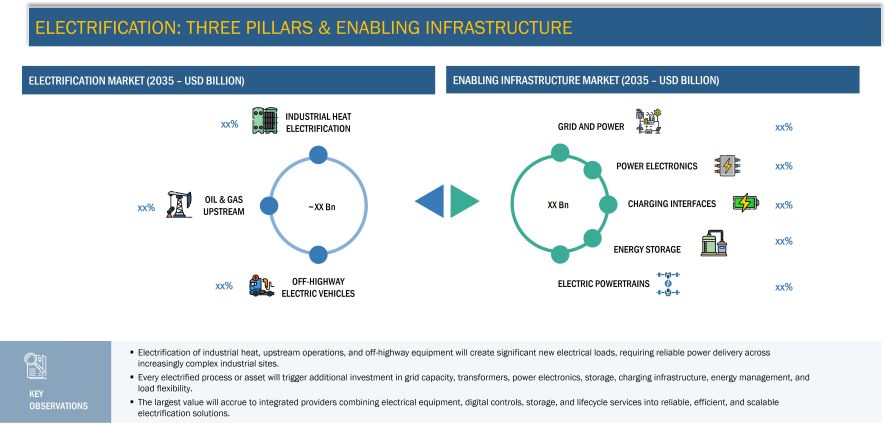
The global industrial electrification market will reach USD 80–90 billion in 2035. Off-highway electric vehicles are expected to account for 52% of the market, industrial heat for 46%, and upstream oil and gas for 2%. The study uses 2025 as its base year, with forecasts from 2026 to 2035 for North America, Europe, Asia Pacific, and the Rest of the World.
The enabling infrastructure market is projected to reach approximately USD 1,349 billion, or USD 1.35 trillion, in 2035. Electric powertrains are expected to account for 62.3% of that market, followed by power electronics at 17.3%, grid and power at 9.5%, charging interfaces at 8.7%, and thermal storage at 2.2%. As industrial sites adopt electric equipment, their ability to connect and operate it will increasingly depend on these supporting systems.
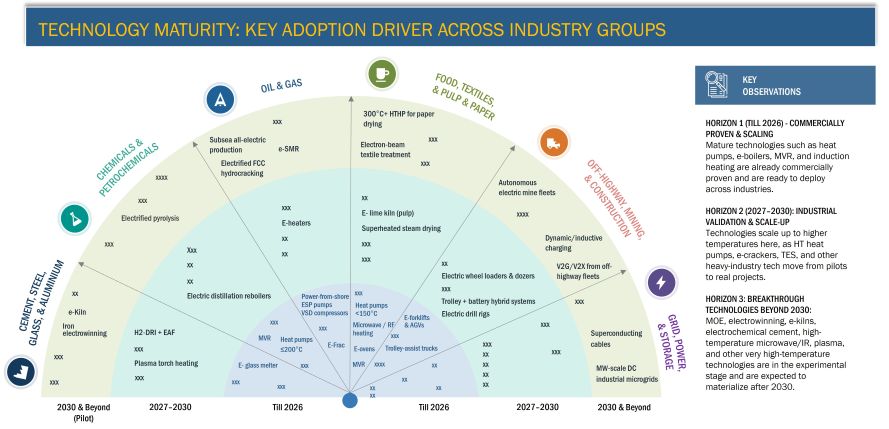
Technology readiness will shape when that demand materializes. As of 2026, heat pumps, electric boilers, mechanical vapor recompression, and induction heating are commercially proven for suitable applications. Between 2027 and 2030, the report expects higher-temperature heat pumps, electric steam crackers, and thermal energy storage to advance through industrial validation and scale-up. After 2030, electric kilns, iron electrowinning, and electrochemical cement could extend electrification to more demanding processes as they prove viable at commercial scale.
The temperature a plant needs helps determine which technologies it can deploy. The study covers industrial heat applications from below 100°C to above 1,000°C. Heat pumps and electric boilers can serve hot water, drying, and steam needs in food and beverages, textiles, and pulp and paper. Electric arc furnaces are established in scrap-based steelmaking. Electric calciners and electrified reformers are still developing for applications in cement and chemicals.
In upstream oil and gas, electric submersible pumps, motors and compressors with variable-speed drives, electric heat tracing, and electric drilling rigs offer established ways to electrify equipment. Offshore platforms can use shore power where a connection is viable. All-electric subsea production is at an earlier stage, and access to reliable power will influence deployment across upstream sites.
Electric forklifts in warehouses and compact electric excavators on construction sites show where off-highway electrification is already practical. Trolley-assist systems can supply power to mine trucks on fixed haul routes
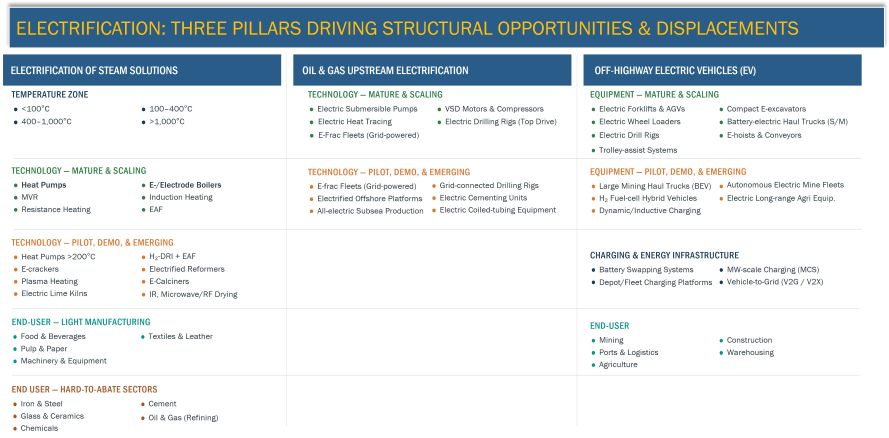
Larger battery-electric haul trucks and autonomous electric mine fleets are still developing. Fleet duty cycles, charging windows, and available site power will shape demand for depot charging, battery swapping, and megawatt-scale charging.
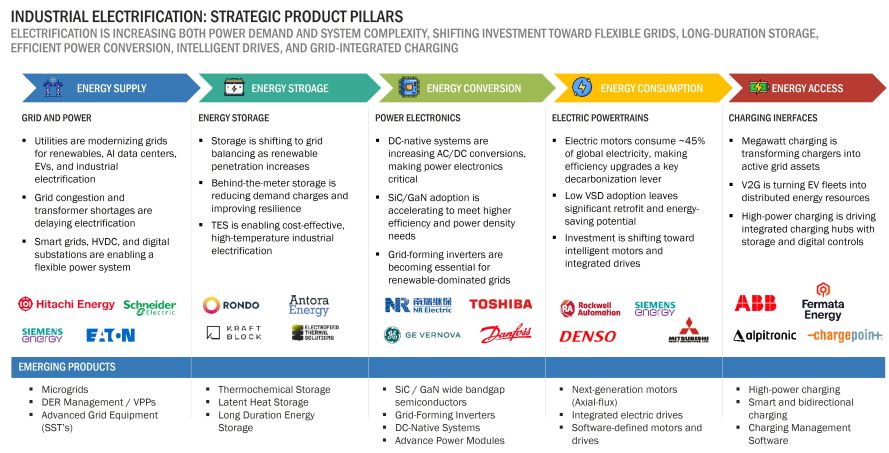
These applications create demand for five groups of enabling products. Utilities are upgrading grid and power systems with digital substations, smarter controls, and higher-capacity connections.
Grid congestion and transformer shortages can delay new connections. Batteries can support grid balancing and site resilience. Latent heat and thermochemical storage systems give plants more ways to store energy for later use as process heat.
Power electronics link generation, storage, and loads. Silicon carbide and gallium nitride devices can improve conversion efficiency, and grid-forming inverters can help stabilize networks with more renewable generation.
Electric motors account for about 45% of global electricity use, according to the report, creating an opportunity to improve efficiency with integrated powertrains and variable-speed drives. Smart charging can manage fleet demand, and bidirectional charging can allow compatible vehicles to supply electricity back to a site or the grid
The direct impact is a change in how electricity moves through the power system. Alternating current (AC) remains the grid backbone, and direct current (DC) is becoming more common as solar generation, batteries, electric vehicle charging, and AI data centers expand. Hybrid AC/DC architectures can reduce repeated conversions by connecting compatible equipment on a local DC network. Growing data center demand can also increase competition for grid connections and electrical equipment in constrained markets
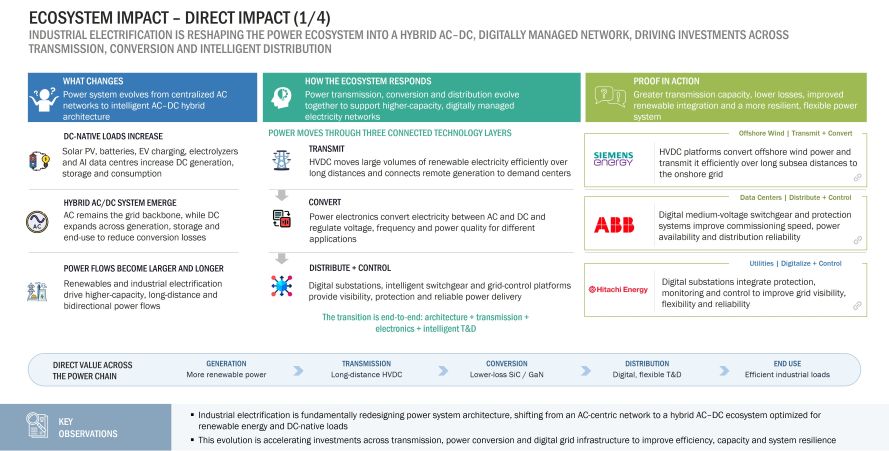
High-voltage direct current (HVDC) links can bring power from remote renewable projects to demand centers. Converters connect AC and DC equipment and regulate voltage and power quality.
Digital substations and intelligent switchgear give operators greater visibility and control over distribution. The report illustrates this shift with Siemens Energy’s offshore wind HVDC platforms, ABB’s digital switchgear for data centers, and Hitachi Energy’s digital substations.
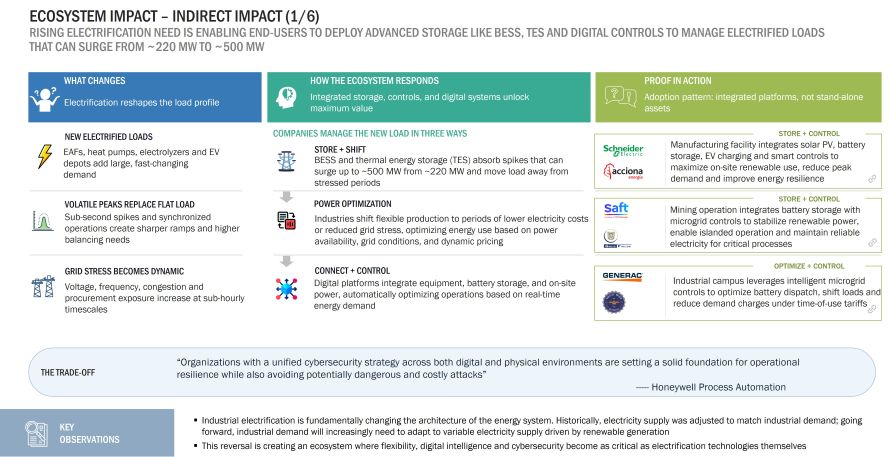
Electrification also changes when industrial facilities draw power and how sharply demand can rise. Electric arc furnaces, heat pumps, electrolyzers, and fleet depots can create large, fast-changing loads, especially when several run together. The report illustrates the possible swing with a load rising from about 220 MW to about 500 MW.
Battery storage can respond to rapid peaks, and thermal storage lets plants produce heat when electricity costs less or is more readily available. Operators can schedule flexible loads around grid conditions and power prices. In the report, a factory uses solar power, batteries, EV charging, and smart controls to manage demand. A mine uses batteries and microgrid controls to keep critical processes running when disconnected from the grid. These connected systems make cybersecurity part of maintaining reliable operations.
Heat-as-a-service reduces the upfront investment in electric boilers and heat pumps. The provider finances and operates the equipment, guarantees thermal performance, and charges for delivered heat. Green power purchase agreements (PPAs) help manufacturers secure renewable electricity at agreed prices. Microgrid-as-a-service providers finance and operate on-site generation, storage, and controls where grid supply is limited or unreliable. MarketsandMarkets estimates 2025 addressable markets of USD 12–14 billion for heat-as-a-service, USD 10–12 billion for green PPAs and offtake, and USD 2–3 billion for microgrid-as-a-service.
In India, electricity supplies less than 15% of industry’s final energy use. MarketsandMarkets estimates that electric heat powered by low-cost renewables is already cost-competitive for about 55% of industrial heat demand. Expanding Green Energy Open Access, upgrading grid connections, and improving financing for smaller manufacturers can help scale deployment.
Sweden already generates about 98% of its electricity from fossil-free sources, supporting investment in green steel and hydrogen. Svenska kraftnät’s 2045 planning scenario puts electricity demand above 300 TWh, up from 127 TWh in 2025, making transmission expansion and faster permitting critical to connecting new industrial projects.
Conclusion
Proven heat, upstream, and off-highway applications offer the earliest growth where electricity is reliable and competitively priced. Higher-temperature processes and heavier-duty fleets will depend on successful scale-up and adequate site power. Through 2035, suppliers that combine equipment with power delivery, storage, charging, and digital controls can help operators connect new loads and manage peaks while keeping production running.
 Exclusive indicates content/data unique to MarketsandMarkets and not available with any competitors.
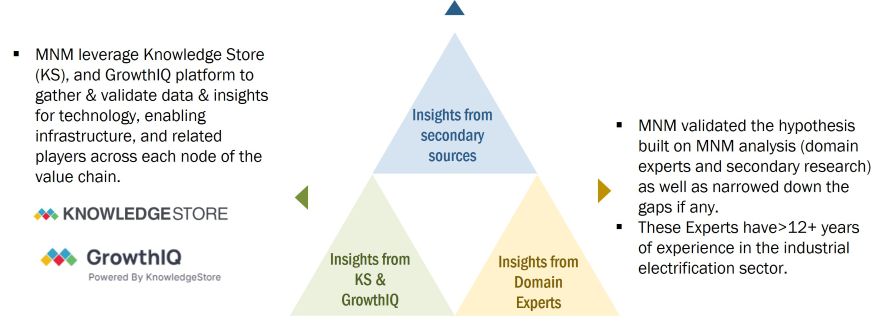
The study analyzes recent developments, technology trends, the competitive landscape, and the players' ecosystem across industrial electrification and enabling infrastructure globally and regionally. It uses 2025 as the base year, with forecasts from 2026 to 2035. The analysis covers industrial heat electrification, off-highway electric vehicles, and upstream oil and gas operations, alongside grid and power systems, energy storage, power electronics, electric powertrains, and charging interfaces. It assesses market size, technology readiness, end-use adoption, and regional growth opportunities. The study also examines regulations, product developments, and the direct & indirect impacts of electrification, including the influence of AI & data centers. Findings were developed through secondary research, MarketsandMarkets’ KnowledgeStore, GrowthIQ platforms, and inputs from domain experts. Data from multiple sources were compared & evaluated to validate assumptions, address information gaps, and develop market estimates & forecasts.
Secondary Research
Secondary sources used for this study included company websites, annual reports, investor presentations, product information, government publications, industry associations, and research databases. These sources provided insights into electrification technologies, enabling infrastructure, technology readiness, industry applications, and regional developments. Key references included the International Energy Agency (IEA), International Renewable Energy Agency (IRENA), US Department of Energy, European Heat Pump Association, Agora Industry, EMBER, SYSTEMIQ, and the World Bank. Company sources included ABB, Siemens, Siemens Energy, Schneider Electric, Eaton, Danfoss, and Hitachi Energy, among others. MarketsandMarkets’ KnowledgeStore and GrowthIQ platforms provided additional information on markets, technologies, and participants across the value chain. The information was analyzed and cross-checked with input from domain experts to support the market assessment and identify growth opportunities.
Primary Research
Input from domain experts was used to review and validate findings developed through secondary research on industrial electrification and enabling infrastructure. These inputs helped assess technology readiness, adoption across end-use industries, implementation challenges, and growth opportunities through 2035. The discussions covered industrial heat electrification, upstream oil and gas operations, and off-highway electric vehicles, along with the infrastructure needed to support their adoption.
Experts provided insights into the role of grid and power systems, energy storage, power electronics, electric powertrains, and charging interfaces. Key areas examined included electricity availability & costs, integration with existing industrial equipment, operational requirements, and barriers to deployment. Expert inputs also supported the assessment of direct & indirect impacts on the energy ecosystem, including changing power demand, flexibility requirements, and the influence of AI & data centers.
Domain experts with more than 12 years of experience in industrial electrification helped validate assumptions and address information gaps. Their inputs, combined with secondary research, MarketsandMarkets’ KnowledgeStore, GrowthIQ platforms, and in-house analysis, informed the findings and recommendations presented in the report.
Market Assessment and Validation
The industrial electrification and enabling infrastructure markets were assessed using secondary research, MarketsandMarkets’ KnowledgeStore, GrowthIQ platforms, and inputs from domain experts. These sources provided insights into market size, technology readiness, end-use applications, and key players across the value chain. Findings and assumptions were cross-checked across sources and reviewed by experts with more than 12 years of experience in industrial electrification. This process helped address information gaps and support the market estimates & forecasts through 2035.
Research Framework: Secondary Sources, Knowledge Platforms, and Domain Expert Validation
Market Definition
Electrification of everything, within the scope of this report, refers to the shift from fossil fuel-based technologies to electric solutions across industrial heat, upstream oil and gas operations, and off-highway vehicles. It also covers the enabling infrastructure required to support this transition, including grid and power systems, energy storage, power electronics, electric powertrains, and charging interfaces. The report assesses market opportunities, technology developments, and adoption trends across industries and regions through 2035.
Key Stakeholders
- Industrial heat pump, electric boiler, and electric furnace manufacturers
- Off-highway electric vehicle and equipment manufacturers
- Oil & gas operators and electrification solution providers
- Utilities, grid operators, and power generation companies
- Transmission and distribution equipment manufacturers
- Battery and thermal energy storage providers
- Power electronics and semiconductor manufacturers
- Electric motor, drive, and powertrain suppliers
- Charging infrastructure and energy management providers
- Industrial end users across manufacturing, mining, construction, and logistics
- Engineering companies, system integrators, and technology consultants
- Industrial automation, software, and digital solution providers
- Government agencies, regulators, industry associations, and research institutions
- Investors, project developers, and electrification technology startups
- AI and data center operators influencing power and infrastructure demand
Report Objectives
- Estimate market size and growth potential for industrial electrification and enabling infrastructure, using 2025 as the base year and forecasts from 2026 to 2035.
- Assess opportunities across North America, Europe, and Asia Pacific.
- Evaluate electrification technologies, their maturity, and adoption potential across industrial heat, upstream oil & gas, and off-highway vehicles.
- Examine end-use sectors by heat requirements, operational needs, and electrification readiness.
- Identify growth opportunities across grid and power systems, energy storage, power electronics, electric powertrains, and charging interfaces.
- Analyze market drivers, barriers, regulations, standards, and infrastructure requirements affecting adoption.
- Map key players and startups across the value chain and assess their technologies, product offerings, and strategic developments.
- Examine the direct and indirect impacts of electrification on power networks, energy demand, storage, flexibility, and digital controls.
- Assess how AI and data center growth affects access to electricity, grid capacity, and critical electrical equipment.
- Identify attractive countries, industry sectors, and technologies to support investment and go-to-market decisions.















Growth opportunities and latent adjacency in Industrial Electrifi