Linear Pluggable Optics (LPO) Market Size, Share, Trends & Growth Report by Form Factor (OSFP, QSFP-DD, OSFP-XD), 400G, 800G, Single-Mode Fiber, Multi-Mode Fiber, Hyperscale Data Centers, High-Performance Computing & AI/ML Infrastructure, Enterprise Data Centers - Global Forecast to 2032


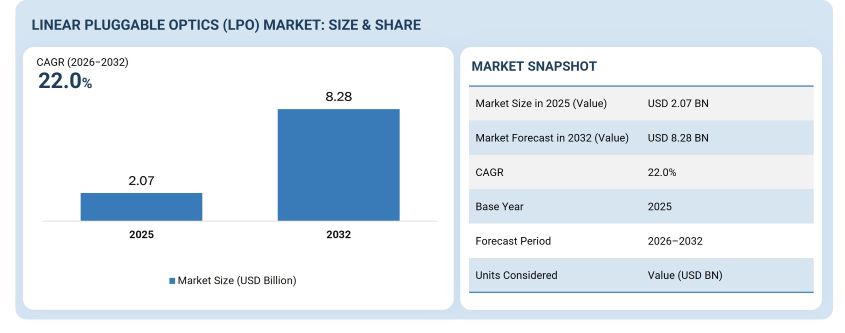
The global linear pluggable optics (LPO) market was valued at approximately USD 2.07 billion in 2025 and is projected to reach USD 8.28 billion by 2032, growing at a compound annual growth rate (CAGR) of 22.0% during the forecast period 2026–2032. This exceptional growth trajectory is anchored in the accelerating deployment of AI-optimized data center infrastructure worldwide — particularly the proliferation of 400G and 800G Ethernet switching fabrics that require high-bandwidth, low-latency, and power-efficient optical interconnects capable of bridging GPU clusters across ever-shortening reach requirements. LPO's DSP-less architecture, which eliminates the digital signal processor from the optical module itself, delivers the latency and power efficiency that hyperscale operators and AI infrastructure builders increasingly demand, making it the defining optical interconnect technology of the AI compute era.
Asia Pacific is the fastest-growing region, driven by China's aggressive hyperscale data center build-out, India's cloud infrastructure expansion, and South Korea and Japan's investments in AI-ready networking. North America retains the largest market share in 2025, underpinned by the concentration of hyperscale operators — Amazon Web Services, Microsoft Azure, Google Cloud, and Meta — whose AI GPU clusters are among the primary demand generators for high-speed LPO connectivity at 800G and above.
Note on triangulation methodology: Global 2025 size was anchored by (a) top-down capture from the ~USD 22 Bn optical transceiver addressable market at an ~9.4% LPO penetration rate; (b) bottom-up build from leading player revenue estimates and announced capacity expansions; and (c) cross-check against hyperscale capex proxies for optical interconnect. Regional splits reflect hyperscale footprint concentration, carrier-grade infrastructure deployment rates, and regulatory adoption intensity. CAGR differentiation reflects AI-cluster densification pace, government digital infrastructure investment, and trade-policy headwinds.
Top 10 Key Takeaways
- North America holds the largest share of the global LPO market in 2025, driven by the concentration of hyperscale cloud operators and AI infrastructure investment.
- Asia Pacific is the fastest-growing region, led by aggressive hyperscale expansion in China and cloud infrastructure build-out in India, South Korea, and Southeast Asia.
- The 800G data rate segment is the dominant growth engine, as AI training clusters and high-density GPU interconnects demand higher bandwidth per lane with reduced power budgets.
- Hyperscale data centers — including those operated by Amazon, Microsoft, Google, Meta, and ByteDance — represent the leading end-user vertical for LPO adoption.
- The defining technology shift is the move from DSP-based to DSP-less (linear drive) optical architectures, fundamentally repositioning power and cost trade-offs in short-reach optical interconnect.
- IEEE 802.3df and OIF standards for 800G LPO are catalyzing interoperability, reducing multi-vendor integration friction and accelerating hyperscale procurement cycles.
- Key players including Coherent Corp., Lumentum, Credo Semiconductor, and Broadcom are scaling LPO capacity ahead of anticipated demand curves for 800G and 1.6T deployments.
- The near-term opportunity lies in retrofitting existing 400G switching infrastructure with LPO modules that extend the usable life and bandwidth of installed spine-leaf architectures.
- The near-term risk is tariff-driven supply chain disruption, as significant LPO module manufacturing is concentrated in China and Taiwan — geographies exposed to escalating US trade policy uncertainty.
- Strategic implication: enterprises and hyperscalers that standardize on LPO architectures now will capture both capital and operational cost advantages over peers still relying on DSP-based coherent pluggables for short-reach applications.
Why the Linear Pluggable Optics Market Matters — Right Now
The networking substrate of the AI era is being built at unprecedented speed. Generative AI model training, large language model inference, and high-performance computing workloads are placing demands on data center interconnect that no previous technology wave has created — not cloud, not video streaming, not IoT. GPU clusters running NVIDIA H100 and H200 architectures consume optical bandwidth not in tens of gigabits, but in hundreds, and they do so across distances measured in meters and low tens of meters where traditional coherent DSP-based optics are architecturally overqualified and economically wasteful.
Linear pluggable optics address this inflection point with an elegant engineering trade-off. By removing the power-hungry digital signal processor from the optical module and instead leveraging the DSP functionality already embedded in the host ASIC — typically the AI accelerator or the Ethernet switching chip — LPO modules achieve dramatically lower per-bit power consumption, shorter latency, smaller footprint, and lower cost per unit than their coherent pluggable counterparts. For a hyperscale operator deploying thousands of GPU servers in a single AI fabric, these advantages compound into meaningful total cost of ownership improvements.
The macro context reinforces this urgency. Global data center capex has surged beyond USD 300 billion annually and shows no sign of plateauing, driven by the simultaneous acceleration of AI model proliferation, cloud-native application migration, and enterprise digital transformation. Sustainability mandates — including European Union data center energy efficiency directives and voluntary net-zero commitments by major cloud providers — are placing power efficiency at the center of optical interconnect selection criteria. Against this backdrop, the LPO market sits at the intersection of multiple megatrends, and its growth trajectory reflects the convergence of structural demand, technology maturity, and standards clarity.
Linear Pluggable Optics Market Trends
The most consequential trend reshaping the LPO market is the rapid commercial transition from 400G to 800G optical interconnects within hyperscale AI fabric deployments. In the 400G generation, the performance gap between DSP-based and DSP-less modules was manageable. At 800G and approaching 1.6T, the DSP power penalty becomes prohibitive — an 800G DSP-based transceiver can consume 15–20W, while an equivalent LPO module targets sub-10W operation. This power-per-bit advantage is not incremental; it is disruptive, and it is why hyperscale procurement teams are actively qualifying LPO at 800G for their next AI fabric generations.
A second major trend is the standardization progress led by the Optical Internetworking Forum (OIF) and IEEE 802.3df. The publication of the OIF LPO Implementation Agreement and the advancement of 800G Ethernet standards have substantially reduced the interoperability uncertainty that historically slowed multi-vendor LPO deployments. As pluggable optics vendors certify their modules against these standards, procurement teams gain confidence in vendor diversification — a critical consideration for hyperscale operators managing supply concentration risk.
Silicon photonics integration is a third trend with long structural implications. Companies such as Intel (now part of Jabil Photonics), Ranovus, and Ayar Labs are developing LPO platforms built on silicon photonics substrates, enabling wafer-scale manufacturing economics that promise significant cost-down trajectories as volumes scale. While EML-laser-based LPO remains the near-term volume leader, silicon photonics is positioned to capture an increasing share of the market through the latter part of the forecast period.
Finally, the concept of co-packaged optics (CPO) — in which the optical engine is integrated directly into the switch or ASIC package — looms as a long-term structural alternative to pluggable form factors, including LPO. Broadcom's Tomahawk 5 and next-generation switching platforms from Marvell and Intel are being designed with CPO in mind. However, CPO standardization, manufacturing yield, and field serviceability challenges mean that pluggable LPO will dominate short-reach interconnect architectures through at least 2028–2029, giving the market a clear and durable runway.
LPO Market Drivers
AI and Generative AI Infrastructure Buildout
The single most powerful driver of LPO market growth is the global surge in AI compute infrastructure. Every major hyperscale operator — Amazon Web Services, Microsoft Azure, Google Cloud, Meta, and a growing cohort of sovereign AI programs in China, Saudi Arabia, the UAE, and Japan — is deploying AI training and inference clusters at scale that were economically and physically inconceivable three years ago. These clusters require very high port-density switching fabrics at 800G and, increasingly, 1.6T, with optical interconnects designed to run at maximum bandwidth while consuming the least possible power. LPO is the only currently commercially viable optical module architecture that meets these criteria simultaneously for short-reach applications within the data center.
Power Efficiency Mandates and Data Center Sustainability Goals
Data center operators face mounting regulatory and reputational pressure to reduce power consumption per unit of compute. The EU's Energy Efficiency Directive (EED) and emerging US Environmental Protection Agency data center efficiency guidelines are formalizing what the largest operators already pursue voluntarily. Within the optical interconnect layer, LPO's elimination of the onboard DSP translates directly into watts saved — at scale, this represents a meaningful contribution to power usage effectiveness (PUE) improvement. The financial logic is compelling: at data center electricity costs, every watt saved per module across tens of thousands of installed transceivers translates into millions of dollars in annual operational savings.
Cost Reduction vs. Legacy Coherent Pluggables
Beyond power, LPO modules offer a structural cost-per-bit advantage over DSP-equipped coherent pluggables for short-reach applications. The DSP component accounts for a significant portion of coherent module bill-of-materials cost. By offloading this function to the already-present host ASIC, LPO module manufacturers can price at a meaningful discount to coherent alternatives for intra-data center reach requirements — typically under 2 km. As manufacturing volumes scale and yield curves mature, this cost advantage is expected to widen rather than narrow through the forecast period.
Standards Maturity and Ecosystem Interoperability
The formalization of LPO standards through OIF implementation agreements and IEEE 802.3df has catalyzed vendor ecosystem development at a pace that would have been unachievable without standards clarity. When procurement teams at hyperscale operators can issue requests for qualification against a published standard, they can simultaneously qualify multiple module vendors — reducing both price and supply risk. This ecosystem maturation is a self-reinforcing driver: more vendors compliant to published standards means more procurement activity, which drives volume, which attracts further vendor investment in LPO product lines.
LPO Market Challenges and Restraints
Signal Integrity Complexity at High Data Rates
LPO's DSP-less architecture, while power-efficient, shifts signal conditioning responsibility to the host ASIC and the physical interconnect. At 800G and approaching 1.6T lane rates, the tolerance for signal impairment is dramatically reduced, placing rigorous demands on PCB trace design, connector quality, and the host ASIC's equalization capability. Not all switching ASIC generations support the linear drive electrical interface specification required for LPO compliance, creating an installed-base compatibility overhang that constrains LPO adoption in enterprise and carrier environments where switching hardware refresh cycles are slower than hyperscale.
Geopolitical and Tariff-Driven Supply Chain Exposure
A substantial proportion of LPO module manufacturing is concentrated in China and Taiwan. The escalation of US trade policy restrictions, including the 2025 tariff adjustments targeting Chinese-origin optical components, has created supply chain uncertainty that affects procurement planning horizons for US hyperscale and enterprise buyers. While module suppliers are pursuing geographic manufacturing diversification — including investments in facilities in Thailand, Malaysia, and the United States — this repositioning takes years to execute at production scale, and near-term tariff exposure remains a meaningful headwind.
Limited Deployed Base of LPO-Compatible Host ASICs
Unlike DSP-based pluggables that can interface with virtually any switching or routing ASIC, LPO modules require a host device capable of driving a linear electrical interface. As of 2025, the installed base of switches and routers with LPO-compatible ASICs remains concentrated among cutting-edge hyperscale deployments. Enterprise and carrier customers operating on 3–5-year hardware refresh cycles will encounter a transition period during which the economic case for LPO must compete against the sunk cost of DSP-compatible infrastructure — a genuine adoption barrier in non-hyperscale segments.
Thermal Management in High-Density Deployments
As switch port densities increase — with 51.2T switches now commercially available and 102.4T on the near-term roadmap — the thermal density within the switching chassis reaches levels that challenge both LPO module design and data center cooling infrastructure. While LPO's lower per-module power draw is a net positive for thermal management, the aggregate power density of a fully populated high-density switch still requires active thermal management solutions that add cost and complexity to the deployment.
LPO Market — Industry and Application Growth
Hyperscale Data Centers
Hyperscale data centers represent the primary and most rapidly growing application domain for LPO. Operators including Amazon Web Services, Microsoft Azure, Google Cloud, Meta Platforms, and ByteDance have publicly disclosed multi-billion-dollar AI infrastructure investment programs, a significant proportion of which flows into networking fabric upgrades. The shift from 400G to 800G switching fabrics at the spine and leaf layers of AI cluster architectures is the immediate commercial opportunity, and LPO is the optics modality of choice for these deployments given its power and cost profile. Hyperscale operators also have the engineering resources and ASIC design capability to drive LPO interoperability qualification at scale — a capability that smaller enterprise buyers lack.
Cloud Service Providers and AI-as-a-Service Platforms
Beyond the largest hyperscalers, the second tier of cloud service providers — including Oracle Cloud Infrastructure, IBM Cloud, Alibaba Cloud, and Tencent Cloud — is following a comparable optical interconnect modernization trajectory with a 12–18 month lag. These operators are deploying AI-as-a-service infrastructure to compete in the enterprise AI market, and their networking investments increasingly track the hyperscale architecture blueprint, including 800G spine-leaf fabrics with LPO modules.
AI and HPC Supercomputing Infrastructure
National and institutional high-performance computing programs — including those funded by the US Department of Energy, the European High-Performance Computing Joint Undertaking (EuroHPC), and RIKEN in Japan — are deploying AI-accelerated supercomputing clusters that share many of the same optical interconnect requirements as commercial hyperscale deployments. These programs have long procurement cycles but represent significant volume when they execute, and their preference for standards-compliant interoperable modules reinforces the demand signal for OIF-certified LPO at 800G.
Telecom and Carrier Ethernet
While telecom and carrier environments have historically been slower adopters of cutting-edge optical interconnect modalities, the growth of carrier-neutral data centers and the integration of AI workloads into telco cloud architectures is creating a new demand vector for LPO. Operators such as AT&T, Deutsche Telekom, NTT Communications, and SoftBank are modernizing their data center interconnect layers as part of broader 5G core and cloud-native network function (CNF) deployment programs — creating incremental but growing demand for LPO in this segment.
LPO Market Segment Insights
By Data Rate
The 800G data rate segment leads the LPO market in terms of growth momentum and is the primary focus of hyperscale qualification activity in 2025. The transition from 400G to 800G reflects the doubling of GPU cluster lane widths and the need to sustain inter-GPU bandwidth at optical interconnect layers without proportional increases in power consumption or rack space. Module vendors have converged on 800G QSFP-DD and OSFP form factors compliant to OIF LPO specifications as the primary commercial vehicle for this data rate.
While 400G LPO remains the largest volume segment in 2025 by installed base, 1.6T LPO is the fastest-growing data rate segment, with initial commercial deployments expected to commence before the end of the forecast period. Early 1.6T LPO activity is concentrated around next-generation switching platforms from Broadcom and Marvell and the GPU interconnect fabrics associated with NVIDIA's Blackwell architecture successors. The 1.6T segment will be catalytic in establishing silicon photonics as a viable LPO substrate for high-volume commercial deployments.
By Form Factor
The OSFP (Octal Small Form-Factor Pluggable) form factor currently leads the LPO market for 800G deployments at the hyperscale tier, preferred for its higher power envelope and superior thermal management in high-density AI switching applications. QSFP-DD retains strong share in 400G LPO applications given its broader installed base in enterprise and carrier switching environments where OSFP cage upgrades have not yet been completed.
OSFP-XD, designed for 1.6T and higher-density future applications, is the fastest-growing form factor segment from a design-win perspective, although commercial revenue remains small in 2025. Its growth reflects the forward-looking architectural decisions of hyperscale operators and OEM switch vendors who are designing their next-generation platforms around OSFP-XD cage arrays to accommodate the bandwidth density requirements of 51.2T and 102.4T switching ASICs.
By Fiber Type
Single-mode fiber (SMF) dominates the LPO market for 800G and above deployments, aligned with the reach and wavelength characteristics of EML-laser-based LPO modules designed for intra-facility and campus-level interconnects in the 100m–2km range. SMF's lower attenuation at 1310nm and its compatibility with the dominant CWDM4 and PSM4 optical designs used in most 400G and 800G LPO products have established it as the fiber medium of choice for hyperscale AI fabric applications.
Multi-mode fiber (MMF) is the fastest-growing fiber type for very short-reach LPO applications — specifically within the rack and top-of-rack switching environments where distances are under 100 meters. VCSEL-based LPO on OM4 and OM5 fiber offers the lowest cost per link at these distances, and the ongoing expansion of GPU rack density is creating new demand for MMF LPO solutions in the 50–100G per lane range for intra-rack AI interconnect.
By Wavelength / Technology
EML (Electro-Absorption Modulated Laser) technology is the dominant enabling technology for LPO at 800G, combining the modulation bandwidth needed for 112Gbps-per-lane electrical interfaces with the optical performance required for single-mode fiber reach up to 2km. EML-based LPO from suppliers including II-VI (Coherent Corp.), Lumentum, and Fujitsu Optical Components has achieved commercial maturity at 800G, and these vendors are actively qualifying EML-based 1.6T designs.
Silicon photonics-based LPO is the fastest-growing technology segment, gaining traction through partnerships between module vendors and silicon photonics foundries including Intel Foundry Services, GlobalFoundries, and TSMC. Companies such as Ranovus and Ayar Labs are developing integrated silicon photonics LPO platforms that promise CMOS-compatible manufacturing scalability, potentially enabling cost structures at 1.6T and beyond that legacy III-V laser technologies cannot match.
By End User
Hyperscale data centers represent the leading end-user segment by both revenue and growth rate, reflecting the structural alignment between LPO technology characteristics and hyperscale AI networking requirements. The top five hyperscale operators collectively account for the majority of current LPO procurement by volume, and their roadmap commitments to 800G and 1.6T switching fabric upgrades underpin the market's growth visibility through 2028.
High-performance computing and AI/ML infrastructure is the fastest-growing end-user segment by application breadth, driven by both commercial AI cloud deployments and publicly funded national supercomputing programs. HPC deployments typically involve higher unit-count procurements at more advanced specifications — making them disproportionately valuable to LPO vendors seeking to establish reference deployments for next-generation data rate products.
Segment Insights — Key Conclusions
- 800G is the dominant commercial data rate for LPO in 2025 and will remain the primary volume driver through 2028, with 1.6T positioned as the next inflection.
- OSFP leads for AI switching applications at 800G; OSFP-XD is the form factor of the future for 1.6T deployments.
- EML technology dominates current-generation 800G LPO, while silicon photonics is establishing the cost-down trajectory for 1.6T and beyond.
- Single-mode fiber leads in volume; MMF is gaining share for intra-rack and very short-reach AI interconnect applications.
- Hyperscale data centers are the anchor end-user segment, but HPC and AI/ML infrastructure is the fastest-growing application category by geographic breadth and specification advancement.
LPO Market — Regional Analysis
North America
North America is the largest regional market for LPO in 2025, valued at approximately USD 820 million, and is projected to reach USD 3.10 billion by 2032 at a CAGR of 20.8% through the forecast period. The United States is the dominant country market, anchored by the world's highest concentration of hyperscale data center campuses — in Northern Virginia, Silicon Valley, the Pacific Northwest, Phoenix, and Dallas — operated by Amazon, Microsoft, Google, Meta, and a growing cohort of AI-specialized cloud providers. Canadian markets are growing through sovereign AI investment and the expansion of hyperscale campuses in Toronto and Montreal. Mexico is an emerging market for near-shore colocation facilities serving US cloud operators seeking geographic redundancy within a tariff-advantaged zone.
The US regulatory environment has been generally permissive for data center expansion, though data center power procurement constraints — particularly in power-constrained markets like Northern Virginia — are influencing optical interconnect efficiency prioritization. The CHIPS and Science Act is catalyzing domestic photonics manufacturing investment, with several LPO component suppliers exploring US-based assembly and testing capacity to mitigate tariff exposure.
Europe
The European LPO market was valued at approximately USD 380 million in 2025 and is expected to grow to USD 1.25 billion by 2032, at a CAGR of 18.6%. Germany, the United Kingdom, the Netherlands, Ireland, and the Nordic countries represent the primary demand markets, driven by Microsoft, Google, Amazon, and Meta's European hyperscale campus expansions as well as significant telco cloud modernization investment. The EU AI Act and the EU's European Green Deal create dual demand signals — AI infrastructure investment drives optics procurement while energy efficiency mandates reinforce LPO's power-efficiency value proposition.
The UK market benefits from continued hyperscale investment post-Brexit, particularly in London and the UK data center corridor, while Ireland and the Netherlands remain the primary European hyperscale hubs for US operators serving GDPR-compliant EU workloads. Nordic countries — Sweden, Denmark, Finland — are emerging as preferred hyperscale destinations for sustainability-mandated operators given access to renewable energy at scale and naturally cool ambient temperatures.
Asia Pacific
Asia Pacific is the fastest-growing regional market for LPO, valued at approximately USD 720 million in 2025 and projected to reach USD 3.45 billion by 2032, at a CAGR of 25.1% — the highest of all regions. China dominates APAC LPO demand through domestic hyperscale operators — Alibaba Cloud, Tencent Cloud, Baidu AI Cloud, ByteDance, and Huawei Cloud — all of which are executing aggressive AI infrastructure investment programs largely independent of US hyperscale involvement due to technology access restrictions. Chinese domestic LPO supply chains, anchored by companies including InnoLight Technology, Eoptolink Technology, and Hisense Broadband, are scaling to meet this demand.
India is the fastest-growing individual country market within APAC, driven by the Tier 1 cloud operators' India expansion programs and India's national AI computing initiative, which envisions significant domestic AI cluster deployment. South Korea and Japan are maturing markets with strong HPC-sector demand and sovereign AI programs (Japan's RIKEN AI supercomputing expansion; Korea's KAIST-linked AI computing infrastructure). Australia and Singapore serve as regional hyperscale hubs for Southeast Asia.
Rest of World
The Rest of World market, encompassing the Middle East, Latin America, and Africa, was valued at approximately USD 145 million in 2025 and is projected to reach USD 480 million by 2032, at a CAGR of 18.6%. The Middle East — led by the UAE and Saudi Arabia — represents the most dynamic growth pocket within this segment, fueled by sovereign AI investment programs (Saudi Arabia's NEOM and Vision 2030 AI initiatives; the UAE's G42 and its NVIDIA GPU procurement programs) and the establishment of hyperscale campuses by Microsoft, Google, and Amazon in Abu Dhabi and Riyadh. Latin America, led by Brazil and Mexico, is growing through cloud operator expansion and enterprise digital transformation. South Africa is the primary African market, serving as a regional hub for sub-Saharan hyperscale deployments.
Regional Outlook — Key Conclusions
- North America retains the largest market share through the forecast period, underpinned by unmatched hyperscale operator density and AI capex concentration.
- Asia Pacific grows fastest, with China's domestic hyperscale ecosystem and India's cloud expansion as the primary engines.
- Europe's growth is steady and regulation-shaped, with the EU AI Act and Green Deal simultaneously accelerating AI infrastructure investment and reinforcing LPO's power-efficiency case.
- The Middle East is the most dynamic growth market within Rest of World, with sovereign AI programs generating substantial optical interconnect procurement activity.
- Tariff and trade policy uncertainty introduces regional supply chain realignment pressure, particularly affecting North American buyers reliant on Chinese manufacturing.
Country-Specific LPO Market Insights
United States
The United States is the world's largest single-country LPO market and will remain so through the forecast period. The demand concentration in Northern Virginia — the world's densest data center market — reflects the co-location of AWS, Microsoft, Google, and federal government cloud workloads in a geography that is now actively managing power infrastructure constraints. US-based hyperscale operators are the primary technology qualification authorities for LPO interoperability standards, meaning their design-win decisions drive global module vendor roadmaps. The CHIPS Act's incentives for domestic photonics manufacturing are beginning to attract LPO component supply chain investment.
China
China operates the world's second-largest LPO market, with a distinctive characteristic: the supply chain is largely domestically owned. Chinese LPO module vendors — InnoLight, Eoptolink, Hisense Broadband — have grown to global scale on the back of domestic hyperscale demand from Alibaba, Tencent, Baidu, and ByteDance. US technology export controls have accelerated Chinese investment in indigenous LPO and silicon photonics capabilities, particularly at the chip and laser component levels, reducing dependence on US and European supply chains.
India
India has emerged as a priority market for global hyperscale operators seeking to serve the world's largest internet user population with locally compliant AI and cloud services. Microsoft, Google, Amazon, and Meta have all announced multi-billion-dollar India investment commitments, and the Indian government's IndiaAI Mission targets domestic AI computing infrastructure deployment at national scale. This investment program creates a structured demand pipeline for optical interconnect equipment, including LPO, over the forecast period.
Germany
Germany is Western Europe's largest data center market and the primary LPO demand center within the EU. Frankfurt is Europe's premier internet exchange point, hosting hyperscale campuses for all major US cloud operators. German industrial digitalization — the Industrie 4.0 program and the associated private 5G and edge computing investments by automotive, chemicals, and manufacturing firms — creates a secondary LPO demand vector in enterprise colocation. The German Renewable Energy Act (EEG) and EU taxonomy requirements are reinforcing power-efficient optical interconnect procurement criteria.
Saudi Arabia and UAE
The Gulf Cooperation Council (GCC) markets — led by Saudi Arabia and the UAE — represent the fastest-growing sovereign AI investment environment globally outside China. Saudi Arabia's Public Investment Fund is a direct investor in AI infrastructure, and Vision 2030's digital economy target is materializing in concrete hyperscale and edge data center deployments. The UAE's G42 has become a globally significant AI infrastructure operator with hyperscale partnerships with Microsoft and NVIDIA. Both markets offer greenfield hyperscale deployment opportunities with limited legacy infrastructure constraints — a favorable environment for LPO adoption at the most current standards.
Country-Level Conclusions
- The United States drives global LPO technology standards and commercial volume through hyperscale operator qualification activity.
- China is self-sufficient in LPO supply chain terms and will maintain separate technology standards trajectories driven by domestic hyperscale demand.
- India is the most important emerging single-country market, with government and hyperscale investment programs creating structured long-term demand.
- Germany anchors European LPO demand through hyperscale concentration in Frankfurt and industrial digitalization programs.
- Saudi Arabia and the UAE are the fastest-growing country markets outside APAC, with sovereign AI programs creating greenfield hyperscale deployments at scale.
Key LPO Market Players
The LPO market is served by a competitive ecosystem of optical component specialists, vertically integrated optoelectronics companies, and semiconductor firms whose ICs enable DSP-less architectures. Leading players include:
- II-VI Incorporated (Coherent Corp.)
- Lumentum Holdings
- Inphi Corporation (Marvell Technology)
- Credo Semiconductor
- Broadcom Inc.
- Fujitsu Optical Components
- Sumitomo Electric Industries
- Acacia Communications (Cisco Systems)
- MACOM Technology Solutions
- HiSilicon (Huawei)
- Hisense Broadband
- Eoptolink Technology
- InnoLight Technology
- Ranovus
- Ayar Labs
Coherent Corp. (formerly II-VI) has positioned itself as a broad-portfolio leader across EML lasers, transceiver modules, and silicon photonics components, with dedicated 800G LPO module lines for hyperscale qualification programs at multiple Tier 1 operators. Lumentum leverages its laser chip manufacturing scale to provide both modules and laser components to OEM transceiver vendors, maintaining competitive cost structures at volume. Credo Semiconductor has carved a distinctive position by focusing on the linear retimer and the active electrical cable (AEC) interface technologies that complement LPO deployments in next-generation switching fabrics.
On the semiconductor side, Broadcom's switching ASICs — the Tomahawk and Jericho families — are the most widely deployed hosts for LPO in hyperscale environments, and Broadcom's design decisions around linear drive electrical interface specifications effectively set the parameters within which LPO module vendors must qualify. Marvell's TERALYNX and PRESTERA ASIC families represent the primary competing platform for hyperscale switching fabric deployments. Ayar Labs and Ranovus represent the silicon photonics vanguard, with Ayar Labs pursuing an optical I/O chiplet approach that embeds optical interconnect directly within the chip package rather than at the pluggable module level.
Company Strategy — Key Conclusions
- Coherent Corp. and Lumentum compete on EML laser chip manufacturing scale and vertical integration depth, targeting Tier 1 hyperscale qualification programs.
- Credo Semiconductor differentiates through linear retimer and AEC products that complement LPO in switching fabric architectures, providing infrastructure-level differentiation beyond the module.
- Chinese vendors — InnoLight, Eoptolink, Hisense Broadband — are scaling on domestic hyperscale demand and developing indigenous laser component supply chains to reduce US/European dependency.
- Silicon photonics players including Ranovus and Ayar Labs are pursuing longer-term cost and integration advantages, with commercial milestones expected in the 1.6T product generation.
- Broadcom and Marvell wield indirect but decisive strategic influence as the host ASIC architects whose electrical interface specifications define LPO module qualification requirements.
Recent Developments in the LPO Market
- In Q1 2025, Coherent Corp. announced commercial availability of its 800G LPO modules in OSFP and QSFP-DD form factors, qualifying across multiple Tier 1 hyperscale operator programs. The modules leverage the company's EML laser chip platform and target the AI fabric interconnect application.
- In Q4 2024, Credo Semiconductor expanded its Dove series of linear retimer ICs with variants optimized for 800G LPO host-side interface conditioning, addressing signal integrity requirements for next-generation hyperscale switching ASICs.
- In 2024, the OIF published its 800G LPO Implementation Agreement, establishing interoperability specifications for 800G DSP-less optical modules — a landmark standards milestone that accelerated multi-vendor qualification programs at hyperscale operators.
- In early 2025, Eoptolink Technology disclosed shipment of its 800G OSFP LPO modules to multiple Chinese hyperscale data center operators, underscoring the pace of domestic China LPO adoption independent of Western supply chains.
- In Q1 2025, Ayar Labs secured additional venture funding to advance its TeraPHY optical I/O chiplet platform, which integrates optical interconnect at the semiconductor package level and represents the conceptual evolution of LPO toward fully embedded optics architectures.
Real-World Use Cases and Deployments
Hyperscale AI Fabric Deployment — Microsoft Azure
Microsoft Azure has been among the earliest large-scale deployers of 400G LPO technology within its AI-optimized data center infrastructure, leveraging LPO's power and latency advantages to support NVIDIA GPU cluster interconnects across its AI supercomputing partnerships — including the infrastructure underpinning the OpenAI training environment. Microsoft's architectural standardization on OSFP LPO for its AI fabric spine has been a key validation event for the technology and has influenced procurement specifications across the broader hyperscale community.
Data Center AI Networking — Meta Platforms
Meta Platforms has publicly disclosed its AI Research SuperCluster (RSC) and Grand Teton architectures as among the world's largest AI training infrastructure deployments. Meta's networking team has been an active participant in OIF LPO standardization efforts and has evaluated LPO-based 800G optical interconnects for deployment in its next-generation AI fabric, specifically for the intra-cluster spine-leaf switching layers where latency and power density optimization are paramount. Meta's scale and architectural transparency make it a reference deployment that influences industry-wide adoption trajectories.
LPO Market Segmentation
The linear pluggable optics market is segmented across five primary dimensions, each reflecting a distinct axis of purchasing decision-making in hyperscale and enterprise optical interconnect procurement. By data rate, the market encompasses 400G (the current installed base volume leader), 800G (the primary current-cycle growth engine), and 1.6T and above (the emerging next generation that will define the second half of the forecast period). By form factor, OSFP leads for high-density AI switching, QSFP-DD addresses broad 400G and some 800G applications, and OSFP-XD is the emerging standard for 1.6T and beyond.
The technology segmentation — EML, VCSEL, and silicon photonics — reflects the optical engine architectures competing for design wins across data rate tiers. EML dominates for single-mode fiber applications at 800G, VCSEL serves multimode very short-reach applications, and silicon photonics is establishing a cost-down trajectory for future generations. By fiber type, single-mode fiber serves the largest share by revenue, while multi-mode fiber addresses the cost-sensitive very short-reach segment. End-user segmentation — hyperscale, enterprise/colo, telecom, HPC/AI/ML, cloud service providers — reflects the differentiated adoption pace, specification requirements, and procurement dynamics across buyer categories.
Market Segmentation — Key Conclusions
- Data rate is the most commercially significant segmentation dimension; the 400G-to-800G transition is the defining procurement cycle of the current market.
- Form factor standardization on OSFP for 800G has reduced module vendor complexity and accelerated hyperscale qualification timelines.
- Silicon photonics' rise as a commercially viable LPO substrate represents the most strategically consequential technology segmentation shift of the forecast period.
- Hyperscale data centers anchor end-user demand but HPC and AI/ML infrastructure are expanding the addressable market scope.
- Single-mode fiber's dominance reflects the reach and wavelength economics of EML-based LPO; VCSEL/MMF cost advantages will sustain a healthy intra-rack optics sub-segment.
Conclusion — Future Outlook for the LPO Market
The linear pluggable optics market stands at an inflection point defined by the convergence of AI infrastructure investment, optical technology maturation, and standards clarity. Through the forecast period to 2032, the market's growth will be shaped by three structural forces: the relentless expansion of AI compute infrastructure at hyperscale, the continued migration from DSP-based to DSP-less optical architectures as power and cost optimization imperatives intensify, and the emergence of silicon photonics as a scalable manufacturing substrate for next-generation LPO at 1.6T and beyond.
AI and generative AI are not peripheral influences on this market — they are its fundamental demand engine. Every AI model training run, every GPU cluster deployment, every inference acceleration initiative creates a proportional demand for high-bandwidth, low-latency, power-efficient optical interconnect. LPO's alignment with these requirements positions it as the optical modality for the AI era in data center interconnect, with a commercial runway that extends well beyond the currently visible forecast horizon. Businesses evaluating their optical interconnect strategies should treat the transition to LPO architectures not as a future consideration but as a present-day competitive imperative — the operators who standardize on 800G LPO fabrics today will be operationally and economically advantaged when the market transitions to 1.6T in the latter part of this decade.
Frequently Asked Questions — Linear Pluggable Optics Market
Q1: How big is the linear pluggable optics (LPO) market?
The global LPO market was valued at approximately USD 2.07 billion in 2025 and is projected to reach approximately USD 8.28 billion by 2032. This growth reflects the structural shift toward AI-optimized data center infrastructure and the increasing adoption of DSP-less optical architectures for high-bandwidth short-reach interconnect applications.
Q2: What is the growth rate of the LPO market?
The LPO market is projected to grow at a CAGR of approximately 22.0% from 2026 to 2032. This rate positions LPO as one of the fastest-growing segments within the broader optical transceiver market, driven primarily by the accelerating deployment of AI infrastructure and the commercial transition from 400G to 800G and 1.6T optical interconnects at hyperscale data centers.
Q3: Which segment leads the LPO market?
The 800G data rate segment with OSFP form factor is the leading growth driver in current market cycles, while hyperscale data centers represent the leading end-user segment. By volume, 400G LPO retains the largest installed base, but new procurement is increasingly weighted toward 800G as hyperscale operators execute AI fabric upgrades.
Q4: Who are the key players in the LPO market?
Leading players in the LPO market include Coherent Corp. (II-VI), Lumentum Holdings, Credo Semiconductor, Broadcom Inc., MACOM Technology Solutions, Fujitsu Optical Components, Sumitomo Electric Industries, InnoLight Technology, Eoptolink Technology, Hisense Broadband, Ranovus, and Ayar Labs, among others. The competitive landscape spans optical component specialists, vertically integrated transceiver vendors, and semiconductor firms whose ICs enable DSP-less host architectures.
Q5: What are the key factors driving the LPO market?
The primary drivers include the global surge in AI and generative AI compute infrastructure deployment, the power-efficiency advantages of DSP-less optical architectures over coherent pluggables for short-reach applications, the standardization of 800G LPO through OIF and IEEE 802.3df, cost-per-bit advantages at scale versus legacy coherent modules, and the concentration of hyperscale capex in AI-optimized switching fabrics that mandate 800G and higher optical interconnect solutions.
 Exclusive indicates content/data unique to MarketsandMarkets and not available with any competitors.
TABLE OF CONTENTS
1 Introduction
1.1 Study Objectives
1.2 Market Definition and Scope
1.2.1 Inclusions
1.2.2 Exclusions
1.3 Study Scope
1.3.1 Markets Covered
1.3.2 Geographic Segmentation
1.3.3 Years Considered
1.4 Currency Considered
1.5 Stakeholders
2 Research Methodology
2.1 Research Approach
2.2 Secondary Research
2.3 Primary Research
2.4 Market Size Estimation
2.4.1 Bottom-Up Approach
2.4.2 Top-Down Approach
2.5 Data Triangulation
2.6 Assumptions and Limitations
3 Executive Summary
4 Premium Insights
4.1 LPO Market — Attractive Opportunities for Market Players
4.2 LPO Market, By Data Rate
4.3 LPO Market, By Region
5 Market Overview
5.1 Introduction
5.2 Market Dynamics
5.2.1 Drivers
5.2.2 Restraints
5.2.3 Opportunities
5.2.4 Challenges
5.3 Value Chain Analysis
5.4 Ecosystem Analysis
5.5 Investment and Funding Scenario
5.6 Pricing Analysis
5.7 Trends and Disruptions Impacting Customer Business
5.8 Technology Analysis
5.8.1 Key Technologies (DSP-Less Architecture, Co-Packaged Optics)
5.8.2 Complementary Technologies (Silicon Photonics, EML Lasers)
5.8.3 Adjacent Technologies (Active Optical Cables, OSFP-XD)
5.9 Porter's Five Forces Analysis
5.10 Key Stakeholders and Buying Criteria
5.11 Case Study Analysis
5.12 Trade Analysis
5.13 Patent Analysis
5.14 Key Conferences and Events
5.15 Regulatory Landscape
5.16 Impact of AI and Generative AI on the LPO Market
5.17 Impact of 2025 US Tariffs on the LPO Market
6 Industry Trends
6.1 AI-Driven Data Center Expansion and Co-Location Growth
6.2 800G and 1.6T Ethernet Adoption Driving Next-Gen Optics
6.3 Shift from DSP-Based to DSP-Less Optical Interconnect Architectures
6.4 Co-Packaged Optics as the Long-Term Successor to Pluggable Form Factors
6.5 Supply Chain Regionalization and Tariff-Driven Realignment
7 Technology Adoption and Strategic Disruption Landscape
7.1 Linear Drive Technology — Architecture and Performance Trade-offs
7.2 LPO vs. Active Electrical Cables (AEC) vs. Traditional Coherent Pluggables
7.3 Standards Bodies and Interoperability (OIF, IEEE 802.3, MSA Groups)
7.4 Impact of Co-Packaged Optics on LPO Adoption Trajectory
8 Customer Landscape and Buyer Behavior
8.1 Buyer Decision-Making Process
8.2 Key Buyer Stakeholders (Data Center Architects, Network Engineers, Procurement)
8.3 Adoption Barriers and Evaluation Criteria
8.4 Vendor Selection Criteria
9 LPO Market, By Data Rate
9.1 Introduction
9.2 400G
9.3 800G
9.4 1.6T and Above
10 LPO Market, By Form Factor
10.1 Introduction
10.2 QSFP-DD (Quad Small Form-Factor Pluggable Double Density)
10.3 OSFP (Octal Small Form-Factor Pluggable)
10.4 OSFP-XD
10.5 Other Form Factors
11 LPO Market, By Fiber Type
11.1 Introduction
11.2 Single-Mode Fiber (SMF)
11.3 Multi-Mode Fiber (MMF)
12 LPO Market, By Wavelength / Technology
12.1 Introduction
12.2 EML (Electro-Absorption Modulated Laser)
12.3 VCSEL (Vertical-Cavity Surface-Emitting Laser)
12.4 Silicon Photonics-Based LPO
13 LPO Market, By End User
13.1 Introduction
13.2 Hyperscale Data Centers
13.3 Enterprise Data Centers and Co-Location Facilities
13.4 Telecom and Service Providers
13.5 High-Performance Computing (HPC) and AI/ML Infrastructure
13.6 Cloud Service Providers
14 LPO Market, By Region
14.1 Introduction
14.2 North America
14.2.1 United States
14.2.2 Canada
14.2.3 Mexico
14.3 Europe
14.3.1 Germany
14.3.2 United Kingdom
14.3.3 France
14.3.4 Italy
14.3.5 Spain
14.3.6 Rest of Europe
14.4 Asia Pacific
14.4.1 China
14.4.2 Japan
14.4.3 India
14.4.4 South Korea
14.4.5 Australia
14.4.6 Rest of Asia Pacific
14.5 Rest of World
14.5.1 Middle East (UAE, Saudi Arabia)
14.5.2 Latin America (Brazil)
14.5.3 Africa (South Africa)
15 Competitive Landscape
15.1 Overview
15.2 Key Player Strategies and Right to Win
15.3 Revenue Analysis
15.4 Market Share Analysis
15.5 Company Evaluation Matrix — Key Players
15.5.1 Stars
15.5.2 Emerging Leaders
15.5.3 Pervasive Players
15.5.4 Participants
15.6 Company Evaluation Matrix — Startups and SMEs
15.6.1 Progressive
15.6.2 Responsive
15.6.3 Dynamic
15.6.4 Starting Blocks
15.7 Competitive Benchmarking
15.8 Competitive Scenario
15.8.1 Product Launches
15.8.2 Deals (Partnerships, Acquisitions, Collaborations)
16 Company Profiles
16.1 II-VI Incorporated (Coherent Corp.)
16.2 Lumentum Holdings
16.3 Inphi Corporation (Marvell Technology)
16.4 Credo Semiconductor
16.5 Broadcom Inc.
16.6 Fujitsu Optical Components
16.7 Sumitomo Electric Industries
16.8 Acacia Communications (Cisco Systems)
16.9 MACOM Technology Solutions
16.10 HiSilicon (Huawei)
16.11 Hisense Broadband
16.12 Eoptolink Technology
16.13 InnoLight Technology
16.14 Ranovus
16.15 Ayar Labs
17 Appendix
17.1 Discussion Guide
17.2 KnowledgeStore — Subscription-Based Intelligence Platform
17.3 Customization Options
17.4 Related Reports
17.5 Author Details













Growth opportunities and latent adjacency in Linear Pluggable Optics (LPO) Market