Prefabricated Power Skids & Integrated Power Modules Market for Data Centers by Configuration (Power Modules, Power Skids, Sidecar Racks), Deployment Mode, Application, and Region — Global Forecast to 2032


Prefabricated Power Skids & Integrated Power Modules Market for Data Centers 2032: Size, Share & Growth Report
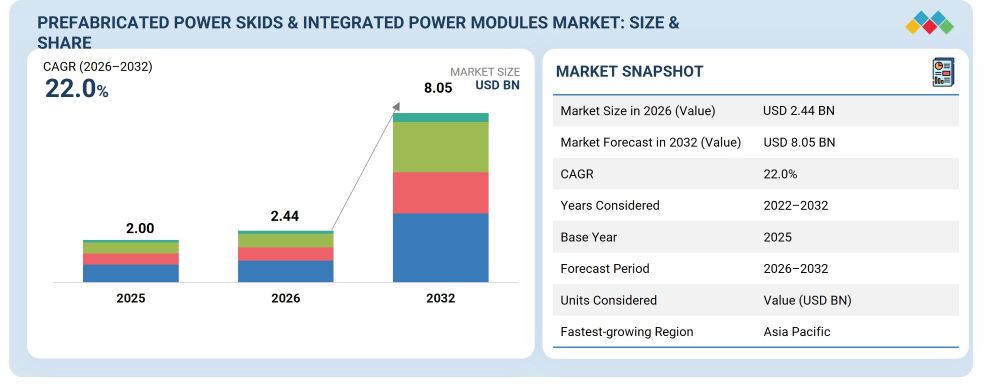
The prefabricated power skids & integrated power modules market for data centers is estimated to be USD 2.44 billion in 2026 and is projected to reach USD 8.05 billion by 2032, growing at a CAGR of 22.0% from 2026 to 2032, fueled by AI data center deployment timelines compressing from years to months as operators shift power infrastructure from site-built construction to factory-tested, pre-validated skids.
Market Overview
The prefabricated power skids and integrated power modules market marks a shift in which data center power infrastructure moves from sequential, site-built construction toward parallel, factory-integrated assembly, letting foundations get poured while power skids are tested on the factory floor rather than waiting for on-site electrical work to begin.
For instance, Rittal and Siemens entered a strategic partnership in March 2026 to develop standardized and energy-efficient power distribution infrastructure for AI and modular data centers, with initial developments including a scalable sidecar power rack and low-voltage distribution systems purpose-built for modular and containerized facilities.
Eaton is pursuing this same standardization push through a different technical path: the company partnered with Siemens Energy in June 2025 to develop standardized modular data centers integrated with on-site power generation, combining Eaton's skidded electrical infrastructure with Siemens Energy's modular power plants specifically to reduce deployment timelines and address the grid-connection constraints increasingly limiting new data center capacity.
Vendors are also under growing pressure from an entirely new source of regional demand: colocation and edge operators in grid-constrained and infrastructure-limited markets increasingly need factory-integrated power skids to bypass local construction and grid-connection bottlenecks. Prefabricated modular power infrastructure deployments expanded by 31% in 2026 as colocation and edge operators sought faster commissioning and reduced labor dependency, with India and the United Arab Emirates specifically accelerating deployment of factory-integrated power skids to support banking, telecom, and smart-city expansion programs.
Top 10 Key Takeaways
- North America has the largest installed base, driven by concentrated hyperscaler AI buildout and deep vendor presence from Vertiv, Eaton, and Schneider Electric.
- Asia Pacific is the fastest-growing region, propelled by expanding data center capacity and accelerating factory-integrated power skid deployment across India and China.
- Power skids, the semi-fabricated configuration, lead by share, reflecting their established role bridging fully site-built and fully factory-integrated power infrastructure approaches.
- Power modules, the fully fabricated configuration, represent the fastest-growing category, as operators increasingly favor complete factory integration over partial, semi-fabricated assembly.
- Prefabricated modular power infrastructure deployments expanded by 31% in 2026, as colocation and edge operators sought faster commissioning and reduced labor dependency.
- Hyperscale AI data centers lead by application, reflecting their position at the forefront of compressed deployment timelines and megawatt-scale power infrastructure needs.
- Strategic partnerships pairing power-specific vendors with industrial majors are becoming the default go-to-market model, exemplified by Rittal-Siemens and Eaton-Siemens Energy collaborations.
- The largest near-term opportunity is integration with 800V DC and HVDC architectures, creating next-generation skid designs purpose-built for centralized, high-voltage power distribution.
- On-site power generation integration is extending skids beyond grid-dependent designs, letting operators bypass interconnection queues that increasingly delay or cancel new data center builds.
- The primary near-term restraint is the higher upfront unit cost of factory-integrated skids relative to site-built alternatives, even as total deployment economics increasingly favor prefabrication.
Why the Prefabricated Power Skids & Integrated Power Modules Market Matters Now
Data center developers have historically built power infrastructure through a comparatively sequential process, adequate when construction timelines of 30 months or more were acceptable relative to the pace of new capacity demand. Prefabricated power skids and integrated power modules are scaling into mainstream data center construction today because that timeline has become commercially unacceptable: Schneider Electric's own analysis shows a prefabricated 2 MW AI data center costs USD 8 million versus USD 14 million for traditional construction and deploys in 12 months versus 30 months, giving operators a concrete economic and speed case that traditional, sequential, site-built power infrastructure can no longer match in an AI-driven capacity race.
The market covers the factory-integrated electrical infrastructure used to accelerate data center power deployment, spanning power modules that arrive fully fabricated and ready to install, power skids that arrive semi-fabricated for final on-site integration, and sidecar and auxiliary power racks supporting modular and containerized facility designs. It includes established critical infrastructure majors that have built dedicated skid and module product lines, and industrial partnerships combining electrical integration expertise with on-site power generation capability. The scope excludes fully site-built power infrastructure with no factory pre-integration, and general modular data center offerings encompassing cooling, IT racks, and building envelope beyond the power-specific configuration. The market connects to the broader modular data center market, the data center power market, and the HVDC / 800V DC power architecture market.
The market's structure reflects a standardization-versus-customization divide. The largest critical infrastructure vendors such as Vertiv, Eaton, and Schneider Electric offer standardized, code-certified skid and module platforms designed for rapid, repeatable deployment across many sites, trading design flexibility for commissioning speed and cost predictability. Industrial partnerships such as Rittal-Siemens and Eaton-Siemens Energy combine power-specific integration expertise with broader industrial or on-site generation capability, trading single-vendor simplicity for access to complementary technology neither partner could offer independently. Hyperscalers increasingly co-design custom platform variants for their own rack power and voltage requirements, while colocation and edge operators in grid-constrained markets rely more heavily on standard, off-the-shelf skid configurations.
Report Scope
|
Report Metric |
Details |
|
Market Size in 2025 (Value) |
USD 2.00 Billion |
|
Market Forecast in 2032 (Value) |
USD 8.05 Billion |
|
Growth Rate |
CAGR of 22.0% from 2026-2032 |
|
Years Considered |
2022-2032 |
|
Base Year |
2025 |
|
Forecast Period |
2026-2032 |
|
Units Considered |
Value (USD Billion) |
|
Report Coverage |
Revenue forecast, company ranking, competitive landscape, growth factors, and trends |
|
Top Companies |
|
|
Growth Drivers |
|
|
Segments Covered |
|
|
Regional Scope |
North America, Europe, Asia Pacific, Rest of World |
Market Trends Shaping Prefabricated Power Skids & Integrated Power Modules
The key trend is power-specific vendors partnering with industrial majors for standardized skid platforms rather than each company developing every capability independently. Rittal and Siemens' March 2026 partnership, producing a scalable sidecar power rack and low-voltage distribution systems for modular and containerized facilities, reflects a broader pattern in which specialized enclosure and electrical vendors combine with industrial automation majors to deliver more complete, standardized platforms than either could offer alone.
Another trend is skid-based deployment converging with 800V DC and HVDC architecture transition. As data centers move toward centralized, high-voltage DC power distribution, skid and module designs are increasingly being engineered around this next-generation architecture from the outset rather than retrofitting legacy AC-distribution skid designs after the fact.
A third trend is on-site power generation integration extending skids beyond grid-dependent designs. Eaton's partnership with Siemens Energy, combining skidded electrical infrastructure with modular power plants, lets operators address grid-connection constraints directly rather than waiting indefinitely in interconnection queues that increasingly delay or cancel new data center capacity.
A fourth trend is domestically manufactured, code-certified platforms gaining preference amid grid constraints. Schneider Electric's March 2025 expansion of pre-configured power and distribution modules designed specifically to accelerate grid interconnection readiness and streamline compliance with US energy standards illustrates how vendors are building certification and grid-readiness directly into standardized product lines rather than treating compliance as a separate, downstream step.
The fifth trend sees rapid deployment timelines becoming a primary competitive differentiator over unit cost alone. With Schneider Electric's own analysis showing a prefabricated 2 MW AI data center deploying in 12 months versus 30 months for traditional construction, vendors increasingly compete on demonstrated deployment speed and commissioning reliability rather than solely on per-unit hardware pricing.
Market Drivers Accelerating Growth
The first key factor is AI data center deployment timelines compressing from years to months. As operators race to bring new AI capacity online, they need considerably more parallel, factory-integrated construction approaches than sequential, site-built power infrastructure was ever designed to support within compressed capacity-race timelines.
The second factor is factory-tested integration reducing on-site construction risk and labor dependency, specifically because pre-validated skids eliminate much of the variability that on-site electrical work introduces. Prefabricated modular power infrastructure deployments expanding by 31% in 2026 gives operators considerably more confidence that factory integration delivers genuinely faster, more predictable commissioning than continuing to rely on site-built alternatives.
The third factor is grid interconnection constraints favoring standardized, rapidly commissionable power infrastructure. As utilities in major data center hubs report unprecedented interconnection queues and AI projects increasingly spend more time waiting for power after approval than in the queue itself, operators require considerably more deployment-ready power infrastructure than custom-engineered, site-built systems can provide once grid capacity finally becomes available.
Market Challenges and Restraints
The key obstacle is the higher upfront unit cost of factory-integrated skids relative to site-built alternatives. Even as total deployment economics increasingly favor prefabrication once construction timeline and labor savings are factored in, that higher initial unit cost remains a genuine barrier for operators evaluating near-term capital budgets rather than full project lifecycle economics.
Another hurdle is logistics and transportation constraints for large, fully assembled power modules, which is a persistent barrier specifically for remote or infrastructure-limited deployment sites. Facilities in locations with limited heavy-transport infrastructure remain understandably constrained in how large a fully fabricated module they can practically receive, even where factory integration would otherwise be the preferred approach.
The third challenge involves standardizing designs across hyperscalers with divergent rack power and voltage requirements. With different hyperscalers pursuing different rack power targets and voltage architectures, vendors face a genuine design challenge in offering enough standardization to achieve manufacturing scale economies while still accommodating each major customer's specific technical requirements.
Segment Insights
By Configuration
Power skids, the semi-fabricated configuration, lead the market by share, reflecting their established role bridging fully site-built and fully factory-integrated approaches for operators not yet ready for complete modular commitment.
Power modules, the fully fabricated configuration, are the fastest-growing category, as operators increasingly favor complete factory integration to maximize the construction-timeline and labor-dependency benefits that prefabrication offers.
By Application
Hyperscale AI data centers lead the market in application share, reflecting their position at the forefront of compressed deployment timelines and their direct co-design relationships with power infrastructure vendors.
Colocation data centers represent a fast-growing application, as operators increasingly adopt standardized, off-the-shelf power skids to serve AI-focused tenants without the custom reference-design resources of hyperscalers.
Key segmentation highlights:
- Power skids remain the primary configuration for operators transitioning from site-built infrastructure, while power modules show the fastest growth toward full factory integration.
- Greenfield data center builds account for the largest share of deployment, though capacity expansion and retrofit projects are gaining share as existing facilities modernize.
- Hyperscale AI data centers account for the largest share of application demand, while colocation data centers represent a fast-growing application segment.
- Edge and regional data centers increasingly serve as an emerging application segment as grid-constrained and infrastructure-limited markets adopt factory-integrated power solutions.
- Vendor consolidation is compressing the number of distinct point solutions a typical operator needs to integrate and maintain across its prefabricated power infrastructure stack.
Prefabricated Power Skids & Integrated Power Modules Market by Region
North America
North America holds the largest base, valued at roughly USD 1.03 billion in 2026 and projected to reach about USD 3.25 billion by 2032, growing at a CAGR of 21.2%.
The US leads with key platform vendors including Vertiv, Eaton, and Schneider Electric, alongside deep hyperscaler concentration driving demand for rapidly deployable power infrastructure. Canada also contributes through growing data center capacity investment and grid-constrained markets favoring standardized, pre-validated power solutions.
Europe
Europe is advancing in line with the global pace, valued at approximately USD 0.63 billion in 2026 and forecast to reach around USD 1.94 billion by 2032, at a CAGR of 20.5%.
Germany spearheads European adoption through Rittal's and Siemens' home-market partnership developing standardized power distribution infrastructure. Ireland and the UK contribute through growing hyperscale data center investment, while the broader region benefits from grid-connection constraints similar to those driving North American demand.
Asia Pacific
Asia Pacific is the fastest-growing region, valued at roughly USD 0.63 billion in 2026 and projected to reach about USD 2.36 billion by 2032, growing at a CAGR of 24.5%.
China spearheads regional growth through Huawei Digital Power's expanding modular data center portfolio and domestic manufacturing scale for power components. India advances through accelerated deployment of factory-integrated power skids supporting banking, telecom, and smart-city expansion programs, while Japan and South Korea contribute through growing AI infrastructure investment.
Rest of World
The Rest of World market reached an estimated USD 0.15 billion in 2026 and is projected to hit about USD 0.43 billion by 2032, growing at a CAGR of 19.5%.
The Middle East is investing in prefabricated power infrastructure as part of broader sovereign AI data center development strategies, with the United Arab Emirates specifically accelerating deployment of factory-integrated power skids. Latin America contributes through growing regional data center capacity tied to expanding digital infrastructure investment.
Key Company Insights
The competitive landscape consists of four tiers: established critical infrastructure majors with dedicated skid and module product lines, industrial partnerships combining electrical integration with broader technology capability, regional and specialized enclosure vendors, and power component makers extending into prefabricated formats. Major players include:
- Vertiv
- Eaton Corporation
- Schneider Electric
- Siemens Energy
- Delta Electronics
- Rittal
- Huawei Digital Power
- ABB
- Hitachi Energy
- Hubbell
- Johnson Controls
- Black Box
- STULZ
- Legrand
- Compass Datacenters
Vertiv leads through the scale and speed of its prefabricated modular deployment track record, exemplified by its SmartMod Max DX platform delivered in 24 weeks for a West African connectivity and managed services provider, compared with the typical 52 to 72 weeks required for conventional construction.
Eaton Corporation has become a leading on-site generation integration partner through its June 2025 collaboration with Siemens Energy, combining skidded electrical infrastructure with modular power plants specifically to reduce deployment timelines and address grid-connection constraints affecting new data center capacity.
Schneider Electric and Rittal each continue extending focused prefabricated power and enclosure expertise into specialized deployment, with Schneider's grid-readiness-focused module expansion and Rittal's partnership with Siemens for standardized sidecar power racks both targeting rapid, code-compliant deployment.
Recent Developments
- March 2026: Rittal and Siemens entered a strategic partnership to develop standardized and energy-efficient power distribution infrastructure for AI and modular data centers, with initial developments including a scalable sidecar power rack and low-voltage distribution systems for modular and containerized facilities.
- June 2025: Eaton partnered with Siemens Energy to develop standardized modular data centers integrated with on-site power generation, combining Eaton's skidded electrical infrastructure with Siemens Energy's modular power plants to reduce deployment timelines and address grid-connection constraints.
- May 2025: Hubbell advanced integrated power distribution assemblies engineered specifically for complete prefabricated data center facilities, reinforcing vendor emphasis on standardized, factory-tested infrastructure that reduces onsite construction variability.
- March 2025: Schneider Electric expanded its US prefabricated solutions with pre-configured power and distribution modules designed to accelerate grid interconnection readiness and streamline compliance with US energy standards.
Real-World Use Cases
Vertiv's SmartMod Max DX deployment for a West African connectivity and managed services provider illustrates how factory-integrated power infrastructure can compress deployment timelines from more than a year to a fraction of that. Delivered in 24 weeks against a typical 52 to 72 weeks for conventional construction, the deployment gives operators expanding into infrastructure-limited markets a concrete demonstration that prefabricated power solutions can deliver reliable capacity considerably faster than site-built alternatives, even in geographies without mature local construction and electrical contracting ecosystems.
Eaton and Siemens Energy's partnership combining skidded electrical infrastructure with modular power plants shows how prefabricated power skids can extend beyond grid-dependent designs into genuinely self-sufficient capacity solutions. By integrating on-site power generation directly into the skid-based deployment model, the partnership gives operators in grid-constrained markets a path to bring new AI capacity online without waiting indefinitely in interconnection queues, addressing the demand-side bottleneck that has increasingly delayed or canceled planned data center builds.
Opportunities and Future Outlook
Through 2032, prefabricated power skids and integrated power modules will continue to reshape how data center operators plan and execute increasingly time-compressed capacity buildouts. The forces driving the market — compressed deployment timelines, factory-tested integration, and grid interconnection constraints — are compounding simultaneously with a new source of demand: integration with 800V DC and HVDC architectures maturing enough to unlock genuinely next-generation skid designs purpose-built for centralized, high-voltage power distribution. The next phase will be fully standardized, on-site-generation-integrated power platforms, with capacity-reservation agreements and digital twin commissioning coordinating deployment at the pace new AI capacity requires.
The competitive landscape will be defined by standardization depth and deployment speed track record. Established critical infrastructure majors compete against industrial partnerships and specialized enclosure vendors for the same hyperscaler and colocation infrastructure budgets. For VP Data Center Construction leaders, Chief Power Engineers, and investors, organizations that combine proven factory-integration capability with genuine grid-readiness and on-site generation options will manage deployment timeline risk and construction cost more effectively than those relying on site-built power infrastructure alone in an increasingly grid-constrained AI buildout environment.
Frequently Asked Questions (FAQ)
1. How big is the prefabricated power skids & integrated power modules market for data centers?
The prefabricated power skids & integrated power modules market for data centers was estimated at roughly USD 2.44 billion in 2026 and is projected to reach about USD 8.05 billion by 2032. North America accounts for the largest share, driven by concentrated hyperscaler AI buildout.
2. What is the prefabricated power skids & integrated power modules market growth rate?
The market is forecast to grow at a CAGR of approximately 22.0% from 2026 to 2032. Asia Pacific is the fastest-growing region at around 24.5%, driven by expanding data center capacity and accelerating factory-integrated power skid deployment.
3. Which segment leads the prefabricated power skids & integrated power modules market?
By configuration, power skids lead the market, while power modules experience the fastest growth. By application, hyperscale AI data centers lead, though colocation data centers show strong momentum.
4. Who are the key players in the prefabricated power skids & integrated power modules market?
Leading players include Vertiv, Eaton Corporation, Schneider Electric, Siemens Energy, Delta Electronics, Rittal, Huawei Digital Power, ABB, Hitachi Energy, Hubbell, Johnson Controls, Black Box, STULZ, Legrand, and Compass Datacenters.
5. What are the factors driving the prefabricated power skids & integrated power modules market?
The primary drivers are AI data center deployment timelines compressing from years to months, factory-tested integration reducing on-site construction risk, and grid interconnection constraints favoring standardized, rapidly commissionable power infrastructure.
Speak With Our Analyst
The prefabricated power skids & integrated power modules market is where data center construction speed and power infrastructure innovation converge into a single deployment-acceleration category, and the segment-level detail on configuration economics, deployment mode, application dynamics, and competitive positioning is where strategic decisions are won or lost. MarketsandMarkets can help you go deeper: request a sample of the full study, speak with our analyst about your specific questions, or customize the scope to your target configurations, applications, and geographies. Reach out to explore how this intelligence can inform your data center construction strategy, platform selection, or investment thesis.
 Exclusive indicates content/data unique to MarketsandMarkets and not available with any competitors.
1 Introduction
1.1 Study Objectives
1.2 Market Definition and Scope
1.2.1 Inclusions and Exclusions
1.3 Study Scope
1.3.1 Markets Covered
1.3.2 Geographic Segmentation
1.3.3 Years Considered
1.4 Currency Considered
1.5 Stakeholders
2 Research Methodology
2.1 Research Approach
2.1.1 Secondary Research
2.1.2 Primary Research
2.1.2.1 Breakdown of Primaries
2.2 Market Size Estimation
2.2.1 Bottom-Up Approach
2.2.2 Top-Down Approach
2.3 Data Triangulation
2.4 Research Assumptions
2.5 Limitations and Risk Assessment
3 Executive Summary
4 Premium Insights
4.1 Attractive Opportunities in the Prefabricated Power Skids & Integrated Power Modules Market
4.2 Market, By Configuration
4.3 Market, By Region
4.4 Market, By Application
5 Market Overview
5.1 Introduction
5.2 Market Dynamics
5.2.1 Drivers
5.2.1.1 AI Data Center Deployment Timelines Compressing From Years to Months
5.2.1.2 Factory-Tested Integration Reducing On-Site Construction Risk and Labor Dependency
5.2.1.3 Grid Interconnection Constraints Favoring Standardized, Rapidly Commissionable Power Infrastructure
5.2.2 Restraints
5.2.2.1 Higher Upfront Unit Cost of Factory-Integrated Skids Relative to Site-Built Alternatives
5.2.2.2 Logistics and Transportation Constraints for Large, Fully Assembled Power Modules
5.2.3 Opportunities
5.2.3.1 Integration With 800V DC and HVDC Architectures Creating Next-Generation Skid Designs
5.2.3.2 Capacity-Reservation Agreements Extending Supplier Relationships Beyond One-Time Purchases
5.2.4 Challenges
5.2.4.1 Standardizing Designs Across Hyperscalers With Divergent Rack Power and Voltage Requirements
5.2.4.2 Supply Chain Lead Times for Switchgear and Transformers Feeding Into Skid Assembly
5.3 Value Chain Analysis
5.4 Ecosystem Analysis
5.5 Investment and Funding Scenario
5.6 Pricing Analysis
5.7 Trends and Disruptions Impacting Customer Business
5.8 Technology Analysis
5.8.1 Key Technologies (Skidded Electrical Infrastructure, Factory-Integrated Switchgear, Sidecar Power Racks)
5.8.2 Complementary Technologies (On-Site Power Generation Integration, Digital Twin Commissioning)
5.8.3 Adjacent Technologies (800V DC / HVDC Architecture, Modular Cooling Systems)
5.9 Porter's Five Forces Analysis
5.10 Key Stakeholders and Buying Criteria
5.11 Case Study Analysis
5.12 Key Conferences and Events
5.13 Regulatory Landscape
5.13.1 US National Electrical Code Provisions for Factory-Assembled Electrical Equipment
5.13.2 UL and IEC Certification Standards for Prefabricated Power Modules
5.13.3 Regional Grid Interconnection and Compliance Requirements Affecting Skid Design
5.14 Impact of AI on the Market
5.15 Impact of 2025 US Tariffs on Supply Chains
6 Industry Trends
6.1 Power-Specific Vendors Partnering With Industrial Majors for Standardized Skid Platforms
6.2 Skid-Based Deployment Converging With 800V DC and HVDC Architecture Transition
6.3 On-Site Power Generation Integration Extending Skids Beyond Grid-Dependent Designs
6.4 Domestically Manufactured, Code-Certified Platforms Gaining Preference Amid Grid Constraints
6.5 Rapid Deployment Timelines Becoming a Primary Competitive Differentiator Over Unit Cost Alone
6.6 Vendor Consolidation Building End-to-End Factory-Integrated Power and Distribution Portfolios
7 Technology Adoption and Strategic Disruption Landscape
7.1 Fully Fabricated Power Modules vs. Semi-Fabricated Power Skids
7.2 Standardized Platform Designs vs. Custom-Engineered Skid Configurations
7.3 Single-Vendor Integrated Solutions vs. Multi-Vendor Component Sourcing
7.4 Build vs. Partner: Data Center Operator Power Infrastructure Sourcing Strategy
8 Customer Landscape and Buyer Behavior
8.1 Decision-Making Process — VP Data Center Construction, Chief Power Engineer, Procurement Director
8.2 Build vs. Buy: Hyperscalers Co-Designing Custom Platforms; Colocation Operators Using Standard Skids
8.3 ROI Framework: Deployment Timeline Reduction, Construction Cost Avoidance, Commissioning Risk Reduction
8.4 Adoption Barriers: Upfront Unit Cost, Transportation Logistics, Design Standardization Across Sites
9 Prefabricated Power Skids & Integrated Power Modules Market, By Configuration
9.1 Introduction
9.2 Power Modules (Fully Fabricated)
9.3 Power Skids (Semi-Fabricated)
9.4 Sidecar and Auxiliary Power Racks
10 Prefabricated Power Skids & Integrated Power Modules Market, By Deployment Mode
10.1 Introduction
10.2 Greenfield Data Center Builds
10.3 Capacity Expansion and Retrofit Projects
11 Prefabricated Power Skids & Integrated Power Modules Market, By Application
11.1 Introduction
11.2 Hyperscale AI Data Centers
11.3 Colocation Data Centers
11.4 Edge and Regional Data Centers
12 Prefabricated Power Skids & Integrated Power Modules Market, By Region
12.1 Introduction
12.2 North America
12.2.1 United States
12.2.2 Canada
12.3 Europe
12.3.1 Germany
12.3.2 United Kingdom
12.3.3 Ireland
12.3.4 Rest of Europe
12.4 Asia Pacific
12.4.1 China
12.4.2 Japan
12.4.3 India
12.4.4 South Korea
12.4.5 Rest of Asia Pacific
12.5 Rest of World
12.5.1 Middle East
12.5.2 Latin America
13 Competitive Landscape
13.1 Overview
13.2 Key Player Strategies / Right to Win
13.3 Revenue Analysis
13.4 Market Share Analysis
13.5 Company Evaluation Matrix
13.6 Competitive Benchmarking
13.7 Competitive Scenario
14 Company Profiles
14.1 Vertiv
14.2 Eaton Corporation
14.3 Schneider Electric
14.4 Siemens Energy
14.5 Delta Electronics
14.6 Rittal
14.7 Huawei Digital Power
14.8 ABB
14.9 Hitachi Energy
14.10 Hubbell
14.11 Johnson Controls
14.12 Black Box
14.13 STULZ
14.14 Legrand
14.15 Compass Datacenters
15 Appendix
15.1 Discussion Guide
15.2 KnowledgeStore: MarketsandMarkets' Subscription Portal
15.3 Customization Options
15.4 Related Reports
15.5 Author Details















Growth opportunities and latent adjacency in Prefabricated Power Skids & Integrated Power Modules Market